Rome. The name itself is a symphony, a whisper of emperors, artists, and gods. It’s a city etched in travertine and time, where every cobblestone has a story. But for a certain kind of dreamer, a devotee of cinema, Rome is painted in shades of black and white. It is the Rome of Federico Fellini, the sprawling, chaotic, and intoxicating stage for his 1960 masterpiece, La Dolce Vita. This isn’t just a film; it’s a cultural baptism, a high-fashion fever dream that forever defined the image of the Eternal City as a playground of glamorous despair and existential beauty. To walk through Rome in search of its locations is not merely sightseeing; it is a pilgrimage. It’s an attempt to capture a fleeting feeling, to chase the ghost of Marcello Mastroianni’s world-weary journalist, Marcello Rubini, as he drifts through seven days and seven nights of hollow spectacles and profound yearning. You come to Rome not just to see the Colosseum or the Forum, but to feel the bittersweet symphony of the sweet life, a life lived in the shadow of ancient wonders and the bright, flashing bulbs of the paparazzi. This journey will take us from the hallowed waters of a baroque fountain to the decadent quiet of aristocratic palaces, from the sacred heights of St. Peter’s dome to the desolate sands of a final, haunting dawn. Prepare to step through the screen and into the very soul of Fellini’s cinematic capital.
This cinematic pilgrimage is a journey shared by film lovers worldwide, much like those who seek the filming locations of Terrence Malick’s The Tree of Life.
The Sacred Waters: The Trevi Fountain
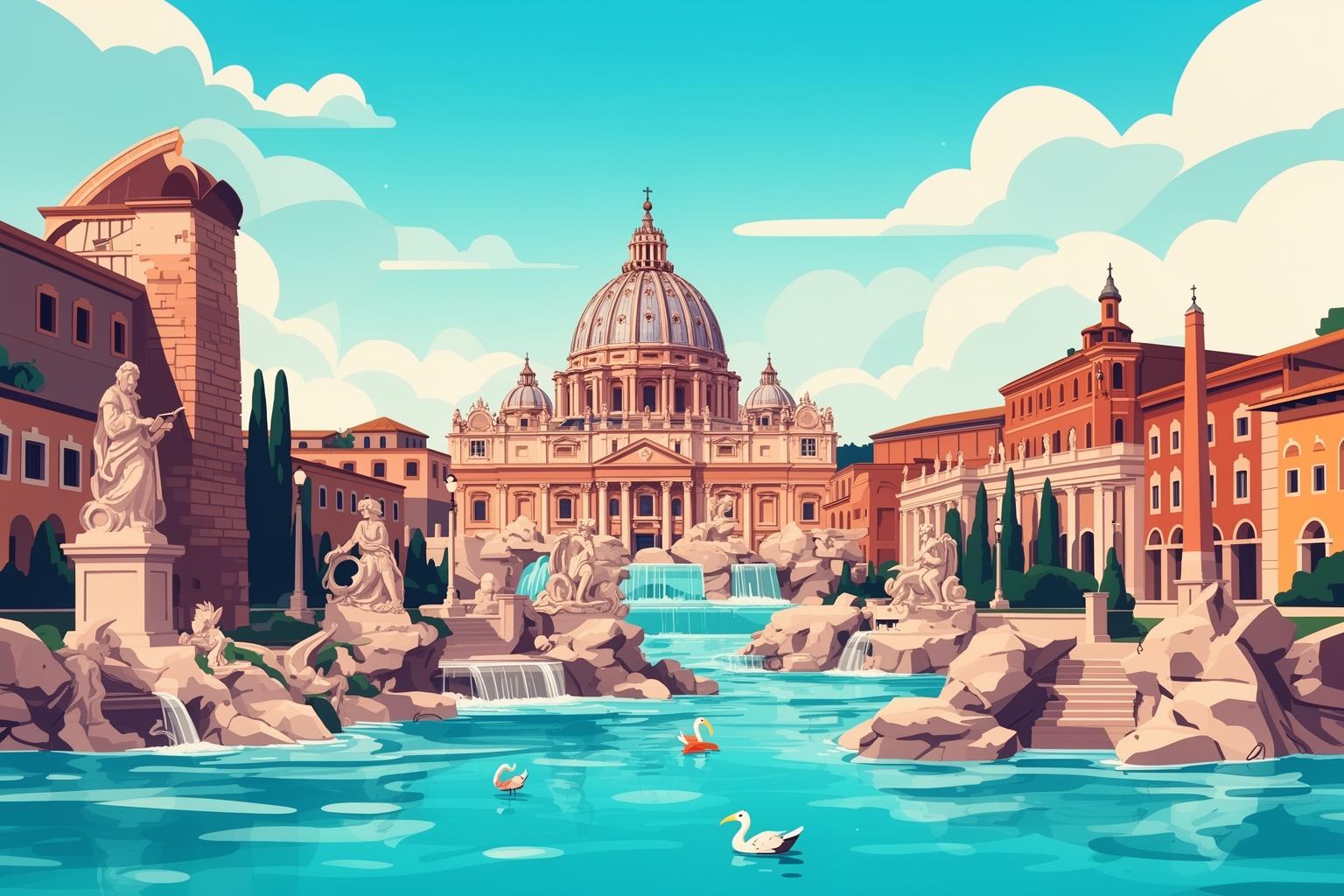
There is no scene in cinema history more closely associated with a city than Anita Ekberg’s moonlit wade into the Trevi Fountain. It serves as the film’s emotional core, a moment of pure, unfiltered cinematic enchantment etched into the global imagination. Sylvia, the statuesque American movie star—like a goddess in a black velvet dress—spontaneously steps into the basin, the water swirling around her as she turns to Marcello, her voice ringing above the cascading water: “Marcello! Come here! Hurry up!” It is a siren’s call, an invitation into a realm of fantasy, spontaneity, and transcendent beauty that rises above the mundane reality Marcello longs to escape. Fellini captures not just a playful act of rebellion but a moment of secular baptism, a cleansing in the waters of Roman myth. The stark black-and-white cinematography transforms the tumbling water and glowing travertine into a dreamscape, making the scene feel impossibly glamorous yet deeply intimate.
Finding the Magic Today
Approaching the Trevi Fountain today means heading into a roar. Long before you glimpse the pristine white figures of Oceanus and his tritons, the thunderous sound of flowing water is a constant, powerful presence within the narrow surrounding streets. Rounding the final corner and beholding it for the first time is a breathtaking reveal. The fountain is colossal—an entire Palazzo Poli façade turned into a mythological spectacle, grand beyond expectation for the intimate piazza it dominates. By day, it becomes a chaotic sea of people. Thousands of pilgrims, both cinematic and traditional, press against the railings, their faces lit by phone screens as they jockey for the perfect selfie. The air is thick with a dozen languages, the clicking of cameras, and the delighted gasps of first-time visitors. It is a spectacle unto itself, a modern reflection of the high-society circus Marcello once navigated.
Practical Pilgrim’s Advice
To glimpse a fragment of the quiet magic Fellini immortalized, you must outwit the crowds by arriving early. Coming just as the sun casts its first golden rays on the city, you may find the piazza almost deserted. In the dawn’s stillness, with only the sound of the water for company, you can truly savor the artistry and scale of Nicola Salvi’s 18th-century masterpiece. This is the ideal moment to sit on the steps, watch light dance on the water, and feel the spirit of Sylvia’s spontaneous joy. Another choice is a late-night visit, long after the dinner crowds have dispersed. The fountain, bathed in dramatic artificial light, adopts a completely different aura—mysterious, romantic, and deeply theatrical. Access is easy; the nearest Metro stop is Barberini on Line A, a pleasant ten-minute walk away. And please, resist any temptation to recreate the scene. Today, wading into the fountain will quickly earn you a firm reprimand from the Polizia Locale and a hefty fine. The magic is for the eyes only.
The Legend of the Coins
Although you cannot enter the water, you can still partake in the fountain’s most beloved tradition. Legend has it that if you toss a coin with your right hand over your left shoulder, you are sure to return to Rome. Two coins mean you will find love. Three, and you’ll marry. Each day, thousands of euros are thrown into the basin, which are then collected and donated to charity. It is a simple, hopeful ritual that connects you with generations of travelers who have stood in this very spot, making wishes in the heart of the Eternal City. It is a perfect, tangible way to leave a small piece of your heart behind, ensuring your story, too, becomes part of the fountain’s endless narrative.
Boulevard of Broken Dreams: Via Veneto
If the Trevi Fountain was the film’s enchanting core, Via Vittorio Veneto was its shimmering, vibrant artery. This elegant, tree-lined boulevard winding up from Piazza Barberini was the hub of 1960s celebrity life, the real-world stage for La Dolce Vita. In the movie, it serves as Marcello’s office and hunting ground. He spends his evenings at the sidewalk tables of its glamorous cafés—such as Café de Paris and Doney—sipping drinks, chain-smoking, and waiting for a story to unfold. Here, the paparazzi (a term popularized, if not coined, by Fellini) swarm around movie stars, exiled royals, and wealthy industrialists. Via Veneto was a realm of performance, where being seen was everything. It epitomized a peak of sophisticated, international glamour that Rome briefly and brilliantly embodied.
A Stroll Through a Bygone Era
Today, walking down Via Veneto is a more subdued experience. The frenetic energy of the ’60s has mellowed into refined, quieter luxury. The street is now home to five-star hotels, exclusive boutiques, and stately embassies. The legendary cafés remain, their awnings providing welcome shade from the Roman sun. Sitting at one of these tables feels like an act of historical homage. The coffee is outrageously expensive, but you’re not just paying for a cappuccino; you’re buying a piece of memory. You sit where Frank Sinatra once held court, where Audrey Hepburn might have rested between takes, and where Fellini’s fictional characters wrestled with their glamorous ennui. The paparazzi have long since vanished, replaced by well-heeled tourists and business travelers. Yet, if you look closely, you can still sense the echoes. You almost hear whispers of gossip, the pop of a flashbulb, the roar of a vintage sports car speeding down the street. The dolce vita may have ended, but its spirit lingers in the stately sweep of the avenue.
How to Experience Via Veneto
To truly savor Via Veneto, see it not as a destination but as a leisurely stroll. Begin near Villa Borghese park and walk downhill toward Piazza Barberini. Admire the architecture and the impeccable doormen stationed at the entrances of hotels like The Westin Excelsior and the Baglioni Hotel Regina. Pause at one of the historic cafés for a brief rest. Order an aperitivo, perhaps a Negroni or an Aperol Spritz, and simply watch the world pass by. Don’t hurry. This is a moment meant to be savored. It’s about inhabiting the space and letting your imagination fill in the gaps. For a deeper immersion, visit Harry’s Bar, a legendary spot featured in the film, and browse the photos of its famous patrons lining the walls. It’s a living museum of the era Fellini both celebrated and critiqued.
The Height of Beauty, The Depths of Despair: St. Peter’s Dome
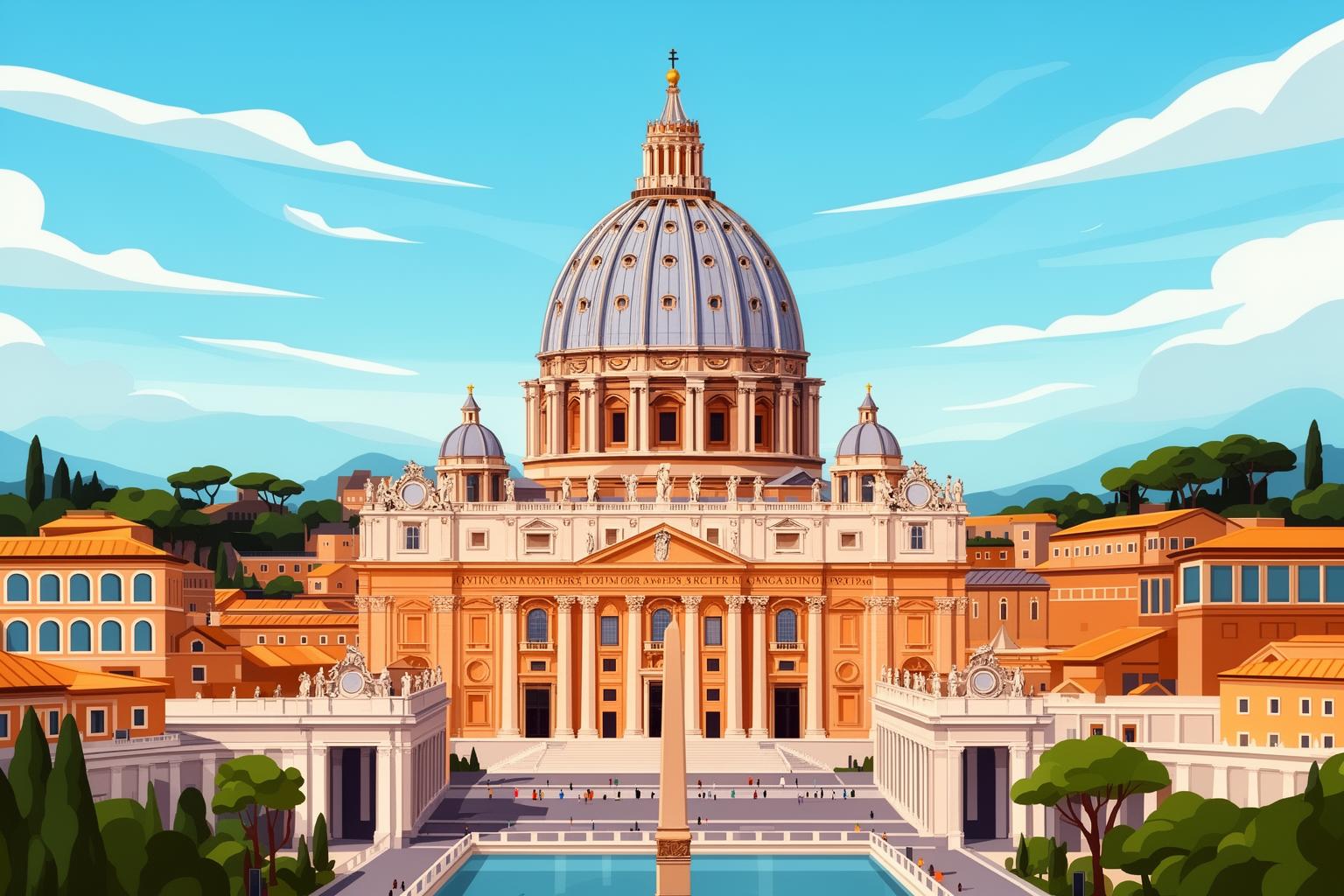
Fellini used Rome’s most sacred landmarks not merely as a backdrop but as a canvas to explore the spiritual emptiness of his characters. In a memorable scene, Marcello and his social circle climb the magnificent dome of St. Peter’s Basilica. As they ascend the narrow, winding staircase, the atmosphere is one of carefree, superficial tourism. They admire the architecture, flirt, and joke around. However, once they reach the viewing gallery, with the vast city of Rome spread out beneath them in stunning detail, the grandeur of the scene only emphasizes their own insignificance and lack of direction. The city, laid out like a map of history and faith, offers a moment of potential transcendence, yet the characters remain too absorbed in their trivial dramas to embrace it. This serves as a powerful visual metaphor: they stand at the physical and spiritual heart of Western civilization, yet feel more lost than ever.
The Ascent: A Modern Pilgrimage
Climbing Michelangelo’s dome today continues to be one of Rome’s most profound experiences. The journey itself adds to the story. While an elevator can take you to the terrace level, the final and more demanding ascent is on foot, through a narrow, spiraling staircase that curves with the dome itself. It can feel claustrophobic and physically taxing, a small penance before the reward. Upon emerging into the blinding light of the cupola, the sensation is one of pure awe. The 360-degree panorama is arguably the finest city view on earth. Bernini’s keyhole-shaped piazza lies directly below, a masterpiece of sacred geometry. You can follow the course of the Tiber River, spot the Pantheon’s oculus, and see the distant outline of the Colosseum. It is overwhelming, beautiful, and humbling.
Visitor’s Guide to the Divine View
Access to the dome is separate from the main basilica and requires a ticket. The entrance is located on the right side of the basilica’s portico. The best tip is to arrive early. Lines can grow extremely long, especially during peak seasons. Getting there as soon as it opens will save time and provide a quieter, less crowded experience at the summit. Keep in mind that this is Vatican City, where a strict dress code is enforced. Shoulders and knees must be covered both to enter the basilica and to access the dome. Take your time once at the top. Find a spot by the railing, breathe deeply, and simply look. Think of Marcello, standing here in this very spot, surrounded by immense beauty but unable to connect with it. It is a poignant reminder that the search for meaning is an inner journey—one that no spectacular view can complete for you.
Palaces of the Past: Aristocratic Ennui
La Dolce Vita uncovers the layers of Roman society, with none more captivating or tragic than the fading aristocracy. Fellini portrays this world through a series of surreal, melancholic party scenes set in lavish yet crumbling palaces. One of the most striking sequences occurs at a gathering hosted by the Steiner family, intellectuals who embody a deeper, more meaningful life that Marcello yearns for. Another significant setting is the aristocrats’ castle, where Marcello and the disenchanted noblewoman Maddalena explore its vast, history-laden rooms. These scenes were shot on location, adding an authentic sense of grandeur and decay.
Palazzo Barberini: Art and Architecture
The stunning spiral staircase designed by Borromini, featured during one of the film’s aristocratic gatherings, is located inside the Palazzo Barberini. This 17th-century palace, a Baroque architectural masterpiece, almost becomes a character itself. Currently, it houses the Galleria Nazionale d’Arte Antica, one of Rome’s foremost art collections. A visit allows you to step directly into Fellini’s world while immersing yourself in centuries of artistic brilliance. You can ascend Borromini’s dizzying staircase and stroll through galleries filled with works by Caravaggio, Raphael, and Holbein. The palace, with its grand salons and frescoes by Pietro da Cortona, offers a tangible sense of the world Fellini depicted—a realm of immense cultural wealth and history, inhabited by people seemingly detached from it.
A Day Trip for the Devout: Bassano Romano
For the most devoted Fellini enthusiast, a trek beyond Rome is essential. The eerie castle party scene, featuring a séance and wanderings through resonant halls, was filmed at the Palazzo Giustiniani-Odescalchi in Bassano Romano, a small town about an hour’s drive north of Rome. Though less accessible, visiting this site provides a special glimpse into the film’s production. The palace often opens its doors for tours, and stepping into its frescoed rooms feels like entering a preserved film set. It offers a chance to experience the distinct atmosphere of fading nobility that Fellini so masterfully captured—the beauty, the history, and the profound, lingering silence.
Ancient Ruins, Modern Anxieties: The Baths of Caracalla
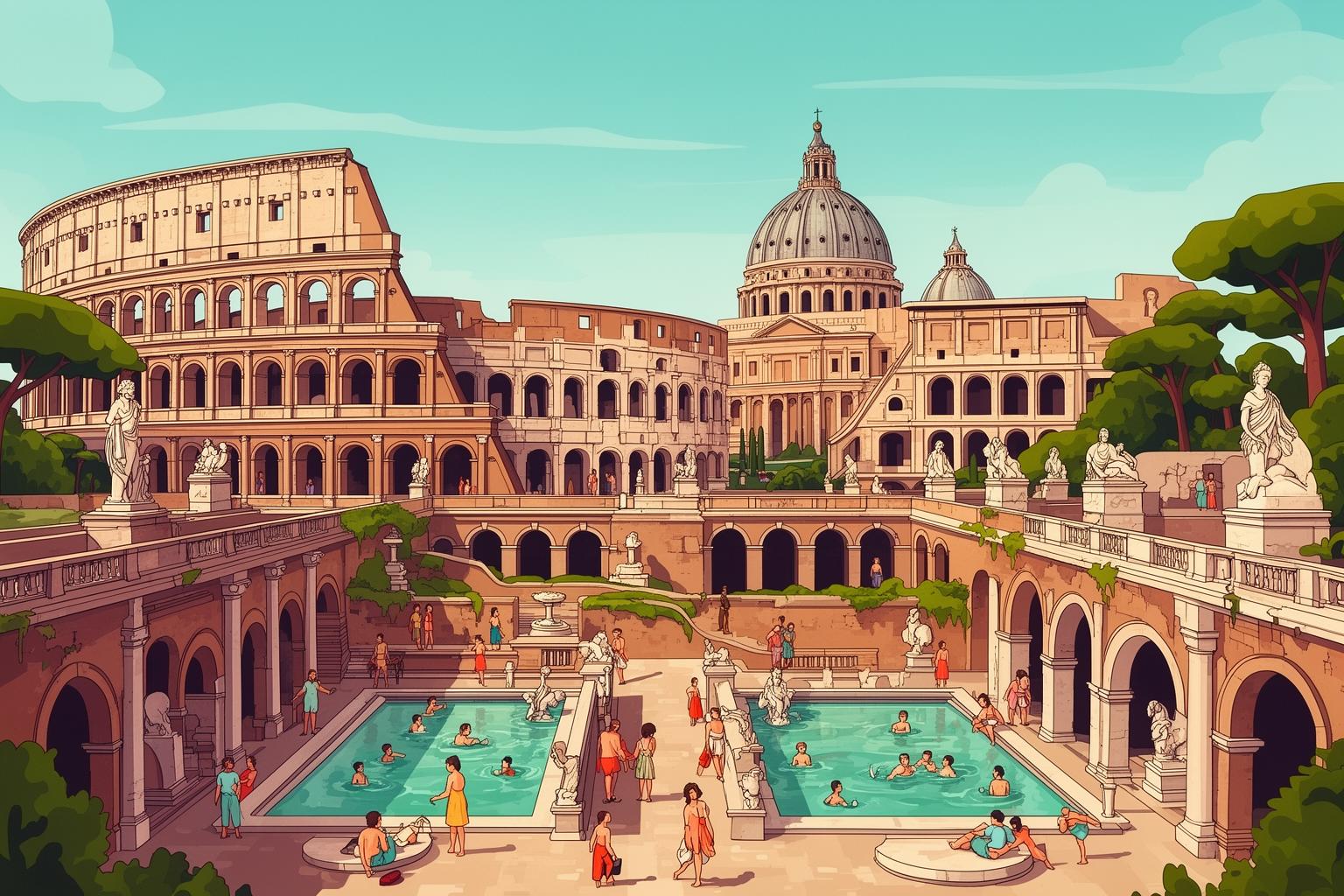
Fellini skillfully contrasts Rome’s layered history to examine modern alienation. One of the most intellectually intense scenes in the film occurs at the party in Steiner’s home, Marcello’s intellectual friend. While the interior scenes were filmed in a studio, Fellini chose the monumental ruins of the Baths of Caracalla for the exterior shots. As Steiner greets his guests, the vast, skeletal arches of the ancient Roman bath complex tower in the background. Constructed in the 3rd century, these baths once thrived as a hub of Roman social life, serving as a place for leisure, health, and commerce. In the film, their dilapidated state offers a poignant setting for a contemporary gathering of artists and thinkers. The ruins stand as a silent reminder of the collapse of a great civilization, subtly commenting on the fragility of the seemingly refined world Steiner has created—a world later shattered by tragedy.
The Baths by Day and by Night
Visiting the Baths of Caracalla today requires a vivid imagination. The sheer scale of the ruins is breathtaking. Walking beneath towering brick arches that once held up vast marble halls and sparkling pools, you begin to grasp the grandeur of Imperial Rome. The site is peaceful and park-like, providing a break from the city’s bustle. You can explore the remnants of the caldarium (hot bath) and frigidarium (cold bath) and trace the outlines of libraries and gymnasiums. To connect with Fellini’s vision, visit late in the afternoon as the sun sets, casting long shadows that highlight the dramatic, skeletal nature of the ruins. For an enchanting experience, check the schedule of the Teatro dell’Opera di Roma, which hosts spectacular open-air opera and ballet performances at the baths during summer. Sitting within these ancient walls on a warm Roman night, listening to the soaring melodies of Puccini or Verdi, is to encounter a fusion of art, history, and atmosphere that epitomizes La Dolce Vita.
The Dawn of Nothingness: Fregene Beach
The film’s devastating and unforgettable finale unfolds not in the glamorous heart of Rome, but on the bleak, windswept beach of Fregene, a seaside town west of the city. After an all-night party marked by utter debauchery at a beachside villa, a weary and hungover Marcello stumbles onto the sand at dawn alongside the other revelers. There, they witness local fishermen hauling a monstrous, bloated sea creature from the waves. The creature, with its dead, milky eye, seems to gaze back at them, serving as a grotesque mirror of their own moral decay and spiritual emptiness. The party has ended. In the film’s closing moments, Marcello is separated from the group by a small inlet. On the opposite side stands Paola, the innocent young waitress he met earlier in a seaside trattoria. She smiles and tries to call out to him, but her voice is swallowed by the sound of wind and waves. He cannot hear her. He shrugs, turns his back on her innocence, and returns to the hollow revelers. It is a moment of profound failure, a final surrender to the meaningless sweet life.
Chasing the Final Scene
Today, Fregene is a popular summer retreat for Romans—a vibrant town filled with beach clubs and seafood restaurants. The specific villa and shack from the film have long since disappeared, lost to time and coastal erosion. A pilgrimage to Fregene is therefore not about locating an exact spot but about capturing a feeling. It is best undertaken on a weekday during the off-season, perhaps on a grey, overcast morning. Take the train from Rome to Maccarese-Fregene, then catch a local bus to the seafront. Walk along the lungomare, the coastal road, and find a quiet stretch of beach. Gaze out at the grey expanse of the Tyrrhenian Sea and listen to the waves. It is here, in the silent solitude, that you can most deeply reflect on the film’s powerful ending. This is a place for contemplating the choices we make, the innocence we lose, and the moments of connection we fail to seize. Conclude your pilgrimage with a simple lunch at a beachfront trattoria, ordering spaghetti alle vongole and a glass of crisp white wine—a small, perfect moment of the genuine sweet life that Marcello could never quite attain.