There are artists who define an era, and then there are artists who create a universe. Tawaraya Sotatsu belongs to the latter. His name, whispered with a certain reverence in the halls of Japanese art history, is a key that unlocks one of the nation’s most dazzling aesthetic movements: the Rinpa school. Yet, the man himself remains a ghost, a brilliant phantom who danced across the dawn of the Edo period in Kyoto, leaving behind a trail of shimmering gold clouds, mischievous gods, and scenes of poetic longing. To trace the life of Sotatsu is not to follow a clear path, but to embark on a pilgrimage of the senses, piecing together a legacy from the places he worked, the temples he adorned, and the very air of the city that nurtured his radical vision. This is not just a tour of Kyoto; it is a journey into the heart of a creative explosion, an attempt to stand where he might have stood, to see the light as he might have seen it, and to feel the eternal pulse of the culture that flowed through his brush. We begin in the ancient capital, a city of a thousand temples and a million stories, to find the whispers of a man who painted the soul of Japan onto folding screens.
This journey to trace the footsteps of a phantom genius shares a spirit with the quest to understand other elusive artists, such as the surrealist pilgrimage through the world of René Magritte.
The Weaver’s District: Where a Legend Took Root
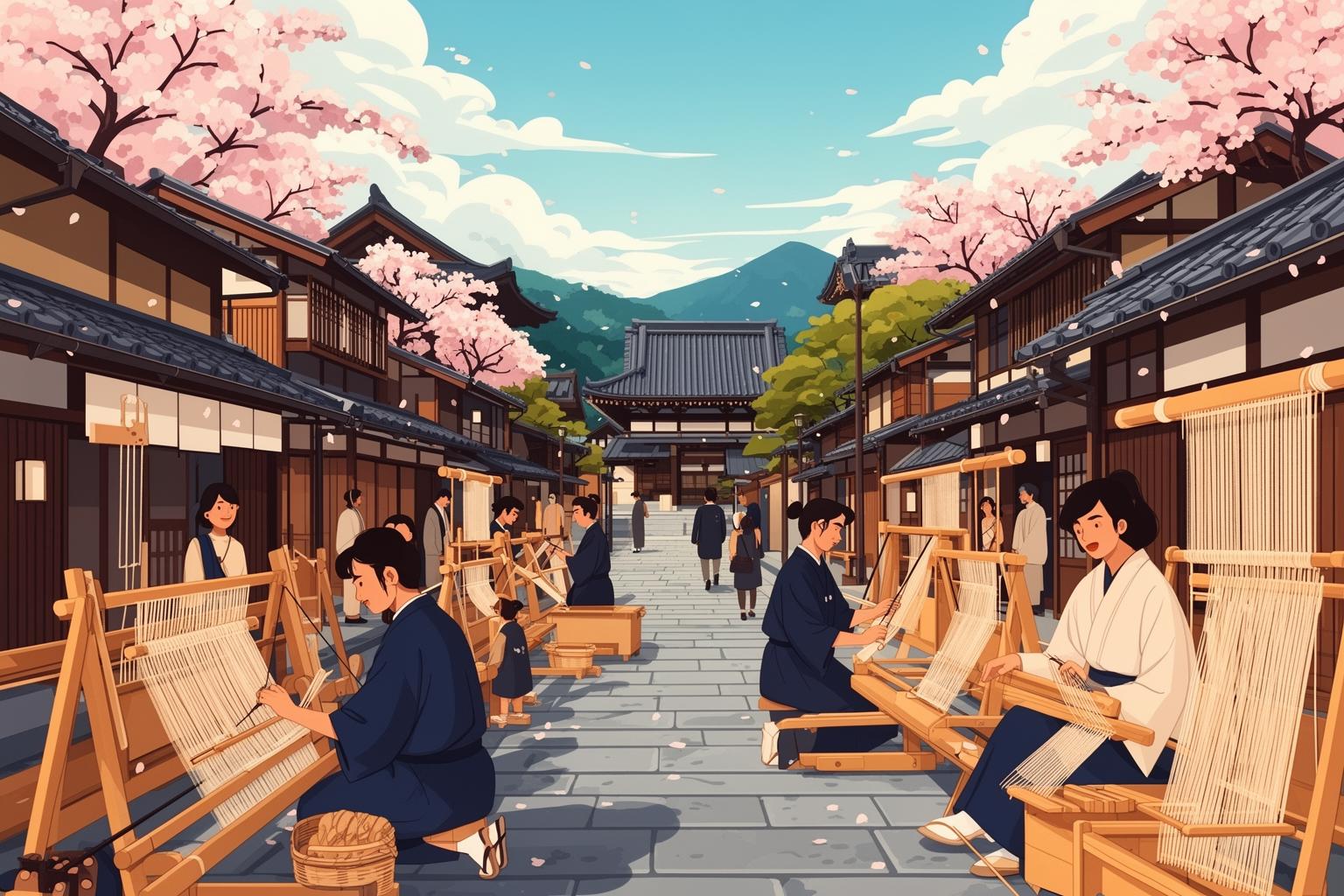
Our journey does not begin in a grand temple or a pristine museum, but rather in the bustling, tightly woven streets of Kamigyō-ku, the northern ward of central Kyoto. To understand Sotatsu, one must first recognize that he did not emerge from the rigid, established painterly academies like the Kano school. He was a product of the merchant class, the chōnin, a world of commerce, craft, and a flourishing urban culture. His family name, Tawaraya, was likely the name of his prosperous shop, a purveyor of fine goods. Walking through the Nishijin district within Kamigyō-ku today, you can still sense a trace of this atmosphere. Though the roar of modern traffic is constant, if you slip into the quieter side streets, you find the elegant wooden lattices of machiya townhouses, some still housing textile workshops. You can almost hear the ghostly clatter of looms that once filled this neighborhood, weaving the luxurious fabrics that clothed shoguns and emperors.
The Scent of Commerce and Creativity
The Tawaraya was no ordinary shop. It was believed to be a high-end atelier specializing in decorated fans and exquisite paper. In early 17th-century Japan, fans were more than mere accessories; they were canvases for artistic expression, vessels for poetry, and essential elements of refined life. This was Sotatsu’s apprenticeship. Here, amid stacks of mulberry paper, pots of brilliant mineral pigments, and the delicate scent of sandalwood from fan ribs, he learned the fundamentals of design—not as a painter of grand narratives, but as a master of decorative arts. He grasped the relationship between an image and the object it adorned. This commercial-artistic environment was his crucible, shaping a sensibility that was both deeply traditional and remarkably innovative. He learned to compose within the challenging, arching format of a fan, a skill that would later enable him to command vast, panoramic landscapes on folding screens with unparalleled dynamism.
Exploring Kamigyō-ku Today
Visiting this part of Kyoto means absorbing the texture of history. Begin at the Nishijin Textile Center to witness the incredible complexity of the weaving that defined this area’s prosperity. Observe how threads of silk and gold are transformed into wearable art. It offers a fresh appreciation for the material culture that shaped Sotatsu’s world. From there, wander aimlessly. Discover small neighborhood shrines like Shiramine Shrine, where the quiet devotion of locals feels worlds apart from the tourist-filled temples downtown. The true treasure of Kamigyō-ku is the sense of living history, a place where craft is not a relic but a continuous, evolving tradition. Imagine a young Sotatsu walking these same lanes, observing the patterns on a kimono, the curve of a temple roof, the play of light on a gilded surface—each feeding the visual vocabulary that would later astonish the world.
The Sage of Takagamine: A Partnership That Forged an Era
An artist’s genius seldom emerges in isolation. For Sotatsu, the spark came from a man named Hon’ami Kōetsu. Kōetsu was a cultural titan—a master calligrapher, a renowned sword appraiser from a lineage that served shoguns for generations, a potter whose Raku ware tea bowls are now national treasures, and a visionary producer who gathered the era’s finest talents. In Kyoto’s northern hills, at Takagamine, the shogun granted Kōetsu a stretch of land. There, he founded an artist’s colony, a sanctuary of creativity that became the heart of what is now known as the Rinpa aesthetic. Sotatsu and Kōetsu are inseparable in discussion; they were two halves of a perfect whole. Kōetsu was the refined, aristocratic visionary with impeccable taste, while Sotatsu was the gifted painter who brought those lofty visions to life.
Kōetsu-ji: A Haven of Wabi-Sabi
At the center of this artistic community stands Kōetsu-ji Temple, a place of deep, tranquil beauty. Reaching it involves a bus ride from the city center, a journey that feels like shedding the noise of urban life. As you ascend the gentle hill to the temple gate, the air cools and carries the scent of pine and wet earth. The temple grounds are humble rather than grand; they embody wabi-sabi, the Japanese aesthetic embracing beauty in imperfection and impermanence. Moss carpets the earth, and a simple bamboo fence, called the Kōetsu-gaki, lines the path. The main hall contains a wooden statue of Kōetsu, but the spirit of the place lives in the scattered tea houses and the garden itself. The view from the garden across the valley to the Takagamine mountains is stunning, especially in autumn when maples blaze in crimson and gold. This is the very landscape Kōetsu and Sotatsu once gazed upon. In rustic tea houses like Daikyo-an, one can imagine them unrolling scrolls, debating poem placement, balancing ink and empty space, and planning the collaborations that would transform Japanese art.
The Interplay of Brush and Ink
Their most renowned collaborations featured Kōetsu’s fluid, dynamic calligraphy layered over Sotatsu’s delicate underpaintings. A famous example is the Deer Scroll, where graceful herds, painted in shimmering gold and silver pigments, move across the paper. Sotatsu’s deer are not precise anatomically; they capture the essence of deer, simplified into elegant, rhythmic forms. Over this luminous scene, Kōetsu inscribed classic waka poems. The painting and calligraphy do not just coexist; they intertwine and dance together. Kōetsu’s characters weave around a deer’s antlers, or a deer peers from between the columns of text. This was a groundbreaking synthesis of literature and imagery, design and fine art. Standing quietly in Kōetsu-ji, one begins to grasp the philosophy behind their work: a profound reverence for nature, a deep appreciation of classical literature, and a conviction that art should resonate emotionally.
A Moment of Reflection at Genkō-an
A short walk from Kōetsu-ji is Genkō-an Temple, not directly linked to Sotatsu but an essential stop on any Takagamine pilgrimage. It is known for its two windows framing the garden. The square window is the “Window of Delusion,” symbolizing the four sufferings of human life. The round window is the “Window of Enlightenment,” representing the perfection and boundlessness of the Zen mind. Sitting on the tatami before these windows offers a meditative experience. The same garden and maple leaves are framed in two distinct ways. This act of framing and focusing perception is closely tied to the Rinpa aesthetic. Sotatsu and Kōetsu mastered composition—using empty space and strategic placement to lead the viewer’s gaze and evoke particular emotions. A visit to Genkō-an deepens one’s understanding of the spiritual and philosophical influences that nourished their creativity.
The Golden Sky: Kennin-ji and the Cosmic Storm
Every great artist has a signature piece, one that captures their essence and transforms the art world forever. For Sotatsu, this is the Fūjin Raijin-zu, the Wind God and Thunder God screens. Encountering this masterpiece is like witnessing an explosion of artistic energy. The original screens are meticulously preserved at the Kyoto National Museum, a must-see for any art enthusiast. Yet, to experience them in their rightful spiritual context, you need to visit Kennin-ji, Kyoto’s oldest Zen temple, situated at the southern edge of the enchanting Gion district. Inside the temple’s Dharma Hall, a magnificent, high-quality replica is permanently displayed, allowing you to feel the electrifying presence of these gods within the sacred space they were meant to inhabit.
Walking into the Void
Entering Kennin-ji is akin to stepping back in time. The grand wooden gates open onto a succession of halls and sub-temples linked by covered corridors. The air is thick with the scent of aged cypress and a subtle, spicy incense fragrance. You tread softly across cool wooden floors, passing serene dry landscape gardens where rocks and raked sand evoke mountains and oceans. Despite the bustling Gion district just outside, the temple remains an oasis of tranquility. Then, you behold them. The screens occupy a large room, and the first thing that commands your attention is the gold. A vast, shimmering expanse of gold leaf covers the entire background. It is not a sky or a landscape; it is a void—a golden emptiness symbolizing the infinite, the cosmos itself.
Fūjin and Raijin: A Divine Confrontation
Suspended within this void are the two gods. On the right panel stands Raijin, the thunder god, a demonic figure with a muscular green body, striking a circle of drums to produce the booming thunder. On the left is Fūjin, the wind god, a pale-skinned figure clutching a large bag of air, releasing the powerful gales that sweep the earth. What sets this apart? Sotatsu stripped the figures of all traditional context. Usually portrayed as fierce protectors flanking temple gates, Sotatsu freed them. He placed them in this abstract golden space, transforming them from mere guardians into elemental forces of nature. They do not seem to battle each other; rather, they appear to call and answer across the vast emptiness dividing them. The ma, the space between, is as vital as the figures themselves, crackling with invisible energy.
The Master’s Technique
Examine the clouds they ride on. Here you witness one of Sotatsu’s hallmark techniques: tarashikomi. He applied pools of ink or pigment onto a still-wet layer of another color, allowing the hues to blur and bleed organically. The effect is a mottled, atmospheric texture giving the clouds a sense of turbulent, unpredictable volume. Also notable are the joyful, almost playful expressions on their faces. They are not merely fearsome demons; they possess character. Sotatsu’s Raijin, especially, appears almost gleeful as he pounds his drums. It is this blend of awe-inspiring power and playful personality that makes the work so endlessly captivating. Standing before these screens at Kennin-ji, surrounded by the temple’s faint ambient sounds, is a profound spiritual experience. You witness the moment when a decorative craftsman rose to become one of Japanese art’s most profound painters.
The Courtly Dream: Genji, Miyabi, and Imperial Favor
Sotatsu’s art extended beyond the realms of merchants and Zen temples. His brilliance attracted the attention of society’s highest ranks: the imperial court and the affluent aristocracy living in Kyoto. This patronage granted him access to luxurious materials and elevated his prestige, enabling him to produce some of his most elegant and poetically expressive works. A recurring theme in his art was The Tale of Genji, the 11th-century courtly literature masterpiece often regarded as the world’s first novel. For the court nobles of Sotatsu’s era, this tale was more than a story; it was a cultural foundation, a guide to aesthetics, romance, and the refined sentiment of mono no aware—a gentle melancholy over the impermanence of things.
The Sekiya and Miyuki Screens: A Glimpse into the Heian World
Among his most renowned Genji-inspired works are the screens portraying the “Sekiya” (The Gatehouse) and “Miyuki” (The Imperial Procession) chapters. The original pieces are treasures of the Seikado Bunko Art Museum in Tokyo, though their spirit belongs to Kyoto. These screens depict two tender moments when Prince Genji has fleeting, indirect meetings with his former loves. What stands out is Sotatsu’s deliberate choice to withhold certain details. The figures are small, with faces depicted in the stylized hikime kagibana (a line for the eye, a hook for the nose) style, leaving them anonymous. The real focus of the paintings is the emotional ambiance, expressed through nature and composition.
In the Sekiya screen, a twisted, windswept cypress tree dominates, its green foliage created using the mokkotsu (“boneless”) technique, where shapes are formed with color washes instead of ink outlines. The tree appears to writhe with the unspoken tension of the meeting below. In the Miyuki screen, a sweeping green hill, painted in bold, simple forms, forms a striking diagonal that separates the two groups, highlighting the distance and longing between them. The vivid green hills against the golden clouds are a signature Sotatsu flourish, turning a literary scene into a stunning design. He wasn’t merely illustrating the narrative; he was capturing its emotional essence.
Walking Through the Pages of the Tale
To truly connect with the world that inspired these screens, one only needs to walk through Kyoto. Visit Kyoto Imperial Palace Park, the city’s vast green heart where the emperor once lived. Though the current buildings are reconstructions, the scale of the grounds and the elegance of the remaining gates evoke the rarefied atmosphere of the Heian court. Picture the rustling of silk, the exchange of poetic notes, and the carefully staged encounters filling the pages of Genji’s story. For a more specific pilgrimage, visit Rozan-ji Temple, said to be built on the site of Murasaki Shikibu’s residence, the tale’s author. Its garden is famous for bellflowers (kikyō), a flower featured in the novel. Experiencing these places helps Sotatsu’s Genji screens resonate on a deeper level, allowing one to see Kyoto’s landscape not only as a physical space but as a repository of a millennium of poetry and art.
The Dream of Matsushima: Painting the Soul of a Landscape
Sometimes, an artist’s deepest bond with a place is one shaped by the imagination. Sotatsu’s magnificent Matsushima-zu Byōbu (Screens of Matsushima) portrays one of Japan’s “Three Great Views”—a breathtaking bay dotted with pine-covered islands in the distant northern province of Miyagi. These screens now reside in the Freer Gallery of Art in Washington D.C., underscoring Sotatsu’s global significance. Whether Sotatsu actually made the long and difficult journey to see Matsushima Bay firsthand remains unknown. Yet, in many respects, it is irrelevant. His work is not a topographical study; it is a meisho-e, a depiction of a famous location that captures its poetic spirit and spiritual meaning. It is Matsushima imagined through a dream.
A Symphony of Gold and Malachite
The screens offer a visual delight. On the right, a jagged rocky shore extends into view, with a twisted pine tree gripping its edge, its needles depicted in fine detail. Beyond, stylized, humpbacked islands cloaked in lush green foliage rise from a golden sea. The waves are not naturalistic; rather, they follow rhythmic, decorative patterns, their crests adorned with frothy white gofun (crushed seashell pigment). The composition is bold, with islands and waves generating a strong, syncopated rhythm spanning the two screens. On the left screen, attention shifts to a vast, swirling golden ocean, anchored by a singular, magnificent pine-covered rock formation. The sky glows with pure, radiant gold leaf. This is not the actual Matsushima; it is an idealized, flattened, brilliantly crafted vision of it—a landscape transformed into a symbol of Japan itself—resilient, beautiful, and eternal.
The Mind’s Journey
This piece invites us on a unique kind of pilgrimage. It reveals that Sotatsu’s brilliance lay not only in observation but in creation. He took real elements—a pines, rocks, water—and reassembled them according to a compelling internal logic of design and aesthetics. It reflects a profound connection to the Japanese literary tradition of honoring famous places in poetry. Just as a poet selects words to evoke a place’s essence, Sotatsu used color, form, and texture. For today’s traveler, visiting the actual Matsushima Bay after viewing these screens is an intriguing experience. You can take a boat cruise through the islands and witness the real pines and rocks that inspired the legend. Yet you will see them through Sotatsu’s vision in your mind’s eye, appreciating how a master artist can capture the soul of a landscape on a golden surface, creating a version that is, in its own way, more real than reality itself.
The Kanazawa Connection: Chasing a Phantom’s Final Chapter
The end of Sotatsu’s life is as enigmatic as its beginning. No definitive records exist regarding his death. One convincing theory proposes that in his later years, he may have relocated from Kyoto to Kanazawa, the affluent castle town governed by the powerful Maeda clan in present-day Ishikawa Prefecture. The Maeda were generous patrons of the arts and crafts, making it highly plausible they sought to bring a master of Sotatsu’s stature into their domain. Although concrete evidence is lacking, the artistic traditions of Kanazawa show stylistic similarities to Sotatsu’s work, suggesting his influence, if not his actual presence, was strongly felt.
Kanazawa: A City of Gold and Elegance
Visiting Kanazawa today is like stepping into a flawlessly preserved segment of Edo Japan. Having escaped the bombings of World War II, its geisha districts, samurai neighborhoods, and the magnificent Kenroku-en Garden remain largely intact. The city is renowned for gold leaf production—it accounts for 99% of Japan’s gold leaf—and this precious material adorns everything from lacquerware to temples to even soft-serve ice cream. This direct, tangible link to the golden world of Sotatsu’s screens is remarkable. Strolling through the Higashi Chaya District with its exquisite wooden teahouses, or the Nagamachi Samurai District with its mud-walled residences, you sense the same commitment to aesthetics and craftsmanship that defined Sotatsu’s Kyoto.
Traces of the Master’s Influence
Though we cannot identify a specific residence where Sotatsu lived, his legacy endures. The art of the Kaga Domain, ruled by the Maeda, showcases a flair for decoration, a passion for bold colors, and an opulence that reflects the Rinpa style. Visiting the Ishikawa Prefectural Museum of Art or the D.T. Suzuki Museum offers insight into the deep philosophical and artistic currents shaping this region. Some temples in Kanazawa, such as Yotoku-in, hold works attributed to Sotatsu’s studio or his followers, providing a tantalizing, albeit indirect, connection. This part of the pilgrimage is more conjectural—a journey chasing a ghost, following the faintest trail of influence to another city that, like Kyoto, treasures beauty and art above all else. It expands our understanding of Sotatsu’s impact, revealing how his influence extended from the capital to enrich the cultural fabric of the entire nation.
A Practical Guide to Your Sotatsu Pilgrimage
Embarking on a journey to explore the life of Tawaraya Sotatsu is an immensely rewarding experience, combining art history with cultural immersion. A bit of planning can greatly enhance your trip. Here is some practical advice to help guide your way.
When to Go
Kyoto is beautiful throughout the year, but for a Sotatsu-themed adventure, autumn is especially enchanting. The vibrant red maples at Kōetsu-ji and Genkō-an in Takagamine will leave you breathless, creating a living backdrop reminiscent of a Rinpa screen. The crisp, clear air and mild temperatures make for ideal walking conditions. Spring, with its iconic cherry blossoms, offers another stunning option, draping the city in a fleeting beauty that reflects the mono no aware sentiment so central to Sotatsu’s Genji paintings. Summer tends to be hot and humid, while winter is cold but presents a stark, quiet beauty with fewer visitors.
Getting Around the Ancient Capital
Kyoto’s public transportation is excellent, with buses, subways, and trains reaching nearly every corner. For central locations like Kennin-ji in Gion, walking is the best way to soak in the atmosphere. To reach Takagamine and visit Kōetsu-ji, the city bus is your best choice; consider purchasing a one-day bus pass for convenience if you plan multiple stops. Renting a bicycle is also an excellent way to explore the flatter parts of the city at your own pace, allowing for spontaneous discoveries in neighborhoods like Kamigyō-ku.
Managing Masterpiece Expectations
It’s important to remember that Sotatsu’s most famous original works are national treasures and are kept in major museums for preservation. They are not permanently displayed in the temples. The originals of the Wind and Thunder Gods are housed at the Kyoto National Museum, and the Sekiya and Miyuki screens are at the Seikado Bunko Art Museum in Tokyo. Always check the museum’s official website before your visit to confirm current exhibitions. While viewing the high-quality replicas in their original temple settings is a remarkable experience, encountering the originals—with the subtle texture of the paper, the sheen of the genuine gold leaf, and the delicate nuances of the brushwork—is unforgettable. Plan your trip to include visits to the museums where these treasures are kept.
Tips for the Thoughtful Traveler
- Wear comfortable shoes. You’ll be doing a lot of walking, often on uneven stone paths or temple grounds where you’ll need to remove your shoes. Slip-on shoes are a practical and convenient choice.
- Embrace the quiet. Temples are active places of worship. Be respectful, speak softly, and avoid photography where it’s prohibited. The aim is to absorb the serene atmosphere, not merely to capture it.
- Savor the culture. After visiting Kennin-ji, wander through the lanes of Gion and try some matcha (green tea) and wagashi (traditional sweets). In the Nishijin area, seek out a local restaurant for a simple, delicious lunch. Food is a vital part of the cultural experience.
- Connect with the craft. Visit shops selling high-quality washi (Japanese paper) or beautifully decorated fans. Handling the materials Sotatsu himself would have used offers a tangible connection to his artistic roots.
The Ever-Present Golden Echo
To follow the path of Tawaraya Sotatsu is to realize that you are pursuing more than just the story of one man’s life. You are tracing the origin of an aesthetic that has come to embody Japanese beauty itself. Sotatsu’s innovations—his bold compositions, his mastery of negative space, his blending of design and painting, his groundbreaking use of color and texture—did not conclude with him. They were embraced and brilliantly reimagined by later masters like Ogata Kōrin, who famously created his own version of the Wind and Thunder Gods in tribute, and Sakai Hōitsu, who painted a scene of summer grasses and flowers on the back of Kōrin’s screens, establishing a dialogue across a century. The Rinpa spirit, born in the workshops and temples of Kyoto, lives on today in contemporary graphic design, fashion, and art worldwide.
Walking the gravel paths of Kennin-ji or standing on the hill at Kōetsu-ji, you sense a strong connection across the centuries. The man remains an enigma, a collection of brilliant fragments. Yet his legacy is everywhere: in the shimmer of gold on a temple wall, in the rhythmic pattern of waves on a scroll, in the profound beauty of a single, perfectly placed maple leaf. The pilgrimage may end, but the golden echo of Sotatsu’s brush lingers with you, offering a new way of seeing the world and a deeper appreciation for the beauty found in both the grand gesture and the quiet, empty space.