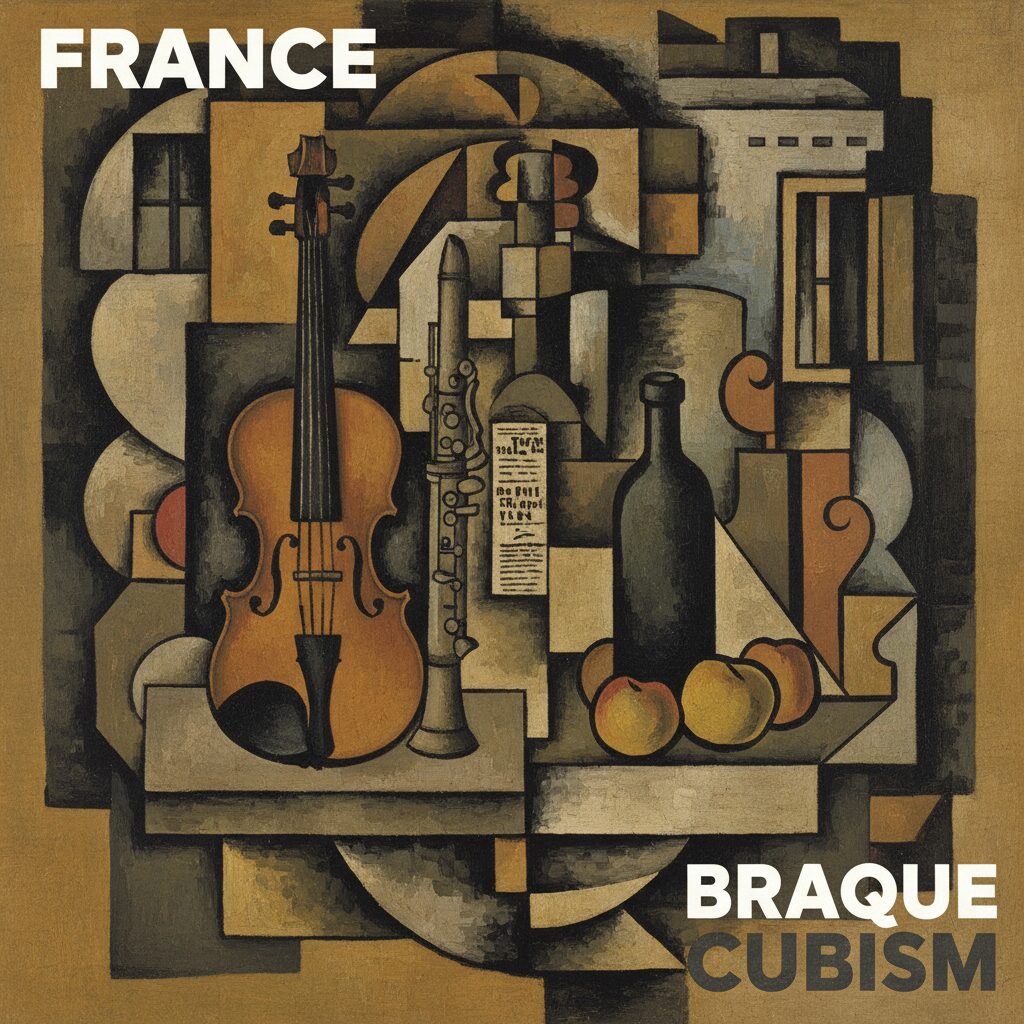
There’s a certain quiet gravity to Georges Braque. In the grand, noisy theater of 20th-century art, where personalities often roared louder than the paint, Braque was a steady, grounding force. He was the craftsman, the methodical thinker, the musician who saw rhythm in geometry. While his friend and collaborator, Pablo Picasso, was a blazing comet, Braque was the North Star—less spectacular, perhaps, but a constant, reliable point of reference by which a new visual language was navigated. To truly understand Braque is to understand not just the explosive birth of Cubism, but the slow, patient evolution of a vision deeply rooted in the soil, sea, and stone of his native France. This isn’t a journey to a single spot, but a pilgrimage through the very landscapes that composed his soul, a tracing of his footsteps from the industrial hum of the English Channel to the sun-bleached shores of the Mediterranean, and finally to the ethereal, cliff-top silence of Normandy. We will follow the ghost of his vision, seeking the painter not just in the hallowed halls of museums, but in the slant of light on a tiled roof, the rugged texture of a cliff face, and the silent flight of a bird across a northern sky. It’s a journey that reveals how one of art’s greatest revolutions was forged not in abstract theory alone, but in the tangible, tactile world of place.
For more on how landscapes shape artistic vision, explore our guide to following Donatello’s footsteps through Florence.
The Seine’s First Murmurs: Argenteuil and Le Havre
Every river has its source, and for Georges Braque, the artistic flow of his life originated along the banks of the Seine—not in Paris itself, but in the suburban town of Argenteuil. Born there in 1882, he entered a world already immersed in artistic upheaval. This was the landscape that, a decade earlier, had served as the open-air studio for the Impressionists. Monet, Renoir, and Caillebotte had set up their easels along these very riverbanks, capturing the fleeting interplay of light on water and the gentle drift of leisure boats. Although the Braque family relocated while Georges was still a child, one cannot help but sense that this surrounding creative energy—the legacy of looking deeply at the world—infused the very air he first breathed. Argenteuil was a place where modern life and nature converged, where a factory smokestack might appear in the same frame as a blooming garden. It was an introduction to seeing the poetry in everyday life, a lesson that would echo throughout Braque’s extended career.
The Port of Possibilities: Le Havre
The true beginning of Braque’s artistic education occurred in Le Havre. If Argenteuil was a gentle introduction, Le Havre was the first robust, invigorating chord. This was a city of substance, a port defined by the vast, brooding expanse of the English Channel, the continual movement of ships, and a distinctive, silvery light that has fascinated painters for centuries. It was here, in this city rebuilt and shaped by its relationship with the sea, that Braque’s father, a house painter and amateur artist, nurtured his son’s talent. Young Georges apprenticed in the family craft, acquiring the technical skills of a decorator—the feel of brushes, the properties of paint, and the techniques for creating faux marble and wood grain. This was no lofty academic training; rather, it was practical, hands-on instruction. It taught him that paint was a tangible substance to be shaped—a lesson that would be crucial to the evolution of Cubism, with its emphasis on texture and form.
Le Havre’s Municipal School of Fine Arts marked the start of his formal training, and there he built significant early friendships with artists such as Raoul Dufy and Othon Friesz. Together, they gazed out at the same turbulent sea and busy docks. The atmosphere of Le Havre is one of raw, elemental force. Even today, walking along the waterfront, you feel the wind blowing in from the sea, carrying the salt and industrial scents. You see the colossal container ships—modern monoliths of shape and color—and you can imagine how this environment, so starkly different from the gentle greenery of Argenteuil, would drive a young artist toward a more daring, structured form of expression.
This was the time of Braque’s Fauvist awakening. Inspired by the vibrant color of Matisse and Derain, Braque and his companions unleashed lively, untamed hues onto their canvases. His paintings of the port from this period are bursts of pure color, capturing the harbor’s energy and light not through realistic detail, but with emotional power. To fully connect with this phase of his life, a visit to the Musée d’art moderne André Malraux (MuMa) is essential. The museum itself is a striking structure of glass and steel, situated right at the harbor’s entrance, its galleries bathed in the very light that inspired the artworks within. Viewing Braque’s Fauvist paintings there, in the city where they originated, is illuminating. The blues, greens, and oranges pulse with a local vitality, revealing that this was not merely a stylistic experiment but a heartfelt response to Le Havre’s compelling spirit.
The Crucible of an Avant-Garde: Montmartre’s Revolution
Leaving Le Havre for Paris in the early 1900s meant exchanging the open sea for a turbulent ocean of ideas, with Montmartre at the heart of that creative storm. No longer the charming, semi-rural village beloved by the Impressionists, it had become a gritty, bustling bohemian enclave perched on a hill above the city—a magnet for artists, writers, poets, and dreamers from across Europe. Today, ascending the Butte Montmartre and weaving through the crowds near the Sacré-Cœur and the portrait artists in the Place du Tertre requires some imagination to peel back the layers of tourism and rediscover the raw, creative energy that once flourished here. That spirit remains hidden in the steep, cobbled streets, the secret staircases, and the sudden, breathtaking views over Paris’s rooftops.
The Bateau-Lavoir: Where Worlds Collided
Braque arrived and settled into this world, eventually finding his way to a dilapidated, maze-like cluster of studios at 13 Rue de Ravignan called the Bateau-Lavoir, or the “Laundry Boat.” The name derived from its rickety, ramshackle appearance, and the place was, by all accounts, one of profound poverty and remarkable creative fertility. With no gas, only a single water tap, and a flimsy structure that creaked in the wind, it nevertheless housed the future of Western art being rewritten within its thin walls. It was here, in the autumn of 1907, that the poet and critic Guillaume Apollinaire introduced Georges Braque to his neighbor, a fiery young Spaniard named Pablo Picasso.
This meeting has become legendary. Picasso showed Braque a painting he had just completed—a monumental, shocking work depicting five nude female figures with sharp, geometric bodies and mask-like faces. It was Les Demoiselles d’Avignon. Braque was initially startled, even horrified, famously remarking that it seemed as if Picasso wanted the figures to eat tow and drink petroleum. Yet the painting’s raw power lodged itself firmly in his mind. It was a challenge, a gauntlet thrown down. Breaking the conventions of perspective and beauty, in its jagged fragments Braque saw a new path, a direction aligned with his own recent explorations inspired by Cézanne.
The collaboration that ensued became one of art history’s most intense and consequential partnerships. For several years, Braque and Picasso were inseparable, engaged in a visual dialogue so deep that their works from this period are often nearly indistinguishable. As Braque later remarked, they were “roped together like mountaineers,” scaling a new artistic summit. They visited each other’s studios daily, analyzing, critiquing, and building on their shared discoveries. Together, they systematically dismantled the traditional single-viewpoint perspective that had dominated painting since the Renaissance. Their goal was to depict an object not as seen from a single spot at one moment, but as it was understood by the mind—from front, side, and back, all at once.
Wandering the streets near the Place Émile-Goudeau today, where a modern storefront now marks the site of the original Bateau-Lavoir—which tragically burned down in 1970—is like walking through the echoes of these conversations. One can almost hear their footsteps on the cobblestones and imagine their debates about form and space over a modest glass of wine in a local bistro. A visit to the nearby Musée de Montmartre offers a rich immersion into this era, showcasing exhibits that capture the bohemian spirit and artistic ferment of the time. It reveals that Cubism was not an academic exercise but a movement born of this specific place, fueled by the energy of these streets and the intense, collaborative friendships forged in cold, cramped studios.
Deconstructing the Sun: Cézanne’s Ghost in L’Estaque
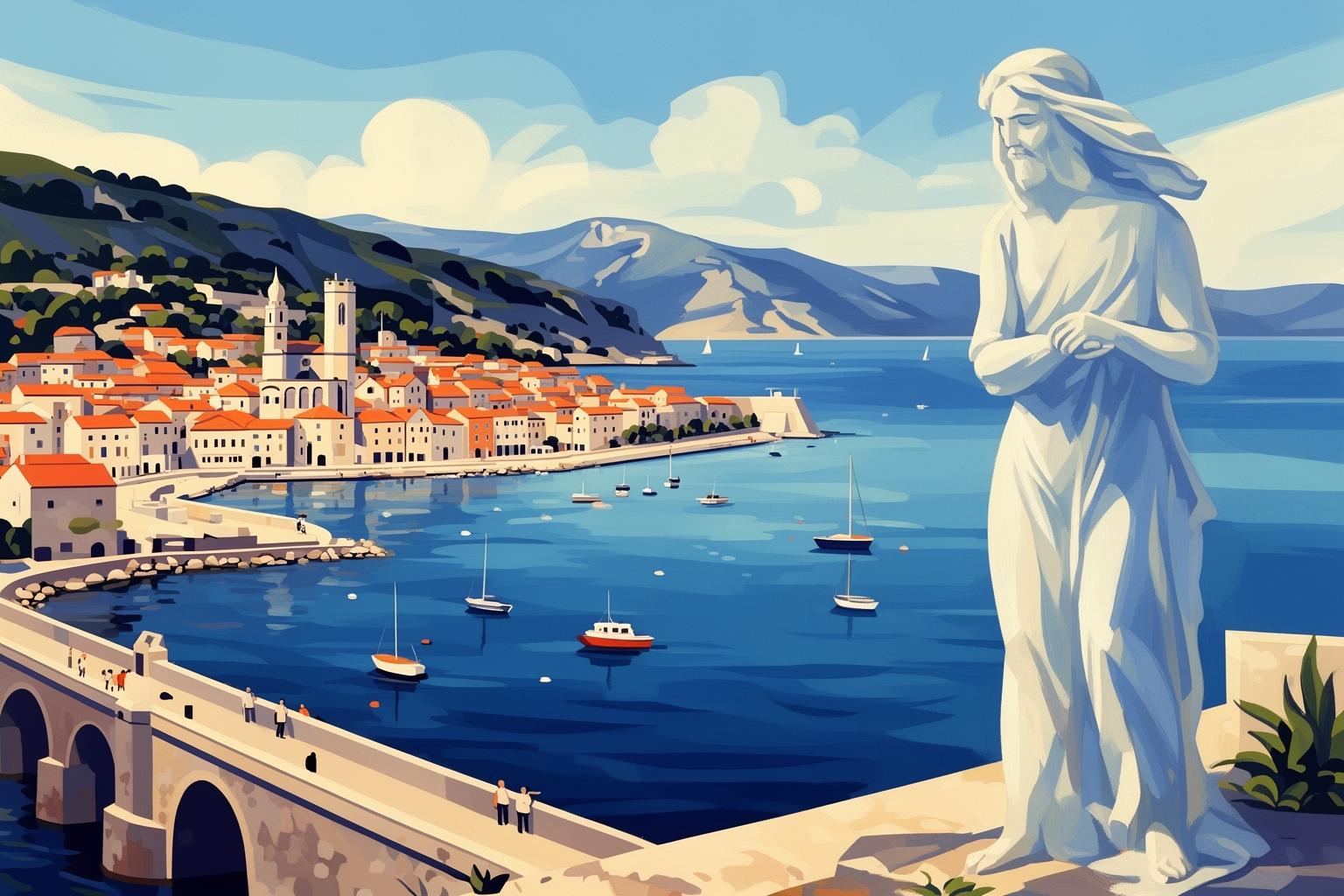
While the theoretical framework of Cubism was being shaped in Montmartre, its visual language was uncovered beneath the brilliant, unforgiving sun of the South of France. For Braque, the key to deciphering this new language lay in the work of Paul Cézanne, the Post-Impressionist master who had become almost mythical to the younger generation. In the summer of 1908, Braque undertook a pilgrimage, traveling to L’Estaque, a small fishing village nestled in the bay of Marseille, where Cézanne had spent years grappling with the challenge of depicting three-dimensional form on a two-dimensional canvas.
Painting the Geometry of Light
The landscape of L’Estaque is a painter’s paradise of form and structure. It is a place of stark contrasts: the deep blue Mediterranean Sea against rust-red soil and ochre rocks, the dark green pine trees casting sharp silhouettes against the sky, and the clustered, blocky houses with terracotta roofs cascading down the hillside. The light here is not the soft, diffused glow of Paris or the silvery haze of Le Havre. It is a strong, architectural light that sharpens everything it touches, carving the world into distinct planes and solid geometric shapes.
Walking the “Chemin des Peintres” (Painters’ Trail) in L’Estaque today, you can spot the exact viewpoints that inspired both Cézanne and Braque. Looking out over the viaduct and bay, the scene arranges itself like a Cubist composition. The houses appear not as individual buildings, but as collections of cubes and cylinders. The trees are reduced to fundamental geometric forms. It was here, in this sun-soaked landscape, that Braque painted works like Houses at L’Estaque. In these paintings, the vibrant colors of his Fauvist period are completely subdued, replaced by a muted palette of greens, ochres, and grays. The emphasis is wholly on form. The houses are simplified into interlocking blocks, their perspective flattened and fragmented. Upon seeing these works, the art critic Louis Vauxcelles mockingly described them as made of “little cubes,” inadvertently naming the new movement.
The sensory experience of L’Estaque adds a further dimension of understanding. You feel the intense, dry heat radiating from the earth. You hear the constant, hypnotic hum of cicadas in the pines. You smell the resinous scent of the trees mixed with the saltiness of the sea. It is a landscape that demands simplification, stripping away the superfluous to reveal the underlying structure of things. For Braque, a man of methodical and deliberate temperament, this place was an ideal laboratory. It supplied the raw material, the visual proof for the theories he and Picasso were developing back in Paris. It confirmed Cézanne’s famous counsel to “treat nature by the cylinder, the sphere, the cone.” In L’Estaque, Braque was not merely painting a landscape; he was dissecting it, analyzing its structure, and reassembling it according to a new, deeper logic.
A Shared Vision in Provence: The Sorgues Seclusion
The intense and nearly symbiotic collaboration between Braque and Picasso reached its peak not in Paris, but during the summers they spent working side-by-side in the heart of Provence. After a brief stint working in Céret, in the Pyrenees, they discovered a creative refuge in Sorgues, a quiet town near Avignon. While Montmartre served as the chaotic public arena for their revolution, Sorgues was the private workshop where they honed the most complex and intellectually demanding phase: Analytic Cubism.
The Summer of Cubism
Picture the scene: two of the 20th century’s greatest artistic minds, removed from the distractions and debates of the capital, living and working closely together. They rented villas near one another and spent their days deeply immersed in creative intensity. The atmosphere in Sorgues contrasted sharply with the bustling urban energy of Paris. It was a land of rolling vineyards, fields of lavender, and ancient stone farmhouses, all illuminated by the warm, golden Provençal light. Life moved at a slower pace, shaped by the seasons. This calm provided the perfect balance to the radical fervor of their work, enabling a level of concentration that was likely unattainable in the Bateau-Lavoir.
During this period, roughly from 1910 to 1912, their paintings grew increasingly abstract. They broke down objects—a guitar, a bottle, a human figure—into intricate networks of intersecting planes and lines. Their palette became even more subdued than in the L’Estaque landscapes, almost entirely limited to monochrome hues of brown, gray, and ochre. This choice eliminated color distractions, directing the viewer’s focus wholly toward the analysis of form. Their works became so alike that they sometimes struggled to tell them apart, prompting playful comparisons to the Wright Brothers, both working on the same invention. They had shifted from simply depicting objects to attempting to capture the entire experience of perceiving an object across space and time.
Visiting the region around Sorgues and Avignon today, you can still sense this atmosphere of peaceful seclusion. A visit to a local market, with its vibrant produce and lively vendor chatter, or a quiet stroll through the countryside, can connect you to the rhythm of life that nourished their creativity. Although there is no specific studio to visit, the whole region serves as a backdrop to their collaboration. It reminds us that even the most cerebral and groundbreaking art is created by people living everyday lives—eating, drinking, and seeking quiet places to think. This Provençal interlude was the final, critical phase of their shared journey before the First World War tragically interrupted their partnership and sent them on separate paths forever.
The Echo of the Sea: Varengeville-sur-Mer’s Final Peace
After the intense creativity of his early years and the trauma of the First World War, which left him with a severe head injury, Georges Braque sought a different kind of landscape. He discovered it on the striking Alabaster Coast of Normandy, in the small, windswept village of Varengeville-sur-Mer. This place became his sanctuary for the last thirty years of his life, where his art evolved into its final, profound phase. In many respects, it is the most intimate and spiritually resonant site on any Braque pilgrimage.
A Haven on the Alabaster Coast
Varengeville sits precariously atop towering white chalk cliffs that drop into the turbulent turquoise waters of the English Channel. This landscape is one of immense, raw beauty and constant transformation. The sky stretches wide, a vast canvas of shifting clouds, and the light possesses a cool, pearlescent quality, quite unlike the sharp clarity of the south. It’s a place that invites introspection and a deep connection with the elemental forces of nature. Braque built a simple, modern house and studio here, nestled back from the cliffs amid lush gardens. From this vantage point, he observed the world with the patience he had nurtured throughout his life. His subjects became those nearest to him: the interior of his studio, his tools, the changing seasons through his window, and above all, the recurring motif of the bird—a symbol of freedom, spirit, and the space between earth and sky.
His later work became more lyrical, vivid, and textured. He incorporated sand and other materials into his paint, giving his canvases an earthy, tactile quality that echoes the cliffs and fields surrounding him. Visiting Varengeville offers insight into this final chapter. As you walk the coastal paths, wind whipping at your clothes and gulls crying overhead, you sense the same primal connection to nature that infused his late paintings. The village itself is charming and tranquil, a web of narrow lanes and hidden gardens such as Le Bois des Moutiers or the Shamrock Collection, home to the world’s largest hydrangea collection. It is a place that values quiet contemplation, a perfect reflection of the artist who chose to make it his home.
The Chapel of Light: L’église Saint-Valéry
The emotional and spiritual heart of Varengeville is the small church of Saint-Valéry. It perches in a breathtaking and precarious spot, right on the edge of the eroding cliffs. The sea remains a constant, visible presence through its clear glass windows. Within this simple, ancient stone building, Braque left his most public and moving legacy. In the 1950s, he was commissioned to design new stained-glass windows for the chapel. He created seven windows, the most magnificent being the Tree of Jesse in the apse.
Stepping inside the church envelops you in a deep sense of peace. When sunlight filters through Braque’s masterpiece, the interior is bathed in an ethereal blue light. The window is not a traditional narrative piece but a work of modern, abstract spirituality. The tree’s branches flow upwards in dynamic, leaded lines, interspersed with lozenges of vivid color—deep blues, radiant yellows, and pure whites. The figures of the saints are rendered in Braque’s distinctive, simplified style. The window feels both ancient and utterly contemporary, a seamless fusion of faith and art. It speaks not of complex theology but of light, hope, and resurrection. Sitting in a pew and letting the colors wash over you is an unforgettable experience, like a direct communion with the artist’s soul and a testament to his faith in the spiritual power of form and light.
A Grave with a View: The Marine Cemetery
Around the church lies the cimetière marin, the marine cemetery, one of France’s most beautiful and poignant resting places. The graves of sailors, artists, and villagers overlook the vast sea they lived by. Beneath a simple, flat stone slab rests Georges Braque and his wife, Marcelle. There is no grand monument, only his name inscribed in the stone. The grave is humble, sincere, and profoundly moving. Standing there, with the sea breeze on your face and the church behind you, you sense the completion of a great life’s journey. He rests in the landscape that inspired his final work, forever united with the sea, sky, and light he so patiently studied. It is the perfect, quiet conclusion to a life dedicated to seeing the world through an artist’s unwavering eye.
The Legacy in the Frame: Where to See Braque Today
A journey through Braque’s France ultimately prepares you to experience his work firsthand. While the landscapes set the scene, it is the canvases that reveal his true essence. Fortunately, his legacy is safeguarded in some of the world’s finest museums, chiefly in his cherished Paris.
The Parisian Pantheon: Centre Pompidou and Musée d’Art Moderne
The Centre Pompidou, renowned for its iconic inside-out design, boasts one of the most important collections of Braque’s work. Visiting here lets you follow his entire artistic trajectory—from the vibrant hues of his Fauvist phase to the intellectual demands of Analytic Cubism, the playful return of color and texture in Synthetic Cubism, and the grand, contemplative still lifes of his later years. Take your time here. Braque’s paintings are not meant for quick glances; they are perceptual puzzles that reward patient observation. Observe his brushwork, the subtle tonal variations, and the ingenious ways he conveys form and space. Nearby, the Musée d’Art Moderne de la Ville de Paris houses another exceptional collection, deepening your appreciation as you see his work conversing with that of his contemporaries.
A Crown in the Louvre
Perhaps the highest honor Braque received came in 1953, when he became the first living artist to have a piece permanently displayed in the Louvre. He was commissioned to paint the ceiling of the Salle Henri II, a room filled with ancient Etruscan artifacts. This monumental project symbolized his stature as a modern master within the grand tradition of French painting. Standing in that historic space looking upward, you encounter his iconic birds—large, dark silhouettes soaring against a deep blue, star-speckled sky. They are simple, powerful, and timeless. The striking contrast between his modern, elemental vision and the classical grandeur of the room is awe-inspiring. It declares that the pursuit of truth and beauty is an unbroken line stretching from the ancient world to the twentieth century.
Art in the Sun: The Maeght Foundation
For those extending their journey to the South of France, a visit to the Fondation Maeght in Saint-Paul-de-Vence is essential. This remarkable museum and sculpture garden was founded by Braque’s friends and dealers, Aimé and Marguerite Maeght. Here, his works are displayed alongside those of colleagues like Miró, Chagall, and Giacometti—set within an environment where art, architecture, and nature blend seamlessly. Viewing his paintings and sculptures in the radiant light of the Côte d’Azur, so distinct from the atmosphere of Normandy or Paris, adds yet another layer to understanding his versatile genius.
Our pilgrimage through Georges Braque’s world comes full circle. From the river towns of his youth to the vibrant heights of Montmartre, from the sunlit geometry of the south to the spiritual shores of the north, we discover a man whose life and work were woven deeply into the fabric of France. He was a painter of great patience and deep insight, a quiet revolutionary who, alongside Picasso, transformed the way we see. To follow his path is to learn that art is never created in isolation. It emerges from place, light, friendship, and a lifetime devoted to looking—truly looking—at the world. It invites us to find Cubist shapes in hillside houses, sense rhythm in a still life, and discover the soaring spirit of a bird in an open sky.