
To read Clarice Lispector is to be handed a key to a room you never knew existed within yourself. Her prose doesn’t just tell a story; it unravels the very fabric of perception, transforming a cockroach, a blind man chewing gum, or the simple act of looking at a flower into a profound, often terrifying, existential revelation. She is a writer of the instant, the epiphany, the sudden, blinding flash of understanding that changes everything. But where did this singular voice come from? To trace the life of Clarice Lispector is to embark on a journey that spans continents and emotional landscapes, from the war-torn shtetls of Ukraine to the sun-drenched, chaotic shores of Brazil, with periods of sterile European exile in between. This is not a typical literary tour. It’s a pilgrimage to the soul of her work, a search for the physical spaces that nurtured, haunted, and ultimately forged one of the most enigmatic and powerful writers of the twentieth century. We will walk the streets where her characters wrestled with the void, stand before the buildings where she penned her searing questions, and feel the same tropical sun or chilling European quiet that seeped into her sentences. This journey is about chasing that Lispectorian epiphany, not just in her books, but in the very air of the places she called home.
This pilgrimage to understand her unique voice is akin to a literary pilgrimage through the world of George Orwell, where the physical landscapes are inseparable from the author’s profound questions.
The Ukrainian Dawn: An Origin in Flight

The story of Clarice Lispector begins not with a place, but with displacement. It starts with the whisper of a name that wasn’t hers—Chaya—in a land she would never consciously remember. Chechelnyk, a small village in Ukraine, is recorded as her official birthplace, but in reality, she was born in transit, into a family fleeing the violent pogroms that devastated the region after the First World War. Her existence was a product of survival, a testament to her family’s desperate escape toward a new world. Visiting Chechelnyk today is like chasing a ghost. The physical traces of her family’s life have vanished, swallowed by the harsh currents of twentieth-century history. Yet, the spirit of this origin story forms the fundamental chord of her work. It is the source of that deep, lifelong feeling of not quite belonging, of being an eternal outsider, even in the country that would become her own.
A Birth Amidst Chaos
Picture the scene: a crowded train, the biting cold of a Ukrainian winter in December 1920, the ever-present threat of violence. This was the world into which Chaya Pinkhasovna Lispector was born. Her parents, Pinkhas and Mania, had already lost their home and belongings. They were on the run. Her birth was no peaceful domestic event but an act of defiance against a world intent on erasing them. Her mother, Mania, had endured unspeakable suffering during the pogroms, and the family clung to a folk belief that the birth of a child could heal her resulting illness. Chaya, the future Clarice, was born as a hope, a potential miracle that never materialized. This burden of being a failed savior, this inherited trauma, runs like a subterranean river beneath the surface of her most powerful narratives. The essence of Chechelnyk is not found in its present streets but in the understanding of this history. It is a conceptual pilgrimage—a recognition that her exploration of the void, the silence behind words, began here, in a place marked by profound loss and uncertain beginnings.
The act of renaming the family upon their arrival in Brazil was more than a practical step toward assimilation. It was a rupture. Chaya became Clarice. The name sounded more Brazilian, more melodic, but it also created a divide between the self that was lost and the self that would emerge. This duality, this sense of a hidden, inaccessible past, would become a central theme in her writing. Her characters frequently find themselves strangers to who they are, caught in moments when their identity feels like a mere costume. This feeling began with the journey from Chechelnyk. To understand Clarice, one must first grasp that she began life as an exile, a traveler whose first home was the fragile space of a journey away from death.
The Brazilian Awakening: Forging a Soul in the Northeast
If Ukraine was a past veiled in mist, the Brazilian Northeast was a sensory explosion. The Lispector family did not arrive in the elegant metropolises of Rio de Janeiro or São Paulo, but in the poorer, harsher, yet vibrant cities of the Nordeste. This was a world of blinding sun, thick humidity, and the scent of tropical fruit and ocean salt. It was here that the abstract sense of foreignness became a tangible, daily reality, and it was here that Clarice’s extraordinary perception of the world began to take root. The Northeast, with its powerful blend of poverty, folklore, intense Catholicism, and raw vitality, was the crucible that shaped her literary voice. It provided the raw material for her entire life’s work.
Maceió: The First Taste of the Tropics
Their initial stop was Maceió, the capital of Alagoas state. A city of startlingly green-blue waters and white-sand beaches, it must have seemed like another world after the frozen plains of Ukraine. There, the family lived in deep poverty, but it was a life nonetheless. Pinkhas, her father, struggled to earn a living. Clarice, still a toddler, absorbed her new surroundings with a child’s unfiltered intensity. This was where she first saw the sea, a recurring and powerful symbol in her work, representing the immense, untamable, and indifferent force of existence. Today, walking along the Pajuçara or Ponta Verde beaches in Maceió, one can try to imagine it through her budding consciousness: the shocking warmth of the water, the vastness of the horizon, the rhythm of the waves like a primordial language. The atmosphere of Maceió in her memory is one of elemental forces. It is less about particular streets and more about the fundamental encounter with the overwhelming power of nature, a theme culminating in a book like The Passion According to G.H.
Recife: The Intellectual and Emotional Cauldron
Recife, in Pernambuco state, is the true heart of Clarice Lispector’s formative years. The family moved here when she was a young child, and it was in this bustling, decaying, and beautiful port city that she came of age. Recife is a city of rivers and bridges, colonial architecture decaying under the relentless sun and humidity. It is a place of stark contrasts, where immense wealth coexisted with grinding poverty. This tension lives on in her early works, especially her first novel, Near to the Wild Heart, and the short stories in Family Ties. Recife was where she learned to read, where she wrote her first fledgling stories, and where she endured the most significant loss of her childhood: the death of her mother when Clarice was only nine years old.
Praça Maciel Pinheiro: A Statue and a Ghost
A pilgrimage to Clarice’s Recife must begin in the Boa Vista neighborhood, specifically at Praça Maciel Pinheiro. This busy public square now hosts a life-sized bronze statue of her, seated on a bench with a book and a suitcase. Created by the artist Demétrio Albuquerque, it has become a beloved city landmark. Sitting beside the statue offers a strangely intimate experience. You can see the determined set of her jaw, the intense gaze seeming to pierce through the surrounding chaos. The square itself is pure Recife: a cacophony of street vendors, honking buses, and people from all walks of life. It’s noisy, vibrant, and a little gritty. This is the world she navigated daily. Her family lived nearby, on Conde da Boa Vista avenue, one of the city’s main thoroughfares. The statue marks the spiritual core of her youth. It’s a place to sit and read her words, letting the sounds of the city she knew wash over you. It feels less like a monument to a deceased author and more like a living presence, a quiet anchor amid the urban storm.
The Streets of Boa Vista and the Loss of a Mother
Walking the streets radiating from the square—Rua da Imperatriz, Rua do Hospício—is to walk through the setting of her early awareness. These were the streets where she discovered the magic of the public library, where she attended the prestigious Ginásio Pernambucano, and where the first stirrings of her intellectual ambition took hold. But these streets are also haunted by profound sorrow. Her mother, Mania, died here, overcome by the long-term effects of illness. This event was catastrophic for the young Clarice. It cemented her sense of life’s inherent tragedy and the terrible silence of God, themes echoing throughout her work. Her early stories often feature young girls navigating a world where adult logic is fragile and mysterious, where a profound sense of orphanhood pervades everything. This atmosphere of budding genius shadowed by immense grief is palpable in Recife’s historic center. The faded grandeur of colonial buildings and the relentless energy of the streets mirror the internal landscape of a young girl discovering both the power of her mind and the deep wound of loss.
The Urban Labyrinth: Rio de Janeiro’s Grand Stage
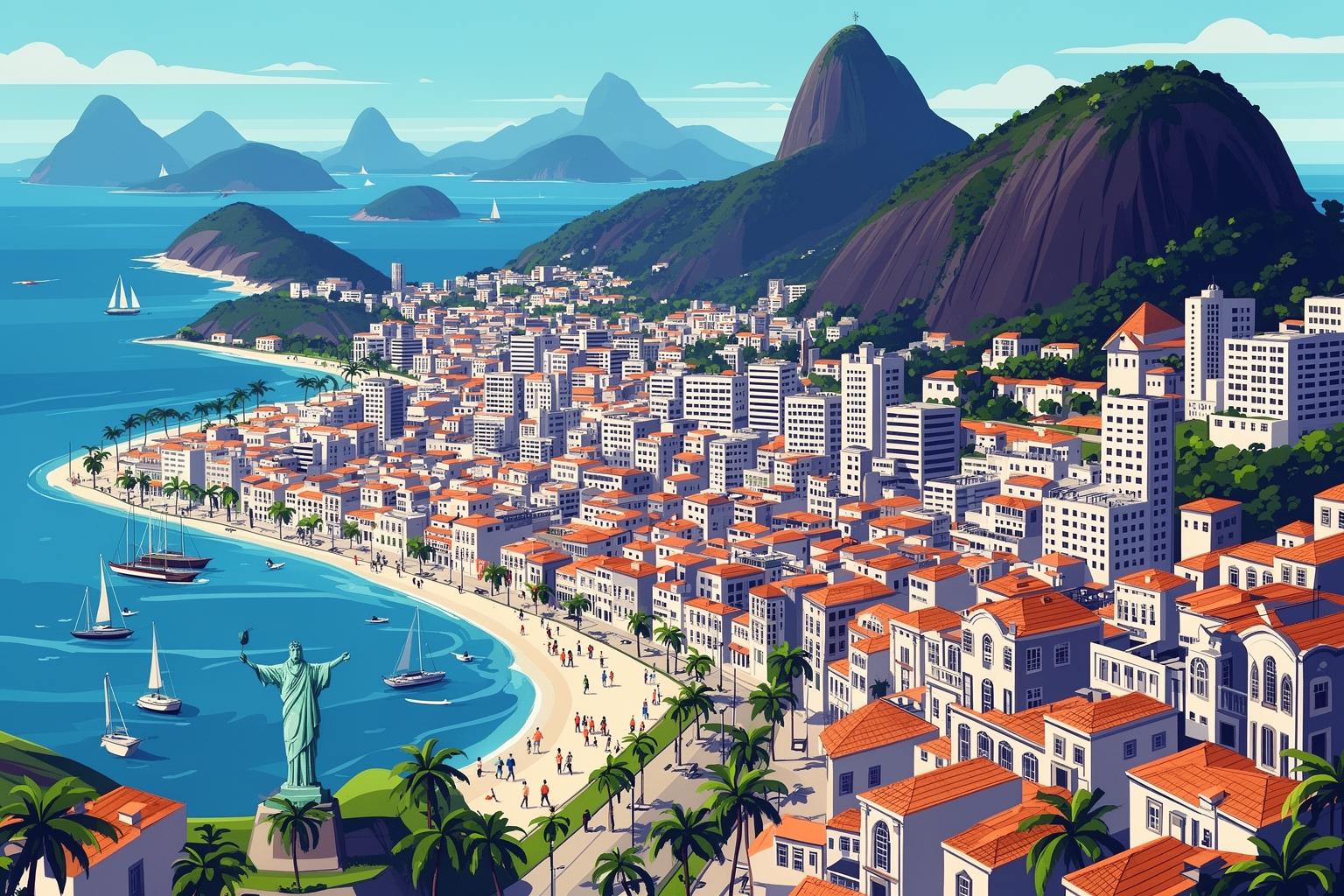
At sixteen, Clarice and her family relocated to Rio de Janeiro. While Recife shaped her childhood, Rio became the setting for her adult life. It was in this city that she started law school, pursued journalism, became a wife and mother, and, most importantly, emerged as the celebrated writer we recognize today. Rio de Janeiro is more than just a backdrop in her work; it is an active character. The city’s distinctive blend of breathtaking natural beauty and harsh urban reality provided an ideal stage for her explorations of inner life. Her characters frequently appear as isolated city dwellers, lost in the metropolis’s anonymity, experiencing transformative moments in ordinary places—a bus ride, a visit to the botanical garden, a quiet moment on a balcony. To explore Clarice’s Rio is to see the city through her eyes and to discover the extraordinary hidden within the everyday.
Leme: The Writer’s Sanctuary by the Sea
For the last twelve years of her life, Clarice resided in Leme, at the quieter end of the renowned Copacabana beach. Her seventh-floor apartment at Rua Gustavo Sampaio, 88, remains the holiest site for any Lispector admirer. The building, a modest mid-century structure called Edifício Riamar, still stands. While entry is not permitted, standing outside and looking up at her windows is a profound experience. This was her sanctuary for writing. It was here, often late at night in a cluttered study, with a cigarette burning and a cup of coffee nearby, that she penned some of her most groundbreaking works, including The Hour of the Star and Água Viva. This apartment was her fortress of solitude, her laboratory for dissecting the human soul. The street’s atmosphere is surprisingly peaceful compared to the hustle of nearby Copacabana. You can hear the distant murmur of waves and feel the sea breeze. It’s a place for quiet reflection. One can almost sense the intense focus that must have filled this apartment, the sheer determination it took to bring her visions to the page.
This apartment also marks a tragic episode. In 1966, after taking a sleeping pill, she fell asleep with a lit cigarette, causing a fire that severely burned her and permanently damaged her right hand, her writing hand. She referred to it as her “mummy hand,” and the incident plunged her into deep depression. Still, she relearned to write, adapting despite the pain. The fire became a part of her personal mythology, a literal trial by fire that left a physical and psychological mark. The building on Rua Gustavo Sampaio thus stands as a symbol of both creation and destruction, a testament to her extraordinary resilience.
The Rhythms of the Shoreline
From her apartment, it’s just a two-block walk to Leme beach. Strolling along the famous calçadão, the black-and-white wave-patterned sidewalk, from Leme toward Copacabana, is to follow in her footsteps. She often walked here, lost in thought, observing the city’s residents. The beach in Rio serves as the city’s great equalizer, a democratic space where people from all social strata come together. For Clarice, it was a stage for human existence. She would watch sunbathers, fishermen, and children playing in the surf. These observations found their way into her weekly newspaper columns, or crônicas, where personal reflection mixed with sharp social critique. The experience of this walk is sensory and meditative. The vast Atlantic Ocean on one side, the towering wall of apartment buildings on the other, and the looming Sugarloaf Mountain in the distance create a landscape encouraging introspection. It is easy to picture her here, feeling both part of and separate from the vibrant life surrounding her—a sensation that defines many of her characters.
Jardim Botânico: A Cathedral of Green
The Rio de Janeiro Botanical Garden was another beloved refuge of Clarice’s. This vast, stunning garden offers a peaceful oasis amidst the bustling city. Visiting it is like stepping into another realm, one shaped by the monumental scale of nature. The iconic avenue lined with royal palms, planted in the early 19th century, forms a natural cathedral that dwarfs human presence and evokes awe. Clarice came here to walk, reflect, and feel. The garden embodies primal life forces, a theme she relentlessly explored. The humid air, the scent of damp earth and blooming orchids, and the strange, ancient forms of the plants provide the perfect setting for a Lispectorian epiphany. In a place like this, the protagonist of The Passion According to G.H. might have her terrifying and ecstatic encounter with a cockroach, a moment that strips away all human artifice to reveal a raw, pulsating core of existence. Visiting here is not merely about admiring floral beauty but about embracing the sense of being a small part of a vast, indifferent, and powerfully alive natural world. Find a quiet bench, perhaps near the Victoria amazonica water lilies, and let the profound silence and overwhelming life of the garden wash over you. It is a deeply clarifying experience.
Centro and the City’s Pulse
Though she lived largely privately, Clarice was also a working woman who spent time in Rio’s chaotic Centro district. As a journalist for various publications, her commute would have taken her into this dense urban core. The architecture here is a dizzying blend of Belle Époque elegance, Art Deco details, and stark modernist towers such as the Palácio Capanema. This is the Rio of bureaucracy, commerce, and daily grind—a world far removed from the introspective calm of her Leme apartment. Visiting Centro provides a vital contrast and helps you understand the environment her characters sought to escape or comprehend. Experiencing the jostle on crowded buses, feeling the oppressive heat radiating from concrete, and navigating anonymous crowds on Avenida Rio Branco reveals the mundane stresses that often spark internal crises in her stories. The city’s relentless energy creates the friction against which her characters’ delicate inner lives emerge.
A Final Rest: Cemitério Israelita do Caju
Clarice Lispector died of ovarian cancer on December 9, 1977, just a day before her 57th birthday. She is buried in the Cemitério Israelita do Caju, located in Rio’s North Zone. Visiting her grave is a solemn but important part of any pilgrimage. The cemetery lies in a working-class industrial area, far from the tourist-friendly South Zone. The journey itself evokes the city’s vastness and stark social contrasts. Her grave is simple—a plain granite slab inscribed with her name in Hebrew and Portuguese, alongside her father’s. The atmosphere is quiet and contemplative. Visitors often leave small stones, following a Jewish tradition, or flowers and handwritten notes. It is a place to pay tribute and reflect on the arc of her extraordinary life—from a frightened refugee family to one of world literature’s most revered figures. It stands as a humble, quiet conclusion to a life lived with fierce intensity.
The Diplomat’s Exile: European Interludes
For nearly twenty years, Clarice’s life was marked by extended stays abroad, following her husband, a Brazilian diplomat. This period was one of great personal challenge, characterized by deep loneliness and a feeling of cultural disconnection. Yet, this exile also served as a profoundly fertile creative space. The unfamiliarity of her environment heightened her awareness and inspired the existential themes in her novels. Viewing Europe through her perspective adds depth to understanding her work, revealing how the sense of being an outsider, which began in her childhood, evolved into a core artistic motif.
Naples: The Besieged City of the Soul
In 1944, Clarice joined her husband in Naples, Italy, soon after the city’s liberation in World War II. She found a place of striking beauty intertwined with utter devastation. The ancient city lay in ruins, its inhabitants facing starvation. The contrast was stark. She volunteered at a hospital for wounded Brazilian soldiers, confronting the harsh realities of war firsthand. This experience of living in a “besieged city” became the central metaphor in her novel A cidade sitiada (The Besieged City), which she wrote there. The novel’s protagonist, Lucrécia Neves, endures a life of quiet despair, her inner world a stronghold against a meaningless outer existence. Walking through Naples today, especially amidst the dense, chaotic streets of the historic center, allows one to feel the energy that both fascinated and overwhelmed Clarice. The layers of history, vibrant life amidst decay, and enduring beauty in hardship are palpable. Her time in Naples deepened her understanding of civilization as a fragile construct, always threatened by the chaos simmering beneath the surface.
Bern: A Sterile, Suffocating Quiet
If Naples embodied chaotic life, Bern, Switzerland, was its stark opposite. From 1946 to 1949, Clarice lived in the immaculate, orderly Swiss capital. She found its quietness and predictability suffocating. For a spirit nourished by the chaotic vibrancy of Brazil, Bern’s sterile perfection felt like a prison. Her correspondence from this time is filled with complaints about boredom and a pervasive, gnawing loneliness. She experienced intellectual and spiritual deprivation. Yet, this profound alienation spurred her creativity. It was in the quiet solitude of her Swiss home that she wrote the manuscript for O Lustre (The Chandelier) and conceived A Maçã no Escuro (The Apple in the Dark), a novel about a man fleeing society in search of a new, pre-linguistic way of existence. Visiting Bern with Clarice in mind changes one’s perception of the city. The charming medieval streets, the peaceful Aare River, and the famous clock tower all take on a subtly sinister edge. One can sense the oppressive orderliness she opposed and the silence she sought to fill with her writing. Her Swiss exile serves as a powerful reminder that for some artists, comfort and tranquility are less inspiring than tension and disorder.
Tracing the Words: The Legacy in Institutions

A pilgrimage involves more than just visiting sites related to life and death; it also means engaging with the ongoing legacy of an artist’s work. In Rio de Janeiro, various institutions preserve her memory and offer spaces for a deeper connection with her creative process, presenting a unique kind of sacred site for literary travelers.
Instituto Moreira Salles: Guardian of the Archive
The Instituto Moreira Salles (IMS) in Gávea, housed in a beautiful modernist building surrounded by lush gardens, is a prominent cultural center in Rio. For Lispector enthusiasts, it holds her personal archives—an invaluable treasure trove, the heart of her legacy. The collection includes thousands of documents, such as manuscripts featuring her handwritten corrections, diaries, letters, photographs, and books from her personal library. Although primarily accessible to researchers, the IMS regularly hosts exhibitions, film screenings, and talks related to her life and work. Visiting IMS offers the chance to see tangible artifacts from her creative journey. Witnessing her delicate handwriting in a draft of Água Viva or viewing family photographs brings her vividly to life in a profoundly moving way. The institution honors the seriousness of her intellectual pursuits and provides enriching context for her writings. Before traveling to Rio, it is advisable to check the IMS schedule for any Lispector-related events. The house and its gardens also provide a beautiful, tranquil setting to spend an afternoon—an environment suited to the deep reflection her work inspires.
The Living Word in Rio’s Bookstores
Arguably, no better way to connect with Clarice’s spirit in Rio exists than by visiting the city’s wonderful bookstores. Venues like Livraria da Travessa, with cozy locations in Ipanema and Leblon, serve as cultural hubs where her books are prominently featured in many editions. The simple act of browsing shelves, touching covers, and sitting at a café with a freshly purchased copy of The Hour of the Star becomes a ritual linking you to the vibrant literary culture of her city. Her works are available in the original Portuguese, alongside translations, critical studies, and biographies—a testament to her lasting influence. In these bookstores, she stands not as a historical figure but as a living presence, continuously speaking to new generations of readers. It reminds us that the most vital place to encounter Clarice Lispector remains, and always will be, within her words.
A Pilgrim’s Practical Guide
Embarking on a Lispectorian journey calls for some practical planning. These locations are not always typical tourist spots, so a bit of preparation can help you engage more deeply with the essence of each place.
Navigating Clarice’s Rio
Rio de Janeiro is a vast city, but the main Lispector sites are fairly accessible. The South Zone neighborhoods—Leme, Copacabana, and Ipanema—as well as the Botanical Garden, are best explored on foot, by bus, or via ride-sharing apps. The Metro also offers an efficient way to travel between the South Zone and the Centro. For the more distant Cemitério do Caju, taking a taxi or a ride-sharing service is the most practical and safest choice. The ideal time to visit Rio is during the shoulder seasons, from April to June and from September to November, when the weather is pleasant and crowds are thinner. Knowing a few Portuguese phrases will be helpful, but English is often understood in major tourist areas. Most importantly, allow yourself time. Avoid rushing from one site to another. Embrace the Lispectorian spirit of observation: sit in a café, stroll on the beach with no fixed destination, and simply watch the city’s life unfold.
Experiencing Historic Recife
Recife’s historic center, including Recife Antigo and the Boa Vista neighborhood, is best explored on foot. Wear comfortable shoes since the cobblestones can be uneven. The city is hot and humid year-round, so stay hydrated and seek shade during the midday sun. While in Recife, dive into the local culture that influenced her. Sample regional dishes like carne de sol or moqueca, and immerse yourself in the sounds of frevo and maracatu. The city possesses a raw, powerful energy that is crucial to understanding Clarice’s early inspirations. Be aware of your surroundings, as you would in any large city, but don’t let that prevent you from fully absorbing the atmosphere of this distinctive and historically rich place.
The Unveiling of the Self

To follow the path of Clarice Lispector is to understand that her true geography was inward. The external scenes of Recife, Rio, Naples, and Bern served merely as triggers, mirrors reflecting the vast, unexplored realm within. Traveling to these places is not about marking spots on a map; it is an invitation to perceive the world through her eyes: with an intensity that pierces beyond the surface of the ordinary. It means standing on Leme beach and sensing the ocean’s terrifying indifference, or wandering through the Botanical Garden and feeling the silent, ruthless wisdom of nature. It involves realizing that a moment of deep revelation—an epiphany, a glimpse of the “living what”—can occur anywhere, at any time. The true journey concludes where it begins: with her books in hand and the startling realization that the wild heart she wrote about beats within each of us.