Step into a world drenched in celestial light, a realm of shimmering silks, grand architectural vistas, and feasts so lavish they could summon the gods themselves. This is the universe of Paolo Veronese, a master of the Venetian Renaissance whose canvases pulse with a life force so vibrant it seems to breathe. To follow in the footsteps of this artistic titan is not merely to trace a line on a map; it is to embark on a pilgrimage into the very heart of sixteenth-century splendor. We journey from the city of his birth, Verona, to the magnificent maritime republic that claimed his genius, Venice, and out into the rolling hills of the mainland where his art dissolved walls and brought the heavens down to earth. This is a quest to understand not just the painter, but the world that shaped him—a world of unparalleled wealth, profound faith, and an unshakeable belief in the power of beauty. It’s a journey to see his masterpieces not as isolated artifacts behind museum ropes, but as living, breathing components of the churches, palaces, and villas they were born to inhabit. Prepare to see color as you’ve never seen it before, to witness sacred stories told with an earthly joy, and to stand in the very spaces where Paolo Caliari, the boy from Verona, became the immortal Veronese.
For a similar journey into the life of another European master, consider a pilgrimage through Modigliani’s Europe.
The Dawn in Verona: Where Caliari Became Veronese
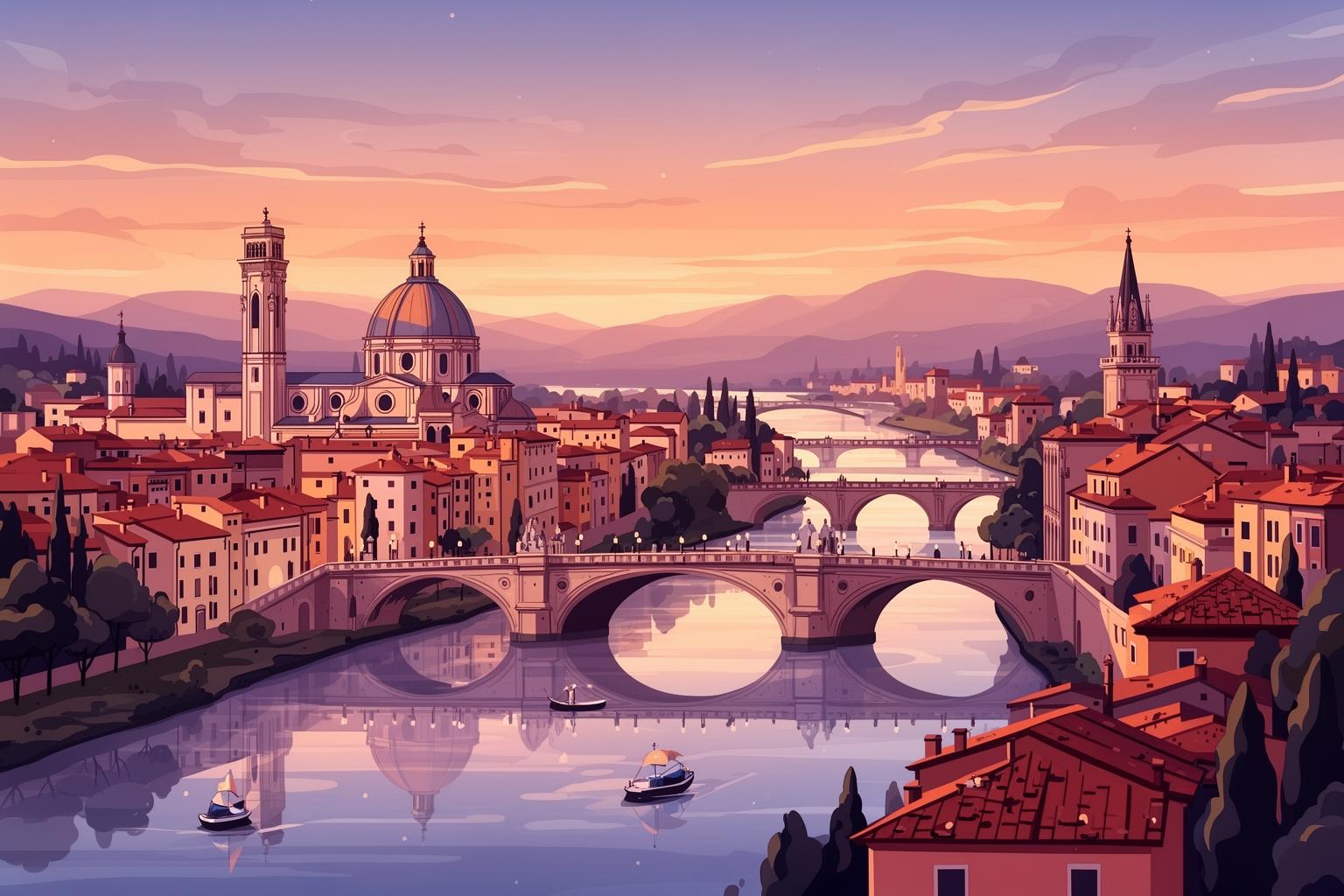
Long before the world came to know him as Veronese, he was Paolo Caliari, the son of a stonecutter, raised in the vibrant, ancient city of Verona. This is where his story begins. Often overshadowed in popular imagination by the romance of Romeo and Juliet, Verona possesses a unique and powerful atmosphere of its own. Its streets are steeped in history, from the vast Roman Arena that still resonates with the energy of summer operas to the sun-warmed stone of the Piazza delle Erbe. The Adige River enfolds the city in a cooling embrace, its waters reflecting the cypress trees and the crenelated medieval towers. This environment first shaped the young artist’s eye. Verona was a city of substance, filled with strong colors beneath a clear northern Italian sky—a place where art was both a source of civic pride and devotional necessity. He trained here under Antonio Badile, his future father-in-law, within a thriving artistic community that, though under Venetian rule, retained its distinct character. To wander through Verona is to catch a glimpse of the foundational palette of a genius—the initial sparks of a fire destined to soon illuminate all of Venice.
The Early Masterpieces: A Tour of Sacred Verona
Your Veronese pilgrimage through his hometown is a journey across sacred spaces, where the initial signs of his extraordinary talent are etched into altarpieces and church walls. It offers a quieter, more contemplative experience than Venice, allowing you to connect with the artist’s origins.
Church of San Fermo Maggiore
Begin at the Church of San Fermo Maggiore, a fascinating dual-level church with a Romanesque lower section and a soaring Gothic upper church. It is here, in the elegant Brenzoni chapel of the upper church, where you’ll find an early but crucial work: the Bevilacqua-Lazise Altarpiece. Painted around 1548, when Veronese was just twenty, it depicts the Madonna and Child enthroned with John the Baptist and other saints. Standing before it, you can already discern the hallmarks of his future style. The composition is confident and balanced, but it is the color that truly captivates. Notice the vibrant blues of the Madonna’s robe and the rich, almost iridescent quality of the fabrics. The figures stand poised and noble, bathed in soft, clear light. The architectural backdrop he paints is classical and grand, a nod to the Renaissance fascination with antiquity sweeping through Italy. It is a work full of youthful ambition, a clear announcement of a new, powerful voice emerging in the Veneto.
Verona Cathedral (Duomo di Verona)
Next, head to the city’s magnificent Romanesque cathedral. Inside the Avanzi Chapel, you will find another pivotal early piece, the Adoration of the Magi. This work showcases his burgeoning skill with complex, multi-figure compositions. The scene beautifully balances solemnity with spectacle. The three kings, draped in luxurious textiles, present their gifts with reverent gestures. Behind them, a bustling assembly of figures and animals suggests the grand, crowded scenes that would later define his career. Observe how he handles light, using it to model the figures and draw your eye to the central figures of the Virgin and Child. The colors are radiant, the details exquisite. Here, at the heart of Verona’s spiritual life, the young Paolo was already revealing his ability to turn a sacred narrative into an enthralling visual drama.
Church of San Giorgio in Braida
For a true masterpiece from his late Veronese period, just before he fully embraced Venice, visit the Church of San Giorgio in Braida, situated across the Adige River. Above the high altar hangs the breathtaking Martyrdom of Saint George. This is Veronese at the height of his powers. The work is rich with theatricality and emotional intensity. The scene is divided into two halves: on earth, St. George is about to be martyred, his expression one of serene faith as he gazes toward heaven. Above him, the heavens open in a swirl of celestial light, with angels and the Virgin Mary ready to receive him. The composition is dynamic, full of diagonal lines that create movement and tension. The colors are spectacular—the shining armor, the brilliant red banners, the golden light of heaven. This painting serves as a bridge, connecting Verona’s solid world with the heavenly visions he would perfect in Venice. It is a must-see, a powerful testament to the artist on the brink of greatness.
La Serenissima’s Embrace: Veronese Conquers Venice
Traveling from Verona to Venice is like following Veronese from his early training grounds to the grand stage of his career. If Verona provided his foundation, Venice gave him the freedom to soar. In the mid-sixteenth century, Venice—known as “La Serenissima”—was more than just a city; it was a phenomenon. A maritime empire established on an improbable lagoon, it was the crossroads of trade between East and West, a republic of immense wealth, grandeur, and artistic patronage. The very air of Venice is an artist’s paradise. The light, diffused through sea mist and reflected off the canals, has a distinct, silvery glow that softens edges and makes colors sparkle. The daily pageantry of gilded barges, elaborate processions, and sumptuous palaces along the Grand Canal was life itself. This was the world Veronese was destined to paint, and upon his arrival, he began transforming its splendor onto canvas with unmatched brilliance.
The Ducal Palace (Palazzo Ducale): Creating Art for the Republic
The ultimate emblem of Venetian power and prestige was the Ducal Palace—the Doge’s residence and the heart of government. A commission here was the highest honor, a mark of true recognition. Veronese didn’t simply receive a commission; he was entrusted with decorating some of its most prestigious halls, crafting visual allegories that exalted the glory, justice, and divine favor of the Venetian Republic.
A Symphony of Ceilings
When visiting the Ducal Palace, be sure to look upwards. Veronese was a master of ceiling painting, creating breathtaking sotto in sù (seen from below) illusions that seem to open the roof to the heavens. In the Sala del Collegio, where foreign ambassadors were welcomed, his ceiling work projected overwhelming power and confidence. The central panel, Venice Enthroned with Justice and Peace, features a personified Venice seated in regal splendor, surrounded by gods and virtues. The illusion is so complete that it feels as though you are gazing into an actual celestial court. His use of foreshortening is exquisite; figures appear to tumble and float in a space that transcends the flat surface of the canvas.
The Apotheosis of Venice
The pinnacle of his work in the palace is the enormous oval canvas on the ceiling of the Sala del Maggior Consiglio, the Great Council Hall, the very core of the Republic. The Apotheosis of Venice is one of the world’s most magnificent paintings. It is a dizzying, triumphant vision of Venice crowned by Victory, surrounded by a swirling array of deities, allegorical figures, and celebrating citizens. The perspective is bold, drawing your eyes upward through concentric rings of clouds and figures into a golden empyrean. The colors burst with gold, blue, and crimson hues. This painting is more than art; it is the ultimate piece of state propaganda—a visual testament to Venice’s belief in its divine destiny. Standing beneath it, you sense the immense pride and power of the Republic, conveyed through the brush of its most brilliant visual poet.
The Church of San Sebastiano: A Votive Offering in Paint
If the Ducal Palace represents Veronese as the state’s artist, the Church of San Sebastiano reveals his innermost soul. Situated in the quieter Dorsoduro district, this church is a must-visit for any Veronese admirer. It became his personal project, one he devoted over a decade to, and ultimately his final resting place. Stepping inside, you are completely immersed in his vision. It is a total work of art, with nearly every surface—ceiling, walls, altar, organ shutters—bearing his touch.
A Total Artistic Environment
He began in 1555 with the sacristy ceiling, painting a radiant Coronation of the Virgin. This success led to the commission for the nave ceiling, where he painted three dramatic scenes from the Story of Esther. These canvases, framed in ornate gilded borders, are masterpieces of narrative energy and illusionistic perspective. Esther, a Jewish heroine who saved her people, was seen as a symbol of both the Virgin Mary and Venice itself, a city as savior. The scenes are rich with opulent costumes and grand architectural settings—hallmarks of his style.
He continued with frescoes of prophets and sibyls between the windows, an altarpiece depicting the Madonna in Glory with St. Sebastian, and scenes from St. Sebastian’s life. Even the church organ shutters became canvases for his genius, showing the Presentation of Jesus in the Temple and The Pool of Bethesda. The overall effect is breathtaking. You enter a world wholly created by him—a seamless blend of painting, architecture, and spiritual devotion. After dedicating so many years to this church, it was fitting that it became his tomb. The simple stone slab marking his grave lies in the floor—a modest final testament from a master whose works were anything but humble.
Gallerie dell’Accademia: The Feast and the Inquisition
No journey into Veronese’s Venice is complete without visiting the Gallerie dell’Accademia to stand before his most famous and controversial work: The Feast in the House of Levi. This colossal canvas, nearly 43 feet wide, is a vibrant spectacle packed with overwhelming detail and vitality, demanding attentive and prolonged viewing.
A Supper Becomes a Feast
Originally commissioned as a Last Supper for the refectory of the Dominican friary of Santi Giovanni e Paolo, the painting shocked both the friars and the Holy Office of the Inquisition. Instead of a solemn, sacred portrayal of Christ’s final meal, Veronese depicted a lavish, chaotic Venetian banquet. The canvas teems with an army of figures: servants, soldiers, nobles, dogs, a jester, and a dwarf. It was this inclusion of what the Inquisition termed “buffoons, drunken Germans, dwarfs, and other such scurrilities” that brought Veronese into trouble.
The Trial of the Artist
The transcript of his Inquisition interrogation is a fascinating record and a stirring defense of artistic freedom. Asked why he included these profane figures, Veronese famously replied, “We painters take the same liberties as poets and madmen.” He explained that he had filled the spare space on the vast canvas with figures of his own invention, just as poets employ creative license. The tribunal was displeased and demanded he “correct” the painting within three months at his own cost. Veronese’s ingenious response was not to alter a single brushstroke but simply to change the title. By renaming it The Feast in the House of Levi—a biblical episode where Jesus dined with tax collectors and sinners—each worldly figure became contextually appropriate. This clever move preserved his artistic vision. Today, the painting stands as a monument to his style: a fusion of sacred and profane, a passion for spectacle, and a joyous celebration of painting the world in all its vibrant, colorful, and chaotic splendor.
Beyond the Lagoon: The Villas of the Terraferma
To fully appreciate Veronese’s genius, one must leave Venice and explore the terraferma, the mainland territories of the Venetian Republic. Here, the affluent Venetian aristocracy constructed magnificent villas—country estates that served as both productive agricultural centers and idyllic retreats for leisure and intellectual engagement. These villas were designed to harmonize with the landscape, and Veronese was invited to adorn their interiors with frescoes that blurred the boundaries between interior and exterior, reality and illusion.
Villa Barbaro at Maser: A Perfect Harmony
The crowning achievement of this tradition, and a crucial destination for those following Veronese’s work, is the Villa Barbaro at Maser. This UNESCO World Heritage Site represents a sublime collaboration among three of the late Renaissance’s greatest figures: architect Andrea Palladio, sculptor Alessandro Vittoria, and painter Paolo Veronese. Commissioned by the educated Barbaro brothers, Daniele and Marcantonio, the villa was designed as a perfect expression of Humanist ideals—a place where art, nature, and philosophy could unite in harmonious balance.
The World of Illusion
Veronese’s frescoes at Villa Barbaro stand as his masterpiece in this medium. They go beyond decoration; they are a total reimagining of space. Employing the trompe l’oeil technique, he painted illusionistic architectural frames, balustrades, and windows that appear to open onto tranquil, idealized landscapes. In the central Sala a Crociera (Cross-Shaped Hall), the walls seem to disappear, replaced by views of rolling hills, ancient ruins, and blue skies. The effect is enchanting, creating a sense of expansive openness that connects the villa’s inhabitants directly to the surrounding countryside.
But the enchantment extends beyond landscapes. The frescoes include witty, playful details that animate the villa. A young pageboy peeks from behind a painted door. A hunter, accompanied by his dogs, returns from the fields. A young girl, a member of the Barbaro family, gazes down from a painted balcony. These delightful figures blur the line between the painted realm and the real world of the villa’s residents. In the Stanza di Bacco, the god of wine is honored, a fitting nod to the villa’s agricultural function. The climax is the ceiling of the Salone dell’Olimpo (Hall of Olympus), where the gods of the seven planets preside over divine harmony, symbolizing the well-ordered universe and the virtuous rule of the Barbaro family.
Visiting Villa Barbaro feels like entering a dream. It is a place of deep beauty, intellectual refinement, and joyful illusion. The light streaming through Palladio’s perfectly positioned windows illuminates Veronese’s palette, making the frescoes glow with vibrant life. It is an unforgettable experience that reveals another facet of the artist—less the creator of grand public spectacles and more the master of intimate, poetic illusion.
The Veronese Legacy: Color, Spectacle, and Lasting Influence
Although the core of Paolo Veronese’s world is rooted in the Veneto, his influence extended far beyond it. Today, his paintings are displayed in the most prestigious museums worldwide—from the Louvre in Paris, home to the monumental Wedding at Cana, to the Prado in Madrid and the National Gallery in London. However, viewing his work apart from its original setting reveals only part of the narrative. The true impact of Veronese emerges when his paintings are seen in situ, harmonized with the architecture and light for which they were designed. His legacy resides not only in these individual artworks but also in the cohesive environments he created.
His style, often defined by the Venetian concept of colorito—the dominance of color over drawing (disegno)—was groundbreaking. He perceived the world through light and color, constructing his compositions with vibrant, layered tones that convey richness and texture. A masterful storyteller, he orchestrated dozens of figures into coherent, dynamic narratives that were both spiritually profound and deeply human. He captured the essence of his era—the opulent, confident, and glorious spirit of the Venetian Republic at its height. This celebration of life, a joyful embrace of worldly splendor even within the most sacred themes, influenced generations of artists, from the Baroque grandeur of Peter Paul Rubens to the romantic color schemes of Eugène Delacroix. To follow the light of Veronese is to grasp how one artist so perfectly embodied the spirit of a city and, in doing so, created a realm of beauty that remains as mesmerizing today as it was five centuries ago.
Practical Guide for the Veronese Pilgrim
Embarking on a journey to follow Veronese requires some planning, but the rewards are immeasurable. Here is practical advice to help you design your ideal artistic pilgrimage.
Planning Your Itinerary
A logical and fulfilling route is to start in Verona, the artist’s birthplace, and spend one or two days exploring the churches that showcase his early works. From Verona, a scenic and easy train ride takes you to Venice. Plan to spend at least three to four days in Venice to fully appreciate the abundance of his art there. The Ducal Palace, the Gallerie dell’Accademia, and the Church of San Sebastiano are all must-see locations. The Villa Barbaro at Maser is best visited as a day trip from Venice. It’s most easily reached by car, but you can also take a train to a nearby town like Cornuda or Montebelluna followed by a short taxi ride.
Navigating Venice
Venice is best explored on foot. The greatest pleasure comes from allowing yourself to get lost in its labyrinth of narrow streets (calli) and charming squares (campi). For longer journeys, the vaporetto (water bus) system is both efficient and essential. Buy a multi-day pass for the best value; it lets you hop on and off freely, making it easy to travel between districts and visit the outlying islands. Keep in mind that Venetian addresses can be confusing, so a good map or a GPS-enabled smartphone is invaluable.
Beyond the Canvas: Experiencing Venetian Culture
To truly connect with the world of Veronese’s paintings, immerse yourself in the culture that inspired them. Attend a Vivaldi concert in a historic church to experience the soundscape of the Republic. Rise early to visit the Rialto Market, a vibrant scene of color, sound, and life that has been the city’s commercial hub for centuries. Take in the fresh seafood, the bright produce, and the bustling crowd—it’s like stepping into one of his festive scenes. In the evening, do as the locals do and visit a bacaro, a traditional wine bar, for cicheti (small snacks) and a glass of local wine. This culture of sociability and simple pleasures captures the essence of life he so vividly portrayed.
A Note on Light
Finally, pay close attention to the light. The unique atmospheric quality of Venice’s light is not a myth. It is a palpable presence that shifts throughout the day. Observe how the morning sun hits the golden mosaics of St. Mark’s Basilica. Notice the afternoon light as it sweeps across the palazzi on the Grand Canal, making the marble glow. Watch the soft, silvery light of dusk as it settles over the lagoon. This is the light Veronese studied, captured, and refined. Witnessing it yourself completes the experience—the key to unlocking a deeper appreciation of his luminous art.
A journey into the world of Paolo Veronese is a feast for both the senses and the soul. It offers a chance to step back in time, walk the same streets, and gaze upon the same canals he once saw. It is to witness the seamless union of faith and worldly splendor, divine narrative and human joy. His art powerfully reminds us that beauty can be a form of devotion and color a kind of prayer. You will leave the Veneto with your eyes wider open, your appreciation of art deepened, and your spirit moved by the enduring, radiant genius of a master.