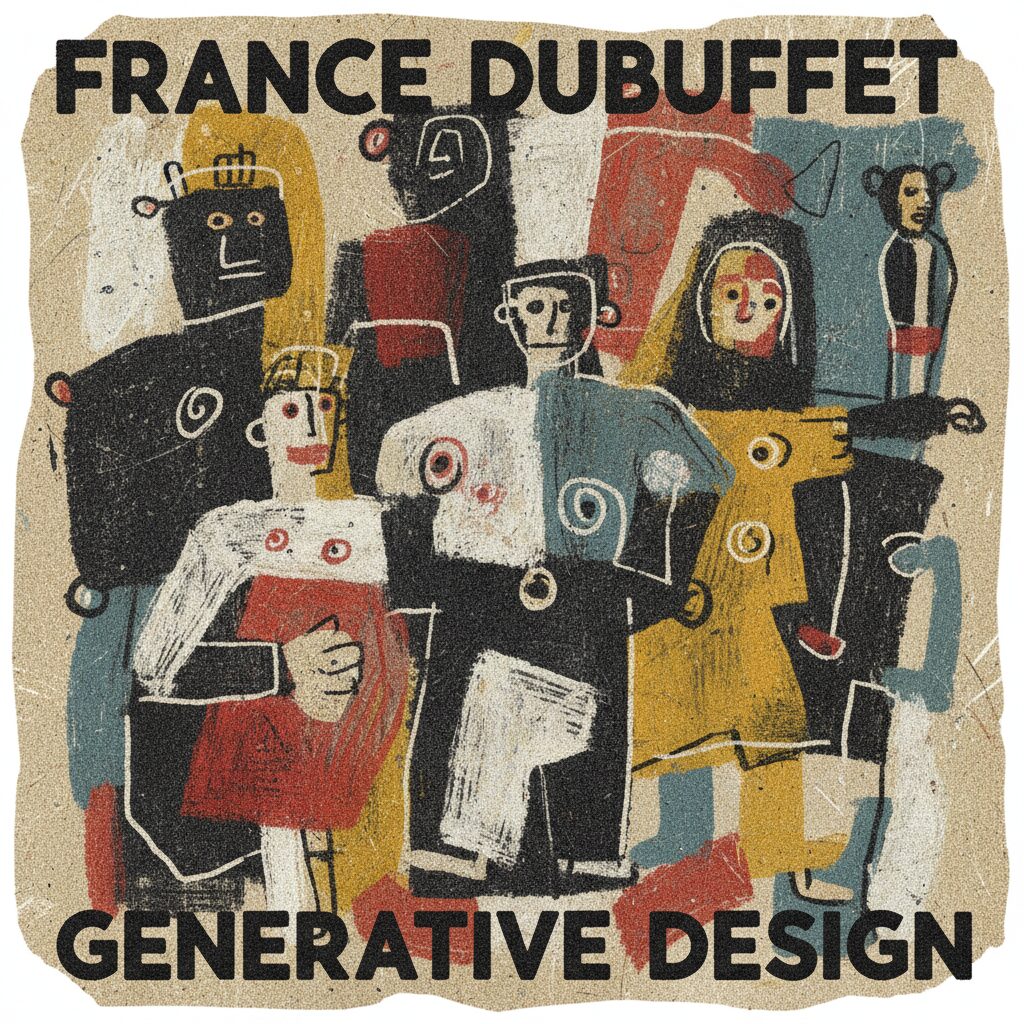
There are artists who paint the world, and then there are artists who invent new ones. Jean Dubuffet was firmly, wildly, and magnificently in the latter camp. To follow his trail through France is to embark on a journey not just through cities and landscapes, but into a revolutionary mind that dismantled the very definition of art. He was the champion of the overlooked, the raw, the unfiltered—what he famously coined Art Brut, or Raw Art. This wasn’t about polished techniques learned in stuffy academies; it was about the primal, urgent, and often chaotic creativity bubbling up from the margins of society. Our adventure is a pilgrimage to the sources of this incredible vision, from the gritty port city of his birth to the intellectual battlegrounds of Paris, and finally, to the monumental, mind-bending worlds he built with his own hands. We’re not just looking at art; we’re stepping inside it, feeling its texture, and hearing its defiant, joyful pulse. This is a trip for the curious soul, a quest to see the world through the eyes of a true original, and to find the extraordinary hidden in the most ordinary of places.
For another artistic journey that explores the vibrant, unconventional spirit of a different Parisian master, consider a pilgrimage into the world of Toulouse-Lautrec.
Le Havre: Where the Seine Meets the Sea and an Artist is Born
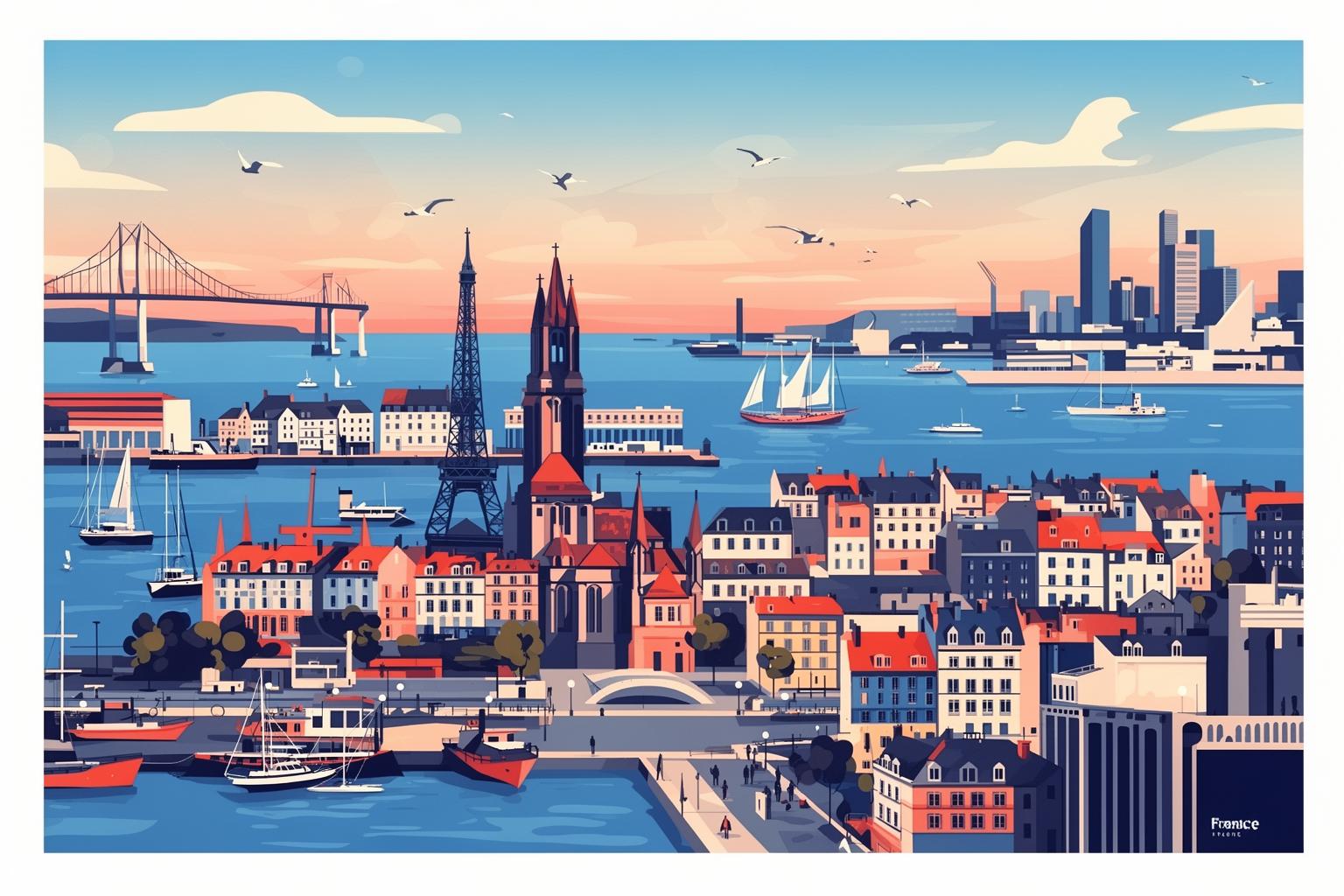
Every story has a beginning, and for Jean Dubuffet, it begins in Le Havre. Born in 1901 to a family of successful wine merchants, his childhood was rooted not in the romantic bohemia of an artist’s garret, but in the practical, bustling atmosphere of a major port city. To truly understand Dubuffet, one must first grasp the spirit of this place. Le Havre is not a city of delicate, postcard-perfect charm. It is a city of industry, of arrivals and departures, where the salty air carries the clang of shipping containers and the cries of gulls. It is a city with grit, texture, and a raw honesty that became the foundation of his entire artistic philosophy.
A Merchant’s Son with an Artist’s Heart
Picture a young Dubuffet walking these streets, caught between two worlds. On one side, the family business—a realm of ledgers, logistics, and the refined tastes of wine connoisseurs. On the other, a growing urge to create, to capture the unfiltered truth of the world around him. This inner struggle shaped his early years; he frequently ventured into the art world only to retreat, seemingly for good, back to the wine trade. Yet, the seeds sown in Le Havre—a profound respect for the common man, skepticism toward high culture, and an eye for the beauty in the raw and real—never faded. The city’s working-class spirit, its modest architecture, and its constant hum of activity were his first, and perhaps most crucial, lessons.
The Scars and Forms of a Rebuilt City
Visiting Le Havre today reveals a landscape that subtly but deeply influenced Dubuffet’s aesthetic. The city was almost entirely destroyed by bombing during World War II. Its reconstruction, masterfully guided by architect Auguste Perret, is a remarkable symphony of reinforced concrete. This might sound bleak, but the effect is anything but. Perret’s vision created a cityscape of clean lines, harmonious structures, and an unapologetic celebration of the raw material itself. The concrete is not concealed or softened; it is displayed with rugged elegance. Walking through the UNESCO-listed city center, one can feel a direct connection to Dubuffet’s later works. His renowned Hautes Pâtes (High Pastes) series, with its thick, troweled-on layers of paint mixed with sand, tar, and gravel, appears as a direct translation of these concrete facades. He wasn’t merely painting a picture; he was constructing a surface, much like Perret built a city from its most fundamental elements.
Discovering Dubuffet’s Traces Today
Your journey should begin with a walk, allowing the city’s unique ambiance to wash over you. Start at the Bassin du Commerce, observing the ships and sensing the industrial rhythm. Then, roam through the rebuilt center, noting the textures of the buildings. For a direct encounter with his work, visit the Musée d’art moderne André Malraux (MuMa). Its impressive glass and steel structure sits right on the waterfront, and its collection often features pieces by Dubuffet, letting you see his creations in the very environment that inspired them. For a fully immersive experience, find a local bistro, order a plate of fresh seafood, and simply watch. The faces, the conversations, the unvarnished reality of daily life—this is the living expression of Art Brut that Dubuffet so fervently championed.
Paris: The Tumultuous Heart of the Avant-Garde
If Le Havre shaped Dubuffet’s character, Paris was the anvil where his artistic identity was forged, broken, and ultimately reforged. He was never a straightforward member of any Parisian school or movement; he was too much of a contrarian, a lone wolf. His relationship with the city was a tumultuous, on-again, off-again affair that lasted for decades. He initially came to study at the Académie Julian in the 1920s, only to quickly reject its formal teachings as stifling. He cycled between returning to the wine business and pursuing art, a pattern of rebellion and retreat that continued until his early forties, when he finally committed himself, with explosive intensity, to becoming a full-time artist.
Saint-Germain-des-Prés: A Bohemian Cauldron
When Dubuffet emerged on the post-war Parisian art scene, its heart was the lively, intellectually charged neighborhood of Saint-Germain-des-Prés. This was the world of Sartre and de Beauvoir, of smoky jazz clubs and endless debates in iconic cafés like Les Deux Magots and Café de Flore. Dubuffet belonged to this milieu, yet he was also its critic. While others sought inspiration from history or psychoanalysis, he looked outward, to the margins. He was captivated by graffiti on city walls, children’s drawings, and art created by psychiatric patients. He perceived in these works a purity and honesty missing from the polished, self-aware realm of professional art. Walking the streets of the 6th arrondissement today is to retrace his steps, imagining him moving through the crowds, an observer collecting the raw data of human life.
The Birth of Art Brut
It was in Paris that Dubuffet developed his groundbreaking concept of Art Brut. He was more than an artist; he became a collector, a researcher, and a passionate advocate for these “outsider” creators. He believed that the most powerful creative impulses came from those untouched by artistic culture, those who created solely for themselves, driven by an inner necessity. Alongside thinkers like André Breton, he founded the Compagnie de l’Art Brut, assembling a collection that became a cornerstone of modern art history. This was a radical gesture, a direct challenge to the Parisian art establishment. He was essentially telling the cultural gatekeepers that the most vital art was happening far from their gilded galleries.
The Foyer de l’Art Brut and Galerie René Drouin
Though specific places have changed, the spirit of Dubuffet’s Parisian revolution endures. His first major and scandalous exhibition took place at the Galerie René Drouin near Place Vendôme in 1944. Critics recoiled at his crude figures and thick, muddy textures, but he had made his bold statement. He also briefly operated the Foyer de l’Art Brut to showcase his growing collection. Today, exploring the streets of the 6th, 7th, and 8th arrondissements feels like a modern treasure hunt, imagining these small galleries as hubs of artistic defiance. The most significant destination, however, is the Centre Pompidou. This architectural marvel, with its inside-out design, is the perfect home for Dubuffet’s work. Viewing his massive, textured canvases and chaotic, vivid paintings there is a powerful experience. You can trace his entire evolution—from the earthy, gritty materiality of his early works to the graphic, cellular eruptions of his later style. It is here that you truly appreciate the scope and daring of his vision.
Vence: A Retreat to the Sun-Drenched Earth
After the intense intellectual battles in Paris, Dubuffet sought a new source of inspiration. In the mid-1950s, he relocated to Vence, a charming hill town nestled within the sun-drenched landscape of Provence. This move was a conscious break from the gray urban grit he had often celebrated. He was searching for fresh textures, new light, and a different connection with the material world. This transition marked a crucial turning point in his work, leading to some of his most captivating and elemental series.
From City Grit to Provençal Soil
Consider the sensory shift involved in this change. Dubuffet traded the smell of asphalt and Metro fumes for the fragrance of lavender, thyme, and warm pine needles. He swapped the city’s monochromatic palette for the brilliant blue of the Côte d’Azur sky and the rich ochre hues of the southern earth. This setting didn’t simply inspire him to paint landscapes traditionally; it urged him to create art from the landscape itself. Vence’s atmosphere is one of ancient, sun-baked calm. It invites you to slow down, observe more closely, touch the rough stone of a medieval wall, or crumble some dry soil between your fingers. This is exactly what Dubuffet did, transforming the very ground beneath him into a medium for cosmic exploration.
A Laboratory of Materials
His studio in Vence became a kind of alchemical workshop. This was the era of his Texturologies and Matériologies. He moved beyond using just paint, experimenting with an eclectic mix of materials. He incorporated sand, gravel, vegetal sponges, and even butterfly wings into his canvases. The resulting works aren’t mere representations of the earth; they are the earth itself, reshaped into a new reality. These micro-landscapes evoke everything from barren desert floors to cosmic vistas seen through a telescope. To experience one of these pieces is to feel the heat and texture of the Provençal terrain. He captured the essence of the place—its elemental spirit—in the most direct way possible.
Walking the Landscape of Inspiration
To truly connect with Dubuffet’s period in Vence, you need to leave the car behind and explore on foot. Wander the narrow, winding streets of the old town, then venture out to the surrounding hills, the baous. Hike the ancient trails that weave through the landscape. This is where you’ll find the inspiration for his textural artworks. Observe the patterns of lichen on rocks, the complex web of roots clutching the soil, and the endless variations in the color of the earth. For a more curated art experience, the nearby Fondation Maeght in Saint-Paul-de-Vence is a must-visit. This renowned modern art institution is set within a beautiful pine forest and testifies to the creative energy that has long attracted artists to this region. While there, take a moment to sit quietly in its sculpture garden and absorb the unique quality of the southern light. The best times to visit are during the mild shoulder seasons of spring or autumn, when gentle weather and golden light make the landscape come alive. This is more than a sightseeing trip; it’s a full sensory immersion into the world that inspired Dubuffet’s most earthy and profound works.
The Hourloupe Cycle: A World Born from a Telephone Doodle
Sometimes, the most monumental artistic transformations begin with the smallest gestures. For Jean Dubuffet, his most iconic and expansive body of work, the Hourloupe cycle, originated from a moment of distraction. In July 1962, while speaking on the telephone, he started doodling absentmindedly with a red and a blue ballpoint pen. He filled the page with fluid, interlocking cells, creating a puzzle-like world of black, white, blue, and red. He was captivated by what emerged: a parallel reality, a vibrant mental landscape. This simple doodle would come to dominate his artistic practice for over a decade, evolving from drawings and paintings into massive, immersive sculptures and architectural environments.
A New Visual Language
The Hourloupe style is immediately recognizable. It is a universe of flowing contours and striped cells, a graphic system adaptable to any form. It is at once playful and intricate, resembling everything from biological cells to jigsaw puzzles to cartographic maps of imaginary realms. Dubuffet viewed it as a means to represent the restless, teeming world of the mind. He no longer depicted the external world, whether the streets of Paris or the soil of Vence; instead, he was constructing, piece by piece, an entirely new one. This style proved incredibly versatile, enabling him to transition from two-dimensional surfaces into three-dimensional space, creating what he called “monuments” that could be not only seen but inhabited.
Closerie Falbala and the Villa Falbala: The Heart of the Foundation
For the ultimate Dubuffet pilgrimage, no destination is more essential than the Fondation Dubuffet in Périgny-sur-Yerres, a quiet suburb just southeast of Paris. This is the home of his magnum opus, the Closerie Falbala and the Villa Falbala. Visiting this place means literally stepping inside the Hourloupe world. The Closerie is a 1,600-square-meter enclosed outdoor environment, a swirling landscape of white epoxy painted with thick, meandering black lines. It is a surreal and disorienting space. The ground undulates, walls curve in unexpected ways, and a stylized black-and-white tree stands in a stark, conceptual grotto. It feels like walking into a drawing, a space where the usual rules of perspective and gravity have been joyfully suspended.
Inside the Mind of a Maker: The Villa and its Garden
At the heart of the Closerie lies the Villa Falbala, a structure that served as a philosophical retreat for the artist. From the outside, it resembles a fantastical mushroom or a melting iceberg. Inside, the Hourloupe style covers every surface, from the walls and floors to the wildly imaginative furniture. One room, the Cabinet Logologique, was a chamber for meditation and mental exercises, designed to shut out the outside world and stimulate the inner one. Visiting the Fondation is an intimate and profound experience. It is not a bustling museum but a quiet, contemplative space that feels deeply personal. As a practical note, visits are strictly by appointment, so booking well in advance through their website is necessary. It requires a bit of planning—a trip on the RER D train from Paris followed by a taxi or a brisk walk—but the reward is unparalleled insight into the mind of a creative genius. For the perfect photo, wear a single, bold color like bright red or cobalt blue; you’ll stand out against the monochrome background like a living element in one of his compositions.
The Late Works: Confronting the Void
An artist as restless as Jean Dubuffet could never remain still. After dedicating more than a decade to the immersive world of Hourloupe, he felt a strong urge to return to the raw, expressive energy of painting. His final years, from the mid-1970s until his death in 1985, were characterized by an extraordinary burst of creative intensity. He launched several significant new series, including the Théâtres de mémoire, the Non-lieux, and the Mires, each delving into complex ideas about perception, memory, and the very act of seeing. These late works stand as a dazzling, chaotic, and deeply moving final statement from an artist who never ceased questioning.
A Return to Raw Painting
The Théâtres de mémoire (Theaters of Memory) are vast, collage-like canvases composed of smaller paintings, portraying a whirlwind of scenes, figures, and moments from Dubuffet’s past. They function as sprawling visual diaries, rejecting any single viewpoint in favor of a vibrant, simultaneous flood of information. After these, he transitioned into pure abstraction with his Non-lieux (Non-places) and Mires (Sight Gages) series. These are some of his most dynamic and challenging pieces. The canvases are filled with a tangle of bright, electric lines, a riot of color and movement. They can feel disorienting, like watching a scrambled television signal or a landscape rushing past a train window at high speed. Dubuffet was pushing the boundaries of perception. He was no longer concerned with creating a recognizable image, but with capturing the pure energy of creation itself—the flow of thought before it solidifies into a concrete idea.
Legacy in Global Collections
This final, explosive phase of Dubuffet’s career cemented his reputation as a towering figure of 20th-century art. While the core of his legacy remains in France, these powerful late works are held in the collections of major museums worldwide. Encountering them at the Guggenheim in New York, the Tate Modern in London, or alongside his earlier works at the Centre Pompidou in Paris offers a comprehensive view of his artistic journey. It reveals the through-line in his work: a lifelong commitment to instinct over intellect, energy over order, and the messy, vibrant, unpredictable beauty of raw creation.
The Enduring Echo of Art Brut
To follow in the footsteps of Jean Dubuffet is to do more than simply visit a series of places on a map. It is an education in a fresh way of seeing. His lasting legacy lies not only in his paintings or sculptures but in the powerful idea he promoted: that art is not an exclusive commodity created by a handful of people, but a universal human instinct present everywhere. It can be found in the graffiti on a wall, the texture of pavement, the uninhibited drawings of a child, and the solitary works of those who exist outside the mainstream.
A journey through Dubuffet’s France—from the industrial grit of Le Havre to the surreal world of the Closerie Falbala—is an invitation to open your eyes to the world of Art Brut that surrounds you daily. It urges you to discover beauty in the unconventional, to value the texture of the overlooked, and to celebrate the raw, unfiltered rhythm of life itself. When you leave, you take a piece of his philosophy with you. You begin to notice the intricate patterns on a weathered door, the accidental collage of posters at a construction site, the unique beauty of a face in the crowd. Dubuffet’s greatest gift was his permission to see the entire world as a museum, a place filled with infinite and astonishing creativity. Carry that spirit of exploration with you, and every journey you embark on will become a treasure hunt for the extraordinary in the ordinary.