To walk in the footsteps of Nikolai Gogol is to step through a looking glass. It’s a journey not just across the vast plains of Ukraine and the imperial avenues of Russia, but into a world teetering on the edge of reality. This is the realm of the surreal, the grotesque, and the profoundly, comically human. Gogol, a master of the absurd and a literary giant whose soul was forever torn between two cultures, didn’t just write about places; he breathed a strange and mystical life into them. His villages pulse with folklore, his cities are haunted by phantoms in overcoats, and his grand boulevards are stages for the most bizarre comedies of manners. Embarking on a Gogol-themed pilgrimage is an invitation to see the world through his uniquely distorted lens, to find the magic in the mundane, the horror in the hilarious, and the ghost in the machine of everyday life. From the sun-drenched, demon-haunted fields of his Ukrainian childhood to the damp, oppressive gloom of St. Petersburg and the final, tragic silence of Moscow, we trace the arc of a life that forever changed the course of literature. This is more than a tour; it’s an immersion into the very soul of his stories, a quest to find the tangible roots of his fantastical imagination.
This quest to understand a writer through their landscapes is a journey shared by those tracing the literary footsteps of Émile Zola through France.
The Cradle of Cossack Spirit: Velyki Sorochyntsi and the Poltava Region

Our journey begins where his did, in the heart of Ukraine’s Poltava region. This is not the grand, imposing Russia of Tolstoy or Dostoevsky, but a land of fertile black soil, thatched cottages, and a sky so vast it seems endless. The very air feels thick with stories, whispered on the wind that stirs through endless sunflower fields. It is here, in this vibrant land rich with folklore, that the seeds of Gogol’s imagination were sown and took root, growing into the fantastical tales that first brought him fame.
Birthplace and Echoes of Folklore
Velyki Sorochyntsi—its name sounds like a line from a folk song. This small village is where Nikolai Vasilyevich Gogol was born in 1809. Today, it remains quiet and unassuming, but for literary pilgrims, it is sacred ground. The main attraction is the Gogol Memorial Museum-Preserve, a reconstructed estate where he was born. Approaching it, one leaves the modern world behind. The path is shaded by ancient trees, and the whitewashed house with its traditional thatched roof looks as if it was lifted straight from the pages of Evenings on a Farm Near Dikanka.
Stepping inside is a powerful experience. The museum is not a sterile display of artifacts behind glass; rather, it strives to recreate the atmosphere of Gogol’s early life. Rooms are furnished with period pieces, personal belongings, and manuscripts, offering a glimpse into the mind of the young Gogol. There is a palpable sense of the world that shaped him—the deep faith of his mother, the theatrical passions of his father, an amateur playwright, and the ever-present backdrop of Ukrainian folk tales filled with witches, devils, and water nymphs. The curators have done an exceptional job evoking this mood—you can almost hear floorboards creak beneath unseen spirits, almost smell the beeswax candles his mother would have lit. Visiting here is essential for understanding that Gogol’s surrealism was not merely a literary tool, but an extension of the world he was born into—a place where the supernatural was as familiar as a neighbor.
Practical advice for travelers: Velyki Sorochyntsi is rural and requires some planning to reach. The most common way is by car or a pre-arranged taxi from the larger cities of Poltava or Mirgorod. Don’t expect a bustling tourist destination; its charm lies in its authenticity and tranquility. Allow yourself a full afternoon to explore the museum grounds and wander the village. Stroll down to the Psel River, imagine the village festivities, and let the quiet settle around you. This is the wellspring of Gogol’s genius.
Dikanka: Where Magic Meets Reality
If Sorochyntsi is the source, then Dikanka is the amplifier. Although Gogol never lived here, he immortalized the town in Evenings on a Farm Near Dikanka, turning it into a semi-mythical place where the devil steals the moon and a lovesick blacksmith flies to St. Petersburg on the devil’s back. Visiting the real Dikanka is a fascinating experience in separating fact from fiction and seeing how a master storyteller transforms a physical place into legendary terrain.
The atmosphere is one of layered history. Landmarks still ground his fantastic tales in reality. The Triumphal Arch, built to commemorate Tsar Alexander I’s visit, stands as a proud and slightly incongruous piece of classicism in the rustic landscape. More evocative is the Trinity Church, which, though not the exact one from “The Night Before Christmas,” perfectly captures the spirit. It is easy to imagine devout villagers gathering there, unaware of the demonic mischief unfolding overhead.
To fully appreciate Dikanka, one must walk. Wander through ancient oak groves, some centuries old and likely standing during Gogol’s lifetime. These gnarled trees feel like silent witnesses to history, their twisted branches shaping the fantastical images that fueled a writer’s imagination. The landscape itself becomes a character—the gentle hills, the sleepy river, the deep shadows cast by forests—all contribute. The magic of Dikanka lies not in a single monument but in the cumulative effect of the surroundings. A tip for visitors: come in late spring or early autumn, when light softens, colors deepen, and the crisp air invites contemplative walks. Bring a copy of Gogol’s stories and find a quiet spot to read—it is an experience that blurs the line between page and world.
Mirgorod: The Province of Mundane Marvels
Our final stop in Poltava is Mirgorod (Myrhorod in Ukrainian), a place that for Gogol symbolized the essence of provincial life—its quiet charm, its stifling boredom, and its petty disputes. He named an entire collection of stories after it, including the beloved tale of two old friends quarreling over a trivial matter in “The Tale of How Ivan Ivanovich Quarreled with Ivan Nikiforovich.”
Today, Mirgorod is best known as a spa town, famous for its mineral waters. The atmosphere is relaxed and leisurely, a world away from the dramatic passions of Dikanka. Yet Gogol’s spirit pervades the town, embraced with a knowing wink. The most famous and symbolic site is the “Mirgorod Puddle,” a small pond in the town center that Gogol described with loving satire as a geographical marvel. A charming monument featuring characters from his stories stands nearby, and sculptures of the two Ivans, blacksmith Vakula, and others are scattered throughout parks and squares. Visiting here feels less like a solemn literary pilgrimage and more like a playful treasure hunt.
Visiting Mirgorod reveals another side of Gogol: master satirist of the mundane. While Dikanka captures his romantic, folklore-inspired vision, Mirgorod focuses on the absurdity of everyday life. It reminds us that for Gogol, the fantastic extended beyond demons and witches to the monumental trivialities of provincial living. Spend a day here strolling along the Khorol River, sampling the famed mineral water, and enjoying the slightly surreal sensation of seeing his characters immortalized in bronze, eternally acting out their small-town dramas for locals and visitors alike.
The Nezhin Lyceum: Forging a Literary Mind
Leaving the rustic heartland of Poltava, our journey leads us north to Nezhin (Nizhyn), a city instrumental in shaping the young boy immersed in folklore into a writer of towering ambition. It was here, at the Bezborodko Lyceum (now the Nizhyn Gogol State University), that Gogol spent seven years as a student. This was his intellectual crucible, the place where his raw talent was refined and his literary ambitions took form.
The Schoolboy Years
Today, the university is a beautiful and atmospheric site, with neoclassical buildings nestled among leafy grounds. It maintains a strong sense of history and academic significance. Walking its corridors, you follow the footsteps of the adolescent Gogol, who was reportedly a complex student—sometimes morose and withdrawn, yet also a gifted actor and the playful editor of a student journal. The lyceum was established as an elite institution, designed to serve as a provincial counterpart to the renowned Tsarskoye Selo Lyceum near St. Petersburg, which Pushkin attended. The curriculum was demanding, and it was here that Gogol was introduced to the broader world of European literature and philosophy.
The centerpiece of any Gogol-themed visit to Nezhin is the university’s Gogol Museum. Located in one of the historic buildings, it is a repository of information about his formative years. Unlike the museum in his birthplace, which concentrates on his childhood, this one explores his intellectual growth. Visitors can view his school records, early satirical works, and sketches. The exhibits depict a young man finding his voice, experimenting with various genres, and already demonstrating the sharp eye for social absurdity that would become his hallmark.
What stands out most when visiting the lyceum is the sense of potential. This was where Gogol dreamed of the future. He yearned to leave the provinces and make his name in the grand imperial capital of St. Petersburg. That restless energy, that longing for a larger stage, still resonates in the quiet lecture halls and library. For visitors, it’s an opportunity to reflect on the transformation from untapped talent to disciplined craft. Nezhin is where Gogol the storyteller evolved into Gogol the writer.
A practical tip for reaching here: Nizhyn is easily accessible by train from Kyiv, making it a convenient and highly rewarding day trip or a stopover on a broader Ukrainian itinerary. The university is centrally located and simple to find. As it is an active university, visitors should be respectful of students and faculty. The experience is less about grand monuments and more about immersing oneself in the scholarly atmosphere that shaped one of the world’s greatest literary minds.
St. Petersburg: The Imperial Labyrinth of Dreams and Despair
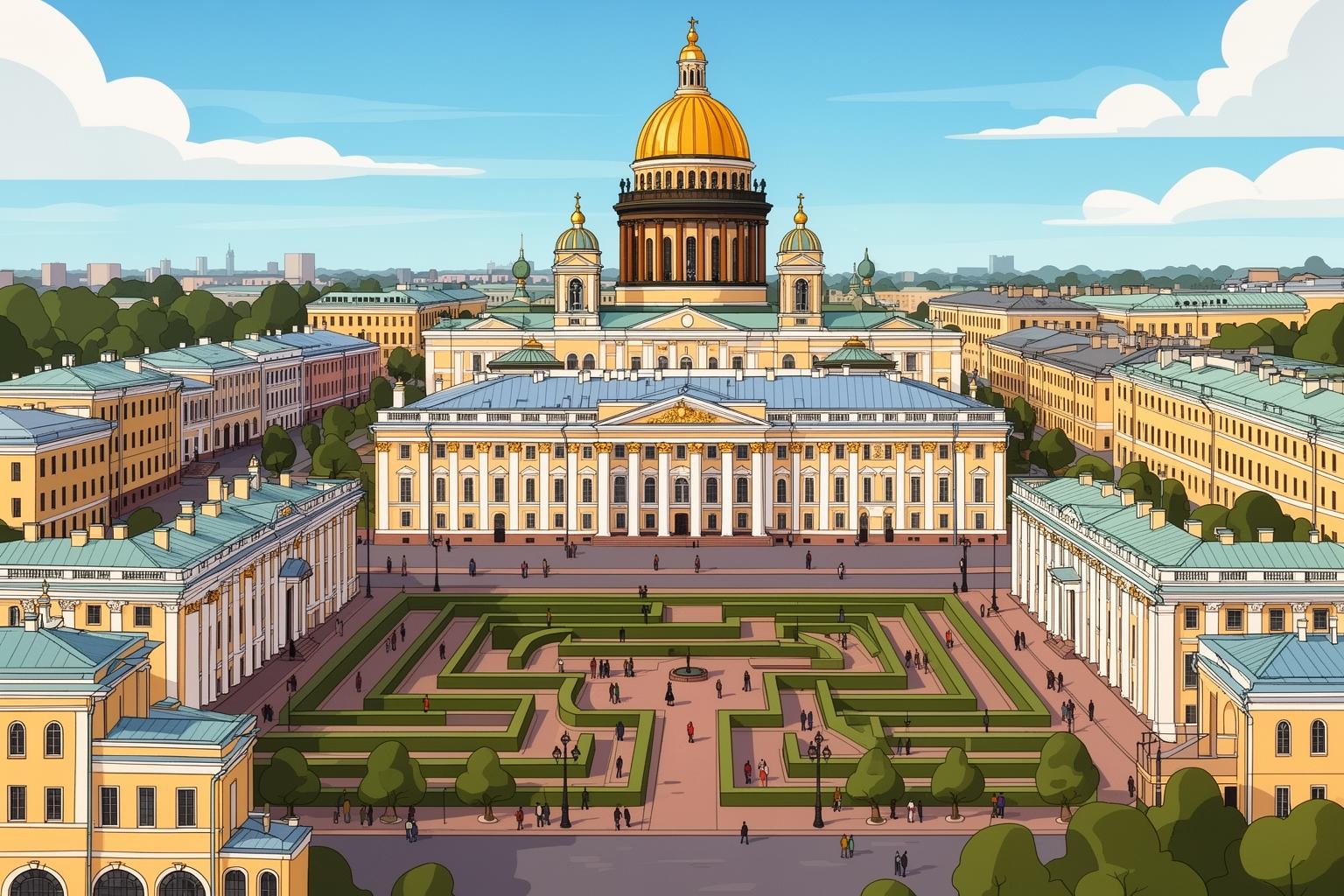
If Ukraine was Gogol’s heart, St. Petersburg was his fevered dream. He arrived in the imperial capital as a young man brimming with ambition, hoping to find fame and fortune. Instead, he encountered a city both magnificent and monstrous—a place of dazzling facades and soul-crushing indifference. St. Petersburg became his ultimate muse, a phantom city built on a swamp where nothing was quite as it seemed. In his “Petersburg Tales,” the city transforms into a character itself—a cold, beautiful, and utterly demonic entity that drives its inhabitants to madness.
Nevsky Prospekt: The Artery of Ambition
“Oh, do not trust this Nevsky Prospekt! … It is all deception, all a dream, all is not what it seems!” Thus begins Gogol’s famous story of the same name, and there is no better introduction to the city’s main thoroughfare. Nevsky Prospekt is more than a street; it is the central nervous system of St. Petersburg, a grand stage on which the city’s entire social drama unfolds. Walking its length allows you to experience the city as Gogol did, witnessing the endless parade of humanity he so brilliantly satirized.
Begin your walk near the Admiralty with its gleaming golden spire. As you proceed, the street changes character. In the morning, it is a place of business, bustling with clerks and officials hurrying to their posts. By midday, it becomes a promenade for tutors, governesses, and their young charges. But according to Gogol, the real spectacle begins in the afternoon. The street fills with dandies in fashionable coats, ladies in elegant dresses, and everyone who is anyone—engaged in the serious business of being seen. The atmosphere turns performative, where every glance, nod, and gesture is part of an elaborate social ritual.
As you walk, notable landmarks emerge like actors on a stage. The majestic Kazan Cathedral, with its sweeping colonnade, seems to solemnly oversee the avenue. Further along, the ornate Singer House with its glass dome—though erected after Gogol’s time—captures perfectly the spirit of commercial ambition he described. Notice the side streets and canals branching off from the main thoroughfare; these are the veins of the city leading to the darker, poorer quarters where many of Gogol’s characters lived. The contrast is striking. One moment you’re on the glittering Prospekt, the next in a gloomy courtyard that feels worlds away. This duality embodies Gogol’s Petersburg. The best tool for a visitor is a good pair of shoes and a willingness to observe. Sit at a café, watch the crowds, and feel the street’s pulse. It’s a living, breathing theatrical production, just as he described.
The Canals and Clammy Corners of Akaky Akakievich
To discover Gogol’s Petersburg truly, you must leave Nevsky Prospekt’s grand stage and venture into the labyrinth of canals and backstreets. This is the world of “The Overcoat” and of the humble copying clerk Akaky Akakievich, one of literature’s most famous “little men.” His Petersburg is a city of perpetual twilight, with damp fog rolling in from the Neva River, peeling stucco facades, and dark, oppressive courtyards.
The best place to feel this atmosphere is along the Griboyedov Canal or the Fontanka River. Here, the grand palaces give way to modest, often crumbling tenement buildings. The air feels heavier and the light dimmer. The canal waters are dark and murky, reflecting the leaden grey sky. This is a landscape of melancholy beauty. The rhythmic sound of footsteps on granite embankments, the mournful cry of seagulls, and the sight of a lone figure hurrying over a bridge evoke the ghost of Akaky Akakievich.
There is no single house to visit, but the district around Sennaya Square (Haymarket Square) and its surrounding canals perfectly embody his world’s spirit. It was once a poor, crowded, and often dangerous part of the city in the 19th century. Although gentrified, its architectural bones remain. Look for the “well-courtyards”—interior yards enclosed by tall buildings that block out the sun. Standing in one, you can viscerally feel the claustrophobia and anonymity that defined many of Gogol’s characters’ lives. For the atmospheric traveler: explore these areas on an overcast day or in the soft light of early morning or dusk. Fog and mist here are not just weather but essential elements of the Gogolian aesthetic, blurring the line between the real and the spectral.
In Search of “The Nose”
Gogol’s story “The Nose,” in which a civil servant’s nose detaches itself and lives a life of its own, is the ultimate expression of St. Petersburg’s absurdity. There is no single site to commemorate this bizarre tale; rather, the entire city becomes a stage for its surreal logic. The story is a savage satire of bureaucracy, social climbing, and the obsession with rank that defined 19th-century Russia.
A conceptual pilgrimage in search of “The Nose” involves visiting the story’s locations and imagining its bizarre events unfolding there. Begin on Voznesensky Prospekt, where the barber Ivan Yakovlevich lives. Walk toward St. Isaac’s Cathedral, near where he attempts to dispose of the rogue nose by throwing it off a bridge. Picture the nose, clad in a State Councillor’s uniform, praying inside Kazan Cathedral or shopping at the Gostiny Dvor department store. This journey invites you to see the city through a funhouse mirror—to notice the pomposity of officials, the rigid social hierarchies, and the sheer strangeness lurking beneath an imperial veneer. Look for the small, absurd details of daily life. The quest for “The Nose” reminds us that in Gogol’s Petersburg, the most fantastic events are met with bizarre, bureaucratic normality.
Moscow: The Final Act of a Troubled Soul
Following the spectral mirage of St. Petersburg, Moscow held a different significance for Gogol. It was the old, “true” heart of Russia—a city characterized by sprawling, chaotic energy rather than strict, planned geometry. Yet, for Gogol, it also became the backdrop for the final, tragic chapter of his life. Moscow was where his spiritual torment deepened, triggering a creative crisis that culminated in one of literature’s most infamous episodes.
The Talyzin House on Nikitsky Boulevard
To grasp Gogol’s final years, one must visit the Talyzin House at 7a Nikitsky Boulevard. This is where he spent his last four years, residing in rooms lent by his friend, Count Alexander Tolstoy. Today, the building serves as the Gogol House Memorial Museum and is among the most poignant, haunting literary sites worldwide. The atmosphere inside is heavy with sorrow and reverence.
The museum is divided into two sections. The ground floor features a traditional exhibition on his life and works. However, it’s the rooms on the first floor—his actual living spaces—that leave a lasting impression. Preserved in a minimalist, almost symbolic manner, visitors see his desk, a few personal belongings, and the fireplace. This fireplace holds the building’s darkest secret. In a moment of spiritual despair and delusion, Gogol burned the manuscript of the second part of his masterpiece, Dead Souls, here just days before his death in 1852.
Being in that room offers a profoundly moving experience. The weight of his artistic and spiritual battle is palpable. The curators have deliberately avoided clutter, allowing the visitor’s imagination to fill the silence. One reflects on the mind of a genius waging war against himself, torn between his biting satirical gifts and a fanatical quest for moral purification that ultimately led to his undoing. The museum does more than display artifacts; it offers an emotional journey through the final, agonizing days of a great writer. This visit is far from cheerful, but essential for anyone seeking to understand the full, tragic arc of Gogol’s life.
Final Resting Place: Novodevichy Cemetery
The strange and troubled narrative of Gogol’s life extends beyond his death. He rests at the esteemed Novodevichy Cemetery, a veritable sculpture park of tombs honoring Russia’s most celebrated artists, writers, and political figures. His journey here, however, was far from simple.
Originally buried at the Danilov Monastery, Gogol’s remains were exhumed and relocated to Novodevichy in 1931 when the Soviets decided to close the Danilov cemetery. This exhumation gave rise to a dark, persistent legend: that Gogol’s body was discovered lying on its side and his skull was missing. Though likely apocryphal, the story perfectly suits the macabre and mysterious aura surrounding the man and his work. It is a tale so fittingly Gogolian that one might almost think he wrote it himself.
Today, his grave at Novodevichy features two monuments. Behind the more traditional Soviet-era bust lies the original gravestone from Danilov Monastery—a large, rough-hewn stone from Crimea known as “Golgotha.” The contrast between the two is telling: the moss-covered Golgotha stone resonates deeply with Gogol’s spiritual and earthly struggles, while the bronze bust symbolizes his official recognition as a literary titan. Visiting his grave is a quiet, contemplative experience. The cemetery itself is a serene and beautiful space, and finding his tomb among those of Chekhov, Bulgakov, and Stanislavski offers a moment to reflect on his complex and lasting legacy.
A Roman Interlude: Gogol’s Italian Escape

No portrayal of Gogol’s world is complete without a brief, sunny interlude in Rome. He escaped to Italy to avoid the harsh Russian climate and the even harsher critics of his play The Government Inspector. He became deeply enamored with Rome, calling it his “soul’s homeland.” It was there, amid the warmth and vibrant chaos of the Eternal City, that he found the tranquility to write much of the first part of Dead Souls.
Via Sistina and the Spirit of Rome
Gogol lived at Via Sistina, 125, where a plaque on the building honors his long and happy stay. Although the apartment is not open to the public, standing outside on the street is enough to connect with this joyful chapter of his life. The Rome he experienced was a city of breathtaking ancient ruins, lively markets, and a passionate, theatrical street life, a stark contrast to the rigid formality of St. Petersburg.
To truly experience his Roman life, visit the Antico Caffè Greco on Via dei Condotti. One of Rome’s oldest and most famous coffee houses, Gogol was a frequent visitor. He would spend hours there, writing and watching the world pass by. The interior, with its red velvet seats, marble tables, and historic paintings, remains largely unchanged. Ordering a coffee here feels like a communion with his happier, more creative self. It offers a delightful contrast to the somber memorials in Moscow and serves as a reminder that despite his darkness, Gogol had a great capacity for joy and a profound love for life’s sensory pleasures.
Practical Guidance for the Gogol Pilgrim
Embarking on a journey across multiple countries that explores deep historical roots requires some preparation to ensure the experience is smooth and enriching.
Planning Your Trip
The best time to visit both Ukraine and Russia for this pilgrimage is late spring or early autumn. The weather is typically pleasant for walking, and the landscapes—especially in Ukraine—are at their most stunning. Summer can be quite hot, while winters are notoriously harsh and may not offer the best conditions for exploring, unless you specifically wish to experience the frozen, snow-covered world of “The Night Before Christmas.”
Traveling between major cities is most convenient by train. The overnight trains in the area offer a unique experience, providing a chance to watch the countryside pass by. In cities like St. Petersburg and Moscow, the metro systems are efficient, beautiful, and an essential part of the local culture. For rural destinations in the Poltava region, hiring a car with a driver or arranging a tour from a larger city is the most practical choice.
It’s also helpful to learn the Cyrillic alphabet. Even being able to sound out street names and signs will make navigation easier and more rewarding. Knowing a few basic phrases in Ukrainian and Russian will also be warmly appreciated by locals.
What to Read Before You Go
To fully bring these places to life, it’s important to immerse yourself in Gogol’s work beforehand. Re-reading his stories during your travels makes the experience even more powerful. For the Ukrainian segment of your journey, focus on Evenings on a Farm Near Dikanka and Mirgorod. As you travel to St. Petersburg, the “Petersburg Tales”—particularly “Nevsky Prospekt,” “The Overcoat,” and “The Nose”—are essential reading. For Moscow, carrying his masterpiece Dead Souls and understanding his later spiritual struggles will add profound depth to your visit. Reading his words in the very places that inspired them is the ultimate aim of this pilgrimage, turning a simple trip into a deeply literary experience.
The Enduring Phantom of Gogol

A journey through the world of Nikolai Gogol is ultimately a pursuit of a phantom. His presence pervades everything—in the scent of the black soil of Ukraine, in the misty canals of St. Petersburg, in the quiet, sorrowful rooms of his Moscow home. You discover him not in grand monuments but in the atmosphere, in the strange and beautiful details of the world he portrayed with such a unique vision. He teaches you to see a bustling avenue as a demonic illusion, a humble clerk as a tragic hero, and a puddle as the universe. To follow in his footsteps is to have your perception of reality subtly and permanently transformed. You leave not only with memories of places but with a new way of seeing—a vision forever attuned to the absurd, the grotesque, and the magical heart that pulses just beneath the surface of everyday life. The phantom may remain elusive, but the pursuit is everything.