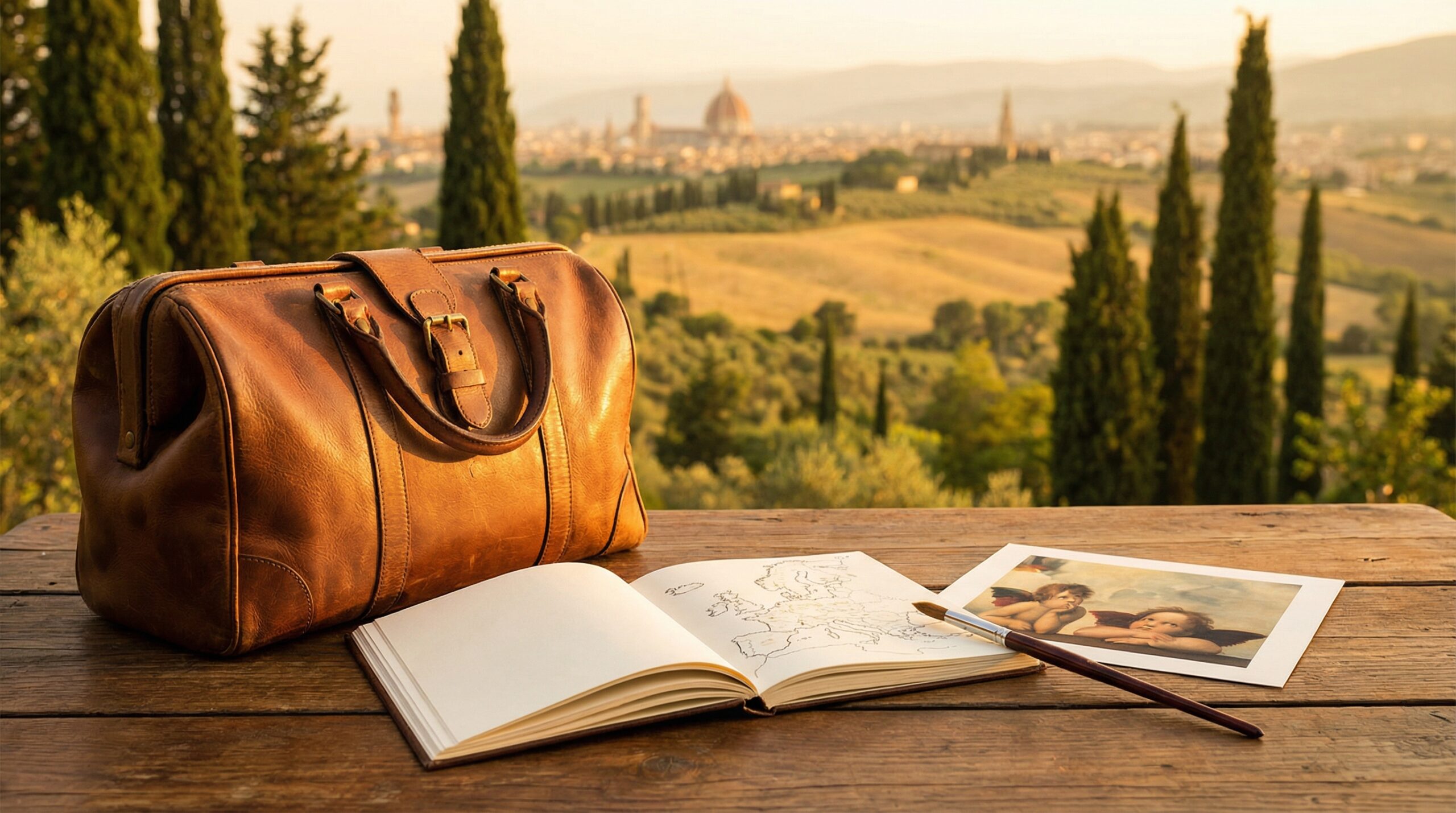
To trace the life of Raffaello Sanzio da Urbino—known to the world simply as Raphael—is to embark on a pilgrimage. It’s a journey not just through the sun-drenched landscapes of central Italy, but through the very heart of the High Renaissance. You don’t simply see his art; you walk the same cobblestone streets he walked, from the windswept fortress of his birth to the magnificent, chaotic heart of papal Rome. This is a story etched into the walls of palaces, churches, and villas, a path that charts the meteoric rise of an artist so gifted, so full of grace, that his contemporaries called him “The Divine One.” His life was a brief, brilliant flash, a mere thirty-seven years, yet he absorbed the spirit of his age and reflected it back with a harmony and clarity that has never been surpassed. We will follow his ghost from the quiet, intellectual courts of Urbino, through the workshops of Perugia, into the competitive crucible of Florence, and finally to the grand stage of Rome, where he became a prince of painters. This is a journey to understand how a boy from the mountains became an immortal architect of Western beauty.
While Raphael’s pilgrimage was through the physical and spiritual heart of the Renaissance, a modern artistic journey can be found by walking the line of Barnett Newman.
The Cradle of Genius: Urbino’s Walled Wonder
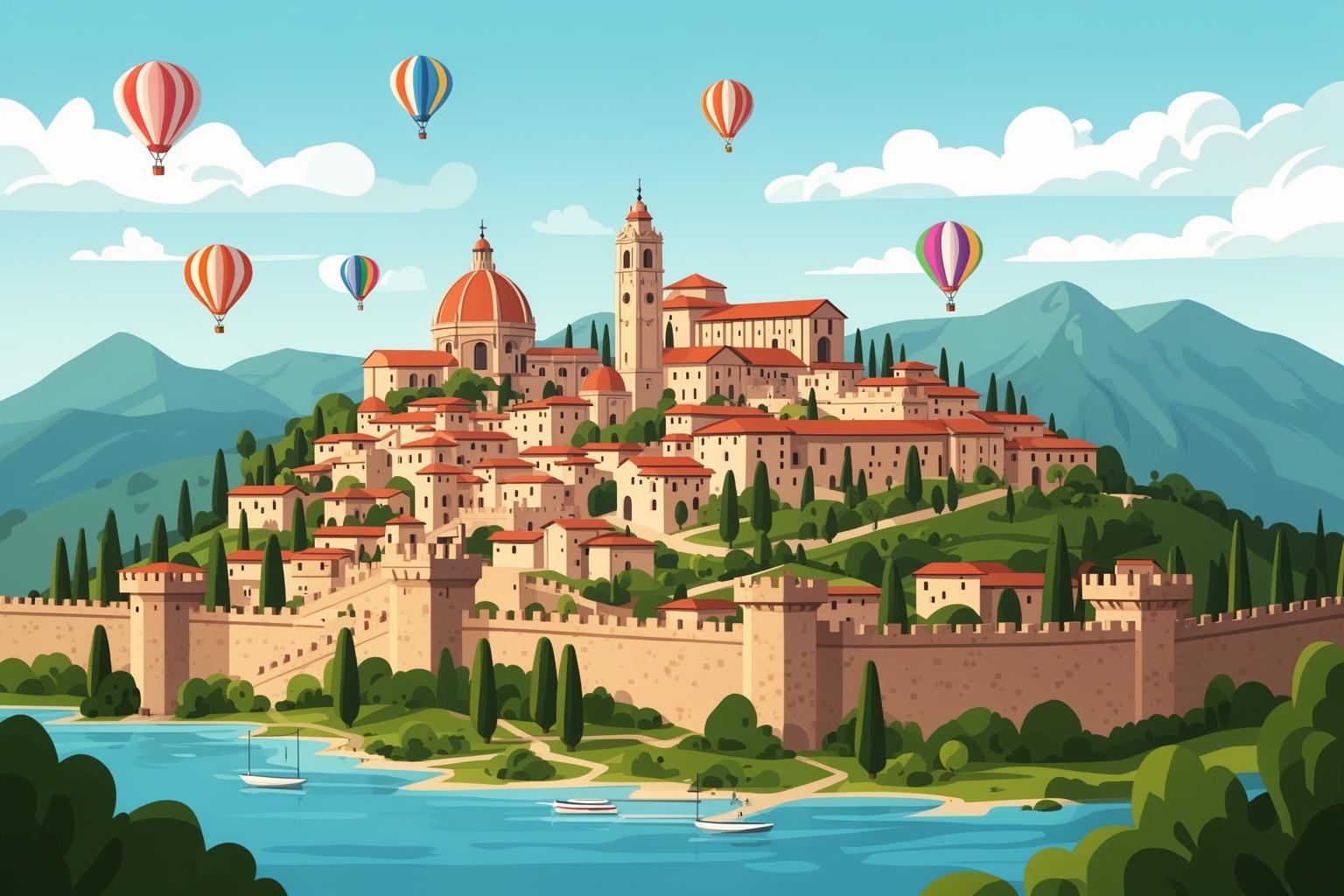
Our story begins high in the hills of the Marche region, in a city that feels frozen in time. Urbino is not a place you accidentally discover; it is a true destination. A steep, winding road leads you up to its fortified gates, and once inside, the noise of the modern world fades away, replaced by the sound of footsteps on stone and the whisper of wind sweeping across the Apennines. This is where Raphael was born in 1483, and the very structure of the city shaped his sense of order, perspective, and grace. It is a city of striking verticality, terracotta roofs, and sandstone walls that glow with golden light in the afternoon sun. The air here carries a distinct quality—clean, sharp, and intellectual.
A City on a Hill
To understand Raphael, one must first grasp the court of Urbino under Duke Federico da Montefeltro. This was no provincial backwater; it was a beacon of Renaissance humanism, a “city in the form of a palace.” The Duke was a legendary condottiero, a soldier-scholar who gathered the greatest minds, artists, and writers of his time. This was the environment that nurtured the young Raphael. His father, Giovanni Santi, served as the court painter, a man of notable talent and intellect. Raphael did not emerge from nowhere; he was born into the very heart of cultural ambition. Even today, walking through the steep, narrow streets of Urbino, you can sense that ambition. Every view appears perfectly composed, each piazza an exercise in geometric harmony. It is a city that teaches you how to see, just as it taught the young Raphael.
Casa Natale di Raffaello
Visiting the birthplace of a genius carries a profound intimacy. The Casa Natale di Raffaello, located on a steep street now named after him, is a beautifully preserved 15th-century home. It is modest yet dignified. Crossing the threshold, the cool stone interior provides relief from the Italian sun. You can stand in the small, quiet room where he was born, looking out a window that perfectly frames a slice of the Urbino sky. The house serves as a small museum, but its greatest treasure is its atmosphere. You can almost hear the scrape of his father’s brushes and the murmur of artistic and philosophical conversations drifting up from the street. In one room, a small fresco of a Madonna and Child, tender and delicate, is attributed to the very young Raphael. Whether painted by his hand or not nearly matters less; it is the possibility that electrifies the space, the sense that this is where it all began. This is where the divine spark first took shape. You can sense the ghost of his father’s workshop, the scent of linseed oil and pigments, and the quiet dedication of a family devoted to art.
The Ducal Palace and Galleria Nazionale delle Marche
If Raphael’s house is the intimate core of his Urbino story, the Palazzo Ducale is its magnificent soul. Dominating the city skyline with its twin turrets, this is Federico da Montefeltro’s masterpiece, a testament to his power and refined taste. Today, it houses the Galleria Nazionale delle Marche, a world-class collection of Renaissance art. Walking through its vast courtyards and grand halls is like stepping directly into the 15th century. The light, the space, and the mathematical precision of the architecture all speak the language of humanistic optimism. This is where Raphael would have encountered works by masters such as Piero della Francesca and Paolo Uccello, artists renowned for their mastery of perspective and light. Their influence formed the foundation upon which his own art was built. The gallery holds two of Raphael’s early works: the enigmatic “La Muta” (The Silent Woman) and the luminous “Portrait of a Gentlewoman.” Seeing them here, in the very building where his artistic awareness was shaped, is a powerful experience. You do not just see the paintings but also the context that created them. For many, the highlight is not a painting but a room: the Duke’s Studiolo. This small, wood-paneled study is a marvel of trompe-l’œil inlay, creating illusions of shelves filled with books, scientific instruments, and allegorical figures. It is a sanctuary of the mind, a perfect expression of the Renaissance ideal of man as the measure of all things. Raphael would have been intimately familiar with this room, and its spirit of intellectual curiosity and perfect harmony stayed with him throughout his life.
The Apprentice’s Path: Perugia and the Umbrian Plains
As a promising young artist, Raphael had to leave his home. His journey led him south from the mountains of Urbino to the rolling hills and fortified towns of Umbria. His destination was Perugia, a rugged, ancient city perched on a hill, the capital of the region and the site of the workshop of the most famous painter in central Italy at the time: Pietro Perugino. The shift from the refined, architectural harmony of Urbino to the grittier, more imposing atmosphere of Perugia marks the next phase of Raphael’s growth. This is where the prodigy became a professional, honing his craft and beginning to develop his own artistic voice.
Under the Master’s Gaze
Perugia has a distinct energy compared to Urbino. It is a larger, more formidable city with a complex history dating back to the Etruscans. Its massive stone walls, grand fountains, and dark, vaulted alleyways speak of power and devotion. It was here that Raphael joined Perugino’s workshop around the year 1500. Perugino was a master of serene, graceful compositions, often depicting sweet-faced Madonnas and saints set against calm, blue-green landscapes. His style was immensely popular, providing Raphael with the perfect finishing school. So gifted was Raphael that he fully absorbed his master’s style. His early works resemble Perugino’s so closely that art historians sometimes struggle to distinguish them. Yet even then, subtle signs of something greater appear—a heightened naturalism and a deeper sense of human emotion. Walking along Perugia’s main street, Corso Vannucci, named after Perugino, one follows the footsteps of the teenage Raphael moving between his lodgings and the workshop, taking in the sights and sounds of this vibrant city.
The Collegio del Cambio
To witness the art that shaped Raphael’s skills, a visit to the Collegio del Cambio, the hall of the money changers’ guild, is essential. This is Perugino’s masterpiece: a suite of rooms adorned with stunning frescoes that he and his workshop, including the young Raphael, completed around 1497-1500. Entering the main hall, the Sala delle Udienze, immerses one in the world of the High Renaissance. The rich fresco colors, the intricately carved wooden benches, and the gilded ceiling create an impression of immense wealth and culture. The frescoes blend classical and Christian themes, featuring Sibyls and Prophets alongside Greek and Roman heroes. This was Raphael’s classroom, where he learned the complex art of fresco painting—grinding pigments, preparing plaster, and transferring cartoons onto the wall. He acquired skills in organizing intricate multi-figure compositions and creating a sense of deep, airy space. Standing in this room, one is surrounded by the direct source of Raphael’s early style. It is a vital stop for anyone seeking to understand his artistic roots.
San Severo Chapel: The First Signature
While the Collegio del Cambio reveals Raphael as the perfect student, a small, modest chapel in the San Severo monastery complex offers a glimpse of the emerging master. Here, in 1505, just before departing for Florence, Raphael painted his first major fresco, a depiction of the Trinity with Saints. The upper portion is his work, showing Christ flanked by saints. It is a powerful, beautifully balanced composition, revealing his move beyond Perugino’s style toward a more monumental and dynamic vision influenced by what he was hearing from Florence. The story behind this fresco is poignant. Raphael left for Florence before its completion. Years later, after Raphael’s death, his aging master Perugino was summoned to finish the lower section. The stylistic differences are striking. Raphael’s figures possess a weight and presence lacking in Perugino’s. It stands as a visual passing of the torch, a testament to how quickly the student surpassed the master. Finding this chapel is somewhat of a treasure hunt, tucked away from the main tourist path, but the reward is a quiet, intimate encounter with a pivotal moment in Raphael’s career.
The Florentine Revolution: Forging a New Language
Around 1504, Florence was the artistic epicenter of the world. Drawn by the magnetic force of two towering geniuses, Leonardo da Vinci and Michelangelo, Raphael journeyed to the city on the Arno. This move was not driven by a commission but by the pursuit of education. He arrived not as a master but as an exceptionally talented artist aware that he still had much to learn. Florence was a crucible—an intensely competitive environment where artistic innovation surged at a breathtaking pace. The city’s vitality—its republican pride, commercial energy, and obsession with artistic brilliance—would transform Raphael’s work, elevating him from the serene grace of Umbria to new heights of complexity, dynamism, and psychological insight.
A City of Giants
The Florence that Raphael entered was electric with creative energy. Leonardo, the seasoned master, had recently returned, revolutionizing art with his sfumato technique—the soft blurring of outlines to create a smoky, atmospheric effect. Michelangelo, the passionate young sculptor, had just unveiled his “David,” a masterpiece of power and anatomical perfection that redefined the human form in art. These two giants were locked in a direct rivalry, each commissioned to paint battle frescoes on opposite walls of the Palazzo Vecchio. In his early twenties, Raphael plunged into this creative storm. He studied their works, sketched their compositions, and absorbed their teachings. From Michelangelo, he learned the secrets of anatomical structure; from Leonardo, he gained mastery of subtle, expressive emotion. Even today, the Oltrarno district of Florence, with its artisan workshops, still carries a faint echo of this creative intensity. Walking its streets, one can imagine the young Raphael, sketchbook in hand, eagerly soaking it all in.
The Uffizi and Pitti Palace: A Gallery of Madonnas
It was in Florence that Raphael perfected one of his most cherished themes: the Madonna and Child. He created a series of these works, each exploring maternal love and divine grace, now showcased in the world’s premier museums. Many of the finest reside in Florence’s top art institutions: the Uffizi Gallery and the Palatine Gallery in the Pitti Palace. In the Uffizi, you will find the “Madonna of the Goldfinch,” a masterpiece of tender interaction and pyramidal composition, a structure Raphael adopted from Leonardo. The figures are connected not just by form but through a network of glances and gestures that feel incredibly natural and emotionally charged. A short walk across the iconic Ponte Vecchio leads to the lavish Pitti Palace. Within its Palatine Gallery, surrounded by rooms dripping with silk and gold, lies an unparalleled collection of Raphael’s Florentine works. Here are his portraits of Agnolo Doni and his wife Maddalena Strozzi, which engage directly with Leonardo’s “Mona Lisa.” Yet the true gems are Madonnas such as the “Madonna del Granduca,” with its dark, enigmatic background, and the “Madonna della Seggiola” (Madonna of the Chair), a circular painting radiant with warmth and intimacy, feeling less like a sacred icon and more like a captured moment of pure human love. To see these works, you must endure the crowds, making it essential to book tickets well in advance. The reward is witnessing Raphael’s synthesis of his rivals’ lessons into a style uniquely his own: harmonious, human, and utterly beautiful.
The Agnolo Doni Portraits
Special mention is due to the portraits of the merchant Agnolo Doni and his wife Maddalena, housed in the Pitti Palace. These paintings go beyond mere likenesses; they form a direct conversation with Leonardo. Maddalena’s pose, with her hands gently resting, clearly nods to the “Mona Lisa.” Yet Raphael does not simply imitate. He infuses his subjects with clarity and directness, contrasting with Leonardo’s enigmatic softness. The fabrics are rendered in exquisite detail, the jewels sparkle, and the sitters meet the viewer’s gaze with a calm, confident presence. In these portraits, Raphael is both learning and competing, asserting his own vision. He takes the innovations of the elder master and transforms them into his own language of serene, accessible humanity. These works mark his arrival on the Florentine stage.
The Eternal City: Rome and the Zenith of Power
In 1508, Raphael’s life was transformed forever when he received a summons from the most powerful and ambitious patron in Europe: Pope Julius II. He was called to Rome. If Florence had been the university where he refined his art, Rome was the global stage on which he would showcase it on an epic scale. The city was undergoing a monumental transformation. The popes, led by the formidable Julius, were determined to restore Rome to its ancient glory, reclaiming its status as the undisputed capital of Christendom. This ambition spurred massive building projects, archaeological discoveries, and an unrelenting demand for art that would convey power, piety, and prestige. For an artist of Raphael’s talent and disposition, it was the ideal environment. He flourished in the Eternal City and, within just twelve years, produced works that would define the High Renaissance and leave an indelible imprint on Western art.
The Vatican Stanze: A Universe on Four Walls
Raphael’s first major commission in Rome was the decoration of the Pope’s private apartments in the Vatican Palace, now known as the Stanze di Raffaello, or Raphael Rooms. This project solidified his fame. Entrusted with four rooms to paint, he adorned them with a breathtaking synthesis of theology, philosophy, law, and poetry. To walk through these rooms today is to be completely immersed in the mind of the High Renaissance. The experience is overwhelming; every surface bursts with life, color, and profound ideas. The centerpiece, and arguably the most perfect expression of the Renaissance spirit ever created, is the “School of Athens” in the first room, the Stanza della Segnatura. The fresco shows the great philosophers of antiquity gathered in a vast, classical hall inspired by the new designs for St. Peter’s Basilica. At its center, Plato points toward the heavens, symbolizing ideal forms, while Aristotle gestures to the earth, representing the observable world. It is a brilliant visualization of the fusion of reason and faith at the heart of Renaissance humanism. Raphael included portraits of his contemporaries: Leonardo as Plato, Michelangelo brooding as Heraclitus, and a self-portrait of Raphael himself, looking out from the right-hand corner. Standing in the center of this room is to feel the intellectual and artistic confidence of the age. It is more than a painting; it is a statement about humanity’s place in the universe. The other rooms continue this narrative, with the Stanza di Eliodoro showcasing divine intervention in history through dramatic, emotionally charged compositions, and later rooms highlighting the expanding role of his large, efficient workshop as his fame soared.
Villa Farnesina: A Breath of Pagan Air
While the Vatican Stanze reflect Raphael’s service to the Church, a visit across the Tiber River to the Villa Farnesina reveals a different, more sensual facet of his art. This stunning suburban villa was built for Agostino Chigi, a Sienese banker and the richest man in Rome. Chigi was a man of refined taste, commissioning Raphael to decorate his ground-floor loggia with scenes from classical mythology. The result is the breathtaking “Triumph of Galatea.” The fresco shows the sea nymph Galatea riding a seashell chariot drawn by dolphins, surrounded by a joyous, lively assembly of sea gods and cupids. Unlike the solemn grandeur of the Vatican, this work exudes pure pagan delight. It is a celebration of beauty, love, and life. Galatea’s figure, twisting in a graceful spiral as she gazes heavenward, ranks among the most beautiful in Western art. The Villa Farnesina itself is a joy to visit, far less crowded than the Vatican, allowing for a more peaceful and intimate experience. Standing in the loggia, with the gardens just outside, one can feel the luxurious, pleasure-loving spirit of the Roman Renaissance. It serves as a reminder that Raphael was not just a painter of Madonnas and philosophers; he was a master of all facets of the human experience.
The Pantheon: A Final Resting Place
Raphael’s brilliant career was tragically cut short. He died on his 37th birthday, Good Friday in 1520, after a sudden illness. The entire city of Rome mourned him. So beloved and esteemed was he that he was granted the highest honor: burial in the Pantheon, the great Roman temple converted into a Christian church. Ending a pilgrimage to Raphael’s tomb is a deeply moving experience. The Pantheon itself stands as one of the world’s architectural marvels, a testament to Roman engineering prowess with its enormous, unreinforced concrete dome and the famous oculus open to the sky. Inside, among the tombs of kings and poets, lies Raphael’s simple sarcophagus. The inscription, written by the humanist Pietro Bembo, reads: “Here lies that famous Raphael by whom Nature feared to be conquered while he lived, and when he was dying, feared herself to die.” Standing in that vast, ancient space—perhaps as a ray of sunlight from the oculus illuminates the marble floor—one feels the weight of history and the enduring power of his legacy. It is a quiet, solemn, and fitting conclusion to a journey tracing the footsteps of a man who, for a brief and shining moment, seemed to touch perfection.
The Legacy of a Prince of Painters
Raphael’s influence persisted long after his death. His vision of harmony, grace, and idealized beauty set the academic standard for painters for centuries. However, his legacy in Rome goes beyond his paintings. As a man of many talents, he embodied the Renaissance ideal of the universal man. His story is not solely about his art, but also about his deep connection with the city he came to call home.
Beyond the Canvas
In his later years, Raphael gained acclaim as an architect. After Bramante’s death, he was appointed one of the architects of the new St. Peter’s Basilica, and he also designed other structures, including the elegant Chigi Chapel in the church of Santa Maria del Popolo—a miniature pantheon perfectly blending architecture, sculpture, and mosaic. He began work on Villa Madama on the slopes of Monte Mario, aiming to recreate the grandeur of an ancient Roman villa. Additionally, he was appointed Prefect of all the antiquities in Rome and undertook a comprehensive project to survey and document the city’s ancient monuments, demonstrating a passion for archaeology and preservation that was well ahead of his time. Raphael was not just beautifying Rome; he was helping to preserve its soul.
Planning Your Raphael Pilgrimage
Planning this journey takes some preparation, but the rewards are enormous. The best time to visit is in the shoulder seasons—spring (April-May) and fall (September-October)—when the weather is pleasant and the crowds smaller than in peak summer. Italy’s excellent high-speed train network makes traveling between Urbino (via nearby Pesaro), Perugia, Florence, and Rome convenient and efficient.
The most important advice is to book tickets for major attractions, especially the Uffizi Gallery in Florence and the Vatican Museums in Rome, as far ahead as possible. Weeks or even months in advance is not too early. Doing so will save you hours of waiting and guarantee entry. When inside these vast museums, avoid trying to see everything. Pace yourself. Get a map, identify the Raphael works you most want to see, and savor your time with them. Art fatigue is real; it’s better to have a deep, meaningful encounter with a few masterpieces than a hurried glance at hundreds of works.
A Traveler’s Note
Beyond the museums and churches, allow yourself to lose track of time wandering the cities themselves. The true spirit of this pilgrimage lies not only in front of the paintings but in the moments between. Sit in Florence’s Piazza della Signoria with a coffee, imagining the artistic debates that once took place there. Enjoy a plate of pasta in a Trastevere trattoria in Rome after a day amid the Vatican’s splendor. Wander through the back streets of Urbino at dusk as the stone buildings glow in the fading light. The food, the light, the language, the rhythm of everyday life—these are what provide the context for the art. They are the living culture Raphael inherited and transformed. Following in his footsteps offers a chance to see Italy through his eyes, appreciate the beauty and harmony he found everywhere, and understand how he translated it into something eternal.