There are journeys that take you to a place, and then there are those that take you into a soul. To walk through the landscapes that shaped Caspar David Friedrich is to embark on the latter. This isn’t just a trip through northern Germany; it’s a pilgrimage into the heart of Romanticism, a movement that didn’t just depict nature, but felt it, questioned it, and stood in awe of its power. Friedrich, its greatest German champion, painted more than just chalk cliffs and ancient oaks; he painted the silence between heartbeats, the vastness of the human spirit gazing into the infinite, and the melancholic beauty of a world steeped in mist and memory. His figures, often seen from the back, are not the subjects. We are. They are our stand-ins, inviting us to step into the frame and feel the wind, the chill, the profound sense of smallness before the grandeur of God and nature. To follow his path, from the Baltic port of his birth to the dramatic sandstone mountains of his adopted home, is to learn how to see the world through his eyes—to find the sublime in a skeletal tree, the spiritual in a sliver of moonlight, and a story in every passing cloud. This journey is about chasing that light, the one he so masterfully captured, and finding a piece of it for ourselves.
For a similar pilgrimage into the soul of an artist, consider walking in the footsteps of Édouard Manet.
Greifswald: The Cradle of Melancholy and Wonder

Our pilgrimage begins where his did, in the modest Hanseatic town of Greifswald along the Baltic Sea coast. To truly understand Friedrich, one must first grasp the essence of this place. It is a town marked by salty air, brisk winds carrying gulls’ cries, and a low, often silver-grey sky that seems to press down on the gabled rooftops. Born here in 1774 as the sixth of ten children, Friedrich’s early years were shaped by profound loss that would forever influence his artistic vision. The drowning of his younger brother, an event that burdened him with lifelong guilt, along with the early deaths of his mother and sisters, enveloped his world in deep melancholy. Yet Greifswald was not solely a place of sorrow; it was also a place of great beauty and quiet reflection, a landscape that provided the foundational language for his art.
The Harbor and the Ships: A Lifelong Motif
The Greifswald harbor, where the shallow Ryck River meets the Bay of Greifswald (Bodden), is the town’s very heart. Even today, a stroll along the water reveals the pulse of its maritime past. In Friedrich’s era, this harbor thrived as a busy trade hub, filled with the tall masts of schooners and fishing boats. To the young artist, these ships were more than mere vessels of commerce; they symbolized life’s journey—departure and return, hope sailing toward the horizon, and the inevitable final voyage. They appear in works like ‘Stages of Life,’ where ships at various distances from shore represent the stages of man’s life. To experience this, walk the harbor at dawn or dusk, when the light is soft, diffused, and tinged with melancholy. Observe the modern sailboats floating where tall ships once stood, and gaze toward the Ryck’s mouth. The silhouettes of these boats against the dimming light are pure Friedrich. You can almost see him as a boy, sketching the intricate rigging, captivated by how the masts seemed to pierce the heavens.
Eldena Abbey: The Gothic Skeleton of Time
A short distance from the town center stands one of Friedrich’s most potent symbols: the ruins of Eldena Abbey. This Cistercian monastery, devastated during the Thirty Years’ War, embodied for Friedrich the passage of time, the transience of human creation, and nature’s enduring power. He obsessively sketched its crumbling Gothic arches throughout his life, making them a recurring motif in some of his most renowned works, like ‘Abbey in the Oakwood.’ In his paintings, the ruins are not mere stones falling apart; they serve as a sacred space where spiritual and natural worlds meet. An ancient oak tree, another favored symbol representing pagan strength and endurance, often stands sentinel over the sacred ground. Visiting Eldena today is a profoundly moving experience. The ruins rest within a peaceful, open park, their skeletal frames open to the sky. The best times to visit are late afternoon, when long shadows stretch across the grass, or on misty mornings when the arches seem to emerge from the fog. It feels less like a tourist destination and more like an open-air cathedral. Sit on the grass, feel the weight of centuries, and watch as nature steadily reclaims this man-made structure. In that moment, you’ll instantly understand why this site held such a powerful allure for an artist obsessed with life, death, and resurrection.
A Practical Note for Visitors
Eldena is easily accessible from Greifswald’s center by local bus or a pleasant, flat bike ride. There is no entrance fee, allowing you to visit anytime to capture the shifting light. Bring a small snack and a thermos of tea; it’s the kind of place that invites lingering and deep quietude.
The Streets and Gables of a Hanseatic Town
Walking through Greifswald’s Old Town feels like stepping back in time. The cobblestone streets and the distinctive stepped gables of the brick Gothic merchant houses create a unique architectural rhythm. Friedrich often included these urban scenes in his work, infusing them with his characteristic stillness and isolation. In paintings like ‘Greifswald in Moonlight,’ the familiar town square transforms into a dreamlike stage bathed in ethereal glow. People are absent or mere shadows, emphasizing solitude and reflection. As you wander, notice the play of light and shadow in narrow alleys, and look up as the sky is framed by steep roofs. The Market Square (Marktplatz) with its patrician houses and impressive Town Hall forms the city’s heart. Though bustling today with cafés and shops, try to find a quiet moment early in the morning before the crowds arrive. See the red brick glow in the first light and imagine a young Friedrich observing, absorbing the geometry and atmosphere that would later emerge in his paintings—always filtered through his singular emotional lens.
St. Nicholas’ Cathedral: A View from Above
For a breathtaking vantage point Friedrich would surely have treasured, climb the tower of St. Nicholas’ Cathedral (Dom St. Nikolai). This towering brick Gothic church dominates Greifswald’s skyline. The climb is steep but richly rewarded. From the top, you gain a panoramic view of the region that shaped his visual lexicon: the intricate red-roofed Old Town, the winding Ryck River, the flat, expansive Pomeranian plains, and on clear days, the shimmering Baltic Sea and distant silhouette of Rügen island. This elevated perspective, looking down on the world, recurs throughout Friedrich’s art. It reflects the viewpoint of the ‘Wanderer’—one that encourages contemplation and detachment from the mundane below. From here, you can truly grasp the geography of his inspiration and understand how the flat, horizontal homeland landscape demanded an emphasis on the vast, dramatic sky—the true emotional core of so many of his paintings.
Rügen Island: The Dramatic Heartbeat of Romanticism
If Greifswald was the primer for Friedrich’s artistic language, then the nearby island of Rügen was his epic poem. A brief ferry ride or a drive across the causeway from the mainland transports you to a landscape of striking contrasts. Here, the calm flatness of the Pomeranian coast transitions to dramatic chalk cliffs, ancient beech forests, solitary beaches, and prehistoric megalithic tombs. Friedrich first visited Rügen in 1801 and returned repeatedly, captivated by its raw, untamed beauty. It was here he discovered the perfect stage for his exploration of the sublime—the thrilling blend of beauty and terror that reveals nature’s awe-inspiring power.
The Chalk Cliffs of Jasmund National Park: The Wanderer’s Perch
The most iconic landscape linked to Caspar David Friedrich is undoubtedly the chalk cliffs (Kreidefelsen) on the Jasmund peninsula. This is the backdrop for his masterpiece, Chalk Cliffs on Rügen. To stand here is to step inside that very painting. The experience is visceral. The sheer white cliffs plunge dramatically into the turquoise and deep blue waters of the Baltic Sea, crowned by the dense, green canopy of ancient beech forests, now a UNESCO World Heritage site. The air here is distinct—cleaner, crisper, weighted with the scent of salt and damp earth.
Königsstuhl (King’s Chair): Facing the Infinite
The most renowned viewpoint is the Königsstuhl, a towering chalk outcrop rising 118 meters above the sea. From its viewing platform, the panorama is breathtaking. You feel perched on the edge of the world, a tiny human figure dwarfed by the vast cliffs, sea, and sky. This is the quintessential Friedrichian encounter: a confrontation with the infinite that invites introspection. While the central figure in his painting is often debated, the emotion it evokes is universal—one of awe, wonder, and a touch of vertigo. Expect crowds, especially during summer, but even amid visitors, you can find moments of quiet reflection. The path to the Königsstuhl through the forest is an experience in itself. The sunlight filtering through the ancient beech leaves, casting dappled shadows on the forest floor, feels magical and readies you for the sudden, stunning burst of light and space when you emerge at the cliff’s edge.
Walking the Hochuferweg Trail
For a more immersive and quieter experience, I highly recommend hiking the Hochuferweg, a trail running along the cliff tops for about 12 kilometers between Sassnitz and Lohme. This route offers a series of stunning, ever-changing views of the coastline. Here, you’ll find more secluded spots that feel intimate, allowing a personal connection with the landscape. Along this path, you can truly embody the spirit of the ‘Wanderer.’ Wear sturdy hiking shoes, as the trail can be uneven and muddy. Bring water and lunch, and allow plenty of time. Every turn reveals a new vista that invites pause and admiration. The sense is one of privileged solitude—walking a path that has inspired artists and dreamers for centuries. You will pass the site where the Wissower Klinken, another famous chalk formation thought by some to be the true subject of Friedrich’s painting, once stood before collapsing into the sea in 2005—a poignant reminder of the very transience that so fascinated the artist.
The Ancient Dolmens and Hünengräber: Whispers of a Pagan Past
Rügen is more than a place of breathtaking natural beauty; it is steeped in ancient history. The island is scattered with hundreds of Neolithic dolmens and passage graves, locally known as Hünengräber (‘giants’ graves’). These prehistoric stone tombs, often found in open fields or tucked within small groves, deeply fascinated Friedrich and the Romantics. They regarded these monuments as symbols of a distant pagan past—emblems of death, endurance, and life’s cyclical nature. Friedrich sketched these megaliths extensively, and they appear in works like A Walk at Dusk and Megalithic Grave in the Snow. In his hands, these ancient stones become more than archaeological relics; they transform into solemn, mysterious altars within nature’s grand cathedral. Seeking them out today is a quiet adventure. Many lie just off main roads, marked by small signs. Standing before one of these massive stones that have withstood millennia evokes a powerful connection to the distant past. They radiate profound stillness, especially in the soft light of dawn or twilight. It’s easy to understand why Friedrich viewed them as portals to a more spiritual, elemental world.
Navigating Rügen: A Traveler’s Guide
Rügen is a large island, and a car is the most convenient way to explore its diverse regions. However, a well-linked network of public buses and the charming narrow-gauge steam train called the ‘Rasender Roland’ can take you to the main resorts and attractions. For the full Friedrich experience, consider renting a bicycle to explore quieter paths and coastal trails. The island’s character shifts with the seasons. Summer brings vibrant greens and blues but also the biggest crowds. Autumn offers a stunning palette of colors in the beech forests and a more melancholic, reflective mood. Misty days in spring or fall can feel even more authentic, wrapping the landscape in the very atmospheric veil Friedrich so loved to paint.
Dresden: The Florence on the Elbe and Friedrich’s Sanctuary
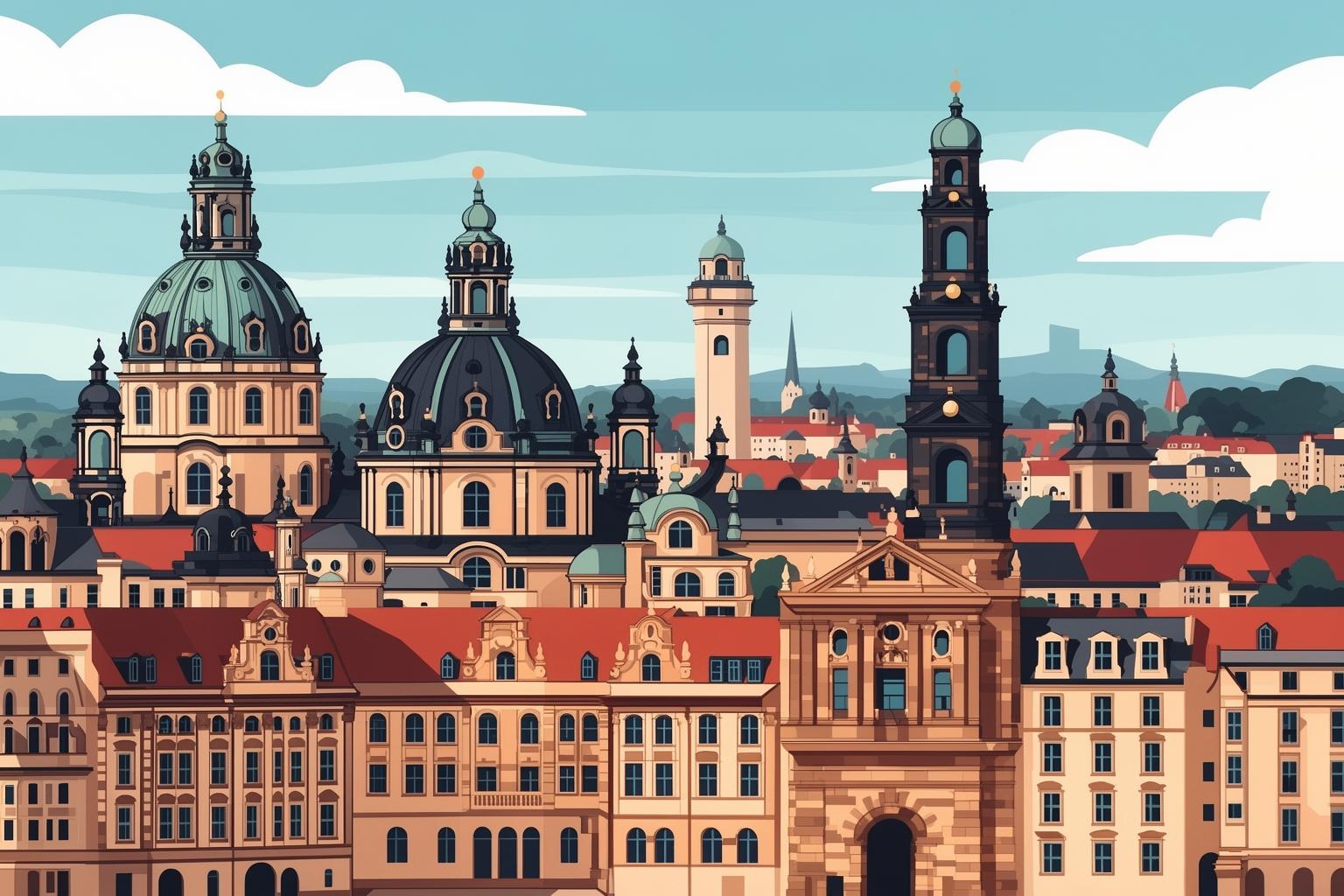
In 1798, Friedrich relocated to Dresden, the vibrant capital of Saxony, which would remain his home for over forty years. While Greifswald and Rügen supplied his raw materials, Dresden was the crucible where he shaped his artistic identity. In this ‘Florence on the Elbe,’ he found a community of like-minded Romantic artists and writers, fell in love, married, and produced many of his most iconic masterpieces. Yet, his inspiration came not from the Baroque grandeur of the city itself, but from the wild, dramatic landscapes just beyond its borders.
The Elbe Sandstone Mountains (Saxon Switzerland): A Painter’s Paradise
A short journey southeast of Dresden reveals a landscape so fantastical it seems born of a dream: the Elbe Sandstone Mountains, known as Saxon Switzerland (Sächsische Schweiz). This region features towering sandstone pillars, deep gorges, mist-filled valleys, and stunning clifftop views. For Friedrich, this was a spiritual home. He hiked these trails relentlessly, filling sketchbook after sketchbook with intricate drawings of the unique rock formations, which he later reassembled in his studio to create his iconic, composite landscapes. This is where the ‘Wanderer above the Sea of Fog’ was born.
The Bastei Bridge: A Man-Made Marvel in a Natural Cathedral
The most renowned landmark in Saxon Switzerland is the Bastei, a towering rock formation connected by a spectacular sandstone bridge spanning a deep ravine. The views here are breathtaking, gazing down onto the winding Elbe River and across a sea of weathered sandstone peaks. This is the epitome of the sublime. While hiking here, you can visit the very viewpoints that Friedrich sketched. The jagged silhouettes of the Lilienstein and the Pfaffenstein mountains in the distance—peaks prominently featured in his work—are easily recognizable. The Bastei attracts many visitors, so for a quieter experience, try to come on a weekday or very early in the morning. Watching the sunrise here, as the mist gently lifts from the valley below, is an unforgettable experience that connects you directly to the mood of Friedrich’s paintings.
Hiking in the Footsteps of the Wanderer
To fully grasp Friedrich’s bond with this land, you must explore it on foot. The region is interlaced with well-marked hiking trails. One of the most rewarding is the ‘Malerweg’ or ‘Painters’ Way,’ a 112-kilometer route passing through the park’s most beautiful parts. You don’t have to complete the entire trail; even a single segment will immerse you in Friedrich’s world. A particularly evocative hike leads to the Schrammsteine, a long, jagged rock formation offering incredible panoramic views. The climb includes steep sections and ladders, but standing atop, with the vast landscape spread out below, captures exactly the emotional peak Friedrich sought to depict. Along your hike, take note of details: the gnarled roots of pine trees clinging to rocks, delicate ferns growing in damp crevices, and the way sound echoes in the gorges. This is the vocabulary of his art.
The City Itself: Art, Friendship, and Loss
While the wilderness was his sanctuary, Dresden was his home and studio. He lived in several apartments, most notably at ‘An der Elbe 33,’ overlooking the river that he immortalized in his famous studio window paintings. These works are intimate and contemplative, framing the outside world and passing ships with a sense of quiet domesticity. Although the original building was destroyed during World War II, standing on the Elbe embankment today still evokes a connection to the river that was a constant presence in his life. It was in Dresden that he found success but also faced artistic rejection as tastes shifted towards Realism. Here, he suffered a debilitating stroke that ended his painting career, and it was in Dresden that he died in relative obscurity in 1840.
The Albertinum and the Galerie Neue Meister
No visit to Friedrich’s Dresden would be complete without seeing the Galerie Neue Meister (New Masters Gallery) in the Albertinum museum. This gallery houses one of the world’s most significant collections of his work. Viewing these paintings in person is a wholly different experience from seeing them in books. You can appreciate the exquisite subtlety of his brushwork, the delicate gradations of his skies, and the immense emotional power they convey. Standing before masterpieces like ‘Cross in the Mountains (Tetschen Altar)’ or ‘Two Men Contemplating the Moon’ is to encounter the very soul of the artist. The gallery expertly situates his work among his Romantic contemporaries, highlighting both his unique genius and central role in the movement. It is the perfect place to synthesize all the landscapes you have seen, recognizing the cliffs of Rügen and the peaks of Saxon Switzerland, now transformed by his spiritual vision.
The Trinitatisfriedhof: The Final Resting Place
For a final, quiet moment of reflection, visit the Trinity Cemetery (Trinitatisfriedhof), where Caspar David Friedrich is buried. His grave is simple and modest, marked by an unassuming gravestone. It is a peaceful, atmospheric place, surrounded by old trees and ivy-clad monuments. Standing here completes the circle of his life’s journey. It is a moment to contemplate the legacy of an artist who painted the deepest longings of the human soul and whose vision has grown even more powerful over time. It feels fitting that his final resting place is a tranquil, natural space—a small ‘Abbey in the Oakwood’ of his own making.
Journeys into the German Heartland: The Harz and the Riesengebirge
Friedrich’s desire to explore extended far beyond his immediate surroundings. He embarked on numerous long journeys on foot, searching for landscapes that reflected his inner world. Two mountain ranges, in particular, served as vital sources of inspiration: the mystical Harz Mountains and the towering Riesengebirge on the border of Bohemia.
The Harz Mountains: Mysticism, Mountains, and Megaliths
In the summer of 1811, Friedrich set out on a hiking tour through the Harz Mountains, a region rich in German folklore and myth. This landscape is characterized by dark spruce forests, deep river valleys, and rugged granite cliffs. It feels ancient and magical, known as the legendary home of witches and emperors. Friedrich was deeply drawn to its brooding atmosphere. He sketched dolmens and burial mounds, oak and fir trees, and the striking rock formations. These sketches later served as the foundation for paintings such as ‘Tombs of the Ancient Heroes,’ where he blends the Harz landscape with a sense of patriotic mourning connected to the Napoleonic Wars.
Brocken: The Realm of Witches and Mist
The highest peak in the Harz is the Brocken, a mountain famous for its frequent fog and the eerie optical phenomenon called the ‘Brocken Spectre,’ where a climber’s shadow is projected onto the clouds below, often surrounded by a halo of light. This place holds a central place in German literature, most famously as the site of the Witches’ Sabbath in Goethe’s ‘Faust.’ Although it is uncertain whether Friedrich climbed the Brocken himself, its aura of mystery and elemental power infuses his Harz-inspired works. Visiting the Harz today feels like entering a Grimm’s fairy tale. One can hike through the same forests, witness the rushing waters of the Bode Valley, and experience the ancient mysticism that so deeply inspired the Romantics.
The Riesengebirge (Giant Mountains): A Cross-Border Muse
In 1810, Friedrich traveled with his friend, the artist Georg Friedrich Kersting, to the Riesengebirge (now called the Karkonosze Mountains), straddling the border between present-day Poland and the Czech Republic. This was the highest mountain range he had encountered, leaving a profound impression on him. The vast, sweeping panoramas and barren, windswept peaks inspired some of his most spiritual and majestic mountain scenes. Paintings like ‘Morning in the Riesengebirge’ are not literal portrayals but emotional composites, conveying the sensation of being above the clouds, on the boundary between the earthly and the divine. The cross often depicted on his painted summits symbolizes faith but also serves as a landmark in the vast, overwhelming wilderness. Hiking in these mountains today, especially to the highest peak, the Schneekoppe (Sněžka), one can still experience the sublime isolation and spiritual elevation that Friedrich so masterfully rendered on canvas.
Walking in Friedrich’s Footsteps Today: A Modern Pilgrimage
Embarking on a journey through Caspar David Friedrich’s Germany is more than a simple art history tour. It’s an invitation to slow down, to observe deeply, and to reconnect with nature in a meaningful way. It’s about understanding how a landscape can shape a soul and how an artist can teach us to see that landscape with fresh eyes.
The Atmosphere of Friedrich’s Germany
What you’ll discover is that the atmosphere he captured isn’t a creation of imagination; it still exists today. It lingers in the morning mist drifting over the Elbe River, in the haunting silence of a beech forest on Rügen, in the golden glow of a Baltic sunset, and in the profound stillness of a snow-covered field near Greifswald. His paintings serve as a guide, showing you where to look and what to feel. They invite you to embrace solitude, to find a high vantage point and watch the clouds, to sense the weight of history in ancient stones, and to stand at the sea’s edge, contemplating the horizon.
Practical Tips for the Artistic Traveler
Best Time to Visit
While summer provides the most favorable hiking weather, consider traveling in the shoulder seasons of late spring or early autumn. The light tends to be more dramatic, the colors richer, and the crowds fewer. A winter visit, though chilly, can be enchanting, revealing the skeletal trees and snow-covered scenery featured in many of his iconic winter landscapes.
Getting Around
Germany’s public transportation is excellent. A mix of trains (Deutsche Bahn) and regional buses can connect you to key sites like Greifswald, Dresden, and the Harz Mountains. For greater flexibility—especially on Rügen island and in Saxon Switzerland—renting a car is highly recommended. This allows you to follow the light, explore remote spots at dawn and dusk, and stop whenever inspiration strikes.
What to Pack for Your Soulful Journey
Beyond typical travel essentials, pack for reflection. Bring a sketchbook or journal, even if you don’t consider yourself an artist. The act of drawing or writing sharpens your observation. Pack sturdy, waterproof walking shoes—this journey is best experienced on foot. Layered clothing is essential, as weather, particularly on the coast and in the mountains, can change suddenly. Most importantly, come with an open heart and a readiness to be still. The greatest rewards of this pilgrimage lie not in checking off sights, but in the quiet moments of connection with the landscape and the enduring spirit of the artist who gave it voice.
This journey stays with you. Long after you return home, you’ll find yourself noticing the particular tilt of light on a cloudy day, the silhouette of a lone tree against twilight, or the melancholic beauty of a foggy morning—and you will think of him. Caspar David Friedrich doesn’t simply reveal a landscape; he transforms the way you see the world. He invites you to stand with him, a wanderer at the edge of the infinite, and simply be in awe.