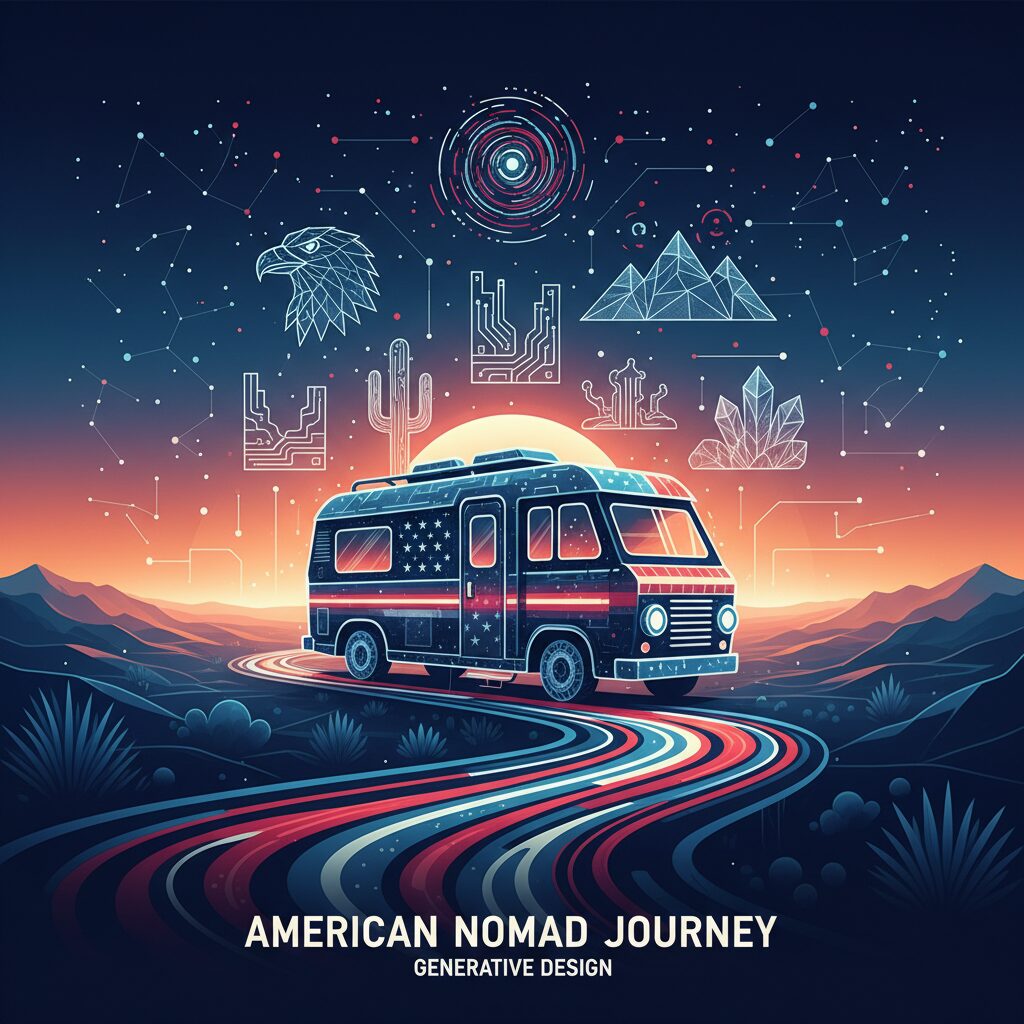
There’s a sound that defines the America of Chloé Zhao’s Nomadland, and it isn’t the roar of an engine or the clamor of a city. It’s the whisper of wind across a vast, empty plain. It’s the gentle rustle of sagebrush and the distant cry of a hawk circling a pale, endless sky. This is the soundtrack to a pilgrimage, not to a place, but through a state of being. The film, a quiet masterpiece of modern cinema, follows Fern, a woman who loses everything in the Great Recession and embarks on a journey through the American West, living out of her van, which she lovingly names Vanguard. It’s a story etched onto the landscape itself, a narrative where the canyons, deserts, and coastlines are not mere backdrops, but characters with their own profound stories of resilience, decay, and timeless beauty. To follow in Fern’s footsteps is to do more than just visit filming locations; it is to seek an understanding of a uniquely American spirit of independence and to find the quiet poetry in the spaces left behind. This is not a trip for the faint of heart, nor for those seeking curated comfort. It’s a journey for the soul that yearns for the horizon, a pilgrimage into the heart of a nation’s geography and its conscience. You’re not just seeing where a movie was made; you’re feeling the pulse of the real lives, the real nomads—many of whom play themselves in the film—who call these wild, forgotten spaces home.
If you’re inspired by this cinematic journey, you might also be interested in exploring other iconic road trip landscapes, such as those featured in a pilgrim’s guide to the epic landscapes of Thelma & Louise.
The Echo of Empire, Nevada
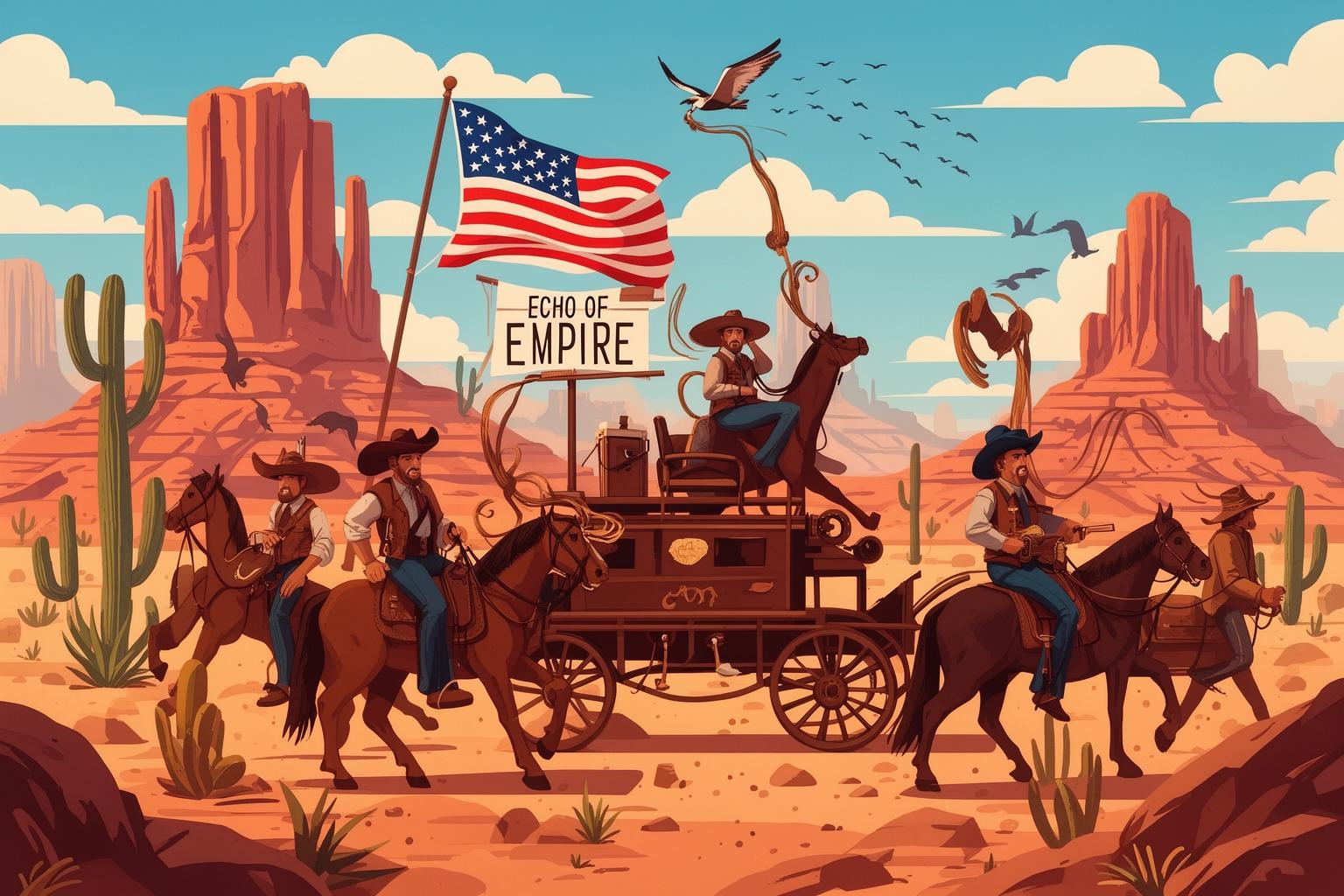
Our journey begins where Fern’s former life ends: Empire, Nevada. The name itself carries a cruel irony—a grand title for a place that has nearly vanished from the map. To reach it, you travel through a landscape that redefines solitude. The road glistens under the relentless desert sun, a black ribbon stretching through a world of muted beige and pale green. The vastness of the surroundings expands around you until your own existence feels beautifully, terrifyingly small. Upon arrival, there is no grand sign or visitor’s center—only a profound, deafening silence. Empire was once a company town, sustained for decades by the U.S. Gypsum plant. When the plant closed in 2011, the town, its lifeblood severed, withered and died within months. Its zip code, 89405, was discontinued. It became a ghost town in the truest sense, haunted not by spirits but by the tangible absence of life.
Walking through the remnants of Empire is a deeply moving experience. You observe the grid of empty streets, concrete foundations standing like tombstones marking where homes once existed. A solitary flagpole may still stand, its rope clinking against the metal in the ceaseless wind. It’s a photographer’s dream and a sociologist’s case study. The midday light is harsh and unforgiving, casting sharp, dark shadows. But at sunrise or sunset, the place transforms. The golden hour bathes the ruins in a soft, melancholic glow, turning decay into something beautiful, something poetic. This is the light Zhao captures so masterfully. You can almost see Fern walking these streets, touching the peeling paint of a forgotten wall, feeling the weight of a community that dissolved into the desert air. Visiting Empire isn’t about seeing ruins; it’s about bearing witness to the fragility of the American Dream. It’s a stark reminder that when the economic engine stops, the communities built around it can disappear with breathtaking speed. For anyone embarking on this pilgrimage, Empire is the essential first chapter—the ground zero of loss from which the entire journey of rebirth and discovery arises. Pack water—more than you think you’ll need. Pack a sense of reverence. And listen. In the silence, you can still hear the echoes of a life that was.
The Ancient Heartbeat of the Badlands
From the stark emptiness of a modern ghost town, the path leads eastward into a landscape that feels prehistoric and almost alien. The Badlands of South Dakota are more than just a location in Nomadland; they serve as a spiritual touchstone. This is where Fern finds a measure of stability, working as a camp host amidst a geological wonderland. The moment you see the formations, you understand why. They rise from the prairie like the very bones of the earth, layered in stripes of pink, white, and gray sediment that tell a story millions of years old. The Lakota people named this place Mako Sica, or “land bad,” a term that speaks to its harsh terrain while masking its breathtaking, otherworldly beauty.
A Canvas of Stone and Sky
Driving the Badlands Loop Road is a cinematic journey in itself. Each turn unveils a new vista, revealing spires, canyons, and buttes that seem almost unreal. The air here feels different—cleaner, ancient. It’s a place that inspires humility. As a photographer, I found myself overwhelmed, my lens unable to capture the immense scale and the subtle, shifting interplay of light and shadow. The most striking moments occur at the edges of the day. At sunrise, the first light ignites the eastern faces of the formations, setting them ablaze in color—a slow, silent fire spreading over the land. At sunset, the sky becomes a bruised palette of purple and orange, with lengthening shadows turning the landscape into a labyrinth of mystery. This is Fern’s world. One can easily picture her walking the trails, her eyes lost in the vast spectacle, finding an odd comfort in being a small part of something so immense and ancient. Here, personal loss seems diminished, put into perspective by the deep time recorded in the rocks. For an authentic pilgrimage, try camping, as Fern does. To sleep beneath the stars of the Badlands is to experience a silence so profound it feels almost tangible. The sky, free from city lights, reveals a dense tapestry of stars, the Milky Way a brilliant, shimmering cloud. It’s a humbling, soul-cleansing experience that connects directly to the film’s core theme: finding home not in any structure, but in the world itself.
The Roadside Anomaly of Wall Drug
Just a short drive from the raw, natural cathedral of the Badlands lies a very different kind of monument: Wall Drug. This sprawling, delightfully strange roadside attraction is a quintessential piece of Americana and a place Fern visits. While the Badlands embody nature’s quiet majesty, Wall Drug embodies humanity’s noisy, chaotic, and endlessly inventive commercialism. It began in the 1930s with a simple, clever marketing ploy: signs along the highway offering free ice water to tired travelers. Today, it has expanded into a sprawling complex covering a whole block, a maze of shops, restaurants, and quirky attractions. Here, you can find everything from handmade donuts and five-cent coffee to a giant, roaring T-Rex that comes to life every fifteen minutes. There are western art galleries, souvenir shops, a chapel, and a backyard filled with photo opportunities. Visiting Wall Drug after the peaceful solitude of the Badlands is a delightful cultural jolt. It serves as a reminder of another America—the one built on hustle, showmanship, and the simple promise of refreshing water on a hot day. It’s a place that doesn’t take itself too seriously, offering a much-needed dose of levity on a journey often steeped in profound themes. Within the context of Nomadland, it symbolizes the communities and quirky havens that travelers find on the road, places offering brief respite from the endless highway and a chance to reconnect with life’s stranger, more whimsical side.
The Winter Sun of Quartzsite, Arizona
The journey then heads south, following the migratory routes of the modern nomad to the sun-drenched plains of Quartzsite, Arizona. In the film, this is where Fern discovers her community. Quartzsite is the heart of the nomadic world, where thousands of van dwellers, RVers, and wanderers gather each winter to escape the cold and connect with others. The highlight of this gathering is the Rubber Tramp Rendezvous, or RTR, an annual event organized by real-life nomad guru Bob Wells, who appears as himself in the film. Visiting Quartzsite during the RTR feels like entering a realm completely detached from mainstream society.
A Community on Wheels
The terrain around Quartzsite is expansive, flat, and dotted with creosote bushes and cacti. For miles in every direction, BLM land hosts an incredible variety of mobile homes. Towering, luxurious Class A motorhomes sit alongside worn-out school buses, converted ambulances, and small, modest vans like Fern’s Vanguard. This is a temporary city that rises from the dust each winter and disappears come spring. The atmosphere is one of radical hospitality. Strangers greet one another with smiles and nods. People share resources, swap goods, and offer advice. Seminars cover topics like installing solar panels, finding work on the road, and living a fulfilling life with less. The film perfectly captures this spirit. Scenes of Fern learning from fellow nomads, sharing campfires, and listening to their stories are genuine and unscripted—a true glimpse into the heart of this community. It is a place founded on mutual support and a shared rejection of conventional life. Here, the loneliness of the road melts away, replaced by a deep sense of belonging. This is where Fern realizes she is not alone—there are thousands like her, each carrying their own tale of loss, resilience, and the pursuit of freedom.
Living with the Desert
Experiencing Quartzsite requires a shift in perspective. Life here is simple and lived in intimate connection with nature. The days follow the rhythm of the sun. Mornings are for chores and socializing, afternoons for quiet reflection or escaping the heat, and evenings for campfires and storytelling. The desert itself is a profound teacher. It instructs you to conserve water, respect the sun, and find beauty in a landscape many might call barren. The sunsets here are breathtaking, flooding the sky with endless shades of orange, pink, and purple. At night, the stars shine bright and close. To truly grasp the allure of this lifestyle, one must spend time here—not as a tourist, but as an observer. Find a quiet spot to camp on BLM land, watch the light shift over distant mountains, and feel the desert’s rhythm. Within this slow, intentional pace lies the genuine freedom of nomadic life. It’s not about escaping the world, but discovering a more authentic way to live within it.
The Final Breath at Point Arena, California
Every great journey reaches an end, a destination where the traveler can finally pause and reflect. For Fern, that place is the rugged, windswept coastline of Northern California. The final, poignant scenes of Nomadland were shot in and around the small town of Point Arena, where the continent draws to a dramatic and breathtaking close. After the vast, arid interior deserts, the sudden encounter with the raw, untamed power of the Pacific Ocean is a deeply immersive experience. Here, Fern faces the immensity of her journey and the limitless possibilities that lie ahead.
Where the Land Meets the Infinite
The Mendocino coast feels worlds apart from the Badlands or the Sonoran desert. It is a land of dramatic cliffs, roaring waves, and a steady, cleansing mist. The air is heavy with the scent of salt and cypress. The ocean’s sound is constant—a powerful roar that echoes timeless forces. The film shows Fern standing on these cliffs, gazing out over the endless stretch of water. It is a moment of profound catharsis. The ocean symbolizes both an ending—the physical limit of the westward journey—and a fresh beginning. It stands as a symbol of the unknown, of a future yet to be written. To stand on these bluffs is to share in that feeling. You can wander for miles along the Stornetta Public Lands, a stunning stretch of coastline preserved for all to enjoy. The trails curve along cliff edges, through fields of wildflowers in spring, and down to secluded coves where seals bask on the rocks. The weather here almost acts as a character itself, capable of shifting from brilliant sunlight to thick, moody fog in mere minutes. Every state offers a distinct kind of beauty, a unique emotional texture.
A Beacon in the Mist
Rising above this rugged coast is the Point Arena Lighthouse. At 115 feet tall, it ranks among the tallest lighthouses on the Pacific coast. Visitors can climb the spiral staircase to the top for a panoramic view that stirs the soul. The wind rushes around you, and the curvature of the earth reveals itself as the ocean rolls out to the horizon. The lighthouse stands as a symbol of endurance and guidance, a beacon of light in the fog. For Fern, and any pilgrim who arrives here, it offers a moment of clarity—a place to look back on the road traveled and forward to the road still to come. The journey through Nomadland’s landscapes is a circle: it begins with an end in Empire and concludes with a new beginning at the sea’s edge. It powerfully testifies to the human spirit’s ability to find beauty in broken places and to build a home—not of wood and nails, but of motion, memory, and the boundless freedom of the open road.
The Veins of the Journey: Work and Passage
While the majestic landscapes provide the soul of Nomadland, the film is firmly rooted in a harsh reality: survival. The journey is not a vacation; it is a way of life sustained by a series of demanding, temporary jobs. These places of labor are as essential to the pilgrimage as the national parks, as they represent the engine that keeps the vans moving and the nomads nourished. They form the circulatory system of this alternative America—often unseen but unquestionably vital.
The Hum of the Fulfillment Center
One of Fern’s earliest jobs is at an Amazon fulfillment center in Fernley, Nevada. The film contrasts the boundless freedom of the open road with the regimented, physically taxing environment of the warehouse. The endless rows of shelves, the constant beeping of scanners, and the relentless pace stand in stark opposition to everything the nomadic life embodies. Yet, for many, this work is a necessary part of the cycle. Amazon’s CamperForce program actively recruits RVers and van dwellers for seasonal employment, providing a steady paycheck and a place to park. Exploring the industrial parks at the edges of towns like Fernley offers a different perspective on the journey. Here, the massive, windowless buildings that power our modern economy come into view, deepening our appreciation for the trade-offs people like Fern must make. It serves as a reminder that the freedom of the road is not free; it is earned through hard labor in the hidden corners of the country.
The Toil of the Harvest
The film also takes us to the sugar beet harvest in Nebraska, another form of seasonal work attracting nomads from across the country. These scenes are raw and unvarnished, showing Fern and her fellow workers battling the cold, their bodies aching from repetitive, back-breaking labor. The work is temporary, lasting only until the last beet is harvested. Yet within this hardship, there is camaraderie. A temporary community forms, bonded by shared toil and the common goal of earning enough to move on. These moments powerfully portray the resilience and work ethic of the nomadic community. They are not dropouts from society; they are some of its hardest workers, willing to take on the jobs others avoid. To understand the world of Nomadland, one must see these workplaces not as detours from the journey, but as integral threads in its fabric—where the romantic ideal of the open road meets the cold, hard reality of economic necessity.
The Road Is the Destination
To follow the path of Nomadland across the American West is to embark on a journey that is as much inward as it is outward. You will discover that the boundaries between the film’s fiction and the reality of the land and its people are beautifully and heartbreakingly intertwined. You will encounter descendants of pioneers alongside the new pioneers of the 21st century, each drawn to the horizon for their own reasons. This is not a list of sights to be checked off. It is an invitation to slow down, to observe more closely, and to listen to the stories the land wants to share. You will sense the ghosts of Empire, be humbled by the vast time of the Badlands, find warmth in the community of Quartzsite, and experience the cleansing power of the Pacific at Point Arena. But above all, you will come to realize that the true sacred site of this pilgrimage is not a single place. It is the road itself—the endless stretch of asphalt, the promise of what lies beyond the next rise. It is the space between destinations where life is truly lived. The journey reveals that home is not a location, but a feeling—a peaceful feeling you carry within, parked for the night beneath a vast and silent sky.