To walk in the footsteps of Francis Bacon is not a gentle stroll. It is a pilgrimage into the storm, a journey through the shadowed corridors and brilliantly lit, claustrophobic rooms that defined both his life and his art. Bacon, a titan of 20th-century painting, did not merely depict the world; he wrestled with it, tearing it apart and reassembling it on canvas with a brutal, electrifying honesty. His geography was his psyche, mapped across a handful of cities that nurtured his genius, witnessed his despair, and fueled his relentless drive to capture what he called “the brutality of fact.” We will not find serene landscapes or picturesque studios on this path. Instead, we will find the raw, visceral energy of Dublin, the chaotic crucible of London, the fleeting inspirations of Paris, the sun-scorched exile of Tangier, and the final, hallowed halls of Madrid. This is a journey to the heart of a man who lived as he painted: without apology, on the very edge of existence. His world was a stage, and these places were the sets for the magnificent, terrifying drama of his life. Before we step onto that stage, let us survey the primary arena of his life’s work, the city that holds the deepest imprint of his soul: London.
While Bacon’s work confronts the raw edges of human existence, a very different artistic pilgrimage explores the vibrant, mass-produced world of Andy Warhol.
A Beginning in Turbulence: Dublin’s Georgian Facade
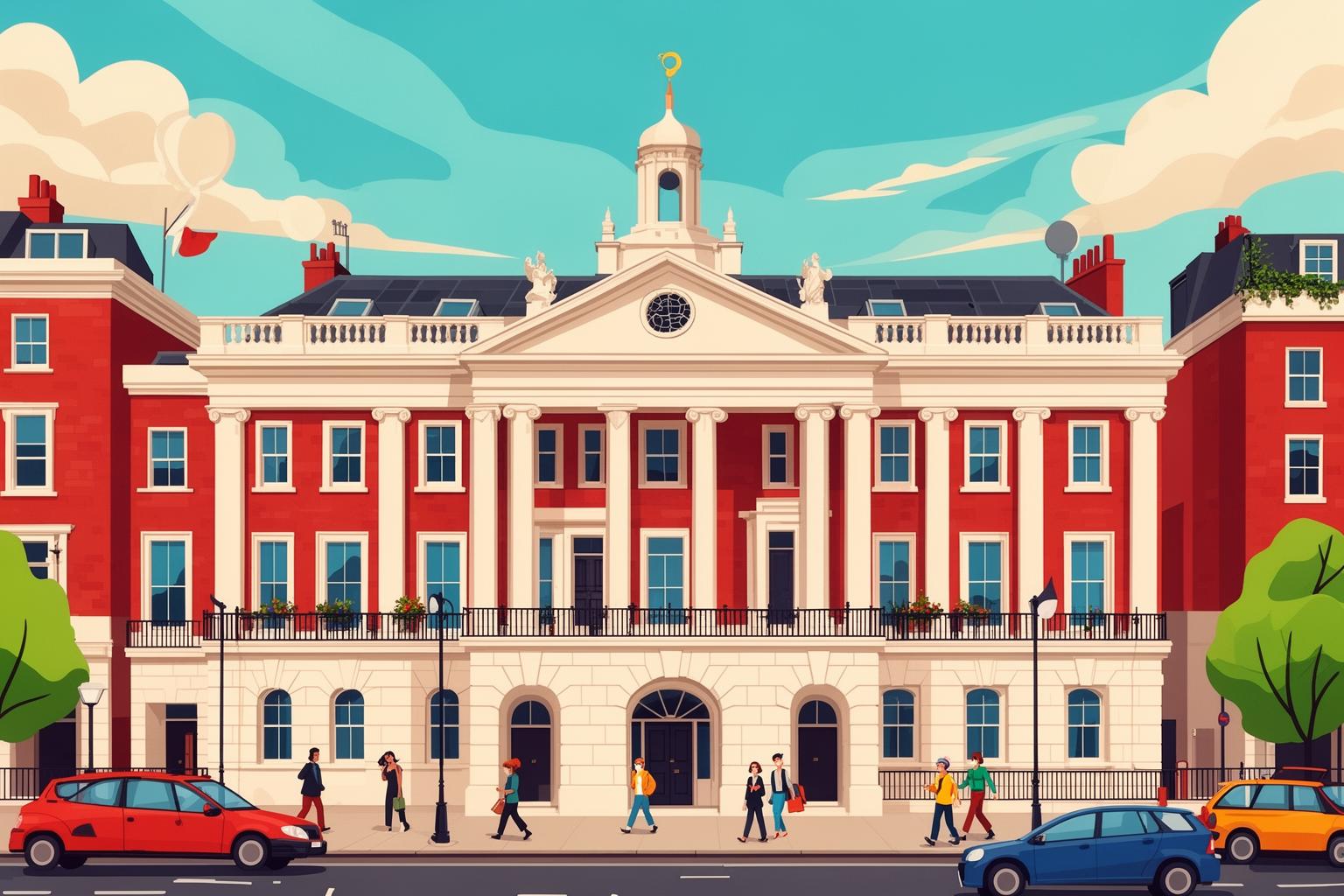
Every storm has an eye, a starting point. For Francis Bacon, that point was 63 Lower Baggot Street, Dublin. He was born there on October 28, 1909, into a world of contradictions that would resonate throughout his life. On the surface, it was a respectable address in the heart of Georgian Dublin, a city of elegant squares and stately brick townhouses. Yet beneath this facade of Anglo-Irish ascendancy, Ireland was a nation simmering with rebellion, on the brink of a violent struggle for independence. This undercurrent of conflict, the feeling of a world on the verge of fracture, permeated the very roots of Bacon’s childhood.
His father, Captain Anthony Edward Mortimer Bacon, was a retired army officer and racehorse trainer, a man of rigid disposition and explosive temper. He was a stern, unyielding presence who showed little patience for his second son, a chronically asthmatic and sensitive boy. Their relationship was a battleground in itself, a source of enduring trauma for Francis. He would later recall being horsewhipped by his father’s grooms, an act of casual cruelty that echoed in the twisted flesh and silent agony of his paintings. The house, with its formal rooms and drafty hallways, was no refuge of warmth or comfort but a stage of tension and estrangement. His mother, Christina Winifred Firth, was a more sympathetic yet distant figure, a society woman absorbed in her own world.
Today, if you stroll down Lower Baggot Street, you won’t find a museum or a plaque commemorating Bacon’s birth. The house is now part of a row of commercial properties, its history swallowed by the city’s relentless modernity. Yet, standing on the pavement and looking up at the elegant windows, one can sense a ghost of that early life. Imagine a young, frail boy gazing out at the Dublin rain, already an outsider in his own home and country. The city’s duality—its blend of Georgian refinement and simmering violence, its poetic spirit and turbulent history—was Bacon’s first lesson about existence. It showed him that civilization is a thin mask worn over a primal, chaotic reality. When visiting Dublin, take a moment to walk from the manicured lawns of St. Stephen’s Green to this stretch of Baggot Street. Feel the weight of history in the architecture, and reflect on the small boy who began his life here, destined to dismantle every polite facade he encountered.
The Cauldron of Creation: Bacon’s London
If Dublin was the prologue, London was the sprawling, magnificent, and chaotic epic of Francis Bacon’s life. He arrived there as a teenager and, despite periods abroad, the city remained his anchor and arena for over sixty years. It was within the smoky, boozy, and intellectually fierce post-war London environment that he forged both his identity and his revolutionary art. London wasn’t just his home; it was his collaborator, muse, adversary, and sanctuary. To trace Bacon’s journey through London is to uncover the very DNA of his work.
The Legendary Chaos: 7 Reece Mews
No address is more synonymous with Francis Bacon than 7 Reece Mews in South Kensington. From the outside, it appears as an unassuming, modest brick building on a quiet, cobbled lane—easy to pass without a second glance. Yet for thirty-three years, from 1961 until his death, the small first-floor space was the world’s most ferociously creative and famously chaotic artist’s studio. This was no conventional studio; it was an extension of Bacon’s mind—a cluttered, claustrophobic, and astonishingly fertile mess.
Photographs by John Deakin and later Perry Ogden immortalized the space. Visitors were confronted with an avalanche of materials, a tidal wave of creative debris. The floor was a thick carpet of discarded canvases, crumpled photographs, empty oil paint tubes squeezed dry, champagne and wine bottles, and books on countless subjects—cookbooks, medical texts on diseases of the mouth, volumes on bullfighting, T.S. Eliot’s poetry, and seminal art history works. A single bare lightbulb hung from the ceiling, casting a harsh, interrogative glare over the scene. The once-white walls were caked with visceral smears of paint, used by Bacon as an impromptu palette to test colors and textures. It was a space of profound disorder, yet for Bacon, it formed a system of inspiration. He claimed he could find anything he needed amid the chaos, that the very disarray sparked new ideas and accidental discoveries.
Measuring just four by six meters, this small room was where Bacon painted his masterpieces. It was here the triptychs of George Dyer’s final moments were born from grief. It was here he wrestled with Velázquez’s ghostly Pope and captured the raw psychological essence of his friends Lucian Freud, Isabel Rawsthorne, and Muriel Belcher. The atmosphere was intensely concentrated energy. Bacon worked in bursts of furious activity, often in the early morning hours, fueled by champagne and urgent desperation. Canvases he disliked were slashed, their remains added to the geological strata on the floor. The studio was simultaneously a battlefield, laboratory, and shrine—a place where life’s messiness was not merely accepted but embraced as the fundamental source of his art.
A Studio Reborn: The Hugh Lane Gallery, Dublin
The physical studio at 7 Reece Mews no longer exists. After Bacon’s death, his heir, John Edwards, made a culturally visionary decision to donate the entire studio contents to the Hugh Lane Gallery in Dublin, Bacon’s birth city. What followed was a project of immense complexity and dedication. Archaeologists, conservators, and art historians spent three years meticulously documenting, excavating, and relocating every single item from the London mews to a specially constructed room in the Dublin gallery.
Over 7,500 items were individually cataloged and mapped. Every scrap of paper, paint-splattered book, and broken piece of furniture was transported and reinstalled in the exact positions they occupied in London. The result is one of the most compelling and immersive artistic exhibits worldwide. Visitors to the Hugh Lane can peer through glass into the preserved chaos of Reece Mews. They can see the famous circular mirror Bacon used for self-portraits, the slashes in the wall where he tested palette knives, and the mountains of source material from which his figures emerged. It is a deeply moving experience, akin to looking directly into the engine room of his genius.
The gallery also created a digital archive, allowing scholars and visitors to explore the studio’s contents, revealing connections between a crumpled photograph of a boxer and the distorted anatomy of a painted figure, or a wildlife book page and the gaping mouth of a screaming pope. Visiting the relocated studio is an essential pilgrimage—a journey not only back to London but to the moment of creation itself. It offers unparalleled insight into Bacon’s process, demonstrating that his art was not conjured from thin air but forged from the tangible, chaotic material of his life. For anyone seeking to understand the artist, a visit to the Hugh Lane is indispensable. Here, the ghost of Reece Mews still lives and breathes.
Soho’s Roaring Heartbeat: The Colony Room Club
While Reece Mews was the private crucible of his work, Soho’s boisterous, decadent world was its public fuel. This central London neighborhood, a maze of narrow streets and hidden alleys, was Bacon’s playground and hunting ground. After intense mornings spent painting, he would leave his studio’s solitude to plunge into Soho’s pubs, restaurants, and private drinking dens. A man of immense appetites—for champagne, fine food, conversation, and risk—he centered his social life in a tiny, green-walled upstairs room at 41 Dean Street: The Colony Room Club.
Founded and presided over by the formidable Muriel Belcher, a lesbian known for razor-sharp wit and legendary foul language, the Colony Room was a sanctuary for a very particular kind of Londoner: artists, writers, actors, petty criminals, and aristocrats. It was a place where societal norms dissolved, conversation was a blood sport, and drinking relentless. Muriel was one of Bacon’s earliest patrons, giving him a small stipend and free drinks in exchange for the company of wealthy friends. Their relationship was deep and complex—a fusion of maternal affection and sparring partnership.
For decades, Bacon held court here. He arrived in the afternoon and often stayed until closing, surrounded by his circle, including fellow painter Lucian Freud (at one time his closest friend and rival), artist Frank Auerbach, photographer John Deakin, and numerous lovers and acolytes. Known for his generosity, Bacon spent his painting earnings on lavish rounds of champagne and expensive meals at nearby restaurants like Wheeler’s. This world of excess and high-stakes social performance was not a distraction from his art but essential to it. In the faces of his drinking companions, flushed with alcohol and animated by argument, he found the humanity he sought to paint. His portraits are not serene likenesses; they are records of existence, twisted by desire, anxiety, and the sheer force of life. The Colony Room was where he studied his subjects in their most natural, unguarded state.
Today, Soho has been gentrified, and the Colony Room Club closed in 2008. Its iconic green door is gone. Yet the spirit of that bohemian world lingers. Walking down Dean Street and ducking into one of the old pubs like The French House, you can still feel the echoes of laughter and argument. It remains a place of creative energy—a reminder that for Bacon, art was not a sterile academic pursuit but something to be lived, messily and magnificently, at the city’s heart.
The Arenas of Art: Tate Britain and The Sainsbury Centre
To see Bacon’s work in person is to experience its full, unsettling power. No reproduction can capture the visceral texture of paint, the scale of the canvases, or the raw emotional impact of standing before one of his triptychs. In the UK, two institutions are essential for any Bacon pilgrimage. The first is Tate Britain in London. Its collection is among the world’s most significant and holds the painting that launched Bacon into public consciousness: “Three Studies for Figures at the Base of a Crucifixion” (1944). When first exhibited, this shocking, terrifying triptych sparked an uproar. The monstrous, biomorphic creatures, their necks straining and mouths agape in silent screams, announced the arrival of a devastating new voice in modern art. The Tate houses many other masterpieces, charting the course of his career. Standing in these galleries is to walk through the history he created.
For a different but equally rewarding experience, one must visit the Sainsbury Centre for Visual Arts at the University of East Anglia in Norwich. Housed in an innovative high-tech building designed by Norman Foster, its collection was amassed by Sir Robert and Lady Sainsbury, close friends and major patrons of Bacon. They collected his work extensively, and the Sainsbury Centre offers an intimate context for it, displayed alongside works by Giacometti and ancient and tribal art that Bacon admired. Seeing his paintings amid these objects of power and ritual highlights the primal, timeless quality of his vision. A visit here provides a focused, contemplative experience, allowing deeper connection with the artist’s later works and the influences shaping his eye.
Parisian Echoes and Velázquez’s Ghost

For Francis Bacon, Paris was a city haunted by ghosts, a place of formative encounters and profound tragedy. He first encountered its intoxicating creative freedom in the late 1920s as a young man who had been expelled from his family home after his father caught him trying on his mother’s underwear. This period of exile proved to be a form of liberation. It was in Paris that Bacon resolved to become a painter, inspired by a visit to an exhibition of Pablo Picasso’s drawings at the Paul Rosenberg Gallery. He was utterly struck. Picasso, he later recalled, was the “father-figure” who provided the “creative shove” he needed. In Picasso’s distorted figures, he found a means to bypass literal representation and reach a deeper, more emotional truth.
He wandered the city, soaking in its culture, from the cinematic shocks of Eisenstein’s “Battleship Potemkin” and Buñuel’s “Un Chien Andalou” to the lavish designs of Eileen Gray. Paris taught him about modernism that was sophisticated, daring, and psychologically intense. He returned to the city many times throughout his life, where it witnessed one of his greatest successes as well as his most profound personal sorrow.
In 1971, the Grand Palais held a major retrospective of his work, solidifying his status as one of the world’s greatest living painters. It represented the peak of his career. Yet, just two days before the exhibition opened, his long-term lover, George Dyer—a volatile and troubled man he had met during a failed burglary—committed suicide in their hotel room. The tragedy was overwhelming and haunted Bacon for the rest of his life. Following this, he created a series of three triptychs, now known as the “Black Triptychs,” which rank among his most powerful and harrowing pieces. They show Dyer’s final moments in stark, desolate detail—a body twisted on a toilet, a shadowy figure vomiting into a sink, a life draining away under the harsh light of a single bulb. The grandeur of the Grand Palais is forever linked with this intimate, unbearable loss. To visit Paris is to trace this trajectory of youthful inspiration and devastating grief, a reminder of the fragile boundary Bacon continually walked between creation and destruction.
Yet perhaps the most significant Parisian ghost was one he never met in person. Throughout his career, Bacon was obsessed with Diego Velázquez’s 1650 masterpiece, “Portrait of Pope Innocent X.” However, despite numerous visits to Rome where the painting resides, he famously refused to see the original. He chose to work from reproductions, photographs, and images in books instead. This deliberate distancing was essential to his process. He did not want to be a copyist; he sought to “unlock the valves of feeling” that the image stirred in him. He aimed to wrestle with the idea of the Pope, to deconstruct the power and authority of the original, and to recreate it in his own terrifying vision. The resulting series of “Screaming Popes” rank among the most iconic artworks of the 20th century, imprisoning the pontiff in a gilded cage, his face dissolving into a silent, existential scream. This obsession, fueled by second-hand images often found in Parisian bookshops, speaks deeply about his relationship with the past: it was not to be revered from afar but to be confronted, challenged, and ultimately transformed.
The Sun-Drenched Exile: Tangier’s Wild Freedom
In the mid-1950s, in search of greater personal and sexual freedom, Bacon made his way to Tangier. At that time, this Moroccan port city was an International Zone—a politically ambiguous and socially permissive refuge that attracted a lively community of expatriate artists, writers, and outcasts. It was a place to live cheaply and without judgment, a sunlit, chaotic world far removed from the gray respectability of post-war London. For Bacon, as for his contemporaries William S. Burroughs and Paul Bowles, Tangier was a landscape of liberation.
His life there revolved around another tumultuous and destructive love affair, this time with Peter Lacy, a former fighter pilot known for his violent and alcoholic nature. Their relationship was a brutal cycle of passion and violence, reflecting the destructive forces Bacon was channeling into his art. They lived in a small, modest house in the old medina, spending their days in the city’s smoky cafes and rundown bars. The light in Tangier was different—harsh and unforgiving, casting deep, sharp shadows. Although Bacon rarely painted Moroccan landscapes, the city’s intense atmosphere undoubtedly influenced his work. The raw, sun-baked colors and the sense of life lived on the edge shaped the psychological intensity of the portraits and figures he created back in London.
Tangier was a place of sensory overload—the mingling scents of spices and sewage in the medina, the cacophony of the souks, the stark contrast between blinding sunlight and cool interior darkness. It was a city of exposed nerves, an ideal setting for the raw emotional states Bacon aimed to portray. A modern visitor can still get lost in the labyrinthine alleys of the medina, linger at a cafe in the Petit Socco, and imagine the city as it once was—a melting pot of cultures and a haven for those living beyond the rules. Though much has changed, the city retains a powerful, almost illicit sense of freedom. It marks a crucial chapter in Bacon’s life, a period when he pushed the limits of both his existence and his art in a place that demanded no explanations.
Final Canvases in the City of Light: Madrid and The Prado
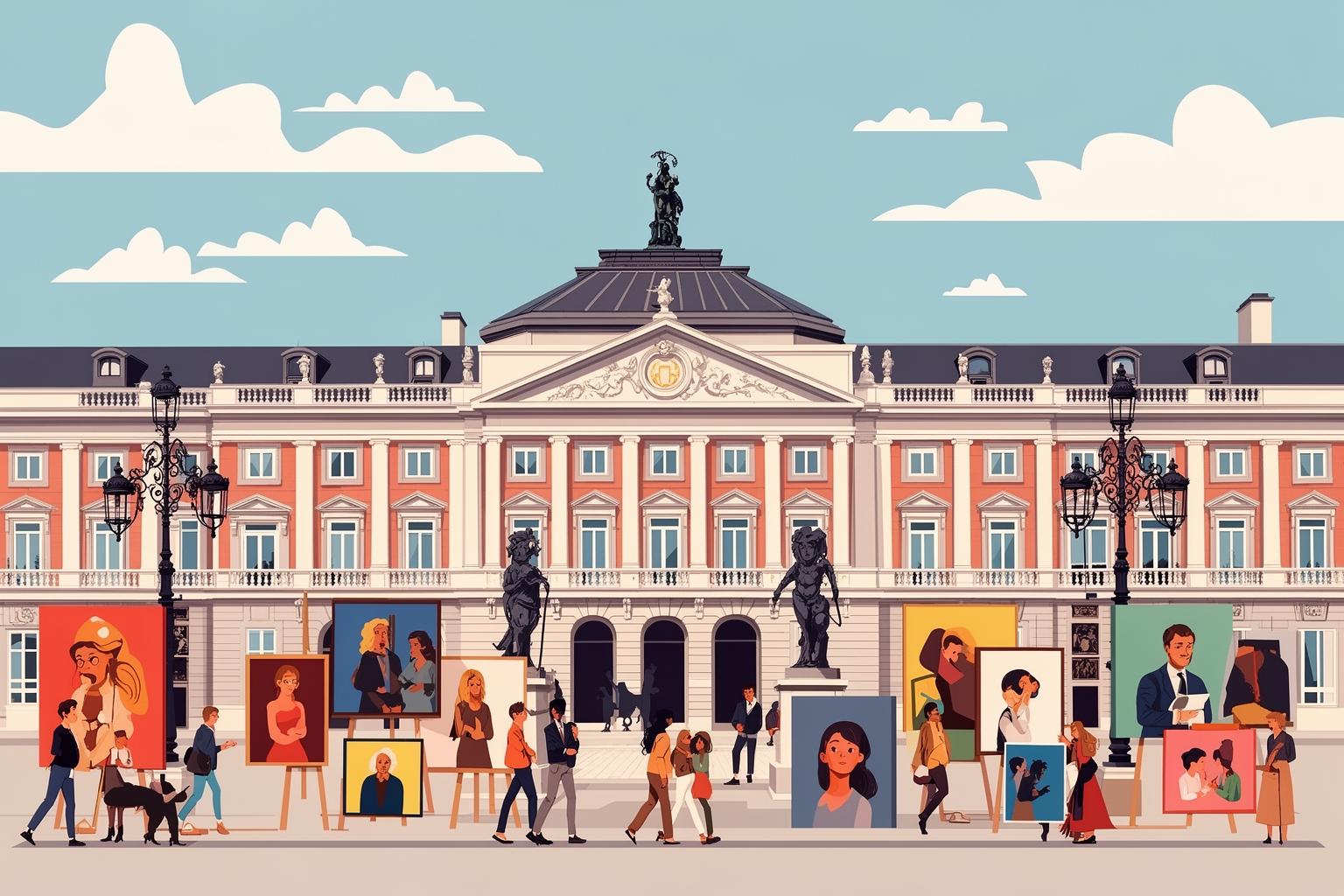
It is fitting that Francis Bacon’s journey ended in Madrid. He passed away there in April 1992, at the age of 82, while visiting a young Spanish lover. Yet, his final pilgrimage was not solely for love; it was for art. Throughout his life, Bacon maintained a profound and deeply personal connection with the Old Masters. He was not a modernist dismissing the past; rather, he sought to engage with it, to draw strength from it, and to transform its power into a contemporary language. The ultimate sanctuary for his artistic devotion was the Museo Nacional del Prado in Madrid.
He would spend hours and days wandering its revered galleries, communing with the painters who were his true peers and eternal rivals. He admired many, but two Spanish masters held unparalleled significance in his personal canon: Goya and, above all, Velázquez. In Goya’s late, haunting “Black Paintings,” with their dark, grotesque figures and expressions of human madness and despair, Bacon found a kindred spirit—an artist unafraid to confront the abyss. He saw Goya’s probing of the dark depths of the human psyche as a direct forerunner of his own work.
Yet it was always Velázquez who embodied the pinnacle of painting for Bacon. He regarded him as the greatest of all. Bacon was captivated by Velázquez’s capacity to create images both astonishingly realistic and deeply mysterious, using paint to evoke the very texture of existence. Standing before masterpieces like “Las Meninas” was, for Bacon, a quasi-religious experience. In Velázquez’s brushwork, he saw a kind of magic—a perfect blend of control and chance that he himself sought throughout his life. He once remarked, “I think of myself as a maker of images. The image matters more than the beauty of the paint.” In the Prado, he found both perfectly united.
His death in Madrid completed his life’s circle. The boy electrified by Picasso in Paris died in the city that housed the work of his ultimate master, Velázquez. For any visitor tracing Bacon’s life, a visit to the Prado is the final, essential stop. To stand in the same spaces where he stood, to gaze upon the same paintings that obsessed and inspired him for more than fifty years, is to grasp the deep historical roots of his radical vision. It reveals him not as an isolated genius but as the last, and perhaps greatest, of the Old Masters.
To follow Francis Bacon is to traverse a landscape of raw emotion. From the tense Georgian elegance of his Dublin birth to the paint-spattered chaos of his London studio, from the drunken intellectual skirmishes of Soho to the hallowed, silent galleries of the Prado, his life was etched across the map of Europe. These places were not mere settings; they actively shaped his work, molding his vision and fueling his relentless pursuit to depict the human condition in all its beautiful, terrifying reality. Walking these streets today, one senses more than history—you feel the lingering energy, the fierce creative spirit of a man who faced life head-on and dared to paint what he witnessed.