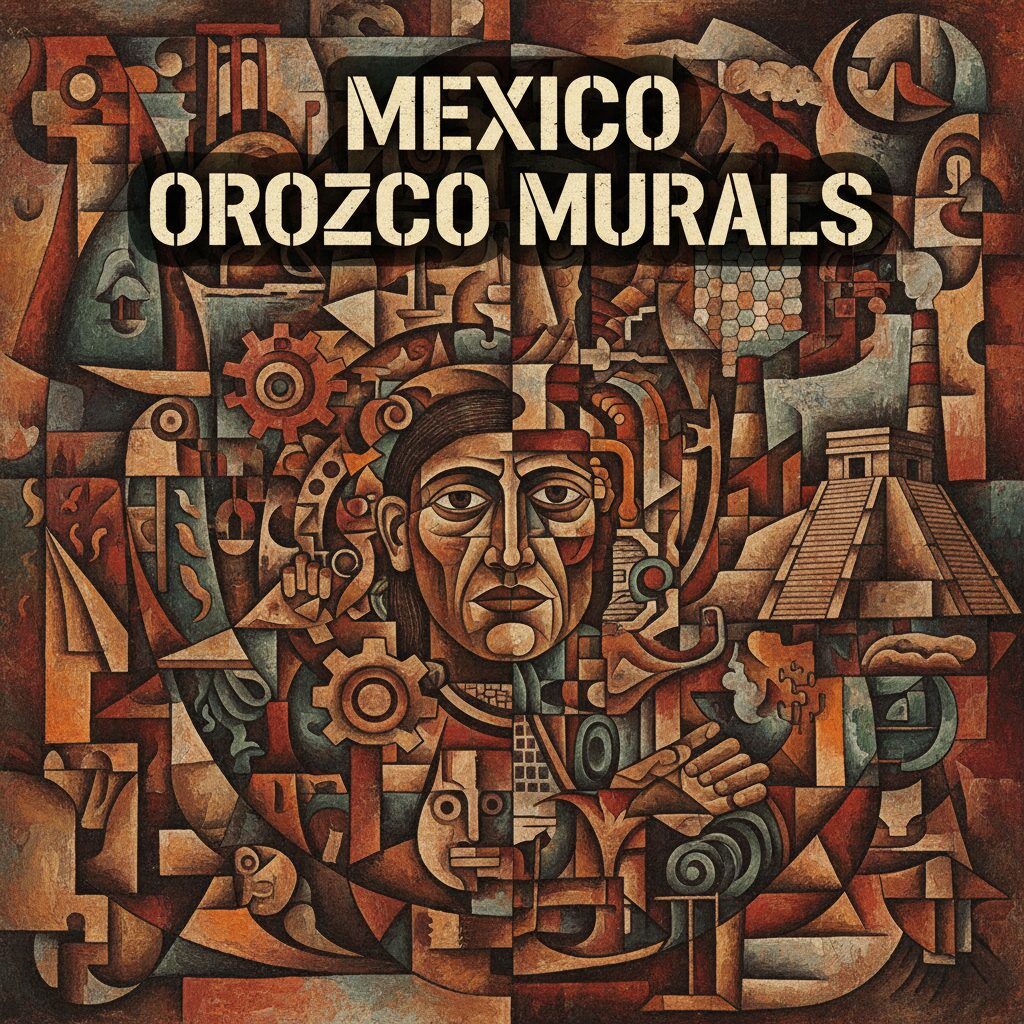
There are artists who paint beauty, and there are artists who paint truth. José Clemente Orozco belonged, unequivocally, to the latter. He was a titan, one of the titanic trio known as Los Tres Grandes—the three greats of Mexican Muralism—who seized the walls of their nation and turned them into canvases of history, revolution, and raw, unfiltered humanity. Alongside Diego Rivera and David Alfaro Siqueiros, Orozco forged a new visual language for a country redefining itself in the wake of a brutal civil war. But where Rivera often wove tales of utopian progress and Siqueiros sculpted figures of dynamic, revolutionary force, Orozco delved into the shadows. His was a world of fire and anguish, of struggle and sacrifice, a universe painted not in gentle hues but in the searing colors of the human soul laid bare. To follow the trail of Orozco is not merely to see art; it is to embark on a pilgrimage. It’s a journey that takes you from the volcanic earth of his birthplace to the hallowed halls of government and academia, tracing the footsteps of a man who wrestled with the epic, often tragic, story of Mexico and mankind. His murals are not passive decorations; they are active, breathing entities that confront, challenge, and command your attention. They pull you into a visceral dialogue about power, faith, corruption, and the eternal conflict that rages within us all. This is a journey to the heart of that fire, a walk through the spaces that shaped his vision and now stand as permanent testament to his unyielding genius.
For a different kind of artistic pilgrimage that explores vibrant abstraction, consider a journey through the world of Joan Miró.
The Roots of a Rebel: Zapotlán el Grande, Jalisco
A City Forged by Fire and Earth
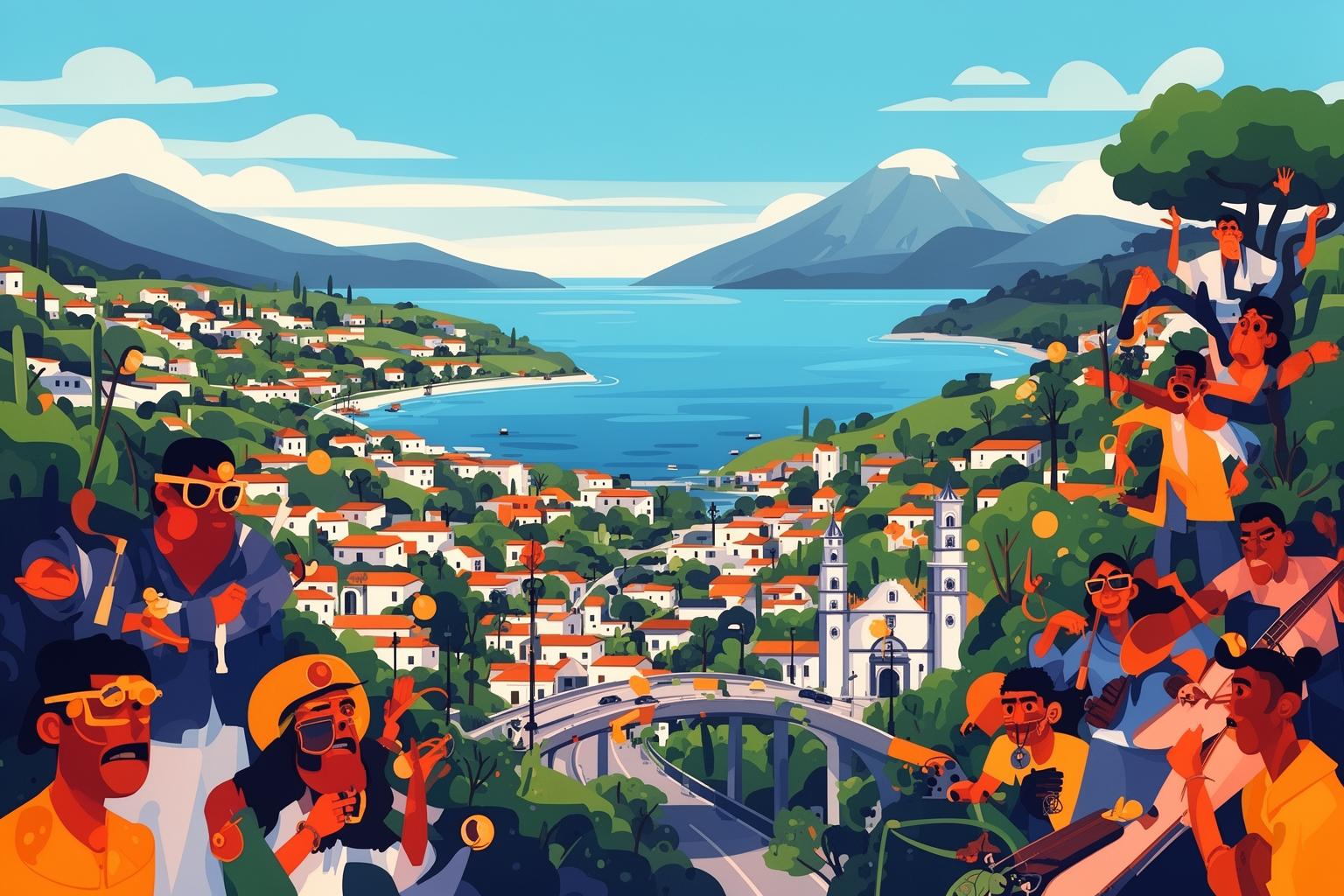
Every storm has its origin. For José Clemente Orozco, that origin was Zapotlán el Grande, a city nestled in a valley in Jalisco, forever shadowed by two towering volcanoes: the dormant Nevado de Colima and the ever-active Volcán de Fuego. Being born there in 1883 meant an early awareness that the ground beneath was anything but still. It was a land marked by immense creative and destructive forces, rich soil alongside sudden, violent eruptions. This dual nature seems to have infused Orozco’s art itself. His work stands as a tribute to this elemental tension—the birth of new worlds from the ruins of the old, the relentless, fiery struggle that defines life. Though his family relocated to Guadalajara and later Mexico City during his youth, the spirit of this land, with its striking landscapes and deep-rooted traditions, undoubtedly laid the foundation for his artistic sensibility.
In Mexico City, on his way to school, the young Orozco had an insight that would shape his destiny. He often paused before the open workshop of master printmaker José Guadalupe Posada. Gazing through the window, he was captivated by Posada’s hands, carving vivid images of life and death, political satire, and grinning calaveras (skulls) into metal plates. This was not the polished, European-style art taught in academies; it was art for the people—raw, immediate, and pulsing with the energy of the streets. Watching Posada, Orozco realized that art could be a weapon, a voice, a mirror revealing the unfiltered truths of society. That moment sparked a fire that smoldered through his formal studies and later erupted into the monumental works that would define his legacy.
A Pilgrim’s Journey Through Zapotlán
Visiting Zapotlán el Grande, now officially Ciudad Guzmán, is less about seeking specific murals and more about absorbing the atmosphere that shaped Orozco. The town itself lacks his major works, but it holds the primal energy of his origins. The best way to take this in is simply to walk. Stand in the central Jardín Principal, gaze toward the twin volcanic peaks dominating the horizon, and sense the vast power of nature that overshadows human effort—a motif Orozco revisited throughout his pieces. The air feels charged here, thick with the history of a region that was a focal point during the Cristero War, a brutal religious conflict in the 1920s. This legacy of fervent belief and violent struggle is woven into Jalisco’s identity and offers vital context for the profound themes of faith and conflict in Orozco’s later murals. Getting there from Guadalajara is easy, with regular buses making the two-hour journey south. It’s a visit worth making, not for glimpses of his art, but for a sense of the world that shaped him.
The Crucible of Revolution: Mexico City
San Ildefonso: The Birthplace of a Movement
If Zapotlán was the initial spark, the Antiguo Colegio de San Ildefonso, located in the historic center of Mexico City, served as the crucible where the Mexican Muralist movement was forged in fire. This expansive baroque structure, once a Jesuit college, became the grand stage for a cultural revolution supported by the post-revolutionary government under the visionary Minister of Education, José Vasconcelos. In the early 1920s, he summoned the nation’s most promising artists to cover its walls with the story of a new Mexico. Here, Orozco, alongside Rivera and others, embarked on his monumental journey into muralism.
The atmosphere inside San Ildefonso is one of quiet reverence. Sunlight pours through tall windows, illuminating vast corridors and a stunning central courtyard. Yet, as your eyes turn to the walls, the calm is shattered. Orozco’s early murals hit hard. They are dark, somber, and thick with the pain and tragedy of the Mexican Revolution. In The Trench, anonymous soldiers, faces hidden, form a stark, angular cross of sacrifice—a powerful anti-war statement that rejects any notion of martial glory. In Cortés and La Malinche, he portrays the Spanish conquistador and his indigenous interpreter-turned-mistress not as romanticized historical figures, but as a single, monumental entity of pale, fused flesh, symbolizing the violent and complex birth of the mestizo race. It is a deeply unsettling and profound image of creation through destruction. Walking these halls is an intense experience. You can almost feel the weight of history, the ghosts of the revolution, and the burning passion of a young artist discovering his powerful, uncompromising voice.
Standing Before the Beginning
To visit San Ildefonso is to witness the origins. Here, you see Orozco experimenting and developing his signature style marked by dramatic diagonal compositions and a strong, almost sculptural use of the human form. Practical advice for visitors is simple: take your time. Don’t rush from one mural to the next. Find a place to sit and let the images wash over you. The building is just a stone’s throw from the Zócalo, Mexico City’s main square, making it an essential stop on any cultural tour of the city center. Buy a ticket, step away from the bustling streets, and enter a world where the walls themselves narrate the nation’s most painful and profound stories.
Palacio de Bellas Artes: A Cry in a Cathedral of Culture
Further along, beyond Alameda Central park, stands the magnificent Palacio de Bellas Artes. A stunning blend of Art Nouveau and Art Deco architecture, its gleaming white marble exterior and magnificent stained-glass curtain give it the aura of a temple devoted to high art. This elegance and grandeur make the presence of Orozco’s mural, Catharsis, all the more jarring. Located on the upper floors alongside masterpieces by Rivera and Siqueiros, Catharsis is not just a mural; it is an explosion, a scream rendered in pigment.
The mural is a swirling vortex of chaos. A massive, terrifying blaze consumes the scene, where humanity is locked in a savage, orgiastic battle with the very machines it has created. Figures twist in agony and ecstasy, a chaotic mob caught in a frenzy of self-destruction. A colossal safe, its door torn open, spews out useless papers, symbolizing the collapse of a corrupt capitalist system. It is a brutal, terrifying, and prophetic vision of the dehumanizing forces of modern society. Completed in 1934, it feels as if it could have been painted yesterday, capturing the anxieties of a world on the edge of war and social collapse. Standing before Catharsis is to feel the heat of its flames, being drawn into its maelstrom. This is Orozco at his most visceral, offering no easy answers, no hope for salvation—only a stark, unflinching stare into the abyss of our own creation.
An Encounter with the Titans
The Palacio de Bellas Artes provides a rare chance to directly compare the styles and ideologies of Los Tres Grandes. Just steps from Orozco’s inferno is Rivera’s meticulously detailed and politically optimistic Man, Controller of the Universe. Seeing them side by side offers a lesson in contrasts: Rivera’s faith in scientific progress and socialist utopia versus Orozco’s deep skepticism and focus on human nature’s tragic flaws. When visiting, plan for at least half a day. The building itself is a masterpiece, and the permanent collection is exceptional. A tip for first-time visitors: the building is sinking into the soft lakebed beneath Mexico City. For the perfect photo of its characteristic tilt, head across the street to the Sears department store, go up to the café on the top floor, where you’ll find one of the most iconic views in the city.
The Magnum Opus: Guadalajara, the Soul of Jalisco
Hospicio Cabañas: The Sistine Chapel of the Americas
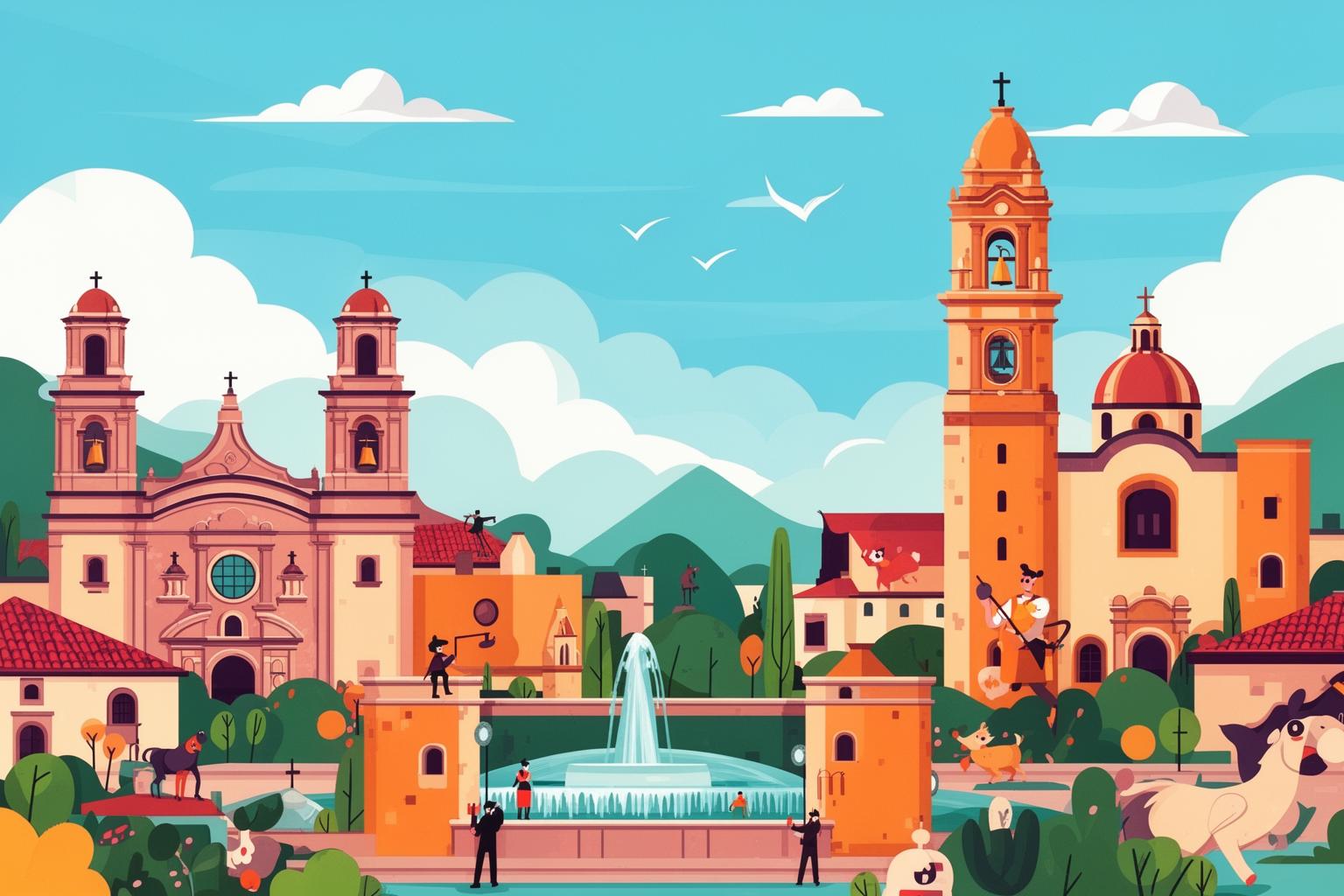
To fully grasp the extent of Orozco’s genius, one must visit Guadalajara, the capital of his home state. And in Guadalajara, the essential destination is the Hospicio Cabañas. This grand neoclassical complex, a UNESCO World Heritage site, was built in the early 19th century as a charitable institution—serving as an orphanage, hospital, and refuge for the vulnerable. Its tranquil courtyards and elegant arches evoke a sense of peace and order. Then you enter the main chapel. And you look up.
What Orozco achieved here between 1937 and 1939 is nothing less than a masterpiece: a series of 57 magnificent frescoes often referred to as the “Sistine Chapel of the Americas.” But while Michelangelo celebrated the glory of God, Orozco depicted the epic, often harsh, story of humanity. The entire space—the dome, the vaults, the walls—pulsates with his vision. He expertly fused his paintings with the building’s architecture, creating a fully immersive experience. The frescoes tell the history of Mexico, from its pre-Hispanic origins and the violent upheaval of the Spanish Conquest to the trials of the modern mechanized world. His figures are far from idealized heroes; they are flesh and spirit, caught in the relentless machinery of history.
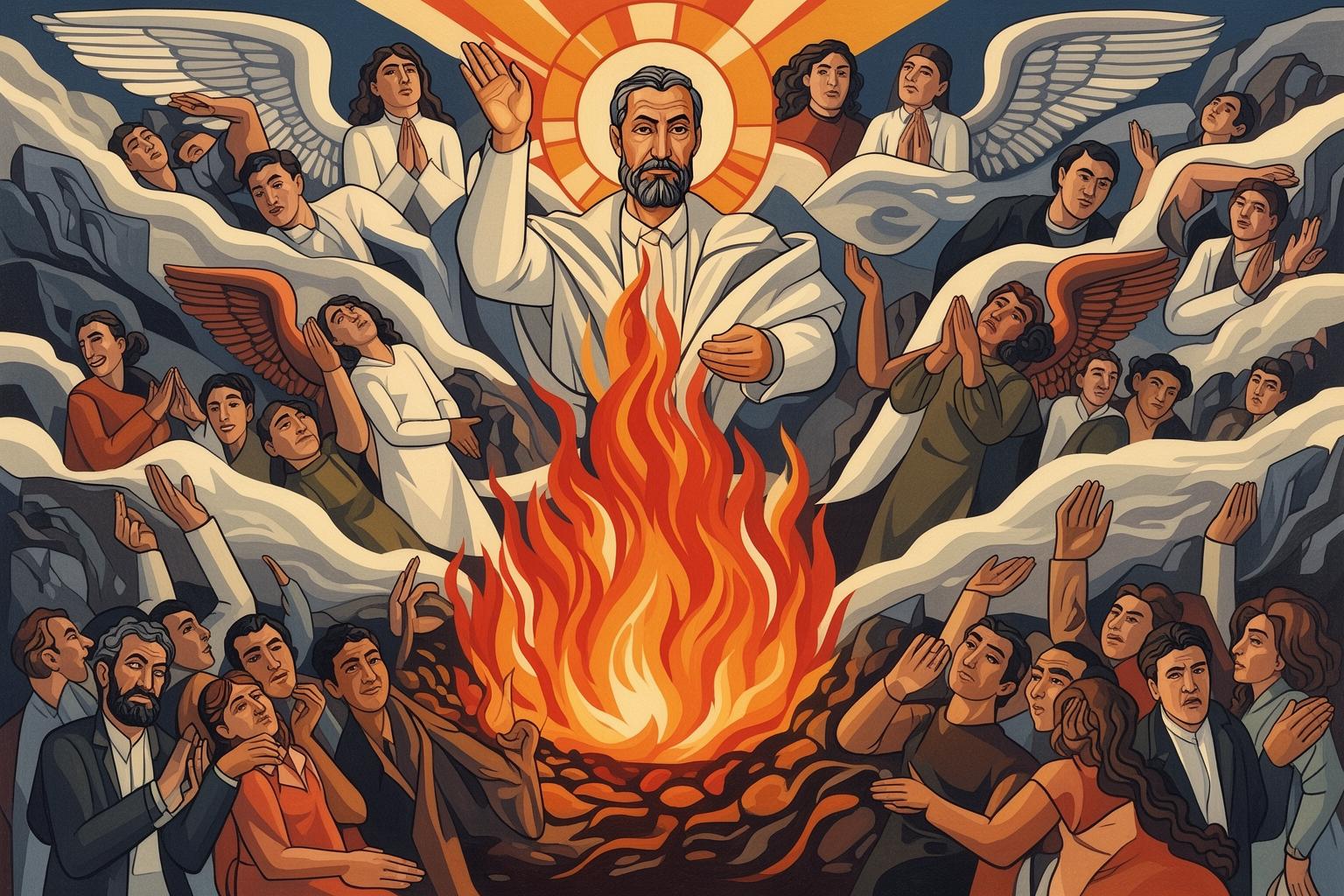
At the heart of it all, in the soaring dome of the chapel, is his most iconic work: El Hombre de Fuego (The Man of Fire). Looking up at the dome, you see a colossal human figure rising through smoke and flame, his form radiating pure energy. He is encircled by three other figures, rendered in stark grays, representing the classical elements of earth, air, and water. Is this Man of Fire a creative genius like Prometheus, stealing fire from the gods to enlighten humanity? Or is he a destructive force, a herald of apocalyptic flames? Orozco leaves this question open. The figure embodies the duality of the human spirit—our capacity for divine creativity and our potential for devastating self-destruction. Lying on the benches directly beneath the dome and gazing up into this swirling cosmos of paint is a profound, almost spiritual experience. You sense the motion, the power, and the immense philosophical gravity of Orozco’s vision.
A Journey into the Flames
Visiting the Instituto Cultural Cabañas, as it is now called, demands a significant time and emotional commitment. Plan to spend at least three to four hours here. Many visitors mistakenly focus only on the Man of Fire, but the surrounding frescoes are equally powerful. Follow the narrative Orozco presents, from scenes of ancient rituals to the haunting, faceless figures of modern dictators. The Cabañas is situated in the eastern part of Guadalajara’s historic center, easily accessible on foot. The sense of place is overwhelming; you stand in a space designed to protect the vulnerable, while above you on the ceiling unfurls a raw, powerful, and deeply compassionate exploration of the human condition, painted by an artist unafraid to confront the truth.
Palacio de Gobierno: The People’s History
A short walk from the Cabañas, facing the beautiful Plaza de Armas, stands the Palacio de Gobierno de Jalisco, the state government palace. Step into its historic courtyard and ascend the main staircase. Here, Orozco unleashes another torrent of historical drama. This space is dominated by a colossal, fiery figure of Miguel Hidalgo y Costilla, the priest who ignited the Mexican War of Independence in 1810.
This is no conventional portrayal of a national hero. Orozco’s Hidalgo is a complex, tormented giant. His face is a mask of anguish and resolve. In one hand, he wields a fiery torch, symbolizing both enlightenment and the violent overthrow of the old colonial order. He is a force of nature, a hurricane of history. Below him, the world writhes in chaotic conflict between rival ideologies, depicted by hammer-and-sickle and swastika flags. Orozco uses the very architecture of the staircase to make the mural confrontational. As you climb, you must look up into Hidalgo’s intense gaze, becoming part of the unfolding historical drama. It’s a masterful work of public art, a daily reminder to the state’s legislators of the violent, idealistic, and tragic origins of their nation.
Steps of Revolution
Entry to the Palacio de Gobierno is free, making it one of Guadalajara’s most accessible and impactful art experiences. The best time to visit is during daylight hours when natural light floods the courtyard, illuminating the mural’s rich, earthy hues. This is a place of constant movement, with government workers and citizens passing through, yet everyone seems to pause, if only for a moment, to look up at the imposing figure on the ceiling. This mural is not housed in a museum; it is part of the living, breathing political life of the city, exactly as Orozco envisioned.
Echoes Across Borders: The American Sojourn
Orozco’s intense critique extended beyond his homeland. While living in self-imposed exile in the United States from 1927 to 1934, he was commissioned to create a mural cycle in the Baker Memorial Library at Dartmouth College in Hanover, New Hampshire. The result, The Epic of American Civilization, is a monumental work regarded as one of the greatest achievements in American public art. Rather than celebrating history, the mural offers a sweeping, critical exploration of the Americas, from the arrival of the serpent-god Quetzalcoatl to the sterile, lifeless conformity of modern industrial society.
Comprising powerful panels that line the library’s reserve reading room walls, Orozco tells a story of ideals found and lost. He portrays the harmony of the pre-Columbian world, the brutality of the conquest, and the emptiness of a modern society obsessed with nationalism and materialism. One of the most striking panels, Gods of the Modern World, depicts skeletons in academic robes indifferently overseeing the stillbirth of knowledge—a sharp critique of an education system he believed had become disconnected from life itself. Creating such a critical work at the heart of an elite American university required immense artistic bravery. Now a National Historic Landmark, the mural exemplifies the universality of Orozco’s vision. He was not merely a Mexican painter but an artist of the human condition, whose fire could expose the hypocrisies of any society.
The Unquenchable Flame
A journey through the world of José Clemente Orozco is an intense, demanding, and ultimately transformative experience. It invites us to view history not as a mere collection of dates and facts, but as a living, breathing, and often painful struggle. His murals are challenging; they offer no comfort or simple answers. Instead, they pose difficult questions and compel us to confront the darkness that exists alongside the light within both our societies and ourselves. From the volcanic soil of Zapotlán to the revered halls of Mexico City and Guadalajara, and even to the quiet libraries of New England, Orozco left a legacy etched in fire and pigment. To stand before his work is to feel the heat of that fire and engage in a silent, powerful conversation with a giant who saw the world with unflinching clarity and dared to paint what he observed. His voice still roars from the walls, a testament to the enduring power of art to reveal the truth, no matter how terrible or magnificent that truth may be.