
There are films that entertain, films that make you think, and then there are films that burrow into your soul and take up permanent residence. Roberto Benigni’s 1997 masterpiece, La Vita è Bella, or Life Is Beautiful, is one such film. It’s a cinematic fable that dares to find laughter in the darkest of shadows, a story that champions the defiant power of imagination against the brutal machinery of history. For so many of us, the story of Guido Orefice, his “Principessa” Dora, and their son Giosuè is not just a movie; it’s a testament to the resilience of the human spirit. And the sun-drenched, terracotta-roofed town that served as the vibrant backdrop for their love story, their joy, and their heartbreaking farewell is just as much a character as any of them. That town is Arezzo, a jewel nestled in the rolling hills of eastern Tuscany, a place where the echoes of Guido’s cheerful “Buongiorno, Principessa!” still seem to dance on the ancient cobblestones. To walk through Arezzo is to step inside the frame of the film, to feel the warmth of Guido’s love and the sharp sting of his sacrifice. It’s more than a visit to a film set; it’s a pilgrimage to the heart of a story that taught the world that even in the face of unimaginable horror, life can, indeed, be beautiful. This journey through its streets is an invitation to reconnect with that powerful message, to see the world through Guido’s hopeful eyes, and to discover the enduring magic woven into the very fabric of this timeless Tuscan town.
For more on how a city can become a character in a beloved story, consider a literary pilgrimage to the sublime city from ‘Her’.
The Grand Stage of a Fable: Piazza Grande
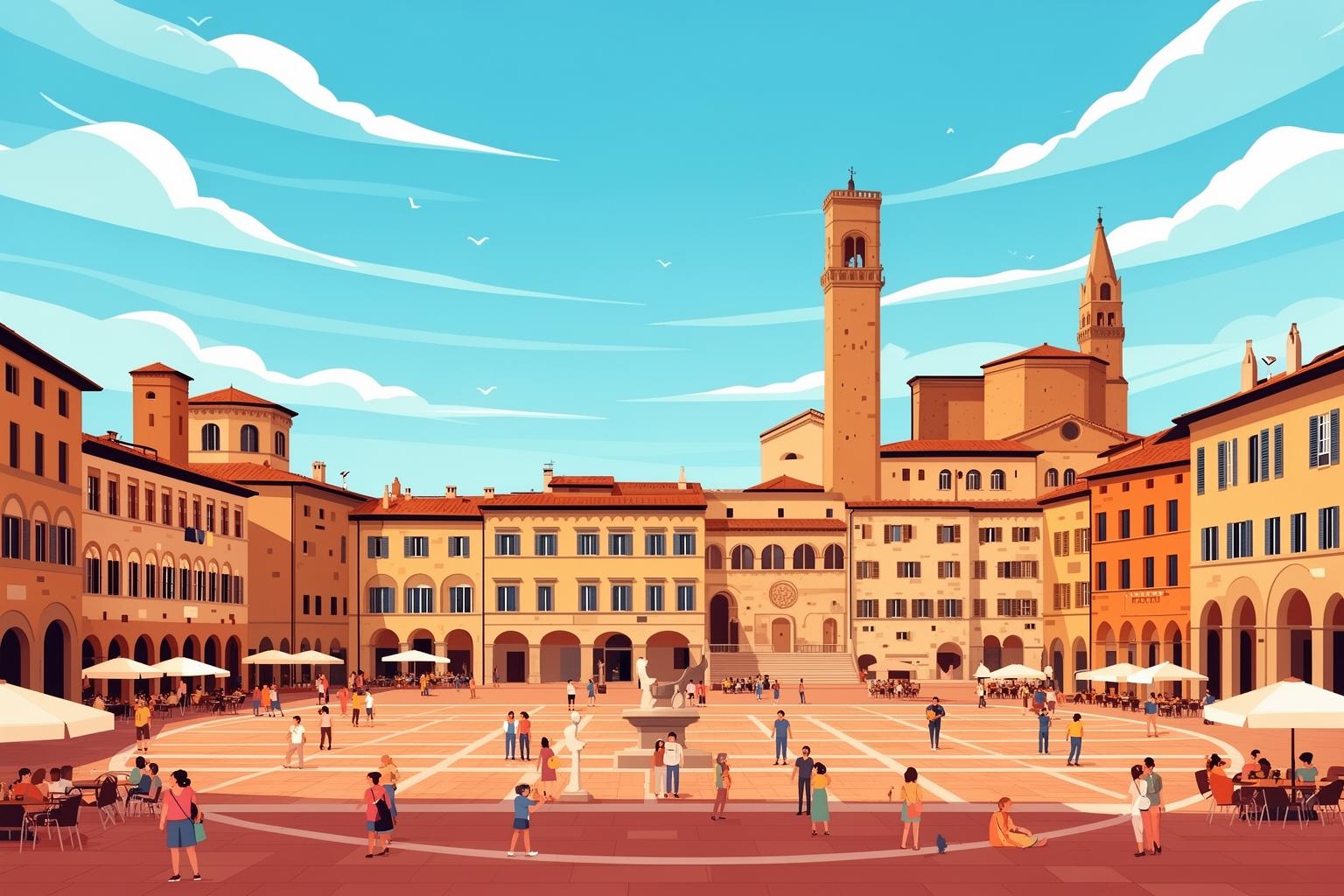
Every great story requires a grand stage, and for Life Is Beautiful, that stage is unquestionably the magnificent Piazza Grande. This piazza is not defined by perfect, symmetrical lines; instead, it’s a stunningly unique, steeply sloping trapezoid of a square—a blend of architectural history where medieval towers stand side-by-side with the graceful Renaissance curves of the Vasari Loggia. It feels less like a deliberately planned civic center and more like a space that has evolved naturally with the town over centuries, carrying its stories, festivals, and sorrows. Standing at its highest point, near the apse of the Pieve di Santa Maria, and gazing across the vast stone expanse is to sense the very heartbeat of Arezzo. This is the spirit of the film’s first act, the lively setting for Guido’s most iconic and theatrical declarations of love.
The Morning Princess
Close your eyes for a moment and you can hear it: the rickety, cheerful clatter of a bicycle rushing down the slope, brakes squealing in protest. This is where Guido, with Giosuè perched in a basket on the handlebars, makes his unforgettable entrance, wildly pedaling his green bicycle through what he pretends is an empty square, shouting his love for his princess into the air. “Buongiorno, Principessa!” The cry bounces off the stones, a sound of pure, unfiltered joy. Standing here, you can follow his path—from the top of the square, past the medieval well, and down toward the lower arcade. The slope is much steeper in reality than it appears on screen, which only makes Benigni’s stunt all the more impressive. It’s a scene so filled with contagious happiness that it’s impossible not to smile as you replay it in your mind. The piazza itself seems to join in the moment, its irregular shape enhancing the playful, chaotic energy of Guido’s ride. You can almost feel the warm Tuscan morning sun on your face as you picture him speeding by, a man so in love that the laws of gravity and decorum no longer apply.
A Sanctuary in the Rain
The piazza also serves as the backdrop for one of the film’s most tenderly romantic moments. During a sudden rain shower, Guido and Dora find refuge beneath the arches of the Vasari Loggia. This elegant portico, designed by the renowned Aretine artist and architect Giorgio Vasari, becomes their spontaneous sanctuary. As the rain falls, creating a shimmering veil between them and the outside world, Guido, ever the magician, crafts a moment of pure magic. He casually mentions wanting to see Dora again, just as a voice calls out from the shadows, “Maria, the key!” Seizing the chance, he pretends the call is meant for him and, with flair, catches a key tossed from an upper window. It is a perfect act of stagecraft, a testament to his talent for bending reality to match his romantic desires. Standing under that loggia today, you can feel the intimacy of that scene. You can run your hand along the cool stone columns and gaze out at the rain-slick piazza, imagining the patter of raindrops and the soft glow of lamps. The world outside slips away, and for a moment, you step inside their private bubble of blossoming love—a realm where anything is possible and every coincidence seems like a sign from the universe.
Echoes of Grandeur: Cathedrals and Theaters
Guido’s courtship of Dora is a performance, a grand opera of romantic gestures set against the backdrop of Arezzo’s most magnificent landmarks. He knows that a love as grand as his demands an equally impressive stage. The town’s towering churches and elegant theater become the scenes for some of his most memorable and heartfelt efforts to win her affection, blending his humble charm with the monumental beauty surrounding him. These locations transform his simple acts of love into something timeless and legendary.
A Carpet for a Queen: The Cattedrale dei Santi Pietro e Donato
Situated at the city’s highest point, the Arezzo Cathedral, with its commanding presence and soaring Gothic architecture, stands as a beacon of spiritual and historical significance. Its stained-glass windows, masterpieces by 16th-century French artist Guillaume de Marcillat, fill the interior with jewel-toned light, while the walls house priceless art, including a moving fresco of Mary Magdalene by Piero della Francesca. It is a place of reverence and quiet reflection. Yet it is on the grand stone steps outside this sacred space that Guido carries out one of his most daring and beautiful gestures. As Dora and her stuffy fiancé emerge from the cathedral after meeting with city officials, they find Guido, ever the opportunist, waiting for them. Just as a sudden rainstorm begins, he unrolls a long, vibrant red carpet down the stone steps for her, announcing, “Your servant, princess! I have unrolled it just in time!” He turns a simple, wet staircase into a royal pathway, treating his beloved librarian like a queen. Standing on those very steps today, one can still sense the power of that simple act. The contrast between the ancient, imposing cathedral facade and the fleeting, vivid red of the imagined carpet perfectly symbolizes the film itself—the resilience of human warmth and color against a cold, forbidding world. It’s a moment that encapsulates Guido’s philosophy: with enough love and imagination, the ordinary world can be made magical.
An Unforgettable Night: The Teatro Petrarca
The Teatro Petrarca is a classic 19th-century Italian opera house, a realm of red velvet, gilded balconies, and hushed anticipation. It represents the high society from which Dora comes—a world of sophistication and strict rules that Guido joyfully flouts. Here, while attending a performance of Offenbach’s The Tales of Hoffmann with her fiancé, Dora finds her thoughts drifting toward the charming, humorous man who keeps crossing her path. Guido, working as a waiter, knows she is present. In a moment of sublime connection that transcends social divides, he uses the power of the opera itself to reach her. Through a series of cleverly orchestrated tricks involving his uncle, he arranges for the stage lights to focus on Dora in her private box just as the enchanting Barcarolle begins to play. Then, from somewhere backstage, his voice seems to join the music—a secret message carried on the melody, meant only for her. It is a scene of breathtaking romance, where music and light conspire to create a moment of pure, undeniable connection. Visiting the Teatro Petrarca today, even when it is empty and silent, you can still feel the echo of that music. You can gaze up at the elegant tiers of boxes and imagine Dora, bathed in light, realizing that Guido’s love is no joke, but a force as powerful and moving as the opera itself. It is a reminder that the grandest gestures often arise not from wealth or status, but from a heart clever enough to speak the language of art and music.
The Tapestry of Daily Life: Streets, Schools, and Shops
While the grand piazzas and theaters serve as the backdrop for Guido’s public declarations, the true heart of the film lies within the quieter, everyday spaces of Arezzo. It is in the narrow, winding streets, the lively schoolyards, and the modest storefronts that the fabric of Guido and Dora’s shared life is woven. These locations anchor the fairy-tale romance in a tangible reality, making the story’s eventual shift all the more heartbreaking. Walking through these parts of town is like flipping through a family photo album, with each corner unveiling another intimate memory of their life before the storm.
Lessons in Laughter: The Scuola Elementare Gamurrini
Just off Piazza Grande, the imposing Scuola Elementare Gamurrini is the school where Dora is a cherished teacher. Here, in one of the film’s most clever and subversive scenes, Guido impersonates a school inspector from Rome to gain a chance to see her. Entering her classroom under false pretenses, he forgoes inspecting the facilities and instead delivers a lecture on racial superiority that is a masterclass in satirical comedy. Standing on a desk and stripping down to his undershirt to showcase the flawless “Italian earlobe” and the perfect “Aryan navel,” he highlights the absurdity of fascist ideology by pushing it to its most ridiculous extreme. He doesn’t merely mock the regime; he dismantles its hateful pseudo-science with humor, all while trying to catch the eye of the woman he loves. The scene balances comedy and dread, perfectly capturing the film’s distinctive tone. Today, standing outside the school’s large windows, one can imagine the children’s faces—first puzzled, then erupting in laughter. You can picture Dora struggling to keep her composure while falling ever deeper in love with this brilliant, eccentric man. The school stands as a tribute to Guido’s courage—not that of a soldier, but the bravery of a jester who dares to reveal the truth by making the powerful look ridiculous.
A Dream in Waiting: Via Borgunto and the Bookshop
Guido’s greatest dream is simple: to open his own bookshop. It’s a vision of a life filled with stories, knowledge, and peaceful quiet. The location he desires, an empty storefront owned by a friend of his uncle, recurs as a motif in the film. The actual shop used in filming sits on the charming Via Borgunto, a narrow medieval street that feels worlds away from the grandeur of the main piazza. Today, this space is no longer a bookshop, but its facade remains instantly recognizable. It is in front of this shop that Guido shares his plans for the future—a future where he, Dora, and Giosuè live surrounded by the magic of books. It symbolizes hope, independence, and the quiet dignity of a life well-lived. Later, after Guido and Giosuè are taken away, Dora frantically cycles down this very street, her desperate search serving as a heartbreaking counterpoint to Guido’s earlier joyful rides. The street and shop become symbols of a stolen dream. Walking down Via Borgunto today, with its artisan shops and residential doorways, feels deeply intimate. It is a space of domestic dreams, a quiet corner of Arezzo holding both the promise of a beautiful life and the profound sorrow of its interruption. It reminds us that the greatest tragedies of history are not mere statistics; they are the sum of millions of small, beautiful dreams—like opening a bookshop on a quiet street—that were never allowed to be fulfilled.
Living the Story: A Practical Guide to Your Arezzo Pilgrimage
A journey to Arezzo is a trip into the very heart of Tuscany, and a bit of preparation can help you fully immerse yourself in the experience, allowing the magic of the film and the charm of the town to envelop you without the distraction of logistical concerns. Arezzo is a town that rewards slow, thoughtful exploration—a place best savored at a leisurely pace, inviting spontaneous discoveries and quiet moments of reflection.
Discovering Tuscany’s Hidden Gem
Arezzo is remarkably accessible, making it an easy addition to any Italian itinerary. The town sits on the main railway line between Rome and Florence. Frequent and reliable trains run throughout the day, making a day trip from Florence (about an hour away) or a longer visit from Rome (around two hours) very convenient. The train station is just outside the old city walls, and a short, pleasant uphill walk leads directly into the historic center. For those who prefer driving, Arezzo is located just off the A1 Autostrada, the main highway that runs the length of Italy. Driving lets you explore the surrounding Tuscan countryside with its rolling hills, vineyards, and charming hilltop towns. However, keep in mind that driving inside the ancient walls of Arezzo is heavily restricted (watch for the ZTL or “Zona Traffico Limitato” signs). It’s best to park in one of the many lots outside the city center and explore the town on foot. The true beauty of Arezzo emerges in its walkable streets, where every corner reveals a new view and a potential film location.
The Pace of Arezzo: When to Visit and What to Expect
Like much of Tuscany, Arezzo is at its most beautiful in spring (April to June) and autumn (September to October). During these months, the weather is pleasantly warm, the countryside lush and colorful, and the crowds smaller than in the peak summer season. The light is soft and golden, ideal for photography and evoking that sun-drenched cinematic atmosphere. Summer can be quite hot, but the town buzzes with energy and outdoor dining. A particularly special time to visit is on the first Sunday of each month (and the preceding Saturday), when Piazza Grande and the surrounding streets transform for the Fiera Antiquaria, one of Italy’s largest and most famous antique fairs. The piazza hums with hundreds of vendors selling furniture, art, books, and curiosities, creating a lively atmosphere that feels like a step back in time. Twice yearly, in June and September, Piazza Grande hosts the Giostra del Saracino (Saracen Joust), an exhilarating medieval tournament where the city’s quarters compete in a spectacular display of pageantry and horsemanship. Planning your visit around one of these events offers a richer glimpse into Arezzo’s living culture and traditions.
A Taste of Guido’s World: Enjoying Local Cuisine
To truly experience Arezzo, you must taste it. Tuscan cuisine is rustic, hearty, and flavorful, built around simple, high-quality local ingredients. The town is dotted with charming trattorias, osterias, and restaurants where you can savor these flavors. Look for dishes unique to the region. Begin with an antipasto of local cured meats (salumi) and cheeses (pecorino), perhaps accompanied by a drizzle of local honey. For your first course, try a thick, comforting soup like Pappa al Pomodoro (bread and tomato soup) or Ribollita (a hearty vegetable and bean soup). Handmade pastas are a must; seek out pici, a thick, hand-rolled spaghetti often served with rich meat or garlic and tomato sauce. For the main course, Tuscany’s grilled meats are legendary, especially the famous Bistecca alla Fiorentina. Pair your meal with a local red wine, such as a Chianti Classico from the nearby hills. Don’t hesitate to stray from the main streets and discover a small, family-run trattoria. Here you’ll find the most authentic food and warmest hospitality—a taste of the simple, beautiful life that Guido cherished.
Beyond the Frame: The Deeper Soul of Arezzo
While Life Is Beautiful has forever enshrined Arezzo in the hearts of film enthusiasts, the town’s own history is far older and richer than any single film can convey. To stroll through its streets is to journey across layers of history, from its ancient Etruscan roots to its rise as a powerful medieval city-state and its contributions to the Renaissance. Appreciating this deeper context enhances the film pilgrimage, lending greater meaning and poignancy to Guido’s fictional story.
Arezzo was one of the twelve key cities in the Etruscan federation long before Rome became dominant. Later, as a Roman city, it gained renown for its distinctive coral-red pottery. In the Middle Ages, it evolved into a free commune, fiercely rivaling neighbors Florence and Siena. This period gave the city its proud towers and magnificent Romanesque and Gothic churches, such as the Pieve di Santa Maria with its remarkable facade of tiered columns. The city also produced extraordinary figures who shaped Western culture: Petrarch, the father of humanism; Guido of Arezzo, the inventor of modern musical notation; and Giorgio Vasari, the painter, architect, and art historian whose work defines much of Arezzo’s Renaissance character. This heritage of art, innovation, and proud independence remains evident in the city’s architecture and civic spirit.
Yet Arezzo also shares in the darker history of 20th-century Italy. The film’s narrative is not pure fiction; it unfolds against the very real backdrop of Mussolini’s Fascist regime and the 1938 racial laws that deprived Jewish citizens of their rights, livelihoods, and, in many cases, their lives. Following Mussolini’s fall and the 1943 Italian armistice, northern and central Italy, including Arezzo, fell under German occupation. The deportation of Italian Jews to concentration camps, as depicted in the film, was a tragic reality. Arezzo itself endured heavy bombing during the war. Knowing this history deepens the impact of Guido’s fable. His relentless campaign of joy and imagination does not occur in isolation; it is a direct act of defiance against a harsh reality aiming to crush the human spirit. Thus, the beautiful, sunlit streets of Arezzo are more than just a scenic backdrop. They stand as silent witnesses to both the pinnacle of human creativity and the abyss of human cruelty. The city’s lasting beauty becomes a symbol of survival, a testament to the truth that even after the darkest storms, art, love, and life can thrive once more.
Reflections in a Tuscan Sunbeam
Leaving Arezzo feels like awakening from a vivid and powerful dream. The characters of Life Is Beautiful seem so real here that you almost expect to see Guido cycling by or hear Giosuè’s laughter echoing through a hidden alley. The town is more than just a collection of filming locations; it serves as a vessel carrying the emotional truth of the story. It reminds you that joy and sorrow are not mutually exclusive but often deeply intertwined, like the sun and shadows playing across the Piazza Grande.
The film’s lasting brilliance lies in its delicate balance. It neither shies away from the horrors of the Holocaust nor avoids viewing them through a lens of radical love. Guido’s great “game” is not a denial of the concentration camp’s reality but a shield forged from imagination to protect his son’s innocence. It is a desperate, beautiful, and ultimately heart-wrenching act of fatherly love. Arezzo, the setting for the story’s sunlit first half, represents the world he strives to preserve for Giosuè—a world of beauty, serendipitous encounters, grand romantic gestures, community, and simple, profound happiness.
As you wander the streets one last time, perhaps sitting at a café in the Piazza Grande with a cappuccino, you realize the pilgrimage is not merely about finding the exact filming locations. It’s about absorbing the atmosphere that made such a story possible. It’s about understanding that the capacity for great love and creativity, embodied by Arezzo’s long history, is the ultimate antidote to hatred and destruction. Both the film and the city teach the same lesson: the human spirit has an infinite capacity for resilience. Guido’s story ends in tragedy, but his victory is eternal. He wins because he ensures his son survives—not only physically but with his soul and capacity for joy intact. He wins because he fills his son’s final memories of him with laughter and love. Standing in the heart of Arezzo, under the warm Tuscan sun, you feel the profound truth of that victory. Life isn’t always easy, and often it is cruel. But in moments of connection, in shared laughter, and in bold declarations of love shouted in a public square, it is, and always will be, beautiful.