
To know Edgar Degas is to know Paris. Not the romanticized, postcard Paris of sweeping vistas and grand lovers, but a city of stolen glances and candid moments. A world of gaslit stages, rain-slicked boulevards, and the quiet intimacy of a woman bathing. Degas was less a painter and more of a journalist with a brush, a chronicler of modern life in all its unposed, fleeting beauty. He captured the in-between moments—the yawn of a dancer, the slouch of a patron at a café, the exhaustion after a performance. To follow in his footsteps is to embark on a journey not just to physical locations, but into a specific way of seeing the world. It’s a pilgrimage for the observer, for the one who finds profound beauty in the ordinary. Our journey begins in the heart of the 19th-century art world, a Paris brimming with revolution, industry, and a new kind of urban poetry. We’ll walk the same streets, breathe in the air of the same theaters, and stand before the same canvases that he once copied, all to understand the man who saw the world in frames of fleeting, brutal honesty. Before we step into the gaslit glow of the opera or the bustling streets of Montmartre, let’s orient ourselves in the city that was both his canvas and his muse.
This artistic pilgrimage to understand a master’s vision is similar to the journey one can take to explore the world of Francisco Goya in Spain.
The Heartbeat of Paris: The 9th Arrondissement and the Opéra Garnier
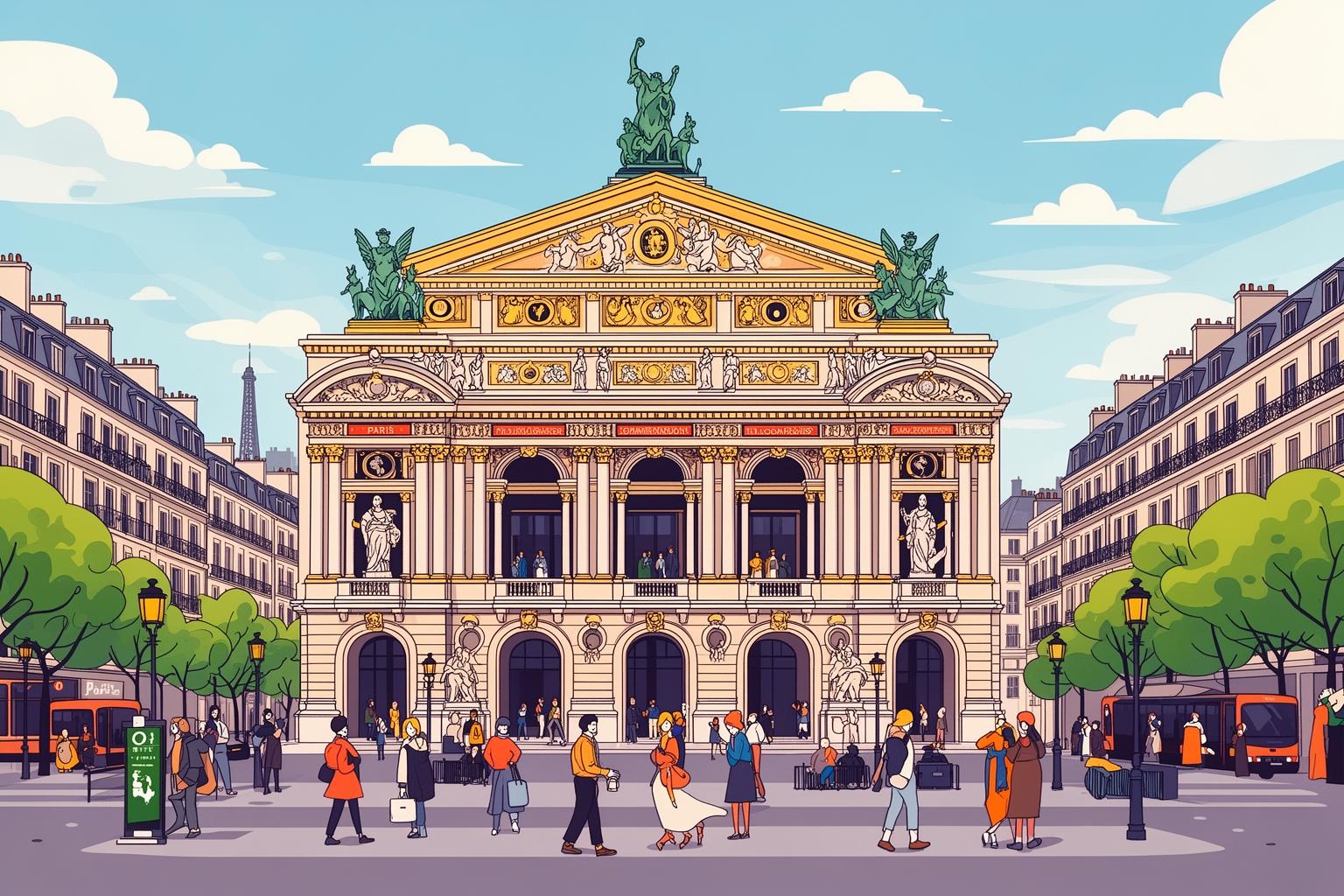
To discover the soul of Degas’s Paris, you must start in the 9th arrondissement. This was his neighborhood, his stomping ground, his universe. Born on Rue Saint-Georges, he spent almost his entire life living and working within this vibrant, chaotic, and quintessentially Parisian district. It stood at the heart of Haussmann’s new Paris, a place of grand boulevards, bustling department stores, and, most importantly, the magnificent Palais Garnier, the opera house that became his most enduring obsession. Walking here today, you can still sense the rhythm he must have felt—the click of heels on pavement, the murmur of conversations spilling from cafés, the distant tuning of an orchestra. It’s a sensory experience that connects you directly to the world he painted.
The Palais Garnier: A Universe on Stage
No place is more closely associated with Edgar Degas than the Opéra Garnier. To him, it wasn’t just a building; it was a microcosm of society, a laboratory for his studies of light, movement, and the human form under pressure. As a subscriber, he enjoyed privileged access to every corner of this gilded palace, from the plush velvet seats of the auditorium to the dusty, arduous world backstage. This duality lies at the heart of his work: the contrast between the effortless illusion presented to the audience and the sweat-soaked reality of the dancers.
Visiting the Opéra Garnier today is like stepping into one of his paintings. The Grand Staircase, a masterpiece of marble and gold, still feels like a stage for the Parisian elite, just as he portrayed it. As you ascend, imagine the rustle of silk gowns and the hum of anticipation. But to truly understand Degas, you must go beyond the public glamour. If possible, take a guided tour that offers a glimpse of the backstage areas. Although the famed Foyer de la Danse—the rehearsal room behind the stage where dancers warmed up and mingled with wealthy male patrons—is rarely open to the public, simply knowing its location enriches your appreciation of his paintings. He captured this space not as a place of glamour but of hard work. This is evident in the casual postures, the strained muscles, and the unsmiling faces of young women waiting for their cue. He reveals the tired, the bored, and the dedicated artists behind the fantasy.
Standing in the auditorium and looking towards the stage, framed by opulent red and gold, you come to understand his fascination with perspective. His compositions often feel radical, cropped like photographs, with figures cut off at the edge of the canvas. Sitting in the orchestra pit, he would gaze up at the dancers, creating the dramatic, almost voyeuristic angles seen in paintings like The Orchestra of the Opera. When visiting, try to find different vantage points—look down from a side box, stand at the back of the stalls—and feel how the space shifts your perception of the stage. This was Degas’s approach—he was a director, a choreographer of sightlines.
Practical Notes for the Modern Pilgrim
Visiting the Opéra Garnier requires some planning. You can tour the public spaces during the day or book tickets for a ballet or opera performance. I highly recommend the latter. Sitting in the dark and watching the curtain rise is experiencing the magic that captivated him. The atmosphere is electric, a living tradition that links you directly to his era. Dress for the occasion; while there’s no strict dress code, Parisians treat an evening at the opera as an event. A simple, elegant dress or a smart blazer suits the setting perfectly and honors the sense of occasion. Be mindful of your belongings, especially in the crowded foyers before a show. A small, secure bag is always a wise choice in any grand Parisian venue. The nearest metro stops—Opéra (Lines 3, 7, 8) and Chaussée d’Antin – La Fayette (Lines 7, 9)—make access easy. After your visit, wander the nearby streets. The grand department stores of Printemps and Galeries Lafayette lie just a block away, their own stages of modern life that would have intrigued Degas.
Montmartre: The Gritty Muse of Modernity
While the 9th arrondissement was Degas’s residence, the neighboring hill of Montmartre served as his artistic playground. In the late 19th century, Montmartre was worlds apart from the bourgeois sophistication of the Opéra district. It was a rustic, semi-rural village on the city’s edge, dotted with windmills, quarries, and working-class cabarets. This was the birthplace of Impressionism, and although Degas famously rejected the label—insisting, “I am a Realist”—he was a vital member of this groundbreaking circle. He captured the essence of Montmartre not through its sunlit landscapes but through its shadowy interiors and intricate social fabric.
Cafés and Concerts: Painting the Urban Spectacle
Degas excelled at portraying the café-concert scene. Venues like the Ambassadeurs or the Alcazar were the lively, noisy, and slightly disreputable centers of Parisian nightlife. In his paintings, he doesn’t offer a glamorous overview; instead, he immerses us in the crowd. We find ourselves at a marble-topped table, smelling the smoke and hearing the piercing voice of the singer on stage. His renowned piece, At the Café-Concert, is a masterclass in social observation. The singer, a burst of red and yellow, belts out a tune, but the focus is on the detached, almost melancholic expressions of the audience. He was intrigued by the isolation one could feel within a crowd—a distinctly modern feeling.
To experience this spirit today, you must stray from the tourist-filled Place du Tertre. Wander down Rue Lepic, where the Moulin de la Galette still stands as a reminder of the dance halls Renoir and Van Gogh also depicted. Although the original bohemian cabarets are gone, the atmosphere remains in the smaller bars and bistros lining the winding streets. Find a small café, order a coffee or absinthe if you dare, and simply watch. Observe the interactions, the expressions, the way light filters through the window. This is the Degas approach—not about pinpointing the exact spot he painted but about adopting his way of seeing. He was an urban anthropologist, and Montmartre was his fieldwork.
The View from the Studio
Degas maintained several studios in this area, particularly near Place Pigalle and Place de Clichy. This was not the charming, romantic Montmartre of the Sacré-Cœur, which was just beginning construction during his lifetime. Instead, it was the lower, rougher part of the hill, an area of constant movement and social tension. His studio was his refuge, a private space to process the world he observed outside. Here, he created his most intimate works—a series depicting women bathing, combing their hair, or stepping out of tubs. These pieces were controversial, seen by some as voyeuristic. But for Degas, they represented an exercise in pure form, capturing the unguarded, unposed female body. He called it “seeing through the keyhole.” He aimed to portray women as if unaware of being observed, in their natural state, free from social artifice.
Walking around Place de Clichy today, you are in the heart of this reality. The area remains a major transportation hub, buzzing with activity. It may not be traditionally beautiful, but it is authentic and vibrant. This was his inspiration. He was drawn to the truth found in movement and the honesty of unposed moments. As a solo traveler, especially at night, it’s wise to stay alert in this area. Stick to well-lit main streets and carry yourself confidently. This practical caution is, in a way, part of the Degas experience—he was, above all, a keen and unsentimental observer of his surroundings.
The Halls of Inspiration: The Louvre and Musée d’Orsay
A pilgrimage to Degas’s Paris is incomplete without visiting the two monumental museums that frame his career: the Louvre, where he learned from the masters, and the Musée d’Orsay, where his own masterpieces now reside.
The Louvre: A Young Artist’s Education
Long before becoming an Impressionist iconoclast, Degas was a devoted student of the classics. In the 1850s, he enrolled as a copyist at the Louvre, a common practice for aspiring artists. He spent countless hours in its vast galleries, meticulously sketching and painting works by Italian Renaissance masters and French classicists like Ingres, whom he deeply admired. He believed that all great art was built on the foundation of the past. His goal wasn’t to imitate, but to deconstruct and comprehend. He studied their use of line, composition, and form, internalizing lessons that he would later apply to his radically modern subjects.
Walking through the Denon Wing of the Louvre today is to follow in his early footsteps. Stand before paintings by Mantegna or Veronese and try to see them through his eyes. Notice the powerful contours, the intricate arrangement of figures, the psychological depth. You can almost sense the young, intense artist beside you, sketchbook in hand, soaking in the secrets of the masters. This context is crucial. It shows that his later innovations—the cropped compositions, the unusual angles—were not accidental, but born from a deep and profound understanding of art history. He broke the rules because he had mastered them first.
Visiting the Louvre can be daunting. My advice is not to try to see everything. Before you go, identify the specific galleries you want to explore—the Italian and French painting sections are essential for a Degas-themed visit. Arrive early on a weekday to avoid the largest crowds. Allow yourself time to sit and truly observe a few key pieces, just as he would have done. It’s about quality of observation, not quantity.
The Musée d’Orsay: The Triumphant Homecoming
If the Louvre was his school, the Musée d’Orsay is his monument. Housed in a magnificent former railway station, the Orsay holds the world’s most extensive collection of Impressionist and Post-Impressionist art, with an entire section dedicated to Degas. Stepping into these rooms is breathtaking. It is here that the full range of his genius is revealed. You move from early, classically influenced portraits to the vibrant chaos of the racetrack, from the quiet intimacy of the milliner’s shop to the explosive energy of the ballet.
Seeing his works in person is a revelation. The pastels, in particular, are extraordinary. No reproduction can capture the raw, textured brilliance of his strokes. In works like The Star (L’Étoile), you can feel the dancer’s energy as she takes her bow, the dusty light of the stage catching the tulle of her tutu. You also encounter his sculptures, most famously The Little Fourteen-Year-Old Dancer. The original was made of wax and dressed in a real fabric bodice and tutu—a revolutionary act of realism for its time. The bronze casts on view at the Orsay still retain that startling vulnerability and awkward grace. It’s a deeply moving piece, symbolizing the young, hardworking girls whose lives he chronicled.
Plan to spend at least half a day at the Orsay. The collection is vast. The fifth floor, home to the main Impressionist galleries, is bathed in natural light from the station’s great glass clock window, creating a beautiful, almost ethereal viewing experience. It’s a popular spot for photos, but take a moment to look beyond the crowds to the view of the Seine and the Tuileries Garden. Degas captured the soul of 19th-century Paris, and from this vantage point, you can see the city that shaped him—the city he made immortal.
Beyond Paris: Journeys of Discovery
While Paris remained the center of his universe, Degas’s art was also profoundly influenced by his travels. These journeys offered new subjects, fresh light, and a stronger connection to his heritage, enriching the work he ultimately created in his Paris studio.
Italy: In the Footsteps of the Renaissance
Between 1856 and 1859, Degas undertook a long, formative journey to Italy—a pilgrimage to the source. With family in both Naples and Florence, he immersed himself in the art of the Italian Renaissance. This was no mere tourist holiday but an intense period of study that cemented the classical foundations of his art. In Naples, where his paternal grandfather had settled, he painted the powerful and psychologically nuanced portrait of his family, The Bellelli Family. This masterpiece captures tension and unspoken domestic drama, composed with the formal rigor of a Renaissance master yet infused with a distinctly modern psychological realism.
Walking through Florence today, you can sense the artistic lineage that inspired him so deeply. Visiting the Uffizi Gallery and the Pitti Palace, where he would have spent hours studying works by Botticelli, Raphael, and his hero Mantegna, reveals the clarity of line and balanced composition he admired—qualities that became hallmarks of his own style and set him apart from the looser, more spontaneous brushwork of many Impressionist colleagues like Monet. A trip to Italy exposes the foundation of Degas’s art, revealing the classicist within the modernist rebel.
When in Florence, cross the Ponte Vecchio into the Oltrarno district—an artisan quarter filled with workshops and smaller studios. This quieter, more authentic area contrasts with the crowded city center and offers a glimpse into the kind of dedicated craftsmanship that Degas, a tireless experimenter with media, would have deeply respected.
Normandy: A Breath of Fresh Air
Degas also visited Normandy, spending time at the country estate Ménil-Hubert owned by his friend Paul Valpinçon. These trips provided a break from the intensity of Paris and introduced a new subject to his work: the landscape. Though not primarily known as a landscape painter, his Normandy scenes are subtle and beautiful, rendered in soft pastels that capture the region’s gentle light and rolling hills. More notably, Normandy was where he explored his passion for horses. The racetracks at Longchamp in Paris and in Normandy offered the perfect subject—a blend of controlled animal energy, modern social spectacle, and vibrant color. In works like The False Start, he captures the nervous, electric moment just before a race begins. The composition is radical, with horses and jockeys cropped and seen from unexpected angles, as if caught in a snapshot. He was fascinated by the anatomy of movement, the same curiosity that propelled his studies of dancers.
Traveling through the Normandy countryside today, especially in the Orne department where Ménil-Hubert is situated, you are struck by the peaceful, pastoral landscape. It is a land of apple orchards, stud farms, and quiet villages—offering a welcome contrast to Paris’s urban energy. For the art pilgrim, visiting a local racetrack or simply driving through the verdant countryside connects you to this less-explored aspect of Degas’s work. It reminds us that even this quintessentially urban painter drew inspiration from the natural world’s lines and forms.
New Orleans: An American Interlude
One of the most intriguing and unique chapters in Degas’s life was his five-month stay in New Orleans from 1872 to 1873. His mother came from a Creole family in the city, and he visited his brothers René and Achille, who had set up a cotton business there. This trip was a profound culture shock as well as a rich source of artistic inspiration. The sweltering heat, distinctive light, and complex social dynamics of the post-Civil War South were unlike anything he had encountered in Europe.
The centerpiece of his American work is A Cotton Office in New Orleans. This masterpiece of realism offers a groundbreaking depiction of modern commerce. Each figure in the painting is a portrait of a family member or business associate, caught in a moment of quiet, focused labor. It is a scene of calm industry while subtly documenting a specific moment in economic history. This work was Degas’s first painting purchased by a museum—a major milestone in his career.
Visiting New Orleans today feels like stepping into a world still distinct from the rest of America. The French Quarter, with its cast-iron balconies and hidden courtyards, retains the European charm familiar to Degas. The house where he stayed, now known as the Degas House, is a historic landmark functioning as both a bed and breakfast and a tour site. Standing on the balcony where he sketched the world passing below, you can almost sense his presence. Exploring the city—from the lively French Market to quieter residential streets—you encounter the unique light and shadows he captured. Taking a walking tour focused on the city’s Creole history enriches understanding of the complex family heritage that brought him here. New Orleans reveals a different Degas—an artist engaging with family, commerce, and a new, unfamiliar culture, channeling it all into his sharp, observant art.
The Final Years: A Solitary Vision

Degas’s later years were characterized by growing isolation. As his vision declined, he increasingly focused on sculpture, a medium he could navigate by touch, and on pastels, which enabled bold, direct strokes of color. He became a reclusive figure, a familiar yet distant presence on the streets of Montmartre, retracing the same paths daily. He passed away in 1917 and is buried in Montmartre Cemetery, close to the world he so diligently captured.
Concluding a pilgrimage at Montmartre Cemetery is a somber yet appropriate ending. It is a peaceful, beautiful, and deeply Parisian place—a city of the dead that reflects the life bustling outside its walls. Finding his modest family tomb offers a moment of quiet contemplation. Here rests the man who transformed art, who taught us to recognize beauty in the awkward, the ordinary, and the transient. He portrayed life as it was, not as it ought to be. Leaving the cemetery and stepping back into the lively, noisy streets of Montmartre, you begin to see the world differently. You notice the way a shopkeeper leans on her counter, the stance of someone waiting for the bus, the unique glow of afternoon light on a stone wall. You start to view the world through his eyes. And that, ultimately, is the greatest tribute to his genius and the true meaning of this journey.