To walk through the world of Raoul Dufy is to step into a melody made visible. His canvases are not mere representations of a place; they are the very essence of its joy, its rhythm, its light, captured in vibrant, dancing lines and translucent washes of color. Dufy painted not what he saw, but the feeling of seeing. He famously said, “My eyes were made to erase all that is ugly.” To truly understand his genius, one must do more than visit a museum. One must embark on a pilgrimage, a journey through the landscapes of France that shaped his vision, from the misty harbors of Normandy to the sun-drenched shores of the Mediterranean. This is a path traced in cobalt blue and cadmium yellow, a travelogue written in the language of light. It’s an invitation to see France through the eyes of an artist who dedicated his life to capturing happiness. Follow this current of color, and you will find that the world Dufy painted still exists, waiting to be rediscovered, its beauty as potent and uplifting as ever. It is a journey that rewires your own vision, encouraging you to find the music in the mundane and the extraordinary spectrum hidden in a simple sky. Let’s trace the map of his life, a geography of pure sensation.
This artistic pilgrimage through France is reminiscent of the journey one can take to understand another master of light and movement, Edgar Degas.
The Dawn of an Artist: Le Havre and the Normandy Coast
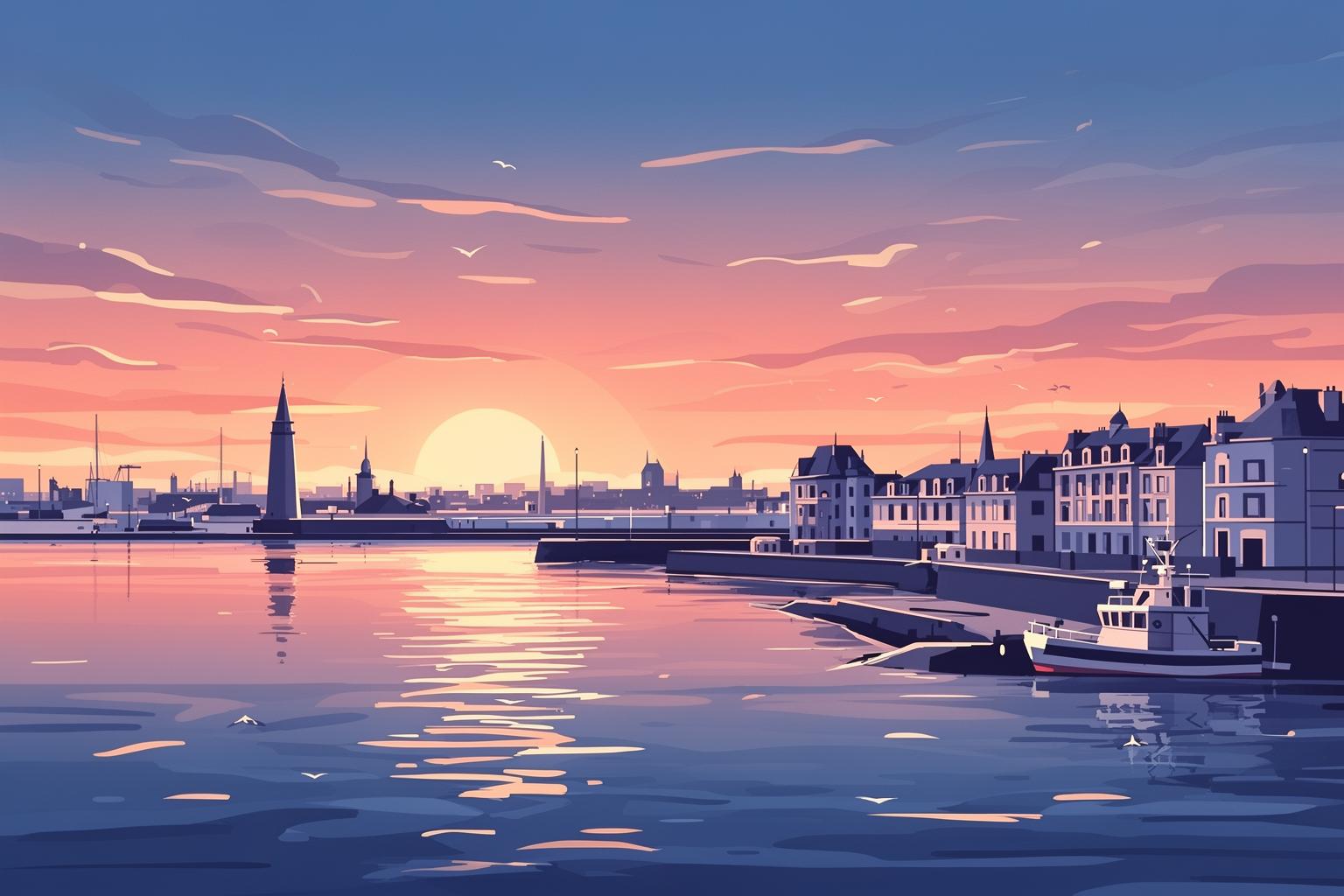
Every story of light begins with contrast, and for Raoul Dufy, that contrast was the pearlescent, often muted light of Normandy. His artistic journey started in Le Havre, a city defined by its connection to the sea—a bustling port where the salty air mingles with a sky that constantly shifts through grays, silvers, and pale blues. This is not the immediate, dazzling brilliance of the south, but rather a subtle, atmospheric light that teaches an artist about nuance, reflection, and the profound beauty of an overcast day. To walk here is to grasp the foundation upon which Dufy built his later bursts of color.
Le Havre: A City Reborn from Salt and Sea
Born in Le Havre in 1877, Dufy’s earliest classroom was the city’s harbor. Picture a young man, sketchbook in hand, seated by the Bassin du Commerce, fully attuned to the world around him. The rhythmic clang of metal on metal, the shouts of dockworkers, the groan of ships straining against their moorings, and the sight of steam and smoke rising into the damp air formed an industrial symphony that became his first muse. He wasn’t painting a static scene; he was capturing the ceaseless motion of the port. His early works show the influence of Norman predecessors Eugène Boudin and Claude Monet, masters of fleeting atmospheric effects whose legacy seems embedded in the very air here. A visit to the Musée d’art moderne André Malraux (MuMa) is essential. Its glass-and-steel architecture appears to invite the harbor’s light directly into the galleries, which house a superb collection of Dufy’s early works. Standing before his paintings of Le Havre, with the actual view just outside the window, is a transcendent experience. You see how he distilled the chaotic energy of the port into remarkably harmonious compositions, finding elegance in the bulky forms of cargo ships and poetry in the patterns of reflections on the water. The city, heavily damaged during World War II, was rebuilt with the bold modernist vision of Auguste Perret. This new identity of resilience and forward-thinking design resonates deeply with Dufy’s artistic spirit, which sought to distill and reconstruct reality into a more vibrant form.
A Walk Along the Quays
To truly connect with Dufy’s Le Havre, spend an afternoon walking the quays. Begin near the MuMa and head towards the city center. Notice how the light shifts and how the water’s surface fractures and reforms the reflections of clouds and cranes. The air here carries a unique blend of maritime and industrial qualities distinct to Le Havre. This sensory palette is what Dufy absorbed, the foundational grayscale against which his future colors would sing with great intensity. It’s a place that teaches you to look once, then look again, to discover the subtle tonal shifts hinting at the rising sun or a clearing storm.
Sainte-Adresse: Where Fauvism Found Its Voice
A short journey from Le Havre’s urban core lies the seaside resort of Sainte-Adresse. If Le Havre was Dufy’s school of composition, Sainte-Adresse was his color laboratory. Here, alongside his contemporary Albert Marquet, Dufy fully embraced the revolutionary spirit of Fauvism. The Fauves—the “wild beasts”—freed color from its descriptive duty. A tree didn’t have to be brown; a shadow didn’t have to be black. Color became emotion, energy, pure sensation. Standing on the pebble beach of Sainte-Adresse, one can almost feel that rebellious spark. Observe the beach huts, the flags snapping in the wind, the bright parasols against the chalky cliffs. In Dufy’s paintings from this time, such as the famous “Street Decked with Flags,” the colors are electrifying. Reds, blues, and yellows are applied in bold, unmixed strokes. The scene vibrates with an almost audible joy. He wasn’t just painting a festive street; he was painting the very feeling of festivity itself. The sea at Sainte-Adresse, often a cool slate-gray, becomes a deep ultramarine in his work. The sand is a slash of ochre. He uncovered the hidden chromatic energy of the Norman coast and amplified it, revealing a vitality that had always been present, waiting for an artist brave enough to see it.
Capturing the Moment
First-time visitors should find a spot on the promenade and simply watch. Watch how the wind stirs everything—the flags, the dresses of passersby, the waves curling on the shore. This kinetic energy lies at the heart of Dufy’s art. His distinctive style, with color often applied independently of his swift, calligraphic drawing, arose from the desire to capture movement and color simultaneously as two separate yet harmonious layers of reality. Sainte-Adresse perfectly reveals this split and synergy. The drawing captures form and motion, while the color conveys light and emotion. It’s a visual dance that began on this very shore.
Honfleur: Echoes of Impressionism
Across the Seine estuary from Le Havre lies Honfleur, a jewel-box town seemingly untouched by time. Its picturesque Vieux Bassin, framed by narrow slate-fronted houses crowded around the harbor, was a cradle of Impressionism. Boudin, Monet, and many others set up their easels here. For Dufy, visiting Honfleur felt like a conversation with his artistic forebears. While his style was evolving beyond Impressionism, he shared their deep love for Normandy’s light and maritime charm. Walking the cobbled streets of Honfleur, one senses a powerful art historical presence. The atmosphere is thick with the ghosts of painters past. Unlike the grand, industrial scale of Le Havre, Honfleur is intimate. You can imagine Dufy appreciating the delicate play of light on ancient timbers and the tightly packed fishing boats. His work here feels lighter, more lyrical. He delighted in the tangle of masts and rigging, rendering them as intricate, playful calligraphy against the sky. A visit to the Eugène Boudin Museum provides essential context, situating Dufy within this proud tradition of Norman landscape painting. It helps you appreciate how he both honored and transcended the Impressionist legacy, taking their fascination with light and pushing it toward a more subjective, emotionally charged expression.
The Parisian Whirlwind: Montmartre and the Avant-Garde
If Normandy provided Dufy with his themes—light and water—then Paris endowed him with a modern sensibility. Upon moving to the capital in the early 1900s, he immersed himself in the creative intensity of Montmartre. This was the era of the Bateau-Lavoir, the legendary, ramshackle building that housed a generation of artistic trailblazers, including Pablo Picasso and Georges Braque. Paris was a city brimming with radical ideas, where the very definition of art was continuously deconstructed and reassembled. For Dufy, it was an exhilarating environment that broadened both his mind and his art, propelling him beyond landscape painting into a far wider creative realm.
Montmartre’s Bohemian Pulse
To stroll through the winding streets of Montmartre today is to traverse layers of artistic mythology. Although the Place du Tertre is now bustling with tourists and portrait artists, the spirit of Dufy’s time can still be sensed if you know where to look. Moving away from the main square, explore the quieter side streets, the hidden staircases, and the small, leafy squares like Place Dalida. Picture a young Dufy here, absorbing the city’s relentless energy. His Parisian works differ from his coastal scenes. They capture the vitality of the boulevards, the crowds, the interiors of concert halls and artist studios. His line becomes even more fluid, more rapid, as if striving to keep pace with the city’s frenzied tempo. He was not merely an observer in Paris; he actively engaged in its cultural life. He mingled with poets such as Guillaume Apollinaire and stood at the heart of the avant-garde debates shaping Cubism and other movements. While his own work never fully adopted Cubism’s deconstruction, its influence appears in his increasingly sophisticated compositions and his intellectual approach to form. He learned from everyone, yet his art remained distinctly his—a joyful counterpart to the more cerebral or angst-ridden creations of some contemporaries.
From Canvas to Creation: The Realm of Fashion and Design
One of the most captivating chapters of Dufy’s Parisian life was his collaboration with the renowned couturier Paul Poiret. This partnership profoundly transformed his art and career. In 1911, he began designing textiles for Poiret and later established his own decorative arts company, La Petite Usine. This deep involvement in design and fashion suited an artist so sensitive to pattern, rhythm, and color. His woodblock prints for fabrics are masterpieces in their own right, featuring elegant, stylized motifs of flowers, animals, and shells. This work significantly influenced his painting, sharpening his sense of decorative composition and reinforcing his belief that art should not be confined to a frame but should extend into everyday life, bringing beauty and joy to the objects we use and the clothes we wear. To explore this aspect of his life, a visit to the Musée des Arts Décoratifs near the Louvre is essential. Though their collection rotates, they showcase examples of his textile work that reveal the sheer brilliance of his design sensibility, inviting you to see his paintings anew—not merely as landscapes, but as magnificent, flowing patterns, like the most exquisite silk scarf imaginable draped over the fabric of reality.
The Siren Song of the South: The Mediterranean Revelation
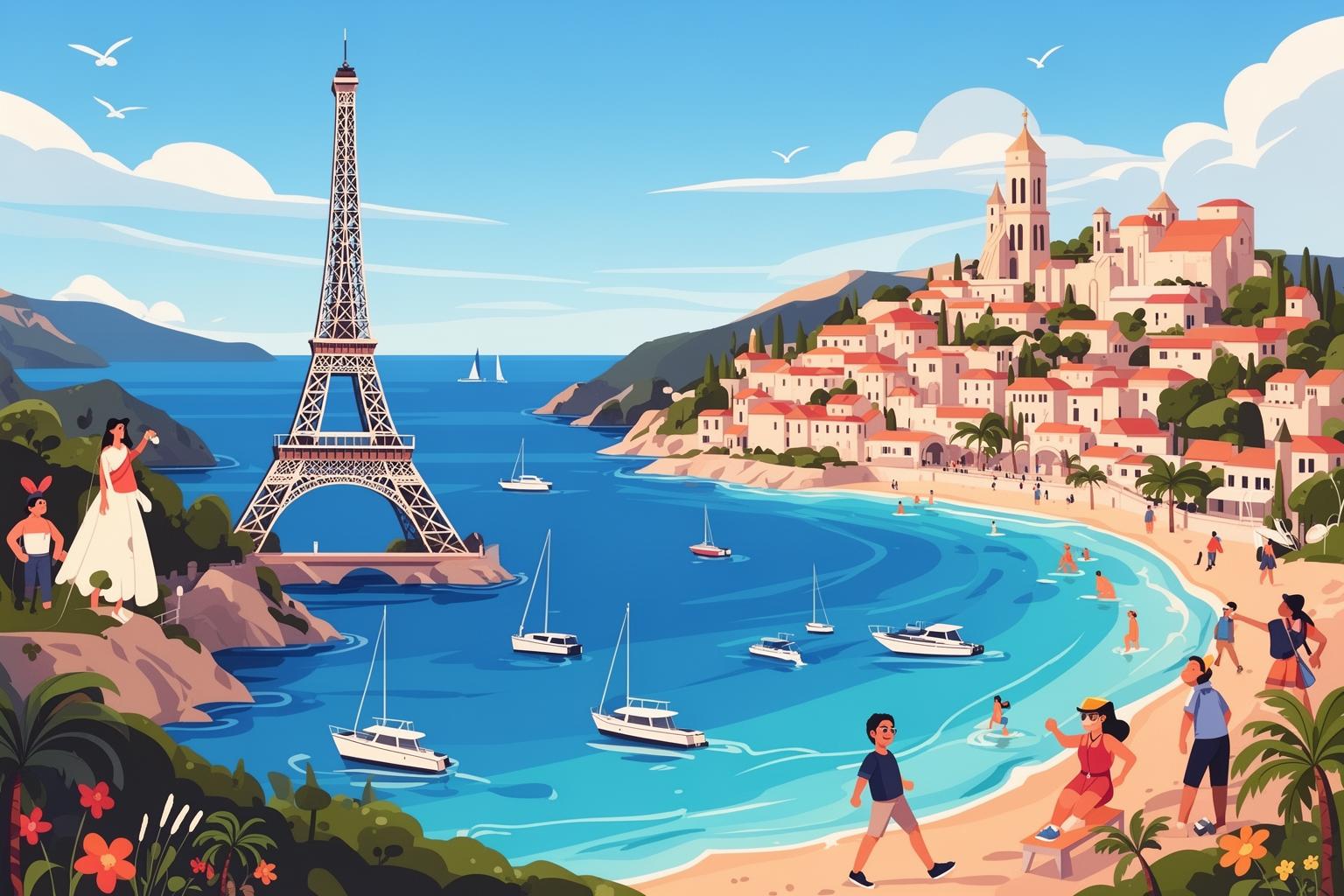
In 1920, Dufy journeyed to the south of France—a trip that would transform him forever. If the light of Normandy was a gentle murmur, the light of the Côte d’Azur was a triumphant exclamation. The intense, crystalline brilliance of the Mediterranean sun was revelatory. It erased shadows and intensified every color to its fullest expression. This was the light his art had long awaited. It was here, in the south, that he developed his mature style, the one for which he is best known: a stunning blend of calligraphic drawing and luminous, transparent color. His palette burst forth. The somber grays and blues of the north gave way to a symphony of cerulean, turquoise, lemon yellow, and vibrant emerald. This was not merely a change of place; it was a spiritual homecoming.
Nice, the Queen of the Riviera: A Symphony in Blue
Nice became Dufy’s second home, a city he returned to repeatedly. The magnificent Baie des Anges (Bay of Angels) became one of his most iconic motifs. To understand his affection for this place, one must stand on the Promenade des Anglais and gaze out at the sea. The blue is almost indescribable. It isn’t a single hue but a thousand blues, shifting with the light, the wind, and the water’s depth. Dufy created a visual language to convey this. Often, he laid down a broad, sweeping band of blue to represent the sea and sky, then, with swift, fluid black lines, he sketched the details—the curve of the bay, palm trees, elegant hotel facades, and small boats bobbing on the water. A key motif in his Nice paintings is the open window. He painted views from his hotel room, using the window frame as a device to connect the intimate, shaded interior with the radiant, sunlit world outside. This motif perfectly symbolizes his art: a window opened onto a world of light and joy. The Musée des Beaux-Arts Jules Chéret in Nice holds a notable collection of his works, and to see them in the city that inspired them is an unforgettable experience. After visiting the museum, find a café on the Cours Saleya, the famous flower market, and simply soak in the colors, sounds, and scents. This vibrant sensory immersion embodies the essence of Dufy’s Nice.
The View from the Balcony
For a fully immersive experience, try to stay in a hotel with a balcony overlooking the Promenade des Anglais. In the morning, as the sun rises, or late afternoon, when the light turns golden, open the doors and look out. You will be seeing Dufy’s most treasured view. Notice the sharp contrast between the cool shadows inside your room and the blaze of light outside. Observe how the palm fronds cast delicate, dancing patterns against the sky. This simple act of observation connects you directly to his creative process. He mastered capturing this precise, blissful moment—the sensation of being suspended between a calm interior and a magnificent exterior.
Vence and the Quiet Majesty of the Hinterland
While Nice represented the glamorous, sun-drenched spectacle of the Riviera, Dufy also drew inspiration from the quieter beauty of the arrière-pays, the hinterland beyond the coast. He spent much time in Vence, a charming medieval hill town nestled among olive groves and pine forests. The light here differs from that on the coast. It’s softer, filtered through the silvery leaves of olive trees, and the air carries the scent of wild herbs. Vence offered a different kind of subject: rolling landscapes, ancient farmhouses (mas), and lush, tangled gardens. His paintings from this period tend to be more serene and contemplative, yet no less joyful. He delighted in capturing the textures of the land—the gnarled trunks of ancient olive trees, terracotta roof tiles in the distance, and vibrant patches of wildflowers. A stroll through Vence’s old town feels like stepping back in time. Narrow, shaded alleys open suddenly onto sunlit squares, a dynamic Dufy adored. The true magic, however, lies in exploring the surrounding countryside. Follow winding country roads through the hills. Find a quiet spot with a view towards the town and sea beyond. Here, one can sense the deep peace that Dufy discovered—a tranquility that enabled him to refine his vision and create some of his most harmonious and mature works.
Forcalquier: The Final Palette
In his later years, Dufy endured severe rheumatoid arthritis, making painting a painful challenge. Seeking relief, he moved to the dry, warm climate of Haute-Provence and spent his final years in Forcalquier. This period might have signaled decline, but for Dufy, it was a testament to extraordinary artistic courage and resilience. Despite the pain, his work retained its vibrancy. Indeed, his colors grew bolder, and his lines freer. He painted his surroundings: his studio, wheat fields shimmering under the Provençal sun, still lifes of flowers and fruit. A profound sense of gratitude and a continued celebration of life resonate throughout these final works. His studio, Le Caset, has been preserved, and although not always open to the public, the landscape around it remains his ultimate canvas. To visit Forcalquier is to honor his indomitable spirit. The town is a classic Provençal charm, with a citadel offering panoramic views of the countryside—a landscape of vast scale and stark beauty, filled with lavender fields, golden wheat, and impossibly blue skies. It was a fitting final setting for an artist who had devoted his life to the pursuit of light.
Dufy’s Masterpieces: Capturing the Ephemeral
Beyond specific locations, Dufy’s art is a journey toward certain themes and sensations—the exhilaration of a horse race, the crescendo of an orchestra, the magnificence of human creativity. Following his path also means discovering the monumental works that embody his legacy.
The Electric Fairy (La Fée Électricité): A Monumental Vision
Arguably, Dufy’s greatest masterpiece is not a landscape but a massive mural celebrating the history of electricity. Currently housed in the Musée d’Art Moderne de Paris, La Fée Électricité offers a breathtaking, immersive experience. Commissioned for the 1937 International Exposition, this U-shaped painting extends over 600 square meters, making it one of the largest paintings in the world. Standing in the center of the dedicated room, one is truly surrounded by Dufy’s universe. Using his distinctive quick-drying paint, which allowed him to work on a grand scale with the delicacy of a watercolorist, he portrays the story of electricity from ancient discoveries to modern power plants. More than a hundred scientists and inventors, from Aristotle to Thomas Edison, are depicted in his signature calligraphic style. They are swept up in a vast, colorful composition that flows like a river of light and energy. The scale and ambition are staggering, yet what is most striking is his retention of a lightness of touch. This is not a heavy, didactic piece; it is a dance of color, history, and science—a joyful tribute to human progress. A visit is essential for any admirer of his work. It embodies his artistic philosophy: that even the most complex, technical subjects can be transformed into objects of beauty and wonder.
Regattas, Races, and a Zest for Life
Dufy was the poet laureate of leisure, the artist of society at play. He was endlessly captivated by events that gathered people in celebration: regattas off the Normandy coast, horse races at Deauville or Ascot, elegant concerts, and theatrical performances. These scenes were ideal for expressing his artistic passions. A regatta, with its crisp white sails against blue sea and sky, fluttering flags, and sense of swift, graceful movement, was a perfect subject for him. A horse race offered the dynamic energy of thoroughbreds, the vibrant silks of jockeys, and the fashionable spectacle of the crowd. In his concert scenes, one can almost hear the music as his lines swoop and soar to depict the orchestra. He wasn’t aiming for a photographic record of these events but sought to capture their atmosphere, energy, and peak moments of excitement and pleasure. To follow Dufy is to seek these places of elegant spectacle: attend a classical concert in Paris, visit the racetrack at Deauville, or simply watch the sailboats in the harbor at Nice. In doing so, you enter the very world of joy and motion that he so brilliantly brought to canvas.
A Traveler’s Palette: Practical Guidance for Your Dufy Pilgrimage
Following in Dufy’s footsteps is less about a strict schedule and more about embracing a particular way of seeing the world. It involves seeking out light, color, and movement. Nevertheless, a bit of practical guidance can help you create your own masterpiece of a journey.
Exploring Normandy’s Coast
The best way to discover Dufy’s Normandy is by car, offering the freedom to travel at your leisure between Le Havre, Sainte-Adresse, and Honfleur. The area is well-connected by train from Paris to Le Havre. The ideal time to visit ranges from late spring to early autumn. Summer brings the lively energy of seaside life and regattas that Dufy loved to capture, while spring and autumn offer softer light and smaller crowds, perfect for quiet reflection. When in Le Havre, be sure to enjoy the local seafood. Find a bistro near the port and savor a meal while watching the ships, just as Dufy likely did many times.
Discovering the Côte d’Azur
The French Riviera is excellently served by public transport. A train line links all the major coastal towns, making it easy to stay in Nice and take day trips. To explore the hinterland and towns like Vence, local buses are efficient, though a rental car offers more flexibility. The southern light is stunning year-round, but July and August can be very hot and crowded. Considering a trip in May, June, or September provides a more comfortable experience. The landscape’s colors are especially vibrant in spring. Don’t limit yourself to the coast—journeying inland reveals a vastly different, more rustic side of the region that was equally important to Dufy’s art.
Parisian Art Experiences
Paris is, naturally, a world unto itself. To view La Fée Électricité, plan to spend a few hours at the Musée d’Art Moderne, located in the Palais de Tokyo, just a short walk from the Eiffel Tower. After immersing yourself in Dufy’s world, take a stroll along the Seine to unwind. When visiting Montmartre, try to arrive early before the crowds to best capture the quiet, artistic atmosphere of its backstreets. For a deeper exploration of his decorative work, visit the collections at the Centre Pompidou and the Musée des Arts Décoratifs. Paris is made for walking, so wear comfortable shoes and allow yourself to get lost in its charming arrondissements.
The Enduring Glow: Dufy’s Legacy of Joy
A journey through Raoul Dufy’s France serves as a powerful reminder that beauty is a choice. He chose to perceive the world not as it was, but as it might be—a realm of radiant color, graceful rhythm, and endless delight. Despite personal struggles, war, and crippling illness, his art remained steadfastly joyful. To follow in his footsteps is to learn to see through his eyes, discovering celebration in a gray Norman sky, movement in a bustling Paris street, and harmony in the vast blue of the Mediterranean. Returning from such a journey offers more than memories; it brings a renewed appreciation for the light that surrounds us daily. Dufy’s extraordinary gift was capturing that light, and by visiting the places he cherished, you can experience its warmth and brilliance firsthand—an enduring glow that brightens both the world and the soul.