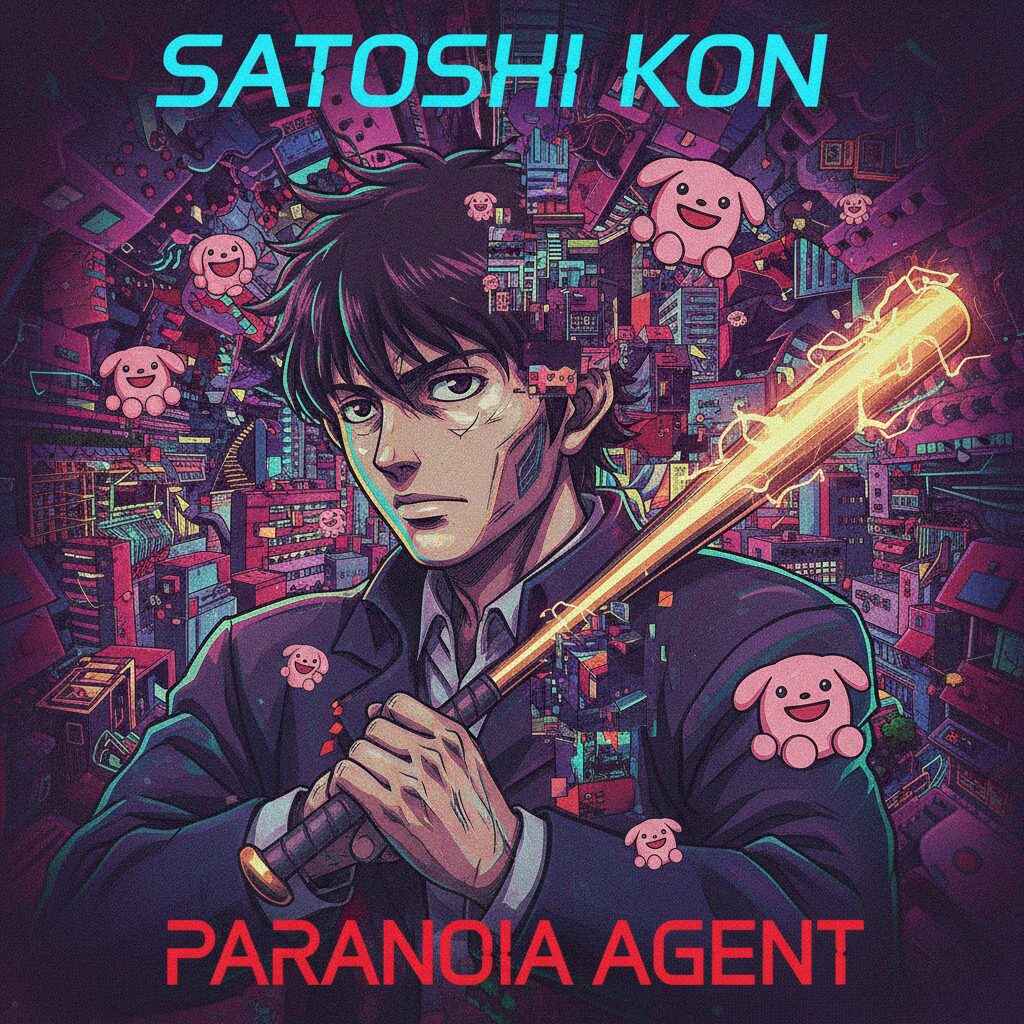
There’s a certain hum to Tokyo, a low-frequency thrum that vibrates just beneath the surface of its impeccable order. It’s the sound of millions of lives moving in concert, a symphony of footsteps, train chimes, and whispered conversations. Most of the time, it’s a comforting rhythm, the heartbeat of a metropolis at the peak of its powers. But sometimes, in the quiet moments between the beats, another feeling creeps in—a subtle, gnawing anxiety. It’s the pressure to keep up, the fear of falling behind, the quiet desperation that hides behind polite smiles. No one captured this feeling, this specific psychological landscape of modern Japan, better than the late, great director Satoshi Kon. And in his 2004 masterpiece, Paranoia Agent, the city of Tokyo itself becomes the main character, a sprawling stage for a surreal drama of collective psychosis.
Paranoia Agent tells the story of a mysterious elementary schooler, nicknamed Shonen Bat, who terrorizes Tokyoites by attacking them with a bent golden baseball bat. His victims, however, are not random. They are all individuals pushed to their breaking point by immense personal and social pressure. For them, the attack becomes a bizarre, violent form of release, a way to escape from an unbearable reality. The series is a chilling, often brilliant exploration of rumor, mass hysteria, and the fragile line between the real and the imaginary. Kon, a master of blending dreams and waking life, uses the very streets, parks, and apartment blocks of the city to amplify these themes. The locations in Paranoia Agent aren’t just backdrops; they are reservoirs of ambient stress, concrete manifestations of the characters’ inner turmoil. To walk through them is to step directly into the anime’s unsettling world, to feel that same hum of a city on the edge. This journey isn’t about finding exact one-to-one replicas of animation cels. It’s about a pilgrimage into an atmosphere, a quest to find the real-world anxieties that fueled one of the most psychologically dense anime ever created.
For a different kind of pilgrimage that explores the real-world settings of a classic anime steeped in urban mystery, consider following the footsteps of Banana Fish.
The Musashino Nexus: Where the Everyday Unravels
The epicenter of the strange events in Paranoia Agent isn’t found in the bright, futuristic heart of Shinjuku or Shibuya but rather in the vast, densely populated suburbs of western Tokyo, especially the district known as Musashino. This area is defined by the Chuo Line, a crucial transportation artery ferrying commuters to and from the city center. It’s a setting of comfortable domesticity, prestigious universities, and leafy parks—an image of peaceful, middle-class life. Yet, it is precisely this façade of normality that provides the ideal breeding ground for the horrors wrought by Shonen Bat. The pressure to uphold this calm exterior is what pushes the characters to their limits. Our journey starts here, in the midst of this deceptive calm.
Kichijoji Station: The Crossroads of Quiet Desperation
Stepping off the train at Kichijoji Station, you are immediately engulfed. It lacks the overwhelming chaos of Shinjuku Station but instead delivers a concentrated, relentless stream of people. Commuters pour in from the JR Chuo and Sobu lines, funneling through the Keio Inokashira Line terminal with fluid, determined motion. The station in Paranoia Agent is a transit hub, a non-place where characters are carried along by forces outside their control. You can almost sense it in the atmosphere. Find a spot near the central ticket gates and observe. Watch the faces: the weary salaryman loosening his tie, high school students laughing into their phones, a mother skillfully maneuvering a stroller through the crowd. On the surface, it’s a slice of everyday life, but look closer—just as Kon’s camera often does. Notice the slight frowns, the hurried steps, the eyes avoiding contact.
This is the environment that nurtures the story of Tsukiko Sagi, the series’ first victim—a timid character designer crushed by the demand to create the next adorable mascot, a pressure emanating from every corner of this consumer-driven world. The station, with its endless advertisements and ceaseless flow of people, physically embodies that pressure. To feel it, try moving against the tide during the evening rush. You’ll experience the tangible resistance of the crowd, a physical manifestation of the social friction defining Kon’s characters’ lives. The station’s clean, well-lit corridors feel infinite, while PA announcements drone endlessly—a place where one can easily get lost, not only physically but mentally, becoming just another anonymous face in a sea of silent anxiety.
Harmonica Yokocho: A Labyrinth of Whispers and Smoke
Just beyond Kichijoji Station’s north exit lies a hidden gem, a relic of another era: Harmonica Yokocho. This tightly packed network of impossibly narrow alleys is a post-war black market that has evolved into a maze of tiny bars, ramen shops, and butcher stalls. Its name comes from the rows of small storefronts resembling the reeds of a harmonica. By day, it’s a bustling market, but as dusk falls, it transforms. Red lanterns flicker to life, casting a warm, conspiratorial glow over the worn concrete. The air thickens with the scents of grilled yakitori, simmering broth, and stale beer. This is the nervous system of the neighborhood’s gossip network.
In Paranoia Agent, whispers of Shonen Bat spread rapidly, passed quietly from person to person. Harmonica Yokocho feels like the perfect place where such rumors would take hold and fester. Squeeze down an alley barely wide enough for one, brushing past salarymen hunched over counters, their conversations a low murmur broken by occasional laughter. The spaces are intimate, almost claustrophobic. It’s easy to imagine old gossipers or the detective’s informants holding court in these ten-seat bars, trading secrets for a drink. The cramped architecture forces intimacy, making it impossible to ignore the lives unfolding just inches away. This setting perfectly blurs the private and public, a key theme in the show. The whispers along these alleys feel poised to coalesce into a shared delusion, giving rise to a phantom like Shonen Bat.
Inokashira Park: A Sanctuary Under Siege
A short walk south of Kichijoji Station opens into the expansive beauty of Inokashira Park, one of Tokyo’s most cherished green spaces—a vast oasis centered around a tranquil pond. Families picnic on the grass, artists sketch by the water, and couples paddle swan-shaped boats across the calm surface. The park represents an escape, a refuge from the urban concrete and crowds. In the anime, it is a place where characters seek comfort and attempt to piece together their fractured thoughts.
Yet in Satoshi Kon’s world, no sanctuary is ever truly safe, because the threat comes from within. The park’s beauty is often tinged with unease. Walk the path encircling the pond—the dappled sunlight filtering through the trees can feel gentle one moment, then sinister the next. The graceful curve of the Bentenbashi bridge, mirrored on the water, seems to warp and distort, echoing the shifting realities of the characters. The park houses a small shrine dedicated to Benzaiten, the goddess of love and fortune, yet there’s a local legend that couples riding the swan boats together are doomed to break up—a perfect fragment of everyday superstition that aligns with the anime’s themes. To truly grasp the park’s duality, visit at different times: in the afternoon, it buzzes with cheerful children’s laughter, but as evening falls, the crowds thin, shadows stretch, and the park adopts a more melancholic, introspective atmosphere. Late at night, it becomes a place of deep silence and solitude, where a lonely, tormented soul might be vulnerable to an attack from a boy on rollerblades.
Suburban Twilight: The Hunting Grounds of Shonen Bat
Paranoia Agent is not a tale of grand, dramatic showdowns at famous landmarks. Its horror is intimate and domestic. The assaults by Shonen Bat almost always occur in the quiet, unremarkable settings of residential Tokyo—on dimly lit streets, in parking lots, and on staircases leading up to plain apartment buildings. These are supposed to be places of safety—their homes. The breach of that safety is what renders the attacks so terrifying. To find these locations, one must venture further into the suburbs, into the endless labyrinth of houses and apartments that extends west of Kichijoji.
The Hills of Seiseki-Sakuragaoka: An Echo of Vulnerability
While anime fans might associate Seiseki-Sakuragaoka with the romantic hills from Studio Ghibli’s Whisper of the Heart, its terrain also perfectly represents the suburban landscapes haunted by Shonen Bat. This area, situated along the Keio Line, is characterized by rolling hills and steep, winding roads. Walking through its residential neighborhoods evokes a strong sense of the world of Paranoia Agent. The houses are closely packed together, their walls forming canyons of concrete and stucco. Overhead, a dense tangle of utility poles and power lines crisscrosses the sky—a motif Kon frequently used to convey a feeling of oppressive complexity and entanglement.
The primary experience here is the climb. Locate one of the many steep staircases that cut straight up the hillsides, linking one residential street to another. As you ascend, city sounds fade, replaced by the summer cicadas’ chirping or the rustling of leaves during fall. You are alone and exposed. At the summit, you can look down on rooftops stretching below—a sea of orderly, repetitive living. This view can feel both beautiful and deeply isolating. It’s the perfect setting for Shonen Bat’s attacks. The silent streets, the sharp corners creating blind spots, the long shadows cast by the setting sun—all combine to build a palpable sense of suspense. One can almost hear the whirring of rollerblades approaching just around the bend. Walking these streets at dusk is an exercise in atmospheric immersion, a way to feel the anime’s characters’ vulnerability in your own bones.
The Danchi Diaries: Conformity and Cracks in the Facade
Another iconic setting in the anime is the danchi, or public housing complex. These massive clusters of identical apartment buildings were constructed in the post-war era to accommodate Japan’s booming population. They are common throughout Tokyo’s suburbs, including around Musashino and Mitaka. In Paranoia Agent, the danchi is the home of Harumi Chono, a woman struggling with dissociative identity disorder, torn between her roles as a prim tutor and secret prostitute. The danchi perfectly symbolizes her inner conflict.
From the outside, these buildings are models of uniformity. The repeating patterns of windows, balconies, and doorways create a hypnotic, almost oppressive, sense of order. Life inside the danchi is governed by unspoken community rules, a pressure to conform that mirrors the pressure Harumi experiences. To experience this atmosphere, you don’t need to visit a specific, famous danchi. Simply take a local train, get off at a smaller station, and walk around—you’ll find one. Notice the details: rows of bicycles in designated parking areas, meticulously tended flower pots on some balconies versus the cluttered disorder of others, the empty, slightly forlorn playground in the central courtyard. These small variations are the cracks in the facade of conformity, subtle signs of the complex individual lives hidden behind those identical doors. The danchi is a microcosm of the society depicted in Paranoia Agent—a place where the struggle for individuality unfolds against a backdrop of crushing sameness. It’s a powerful and deeply melancholic environment to explore.
The Concrete Jungle’s Roar: Media Saturation and Mental Collapse
While physical attacks occur in the suburbs, the psychological roots of the crisis are planted in the hyper-stimulated core of the city. Central Tokyo, with its towering skyscrapers, massive video screens, and relentless noise, embodies the overwhelming flood of information and media hype that transforms Shonen Bat from a series of isolated incidents into a widespread social phenomenon. This is the world that consumes the detectives working on the case and feeds the delusions of those who become lost in the narrative.
Shinjuku’s Neon Nightmare: Drowning in Information
Shinjuku is the city’s chaotic, pulsating heart, serving as the ideal backdrop for the media frenzy depicted in the anime. Standing in front of Shinjuku Station’s east exit, you are bombarded from every direction. The Yunika Vision screens and huge LED billboards on the opposite building continuously play music videos and commercials. The sound blends with station announcements, the shouts of touts, and the general roar of the crowd. It’s a sensory overload, a dizzying mix of light and sound.
This environment mirrors the mental state of characters like Detective Maniwa as he sinks deeper into the case, losing his grip on reality and perceiving patterns and conspiracies everywhere. The flood of media reports about Shonen Bat in the anime reflects the real-life experience of being in a place like Shinjuku. The story becomes unavoidable, plastered on every screen and echoed in every conversation. To truly grasp this, spend some time in Kabukicho’s arcades, the city’s famous red-light district. The cacophony of hundreds of pachinko machines and rhythm games creates a disorienting wall of noise. It’s an atmosphere that encourages tuning out and retreating into one’s own mind, exactly the condition that allows a figure like Shonen Bat to flourish. Shinjuku is where the city’s collective consciousness is shaped and amplified, for better or worse.
Underpasses and Overpasses: The City’s Shadow Self
Satoshi Kon was fascinated by liminal spaces—those in-between places that are neither here nor there. His works frequently feature scenes set in the gritty, utilitarian arteries of the city: the pedestrian underpasses beneath busy roads and the elevated highways casting constant shadows over the streets below. These are not tourist attractions but functional, often overlooked parts of Tokyo’s infrastructure. Yet in Paranoia Agent, they carry symbolic weight.
Such spaces are transitional, places of movement and anonymity. Often dark, damp, and echoing, they starkly contrast with the bright, pristine city above ground. They represent the city’s subconscious—the hidden paths and dark corners of the collective psyche. Walking through the long, tiled pedestrian tunnels beneath Shinjuku Station or the shadowed areas under Shibuya’s elevated expressways can be unexpectedly unsettling. The constant rumble of traffic overhead feels like the city breathing down your neck. Graffiti on the walls seems like secret messages from another realm. These are the places where characters face moments of crisis, confronted by their own metaphorical demons before encountering the literal one. Exploring these spaces offers insight into Tokyo’s other side—the gritty, unpolished reality lurking just below the city’s polished surface.
Capturing the Kon Vibe: A Pilgrim’s Practical Guide
Embarking on a Paranoia Agent pilgrimage is less about ticking off a checklist of locations and more about learning to see the city through Satoshi Kon’s perspective. It’s about discovering the surreal within the ordinary and appreciating the psychological depth of the urban landscape.
The Art of Observation
To truly connect with the essence of the anime, you need to slow down and observe closely. Notice the details that Kon was fascinated by. Look for reflections—the distorted images of faces and buildings in train windows, puddles on the pavement, and convex mirrors at street corners—these were all techniques he employed to depict a fractured reality. Observe the clutter. Unlike many idealized portrayals of Japan, Kon’s world feels lived-in and chaotic. He illustrated cluttered desks, cramped apartments, and alleyways piled with overflowing trash cans. This visual noise mirrors the mental turmoil of his characters. And look up. The sky over Tokyo is seldom a clear, open space. It’s a complex web of power lines, telephone cables, and building edges. This visual network conveys a sense of entrapment and constant surveillance, which is central to the show’s paranoid mood. Bring a camera, but focus less on panoramic views and more on these small, evocative details.
Practical Information for the Urban Explorer
Navigating this pilgrimage is fairly straightforward, relying on Tokyo’s excellent public transit system. The JR Chuo Line, running east-west through the city’s core, will be your main route. A Suica or Pasmo IC card is essential; you can tap it on any train or bus and reload it at stations.
Kichijoji is a key stop on the Chuo Line, easily reachable from Shinjuku or Tokyo Station. From there, Inokashira Park is just a short five-minute walk. To explore the hilly suburban areas, transfer at Shinjuku from the Chuo Line to the Keio Line and travel to Seiseki-Sakuragaoka.
When visiting residential neighborhoods like Seiseki-Sakuragaoka or seeking out danchi complexes, respect is paramount. You are a visitor in someone’s community. Keep your voice low, avoid trespassing on private property, refrain from intrusive photography of people or homes, and be considerate of local life. The goal is to soak in the atmosphere, not to disturb it.
The ideal time to experience the eerie, suspenseful vibe of the anime is during the “magic hour” at twilight, when the sun sets and streetlights begin to glow. This transitional time mirrors the show’s themes of blurred boundaries. Nonetheless, visiting during the bright light of midday or the quiet solitude of late night will offer different, yet equally meaningful, insights into the city’s character.
This journey into the world of Paranoia Agent is also a journey into the heart of urban anxiety, a theme more relevant now than ever. Walking these streets reveals that the monsters we fear most often arise from the pressures and stresses of the world we’ve created ourselves. Satoshi Kon’s brilliance lay in showing us that the setting of our lives is never just a passive backdrop—it’s an active participant in the story of our minds. Standing on a quiet suburban street at dusk, listening to the distant rumble of a train, you may feel a shiver of recognition—a sense that the line between this world and the anime’s world is thinner than you ever imagined.