
There’s a certain kind of magic that pulses at the heart of Keep Your Hands Off Eizouken!. It’s not just in the frantic, brilliant energy of Asakusa’s imagination, the sharp-witted pragmatism of Kanamori, or the delicate, life-breathing artistry of Mizusaki. It’s in the world they inhabit. Shibahama, their sprawling, chaotic, and wonderfully complex hometown, isn’t merely a backdrop; it’s the fourth member of the Eizouken, a silent collaborator providing endless inspiration. It’s a city of impossible staircases, weathered concrete, tangled power lines, and hidden wonders—a place that feels impossibly real because, in a way, it is. Shibahama is a dreamscape stitched together from the fabric of real Japanese coastal towns, a vibrant mosaic that invites you to step through the screen and explore its labyrinthine streets for yourself. This journey isn’t just about finding filming locations; it’s about learning to see the world through an animator’s eyes, to find the extraordinary lurking within the wonderfully ordinary. It’s a pilgrimage to the very source of creativity, a quest to find your own “greatest world” hidden in the nooks and crannies of a place that feels both nostalgic and thrillingly new. So, lace up your most comfortable walking shoes, pack your sketchbook, and get ready to dive headfirst into the organized chaos that is Shibahama.
If you’re captivated by the way animation transforms real-world settings into dreamscapes, you might also enjoy exploring the real-world locations of Sonny Boy.
Atami: The Heartbeat of Shibahama’s Labyrinthine Charm
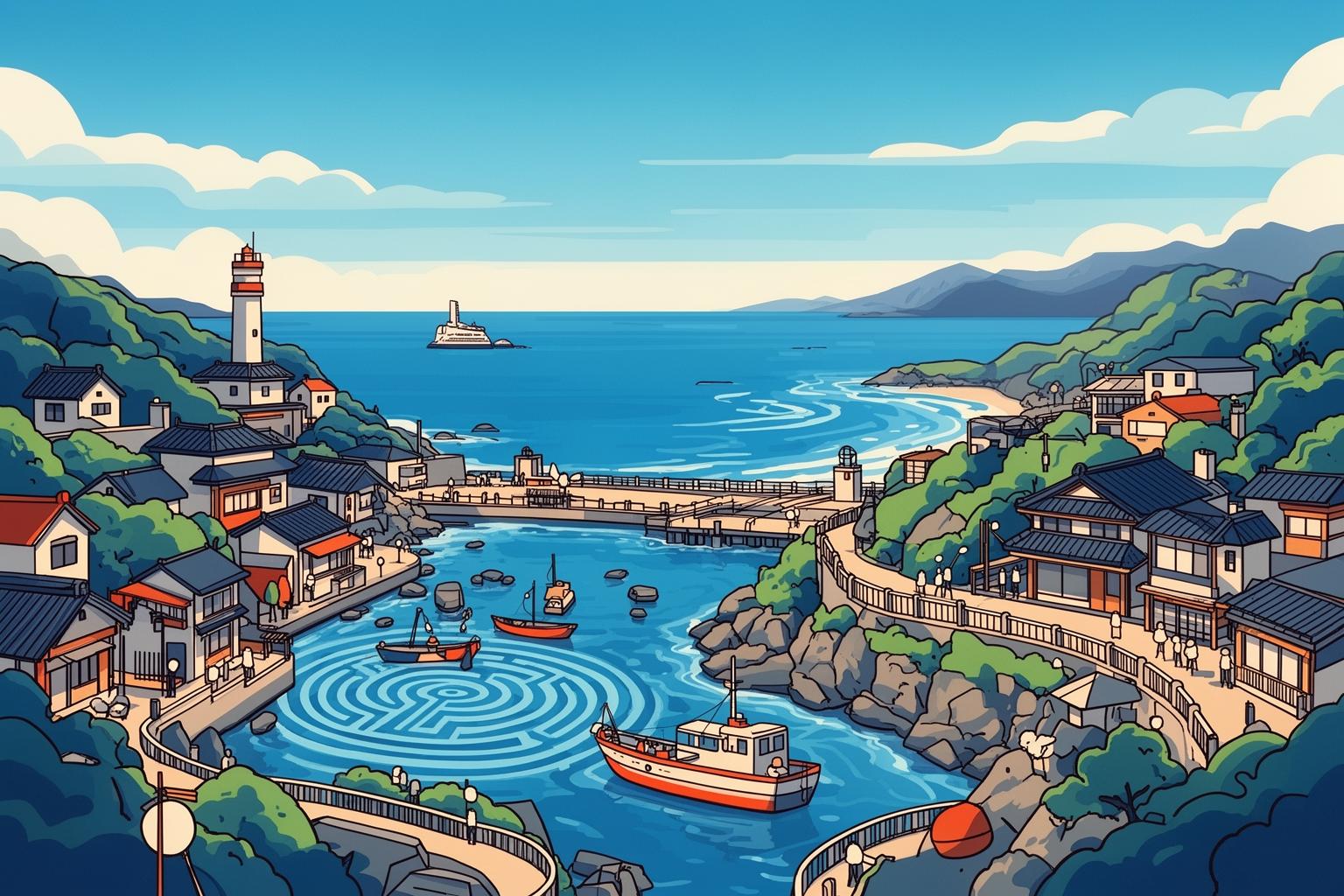
If Shibahama has a soul, its rhythm is shaped by the seaside city of Atami in Shizuoka Prefecture. This serves as the main canvas where Masaaki Yuasa and his team crafted their masterpiece. Atami is a city that defies gravity—a resort town perched on the steep slopes of a volcanic crater that descends directly into the sparkling Sagami Bay. It’s a place where the Showa era seems never to have ended, where retro-futuristic buildings stand side-by-side with ancient shrines and quiet, traditional residences. To stroll through Atami is to stroll through Shibahama. The air, heavy with the scent of salt and hot spring minerals, carries the echoes of Asakusa’s excited shouts and Kanamori’s weary sighs. This is not a literal recreation, but a spiritual one. Atami provides the texture, verticality, and beautifully weathered aesthetic that make Shibahama feel alive and breathing.
The Endless Slopes and Stairways: A Vertical Exploration
One of the first things that strikes you in Eizouken, and in Atami itself, is the overwhelming verticality. The city is a three-dimensional maze of winding roads, switchbacks, and staircases seemingly stretching into the sky. For an outdoor enthusiast like me, it’s a hiker’s paradise masquerading as an urban area. Every street slopes uphill, every alley offers a potential shortcut up or down the mountainside. This captures the very essence of Asakusa’s world. She is constantly climbing, scrambling, and searching for higher ground to gain a fresh perspective, to see how the pieces of her city interconnect. Her imagination is fueled by this ever-changing elevation.
Walking through Atami, you come to understand this deeply. You might find yourself ascending a narrow stone staircase squeezed between two buildings, only to emerge onto a residential street you didn’t know existed, where a breathtaking panoramic view of the bay suddenly unfolds. It’s in these moments of discovery that you feel most connected to Eizouken. The physical effort of the climb is rewarded by a fresh vista, a new angle on the world. This fuels creativity. You’ll notice houses perched on stilts, monorails linking hotels to the main road below, and bridges spanning unexpected gaps between neighborhoods. The city’s ingenious solutions to its topographical challenges feel like something straight out of an animator’s concept art. My advice: embrace the climb. Wear sturdy shoes, get comfortable, and allow yourself to get lost. Don’t stick to the main coastal roads—venture into the residential hills. There, among quiet homes and terraced gardens, you’ll find the true spirit of Shibahama’s layered complexity.
Atami Ginza Shopping Street: The Retro-Futuristic Marketplace
Atami Ginza Shopping Street, or shotengai, is another fundamental element of the Shibahama experience. This covered arcade is a time capsule and a vibrant artery pulsing with the life of local commerce and community. Step inside, and it feels like entering a world where mid-20th-century visions of the future are preserved in amber. The air buzzes with unique energy—the clatter of pachinko balls from a nearby parlor, the sizzle of seafood grilling at a storefront, the cheerful calls of vendors selling dried fish and local sweets. This lively, slightly chaotic atmosphere is exactly where Kanamori would thrive, skillfully navigating the currents of commerce and information.
The architecture itself is a feast for the eyes. The high arched ceiling, vintage neon signs, and tiled floors worn smooth by decades of foot traffic evoke the slightly faded but deeply cherished aesthetic of the anime. You can almost see the Eizouken trio stopping here for a snack after a long day, Mizusaki admiring shoppers’ movements, Asakusa sketching the detailed patterns on an awning, and Kanamori calculating the profit margins of a mochi stand. The street is a sensory overload in the best sense. You can sample freshly made onsen manju (steamed buns filled with sweet bean paste and steamed using hot spring vents), browse quirky souvenir shops, or simply sit in a classic kissaten (old-fashioned coffee shop) and watch life unfold. While the Dandelion Cafe from the anime has no single definitive location, its spirit lives on in these small, independent shops along Atami Ginza. To truly savor the atmosphere, visit in the late afternoon as the lights flicker on, casting a warm, nostalgic glow throughout the arcade. At that moment, the street feels like a living set piece, a stage for countless stories waiting to emerge.
Sun Beach and the Coastal Vistas
No trip to Atami is complete without visiting its coastline. Sun Beach, a man-made stretch of white sand, delivers a classic Japanese beach town vibe, complete with palm trees and a relaxed, leisurely spirit. Yet for the Eizouken pilgrim, the true allure lies in the surrounding infrastructure and the views from above. The series often contrasts the sprawling, intricate cityscape with the vast open ocean to create moments of awe and scale. Think of the climactic robot battle in their first major project—the action unfolds against a backdrop of seawalls, piers, and coastal highways that seem lifted directly from Atami’s shores.
Stroll along the promenade bordering the beach. Notice the concrete tetrapods arranged to break the waves, forming geometric patterns that Asakusa would find fascinating. Look up at the hotels and buildings towering over the shoreline, their lights twinkling as dusk descends. This is a landscape brimming with possibility. From here, you can see the city’s steep incline rising sharply from the water’s edge. For a different viewpoint, seek out one of the coastal roads or walking paths that offer elevated vantage points. It is from these heights that you can fully appreciate the dynamic interplay between urban life and nature—a theme deeply woven into the anime. The changing light throughout the day transforms the mood: mornings offer crisp, clear views, while sunsets paint the sky and sea in shades of orange and purple, creating a breathtaking, cinematic scene that seems perfectly poised for animation.
Kamakura and Enoshima: Echoes of Academia and Seaside Life
While Atami serves as Shibahama’s chaotic, vertical core, the Kamakura and Enoshima areas in Kanagawa Prefecture offer a different yet equally essential atmosphere. This region, celebrated for its rich history as a former capital of Japan, its iconic Great Buddha, and its relaxed surf culture, influences the academic and residential side of the Eizouken universe. The vibe here is calmer, steeped in tradition but energized by the youthful spirit of students and beachgoers. The journey from Tokyo aboard the charming, slightly rickety Enoden train line is an experience in itself, providing a perfect transition into the slower-paced, sunlit world that inspired parts of Shibahama High School and its surroundings.
The Model for Shibahama High School
Shibahama High School stands out as a character itself—a sprawling, Frankenstein-like campus with mismatched buildings, secret passages, and a history that seems embedded in its very walls. Rather than being modeled on one specific school, it represents the concept of schools found in this historic coastal region. Kamakura hosts many older educational institutions boasting beautiful, sometimes imposing architecture. Strolling through the city, you encounter campuses blending Western-style and Japanese buildings, connected by covered walkways and surrounded by lush greenery—much like in the anime. The school in Eizouken feels layered with history, where new wings have been added over decades, resulting in a confusing yet fascinating layout perfect for exploration—and for concealing a renegade film club.
The overall environment of Kamakura deeply enhances this impression. The city lies nestled in a valley, surrounded by wooded hills dotted with temples and shrines. This mix of nature, history, and everyday life creates a unique mood. One can easily picture the Eizouken trio walking home from school, passing ancient temples, quiet residential streets, and canals. The sense of a community living in tandem with history is strong, anchoring the anime’s occasional fantastical elements in a believable reality. To truly capture this feeling, take time to stray from the main tourist routes. Explore the smaller residential alleys and the trails winding into the hills—these are where you’ll discover the quiet, reflective side of Shibahama’s world.
The Dandelion Cafe’s Seaside Spirit
The Dandelion Cafe serves as the Eizouken’s unofficial off-campus hub—a spot for brainstorming, deal-making, and occasional relaxation. While its exact location is fictional, its essence is found in the many seaside cafes that line the Shonan coast, especially around Enoshima and Kamakura’s beaches. These cafes are integral to local culture, offering stunning ocean views often featuring Enoshima Island and, on clear days, Mount Fuji. They are places where time slows, where life’s rhythm follows the ebb and flow of the tide.
Imagine discovering a small cafe with a broad terrace overlooking the water. You order coffee and a slice of cake, sitting back to enjoy the sea breeze and the distant waves. This is the heart of the Dandelion Cafe experience—a mental pause, a break from the frantic pace of creation. These cafes are often cozy and full of character, decorated with driftwood, surfboards, and local art. They capture a creative, bohemian spirit that perfectly matches Eizouken’s vibe. Visiting one is a must for any fan, offering a chance to step into one of the anime’s most comforting and repeated settings and a perfect moment to pull out your own notebook and jot down ideas, inspired by the vast, beautiful expanse of sea and sky before you.
Deconstructing the Details: Iconic Locations and Their Real-World Counterparts

The genius of Shibahama lies not only in its expansive atmosphere but also in its distinctive, memorable details. The city is brimming with landmarks and hidden spots that the Eizouken club claims as its own. These places are often amalgamations, blending elements from multiple locations to create something entirely new and unique. As a result, the act of pilgrimage transforms into a kind of scavenger hunt—a quest to discover the real-world puzzle pieces that form the fictional whole. This is when you truly begin to see the world through the eyes of a background artist, noticing the particular architectural quirks and environmental textures that give a place its character.
The Clock Tower: Shibahama’s Timeless Beacon
The clock tower stands as one of Shibahama’s most notable landmarks, serving as a central reference point within the city’s chaotic layout. In the anime, it functions as a meeting place and a symbol of the town’s enduring, if somewhat quirky, character. Its real-world inspiration is widely believed to be the old clock tower of the Kyu-Oshiba-rikyu Gardens in Tokyo, or features drawn from similar structures in older Japanese towns. However, its placement within a hilly, seaside city like Atami gives it a uniquely Shibahama identity. While you won’t find an exact replica in Atami or Kamakura, the spirit of the clock tower lives on in the many distinctive architectural details scattered throughout the landscape.
Keep an eye out for old public buildings, fire stations, or community centers from the Showa period. Many of these structures showcase distinctive features—small towers, unusual rooflines, or decorative facades—that served as visual anchors for their neighborhoods. Searching for the clock tower becomes less about pinpointing a single object and more about appreciating the architectural landmarks that define a community’s character. It’s a lesson in observation. As you explore, take note of these local beacons. Photograph them, sketch them, and consider their history and role within the urban fabric. In doing so, you engage in the same world-building process that Eizouken’s creators embraced, recognizing how individual elements combine to create a strong sense of place.
Kanamori’s Domain: The Spirit of Local Commerce
Kanamori’s family business, a hybrid liquor store and café, perfectly represents the small, multi-generational shops that form the backbone of many Japanese communities. This kind of establishment, known as a sakaya, is a common sight tucked away in the backstreets of towns like Atami. While the exact Kanamori-ya might be elusive, countless shops share its essence. Look for stores with weathered wooden signs, sliding glass doors, and interiors packed with merchandise. These are places deeply rooted in their communities, where owners know every customer by name.
The atmosphere inside such shops is one of cozy, organized clutter. Shelves are lined with bottles of sake, shochu, and beer, alongside snacks, household goods, and local specialties. There’s a palpable sense of history, a feeling that the business has operated in the same spot for decades. The owners often display a no-nonsense, pragmatic demeanor that epitomizes Kanamori. Visiting one of these local stores to buy a drink or snack is a wonderful way to connect with the local culture and support the very kinds of businesses that give Shibahama its authentic character. It’s an experience that transcends mere sightseeing, offering a glimpse into the everyday lives behind the anime’s grand adventures.
The Secret Bases: Discovering Eizouken’s Creative Sanctuaries
The Eizouken’s main hideout—the old anime club’s warehouse—is the ultimate symbol of their creative spirit. It’s a neglected, forgotten space that the trio transforms into a vibrant hub of imagination and production. Finding these “secret bases” is one of the most thrilling aspects of an Eizouken pilgrimage. Japan is full of such liminal spaces—abandoned buildings, overgrown lots, disused sheds, and forgotten corners of public parks. These are exactly the kinds of places Asakusa would instinctively be drawn to, perceiving not decay but potential.
As you wander through the backstreets of Atami or the hills of Kamakura, keep an eye out for these hidden treasures. You might come across an old, disused public pool, reminiscent of the one the club briefly considers as a filming location. You might stumble upon a small, abandoned warehouse or factory on the outskirts of town, its windows boarded up but its structure still imbued with a certain industrial charm. These spaces ignite the imagination. What stories might they hold? What could they become? This act of discovering potential in overlooked places captures the very essence of Eizouken’s creative process. It serves as a reminder that inspiration can be found anywhere—especially in the places most people have stopped noticing.
The Pilgrim’s Journey: Crafting Your Eizouken Adventure
Embarking on an Eizouken pilgrimage is more than just ticking off locations from a list. It’s about creating an experience, a personal journey through the landscapes that inspired a masterpiece. It calls for a mindset of curiosity and a willingness to stray off the beaten path. The best way to approach it is to imagine yourself as a member of the Eizouken location scouting team. Your goal is to capture the feeling, texture, and spirit of Shibahama, not merely its physical appearance. This means embracing the climbs, savoring the views, and allowing yourself to be surprised by the discoveries along the way.
A Suggested Itinerary: From Coastline to Hilltop
To fully immerse yourself in the world of Shibahama, a two-day itinerary works best, giving you a chance to experience both the dense urban energy of Atami and the historical seaside charm of the Kamakura region. On day one, focus on Atami. Begin your morning at the train station and make your way down toward the coast. Resist taking the most direct route; instead, meander through residential neighborhoods, navigating narrow staircases and winding roads. This will introduce you to Shibahama’s verticality. Have lunch at Atami Ginza Shopping Street, soaking in its retro vibe. In the afternoon, explore the coastline by walking along Sun Beach and the nearby promenades. As evening falls, find a high vantage point in the city to watch the lights come on, transforming the landscape into a sparkling wonderland.
On day two, take a train to Kamakura. Start by riding the iconic Enoden line, a charmingly old-fashioned train that hugs the coastline and offers spectacular views. This journey itself feels like a scene from the anime. Spend the late morning around Kamakura High School, a famous location that, while not a direct model for Shibahama High, perfectly captures the sensation of a school with a million-dollar ocean view. In the afternoon, find a seaside cafe along the Shichirigahama or Inamuragasaki coast to enjoy your own Dandelion Cafe moment. Relax and reflect on your journey while letting the scenery inspire you. End your day with a stroll through Kamakura’s historic streets, feeling the weight of history grounding the world of Eizouken.
The Art of Observation: How to See the World Like an Animator
This pilgrimage offers a perfect chance to practice the art of observation and see the world through the sharp eye of an animator. Don’t just glance at a building; study its texture. Notice the stains on the concrete, the rust on the railings, the moss growing in cracks. These are the kinds of details Mizusaki would obsess over to make her animations feel authentic. Listen closely to the city’s soundscape: the rumble of trains, the calls of seagulls, the distinctive jingle of a local convenience store. This is the raw material a sound designer would cherish. Observe how people move, the “acting” in everyday life.
Bring a sketchbook and a pen, just like Asakusa. You don’t need to be a skilled artist. The aim isn’t to create a masterpiece but to train yourself to look more carefully. Sketch the intricate web of power lines against the sky. Draw the shape of a quirky vending machine. Take notes on how the light filters through the roof of a shopping arcade. This practice changes your connection to your surroundings. You become more than a passive tourist; you turn into an active observer and participant in the creative process. You start to see stories in everything and realize that the “greatest world” Asakusa talks about is right here, all around you, waiting to be discovered.
Practical Logistics for the Shibahama Explorer
Navigating your Shibahama adventure is quite straightforward. Both Atami and Kamakura are easily reachable from Tokyo. For Atami, the Tokaido Shinkansen (bullet train) is the fastest option, bringing you there in under an hour. Local trains on the Tokaido Main Line offer a more budget-friendly alternative. Kamakura is best accessed via the JR Yokosuka Line or the Shonan-Shinjuku Line. Once you arrive, your best mode of exploration is on foot. Atami’s steep hills also have a comprehensive bus network, which can help when you need a break from climbing. In Kamakura and Enoshima, the Enoden line is more than just transport—it’s an essential part of the experience.
The ideal time to visit is during spring (March to May) or autumn (October to November) when the weather is mild and perfect for long walks. Summer tends to be hot and humid, while winter is colder but often brings clear days with better chances of viewing Mount Fuji from the coast. As with any trip in Japan, be mindful of local customs: stay quiet and respectful in residential areas and on public transport. Many small shops and cafes accept only cash, so it’s wise to carry some yen. Above all, stay flexible. Some of the best discoveries come from deviating from your plan and letting curiosity lead you down intriguing side streets.
Beyond the Frame: The Philosophy of Shibahama

To view Shibahama simply as a collection of real-world locations is to overlook its true meaning. The city, in all its chaotic splendor, embodies the anime’s central philosophy: creativity emerges from chaos. Director Masaaki Yuasa excels at uncovering beauty within the messy, imperfect, and overwhelmingly complex reality of the world. He doesn’t sanitize the urban environment; he embraces it. The tangled wires, the mismatched buildings, the relentless verticality—these are not flaws to be eliminated but characteristics to be celebrated. They give the world its energy, its character, and its sense of history.
Shibahama shows us that inspiration doesn’t come from a pristine, flawless art gallery. It’s discovered by climbing a rickety staircase, peering through the window of an old shop, or observing how the afternoon light falls on a weathered concrete wall. The world is a vast, disorganized library of ideas, and a creator’s task—whether animator or not—is to explore it, observe it, and find the elements that resonate. The act of undertaking this journey is, in a small way, a participation in that creative process. You walk through the same raw material that the anime’s creators used, invited to perceive it with the same sense of wonder and possibility. The journey reminds us that the world is infinitely more intricate and fascinating than it seems at first glance, and that a truly “easy-peasy” life is one constantly engaged in discovery.
Your personal journey through the real Shibahama offers a chance to craft a new story. It’s an opportunity to discover your own secret base, be moved by a sudden breathtaking view, and uncover magic within the ordinary. The spirit of the Eizouken extends beyond the screen; it’s a way of seeing the world. As you leave behind the steep streets of Atami and the sunny beaches of Kamakura, you carry a piece of that spirit with you. You may begin to see your own hometown differently—spotting hidden stairways, quirky old buildings, and stories waiting to be told in the most unexpected places. The greatest world lies ahead, and the adventure has only just begun. Easy-peasy.