To walk in the footsteps of Camille Pissarro is to embark on a journey not just through places, but through light itself. He was more than a painter; he was a chronicler of the earth, a poet of the everyday, the steadfast soul of a revolution in art. Dubbed the “father of Impressionism” by his peers, he was the only artist to show his work in all eight of the Impressionist exhibitions, a testament to his unwavering belief in a new way of seeing. His was not a world of grand historical epics or mythological dramas, but of muddy country roads, bustling market squares, and the quiet dignity of a peasant tilling the soil. Pissarro’s canvas was life, unfiltered and unadorned, captured with a heart full of empathy and an eye attuned to the most subtle shifts in atmosphere. This pilgrimage takes us from the sun-drenched shores of the Caribbean where his vision was born, through the revolutionary fervor of Parisian boulevards, and deep into the heart of the French countryside that he made his own. It’s an invitation to see the world as he saw it—to find the extraordinary in the ordinary, to feel the warmth of the sun on a stone wall, and to understand that the most profound beauty often lies in the most humble of places. Prepare to wander, to look closely, and to discover the landscapes that shaped the gentle, colossal master of Impressionism.
While this journey focuses on Pissarro’s world, you can also explore the vibrant landscapes of another artistic giant, Willem de Kooning.
The Caribbean Dawn: St. Thomas and a Vibrant Beginning

Long before the dappled light of the French countryside illuminated his canvases, Pissarro’s world was dominated by the blazing tropical sun and jewel-toned seas. He was born in 1830 in the bustling port of Charlotte Amalie on the island of St. Thomas, then part of the Danish West Indies. This origin story is vital, a vibrant prelude that distinguishes him from his European peers. His father was a French-Jewish merchant, and his mother was Creole. This mixed heritage situated him at a cultural crossroads, an outsider from the beginning, a position that likely fostered his independent spirit. St. Thomas was a melting pot of cultures, a noisy, colorful tapestry of sailors, merchants, and enslaved Africans living beneath a brilliant, relentless sky. This was his first art school.
Picture the young Pissarro, sketching in the shade of palm trees, his eyes absorbing a palette entirely unlike the muted greens and grays of Northern Europe. He captured everyday scenes of the port: market women balancing baskets on their heads, washerwomen gossiping by the river, the strong forms of laborers loading ships. These early illustrations, teeming with life and a profound sense of place, lay the groundwork for his artistic philosophy. He was never interested in idealizing his subjects; he was attracted to the truth of their existence, the rhythm of their labor. The intense Caribbean light taught him about contrast, the deep, sharp shadows cast at midday and the soft, diffused glow of twilight. It trained him to see color not as a fixed attribute of an object, but as a transient effect of light.
A Formative Escape
His bourgeois family intended for him to join their business, a path Pissarro resisted. His true awakening came when he met the Danish painter Fritz Melbye, who encouraged his artistic dreams. In a daring move, the 22-year-old Pissarro abandoned his responsibilities and fled with Melbye to Caracas, Venezuela. There, they lived and worked together for two years, during which Pissarro devoted himself entirely to art. This period was his real, informal education. He sketched voraciously, sharpening his skill to capture the world swiftly and accurately. He was learning to be an artist of the moment, a concept that would later define Impressionism.
Visiting St. Thomas Today
To visit Charlotte Amalie today is to step into the humid, historic atmosphere that Pissarro once knew. Although the island has modernized, the heart of the old town, with its Danish colonial architecture and steep cobblestone streets (known locally as “steps”), retains a strong sense of its past. The Camille Pissarro Building, located on Main Street, stands as a proud monument. This was his childhood home and the site of his family’s business. Today, the upper floors host an art gallery celebrating his work and legacy. Standing on one of its balconies, gazing over the red roofs toward the harbor, you can feel a direct connection to the young artist who dreamed of a world beyond the horizon. For travelers seeking Pissarro’s origins, a walk through the market square is essential. Although the goods have changed, the energy, the sounds, and the vibrant flow of people still echo the scenes he captured nearly two centuries ago. Here, it becomes clear that his lifelong focus on the common person was never merely a political stance adopted later in life; it was ingrained in his very soul from his earliest days in this lively Caribbean port.
Parisian Aspirations: The Making of a Rebel
Paris in the 1850s was a city alive with artistic and intellectual energy. When Pissarro finally arrived, sent by his parents to formally study art, he entered a world tightly governed by the Académie des Beaux-Arts. The official Salon, the highest honor for artists, preferred polished, historical paintings. Yet in the cafés and studios across the city, a rebellion was quietly taking shape. Pissarro, with his independent spirit shaped by his Caribbean upbringing, was naturally drawn to these rebels. He found the academy’s formal instruction confining and instead sought inspiration from artists like Jean-Baptiste-Camille Corot, a leading figure of the Barbizon School who painted landscapes directly from nature, en plein air. This was a revelation.
This initial period in Paris was one of absorption and connection. He enrolled at the private Académie Suisse, a less formal studio where artists could draw from live models without the strict hierarchy of the École des Beaux-Arts. It was here that he met a young, ambitious painter named Claude Monet. Their friendship would become foundational to the Impressionist movement. Soon, their circle grew to include Auguste Renoir, Alfred Sisley, and Frédéric Bazille. They were a brotherhood united by their dissatisfaction with the establishment and their shared passion for a new, more truthful art. They gathered at the Café Guerbois, debating late into the night, their conversations fueled by coffee and a burning desire to capture modern life’s fleeting, sensory experiences.
The Birth of an Impressionist
Pissarro was older than most in this group, and his calm, thoughtful nature quickly earned their respect. He became a mentor, a steadying influence who always encouraged his friends to trust their own vision. Unlike Monet’s fiery temperament or Manet’s provocative style, Pissarro’s quiet determination was equally revolutionary. He painted the outskirts of Paris—the working-class suburbs, the banks of the Seine and the Marne. He was drawn to the unvarnished, everyday reality of the landscape as industrialization transformed it. While others painted nymphs and goddesses, Pissarro focused on factory smokestacks.
His role as an organizer was just as vital as his artistic work. Frustrated by repeated rejections from the official Salon, Pissarro was a primary force behind drafting the charter for a new, independent artist cooperative. This led to the landmark exhibition of 1874, held in the former studio of photographer Nadar. There, a hostile critic mockingly dubbed the group “Impressionists,” after Monet’s “Impression, Sunrise.” They embraced the label, and a movement was born. Pissarro served as the anchor, holding the group together through internal disputes and public derision.
The Grand Boulevards: A Final Parisian Opus
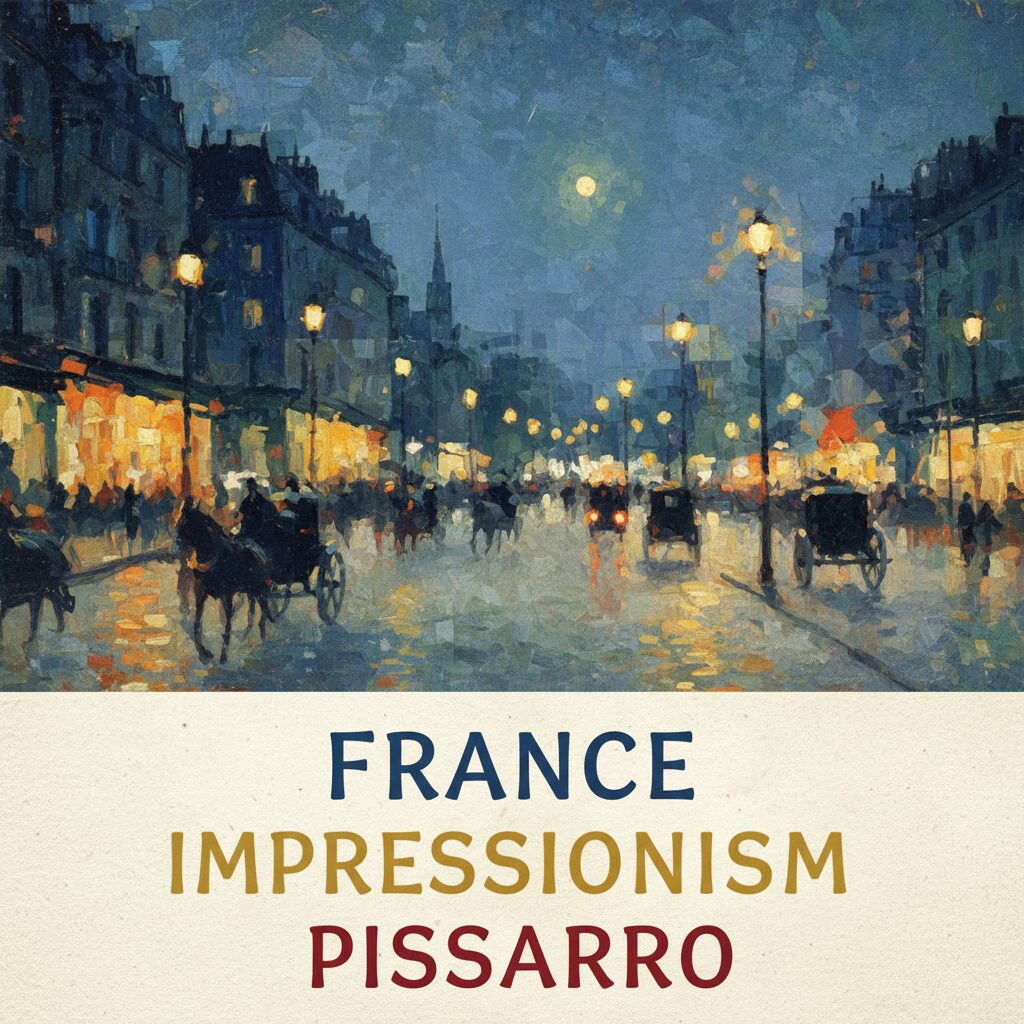
Decades later, in the 1890s, Pissarro returned to Paris not as a struggling artist but as a respected master. Battling a recurring eye infection that made outdoor painting difficult, he adopted a new approach. He rented rooms in hotels overlooking the grand boulevards that Baron Haussmann had carved through the city. From these elevated viewpoints, he created what is arguably his most celebrated series: views of Boulevard Montmartre, Avenue de l’Opéra, and the Tuileries Garden. These paintings form a symphony of urban life.
He painted the same scene repeatedly—at different times of day, through different seasons, and under varying weather conditions. He captured Boulevard Montmartre on a sunny afternoon, filled with carriages and pedestrians, their forms dissolving into swirling light and movement. He painted it again at night, with gaslights casting a golden glow on the wet pavement. He depicted it in snow, the scene softened and hushed beneath a blanket of white. Each canvas is a study in atmosphere, a snapshot of a fleeting moment. Remarkably, his perspective makes him both a part of the city and an observer floating above it, capturing the relentless rhythm of modern Paris. He saw the boulevards as great rivers of life, a constantly shifting spectacle of light, color, and motion.
For today’s traveler in Paris, visiting the Musée d’Orsay is essential—it houses an unparalleled collection of Impressionist works, including many of Pissarro’s masterpieces. Afterwards, find a café on the second floor of a grand department store like Galeries Lafayette or Printemps. From their windows, you can gaze down on the same boulevards Pissarro painted. Watching the flow of traffic, the scurrying pedestrians, and the way light hits the magnificent façade of the Opéra Garnier, you share his vantage point. You see the city not just as monuments, but as a living, breathing organism—a masterpiece of perpetual motion he so brilliantly captured.
The Heart of Impressionism: Pontoise and the Lure of the Countryside
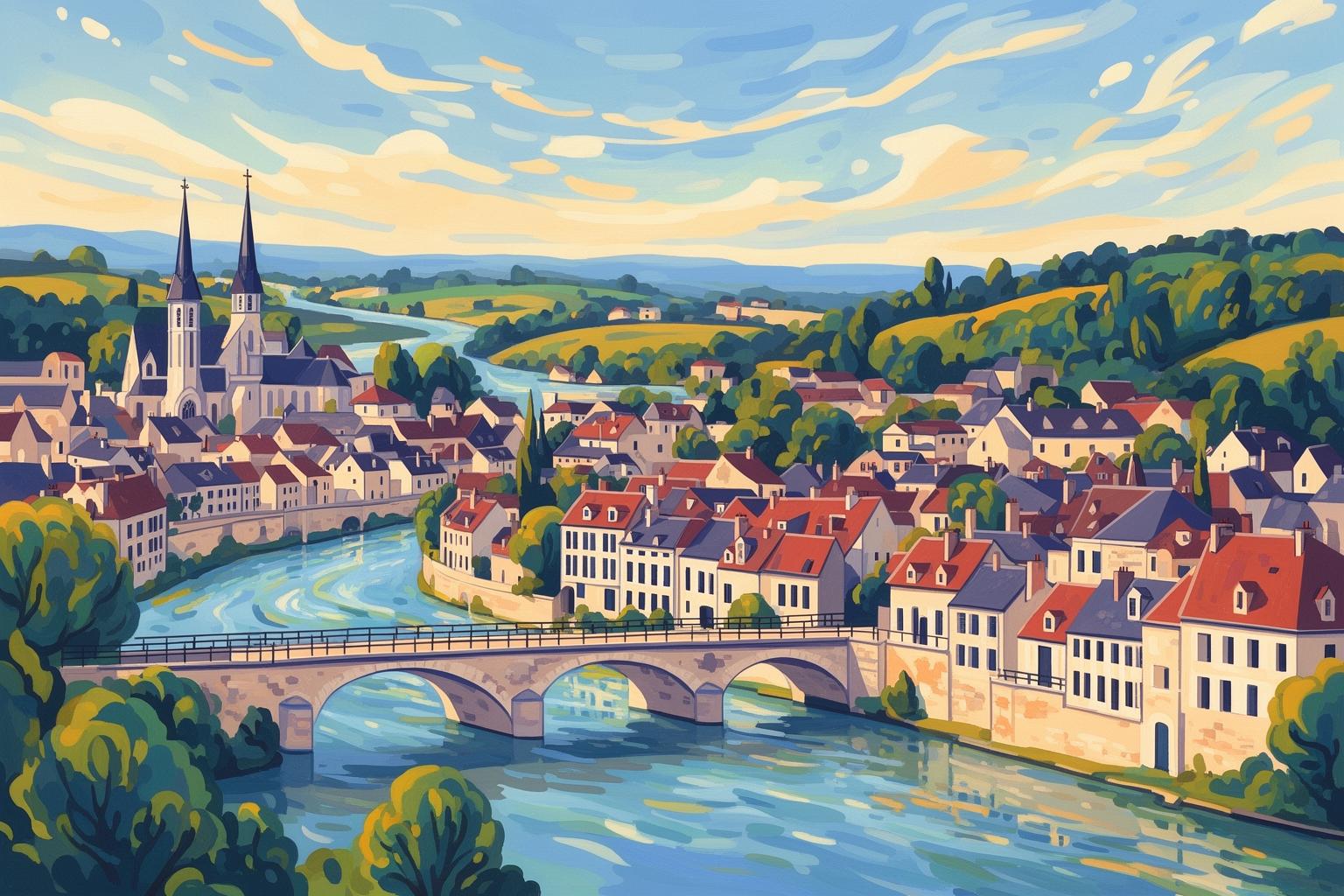
If Paris was the crucible where Impressionism was born, then the small market town of Pontoise was its heart, with Camille Pissarro as its high priest. Nestled in the rolling hills of the Vexin region, about an hour northwest of Paris, Pontoise and the nearby villages along the Oise River became Pissarro’s sanctuary and open-air studio for nearly two decades. It was here, far from the theoretical debates of city cafés, that he created his most foundational work, developing his unique visual language and mentoring a new generation of artists. He moved his family to Pontoise in 1866, returned in 1872, and stayed until 1882—marking the peak of his landscape painting career.
The atmosphere of 19th-century Pontoise was one of agrarian simplicity. It was a working town, not a scenic tourist spot. Its steep, winding streets bustled with farmers bringing produce to market; the hills were dotted with kitchen gardens (notably the famous chou or cabbage fields), and the riverbanks were lined with barges and small factories. This authenticity was exactly what Pissarro cherished. He had no interest in an idealized, romantic countryside. Instead, he sought to paint the land as it truly was: a place of labor, seasonal change, and modest, everyday beauty. His Pontoise paintings capture the textures of rural life—the rough stone of a farm wall, the freshly plowed earth, the tangled branches of a winter orchard.
The Humble and Colossal Mentor
Pontoise is inseparable from Pissarro’s identity as a teacher and mentor. In the summer of 1872, a young, difficult, and brilliant artist named Paul Cézanne came to stay nearby in Auvers-sur-Oise. For the following two years, the two painted side-by-side, setting up their easels along the same country lanes and fields. The experience was transformative for Cézanne. Pissarro, with his patient and generous spirit, taught him how to observe nature, break a scene into patches of color, and compose with the brush. He encouraged Cézanne to lighten his palette and abandon the dark, dramatic style of his early work. Cézanne later said of him, “He was a father to me. A man to consult and something like the good Lord.” He famously called Pissarro “the humble and colossal Pissarro,” perfectly capturing the man’s character and artistic stature. Even Paul Gauguin, another notoriously prickly personality, came to Pontoise to learn from the master, absorbing Pissarro’s techniques and dedication to his craft.
Walking the Pissarro Trail
Today, visiting Pontoise offers one of the most immersive art pilgrimages possible. The town has created a walking trail where you can stand in the exact spots where Pissarro painted some of his most famous works. Along the route, reproductions of the paintings allow direct comparisons between canvas and landscape. The journey typically starts in the Hermitage district, a quiet, almost rustic neighborhood where Pissarro lived. As you ascend the Sentier des Pâtis (Path of the Fields), you reach the viewpoint for “The Hermitage at Pontoise,” seeing the same jumble of red-tiled roofs, sloping gardens, and village clinging to a hillside. Further along, you can stand before the vast cabbage fields he painted so often, appreciating his fascination with the repetitive, geometric patterns of the cultivated land. From the old town’s ramparts, you get a sweeping view of the Oise valley, the very vista featured in paintings like “Jalais Hill, Pontoise.” What feels truly magical is realizing that, despite some changes, the fundamental landscape—the light, hill contours, and atmosphere—remains remarkably intact. It’s as if you’ve stepped through the frame into his world.
Practical Notes for the Pilgrim
Getting to Pontoise is straightforward. It’s a direct train ride from Paris’s Gare Saint-Lazare or Gare du Nord. Upon arrival, the tourist office provides maps for the Pissarro trail. The Musée Pissarro, housed in a historic building atop the old ramparts, is a must-see. Though it holds only a few original works, it offers valuable context with art by his sons and other artists of the Oise valley school. The true experience, however, is the walk itself. Wear comfortable shoes since the paths can be steep and uneven. Take your time. Sit on a bench and simply observe. Notice how light filters through the leaves, the patchwork of colors on the distant hills. In Pontoise, you’re not just viewing reproductions of Pissarro’s art—you’re engaging in the very act of seeing that defined his lifelong work.
A Rural Idyll: Louveciennes and the Changing Seasons
Before Pontoise became his long-term refuge, Pissarro discovered a different kind of rural tranquility in the village of Louveciennes. Nestled between Versailles and Paris, Louveciennes was closer to the capital, a peaceful, green suburb that provided a break from the city’s noise. Pissarro and his family lived here from 1869 to 1872, a short yet highly productive and ultimately tragic time. The art he created in Louveciennes is marked by a profound and sensitive attention to the changing seasons and the impact of weather on the landscape. He was especially intrigued by roads—not simply as pathways, but as compositional elements that guide the viewer’s eye deep into the painting, evoking a sense of space and journey.
His works from this period, such as “The Road to Versailles at Louveciennes,” are masterpieces of atmospheric effect. He depicted the same road bathed in the bright sunlight of spring, beneath the heavy, overcast autumn skies, and shrouded in the thick, muffling silence of snow. His snow scenes from Louveciennes rank among the greatest in art history. He recognized that snow is not just white; it serves as a canvas reflecting the subtle hues of the sky—pinks, blues, and pale lavenders. He appreciated the striking graphic contrast of dark tree trunks against a white field and the soft, rounded shapes of snow-laden branches. Louveciennes was where he honed his skill to capture a precise moment in time, a specific weather condition, with remarkable accuracy and poetic sensitivity.
The Trauma of War
The peacefulness of Louveciennes was violently disrupted by the outbreak of the Franco-Prussian War in 1870. As the Prussian army approached Paris, Pissarro, holding a Danish passport, was forced to flee with his family. They initially went to Brittany and later took refuge in London. Although this exile proved creatively rich—he and Monet painted the parks and bridges of the British capital—it came with a devastating personal toll. The house he had rented in Louveciennes was occupied by Prussian soldiers, who reportedly used his canvases as floor mats to keep their boots out of the mud. Upon returning after the war, Pissarro discovered that nearly twenty years of his work—some 1,500 paintings—had been destroyed. This was a catastrophic loss, erasing almost his entire artistic output up to that time.
This tragedy lends profound poignancy to the surviving works from Louveciennes. They are not just beautiful landscapes; they are treasured artifacts, survivors of a conflict that shattered his life. The resilience he displayed in the aftermath of this disaster speaks volumes about his character. He did not give in to despair; instead, he returned to his easel and began anew, relocating to Pontoise to rebuild both his life and his body of work. The serene, peaceful scenes of Louveciennes now bear the weight of this history, symbolizing a paradise lost and an unbroken spirit.
Louveciennes Today
Visiting Louveciennes today feels much like stepping into an affluent, quiet suburb of Paris. The exact roads Pissarro painted can still be followed, especially the Route de Versailles. Walking these streets, you can match the perspectives with reproductions of his paintings, noticing the same road curves and stone walls. The Aqueduct de Marly, a grand 17th-century edifice featured in some of his backgrounds, remains a majestic landmark. Though the town is less of a direct artistic pilgrimage spot than Pontoise, a visit offers a tranquil, reflective experience. It’s a place to contemplate the fragility of peace and the lasting power of art to find beauty even on the brink of disaster. The soft light and gentle hills seem imbued with the memory of the artist who tenderly captured them before his world was turned upside down.
Anarchist Arcadia: Éragny-sur-Epte, The Final Chapter
In 1884, Pissarro made his final move by purchasing a large farmhouse in the small, secluded village of Éragny-sur-Epte, near Gisors on the border of Normandy. This was more than just a residence; it was a homestead, a project, and a tangible expression of his deeply held political and social beliefs. For the last twenty years of his life, Éragny became his entire world. There, the aging patriarch, surrounded by his wife Julie and their many children—several of whom also became artists—cultivated a life that reflected the ideals embodied in his art. Pissarro was a dedicated anarchist-communist, not in a violent or revolutionary way, but through his conviction in a utopian society founded on mutual aid, collective labor, and a harmonious relationship with the land.
Éragny was his arcadia. He devoted his energy to the property, planting an extensive garden and a sprawling orchard. This garden became his primary subject. Unlike Monet’s carefully curated, purely aesthetic garden at Giverny, Pissarro’s was a working garden—a place of production. His paintings from this era celebrate rural labor, depicting his family and neighbors planting, weeding, and harvesting. Works such as “Apple Picking at Éragny-sur-Epte” are more than merely charming genre scenes; they portray a miniature ideal society. The figures are not laboring peasants in the 19th-century realist style of Millet, but rather joyful participants in a collective, fruitful endeavor. The light is often golden, the colors vibrant, and the compositions filled with a gentle, rhythmic harmony. It is a vision of humanity living peacefully with nature and one another.
A Time of Experimentation
The Éragny period was also marked by artistic exploration. In the mid-1880s, Pissarro became intrigued by the scientific color theories of Georges Seurat and Paul Signac. For several years, he embraced their meticulous Pointillism technique (or Neo-Impressionism), constructing his paintings with tiny dots of pure color. His friends and dealer were horrified, as these works were difficult to sell and seemed to betray the spontaneity of Impressionism. For Pissarro, however, it was a necessary experiment—an effort to bring a more systematic, scientific rigor to his art. Although he eventually found the technique too restrictive and returned to a freer, more fluid style, his Neo-Impressionist works represent a fascinating chapter in his career, showcasing his lifelong intellectual curiosity and refusal to become complacent.
The Family and the Press
Éragny was a hub of creative activity. Pissarro’s son Lucien, a gifted artist in his own right, became a prominent figure in the English Arts and Crafts movement. Together, father and son founded the Éragny Press in their farmhouse, producing beautiful, handcrafted books with woodcut illustrations. This venture further expressed Pissarro’s belief in the value of artisanal labor and the integration of art into everyday life. The house was frequently visited by artists, writers, and political thinkers. It stood as the nerve center of his world—a place where art, family, and politics were inseparably connected.
The Spirit of Éragny Today
The house at Éragny remains privately owned by the Pissarro family and is not open to visitors. However, the spirit of this final chapter in his life can still be felt by exploring the surrounding countryside of the Vexin Normand. This is a quiet, deeply rural region of France, with rolling fields, ancient farmhouses, and peaceful rivers. A walk through the fields and orchards around the village allows one to see the landscape that served as the backdrop for his utopian vision. This is not a place of specific landmarks, but one of atmosphere. It invites an understanding of the philosophy that guided him in his later years: a faith in the restorative power of nature, the dignity of labor, and the possibility of a better, more equitable world. The gentle, productive landscapes of Éragny are the final, serene canvases of a man who spent his entire life in search of harmony—in color, in composition, and in human society.
The Port Cities: Rouen and Le Havre’s Industrial Pulse
While Pissarro is most commonly linked with the pastoral calm of the countryside, his artistic curiosity was far too restless to be limited to a single theme. Just as he was attracted to the modern spectacle of the Parisian boulevards, in his later years he focused on the industrial vibrancy of France’s port cities. He created several series in Rouen, the historic capital of Normandy, and in the busy port of Le Havre. These works reveal his lasting fascination with the evolving face of modern life, where nature and industry intersect. He saw no contradiction in painting a field of cabbages one month and a steam-emitting tugboat the next. To him, both subjects were valid and vital for a modern artist.
In Rouen, he stayed in a hotel overlooking the Seine, captivated by the constant activity on the river and the architectural marvel of the Pont Boieldieu, an iron bridge symbolizing modern engineering. While his friend Monet famously painted the facade of Rouen Cathedral at the same time, absorbed in the ethereal effects of light on ancient stone, Pissarro directed his easel the other way, toward the port. He was interested in the city’s lifeblood: the smoke, the steam, the crowds of workers, the loading and unloading of cargo. His paintings, such as “The Pont Boieldieu in Rouen, Sunset,” burst with energy. The setting sun gleams on the water, churned by river traffic, and the sky is hazy with industrial smog. He finds a gritty, powerful beauty in this scene, one that is wholly of its era.
Capturing the Modern Harbor
His series in Le Havre and Dieppe followed a similar approach. He was drawn to the outer harbors, the jetties, and the interplay of ships, water, and sky. He loved the complex silhouettes of masts and cranes against a cloudy background, the reflections of hulls in choppy waters, and the sense of constant motion. These are not quiet, meditative seascapes in the traditional sense. They’re noisy and vibrant. You can almost smell the coal smoke and salty air. In these works, Pissarro adeptly uses his broken Impressionist brushwork to express the shimmering, ever-changing water surface and the fleeting effects of light and weather. A painting like “The Outer Harbor, Le Havre, Morning Sun” is a brilliant study of atmospheric conditions, capturing the damp, misty air of a Normandy morning as the sun begins to emerge.
A Traveler’s Perspective
A visit to these cities today offers a compelling dialogue with Pissarro’s art. Rouen’s historic center remains magnificently preserved, and a stroll along the Seine’s quays, though modernized, still evokes the river’s central importance. You can stand and watch barges pass by, imagining Pissarro at his hotel window, quickly dabbing paint on his canvas to capture the scene before the light shifted. The Musée des Beaux-Arts de Rouen houses an excellent collection, including several of Pissarro’s Rouen series, allowing visitors to view the works in the very city that inspired them. Le Havre, heavily bombed during World War II and rebuilt in a stark modern style, offers a different experience, yet its identity remains defined by its massive port. A visit to the harbor, with its colossal container ships and bustling activity, connects you to the industrial energy that fascinated Pissarro. The Musée d’art moderne André Malraux (MuMa) in Le Havre, with its stunning glass facade facing the sea, boasts an outstanding Impressionist collection and serves as the perfect place to reflect on Pissarro’s vision of the modern port.
These series from port cities are a vital part of Pissarro’s legacy. They demonstrate that his Impressionism was not an escape from the modern world but an enthusiastic engagement with it. He found beauty everywhere—not only in sun-dappled fields but at the heart of industrial and commercial life—solidifying his reputation as the most versatile and far-reaching observer of his generation.
The Enduring Vision of a Humble Master
Our exploration of Camille Pissarro’s path comes to an end, yet his vision continues to resonate softly and powerfully. From the vibrant, sunlit chaos of his birth in St. Thomas to the revolutionary energy of Paris, from the rich, working landscapes of Pontoise to the utopian garden of Éragny, his life stood as a tribute to the deep beauty of the world as it truly is. He was an artist of unmatched integrity and humility, a wanderer whose gaze rested on the overlooked and ordinary, elevating them to the sublime. He showed us that a muddy road, a lively market, or a factory smokestack could hold as much significance as any classical hero.
Traveling to these places involves more than merely marking destinations on a map. It invites a new way of seeing. It means standing on a hillside in Pontoise and feeling the same breeze that guided his brush, or looking down on a Parisian boulevard and sensing the urban rhythm he so masterfully captured. Pissarro’s greatest lesson is one of attentiveness. He urges us to look more closely at our surroundings, to discover the poetry in everyday moments, and to cherish the transient magic of particular light qualities. He was Impressionism’s anchor, its conscience, and its heart. Following in his footsteps reveals that the most meaningful journeys often lead us back to the simple, profound, and radiant beauty of the world right before our eyes.