Some journeys don’t follow a map of roads and cities, but a map of a soul. They trace the contours of a life lived with such ferocious vision that the earth itself seems to hold the memory. To follow Constantin Brancusi is to embark on such a pilgrimage. It’s a journey that begins in the soil of a forgotten Romanian village, carved from ancient forests, and ascends, quite literally, to pierce the heavens above an industrial town. It’s a path that winds through the bohemian heart of Paris, where the very definition of sculpture was shattered and remade, and finally scatters across the globe, enshrined in the pristine galleries of the modern world. Brancusi wasn’t just a sculptor; he was a philosopher working in stone, wood, and bronze. He sought not the image of things, but their essence, their secret music, the rhythm of their being. To travel in his wake is to learn to see the world differently, to find the potential for flight in a piece of marble, the promise of a universe in a block of wood, and the infinite in a simple, repeated form. This is not just a tour of museums and monuments, but an expedition into the heart of modernism, a quest for the simple, profound truths that Brancusi spent a lifetime uncovering. It’s a story of a peasant boy who walked to Paris and taught the world a new way to feel.
For a similarly transformative journey into the essence of color and spirit, consider embarking on a pilgrimage into the world of Yves Klein.
The Soul’s Soil: Hobița and the Heart of Romania
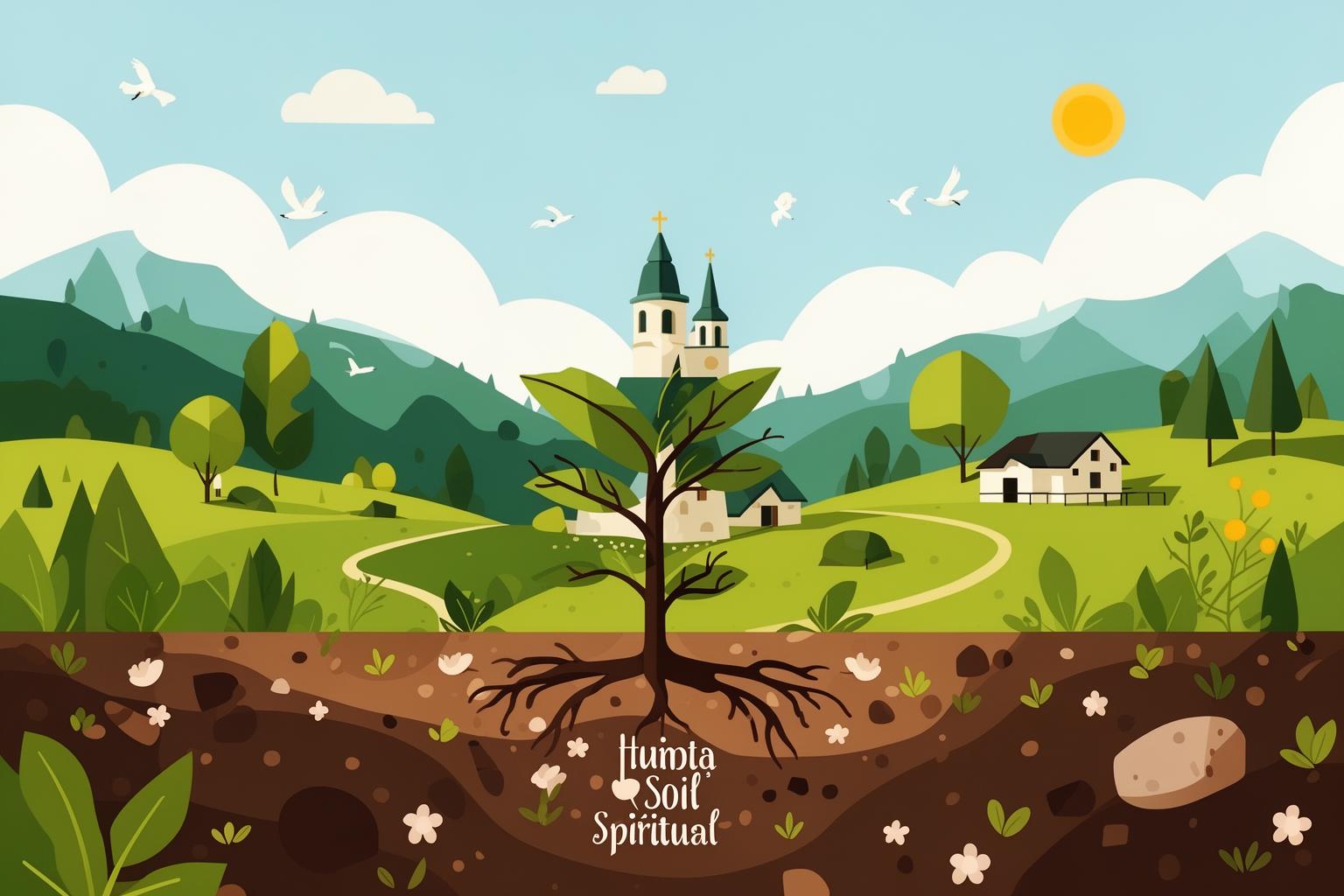
Our journey starts where his once did, in a place that feels a world apart from the polished floors of a modern art gallery. We head to Oltenia, a historic region nestled in the Southern Carpathian Mountains of Romania. Here, among the rolling foothills, lies the village of Hobița. This is not a place you discover by chance; it’s a destination you deliberately seek. The air itself feels different—denser, scented with damp earth, woodsmoke, and a faint, sweet aroma of hay. This is the primal landscape that shaped Brancusi’s hands and vision. Born here in 1876, he lived a life of poverty, tending sheep on fields that slope gently toward the mountains. Yet this land was rich in another kind of wealth: a profound, unbroken tradition of woodcraft.
Even before reaching his memorial home, you see this everywhere. The wooden gates of village houses are not just entrances but monumental sculptures in their own right, intricately carved with geometric patterns, sun-discs, and the rope-like motif that Brancusi would later echo in his Endless Column. The houses themselves, with their steep, shingled roofs and sturdy oak beams, speak a language of material honesty. Here, wood is not merely a building material; it is a spiritual medium, a living substance imbued with the soul of the forest. As a boy, Brancusi didn’t learn art in a classroom; he absorbed it. He learned the character of wood—its grain, its scent, its resistance, and its readiness to yield to a sharp blade. He carved spoons, chairs, and tools, mastering ancestral techniques passed down through generations.
The Memorial House
Today, the Constantin Brancusi Memorial House stands as a quiet tribute to these beginnings. It is a simple, traditional Oltenian cottage, reconstructed on the original site, built using the same materials and methods as the home he would have known. Stepping inside feels like stepping back a century. The low ceilings, the dark, hand-hewn wooden beams, and the hearth that was the heart of family life—all speak of humility. There are no grand sculptures here. Instead, you find photographs, documents, and a collection of rustic furniture and tools that evoke his childhood world. The power of this place lies not in what is displayed, but in what it symbolizes. It is the soil from which the giant grew. Standing on the porch, looking out at the same green hills that a young Constantin once gazed upon, you begin to grasp the source of his art. His work was never an abstraction detached from life; it was an extraction, a distillation of the forms he knew instinctively—the arch of a gate, the curve of a well, the vertical surge of a fir tree.
A Practical Guide to Hobița
Visiting Hobița requires some planning. It’s located in Gorj County, about 30 kilometers west of the city of Târgu Jiu. The easiest way to reach it is by car, which also allows you to explore the surrounding countryside at your own pace. The drive itself is part of the experience, winding through picturesque villages and lush landscapes. Hobița has little in the way of tourist infrastructure—no grand hotels or bustling restaurants—and that is its charm. It remains a living village, not a theme park. Plan a day trip from Târgu Jiu, or stay in a nearby guesthouse (pensiune) for a more immersive experience. The best time to visit is in late spring or early autumn, when the weather is mild and the countryside is at its most vibrant. Bring cash, as credit cards are not widely accepted in small rural shops. More importantly, bring a sense of quiet curiosity. This is a place for slow walking, for listening to the birds, and for feeling the deep, foundational pulse of rural Romania that beat within Brancusi throughout his life.
A Monument to Heroes: The Sacred Axis of Târgu Jiu
From the tranquil cradle of Hobița, we journey to the nearby city of Târgu Jiu. If Hobița nurtured his vocabulary, Târgu Jiu is where he penned his epic poem. In the late 1930s, Brancusi, by then a world-renowned artist living in Paris, was invited back to his native region to create a memorial for the Romanian soldiers who defended the town against German forces during World War I. He accepted the commission but declined payment, viewing it as a gift to his homeland. What he created was not a statue of a soldier on horseback or a solemn obelisk, but one of the most ambitious and spiritually profound works of public art of the 20th century. He reshaped the city’s very layout, establishing a monumental axis stretching over a mile and connecting three distinct sculptural works: The Table of Silence, The Gate of the Kiss, and The Endless Column.
To fully experience the ensemble as intended, one must walk it. The journey starts in the city’s central park, along the banks of the Jiu River, where you first encounter The Table of Silence.
The Table of Silence (Masa Tăcerii)
The mood shifts as you draw near. Set within a wide, grassy clearing, a large circular stone table is surrounded by twelve hourglass-shaped stools. The immediate feeling is one of deep stillness. The forms are so simple, so pure, they seem to absorb the surrounding sounds. Brancusi himself was ambiguous about its meaning, but many interpret it as representing the Last Supper or perhaps the silent, contemplative moment a soldier experiences before battle. The hourglass design of the stools powerfully symbolizes time, moments slipping away. Sitting on one of the stone seats—which are spaced wider than at a typical table, creating a sense of both community and isolation—is a meditative experience. You sense the weight of history and silent reflection on sacrifice. The piece does not loudly declare its meaning; it whispers, inviting pause and contemplation before continuing the journey.
The Gate of the Kiss (Poarta Sărutului)
From the Table, you walk down a tree-lined path known as the Alley of Chairs, flanked by more stool-like forms. At the park’s entrance stands the second element: The Gate of the Kiss. This is not a triumphant victory arch, but a gateway of love and transition. It’s a massive structure made of travertine, yet it feels intimate. The lintel is carved with a repeating motif—on each side, two halves of a circle, resembling two eyes meeting. This motif distills his earlier sculpture, The Kiss, where two lovers are merged into a single block, their forms inseparable. Here, the idea expands into architecture. The kiss becomes a symbol of passage—the journey from life to death, from the civilian world to the spiritual realm. Walking through the gate feels momentous. You physically pass through a symbol of unity and love, leaving the world of quiet reflection and progressing toward the final, transcendent statement.
The Endless Column (Coloana Infinitului)
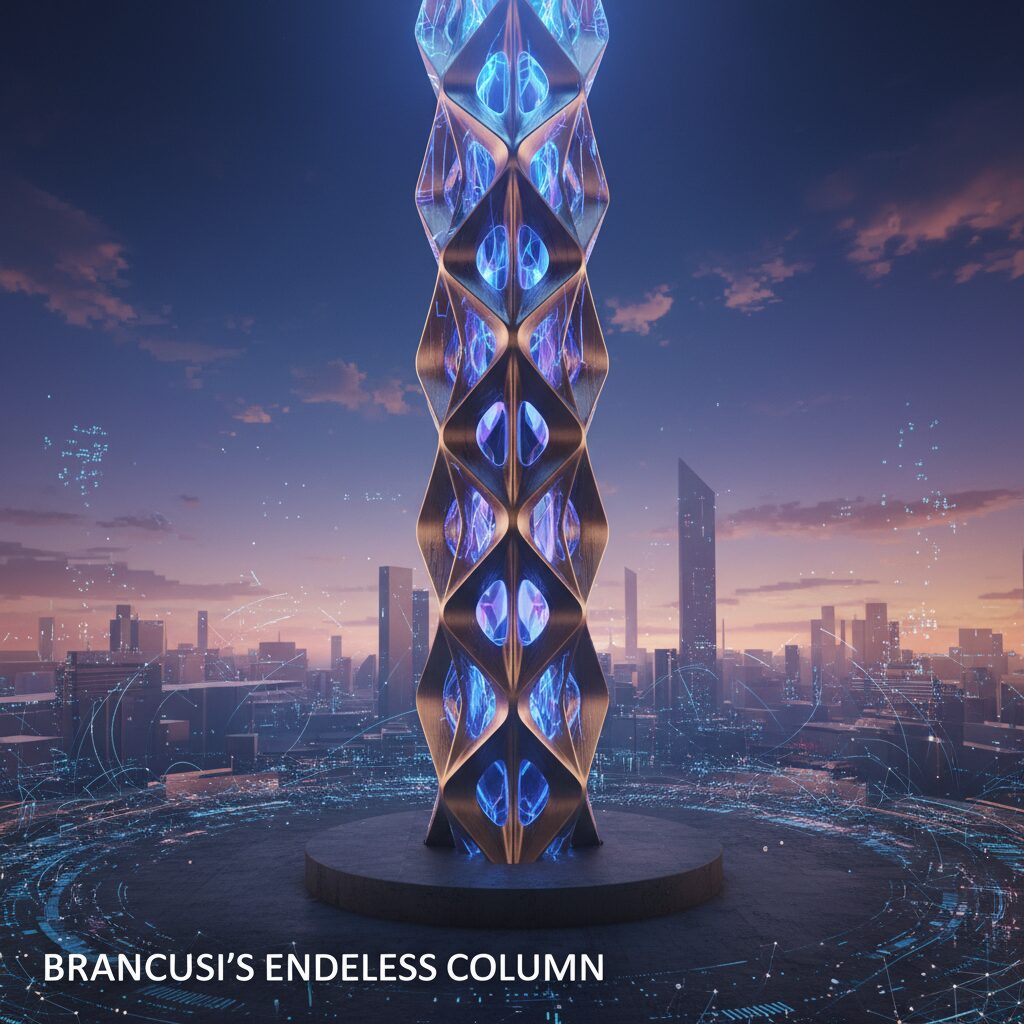
Exiting the park, you gaze down a long road, Calea Eroilor (The Path of the Heroes). There, in the distance, it rises—a shimmering golden needle stitching earth to sky atop a small hill on the city’s far side. The Endless Column is, without question, Brancusi’s ultimate masterpiece. Approaching it, its scale becomes clear. Nearly 30 meters tall, it’s composed of seventeen rhomboidal cast-iron modules plated in brass that catches light beautifully. The form’s genius lies in its optical illusion. Half-modules at the top and bottom give the impression that the column has no end, continuing infinitely skyward and deep into the earth. It serves as a true axis mundi, a world pillar connecting earthly and celestial realms. It symbolizes infinite sacrifice and the eternal ascent of the human spirit. Standing at its base and looking up, the modules seem to pulse with a rhythmic upward energy. The experience is deeply moving—both powerful and serene. The column’s appearance shifts dramatically with the light. At dawn, it feels ethereal and ghostly; in bright midday sun, it shines as a brilliant, solid beacon. At sunset, as the brass glows golden, it truly seems like a stairway to heaven.
Experiencing the Ensemble
To truly appreciate Brancusi’s vision in Târgu Jiu, take your time. Don’t rush from one piece to the next. Walk the entire length of the axis. Begin at the Table of Silence in the morning, when the park is tranquil. Feel the cool stone beneath you. Move slowly through the Gate of the Kiss, pondering its symbolism. Then make a pilgrimage down Calea Eroilor toward the Column. Visit the Column at different times of day to witness how the light transforms it. The city of Târgu Jiu rightly cherishes this legacy, and the ensemble is well maintained and accessible to all, free of charge and open at all hours. It is public art in the truest sense—woven into daily life yet transcendent in its ambition.
The Great Walk: From Bucharest to the City of Light

After completing his studies in Bucharest, Brancusi was drawn to a new world. In 1904, at 28 years old, he decided to move to Paris, the undisputed center of the art world. Without the money for a train ticket, he did what seemed natural for a man raised in the Romanian countryside: he started walking. This journey has become a key element of the Brancusi legend, a story that reveals much about his character—his resilience, determination, and deep bond with the earth.
This route is not one a modern traveler could easily follow, but understanding its spirit is essential to the pilgrimage. He walked through Hungary, Austria, and Germany, taking on odd jobs along the way to survive. Imagine the journey: a young man with few belongings, crossing a continent on foot, observing the changing landscapes, diverse architectures, and unfamiliar faces. It was not a race but a slow, conscious immersion in the world. He wasn’t a tourist passing through; he was a pilgrim heading toward his destiny. This long walk was a time of transformation, shedding one identity and preparing for another. It instilled in him self-reliance and single-mindedness that would come to define his career. When he finally reached Paris, tired and penniless, he wasn’t an empty vessel waiting to be filled. He was a man who had earned his place by measuring the continent with his own feet, carrying with him the silent wisdom of the long road.
Reflecting on this journey adds deep meaning to his later work. The upward movement in the Endless Column, the grounded nature of his bases, and the organic, flowing lines of his sculptures all seem connected to this foundational experience of continuous, rhythmic motion across the land. It reminds us that his modernism did not emerge from a sterile intellectual environment; it was shaped by hardship, rooted in the earth, and driven by an unstoppable creative will.
The Crucible of Creation: Montparnasse, Paris
Upon arriving in Paris, Brancusi discovered his spiritual home in the bohemian maze of Montparnasse. This wasn’t the postcard-perfect Paris; rather, it was a gritty, lively, and revolutionary neighborhood filled with artists, writers, and thinkers from around the globe who were collectively dismantling the old order and creating the new. This was the realm of Picasso, Modigliani, Satie, and Duchamp. For a period, Brancusi worked in the studio of the great Auguste Rodin, the giant of 19th-century sculpture. Yet, he famously departed after just a few months, stating, “Nothing grows under the shadow of big trees.” He understood he had to seek his own light.
The Impasse Ronsin Studio
He found that light in a series of studios, culminating in his legendary space at Impasse Ronsin, a shabby alley lined with artists’ workshops. This studio was more than just a workspace; it was his sanctuary, his laboratory, and an artwork in its own right. He whitewashed the walls, crafting a space of monastic simplicity where his sculptures could exist in perfect harmony. Photographs from that era reveal a carefully arranged world. Polished bronze forms gleam against rough-hewn wooden bases. Smooth, egg-shaped marble heads lie beside jagged, primitive-looking carvings. Nothing was left to chance. He referred to it as his “architectural ensemble,” where sculptures, bases, tools, and the space itself formed a cohesive whole. Known as a meticulous host who cooked Romanian polenta for friends on a brick stove, he was also fiercely protective of his creative environment. Visiting the studio was like entering a temple. Here, he chiseled away the non-essential, in both art and life, searching for the pure, underlying form—the essence of a bird in flight, the promise of life in an egg, the eternal bond of a kiss.
The Rebirth at Centre Pompidou: The Atelier Brancusi
Brancusi lived and worked at Impasse Ronsin until his death in 1957. Aware that his studio was his ultimate masterpiece, he bequeathed its entire contents to the French state on the condition that it be faithfully reconstructed exactly as he left it. Although the original Impasse Ronsin was demolished, his wish was honored. Today, nestled in the piazza before the iconic Centre Pompidou, stands the Atelier Brancusi. Housed in a modern pavilion designed by architect Renzo Piano, it is a stunningly faithful recreation of his final studio space.
Visiting the Atelier
Approaching the large glass windows of the Atelier is a breathtaking experience. Visitors cannot enter the space itself—it is preserved like a sacred relic—but they can observe his world from various angles. It feels as if the master has only just stepped out. Tools are laid out, sculptures appear in different stages of completion, and the carefully controlled light streams in just as it once did. Visitors can see the famous groupings he arranged: a flock of Birds in Space seemingly lifting off together, the serene, reflective faces of the Sleeping Muses, and the powerful, totemic wooden statues such as Socrates and The Cock. It is a quiet, potent, and profoundly moving experience. One can spend hours simply observing, absorbing the relationships between forms, the textures of diverse materials, and the immense spiritual force of the environment he created. Admission is free, a wonderful gift to the city. The best advice for first-time visitors is to arrive with time to be slow and quiet. Let your eyes adjust. Notice not only the individual sculptures but also the spaces between them. Feel the rhythm of the arrangement. It is the closest encounter we can have with the man himself and the purest understanding of his vision.
The Essence Takes Flight: Brancusi Across the Globe

While Romania and Paris stand as the two main centers of Brancusi’s world, the final stage of the pilgrimage takes on a global dimension. His influence was vast, and his works were highly sought after by the most progressive collectors and museums worldwide. To fully understand his evolution and impact, the journey must extend further, especially to the United States, a nation that embraced his radical vision.
New York’s Embrace
New York City arguably represents the third most significant Brancusi site. The Museum of Modern Art (MoMA) houses an extraordinary collection, including the exquisite marble version of Bird in Space. It is here that one can truly appreciate the sleek, upward-reaching form that sparked a customs controversy in 1926. When Brancusi’s friend Marcel Duchamp attempted to import the sculpture, U.S. officials refused to recognize it as art, instead taxing it as raw metal under the category “Kitchen Utensils and Hospital Supplies.” The resulting court case, Brancusi v. United States, became a landmark trial that legally redefined what could be considered art. Brancusi prevailed, paving the way for the acceptance of abstract art in America. The Solomon R. Guggenheim Museum also features a significant collection, and viewing his polished bronzes within Frank Lloyd Wright’s spiraling masterpiece offers a uniquely harmonious experience. The organic curves of the building seem to perfectly echo Brancusi’s aesthetic.
Other Sanctuaries
Outside New York, the Philadelphia Museum of Art is another vital stop for any Brancusi enthusiast. It was home to one of his most important patrons, Walter Arensberg, and its collection reflects this close relationship, showcasing masterpieces in wood, stone, and bronze. Naturally, the National Museum of Art of Romania in Bucharest deserves mention as well. Visiting here completes the journey, allowing one to see his early, more academic works and follow the trajectory of his genius from its formal beginnings to revolutionary breakthroughs. Viewing pieces like The Prayer or the original version of The Kiss in his homeland, after visiting Hobița and Târgu Jiu, provides a rich, full-circle sense of closure to the European segment of the pilgrimage.
A Traveler’s Guide to the Brancusi Trail
Embarking on an artistic journey across multiple countries calls for some logistical planning. Here is practical advice to help you explore the essential sites along the Brancusi trail.
Navigating Romania
Romania is a beautiful and enriching destination, though it may pose challenges for travelers accustomed to Western European infrastructure. Renting a car is the most practical way to visit Hobița and Târgu Jiu, offering the freedom to travel at your own pace and discover the picturesque Oltenian countryside. You can fly into Bucharest or Sibiu and pick up a rental car from there. The drive to Târgu Jiu takes several hours and traverses scenic mountain passes and rural areas. While Romanian roads are improving, be prepared for some uneven conditions. The local currency is the Romanian Leu (RON). Credit cards are accepted at larger hotels and restaurants in cities like Târgu Jiu, but cash is essential for smaller guesthouses, local shops, and villages such as Hobița. The best times to visit are spring (May-June) and autumn (September-October), when the weather is mild and the scenery vibrant. Learning a few basic Romanian phrases, like “Bună ziua” (Good day) and “Mulțumesc” (Thank you), will be greatly appreciated.
Mastering Paris
Paris, by comparison, is very easy to get around. Its public transportation system, especially the Métro, is efficient and will take you wherever you need to go. The Atelier Brancusi is situated at the Centre Pompidou in the 4th arrondissement, conveniently accessible via the Rambuteau or Hôtel de Ville Métro stations. While entry to the Atelier is free, the main Centre Pompidou, which houses an outstanding modern art collection, requires a ticket. Booking online in advance is recommended to avoid long lines. For the complete Montparnasse experience, consider a walking tour of the area. After visiting the Atelier, you might explore Montparnasse Cemetery (Cimetière du Montparnasse) to see Brancusi’s grave, where he rests alongside two other expatriate artists. His tomb is adorned with a stone rendition of The Kiss, a final, moving tribute to his lasting theme of unity.
The Endless Journey
Following in the footsteps of Constantin Brancusi is more than just a travel itinerary; it is a lesson in perception. It is a journey that reveals the power of place, the pull of heritage, and the bravery needed to carve a new path. From the ancient wood-carving traditions of Hobița, you learn that even the most radical modernism can have deep roots. In the monumental silence of Târgu Jiu, you see how art can heal a community and transform a landscape into a sacred space. In the ghost of his Paris studio, you sense the intense energy of an artist who distilled the universe into its essential forms. And in the great museums of the world, you witness the results of that unique vision—an art that transcends culture and time, speaking a universal language of grace, spirit, and aspiration. Brancusi’s life stands as a testament to the idea that simplicity is the ultimate sophistication. His journey from shepherd boy to modern master is a story of relentless focus and unwavering faith in the power of art. To follow his path is to be reminded that the most profound journeys often lead us back to the simplest truths, and that, like his Endless Column, the human spirit is always, endlessly reaching for the light.