To trace the life of Marc Chagall is to follow a map drawn not with ink, but with the vibrant, soul-stirring colors of his own palette. His was a journey that stretched from the snowy wooden rooftops of a Russian shtetl to the sun-drenched azure of the Mediterranean coast, a pilgrimage through the tumultuous heart of the 20th century. Chagall didn’t just paint scenes; he painted his soul’s geography, a world where lovers float over towns, fiddlers perch on roofs, and angels mingle with donkeys. To walk the streets he walked is to step inside his waking dream, to understand how a boy from Vitebsk learned to paint the very air we breathe with love, memory, and a profound sense of wonder. This is not just a tour of museums and old houses; it is a quest to find the source of his light, to stand in the places that shaped his vision and filled his canvases with a joy so fierce it could defy gravity itself. We begin in the East, in the homeland of his heart, and travel west towards the sun, following the arc of a life lived entirely through art.
Much like the journey of an artistic exile navigating between worlds, Chagall’s pilgrimage reveals how place forever shapes a creator’s vision.
The Soul’s Homeland: Vitebsk, the Floating City
Every story of Chagall begins and ends in a single place: Vitebsk. Although he lived in Paris, New York, and the South of France, his spirit eternally hovered over this small city in what is now Belarus. It was his personal Jerusalem, the source of his iconography. When you view a Chagall painting, you are seeing Vitebsk—the tilted wooden houses, the onion domes of churches piercing the sky, the everyday figures of bakers, milkmen, and musicians—they all originated here. Visiting Vitebsk means feeling the gravitational pull of his memory. The air itself seems thick with his visions, a place where the boundary between the physical and the mystical feels impossibly thin. It is a quiet pilgrimage, a journey into the heart of the world he carried within him all his life, a world he lovingly recreated again and again from thousands of miles away.
Walking Through a Waking Dream: The Marc Chagall Museum
Your first stop should be the modest, two-story brick building on Pokrovskaya Street. This is the house where Marc Chagall spent his youth, the home his father built with his own hands. Now the Marc Chagall Museum, it functions less as a gallery and more as a time capsule. Crossing the threshold, with the floorboards creaking softly beneath your feet, you enter the very space that nurtured his imagination. The rooms are simply furnished, reflecting the humble life of his family. You can stand in the small bedroom he shared with his siblings and look out the window, imagining a young Chagall gazing at the same view, perhaps already envisioning lovers drifting across the moonlit sky. The museum doesn’t house his major oil paintings—those are scattered among the world’s great institutions—but it holds something far more intimate: the ghost of his childhood. Seeing the simple kitchen, the family portraits, and the nearby view of the Dvina River, you begin to understand that for Chagall, art was not an escape from life but a transformation of it. It’s a deeply moving experience, sensing the presence of his past in the quiet, reverent atmosphere. For a first-time visitor, I recommend going early in the morning, when the light is soft and the house is still, allowing for a more personal connection with the space.
The Echo of Color: The Art Centre
A short distance from his family home stands the Marc Chagall Art Centre, a modern counterpart to the historic house. This institution is devoted to his graphic works, housing an impressive collection of his lithographs, woodcuts, and etchings. Here, you witness the evolution of his famous motifs in both black and white and vivid color. It’s fascinating to see his Vitebsk memories distilled into pure line and form. The collection includes his renowned illustrations for Gogol’s “Dead Souls” and La Fontaine’s “Fables,” demonstrating his mastery as a storyteller across different media. The Art Centre serves as the intellectual heart of Chagall’s Vitebsk legacy. While the family home offers the emotional core, the Centre delivers the artistic context. Spend time with his illustrations; notice how a single, expressive line can convey profound joy or sorrow. It’s a masterclass in visual poetry. The city itself feels like a living exhibit, and after visiting these two sites, a stroll along the river or through the old Jewish quarter becomes a journey through one of his canvases.
The Crucible of Creation: Paris, City of Light and Love
If Vitebsk was the essence of Chagall’s soul, Paris was both his mind and his heart. He famously stated that he was born twice—first in Vitebsk, then again in Paris. Arriving in 1911, he was immersed in the vibrant, revolutionary world of the avant-garde. Among the Cubists, Fauvists, and Surrealists, he didn’t just blend in; he absorbed. He incorporated the structural innovations of Cubism and the vivid colors of Fauvism through his own deeply personal, folkloric lens. Paris provided him with the artistic language to express the dreams he carried from Russia. The city was more than a mere backdrop; it was a catalyst. It was where he envisioned his first great love, Bella Rosenfeld, long before they reunited, and their love became the ethereal, floating centerpiece of his work, forever intertwined with the rooftops of Paris.
La Ruche: The Beehive of Genius
Hidden away in the 15th arrondissement, far from the main tourist pathways, stands La Ruche, or “The Beehive,” a quirky circular building. This legendary, ramshackle artists’ commune offered a generation of émigré artists an affordable, if chilly, place to live and create. Chagall had a small, wedge-shaped studio here alongside Amedeo Modigliani, Chaim Soutine, and Fernand Léger. It was a place marked by great poverty but even greater creative energy. One can almost imagine the scent of oil paint, turpentine, and cheap wine mingling in the air, with passionate debates about art echoing through the thin walls. Today, La Ruche remains an active workspace for artists and is not open to the public. However, a pilgrimage to its gates is vital. To stand outside and gaze upon this icon of modernism is to pay tribute to the grit and passion that inspired a revolution. Afterwards, stroll through the surrounding Montparnasse neighborhood. Sit at La Coupole or Le Dôme, cafes where these artists sought refuge from their cold studios, and soak in the atmosphere of a Paris that treasured art above all else.
A Ceiling of Celestial Dreams: The Palais Garnier
For the most grand and public expression of Chagall’s love for Paris, one must visit the lavish Palais Garnier, the city’s historic opera house. In 1964, at the age of 77, Chagall was commissioned to paint a new mural on the grand ceiling—a bold, controversial choice to introduce modern art into a Second Empire masterpiece. The result is an explosion of pure joy. Gazing upward feels like diving into a kaleidoscope of color. Chagall created a vibrant tribute to the great composers, weaving characters from their operas and ballets—Mozart’s “The Magic Flute,” Tchaikovsky’s “Swan Lake”—into a swirling vortex of color, animals, and Parisian landmarks. It is a symphony painted in vivid hues. My recommendation for visitors is to take a self-guided tour on a weekday afternoon to avoid performance crowds. Find a spot in the center of the auditorium—perhaps even lie down on a bench if possible—and allow your eyes to wander. The brilliance of the work lies in how it both honors and rejuvenates the historic space, creating a dialogue between the 19th and 20th centuries through Chagall’s timeless vision. Don’t forget to bring a small pair of binoculars to appreciate the intricate details embedded within the grand design.
Conversations with the Masters: The Louvre
Chagall’s artistic development in Paris didn’t occur solely in Montparnasse studios; it happened within the revered halls of the Louvre. He spent countless hours there, studying masterpieces by Old Masters such as Rembrandt and Delacroix, learning from their mastery of light and composition. A Chagall-themed visit to the Louvre offers a unique perspective on the museum. Rather than heading straight for the Mona Lisa, seek out the artists he admired. Observe the dramatic chiaroscuro in a Rembrandt and notice its reflection in Chagall’s more mystical pieces. See the vibrant, emotional color in a Delacroix and recognize how Chagall amplified that emotional intensity to a dreamlike level. Understanding his teachers enriches the appreciation of his genius as both a student and a revolutionary artist. It frames his work not as a total break from tradition, but as a deeply personal continuation of the great dialogue of art history.
A Sanctuary of Sun: The French Riviera’s Golden Embrace
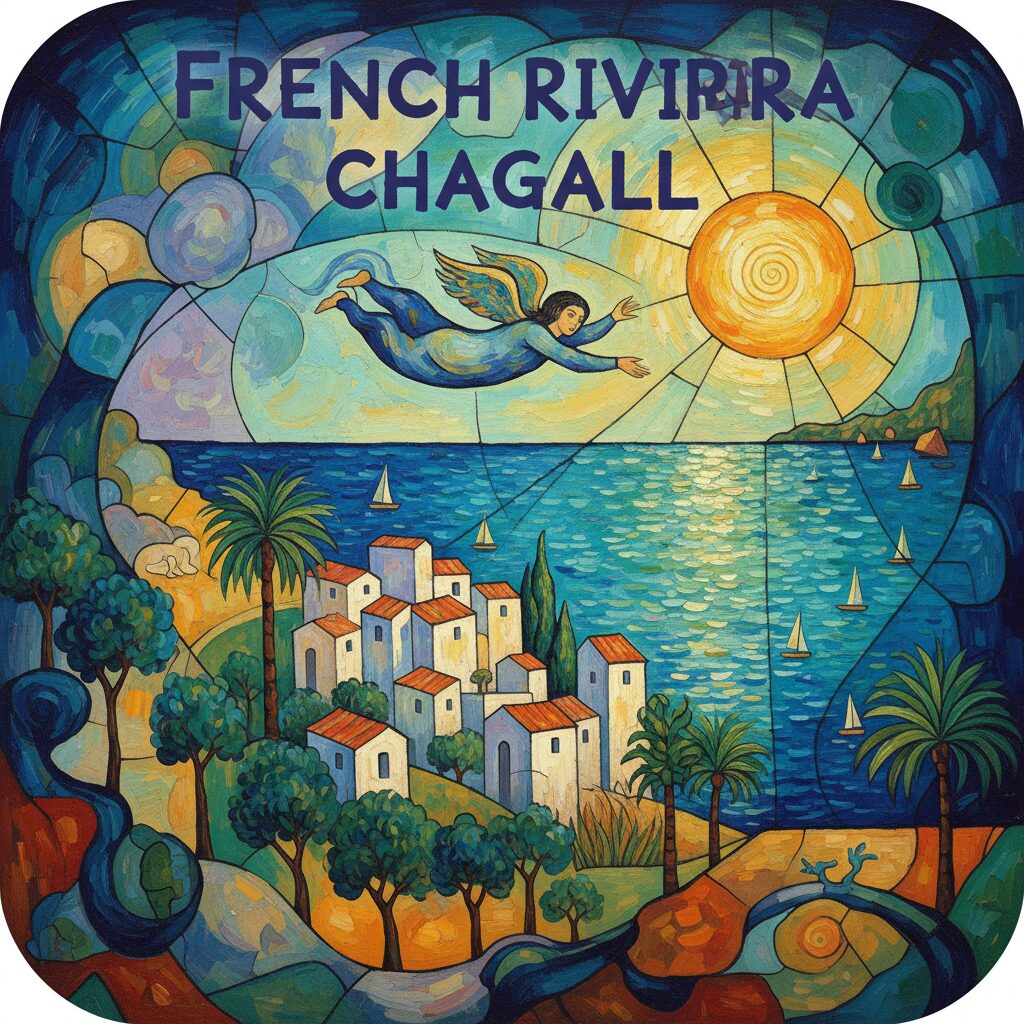
After the trauma and exile of World War II, Chagall found refuge and tranquility in the south of France. He settled in the hills of Provence, a landscape that had already inspired artists like Cézanne, Van Gogh, and Picasso. This relocation marked a major transformation in his art. The dark, somber tones of his wartime works gave way to a burst of radiant, Mediterranean color. The azure sea and the brilliant golden sun filled his canvases. This period was his final chapter—a long and remarkably productive time during which he explored new media such as ceramics, sculpture, mosaics, and most notably, stained glass. The French Riviera was not a place of retirement but a rebirth, a sunlit sanctuary where he produced some of his most monumental and spiritual creations.
The Biblical Message in Nice: Musée National Marc Chagall
Of all the sites dedicated to his art, none is more vital than the Musée National Marc Chagall in the Cimiez hills overlooking Nice. This is no ordinary museum; it is a sanctuary designed by Chagall himself to showcase his most important series, the Biblical Message. He participated in every detail of its design, from the arrangement of the galleries to the planting of the gardens, ensuring the space would foster contemplation and peace. The centerpiece is the main gallery, housing seventeen enormous paintings that depict scenes from Genesis and Exodus. Standing in this room, one is completely immersed in his vision. The colors are overwhelming, the compositions monumental. These are not mere illustrations; they are profound theological and human reflections on creation, love, and faith. Beyond this central cycle, the museum includes a concert hall with stunning blue stained glass windows illustrating the creation of the world, a serene garden, and a bright café. My personal recommendation for any visitor is to set aside at least half a day: view the paintings first, then relax in the garden or by the mosaic pool. Let the works resonate within you. Listen to the hum of the cicadas. This place stands as a testament to the enduring power of his faith—not only in God but also in the power of love and color to redeem the world.
The Final Easel: Saint-Paul de Vence
A short drive from Nice brings you to the incredibly picturesque medieval hilltop village of Saint-Paul de Vence. With its cobblestone streets, art galleries, and panoramic countryside views, it is a work of art in its own right. This was Marc Chagall’s home for the last two decades of his life. He lived and worked in a villa called “La Colline” (The Hill), and the village became his community. His spirit can be felt in the narrow alleyways and sun-dappled squares. Although his house remains private, the entire village serves as a living monument to his presence. A must-see is the Fondation Maeght, a magnificent modern art museum nestled in the woods just outside the village walls, featuring several of Chagall’s works, including a stunning mosaic. The most touching stop on this pilgrimage is the small village cemetery, where Marc Chagall and his second wife, Vava, rest beneath a simple, sun-bleached stone slab. It is an unassuming and deeply peaceful final resting place, overlooking the landscape that brought him such comfort. Visitors often leave small pebbles on his grave, a traditional Jewish symbol of remembrance. Standing there, with the scent of pine and lavender in the air, one senses the end of the journey—a feeling of closure for a life that began far away and ended embraced by the light of Provence.
Echoes Across the Atlantic and the Holy Land
Chagall’s journey extended far beyond Europe. The turmoil of the 20th century scattered him around the world, and his art left lasting impressions in places well beyond his familiar landscapes. These locations stand as a tribute to his resilience and the universal power of his artistic voice, which conveyed messages of hope and humanity across diverse cultures.
New York: A Refuge in the Storm
In 1941, with assistance from the Emergency Rescue Committee, Chagall and Bella escaped Nazi-occupied France for New York City. He found the city bewildering and alien, a “Babylon” of concrete and steel vastly different from his cherished Paris. His work from this era carries the shadow of war and the deep sorrow of Bella’s sudden death in 1944. Yet, even in exile, his creativity thrived. He was commissioned to design sets and costumes for ballets, notably “Aleko” and Stravinsky’s “The Firebird.” These productions, vibrant with his distinctive color and folkloric fantasy, were met with great acclaim. While New York lacks a singular “Chagall site” like Paris or Nice, his works are prominently displayed at the Museum of Modern Art (MoMA) and the Guggenheim. Viewing his paintings there reveals a vital, if painful, chapter of his life—a time of survival that ultimately enriched the emotional depth of his later art.
The Twelve Tribes of Light: Jerusalem’s Stained Glass
Arguably the most spiritually profound of all Chagall’s monumental works are the twelve stained-glass windows he created for the synagogue at Jerusalem’s Hadassah Medical Center. Each window symbolizes one of Jacob’s twelve sons, the founders of Israel’s twelve tribes. Chagall devoted two years to this project, which he regarded as a gift to the Jewish people. The windows form a stunning symphony of color and light. He avoided depicting human figures in keeping with the Jewish prohibition on graven images, instead employing a rich array of symbols—animals, fish, flowers, and Jewish ritual objects—to evoke each tribe’s character. The windows transform with the daylight, shifting from the cool blues of morning to the fiery reds of sunset. Being in that space is to be enveloped by living color, to experience Biblical stories not as narrative but as pure, transcendent light. This project stands as the pinnacle of his life’s work, a grand expression of his identity, faith, and artistic vision, situated in the spiritual heart of the people who first inspired his art in Vitebsk.
A Practical Palette: Planning Your Chagall Pilgrimage
Setting out to trace the steps of Marc Chagall offers an immensely rewarding experience, though it covers multiple countries and cultures. With some planning, you can make the journey as smooth and inspiring as the artist’s own flowing lines.
Crafting Your Itinerary
From a logistical standpoint, it’s practical to group the French destinations together. Traveling from Paris to Nice by high-speed train allows for a scenic passage through the French countryside. This portion of the pilgrimage is the most concentrated and easily accessible. Visiting Vitebsk requires a separate trip, involving more preparation for visas and travel arrangements within Belarus. Sites in Jerusalem and New York are best incorporated into larger visits to those cities. For museums such as the Musée National Marc Chagall in Nice and the Palais Garnier in Paris, booking tickets online in advance is highly recommended. This saves time waiting in queues and ensures entry, especially during busy tourist seasons. Allow yourself plenty of time at each stop; this journey is not one to hurry. The aim is to absorb the atmosphere that deeply influenced Chagall’s art.
Traveling with an Artist’s Eye
To truly immerse yourself in Chagall’s world, try to view it through his perspective. Carry a small sketchbook and some colored pencils. You don’t need to be an artist; simply pause to sketch the curve of a rooftop in Saint-Paul de Vence or the way light filters through the trees in a garden in Nice. Journaling is another excellent way to process your experience. Write not only what you see but what you feel. Observe the quality of light: the silvery, often overcast glow of Northern Europe that appears in his early work, contrasted with the sharp, golden Mediterranean light that brings vivid color to his later pieces. This active observation will connect you more deeply to his creative process.
Safety and Serenity for the Solo Traveler
As a woman who frequently travels alone, I understand that feeling secure is key to opening yourself to a new place. The Western European locations on this route are generally very safe for solo female travelers, though common sense remains important. In crowded spaces like the Louvre or tourist-heavy neighborhoods like Montparnasse, stay aware of your belongings. A crossbody bag worn in front is a smart choice. Nice and Saint-Paul de Vence offer a more relaxed atmosphere, but it’s still wise to stay alert, especially after dark. Use reliable transportation services and consider arranging airport transfers ahead of time for added peace of mind. Choosing accommodations in well-lit, central neighborhoods will also boost your security. Ultimately, trust your intuition: if a situation feels off, remove yourself. Traveling solo on a trip like this invites moments of quiet reflection, and with these simple safety measures, you can keep your focus on the art and beauty surrounding you.
Chagall’s journey across countries was more than a search for a home—it was a testament to how memory travels. He showed that you can carry your village within you and paint your childhood skies from any window in the world. To follow his path is to realize that our inner landscapes are as real as the physical places we inhabit. It reminds us that, like the floating lovers in his paintings, what truly grounds us—love, faith, and the stories that shape us—are weightless, able to accompany us wherever we go. You may begin this journey seeking Chagall, but by its end, you will almost certainly discover a part of yourself reflected in the vibrant, dreaming colors he left behind.