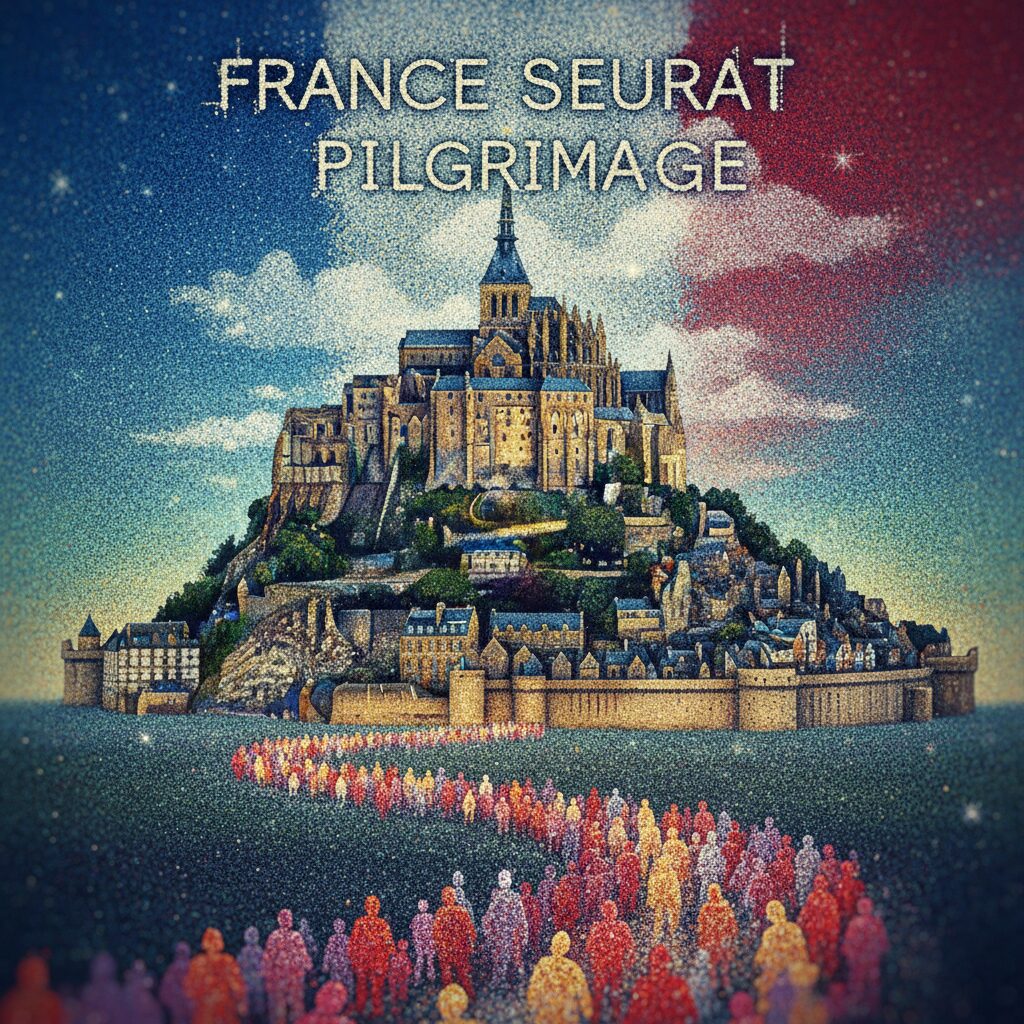
There’s a certain kind of magic that happens when you stand in the exact spot where a masterpiece was born. The air feels different, charged with a faint echo of creative energy. As someone who spends most of their time tracing trails through mountains and forests, I’ve learned that every landscape has a story, a rhythm. But the landscapes painted by Georges Seurat tell a story that’s both intensely natural and profoundly scientific. He didn’t just capture a scene; he deconstructed light itself, atomizing it into a million tiny dots of pure color that shimmer and vibrate, coalescing in the viewer’s eye to form a world more solid and luminous than reality. To walk through Seurat’s France is to follow a path of light, from the lazy, sun-drenched banks of the Seine just outside Paris to the vast, moody shores of the English Channel. It’s a journey not just to see where he painted, but to understand how he saw—to feel the sun on your skin as he must have, to hear the whisper of wind through the same poplar trees, and to witness the slow, deliberate dance of light on water that so utterly captivated him. This is more than an art history tour; it’s an outdoor pilgrimage into the heart of Pointillism, a chance to connect with the very atmosphere that fueled a revolution in seeing. Our journey begins where his most famous vision was immortalized, on a sliver of land in the Seine that became a canvas for Parisian life, frozen in a timeless Sunday afternoon.
While Seurat’s scientific approach to light was revolutionary, you can explore a more atmospheric and fluid interpretation of the French landscape by following the journey through Alfred Sisley’s France.
The Sunday Specter: Île de la Grande Jatte
Your journey into Seurat’s world must begin here. The Île de la Grande Jatte, a narrow island nestled in the Seine between the communes of Neuilly-sur-Seine and Levallois-Perret, is more than just a location. It is a legend, the backdrop for A Sunday Afternoon on the Island of La Grande Jatte, a painting that transformed the boundaries of art. Getting there today is straightforward—a short Métro ride on Line 3 to Pont de Levallois-Bécon, followed by a walk across the bridge. As you cross, the sounds of Parisian traffic start to fade, replaced by the gentle lapping of water and the rustle of leaves. The change is tangible. You leave behind the city’s frantic beat and enter a pocket of serene timelessness.
Walking into the Canvas
Stepping onto the island feels like passing through a portal. Now a public park, it is a green space cherished by locals for jogging, picnics, and quiet reflection. Yet, the spirit of Seurat’s painting is everywhere. Find a spot on the northern tip, the Parc de la Grande Jatte, and let your eyes adjust. This is the scene. The light, even today, holds a unique quality. It filters through the canopy of plane trees and poplars, casting a mosaic of sun and shadow over the grassy banks. You can almost sense the presence of Seurat’s carefully arranged figures: the stiffly formal couple with their pet monkey, the woman fishing, the soldiers standing at attention, the small child in white frozen mid-run. Of course, they are no longer there. Instead, modern Parisians occupy the space: families with strollers, couples lounging on blankets, teenagers listening to music. Yet, the essential spirit of the place—a haven for leisure at the edge of a great metropolis—remains. To fully connect with the scene, walk the length of the island’s main path. Notice how the perspective shifts, how the view of the water and the opposite bank changes. Seurat spent two years on this painting, producing countless preliminary sketches and oil studies. He wasn’t merely capturing a fleeting moment; he was crafting a flawless, enduring vision of modern life. He would sit here for hours, observing, analyzing the light, and translating it into his new visual language. The air is often hazy, softening the edges of distant buildings on the La Défense skyline, a modern backdrop Seurat could never have imagined, yet it somehow echoes the industrial haze in some of his other suburban scenes.
The Feeling of the Place
The atmosphere is one of peaceful separation. Despite its proximity to the city, the island feels secluded. The dominant sounds are natural: birds chirping, the gentle current of the Seine, the wind sighing through tall trees. This tranquility is exactly what drew Parisians here in the 1880s, seeking an escape from the crowded, noisy city center. It was a place for strolling, for seeing and being seen. Seurat captured this social ritual but infused it with a strange, monumental stillness. His figures resemble statues, frozen in place forever. When you are there, you realize this stillness is an artistic decision, not a depiction of reality. The island is alive with movement. Boats continue to pass on the Seine, their wakes creating ripples that catch the light. People move constantly and fluidly. Seurat’s genius was to impose a classical, almost Egyptian order on this everyday chaos, giving it a sense of timeless grandeur. A useful tip for first-time visitors is to come on a weekday afternoon if you want a quieter experience closer to the painting’s calm serenity, or on a Sunday afternoon if you want to see the island fulfilling its historic role, bustling with Parisians at leisure. Bring a blanket and a book, find a spot on the grass, and simply watch. Watch the light dance on the water. Watch the people. You are taking part in the very scene Seurat worked so hard to immortalize.
The Working River: Bathers at Asnières
Just across the river from La Grande Jatte, a brief walk over the Pont d’Asnières reveals the scene of another of Seurat’s seminal masterpieces, Bathers at Asnières. While La Grande Jatte portrays the bourgeoisie at leisure, Bathers depicts the working class finding a moment of respite. The contrast is sharp and deliberate. In the 1880s, Asnières-sur-Seine was a growing industrial suburb. The painting’s background is dominated by factory smokestacks, their smoke drifting into the summer sky. It’s a vivid clash of industry and relaxation.
Finding the Viewpoint
Locating the precise spot where Seurat painted Bathers is more difficult than for La Grande Jatte. The riverbanks have undergone extensive development over the past century. The grassy hillside where the boys and men once lounged has been replaced by stone quays and walkways. Still, the essence of the place endures. Stand on the Quai du Docteur Dervaux and gaze across the water toward La Grande Jatte and the railway bridge at Asnières. The key features remain: the broad river, the island, and the feeling of being on Paris’s industrial outskirts. The light feels different here, less softened by abundant trees and more direct, reflecting sharply off the water. Seurat captures this masterfully. The sun beats down on the figures, bleaching colors and evoking a palpable heat. The atmosphere is less formal, more casual than the rigid poses across the river. These are factory workers, clerks, and boatmen cooling off after a long week. They are not posed; they are simply existing. As an outdoor enthusiast, this scene resonates deeply with me. It celebrates the simple, universal joy of cool water on a hot day—a natural moment of bliss taken from an industrial environment.
A Tale of Two Banks
The connection between Bathers at Asnières and A Sunday Afternoon on the Island of La Grande Jatte forms a dialogue across the water. Painted two years apart, they represent two facets of modern Parisian life. To fully grasp Seurat’s vision, you must visit both places. Walk from the manicured park of La Grande Jatte, cross the bridge, and follow the quays of Asnières. The journey itself narrates the story. You transition from an elegant leisure park to a practical, working riverfront. Seurat’s groundbreaking gesture was to elevate the working-class bathers to the same monumental scale and classical dignity as the wealthy promenaders. He found the epic in the everyday, the heroic in the ordinary. Standing in Asnières, with RER trains rattling over the bridge behind you and barges chugging along the Seine, you sense that blend of industry and nature, human activity set against the timeless river backdrop. It’s a powerful reminder that Seurat was not merely a painter of idyllic scenes but a profound commentator on the social fabric of his era.
The Northern Light: Seurat on the Normandy Coast

While Seurat is forever associated with the Seine, his artistic development owes just as much to the sea. Like many of his contemporaries, he was attracted to the Normandy coast, a region renowned for its dramatic tides, expansive skies, and a softer, more diffuse, and ever-changing quality of light. His coastal paintings embody minimalism and atmosphere, where the shimmering dots of color serve not to define figures but to convey the infinite stretch of sea and sky. For those who appreciate wild, open spaces, these locations are essential to visit.
The Harbors of Honfleur and Port-en-Bessin
Honfleur was among Seurat’s earliest coastal retreats. This charming harbor town, with its narrow slate-fronted houses and lively Vieux Bassin (Old Harbor), had drawn artists for decades, including Monet and Boudin. Yet, Seurat perceived it differently. He overlooked the quaint, anecdotal features that delighted other painters and instead concentrated on the scene’s fundamental geometry: the vertical masts of boats, the horizontal lines of jetties, and the vast, empty planes of water and sky. Visiting Honfleur today, you can still locate the viewpoints for paintings like The Hospice and Lighthouse of Honfleur. Walking along the jetty, you can feel the sea breeze and observe how the light plays across the water and stone. Seurat’s works from this area are often quiet and contemplative, capturing the harbor at low tide when boats rest on the muddy seabed, their forms reduced to stark, powerful shapes. The air carries the sharp, clean scent of salt and seaweed, cutting through the haze. A similar atmosphere is found in Port-en-Bessin, another active fishing port he depicted. His painting Port-en-Bessin, the Outer Harbor, Low Tide exemplifies mastery in composition and color harmony, where his pointillist technique traces subtle color shifts on the wet sand and the shimmering, almost indistinguishable boundary between sea and sky.
The Austere Beauty of Gravelines and Le Crotoy
Later in his career, Seurat was drawn to even more austere landscapes further north, near the Belgian border. Gravelines, a fortified town interwoven with canals, offered him a unique fusion of architecture and nature. His series portraying the Channel of Gravelines ranks among his most serene and abstract pieces. He was captivated by the canal’s long, straight line stretching to the sea, a man-made element cutting through the natural surroundings. To find his vantage point, walk along the Chenal de l’Aa. The landscape is remarkably flat, dominated by an immense sky, encouraging quiet reflection. The wind is a constant presence, sweeping across dunes and rippling the water’s surface. Seurat perfectly captured this sense of quiet, windswept emptiness, where his dots of color merge to create a soft, vibrating atmosphere that feels almost meditative. Likewise, Le Crotoy on the Baie de Somme offered vast sandy beaches at low tide. The bay is famed for its ethereal light, and Seurat’s paintings from this location are luminous and open. He depicted endless sands, the distant seaside horizon, and the tiny figures of shrimpers, their forms almost dissolving into the bright, hazy air. Visiting these coastal towns provides an experience distinct from Parisian sites. It is less about recognizing specific landmarks and more about immersing oneself in the elemental forces that inspired Seurat’s most refined works. The ideal time to visit is during the shoulder seasons—spring or autumn—when the light is often at its most dramatic, and the crowds have thinned, allowing a more personal connection with these vast, poetic landscapes.
The Artist’s Paris: Studios and Salons
While Seurat’s most celebrated works were painted en plein air along rivers and coasts, he was essentially a Parisian artist. His life revolved around the city, which served as both his home and the intellectual forge for his ideas. Following his footsteps through Paris uncovers the man behind the easel—the methodical scientist, the ambitious revolutionary, and the key figure in the emerging Neo-Impressionist movement.
A Studio of One’s Own
Seurat was famously private, and his studio was his refuge. His most important and longest-used studio stood at 128 bis Boulevard de Clichy, in the heart of Montmartre. Although you cannot enter the building today, standing outside offers a vivid sense of his world. In the late 19th century, Montmartre was the hub of the Parisian avant-garde, a rough, bohemian district filled with windmills, cabarets, and inexpensive artists’ lodgings. Yet Seurat was no typical starving artist; he came from a prosperous family and lived a disciplined, almost ascetic life devoted to his craft. Picture him walking these same streets, past the rowdy Moulin Rouge, then retreating to his serene studio to painstakingly apply thousands of tiny dots to his enormous canvases. It was in this very studio that La Grande Jatte was completed, a meticulous process spanning two years. The striking contrast between the vibrant, chaotic life of Montmartre outside his window and the obsessive, controlled order of his artistic process is remarkable. Later, he moved to a quieter studio in the Passage de l’Élysée-des-Beaux-Arts (now Rue André-Antoine), still in Montmartre. Strolling through these backstreets, away from main tourist areas, you can still discover remnants of the old neighborhood, evoking the world Seurat inhabited.
The Salon des Indépendants
Seurat’s groundbreaking technique was not instantly accepted by the official art establishment. After his Bathers at Asnières was rejected by the official Salon in 1884, he and other like-minded artists, including Paul Signac, co-founded the Société des Artistes Indépendants. Their motto, “Sans jury ni récompense” (“Without jury nor reward”), guided the Salon des Indépendants, their annual exhibition that became the primary platform for avant-garde art in Paris. It was here, in 1886, that A Sunday Afternoon on the Island of La Grande Jatte debuted, sparking a sensation and effectively launching the Neo-Impressionist movement. Although the Salon’s location shifted over the years, its early exhibitions often took place in temporary structures around the city center, such as near the Tuileries Garden. Walking through this area today, from the Louvre to the Place de la Concorde, you tread the ground where the art world was forever transformed. Here, Seurat and his followers openly challenged the dominance of both the academic tradition and the “romantic” Impressionism of Monet and Renoir, proposing instead a new, “scientific” Impressionism grounded in optical theory and rigorous method.
The Artificial Paradise: The Light of the Parisian Night
In his later years, Seurat’s attention shifted from the natural daylight of the outdoors to the artificial gaslight illuminating Paris’s entertainment venues. His final major works portray the vibrant, hectic world of the café-concert and the circus. These paintings explore a new type of light—sharper, more dramatic, and capable of evoking a distinct modern poetry. They reveal an artist still innovating and pushing the boundaries of his technique, right up until his untimely death.
Le Chahut and the Café-Concert
The painting Le Chahut (The Can-Can) depicts a high-kicking dance, a popular feature at café-concerts such as La Scala or the Eldorado. These venues were noisy, crowded, and somewhat risqué—a stark contrast to the peaceful banks of the Seine. Seurat captures the exuberant energy of the performance through the dancers’ synchronized kicking and an upward-tilting perspective that conjures a dizzying sense of motion. He was fascinated by how gaslight illuminated the stage, casting sharp shadows and a yellowish, almost electric glow. Though the original venues that inspired him are gone, the spirit of Parisian nightlife endures in areas like Pigalle and the Grands Boulevards. A nighttime stroll through these districts, with their glowing neon signs and lively theaters, offers a glimpse of the “artificial paradise” that captivated Seurat and his contemporaries. He wasn’t merely painting a dance; he was dissecting the optics of excitement and the contrived joy of urban entertainment.
The Final Masterpiece: The Circus
Seurat’s last, unfinished painting was The Circus, a dynamic scene showing a female acrobat riding a galloping horse at the Cirque Fernando (later the Cirque Medrano) in Montmartre. Located at the corner of Boulevard de Rochechouart and Rue des Martyrs, it’s just a short walk from his former studio. Today, the circus is gone, replaced by a plaque and a bustling intersection, yet the neighborhood’s energy persists. This painting is a symphony of curves and dynamic lines, capturing both the spectacle and its audience within a single, vibrant frame. The light is bright and theatrical, and the colors joyful and celebratory. Brimming with life and vitality, it makes his sudden death from infectious disease at age 31 all the more tragic. He was at his creative peak, exploring fresh and exciting subject matter. Standing at that corner in Montmartre, one can almost hear the circus band, the crowd’s roar, and imagine Seurat, the quiet observer, sketching in the shadows, breaking down this scene of chaotic joy into its elemental parts of color and light.
A Pilgrim’s Practical Guide
Embarking on a journey through Seurat’s France is immensely rewarding, though a bit of planning makes all the difference. The Parisian sites—La Grande Jatte, Asnières, and his Montmartre haunts—are easily reached via public transport. A Navigo pass or a carnet of tickets will prove invaluable. For La Grande Jatte, aim for a late spring or summer afternoon to witness the light closest to what Seurat captured. Wear comfortable shoes, as the best way to connect La Grande Jatte and Bathers at Asnières is on foot.
When you’re ready to view the completed masterpieces, the Musée d’Orsay in Paris is your main destination. Housed in a stunning former railway station, it boasts an unmatched collection of Impressionist and Post-Impressionist art. Seeing The Circus and other works after visiting the sites that inspired them is a deeply moving experience. You’ll also find key pieces in international collections, notably A Sunday Afternoon on the Island of La Grande Jatte at the Art Institute of Chicago and Bathers at Asnières at the National Gallery in London.
For the coastal portion of the journey, renting a car is the most practical choice, giving you the freedom to explore the small harbor towns of Honfleur, Port-en-Bessin, Gravelines, and Le Crotoy at your own pace. The light in Normandy and the north is famously changeable, which adds to its charm. Be ready for shifting weather, and give yourself time simply to sit and watch the sky and tides. This is the essence of what Seurat sought to capture: not a static scene but the pulsating, ever-changing atmosphere of a place.
For a first-time visitor, my best advice is to slow down. Seurat’s art isn’t about fleeting impressions; it’s about prolonged, intense observation. Don’t rush to a viewpoint, snap a photo, and leave. Spend time there. Absorb the environment. Notice the small details: the way the wind stirs the leaves, the precise color of the water at that moment, the sounds filling the air. By immersing yourself fully in the sensory experience of these places, you come closer to grasping Georges Seurat’s revolutionary vision. It’s a journey that will deepen your appreciation of his art and alter the way you perceive light and color in the world around you.
This pilgrimage is a unique kind of journey. It doesn’t lead to a mountain peak but to a deeper understanding of a quiet revolutionary who saw the world as points of brilliant light. Walking in his footsteps, you discover that his meticulous, scientific approach was simply his way of expressing a profound, almost spiritual bond with the places he cherished. The dots on his canvases are not mere paint; they are particles of light, fragments of atmosphere, echoes of a time and place that, thanks to his genius, you can still experience today. As you leave the banks of the Seine or the shores of the Channel, you carry a piece of that luminous world with you. You begin to see the world as Seurat did—not as solid forms, but as a shimmering, vibrant dance of color.