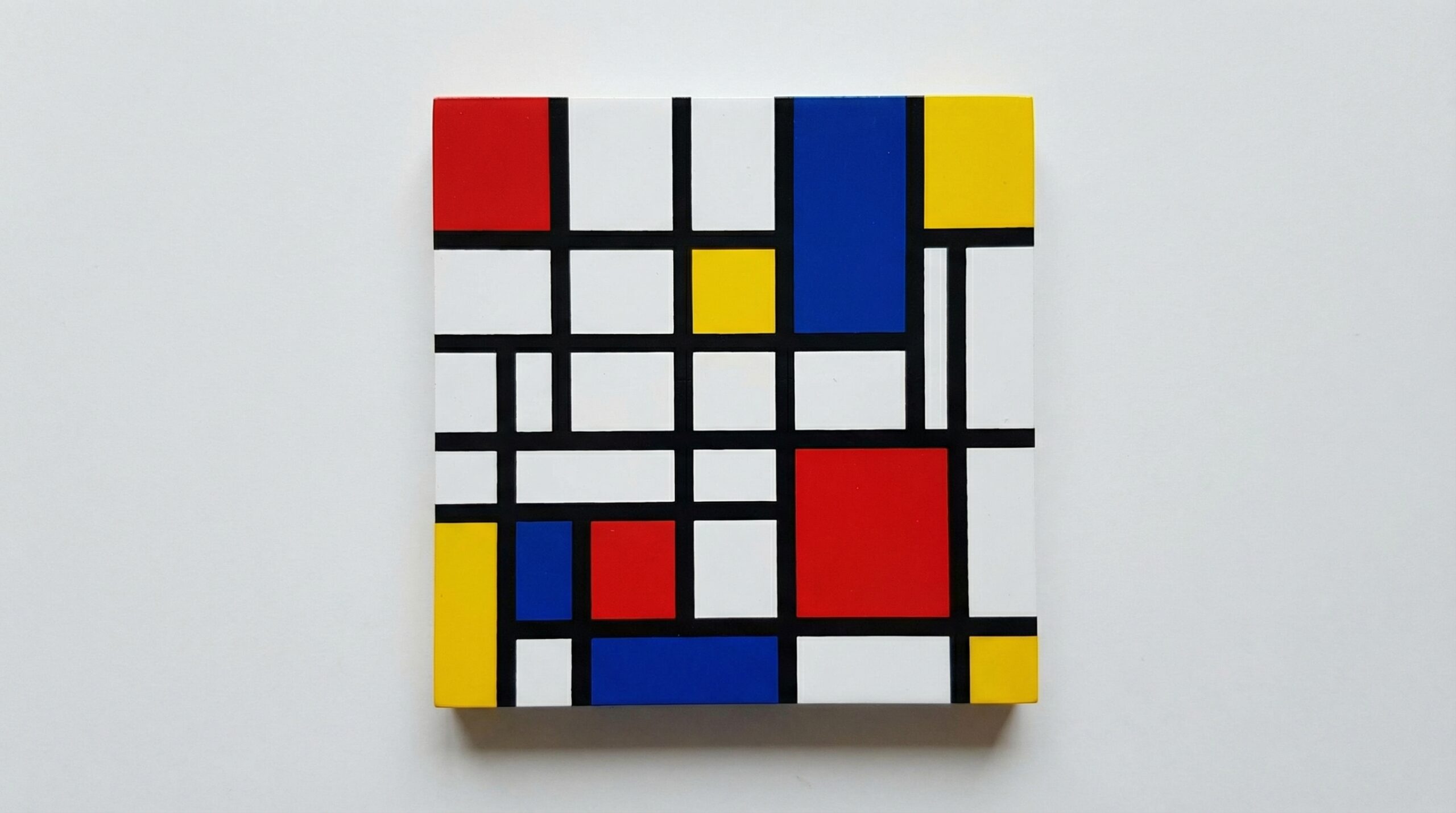
The world knows Piet Mondrian through a language of straight lines and primary colors. His iconic grids are a testament to pure, unadulterated form, a visual music that stripped away the noise to find a universal harmony. But this radical simplicity wasn’t born in a vacuum. It was forged in the quiet canals of the Netherlands, hammered into shape in the bohemian crucible of Paris, and finally set loose to dance in the electric canyons of New York City. To truly understand Mondrian is to walk the paths he walked, to see the light that fell on his canvas, and to feel the rhythm of the cities that shaped his soul. This journey isn’t just a tour of museums; it’s a pilgrimage through the life of an artist who didn’t just paint the world—he reordered it. We’ll trace his evolution from a painter of moody Dutch landscapes to the father of Neo-Plasticism, following a map drawn not with roads, but with black lines, and colored with red, yellow, and blue. It’s a journey from the pastoral to the metropolitan, from the horizontal plane of the Dutch horizon to the vertical thrust of the skyscraper, exploring how each place left an indelible mark on his quest for pure abstraction.
For a different perspective on how a city can shape an artist’s vision, consider walking in the footsteps of Édouard Manet through Paris.
The Dutch Roots: Amersfoort and Winterswijk
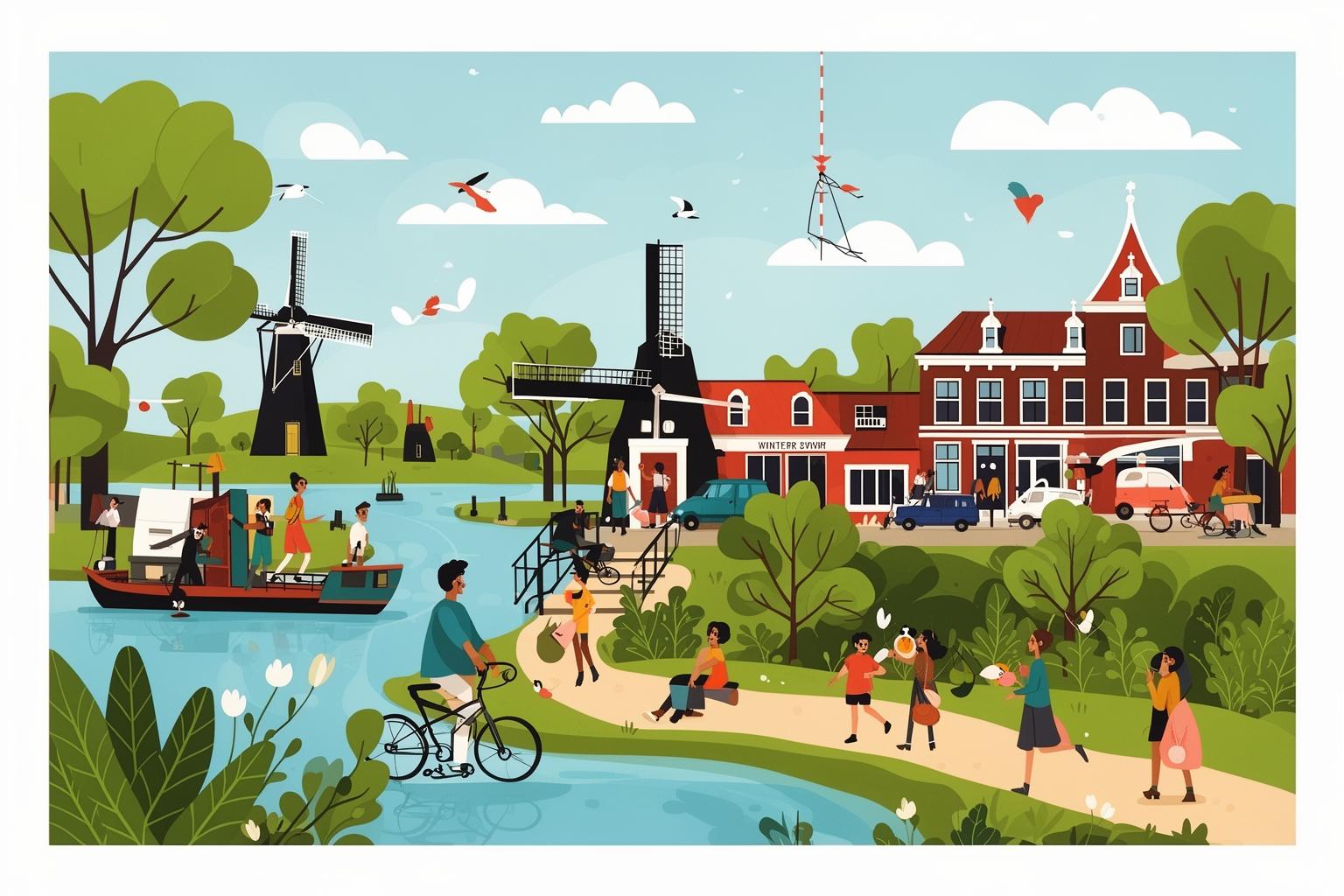
Every revolution begins somewhere, with a quiet origin story that precedes the manifesto. For Piet Mondrian, that story unfolds in the heart of the Netherlands, in locations that feel worlds away from the stark, modern canvases that would later define him. It is here, among medieval brick buildings and peaceful pastures, that the fundamental elements of his future vision—line, plane, and a certain spiritual tranquility—first took shape.
Birthplace of a Visionary: The Mondriaanhuis in Amersfoort
To start your journey into Mondrian’s world, begin where his began: in Amersfoort. This city is a living postcard of Dutch history, featuring a beautifully preserved medieval center crisscrossed by canals and dominated by the soaring Onze Lieve Vrouwetoren. It is steeped in tradition, a place of order and structure. Walking its cobblestone streets, one can almost feel the weight of centuries, a groundedness that would later serve as the foundation for Mondrian’s leap into abstraction. It is here, on the quiet Kortegracht street, that you will find the Mondriaanhuis, the house where Pieter Cornelis Mondriaan was born in 1872.
Today, his birth home functions as a vibrant museum, a portal that guides visitors through the artist’s life. Far from a dusty, static display, it offers an immersive experience that expertly traces his artistic and philosophical development. You begin with his earliest works—somber, traditional landscapes that reveal a masterful grasp of conventional painting. These pieces often surprise those familiar only with his grids; they depict an artist deeply connected to nature, capturing the moody light and damp earth of his native land. Even here, however, you can discern the beginnings of his future focus—a fascination with the strong vertical lines of trees set against the steady horizontal horizon.
The museum’s true brilliance lies in its full-scale reconstructions of his renowned studios. You can step into an exact replica of his Paris studio at 26 Rue du Départ, a space that was as much an artwork as the creations made within it. Stark white walls, carefully positioned blocks of primary color, minimalist furniture—this was a living laboratory for Neo-Plasticism. Standing there, you understand that for Mondrian, this was not merely an art style but a way of life, a spiritual quest for order and harmony. The journey concludes with a reconstruction of his final New York studio, a more dynamic, rhythmic space pulsating with the energy he found in Manhattan. Viewing these studios in sequence provides a compelling narrative of his life’s evolution.
For first-time visitors, a practical tip is to purchase tickets online in advance, especially during peak tourist periods. Amersfoort makes for an easy day trip from Amsterdam, just a short train ride away, yet it merits more than a hurried afternoon. After visiting the museum, take time to wander the city. Rent a canal boat or walk alongside the water, noticing how the geometric patterns of the brick houses and their reflections form a real-world grid. Here, you realize Mondrian wasn’t inventing a new world out of thin air; he was distilling the essence of the world that had always surrounded him.
Formative Years in Winterswijk: Villa Mondriaan
To delve deeper into the roots of Mondrian’s youth, travel east to Winterswijk, a quiet town near the German border where his family relocated when he was eight. If Amersfoort was his birthplace, Winterswijk was his crucible. The family lived in an elegant white house, now the Villa Mondriaan, a museum devoted entirely to his formative years. Here, you encounter the young Piet—the artist before the icon.
The landscape surrounding Winterswijk stands in stark contrast to Amersfoort’s urban setting. Part of the Achterhoek region, it is a serene expanse of flat fields, dense woods, and winding streams. This environment was Mondrian’s first and most influential teacher. He spent hours sketching the local farms, solitary trees, and the calm waters of the Boven-Slinge stream. The museum’s collection is enlightening, highlighting his extraordinary talent for naturalistic painting. You’ll see moody, atmospheric landscapes influenced by the Hague School, detailed still lifes, and surprisingly tender portraits.
Villa Mondriaan’s significance lies in its answer to the question why. Why did an artist so skilled in representation choose to abandon it? The answer emerges in the recurring motifs. You witness him painting the same clusters of trees, the same farmhouse, the same canal repeatedly. With each version, you sense him searching for something deeper than surface appearance—an underlying structure. The trees become more than trees; they transform into vertical forces. The horizon becomes more than a line; it represents a state of being, a symbol of universal calm. The museum thoughtfully pairs his early works with contemporary art that engages in a similar dialogue with form and landscape, creating a bridge between his past and present-day art.
Visiting Winterswijk requires more planning due to its limited connections compared to Amersfoort, but the journey itself is part of the experience. It offers a tranquility essential for understanding Mondrian’s mindset. The museum is an architectural gem, seamlessly combining the historic villa with a modern extension. A great way to explore the area is by renting a bicycle—the quintessential Dutch mode of transport. Cycle out of town to find a spot by a canal. Observe the trees reaching skyward and the flat, endless land spreading before you. In that quiet moment, you see the world as the young Mondrian once did—a composition of horizontal and vertical lines, patiently awaiting harmony.
Amsterdam: The Cauldron of Artistic Awakening
Every artist needs a city to test their mettle, a place where tradition and rebellion intersect. For Mondrian, that city was Amsterdam. At the dawn of the 20th century, it was a bustling metropolis—a hub of commerce and culture brimming with new ideas. It was here that he shed the identity of a provincial landscape painter and embarked on his formal, intellectual, and spiritual journey toward modernism. Amsterdam provided him with the tools, the community, and the tension necessary to begin constructing his new visual language.
The Academy and the Avant-Garde
Mondrian arrived in Amsterdam in 1892 to enroll at the prestigious Rijksakademie van Beeldende Kunsten. This bastion of classical training was where he refined his technical skills in drawing and painting, meticulously copying the Old Masters. The impressive academy building still stands today, barely a stone’s throw from the Rijksmuseum. Standing before it, one can imagine the young, earnest artist entering its doors, absorbing the lessons of centuries of European art. He was a diligent student, but a restless one. While his days were devoted to academic discipline, his mind was pulled in other directions.
He lived in various studios around the city, often in the vibrant working-class neighborhood of De Pijp. Known as the city’s Latin Quarter, this area was a melting pot of artists, writers, and thinkers. It was here, away from the academy’s strict confines, that he encountered influences that truly shaped him. He became deeply interested in Theosophy, a spiritual movement seeking to understand the hidden unity underlying the universe and all religions. This was not a casual fascination; it became central to his artistic philosophy. He came to believe that art could be a pathway to a higher spiritual reality, and that by purifying his art of worldly details, he could reveal universal truths. Walking through De Pijp today, with its bustling Albert Cuyp Market and lively cafés, you can still sense the creative energy that lingers. It’s a place to picture Mondrian not merely as a painter, but as a seeker, debating philosophy with friends late into the night.
Encountering Modernism: The Stedelijk Museum
A pivotal moment during Mondrian’s years in Amsterdam came through the Stedelijk Museum. In the early 1900s, the Stedelijk was one of Europe’s most progressive art institutions, serving as a gateway for the Dutch public to the radical new art emerging from Paris and beyond. It was at a 1911 Cubism exhibition there that Mondrian first encountered the works of Picasso and Braque. The experience was earth-shattering. He recognized in their fragmented forms a means to break free from the limits of direct representation—a method for analyzing and restructuring reality on the canvas. This encounter was the catalyst that propelled him toward abstraction.
Today, the Stedelijk Museum remains one of the world’s leading institutions for modern and contemporary art, and is an essential stop on any Mondrian pilgrimage. Situated on the renowned Museumplein alongside the Rijksmuseum and the Van Gogh Museum, it houses an extraordinary collection of works by Mondrian and his De Stijl contemporaries, such as Theo van Doesburg and Gerrit Rietveld. Here, you can trace his entire Dutch evolution in a single visit. You will see his Luminist paintings from Zeeland glowing on the walls, then witness his initial exploratory steps into Cubism with paintings like The Gray Tree, and finally experience his mature De Stijl compositions. Viewing his work alongside that of his peers offers invaluable context. You come to understand that Neo-Plasticism was not a solitary invention but part of a broader cultural movement aiming to create a new, harmonious world after the chaos of World War I.
A tip for visiting Museumplein: it can be overwhelming. Don’t try to visit all three major museums in one day. Give the Stedelijk the time it deserves. Focus on the De Stijl galleries. Sit on a bench and let your eyes wander across his canvases. Notice the subtle variations in line thickness, the different shades of white he employed, and the incredible balance of the compositions. This is where you move from simply seeing his work to truly experiencing it.
The Canals and the Light: Finding Abstraction in the City
Beyond the museums and studios, the city of Amsterdam itself was a source of inspiration. The very layout of the old city center is a grid. The concentric rings of canals intersect with radiating streets, forming a vast geometric pattern. Mondrian was a keen observer and would have been intimately familiar with this urban design. A great way to connect with his Amsterdam is by taking a canal cruise or simply walking along the Brouwersgracht or the Prinsengracht. Observe the tall, narrow canal houses, their rows of large windows forming perfect grids. Notice how their reflections shimmer and fragment in the water, abstracting their forms into shifting patterns of light and color. It’s a living Mondrian painting.
He was fascinated by the interplay of horizontal and vertical lines, and Amsterdam is a city defined by just that. The horizontal planes of canals and bridges are continuously intersected by the vertical lines of houses, lampposts, and boat masts. This fundamental opposition, this dynamic balance, became the foundation of his entire artistic theory. As you explore, try to see the city through his eyes. Frame views with your hands. Observe the geometry in a bridge railing, the rhythm of window patterns on a facade, the stark black lines of bare tree branches against a gray winter sky. You’ll begin to see his compositions everywhere, and realize that his journey into abstraction was not a retreat from reality, but a deeper engagement with it. Amsterdam was the city that taught him how to see.
The Zeeland Light: Domburg and the Luminist Phase
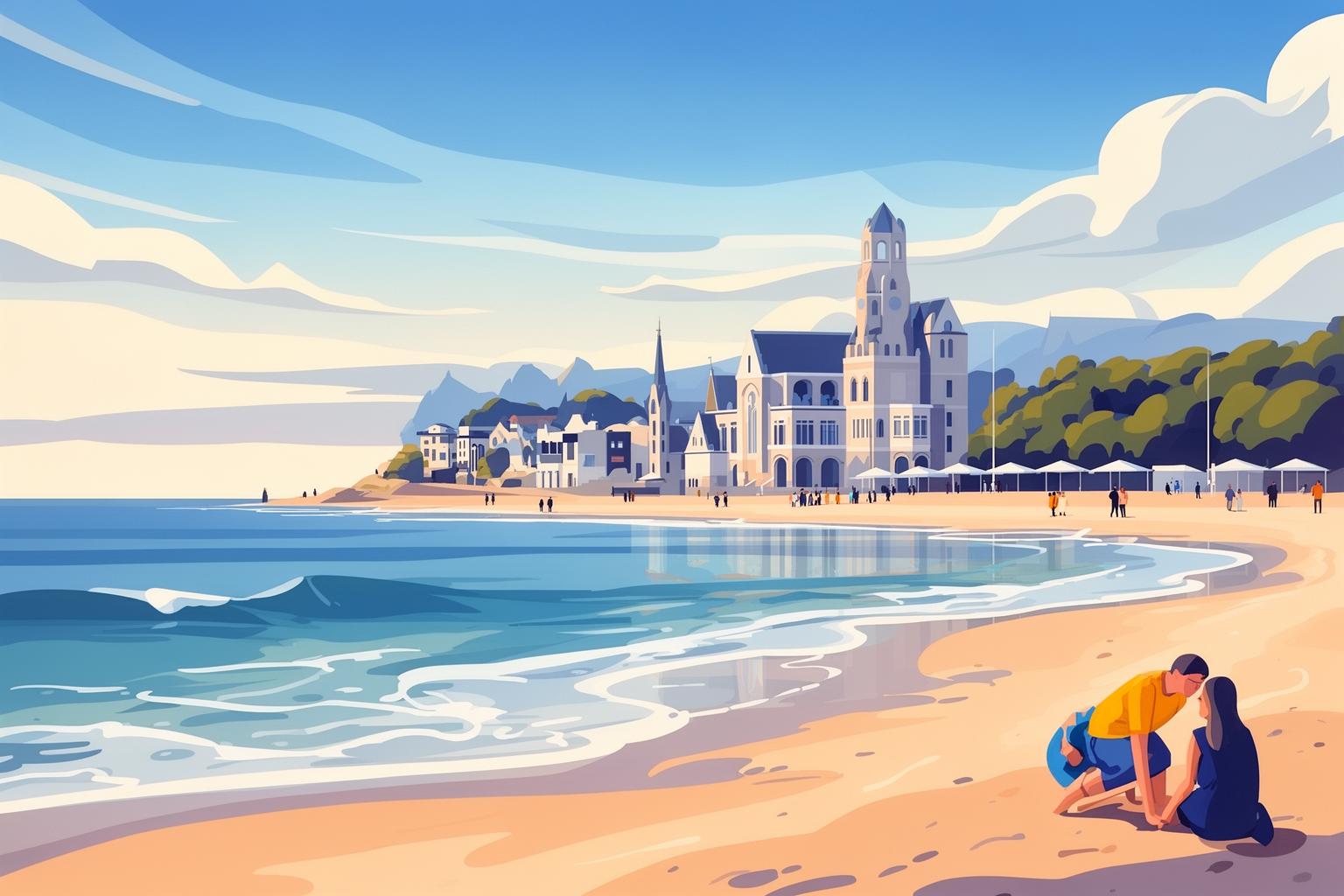
After the intellectual intensity of Amsterdam, Mondrian sought a different source of inspiration—a kind that was elemental, spiritual, and bathed in a distinct, otherworldly light. He discovered it in Domburg, a small seaside village on the Walcheren peninsula in Zeeland. This was no ordinary coastal town. For decades, it had drawn artists who were captivated by a quality of light reputed to be clearer and more brilliant than anywhere else in Europe. Here, on the edge of the Netherlands, where land meets the powerful North Sea, Mondrian’s art underwent a profound transformation, bursting with color and spiritual energy.
A Coastal Revelation
The atmosphere in Domburg is palpable from the moment of arrival. The air carries the scent of salt and sea spray. The sky feels vast, an ever-shifting canvas of blues, greys, and whites. The defining feature is the dunes—immense, rolling hills of sand held fast by hardy marram grass, creating a natural barrier against relentless wind and waves. Climbing to the top of a dune and seeing the endless stretch of sea on one side and flat, green land on the other is to experience the primal horizontal that so obsessed Mondrian. It was in this dramatic, elemental landscape that he began to reinterpret the visible world in a new way.
From 1908 to 1916, he spent his summers here, part of a vibrant artists’ colony centered around painter Jan Toorop. This period, known as his Luminist phase, saw him abandon the muted, earthy tones of his earlier work for a palette of striking intensity. He painted with vibrant blues, fiery reds, and radiant yellows, using color not to depict an object, but to convey its essential energy and his emotional response to it. He was no longer merely representing a scene; he sought to capture its spiritual essence.
His subjects were iconic elements of the local landscape, which he painted repeatedly, each time pushing them further toward abstraction. The most famous are his series of the church tower in Domburg and the lighthouse in nearby Westkapelle. In early versions, the structures remain clearly identifiable. But in later paintings, the church tower becomes a blazing, nearly psychedelic totem of vertical energy, its form dissolving into pure color and light. The Westkapelle lighthouse, a solid, imposing structure, transforms into a pulsating column of light—a beacon of spiritual illumination against sea and sky. Seeing these paintings is to witness an artist on the brink of a breakthrough, harnessing the power of color to transcend physical reality.
Experiencing Domburg Today
A visit to Domburg offers the rare chance to stand where a great artist created some of his most pivotal works. The town itself is charming, a blend of historic villas and modern seaside amenities. A good first stop is the Marie Tak van Poortvliet Museum, a small but excellent institution dedicated to the artists who worked in Domburg. It provides valuable context for Mondrian’s time there, displaying his work alongside that of his contemporaries.
From there, the true pilgrimage begins. Walk to the town center to see the church. It is smaller and humbler than one might imagine from the paintings, which makes his transformative vision even more remarkable. Then head to the dunes. The feeling of the wind, the cries of gulls, the vastness of the view—all connect you directly to the sensory experience that inspired his creativity. The best way to explore is by renting a bicycle. Follow the coastal path southwest to Westkapelle, a journey of about five kilometers. The path often runs atop the dykes, providing spectacular views. When you finally glimpse the Westkapelle lighthouse in the distance, it’s an exhilarating moment—it’s the motif come to life. Stand before it and try to sense the “immense, tragic, and epic” quality he perceived in it.
Practical advice: the best time to visit is late spring or summer when the light is at its brightest and lasts longest. However, visiting in the off-season offers a different kind of beauty—moodier, more dramatic, and certainly less crowded. Domburg is a place to slow down. It’s not about ticking off sights; it’s about observation and contemplation. Find a café with a sea view, or simply sit on a bench in the dunes and watch the clouds pass by. In the quiet rhythm of the waves and the clear, sharp light of Zeeland, you can feel the spiritual energy that set Mondrian on his irreversible path to abstraction.
Paris: The Birth of Neo-Plasticism
If the Netherlands was Mondrian’s foundation, then Paris served as his laboratory. He relocated to the French capital in 1911, attracted like many artists of his generation to the uncontested center of the modern art world. It was there, amid the buzz of cafés and the creative energy of Montparnasse, that he experienced the most transformative period of his life. Arriving as an artist exploring Cubism, he departed as the leading figure of a new artistic movement: Neo-Plasticism. Paris was where he discovered his signature style, honed his philosophy, and created a studio that could be considered his greatest masterpiece.
The Studio on Rue du Départ
Mondrian’s life in Paris was marked by stark contrasts. He lived in the heart of Montparnasse, a neighborhood alive with legendary artists like Picasso, Modigliani, and Soutine, who filled the cafés on Boulevard du Montparnasse with lively debate and bohemian revelry. Yet Mondrian himself was famously ascetic and reclusive, rarely socializing in these cafés and preferring instead the monastic solitude of his studio. And what a studio it was.
From 1921 to 1936, he occupied a space at 26 Rue du Départ that became legendary. More than just a workspace, it was an immersive environment—a three-dimensional expression of his Neo-Plastic ideals. He painted the walls a stark, clinical white to enhance the light, and the furniture—an easel, table, and a few chairs—was finished in white, black, or gray. The only color in the room came from movable cardboard rectangles painted red, yellow, or blue, which he meticulously arranged and rearranged on the walls. He composed his surroundings with the same rigor and precision as his canvases, seeking a perfect, dynamic balance. Visitors described entering the studio as stepping into another world, one of profound peace, order, and spiritual clarity. It was an immaculate sanctuary of harmony, crafted by Mondrian amid the chaos of the city. For him, there was no division between life and art; the studio was the ultimate evidence of this union.
Unfortunately, the entire block on Rue du Départ, including his studio, was demolished in the 1960s to make way for the Tour Montparnasse. However, the studio’s legacy endures so strongly that a full-scale, faithful reconstruction is displayed at the Mondriaanhuis in Amersfoort. Even without the original building, a visit to Montparnasse remains essential. Standing near the site of 26 Rue du Départ, now overshadowed by the towering skyscraper, one can pause to imagine the quiet, light-filled retreat that once stood there. It is a poignant artistic pilgrimage, honoring a lost space of creativity.
De Stijl in the City of Lights
Within the white walls of his Parisian studio, Mondrian systematically developed and refined Neo-Plasticism. Influenced by Cubism’s deconstruction of form and his own Theosophical beliefs, he distilled his visual language to its most essential components: the straight line (horizontal and vertical), the three primary colors (red, yellow, blue), and the three non-colors (white, black, gray). He believed this universal language could express the underlying harmony of the cosmos, a balance of opposing forces. This was his grand endeavor: to create an art of pure relations, free from the distractions of the natural world.
To witness the results of this intense period, a visit to the Centre Pompidou is indispensable. This iconic building, with its inside-out architecture, is Paris’s home for modern and contemporary art and houses a superb collection of Mondrian’s works from his Paris years. There, you can see his compositions at their purest and most balanced. Observe the subtlety in his work—the way a thick black line feels heavy and grounding, while a thin one seems to vibrate with energy. Notice how a small red square can stabilize an entire composition, creating a tangible tension and harmony. Viewing these paintings in Paris, the city where they were conceived and created, adds a profound layer of meaning. They are not merely abstract patterns but the culmination of a two-decade intellectual and spiritual quest conducted at the heart of this city.
After visiting the Pompidou, take some time to stroll through Montparnasse. Though Mondrian kept to himself, the neighborhood’s energy still defined the era. You can still visit legendary cafés like La Rotonde, Le Dôme, or La Coupole, where the air once buzzed with conversations that shaped 20th-century art. Imagining the solitary, sharply dressed figure of Mondrian walking these very streets, his mind absorbed by thoughts of universal harmony, offers a fascinating contrast to the more famous bohemian tales of the area. Paris gave him the freedom and intellectual space to pursue his unique vision to its fullest realization.
London: A Brief, Tense Interlude
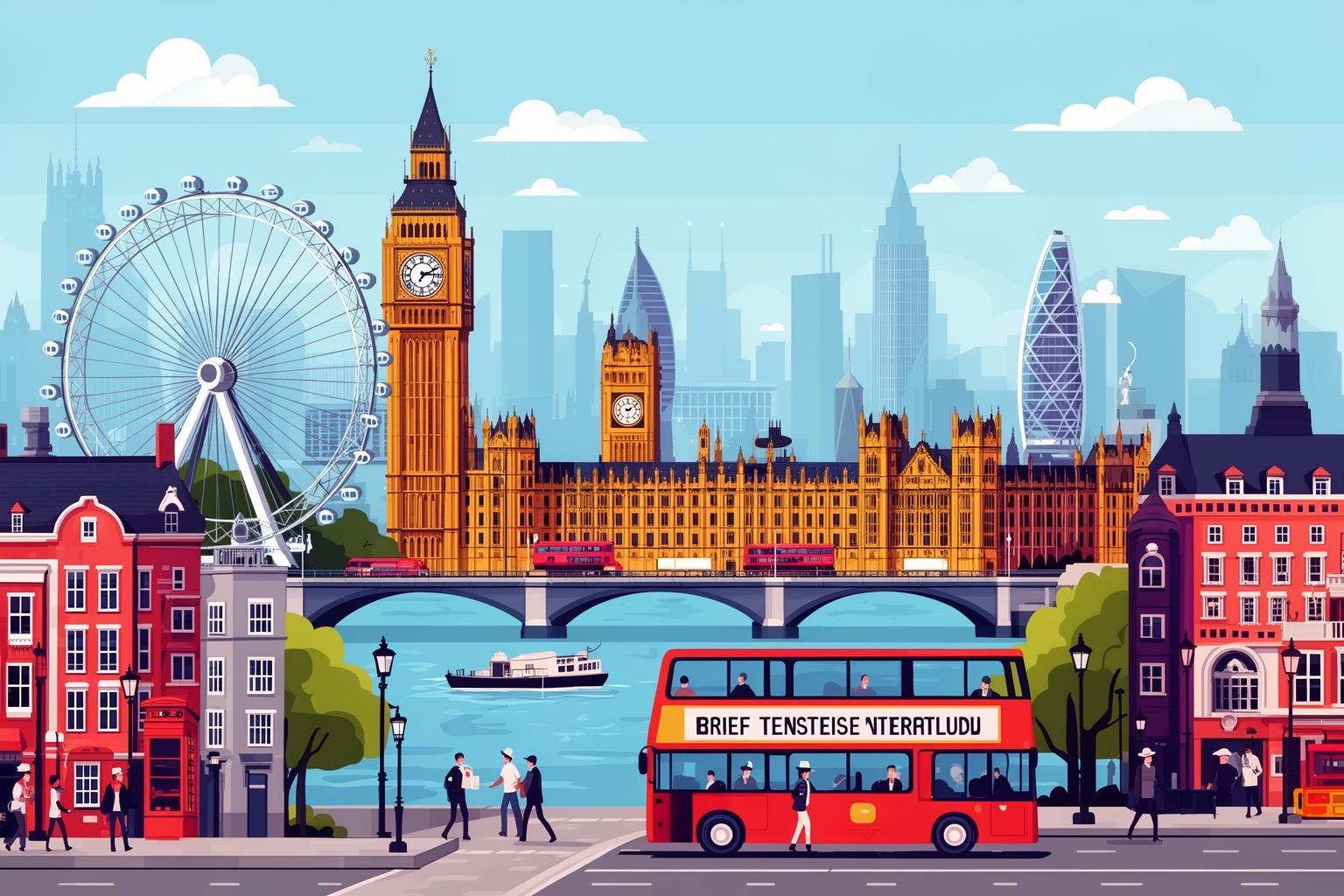
By the late 1930s, Paris’s vibrant creative atmosphere had darkened. The rise of Nazism and the looming threat of war cast a long shadow over Europe. For Mondrian, whose art was branded “degenerate” by the Nazi regime, staying in Paris was becoming increasingly perilous. In 1938, with a heavy heart, he packed up his life and studio and sought refuge across the English Channel in London. His stay there would be brief—just two years—but it served as a vital link between the established order of his European life and the explosive freedom he would later find in America.
Seeking Refuge near Hampstead Heath
Mondrian settled in Hampstead, a leafy, intellectual suburb of north London that was already home to a growing community of émigré artists and thinkers. He found a flat at 60 Parkhill Road in Belsize Park, a quiet, residential street lined with Victorian terraces. British artist friends—including painter Ben Nicholson and sculptor Barbara Hepworth, who lived nearby and were deeply influenced by his work—welcomed him. They helped him find his footing in a new city where he barely spoke the language and the culture was unfamiliar.
Despite the anxiety of the times and his personal displacement, his first instinct was to do what he always did: transform his living space into a sanctuary of Neo-Plastic order. He painted the walls of his London flat white and began arranging his colored cardboard panels, recreating the harmonious environment of his beloved Paris studio. This act was more than decoration; it was a way of establishing his spiritual and creative balance amid a world rapidly descending into chaos. He continued to work, and the paintings he produced in London reveal a fascinating evolution. His black lines began to multiply, growing more complex and rhythmic, and he started experimenting with colored lines, hinting at the dynamic shift to come.
Today, you can visit Parkhill Road and see the building where he lived. A commemorative blue plaque, installed by English Heritage, marks the spot, reading “Piet Mondrian, 1872-1944, Painter, lived here 1938-1940.” It is a quiet, modest building on a pleasant street—no museum or visitor center, just the plaque. For devoted followers of Mondrian’s journey, standing there is a deeply moving experience—a moment to reflect on life’s fragility and the resilience of the creative spirit. Here was a man in his late sixties, a refugee from tyranny, who in this very building continued to push his revolutionary art forward.
The London Vibe and Its Subtle Influence
While his time in London was marked by tension, the city itself may have subtly influenced his work. It’s tempting to speculate. Did the iconic red of the city’s double-decker buses and post boxes reinforce his commitment to primary color? Did the complex, grid-like pattern of the London Underground map, a masterpiece of abstract design, resonate with his own compositions? We can’t know for sure, but it’s clear his London work became more linear and intricate. Paintings like Composition with Red from this period feature a denser web of black lines, producing a more syncopated, less serene rhythm than his Paris creations.
A great way to connect with his London experience is to pair a visit to Parkhill Road with a long walk on Hampstead Heath, just a short distance away. This vast, wild park would have been his local green space. The contrast between the Heath’s untamed, natural beauty and the rigorous, man-made order of his studio must have been striking. It highlights the central tension in his entire artistic project: the desire to find a universal, abstract harmony that transcends the chaotic, organic world. As the Blitz began raining bombs down on London in 1940, it became clear this refuge was no longer safe. With the help of American artist Harry Holtzman, Mondrian secured passage on a ship bound for his final destination: New York City.
New York: The Final, Rhythmic Crescendo
When Piet Mondrian arrived in New York City in the fall of 1940, he was 68 years old and had dedicated his life to reducing his art to its most fundamental elements. He might have been forgiven for remaining within his established style, that of a respected elder statesman of abstract art. Instead, something extraordinary occurred. The vibrant, syncopated, vertical energy of Manhattan did more than welcome him; it energized him. The city’s pulse became his pulse, its rhythm his rhythm. In the final years of his life, in this new environment, Mondrian’s art didn’t merely evolve; it erupted into a joyful, lively celebration of life, a final, triumphant crescendo.
Broadway Boogie Woogie: The Spirit of Manhattan
New York was unlike any city Mondrian had ever experienced. Paris was meant to be strolled through; New York was a city of constant motion. He was mesmerized by its immense scale—the skyscraper canyons forming a monumental real-world grid. He was intrigued by the unending flow of yellow cabs, the blinking traffic lights, and the city’s unyielding grid system. Above all, he fell in love with its music. He became captivated by boogie-woogie jazz, whether heard in clubs or on his record player. The music’s improvisational yet tightly structured character, its syncopated rhythms and driving bass lines, deeply resonated with his artistic vision. For him, it was the audible counterpart of Neo-Plasticism.
This dynamic blend of architectural grandeur and musical vitality sent a shockwave through his artwork. The strict, heavy black lines that had characterized his work for twenty years vanished. Instead, lines composed of small, pulsating blocks of color emerged. His canvases, once calm and meditative, now buzzed and vibrated with kinetic energy. He discovered a way to paint the very rhythm of modern life.
The pinnacle of this era is represented by his two final masterpieces, Broadway Boogie Woogie and the unfinished Victory Boogie Woogie. These paintings distill his New York experience to its essence. They are not representations of the city; they embody the feeling of the city. The intersecting yellow lines mimic the flow of taxis along Broadway and the avenues, while the small red and blue blocks resemble blinking neon signs and traffic lights. The entire canvas shimmers with the stop-and-go, syncopated beat of a boogie-woogie tune. It is a work of immense complexity and profound joy, the final statement of an artist who, at life’s end, discovered a new and exhilarating harmony.
The New York Studios and Legacy
As ever, Mondrian’s studio was the heart of his world. He had two studios in New York, first at 353 East 56th Street and later, his final studio at 15 East 59th Street. He transformed these ordinary Manhattan apartments into immersive Neo-Plastic environments. Yet, like his paintings, the studios took on a new vitality. Employing colored tapes alongside his cardboard panels, he created webs of lines stretching across walls and furniture, making the entire space resonate with a fresh visual rhythm. Visitors described a man completely renewed, brimming with boyish enthusiasm for his new home and his new work.
To complete your Mondrian pilgrimage, there is one last, absolutely essential stop: The Museum of Modern Art (MoMA). MoMA houses an unmatched collection of his works, including the crown jewel, Broadway Boogie Woogie. Viewing this painting in person is a breathtaking experience. It is larger, more intricate, and more vibrant than any reproduction can convey. It is a painting you don’t simply look at; you feel it. Spend time with it. Let your eyes dance across the canvas, tracing the rhythmic pathways of color. It is the grand finale, the culmination of a journey that began in a quiet Dutch town and ended here, in a blaze of glory in the heart of the modern world. A tip for visiting MoMA: it’s a large and popular museum. Consider booking an early morning timed ticket to enjoy a few moments of relative quiet with the painting before the crowds arrive.
Walking the Grid
After MoMA, the final act of the pilgrimage is to walk the city streets. Head to Midtown, stand at a corner of Broadway or Seventh Avenue, and simply observe. Notice the grid of the streets, the grid of skyscraper windows, the grid of the crosswalks. Listen to the sounds—the car horns, sirens, the murmur of the crowd. Feel the energy. You are standing inside his ultimate inspiration. You are inside the painting. Mondrian saw New York as the city of the future, a place where the dynamic equilibrium he had sought throughout his life was realized. He found his Utopia, not in a spiritual realm, but on the bustling, chaotic, and beautiful streets of Manhattan.
Tracing Piet Mondrian’s path is to witness an extraordinary artistic and personal journey. From the misty, horizontal landscapes of the Netherlands to the vibrant, vertical energy of New York, each place he lived sparked his evolution. He was a traveler on a quest, not for new sights, but for a new way of seeing. To follow in his footsteps is to see the world through his eyes, to uncover the hidden structure, the underlying rhythm, and the profound harmony in the world around us. It is a journey that begins with a painting but ends with a renewed appreciation for the lines, colors, and rhythms that shape our own lives.