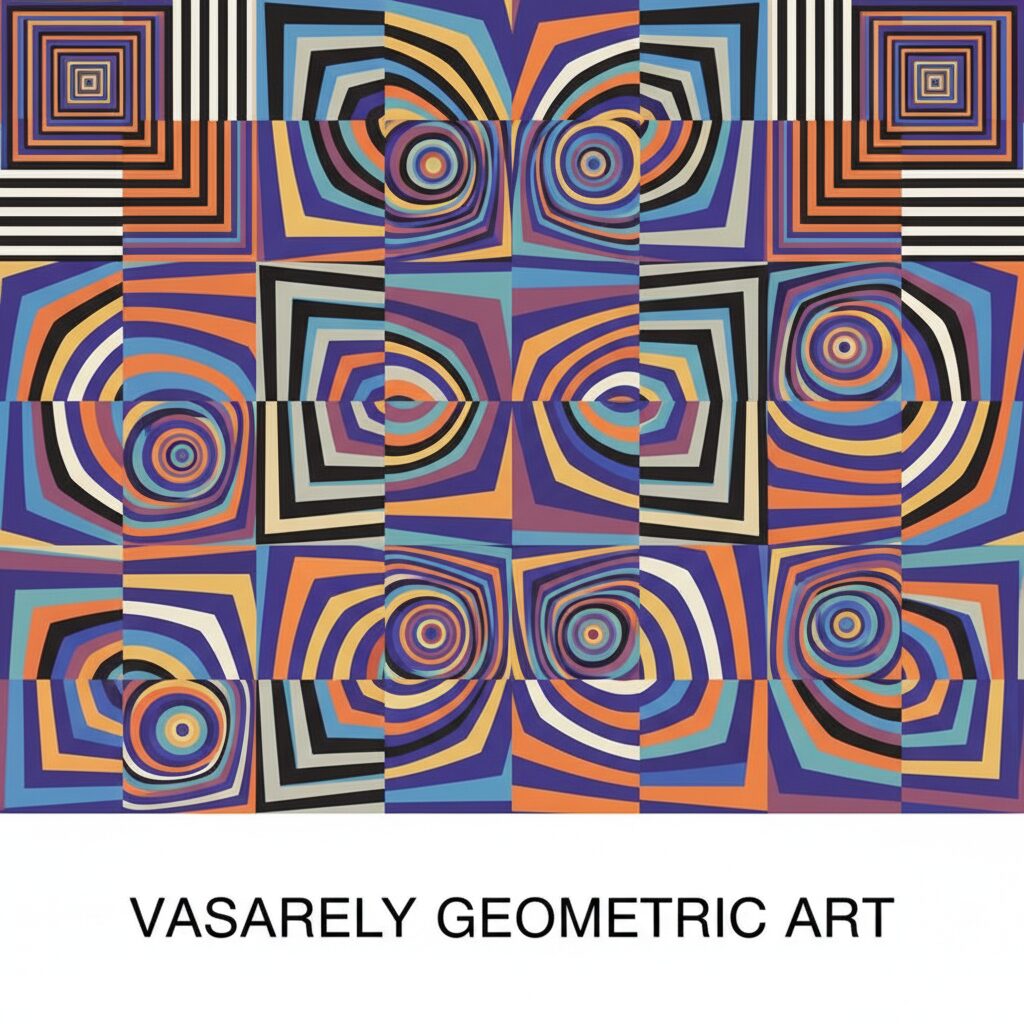
Step into a world where squares pulsate, circles recede, and grids ripple with an unseen energy. This is the kinetic universe of Victor Vasarely, the Hungarian-French artist who became the undisputed grandfather of Optical Art. Long before computer graphics made digital illusions commonplace, Vasarely was meticulously hand-painting canvases that tricked the eye, challenged perception, and seemed to vibrate with a life of their own. His work wasn’t just about creating pretty patterns; it was a profound investigation into the mechanics of vision, a utopian dream of a universal visual language that could transcend cultural barriers and beautify the modern world. To trace the footsteps of Vasarely is to embark on a journey that is as much about geography as it is about geometry. It’s a pilgrimage that takes you from the historic plains of Hungary, through the bustling artistic heart of mid-century Paris, and into the sun-drenched, lavender-scented landscapes of Provence. This is not just a tour of museums; it is an exploration of the very places that forged his vision, the environments that provided the raw data for his “plastic alphabet.” We will follow the evolution of a young graphic designer into a visionary artist, seeing how the light, architecture, and even the pebbles on a beach informed a body of work that would change art forever. This guide is your map to that journey, a way to see the world through Vasarely’s eyes, where every shape holds potential and every color combination is a new reality waiting to be perceived. Prepare to have your vision playfully warped and your imagination expanded as we chase the hypnotic illusions of a modern master.
For a different kind of artistic pilgrimage that also connects deeply to place, consider walking through the landscapes of John Constable.
The Hungarian Roots: Forging a Foundation in Form and Color
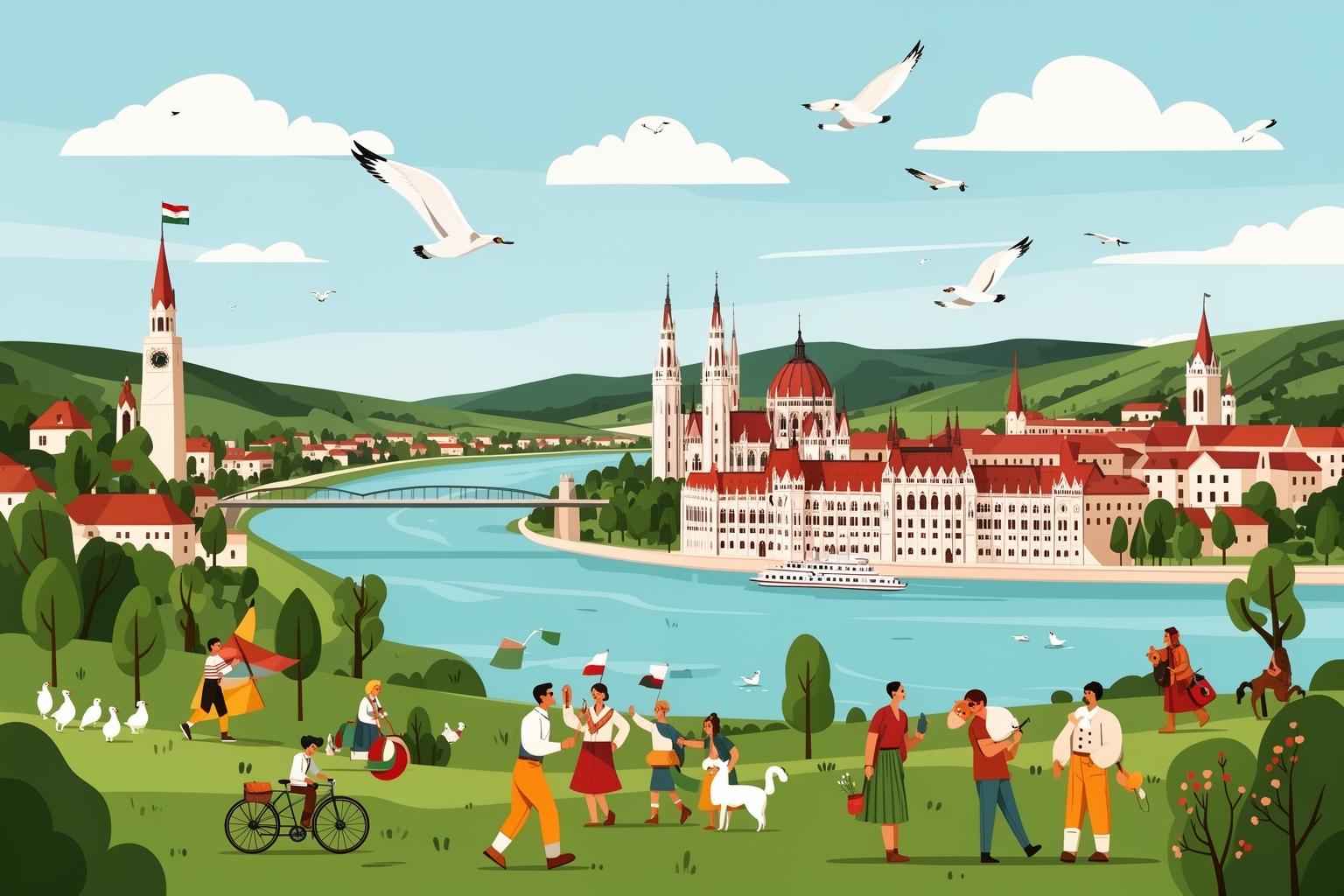
Every great artistic journey has a beginning, and for Victor Vasarely, that beginning was woven into the rich cultural fabric of early 20th-century Hungary. His formative years, split between the ancient city of Pécs and the lively capital of Budapest, were not merely a setting but the very crucible that shaped his analytical and systematic approach to art. The influences of this land—its folk art traditions rich with geometric patterns, its architectural heritage, and the intellectual rigor of its avant-garde movements—sowed the seeds of a visual language that would later flourish into the global phenomenon known as Op Art. To truly grasp the complex grid systems and hypnotic color theories of his mature work, one must first walk the streets he once walked, visit the institutions that molded his mind, and sense the unique cultural pull of a nation caught between a storied past and a rapidly modernizing future. This is where the story of the pixel, the plastic unit, and the kinetic illusion genuinely begins.
Pécs: The Birthplace of a Visionary
Nestled among the rolling hills of southern Hungary, the city of Pécs feels timeless. With a history tracing back to Roman Sopianae, its streets tell a layered narrative of architectural styles, from early Christian mausoleums to Ottoman mosques and elegant Baroque facades. Into this rich historical setting, Győző Vásárhelyi was born in 1906. Walking through Pécs today, one can still sense the deep culture that enveloped the young artist. The city’s renowned Zsolnay porcelain manufactory, famous for its iridescent glazes and intricate designs, had already established Pécs as a hub for decorative arts. It’s easy to imagine a young Vasarely absorbing the geometric precision embedded in the tile work decorating the city’s buildings—an early, subconscious lesson in the power of repeated forms and vibrant color. The atmosphere exudes quiet creativity, a place where art is not confined to galleries but is interwoven into the very fabric of the urban environment.
A pilgrimage to Pécs is incomplete without visiting the Vasarely Museum on Káptalan Street, part of the city’s famed Museum Street. Housed in a historic building, the museum holds a significant collection donated by Vasarely himself in 1976. Here, you encounter the artist before he became the internationally celebrated master of Op Art. The collection is a treasure trove of his early graphic works from the 1930s and 40s, revealing his exceptional draftsmanship and masterful understanding of composition, skills honed during his years as a commercial artist. Posters, book covers, and experimental graphics unveil a mind already fascinated by illusion, depth, and the interplay of positive and negative space. Pieces like his renowned “Zebras” (1937), composed entirely of curving black and white lines that generate a strong sense of volume and movement, serve as a striking prelude to his later achievements. Visiting this museum is like uncovering an artist’s secret origin story—intimate and revealing, it showcases the meticulous groundwork and intellectual exploration that laid the foundation for his more explosive optical experiments. First-time visitors are advised to allocate a full day to Museum Street, as the Csontváry Museum and the Zsolnay Museum lie just steps away, offering broader insight into the artistic heritage that shaped him. A pleasant train ride of a few hours from Budapest makes Pécs an essential, accessible first stop on any Vasarely itinerary.
Budapest: The Bauhaus Awakening
If Pécs provided the cultural soil, Budapest was the intellectual greenhouse where Vasarely’s ideas began to take root. In the late 1920s, he moved to the vibrant Hungarian capital and enrolled in the Műhely, or “Workshop,” an art school founded by Sándor Bortnyik. Conceived as Budapest’s counterpart to the legendary German Bauhaus, the Műhely immersed Vasarely in principles of functionalism, constructivism, and the integration of art and technology. Bortnyik, who had connections with luminaries like Walter Gropius and Theo van Doesburg, instilled in his students a disciplined, almost scientific approach to design. The curriculum emphasized not romantic self-expression but objective principles of color, form, and composition. This experience was transformative for Vasarely. It stripped away conventional, academic art notions and replaced them with a belief in universal visual laws. He learned that art could be systematic—constructed from a core set of elements, a “plastic alphabet,” much like a language.
Today, the Vasarely Museum in Budapest provides a brilliant complement to the collection in Pécs. Situated in the elegant Zichy Palace in the historic Óbuda district, this museum showcases the artist at the peak of his powers. It houses an extensive collection, also donated by Vasarely, focusing on his mature Op Art and kinetic pieces from the 1950s through the 1970s. Entering these halls is a dazzling experience. You confront large-scale canvases that shimmer and warp as you move past them. Works from his “Vega” period, where checkerboard grids are distorted to create the illusion of bulging spheres, seem to pulse on the walls. The colors are electric, the compositions dizzyingly precise, and the effect immersive and deeply engaging. It is as much a physical experience as a visual one; your movement becomes part of the artwork. This museum feels less like a quiet gallery and more like a vibrant laboratory of perception. It testifies to the Bauhaus ideals Vasarely embraced decades earlier: art that is dynamic, participatory, and designed to interact with the viewer in a modern fashion. To fully appreciate the visit, spend some time exploring the surrounding Óbuda neighborhood. Its blend of Roman ruins, Baroque squares, and socialist-era apartment blocks offers a fascinating backdrop, reminding visitors of the complex historical layers in the city that propelled Vasarely to international acclaim.
The Parisian Transformation: The Birth of Op Art
In 1930, Paris stood as the unquestioned epicenter of the art world, a vibrant city drawing ambitious talents from all over the globe. For Victor Vasarely, relocating to Paris was far more than a mere change of environment; it marked a profound transformation. He arrived not as a painter but as a graphic designer, equipped with the rigorous training of the Budapest Műhely and a fierce ambition. The French capital would become his home and his experimental laboratory for more than six decades. It was amidst the city’s ceaseless energy and rich artistic exchanges that he evolved from a successful commercial artist into a revolutionary painter. Paris provided the backdrop for his most crucial breakthroughs: the discovery of abstract forms in nature, the development of his distinctive “plastic alphabet,” and the explosive emergence of Op Art as a major international movement. This phase of his life is a tale of meticulous effort, intellectual excitement, and the gradual, deliberate creation of a new visual language.
The Graphic Artist and a Pivotal Discovery
For nearly fifteen years following his arrival in Paris, Vasarely flourished in the commercial art sector. He worked with leading advertising agencies such as Havas and Draeger, producing posters and graphic works that stand as masterpieces of modernist design. This phase was not a diversion from his artistic journey but a vital part of it. The demands of advertising—the need for instant visual impact, clear communication, and masterful composition—perfectly matched his analytical mind. During these years, he experimented with trompe-l’œil effects, axonometric perspective, and figure-ground interplay, all techniques that would become central to his later paintings. Essentially, he was conducting rigorous research into the science of perception, funded by his commercial work. His studio in Annet-sur-Marne, a quiet suburb east of Paris, served as the crucible for these experiments, a site of intense, focused work far from the bohemian cafés of Montparnasse.
The major turning point arrived in 1947 during a summer spent on Belle-Île, an island off Brittany’s coast. The island’s raw, elemental nature struck him with a powerful revelation. He became captivated by the simple, organic shapes of the sea-worn pebbles on the beach, the gentle curves of the waves, and the fractured light on the water. Within these natural elements, he perceived the fundamental building blocks of the universe. He famously described how the “internal geometry of nature” was unveiled to him there. This “Belle-Île” period marked his decisive shift toward abstraction. He began creating works inspired by these ovoid, pebble-like forms, viewing them not as stone representations but as pure plastic units. This experience cemented an idea that had been developing since his Bauhaus days: all forms, both natural and man-made, could be reduced to a core vocabulary of simple geometric shapes. This was the origin of his “alphabet plastique,” a system where a limited set of forms (square, circle, triangle, ellipse) and a range of colors could be combined infinitely to create a universal visual language. Though his studio in Annet-sur-Marne is not open to the public, visitors to Paris can experience the legacy of this era by visiting the Centre Pompidou, home to several of his key works. Viewing them alongside other post-war European artists highlights the radical originality of his vision.
The “Yellow Manifesto” and the Dawn of a Movement
By the mid-1950s, Vasarely’s theories had crystallized into a robust artistic agenda. This culminated in the landmark 1955 exhibition “Le Mouvement” at Galerie Denise René in Paris, now regarded as the official birth of kinetic and Op Art. Alongside artists such as Alexander Calder, Marcel Duchamp, and Jean Tinguely, Vasarely presented works that actively engaged viewers’ perception and movement. For the exhibition catalogue, he penned his seminal “Manifeste Jaune” (Yellow Manifesto), a fervent declaration of his artistic ideals. He argued that art should transcend the static, contemplative easel painting. He envisioned a new, dynamic art form based on the principle that “the work is not the only thing, the viewer also matters.” His contributions included pieces made of superimposed transparent panes that generated shifting patterns as viewers moved past them. The atmosphere inside the gallery must have been electrifying, evoking a sense of witnessing a fundamental break from the past. Art was no longer merely an object to be observed passively; it became an experience to be activated, a perceptual event unfolding in time and space. The exhibition declared that the viewer’s eye and body were now integral components of the artwork. This moment secured Vasarely’s status as a leading avant-garde figure and paved the way for Op Art to become a defining aesthetic of the 1960s.
The Provençal Dream: A Utopian Vision in the Sun
The transition from the gray, intellectual light of Paris to the brilliant, vibrant sun of Provence represented the final and most ambitious phase of Victor Vasarely’s career. Drawn by the region’s intense luminosity, stark landscapes, and the almost geometric clarity of its ancient villages, he discovered in the South of France the ideal canvas for his utopian ideals. Provence was more than just a beautiful place to live and work; it was the chosen home for his grandest project: the creation of a “cité polychrome du bonheur” (polychrome city of happiness). He believed his art, with its universal language of form and color, could be seamlessly integrated into architecture and urban planning, enriching the lives of all citizens. This was the Bauhaus dream revived under the Mediterranean sun. His time in Gordes and, ultimately, Aix-en-Provence was devoted to turning this vision into reality, culminating in the creation of a foundation that stands today as a unique and powerful monument to the fusion of art and life.
Gordes: The Castle in the Sun
Perched dramatically on a cliffside in the Luberon, the village of Gordes is an architectural marvel. Its tightly packed stone houses, winding cobblestone streets, and commanding medieval castle appear to grow organically from the rock itself. It’s easy to understand why Vasarely fell in love with this place in the late 1940s. The interplay of bright sun and sharp shadow across the cubist-like arrangement of buildings was a real-world reflection of the geometric principles he explored in his art. He purchased and renovated the village’s Renaissance château, and in 1970, he opened the Musée didactique Vasarely. This was no ordinary museum. As its “didactic” name implies, its purpose was educational. Vasarely designed it as a pedagogical journey, guiding visitors step-by-step through the evolution of his thought, from his early graphic work to his mature plastic alphabet. He aimed to demystify the artistic process, showing that his creations were the result of a logical, systematic method that could, in theory, be understood and applied by anyone.
For over twenty years, the museum in the Gordes castle served as a beacon for Op Art enthusiasts. However, due to complex legal and financial issues following the artist’s death, the museum closed in 1996, and the collection was sadly dispersed. Today, the castle hosts other exhibitions, with little trace of Vasarely’s presence remaining. Yet, Gordes remains an essential stop on a Vasarely pilgrimage. The spirit of his connection to the place endures. To wander its streets is to comprehend his fascination with structure, light, and perspective. The panoramic views from the belvedere overlook a landscape of gridded fields and geometric forms, a scene straight from one of his canvases. A first-time visitor should simply allow themselves to get lost in the village, to feel the texture of the ancient stone, and to observe how the shifting position of the sun transforms the architecture throughout the day. While the museum is gone, the inspiration remains, making a visit to Gordes a poignant and beautiful experience—a tribute to the place that first anchored his Provençal dream.
Aix-en-Provence: The Luminous Polychrome City
The ultimate realization of Vasarely’s utopian vision is found on the outskirts of Aix-en-Provence: the Fondation Vasarely. Opened in 1976, this extraordinary building is the artist’s masterpiece, a true architectural “integration” where the structure itself becomes the art. Designed by Vasarely, the building consists of sixteen massive, interconnected hexagonal modules—a honeycomb of concrete and glass. The exterior facades are monumental Op Art works, clad in anodized aluminum and enameled glass panels featuring his iconic circle and square designs in black, white, and shimmering metallics. As you approach, the building seems to shift and vibrate beneath the Provençal sun, a kinetic sculpture on a grand scale. It doesn’t rest on the landscape; it commands it, a futuristic temple dedicated to geometric abstraction.
Inside, the experience is immersive and overwhelming. The interior comprises seven hexagonal cells, each housing six monumental installations—forty-two in total, with two additional pieces in the entrance hall. These are not paintings hanging on walls; they are the walls themselves. Towering works, some over six meters high, are crafted from various materials: woven tapestries, colored glass, metal, and ceramic tiles. You no longer view artwork; you stand within it. The scale is designed to envelop your vision, forcing a purely optical and sensory experience. The echo of your footsteps on the concrete floor, the way light filters through the colored panels, and the dizzying effect of pulsating patterns combine to create an atmosphere both awe-inspiring and disorienting. This is the “polychrome city” in miniature—a prototype for a future where art and architecture are one. The Fondation was conceived as a research center for artists, architects, and urban planners to collaborate on creating beautiful, functional environments for all. A practical tip for visitors: the Fondation is located in the Jas-de-Bouffan district, a short bus or taxi ride from Aix’s center. Allow several hours to fully experience the space. Don’t rush. Sit on the benches in the center of each cell and let the illusions envelop you. It is a powerful, almost meditative experience that conveys Vasarely’s ambitious dream more eloquently than any words ever could.
The Legacy and Global Echoes
Victor Vasarely’s influence reaches far beyond the confines of his dedicated museums. He tirelessly pursued his vision of a “social art,” one that would break free from gallery walls and weave itself into everyday life. His visual language was so powerful and versatile that it rapidly spread across global culture, leaving a lasting imprint on everything from corporate branding and public architecture to fashion and design. To truly follow in his footsteps is to recognize these resonances throughout the broader world, understanding how his systematic use of form and color became embedded in the modern visual landscape. Thus, the pilgrimage doesn’t end in Aix-en-Provence; it continues wherever his utopian vision took root, proving that his “plastic alphabet” could indeed become a universal language.
Beyond the Museums: Vasarely in Public Spaces
Vasarely was a passionate proponent of integrating art into architecture, working closely with architects to incorporate his creations directly into buildings. One of his most celebrated, though now demolished, works was the monumental facade of the RTL headquarters in Paris (1972), where metal bands produced a shimmering, kinetic effect on a grand urban scale. He crafted striking murals for the Montparnasse train station in Paris and introduced his vibrant geometric style to the University of Caracas in Venezuela. He also created works for the German Bundesbank in Frankfurt and designed the iconic three-dimensional star logo for the French automaker Renault in 1972—a piece of Op Art seen by millions daily on roads worldwide. His influence was so widespread during the 1960s and 70s that the “Vasarely effect” came to define the aesthetic of the era. Fashion designers like Paco Rabanne translated his checkerboards and pulsating circles into futuristic attire. His patterns were featured on textiles, album covers, and furniture, injecting optical dynamism into the domestic sphere. He succeeded in his aim: art ceased to be a precious object reserved for the elite and became a democratic, accessible visual experience.
The Pilgrim’s Mindset: Seeing the World like Vasarely
Ultimately, the most profound way to connect with Vasarely’s legacy is to embrace his way of seeing. A journey to the places that shaped him is not merely about marking locations on a map; it is an education in perception. After immersing yourself in his world, you begin to see through his eyes. You start to notice the flawless geometry in a spider’s web, the kinetic sparkle of light dancing on the surface of a river, the intricate grid of a city street viewed from above. You come to understand his insight at Belle-Île—that the entire world, from the tiniest pebble to the vastest landscape, rests upon a fundamental geometric structure. This is the true gift of a Vasarely pilgrimage. It provides you with a new lens on reality. It encourages you to discover the abstract within the concrete, to appreciate the interplay of color and form in your surroundings, and to realize that perception itself is an act of creation. The journey shifts from a simple tour to an active mode of seeing, uncovering the hidden rhythms and patterns that enliven the world around us. It invites you to view the universe as he did: an infinite, vibrant, and beautifully logical work of art.
A Journey Through Perception
A pilgrimage following the footsteps of Victor Vasarely is an extraordinary journey across Europe and, more profoundly, through the landscape of modern vision. It begins on Hungary’s culturally rich soil, where a solid intellectual foundation was established, then moves to the vibrant heart of Paris, where a new artistic language was shaped amid the fusion of commercial design and avant-garde theory. The journey reaches its radiant peak under the Provence sun, where a utopian vision of art integrated with life took its most spectacular and enduring form. Traveling from the early graphics in Pécs to the dizzying monumental works in Aix-en-Provence reveals the relentless, lifelong evolution of a unique idea: that art could be a universal, democratic force, built from a simple alphabet of form and color, capable of transforming our surroundings and enhancing our perception. Vasarely offered more than paintings; he offered a fresh way of seeing. His legacy extends beyond museums, resonating in the very design of our world and, most powerfully, in the potential he revealed within our own eyes. To embark on this journey is to accept his invitation—to look deeper, see the hidden geometry in all things, and discover the kinetic energy that breathes life into our reality.