
To stand before a painting by Joseph Mallord William Turner is to witness a battle. It’s a glorious, chaotic, and utterly mesmerizing conflict waged between light and shadow, storm and stillness, creation and decay. He wasn’t just a painter of landscapes; he was a painter of forces, a man who dipped his brush into the very essence of the atmosphere and smeared it across the canvas. They called him “the painter of light,” but that feels too gentle. Turner was a conductor of elemental symphonies, a visionary who saw the raw, untamable power humming just beneath the surface of the world. To truly understand his work, to feel the thunder in his seascapes and the searing heat in his sunsets, you can’t just confine yourself to the hushed halls of a gallery. You must step into his world. You must walk the cobbled lanes where he was born, feel the same salty spray on your face that inspired him, and stand in the very rooms where he translated the sublime chaos of nature into immortal art. This is not just a tour of locations; it is a pilgrimage, a journey that follows the ghost of a genius, chasing the same ethereal, ever-shifting light that obsessed him for a lifetime. We begin in the heart of London, the city that birthed and buried him, and from there, we will follow the light to the coast, across the channel, and into the very heart of his inspiration.
For a different kind of artistic pilgrimage that also explores how a master transformed his world into art, consider a journey into John Constable’s England.
The Cockney Visionary: Turner’s London

London was Turner’s crucible—the city of his birth, education, ambition, and ultimate refuge. It was a place of sharp contrasts: immense wealth alongside dire poverty, Palladian elegance contrasted with industrial grime. For Turner, London was a continually evolving subject, a living canvas of stone and water, where light performed daily miracles as it pierced coal smoke and shimmered on the Thames’s muddy waters. Following his footsteps here means understanding the foundation of his entire artistic world.
Birthplace in Covent Garden
Our journey starts in Maiden Lane, Covent Garden. Today, it’s a lively street filled with theaters, shops, and restaurants, buzzing with the commercial energy of modern London. But imagine London in 1775: the air thick with coal smoke, horse manure, and gin; narrow lanes with buildings leaning in close, allowing only a sliver of sky overhead. It was at number 21 that J.M.W. Turner was born, the son of a barber and wig-maker. His father’s shop served as his first gallery, where the young prodigy’s drawings were displayed and sold for a few shillings each. Though the original building no longer stands, a plaque marks the spot, silently honoring the artist’s modest origins. Standing here makes you feel the vast journey Turner undertook—not in distance but in status and fame. A true Cockney, his accent thick and demeanor sometimes seen as gruff and unpolished, from this noisy, cramped corner of London emerged a vision that would change art forever. When visiting, pause and watch the crowds, then look up to the sky—notice how the light touches the building edges. Turner’s genius lay in discovering the extraordinary within the ordinary, and it all began here.
The Royal Academy and Somerset House
From the rough world of Covent Garden, Turner’s extraordinary talent led him to the prestigious Royal Academy of Arts. In his youth, the Academy was based in Somerset House, a grand neoclassical palace on the Thames. This hub of British art was everything to an ambitious young artist like Turner. He entered the RA schools at just fourteen, a prodigy, and exhibited watercolors by age fifteen. Picture the young Turner walking through these majestic arches, his mind alive with ideas, eager to prove himself among greats like Sir Joshua Reynolds. The annual Summer Exhibition was the key event, where careers were made or broken. Turner quickly mastered attracting attention, often submitting paintings with bold dashes of red or yellow that made his work leap off crowded walls. Today, visiting Somerset House, you can still sense its grandeur and authority. Walk the vast courtyard, listen to the fountains, and gaze toward the river—it was here that Turner first claimed his place, representing the tradition he initially aimed to master and ultimately transform.
Queen Anne Street and Harley Street: The Artist’s Domain
As his reputation and wealth increased, Turner became astute about how his work was displayed. A savvy businessman, he appreciated the power of presentation. In 1804, he opened a private gallery at his home on Harley Street, later relocating to a specially designed space at 47 Queen Anne Street West. This gallery was both sanctuary and fortress, freeing him from competing for attention at the Royal Academy. He curated the environment carefully, managing the lighting and arrangement of his paintings. The space was dimly lit and cluttered with canvases, yet entirely his own. Visitors described the experience as almost religious—a pilgrimage to witness the master’s newest works. The building still stands, now private, but strolling along this quiet, elegant street reveals the world Turner inhabited as a successful man. From the barber’s shop in Maiden Lane to a fine London townhouse, his rise was remarkable. Here, in the privacy of this studio, Turner freely experimented, pushing his art beyond conventional limits, creating the swirling, abstract vortices that defined his later years.
The Thames: The River of Life and Light
More than any building, Turner’s true London studio was the River Thames—a lifelong muse and endless inspiration from his earliest sketches to his final, stunning oil paintings. He witnessed its many moods: calm, misty mornings with the sun rising like a pale wafer; the industrial fury of busy ports where steamships belched smoke mingling with fog; and dusks when the setting sun set the Houses of Parliament alight with color. Turner would hire a boat and sketch for hours, drifting on the water, observing the constantly shifting interplay of light, water, and air. It was here he saw the great warship Temeraire being towed to its final berth, a fading ghost against a fiery sunset, inspiring one of his most beloved paintings. To connect with Turner’s London, one must get on the river—take a Thames Clipper from Westminster to Greenwich. As the cityscape unfolds, observe how light reflects off the Shard’s glass and the Tower of London’s ancient stone. Notice the water’s color and the sky’s texture. Boats and buildings may have changed, but the river and light remain—a glimpse into London through the master’s eyes.
The Kingdom of the Sky: Turner and the Kent Coast
While London shaped his ambition, it was the coast of Kent that nourished his soul. Turner was captivated by the sea—its power, its unpredictability, and above all, the distinctive quality of light where land meets water. He discovered his ultimate coastal muse in the seaside town of Margate, a place to which he returned repeatedly throughout his life. For Turner, this was no gentle holiday resort; it was an arena where the elements clashed spectacularly.
Margate’s Ever-Changing Skies
Turner famously stated that “…the skies over Thanet are the loveliest in all Europe.” Standing on Margate’s harbour wall, you begin to grasp what he meant. There is something truly extraordinary about the light here. It spans a vast, open space where the sky seems immense, stretching from the chalk cliffs to the horizon. The light, filtered through the sea haze, takes on a luminous, silvery quality that is always shifting. One moment the sun breaks through clouds in dramatic shafts, illuminating the waves; the next, a storm rolls in from the North Sea, turning the sky a bruised purple-grey. This was Turner’s stage. He shunned calm, picturesque beach scenes, instead craving the drama, movement, and raw energy of the weather. The atmosphere in Margate, particularly on a windy day, is invigorating. Salt spray hits your face, gulls cry overhead, and you feel a deep connection to the natural world. It’s a place that humbles you before nature’s grandeur—the sublime feeling Turner sought to capture. Today, a visit is incomplete without spending time at the Turner Contemporary gallery. Situated on the very site of Turner’s favorite boarding house, this sleek, modern building aims to do one thing: frame the view. Its vast windows open onto the sea and sky, making the landscape itself a living exhibit—a breathtaking tribute that links his work directly to its source of inspiration.
A Room with a View
Turner’s bond with Margate was also deeply personal. For many years, he stayed with Mrs. Sophia Booth in her guesthouse overlooking the harbour. After her husband’s death, she became his companion, and his time in Margate was one of rare domestic contentment in an otherwise solitary life. He stayed for weeks at a stretch, renting a room with an ideal view of the sea, where he set up a makeshift studio to capture the fleeting effects of light and weather. Picture him at that window day after day, keenly observing every nuance of the changing sky, sketching furiously in his notebooks. This was his sanctuary, a refuge from the pressures of the London art scene. For today’s visitors, the key is to slow down. Don’t just snap a photo and leave. Find a bench on the promenade or harbour arm, buy some fish and chips, and simply watch. Watch the tide ebb and flow. Watch the clouds build and dissolve. See how the sea’s color shifts from turquoise to grey to deep blue. This meditative experience is what drew Turner back time and again. It’s in these quiet moments of observation that you can sense his presence most keenly, a silent fellow observer of the sky’s endless drama.
Patronage and Peace: The Sanctuary of Petworth House

If Margate represented Turner’s escape into the raw forces of nature, Petworth House in West Sussex was his refuge into a realm of culture, comfort, and enlightened patronage. This magnificent stately home served as the residence of the 3rd Earl of Egremont, one of Turner’s most significant patrons and a close friend. The Earl’s invitations provided Turner with a sanctuary, a place where he could work undisturbed, surrounded by one of England’s finest art collections, and engage with poets, sculptors, and fellow painters.
Lord Egremont’s Invitation
The relationship between Turner and Lord Egremont was far removed from the formal, often transactional connections typical of artists and patrons. Egremont was a genuine connoisseur who admired Turner’s genius and granted him extraordinary freedom. At Petworth, Turner was treated not as a hired artist but as a cherished guest. He was given his own studio—the old library—and was free to explore the vast house and the sprawling 700-acre deer park designed by the renowned Lancelot “Capability” Brown. This setting contrasted sharply with his cluttered London studio and the windswept coastline. It was a world of aristocratic ease, candlelit dinners, and long strolls through manicured landscapes. This haven allowed a different facet of Turner’s art to flourish, one focused on the nuances of light within a refined and luxurious environment.
Painting Light Within Walls
Visiting Petworth House today, now managed by the National Trust, is like stepping inside one of Turner’s paintings. The collection of his work here is unmatched in its connection to a single location. Turner was commissioned to create four landscapes of the estate, which hang in the breathtaking Carved Room—a space so ornate it appears carved from a single piece of wood. These paintings depict the park and the nearby lake in varying light, from the golden radiance of a summer evening to the cool light of dawn. Even more captivating are the intimate, near-impressionistic watercolors and gouaches he produced for his own enjoyment. He painted the library where he worked, with sunlight streaming through the windows. He captured guests playing billiards, the lamp light casting long shadows. He was fascinated by how light behaved indoors—how it reflected off polished floors, refracted through glasses of wine, and illuminated the lavish interiors. A visit to Petworth allows you to stand exactly where he created these masterpieces. You can look out the very windows, see the same views, and appreciate his talent for capturing not only landscapes but the atmosphere of a place. Take your time. Wander through the rooms, then explore the park. Find a spot by the lake and watch the light dappling through ancient trees. Petworth reveals a gentler, more reflective Turner, a master of both domestic and elemental light.
The Grand Tour and the Sublime: Turner in Europe
Turner’s unquenchable curiosity and his pursuit of novel forms of light and landscape could not be confined to England’s shores. Like many artists of his era, he set out on Grand Tours of Europe, but his travels were distinct. He wasn’t merely checking off classical ruins on a list; he was chasing the sublime, seeking the most dramatic, awe-inspiring, and fearsome landscapes the continent offered. His journeys, especially to Venice and the Alps, transformed his art, steering it toward the shimmering abstraction that characterized his later work.
Venice: The Sinking City of Dreams
For a painter fascinated by the interaction of light and water, Venice was the ultimate destination. Turner visited three times, and the city completely captivated him. He discovered a place seemingly dissolving back into the sea, a city of dreamlike beauty and poignant decay. He moved away from the precise architectural detail of earlier painters such as Canaletto. Instead, he concentrated on the atmosphere and the way the golden Venetian light fractured in the humidity, causing the stone palazzos to appear to float and shimmer. His Venetian paintings are less representations of a city and more evocations of a feeling. Buildings melt into the water, gondolas become fleeting black strokes, and the sun and moon dissolve across the sky and lagoon in breathtaking bursts of color. To truly experience Turner’s Venice, you must embrace this sense of dissolution. Get lost in the maze of back alleys, away from the crowds of St. Mark’s Square. Ride the vaporetto, the public water bus, especially early morning or sunset. Stand on the Accademia Bridge and gaze toward the dome of Santa Maria della Salute, a view he painted repeatedly. Watch it fade into mist at dawn. The best time to visit for a genuinely Turner-esque experience is during spring or autumn when the weather can be misty and atmospheric. The city then reveals its ghosts, and you can almost feel Turner at your side, furiously sketching in his notebook, striving to capture the impossible beauty of it all.
Conquering the Alps: In Search of the Sublime
If Venice was Turner’s dreamscape, the Alps were his battlefield of awe and terror. In the late 18th and early 19th centuries, the idea of the “Sublime” was a potent aesthetic concept. It described an experience of nature so immense, powerful, and overwhelming that it elicited a blend of exhilaration and fear. This was what Turner sought in the mountains of Switzerland and France. He crossed perilous passes like the St. Gotthard, sketching avalanches, rockfalls, and raging torrents. He wasn’t depicting picturesque mountain scenes; he was portraying the raw geological force of the earth. His alpine watercolors are masterpieces of controlled chaos. You can almost feel the glacier’s cold, the crushing weight of rock, and the terrifying scale of the peaks. In his famous oil painting, “Snow Storm: Hannibal and his Army Crossing the Alps,” the historical subject is nearly consumed by a swirling vortex of wind and snow. The drama of the weather is the true focus. For the modern traveler, replicating the hardships of his journeys is impossible, but you can still encounter the sublime. Take a train through the Swiss Alps, such as the Bernina Express or the Glacier Express. As you climb, watch the landscape shift from green valleys to stark, rocky heights. Disembark at a high pass and breathe the thin, crisp air. Listen to the silence, broken only by the wind. Feel the immense scale of the mountains surrounding you. It’s a humbling, awe-inspiring experience that connects you directly to the emotions that propelled Turner to depict these monumental landscapes.
The Final Mooring: Chelsea and the Last Light
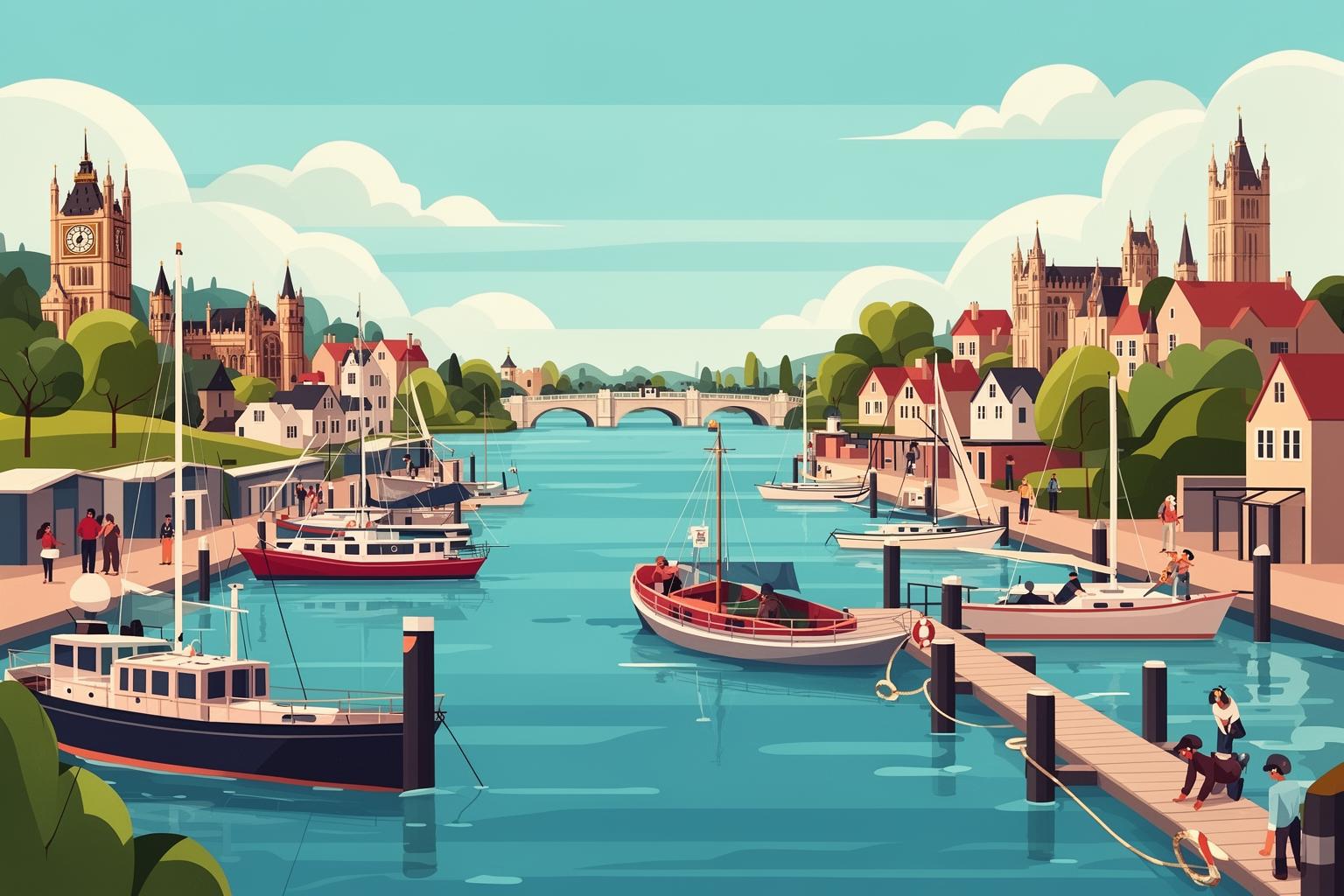
After a lifetime of relentless travel and artistic innovation, Turner spent his final years in quiet seclusion—not in his grand Queen Anne Street residence, but in a modest cottage located in what was then a remote area of London: Chelsea. He had come full circle, returning to his cherished River Thames to witness the last sunsets of his life.
An Anonymous Refuge
In his later years, Turner sought anonymity. He purchased a small cottage at 119 Cheyne Walk with his companion, Sophia Booth, living there under her name and occasionally referring to himself as “Mr. Booth” or, humorously, “Admiral Booth.” His neighbors had no inkling that the short, stout old man who climbed to the roof to watch the sunrise was Britain’s most celebrated artist. This cottage became his final sanctuary, a place of tranquility. It boasted a direct, unobstructed view of the Thames, across the slow-moving expanse of water to Battersea. Here, he maintained his daily practice of observing light—watching morning mists rise, barges drift by, and the sky blaze with color at day’s end. The house remains today, marked by a blue plaque. Standing on the embankment opposite, gazing at the same view, one feels a deep sense of peace. This was where the great tempest of his life finally quieted. Having chased light across Europe, he returned to the river of his youth to behold it one last time.
The Legacy in Trafalgar Square and Millbank
Turner died in his Chelsea cottage in 1851. In his will, he left his completed paintings to the nation, with the stipulation that they be kept together. This extraordinary gift, known as the Turner Bequest, forms the heart of the world’s greatest collection of his works. The ultimate destinations on any Turner pilgrimage are therefore twofold. First, the National Gallery in Trafalgar Square, where masterpieces like “The Fighting Temeraire” and “Rain, Steam and Speed” hang alongside the Old Masters he admired and challenged. Yet the true core of the bequest lies at Tate Britain, down the river at Millbank. Within the Clore Gallery, one can fully immerse in the breadth of his genius, seeing not only grand exhibition pieces but also thousands of sketches, watercolors, and unfinished “color beginnings” discovered in his studio. These private experiments are perhaps the most exhilarating of all—pure Turner, free from public expectation, with swirls of color and light that feel strikingly modern. Viewing them collectively reveals his process, his obsession, and his revolutionary vision. It is an overwhelming and emotional experience, the final, brilliant crescendo in the symphony of his life and work.
A Traveler’s Palette: Practical Tips for Your Turner Pilgrimage
Setting out on a journey following in the footsteps of J.M.W. Turner calls for a particular mindset. It involves more than simply visiting places; it means learning to perceive the world as he did—as a realm of constant, beautiful change. Here are some practical tips to guide your way.
Best Seasons to Travel
The season you choose will deeply influence your experience, as light and weather were Turner’s chief subjects. For the dramatic, stormy skies of Margate, plan a visit in autumn or early spring. The turbulent seas and swiftly moving clouds will offer a genuine sense of the sublime. For the soft, golden light of Petworth, late summer and early autumn are perfect, when the low sun bathes the parkland in rich tones. London’s Thames is captivating year-round, but the misty autumn mornings can be especially enchanting, mirroring his ethereal works. When visiting Venice, avoid the height of summer. The hazy, atmospheric lighting of spring and autumn better evokes his artistic vision.
What to Pack
Besides the usual travel essentials, two items are crucial for a Turner-inspired trip. First, a reliable waterproof jacket and sturdy footwear. England’s weather is notoriously unpredictable, and to fully experience the coast or river, you must be ready to embrace the elements, just as Turner did. Second, and perhaps most importantly, a sketchbook. Artistic skill is not required. The simple act of sitting down to sketch—even with just a few lines or notes on color and light—encourages deeper observation. It slows you down and connects you with Turner’s continual practice of careful watching. The focus isn’t on the finished product but on the process of truly seeing.
Getting Around
Getting around the UK portion of the pilgrimage is fairly straightforward. London’s public transportation is excellent. A high-speed train from St. Pancras will bring you to Margate in roughly 90 minutes. Petworth, being more rural, is easiest reached by train to Pulborough followed by a short taxi ride. For the European stops, trains provide a scenic and immersive way to travel, particularly through the Alps, reflecting the leisurely pace of Turner’s own journeys.
Beyond the Canvas
Above all, engage all your senses. Turner’s art is powerful because it appeals not just to sight but to feeling. In Margate, let the wind and sea spray touch your skin. At Petworth, breathe in the scent of damp earth from the ancient forest floor. In Venice, listen to the gentle lapping of water against the city’s stone foundations. Along the Thames, note the fragrance of the river. Fully immersing yourself in these sensory experiences moves you beyond simple sightseeing. It helps you grasp the raw essence from which Turner shaped his timeless visions.
Following Turner’s path is a journey that transforms your way of seeing. You begin to recognize subtle shifts in sky color, the reflection of light on wet pavement, the dramatic beauty of an incoming storm. His paintings stop being mere images on a wall; they become a key to perceiving the profound beauty and power surrounding us every day. He showed that a sunset over a muddy river can be as magnificent as any classical myth, that a storm at sea can embody both terror and beauty like a divine drama. To walk where he walked is to accept his invitation: to pause, to observe, and to be truly amazed by the light.