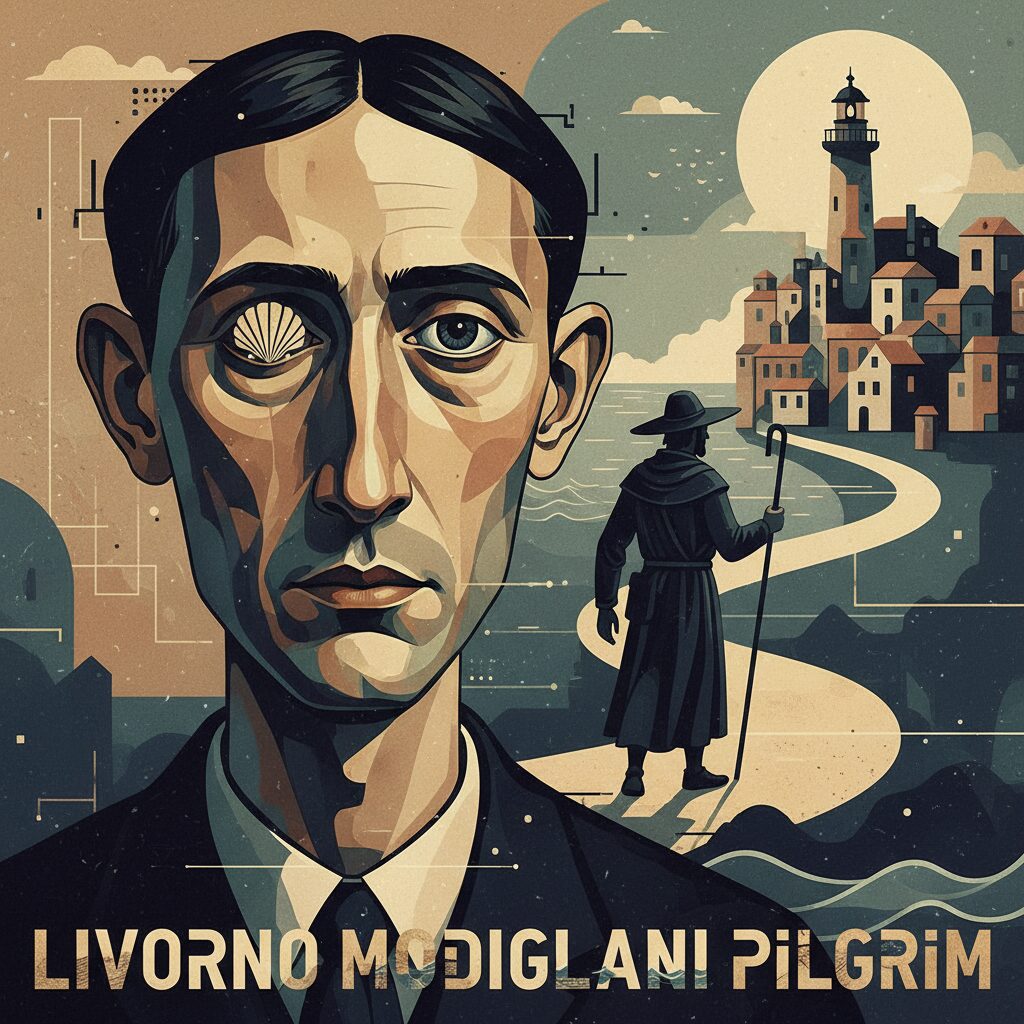
There are artists whose lives are as hauntingly beautiful and tragically brief as their masterpieces. Amedeo Modigliani is one of them. His name evokes images of elongated necks, soulful almond-shaped eyes, and a raw, melancholic elegance that feels utterly modern, even a century after his death. To know Modigliani is to know the faces he painted, but to truly understand him, you must walk the streets that shaped him. This is not just a tour of museums; it is a pilgrimage through the sun-drenched ports of Italy and the rain-slicked cobblestones of Paris, a journey into the heart of a bohemian inferno that forged one of the 20th century’s most distinctive artistic voices. We will trace the arc of his life, from the promising young artist in Livorno, to the struggling sculptor in Montmartre, and finally, to the “cursed prince” of Montparnasse. This is the story of Amedeo, or “Modì,” a man who burned with a furious creative fire, leaving behind a trail of luminous art that continues to captivate the world. So, pack your bags, open your mind, and let’s follow the ghost of the swan-necked painter through the cities that he called home.
For another profound artistic pilgrimage that explores the mind of a visionary master, consider following the path of Hieronymus Bosch.
Livorno: The Salt-Kissed Cradle
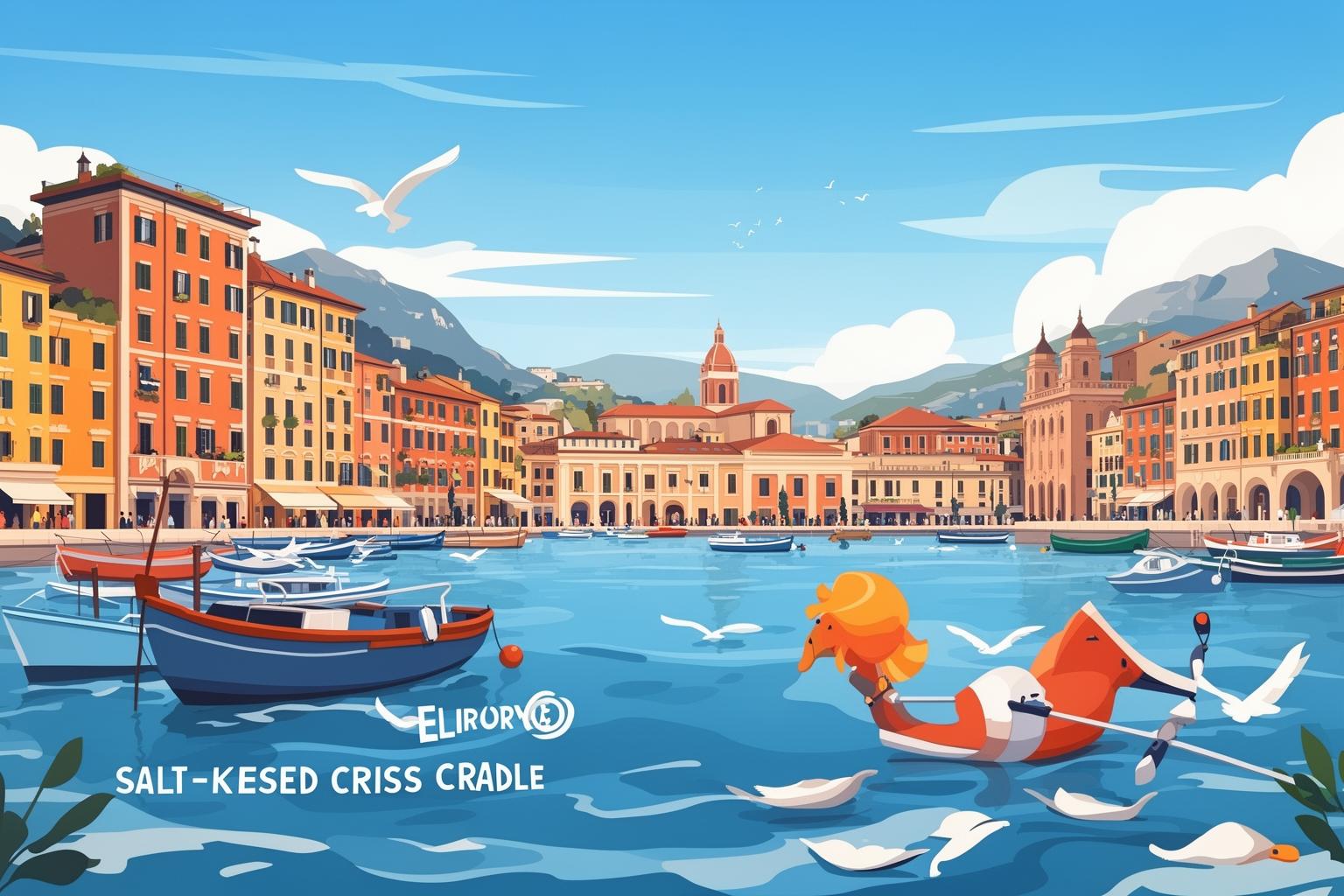
Every story has a beginning, and Modigliani’s begins not in the bohemian chaos of Paris, but in the vibrant, salty air of Livorno. Born in 1884 in this bustling Tuscan port city, Amedeo was the fourth child of a Sephardic Jewish family whose fortunes had declined. To understand Modigliani, you must first understand Livorno. Unlike Florence, with its ancient, delicate frescoes, Livorno was a practical, multicultural hub—a crossroads of commerce and ideas. Its canals, designed in the 17th century, earned it the nickname “Venice of Tuscany,” and this watery landscape, combined with the vast expanse of the Ligurian Sea, gave the city a sense of openness and constant movement. Walking through Livorno today, you can still feel this energy. The Mercato Centrale, an impressive iron-and-glass building from the 19th century, hums with the calls of vendors and the aroma of fresh fish and local produce. You can almost picture a young, observant Amedeo taking it all in, his artistic sensibilities shaped by the diverse faces and lively trade around him.
His childhood home was at Via Roma 38, although the family moved often due to financial difficulties. Within these walls, his mother, Eugénie Garsin, a woman of great intellect and culture, nurtured his artistic talents. She recognized his passion early and became his most devoted supporter. The city itself served as his first canvas. He studied under the local master Guglielmo Micheli, a pupil of one of the leaders of the Macchiaioli movement—Italy’s response to French Impressionism. Micheli’s school was situated in the lush, expansive grounds of Villa Fabbricotti. Visiting the park today, you can find a quiet bench beneath ancient trees and imagine Modigliani, a frail but determined youth already battling the tuberculosis that would haunt his life, sketching the interplay of light and shadow, refining the foundational skills that he would later both honor and challenge in his mature work.
Livorno’s influence extends beyond his early training. As a historically tolerant city and refuge for those fleeing persecution, it nurtured a unique cultural blend. This environment of acceptance and diversity likely shaped Modigliani’s lifelong humanism, his deep interest in the individual soul, which shines through in every portrait. To truly experience this, take a walk along the Terrazza Mascagni, a dramatic checkered promenade by the sea. As the waves crash against the balustrade, you look out at the same horizon Modigliani once saw—a horizon promising a world beyond Livorno, a world of art, passion, and destiny.
The Renaissance Classroom: Florence and Venice
To become a master, one must first learn from those who came before. In 1902, Modigliani’s artistic journey truly began. He left the familiar comfort of Livorno for the revered halls of Florence, the birthplace of the Renaissance. Imagine the overwhelming sensory experience for a young artist. He enrolled in the Scuola Libera di Nudo (Free School of Nude Studies), fully immersing himself in the study of the human form that would become his lifelong passion. However, his true education occurred outside the classroom. He frequented the Uffizi Gallery and the Bargello, standing before masterpieces by Botticelli and Simone Martini. The influence of these artists echoes through his work—the graceful, lyrical lines of the Sienese masters and the elegant elongation of form. He wasn’t merely copying; he was absorbing and transforming the very essence of the Renaissance, preparing to create something uniquely his own.
Walking through Florence today, tracing his path from the Accademia to the Ponte Vecchio, feels like stepping into his sketchbook. The city’s overwhelming beauty and rich artistic heritage must have been both inspiring and daunting. He was a modern man in an ancient city, grappling with the legacy of great masters while striving to find his own voice. He wrote to a friend during this period, expressing a desire to create art that was “the expression of our own time,” clearly indicating that he was already looking beyond the past.
If Florence was the classroom, Venice was the after-party. In 1903, he moved to the floating city, enrolling in a similar school but discovering a different kind of education amid its winding streets and shadowy canals. Venice was more decadent and mysterious than Florence. Here, amidst the fading grandeur and artistic energy of the Venice Biennale, Modigliani reportedly experienced hashish for the first time and fully embraced a bohemian lifestyle. The city’s atmosphere—filled with masked balls, fleeting beauty, and a sense of eternal twilight—served as an apt backdrop for this new, more dissolute chapter of his life. It was a period of transformation, a final Italian act before the main event. He was shedding the skin of a provincial student and cultivating the persona of an avant-garde artist, the visionary destined to soon make Paris his stage.
Paris, The Savage Eye: Montmartre
In 1906, armed with a small allowance and a portfolio full of sketches, Modigliani arrived in Paris. It was the undisputed art capital of the world, a magnetic center for every ambitious young artist from around the globe. He initially settled in Montmartre, the legendary hill topped by the Sacré-Cœur, whose slopes were a maze of winding streets, steep staircases, and artists’ studios. His first destination was Le Bateau-Lavoir, a dilapidated, almost laughably ramshackle building on Place Émile-Goudeau that served as the epicenter of modern art at the time.
Calling it a building may be generous; it was more a tinderbox of wooden studios, freezing in winter and sweltering in summer, with a single water tap shared by many residents. Yet, within its walls, a revolution was unfolding. Here, Modigliani mingled with figures like Pablo Picasso, who was then painting Les Demoiselles d’Avignon, the groundbreaking work that would shatter traditional art. He also met Max Jacob, Guillaume Apollinaire, and André Salmon. The very air must have buzzed with intellectual energy and the excitement of breaking conventions and inventing new visual languages. Initially, the handsome, aristocratic Italian, clad in formal attire and exhibiting refined manners, seemed out of place among the rough-and-tumble bohemians. He was nicknamed “Modì,” a moniker he embraced, cleverly playing on his name and the French word “maudit,” meaning “cursed.”
Montmartre became a crucible for him, stripping away his provincialism and thrusting him into the avant-garde core. The influence of Cézanne, whom he admired deeply, is evident in his early works in Paris. You can see him moving away from the Macchiaioli style of his youth and wrestling with Post-Impressionism and emerging Cubism. To explore Montmartre today, you must look beyond the tourist throngs at Place du Tertre. Seek out the quieter side streets, the ivy-clad walls, and the steep stairways. Stand in the small square where Le Bateau-Lavoir once stood (destroyed by fire in 1970, though a replica façade remains) and attempt to channel the chaotic, creative spirit of that time. It was here that Modigliani the student died and Modì the artist was born.
The Sculptor’s Dream
For a brief but intensely focused period, roughly from 1909 to 1914, painting took a backseat to another passion: sculpture. Encouraged by his new friend, the Romanian sculptor Constantin Brâncuși, Modigliani devoted himself to carving. He considered it his true vocation. His ambition was to create a “temple of beauty” adorned with caryatids and heads he sculpted directly from stone. This was no delicate clay modeling; it was a primal, physical struggle with the material. He would pilfer limestone from construction sites and work tirelessly in his cramped studio at the Cité Falguière in Montparnasse, filling the air with dust and the sharp sound of relentless chipping.
His sculptures are revelations. Deeply inspired by African, Egyptian, and archaic Greek art, which he avidly studied at the Trocadéro Museum, they feature radically simplified forms. The elongated noses, pursed lips, and vacant almond-shaped eyes that characterize his later paintings first manifested in these stone heads. They are serene, timeless, and almost architectural. This period was pivotal; working in stone’s three-dimensional form, he refined the elegant, elongated line that became his hallmark. However, the immense physical strain and the cost of materials proved unsustainable for the impoverished, increasingly ill artist. The outbreak of World War I made stone even scarcer, and he reluctantly returned to painting. Yet he never abandoned sculpture entirely; instead, he began to paint as if carving, chiseling his subjects’ features onto the canvas with his brush.
The Prince of Montparnasse
As the artistic energy in Paris shifted from Montmartre to the broad boulevards of Montparnasse, so did Modigliani. This area, centered around the junction of Boulevard du Montparnasse and Boulevard Raspail, became the new hub of the international avant-garde. It was less a village and more a vibrant, cosmopolitan stage where artists, writers, models, and dealers from across the globe gathered.
The Cafés: A Living Room on the Street
The heart of Montparnasse was its cafés: La Rotonde, Le Dôme, La Coupole. These were far more than spots to grab a coffee or a glass of wine; they served as offices, studios, and social clubs. An artist could spend hours with just one drink, staying warm, meeting peers, and finding models. It was within these smoky, crowded spaces that Modigliani truly became a local legend. Tall, handsome, and often fueled by absinthe and hashish, he was a magnetic and unpredictable figure. He would stride through the cafés, sketchpad in hand, offering portraits for a few francs or, more often, in exchange for another drink. These quick, economical sketches, capturing the essence of his subjects, are now regarded as masterpieces. Visiting these historic cafés today, now more polished and catering to a wealthier clientele, requires some imagination. But sitting at a corner table and squinting, one can almost see the ghosts of Modigliani, Soutine, Picasso, and Hemingway debating, laughing, and reshaping the future of art.
Jeanne: The Final Muse
Montparnasse was where Modigliani’s life and art became deeply entwined with the women he loved and painted. After a turbulent, well-documented affair with English writer Beatrice Hastings, he met the love of his life in 1917. Jeanne Hébuterne, a 19-year-old art student with auburn hair and a quiet, reserved nature, stood in sharp contrast to his own public turbulence. Their love story was epic and ultimately tragic.
Jeanne became his everything: partner, muse, and mother of his child. He painted her repeatedly, nearly two dozen times. In his portraits of Jeanne, his style reached its peak. The long, swan-like neck, the tilted head, the opaque, haunting eyes—they became icons of tenderness and melancholy. He wasn’t just capturing her likeness, but also his devotion and ideal of beauty. They lived in a succession of modest studios, most famously at 8 Rue de la Grande Chaumière, constantly battling poverty and his declining health. Their love was a small, fragile flame of domesticity amid the wild, chaotic bohemia of Paris.
The Scandal of the Nudes
During his time with Jeanne, supported by his devoted dealer and friend Léopold Zborowski, Modigliani created his most famous series: the great reclining nudes. These were not coy, mythological nudes of the academic tradition. They were strikingly direct, sensual, and modern. His models, relaxed and unapologetic in their nudity, looked straight at the viewer with quiet confidence. They were celebrations of the female form, painted with warm, luscious colors and his signature flowing lines.
In December 1917, Zborowski arranged Modigliani’s one and only solo exhibition at the Berthe Weill Gallery. The centerpiece was one of these magnificent nudes, prominently displayed in the gallery window on Rue Taitbout. The reaction was immediate and scandalous. A crowd gathered, and the local police chief, offended by the painting’s frankness—especially its depiction of pubic hair—considered it an offense to public decency. He stormed into the gallery and ordered the exhibition closed on its opening day. The story became legendary, a perfect symbol of the clash between the avant-garde and the establishment. For Modigliani, it was yet another professional and financial setback in a life rife with them.
The Light of the South
The war continued to rage in Europe, and in 1918, the Spanish Flu pandemic began its deadly spread across the continent. Paris, already bombarded by German artillery, was a dangerous place to be. Concerned for the health of his pregnant wife, his artists, and especially the frail Modigliani and the pregnant Jeanne, Zborowski arranged for a group of them to move to the south of France. They settled in the areas around Nice and Cagnes-sur-Mer on the French Riviera.
This period marks a fascinating, though brief, transformation in Modigliani’s work. The Mediterranean light, so different from the grey skies of Paris, influenced his palette. His colors became brighter and more luminous. He even painted a few landscapes, a genre he had almost entirely overlooked throughout his career. These works, featuring the cypress trees and rolling hills of Provence, are rare and beautiful, but his primary focus remained on people. He painted local children, peasants, and fellow artists, all with a renewed sense of tranquility. In November 1918, in Nice, Jeanne gave birth to their daughter, also named Jeanne. For a moment, it seemed as if a life of peaceful domesticity might be possible. The Mediterranean sun provided a fleeting respite, a warm, golden chapter before the final, dark return to Paris.
The Final Act: Père Lachaise
They returned to Paris in May 1919. Although Modigliani was finally beginning to gain some recognition and his paintings were starting to sell, his health was rapidly deteriorating. Years of poverty, malnutrition, alcoholism, and drug use had ravaged his body, making him susceptible to the tuberculosis that had troubled him since childhood. Despite this, he continued to work, creating some of his most profound and soulful portraits, including a self-portrait that reveals a man fully conscious of his own mortality.
In January 1920, a concerned neighbor, having not heard from him for several days, checked on the family. He found Modigliani delirious in bed, clutching Jeanne, with the room cluttered with empty sardine tins and wine bottles. Modigliani was rushed to the Hôpital de la Charité, where he died of tubercular meningitis on January 24, at the age of 35.
The tragedy did not stop there. Jeanne Hébuterne, devastated and nine months pregnant with their second child, was taken to her parents’ home. In the early hours two days after Modigliani’s death, she threw herself from a fifth-floor window, ending her own life and that of her unborn child. This was the final, heartbreaking chapter of a love story that was as passionate and absolute as it was tragic.
Modigliani was laid to rest in Père Lachaise Cemetery, the resting place of numerous artists and luminaries. A large procession of artists from Montparnasse followed his hearse in a solemn tribute. Nearly ten years later, Jeanne’s family finally allowed her body to be buried alongside his. Today, their shared grave, marked by a simple stone slab beneath a canopy of trees, serves as a pilgrimage site for art lovers worldwide. Modigliani’s epitaph reads: “Struck down by Death at the moment of glory.” Jeanne’s inscription states: “Devoted companion to the extreme sacrifice.” Standing there in the quiet cemetery, one can feel the full weight of their story—a tale of extraordinary talent, deep love, and unbearable loss.
Your Modigliani Pilgrimage: A Practical Guide
Tracing Amedeo Modigliani’s life is a journey that leads from the shores of Italy to the vibrant heart of Paris. It offers an immersive way to appreciate not only his art but also the world that shaped him.
Where to See His Masterpieces
Though his life was marked by hardship, his art is now cherished in some of the world’s most prestigious museums. Any devoted visitor should make time to experience the works firsthand.
- Paris: The Musée de l’Orangerie features an impressive collection from the Paul Guillaume collection, an early champion of Modigliani. The Centre Pompidou also houses several important pieces.
- Lille, France: The Lille Métropole Museum of Modern, Contemporary and Outsider Art (LaM) dedicates a room to his work, showcasing a significant collection.
- Philadelphia, USA: The Barnes Foundation boasts one of the largest assemblages of Modigliani’s art globally and is a must-visit for enthusiasts.
- New York, USA: Both the Metropolitan Museum of Art and the Solomon R. Guggenheim Museum display some of his iconic works.
- Washington D.C., USA: The National Gallery of Art presents several stunning portraits along with one of his famous nudes.
Travel Tips and Safety
Planning a multi-city trip through Italy and France is an exciting adventure. Livorno is highly walkable and offers a more authentic, less touristy Italian experience. In Paris, the Métro is your go-to mode of transportation. A Navigo pass offers a cost-effective option for travel over a week. The neighborhoods of Montparnasse and Montmartre are best explored on foot, so comfortable shoes are recommended.
For solo travelers, especially women, both Paris and Italian cities are generally safe, but staying alert is important. In crowded places like the Paris Métro or busy tourist spots, keep your bag zipped and in front of you to avoid pickpockets. Be cautious of overly friendly strangers who might approach you with petitions or ‘gold ring’ scams. It’s wise to walk with confidence and purpose. At night, stick to well-lit main streets. Enjoying a late-night coffee at a café terrace in Montparnasse is a classic Parisian experience that is perfectly safe, but always remain mindful of your surroundings and belongings.
When to Go
The shoulder seasons of spring (April-May) and fall (September-October) are the best times to visit. The weather is pleasant for walking, and the crowds are smaller than during the peak summer months. Springtime in Paris is especially enchanting, and Livorno’s seaside promenade is delightful before the summer heat arrives.
The Echo of an Artist
To follow Modigliani is to chase a phantom through a century of art history. You’ll encounter him in the salt spray along the Livorno coast, in the toll of a Florence church bell, and most of all, in the lingering bohemian spirit of the Parisian cafés where he once exchanged his genius for a glass of wine. His life was a frantic, desperate race against time and illness—a brilliant flame that burned out far too soon. Yet, through his art, he attained a form of immortality. He captured the souls of his subjects in pure, elegant lines, crafting a world of melancholy beauty that is uniquely his. Walking in his footsteps reminds us that art is not born in isolation; it is forged in the fires of life, love, poverty, struggle, and the relentless pursuit of a singular vision. And his vision, marked by swan-like necks and empty, knowing eyes, continues to watch us—timeless and unforgettable.