Andy Warhol wasn’t just an artist; he was a universe. A whirlwind of silver wigs, Polaroids, and Campbell’s Soup cans that spun the art world on its head and never let it go. To understand him, you can’t just look at his work in a gallery. You have to walk his streets, breathe the air of the cities that made him, and feel the pulse of the places that he transformed into his canvas. This isn’t just a trip; it’s a pilgrimage into the heart of Pop, a journey that traces the incredible arc of a shy boy from a soot-stained steel town to the undisputed king of New York’s cultural cosmos. We’ll follow the ghost of Andrew Warhola from the Byzantine churches of his youth to the glittering chaos of The Factory, uncovering the man behind the myth, one landmark at a time. It’s a story etched onto the map of America, a vibrant trail of creativity, ambition, and revolution. So, let’s begin where he did, in the industrial heartland that gave birth to an icon, and follow him to the city that he claimed as his own.
If you’re drawn to artistic pilgrimages that explore how an artist’s environment shaped their vision, consider embarking on a similar journey into the mesmerizing world of Bridget Riley.
The Pittsburgh Roots: Forging an Icon in the Steel City
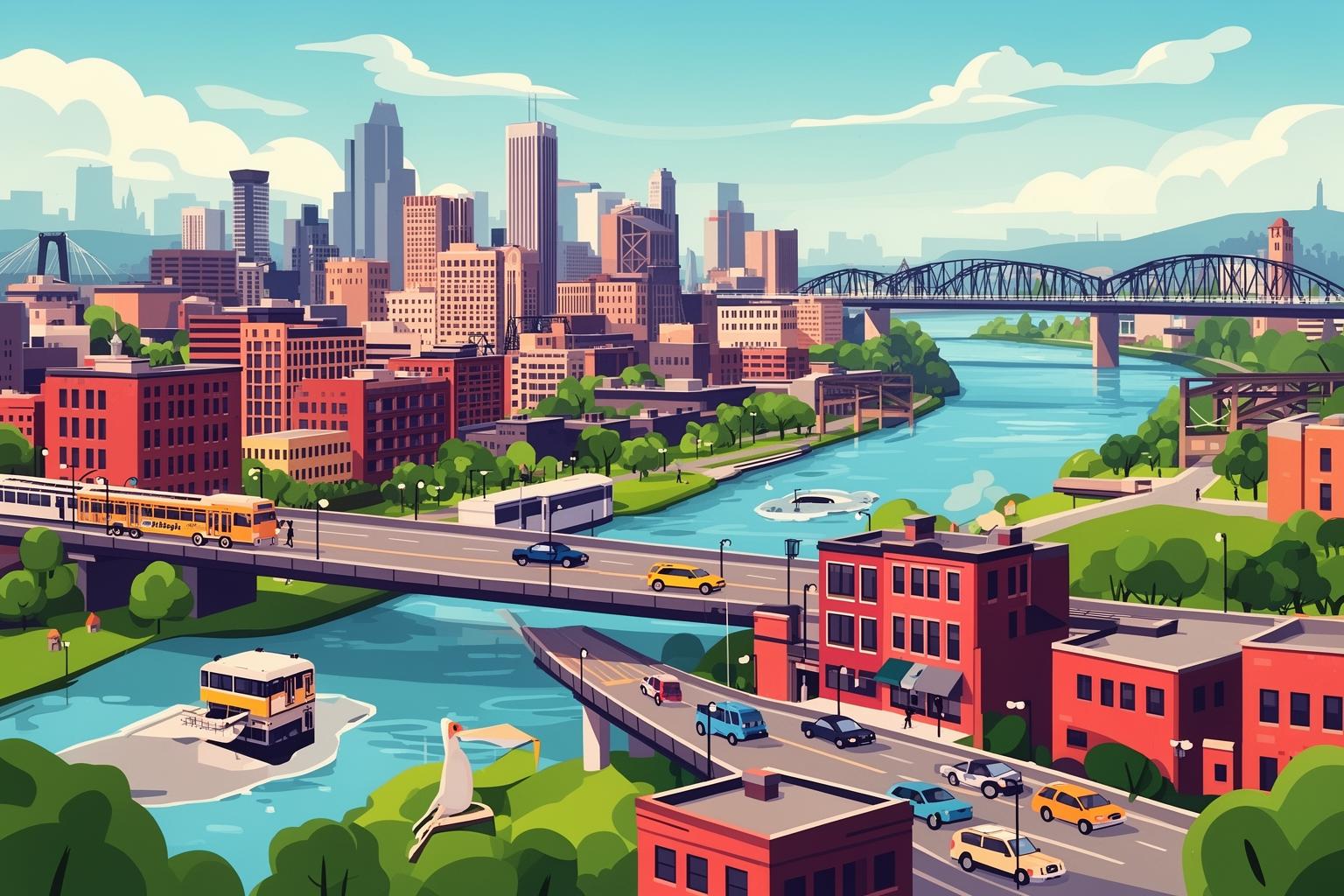
Before the silver wigs and the fleeting fifteen minutes of fame, there was Pittsburgh—not the sleek, tech-savvy Pittsburgh of today, but a city of smoke and steel, where the air tasted of coal and the horizon was jagged with factory silhouettes. This was the world that welcomed Andrew Warhola into being in 1928. It was a city of immigrants, hard work, and quiet faith—a landscape painted in various shades of gray. It seems an unlikely birthplace for the vibrant, explosive color palette Warhol would one day reveal to the world, yet amid the grit and grind, the seeds of his unique vision were planted. To truly understand Warhol, one must first grasp the profound, almost spiritual influence of this city—the place that shaped both his eye and soul long before he ever set foot in Manhattan.
A World of Icons: The Byzantine Echo
Long before silkscreening Marilyn Monroe’s face, Andy was captivated by other icons. The Warhola family were devout Byzantine Catholics, centering their spiritual life around St. John Chrysostom Byzantine Catholic Church. Stepping inside this church today, nestled in Greenfield’s “The Run” neighborhood, feels like stepping back into Warhol’s formative years. The air is thick with incense, and the walls glow with a divine light. This was no minimalist faith; it was one rich with opulent imagery. The iconostasis—a screen displaying holy figures that separates the sanctuary from the congregation—is a dazzling wall of saints, their faces serene, halos shimmering in gleaming gold leaf.
This was Warhol’s first art gallery. He would sit for hours in the pews with his mother, Julia, gazing at these repeated, stylized images. Look closely at the rows of saints, and you begin to see the blueprint for his Pop Art: the flattened perspective, bold outlines, gold backgrounds, and the serial repetition of a strong, singular image—it’s all there. The difference between a wall of St. John the Baptist and a grid of Elvis Presley lies in subject, not technique. By creating his celebrity portraits, Warhol was crafting modern icons for a new religion: the religion of fame. He took the sacred visual language of his childhood and applied it to the profane saints of Hollywood and pop culture. Visiting St. John Chrysostom is not merely a historical stop; it’s an artistic revelation—a place to feel the deep, spiritual currents beneath the shimmering surface of his work. When you visit, remember this remains an active place of worship. Move quietly, show respect, and allow the gilded atmosphere to connect you with the artist’s earliest and most profound influence.
The Making of an Artist: Home and School
His family life was the foundation of his creativity. The Warhola home—first on Beelen Street, later at 3252 Dawson Street in the working-class Oakland neighborhood—was a sanctuary. Though the family had little money, their household was rich in creativity, largely thanks to his mother, Julia. An artist herself, she drew whimsical pictures of cats and angels, and her distinctive, elegant script later adorned many of Andy’s commercial illustrations and album covers. She nurtured his artistic talents, encouraging him to draw constantly, especially during his childhood illnesses that kept him bedridden. In this modest house, he developed his love for Hollywood glamour, poring over movie magazines and collecting autographs from stars. Today, the Dawson Street house is a private residence, so entry isn’t possible. Yet, standing quietly on the street, looking at the simple brick home, one can sense the stark contrast between his humble origins and the extraordinary world he would eventually command. It’s a quiet moment of reflection—a reminder that genius can emerge from the most ordinary places.
His formal education further honed his innate talent. At Schenley High School, he stood out as a shy, artistic boy among a crowd of robust, sports-loving peers, but his talent was undeniable. He then attended the Carnegie Institute of Technology—now the renowned Carnegie Mellon University—where, in the Department of Painting and Design, he was both a dedicated student and a budding rebel. Studying pictorial design and art history, he also experimented, developing his signature “blotted line” technique: a rudimentary printmaking method combining drawing and stamping. Walking through Carnegie Mellon’s campus, with its blend of historic and modern architecture, offers insight into the academic rigor that laid the technical groundwork for his artistic revolution. Here, he learned the rules of commercial art—rules he would spend much of his life brilliantly breaking.
The Modern Mecca: The Andy Warhol Museum
All paths in Warhol’s Pittsburgh lead to one essential destination: The Andy Warhol Museum. Housed in a massive converted industrial warehouse on the city’s North Shore, this museum is the definitive repository of his life and work. Without exaggeration, it’s one of the most comprehensive single-artist museums worldwide, offering an immersive, multi-sensory journey through his career. The museum is brilliantly organized chronologically across seven floors. Starting at the top, you encounter his earliest drawings and commercial illustrations from the 1940s and ’50s; descending, you move forward through time—witnessing his explosive rise as a Pop artist, his experimental films, television projects, and culminating monumental works.
Inside, there’s a feeling of constant discovery. One floor immerses you in the playful, silver-draped world of his Silver Clouds installation, where metallic helium-filled pillows float gently, bumping softly against you. Another confronts you with the raw power of his Disaster series—stark, haunting images of car crashes and electric chairs revealing the darker side of the American dream. You can sit in a small theater to watch his famous Screen Tests, silent, slow-motion portraits capturing subjects like Lou Reed and Edie Sedgwick with unnerving intimacy.
Highlights abound: iconic soup cans, vibrant Marilyns, commanding Elvis paintings. Yet the museum’s true strength lies in its scope, showcasing the breadth of his genius beyond the famous prints. You’ll find his Time Capsules—over 600 cardboard boxes packed with everyday ephemera like mail, receipts, magazines, and souvenirs—an obsessive, accidental archive of his life. His elegant shoe advertisements from his commercial illustrator days reveal his masterful draftsmanship. The sheer volume of work is staggering and attests to his relentless, almost manic work ethic.
For first-time visitors, the best advice is to take your time—don’t rush. Allocate at least three to four hours to fully absorb it all. Begin on the seventh floor and work your way down. The museum also offers workshops in its basement studio where you can try silkscreening yourself—a fantastic way to physically connect with his process. More than a gallery, the museum is a living, breathing archive of a cultural phenomenon—a definitive chapter in his Pittsburgh story and a triumphant homecoming cementing his legacy in the city that first shaped him.
The New York Transformation: Inventing Andy Warhol
If Pittsburgh was the canvas, New York City was the paint. In 1949, with twenty dollars in his pocket and a portfolio full of drawings, Andrew Warhola arrived in the city that never sleeps and began the meticulous process of inventing “Andy Warhol.” Post-war Manhattan was a crucible of ambition—a chaotic, electric metropolis where fortunes were made and identities forged overnight. It was the perfect stage for a man who understood better than anyone the power of image and the art of self-creation. The city became his studio, his subject, and his social playground. Tracing his path through New York is to chart the meteoric rise of Pop Art itself, from the pages of fashion magazines to the silver-lined walls of the most famous art studio in history.
From Illustrator to Icon: The Early Years
Warhol didn’t arrive in New York as a starving artist; he came as a commercial artist with fierce ambition and a unique style. He quickly became one of the most successful illustrators of the 1950s. His whimsical, blotted-line drawings were in high demand for advertisements, editorials, and album covers. He was especially known for his shoe illustrations for the brand I. Miller, which became a defining look of the era. This period is often overlooked but was fundamentally important. Here, he learned to work on deadline, satisfy clients, and think of art as a product. He blurred the lines between high art and commerce long before his first soup can painting.
During these years, he lived in several apartments, including a notable one on Lexington Avenue and 89th Street that he shared with his mother, Julia, who had moved from Pittsburgh to join him. While these early homes aren’t public landmarks, you can still visit one of his favorite haunts from this period: Serendipity 3 on the Upper East Side. This whimsical restaurant and dessert parlor served as his unofficial office and social club. A regular visitor, he often paid his bills with drawings before his fame skyrocketed. Visiting Serendipity 3 today is like stepping into a time capsule. With its Tiffany lamps and eclectic decor, it retains the magical charm that captivated him. Ordering their famous Frrrozen Hot Chocolate, you can easily picture a young, ambitious Andy sketching at a nearby table, dreaming of the future of art.
The Factory: The Silver Dream Machine
The Factory was more than a place; it was a phenomenon. It was the epicenter of Warhol’s universe—a studio, film set, concert hall, and nonstop party all rolled into one. There were three successive locations, each reflecting a different stage of his career and evolving persona.
The Silver Factory (231 East 47th Street)
The first and most legendary Factory, located on the fifth floor of an unassuming Midtown building, was a burst of creative energy. In 1964, Warhol had his friend and collaborator Billy Name cover the entire loft with silver paint and aluminum foil. The effect was dazzling and otherworldly, creating a space-age cocoon where reality seemed to bend. This was the birthplace of his most iconic ’60s works: the Brillo Boxes, the Flowers, and the Campbell’s Soup Cans. Here, he perfected his silkscreening process, turning art production into an assembly line—an innovative idea that challenged the traditional notion of the solitary artistic genius.
But the Silver Factory was much more than a workshop; it was the headquarters of the counterculture. Its doors opened to a mesmerizing cast of characters—artists, poets, filmmakers, musicians, and the beautiful, damaged souls he called his “Superstars,” like the tragic heiress Edie Sedgwick. The Velvet Underground rehearsed in one corner while Warhol filmed his experimental movies in another. The atmosphere was a potent mix of frenetic creation and decadent languor. Though the original building no longer houses The Factory, standing outside on East 47th Street and imagining the creative energy that once pulsed within is a powerful experience. It was the silver-lined heart of the Swinging Sixties—a place where art and life collided in a spectacular, beautiful mess.
The Decker Building (33 Union Square West)
When the lease on the first Factory expired, Warhol moved his operations to a more conventional, office-like space in the Decker Building overlooking Union Square. This second Factory, active from 1968 to 1974, marked a significant change. The freewheeling chaos of the ’60s was giving way to sobriety. The space was larger and more professional, with Warhol increasingly focused on building his empire. Here he founded Interview magazine, his “crystal ball of Pop,” which further cemented his role as a cultural arbiter.
The vibe was less about communal art-making and more about business. However, this location is also known for a dark, transformative moment. In 1968, Warhol was shot and critically wounded in his office by Valerie Solanas, a radical feminist writer. He barely survived, and the attack left him physically and emotionally scarred for life. The shooting effectively ended the open-door policy of the original Factory. The dream of the ’60s died on that floor, replaced by new caution, security, and an even deeper fixation on the mechanics of fame and disaster. Walking through Union Square today—which bustles with its greenmarket and street performers—offers a stark contrast to the trauma that unfolded in the building on its western edge.
The Final Factory (860 Broadway)
The third and final Factory, located just north of Union Square, served as the headquarters of Andy Warhol Enterprises from 1974 until his death in 1987. If the Silver Factory was a bohemian paradise and the second Factory a transitional space, this was corporate headquarters. It was a sleek, professional office where Warhol, now a global celebrity, managed sprawling business interests. The principal artistic output here was commissioned portraits of the wealthy and famous—Mick Jagger, Liza Minnelli, Jean-Michel Basquiat. Warhol had become the court painter of the jet set. The days of all-night open-door parties were gone, replaced by business meetings and managed appearances. This space reflected Warhol’s final evolution: from avant-garde provocateur to blue-chip brand, a true master of the business of art.
Centers of the Scene: Where Pop Culture Lived
Beyond The Factory, Warhol’s New York was a constellation of clubs, restaurants, and galleries that defined the city’s cultural life. He was a master observer, and these spots were his prime overlooks. Max’s Kansas City, a steakhouse and bar near Union Square, was a key hangout for The Factory crowd in the late ’60s and early ’70s. The back room belonged exclusively to Warhol and his entourage, where artists like Robert Rauschenberg and Willem de Kooning mingled with rock stars such as Lou Reed and Iggy Pop. It was a hotbed of intellectual and creative exchange, fueled by cheap drinks and endless conversation.
In the late 1970s, the center of glamour shifted to Studio 54. This legendary disco nightclub was the ultimate expression of celebrity worship and hedonism, and Warhol was its high priest. A fixture in the VIP lounge, he was not a wild partier but a quiet, watchful presence with camera and tape recorder, documenting the spectacle of fame in its natural habitat. Studio 54 was a living, breathing Warhol artwork—a dizzying fusion of high and low, celebrity and anonymity, beauty and excess. Although both Max’s Kansas City and Studio 54 are now gone, their locations remain points of interest for cultural pilgrims, charged with the phantom energy of a legendary past. Visiting these spots means tuning into the frequency of a bygone era, imagining the flash of paparazzi bulbs and the thumping bass that were the soundtrack to Warhol’s New York.
Art, Place, and the American Landscape

Andy Warhol’s genius lay not only in what he painted but in where he discovered his subjects. Rather than drawing inspiration from classical mythology or abstract emotions, he looked to supermarket shelves, tabloid front pages, and the flickering screens of movie theaters. He transformed the entire American cultural landscape into his studio. To truly understand his most famous works is to grasp the physical and psychological places from which they emerged. His art served as a mirror reflecting the world around him—its beauty, absurdity, and soul.
The Supermarket Aisle: Campbell’s Soup Cans
The Campbell’s Soup can is arguably the most iconic image in modern art. When Warhol first displayed his 32 canvases, one for each flavor, in 1962, the art world was scandalized. This wasn’t art; it was a grocery list. But that was exactly the point. The supermarket—a place of dazzling uniformity and mass-produced abundance—had become the new American cathedral. Warhol recognized that the branding, packaging, and relentless repetition of a product like Campbell’s Soup held a power and cultural significance as potent as any religious icon.
He said he painted them because he had soup for lunch every day for twenty years. Whether true or not, the statement underscores his deep connection to the mundane and everyday. He took an object so familiar it was often overlooked and forced viewers to see it as an object for aesthetic contemplation. There is no single supermarket to visit on this pilgrimage, for every supermarket is the site. Walking down the canned goods aisle of any American grocery store today is a uniquely Warholian experience. You are surrounded by his subject matter—the grid-like repetition and bold graphic design he identified as a compelling visual language. He taught us to find art in the everyday and to recognize the icon in the aisle.
Hollywood’s Pantheon: Marilyn, Elvis, and Liz
Warhol was fascinated by fame. He viewed celebrities not as individuals but as products, manufactured and consumed by the public just like a can of soup or a bottle of Coca-Cola. His portraits of Marilyn Monroe, Elvis Presley, and Elizabeth Taylor aren’t intimate psychological studies; they are icons of celebrity itself. These images were sourced not from live sittings but from pre-existing, mass-produced publicity stills or newspaper photographs. He painted a picture of a picture, highlighting the gap between the real person and their public image.
These works belong to the abstract, mythological realm of Hollywood. Warhol, a boy who grew up writing to movie stars for autographs from his small Pittsburgh bedroom, understood the power of this dream factory. His portraits captured the tragic glamour of Marilyn, whose image he began screen-printing shortly after her death, turning her into a colorful, garish martyr for the cult of celebrity. His images of Elvis, taken from a film still for the Western Flaming Star, portray the King as a swaggering, almost dangerous pop deity, endlessly repeated like a film strip. These pieces comment on the media landscape and how images are reproduced and disseminated until they become more real than their subjects. They explore the “place” of a celebrity in our collective consciousness—a space that is everywhere and nowhere simultaneously, existing only on screens, magazine covers, and in Warhol’s dazzling, immortal prints.
A Final Supper: The Return to Faith in Milan
Warhol’s career concluded where it began: with religious imagery. His last major series, The Last Supper, included over 100 works based on Leonardo da Vinci’s masterpiece. This was no accident. The commission came from a Milan art dealer for an exhibition in a gallery directly across the square from Santa Maria delle Grazie church, home to the original fresco. This close proximity held deep significance, placing Warhol in direct dialogue with Western art history and the religious imagery that had captivated him in childhood.
He approached Leonardo’s sacred scene with his characteristic Pop sensibility, merging the Renaissance composition with corporate logos like Dove soap and Wise potato chips. This startling and brilliant fusion of the sacred and profane offered a final commentary on a world where commerce and faith had become inseparably intertwined. The series brought his life and art full circle. The boy who marveled at golden icons in his Pittsburgh church became the global artist reinterpreting one of history’s most famous religious images. Visiting Milan’s Palazzo delle Stelline, the site of that landmark exhibition, and then crossing the street to see Leonardo’s original is the ultimate conclusion to a Warhol pilgrimage. It bridges centuries, connecting the humble faith of his youth to the grand, complex, and brilliant artistic legacy he left behind. Beneath Pop’s cool, detached surface, there was always a profound engagement with life’s deepest questions: mortality, faith, and immortality.
The Echo of Pop
A journey through Andy Warhol’s world is a journey across twentieth-century America. It’s a voyage that moves from the industrial grit of Pittsburgh to the dazzling, myth-making machinery of New York City, with stops along the way at the Hollywood dream factory and the aisles of the American supermarket. To walk these streets and visit these places is to realize that Warhol’s art was never solely about what appeared on the canvas; it was about the world from which it emerged. He was a collector, an archivist, and a mirror. He recognized the power in the ordinary, the sacred in celebrity, and the artistry in commerce.
Whether visiting The Andy Warhol Museum or standing quietly on a street corner in Union Square, you sense the enduring echo of his influence. He transformed not only the subject matter of art but also how we perceive the world around us. He taught us to notice the surfaces, the packaging, the headlines, and the faces that shape our culture. He grasped, perhaps better than any artist before or since, the strange, chaotic, and beautiful poetry of modern life. Following in his footsteps is more than a history lesson; it’s an invitation to see the world through his eyes—a world where everything is fascinating, everything is interconnected, and everyone holds the potential for their own fifteen minutes of fame.