There are journeys that unfold across maps, charted by roads and flight paths. And then there are journeys that trace the contours of a human soul, following the restless footsteps of a ghost. To follow Paul Gauguin is to embark on the latter. It is a pilgrimage that begins not in a single location, but in an act of radical departure. It’s the story of a man who held the modern world in his hands—a successful Parisian stockbroker with a family, a comfortable life, a future paved in gold—and chose to let it all fall away, piece by piece, in a relentless, agonizing, and ultimately transcendent quest for something more. He sought a world stripped of its artifice, a reality more potent and profound, a “savage” truth he believed civilization had paved over and forgotten. He was a painter, yes, but he was first and foremost a seeker, and his canvases were not just images; they were dispatches from the frontiers of his own spirit.
This is not a simple tour of museums or scenic vistas. This is a journey into the heart of a paradox. We will walk through the cobbled lanes of Brittany, where the gray Atlantic light first taught him to see in pure, bold color. We will stand in the scorched, sun-drenched fields of Provence, feeling the ghost of his volatile friendship with Vincent van Gogh. And we will travel to the edge of the world, to the volcanic isles of French Polynesia, where he searched for an untouched paradise and, finding it already fading, decided to invent one of his own on canvas. To follow Gauguin is to understand that the destination was never a place, but a feeling; a raw, untamed vision of life that he chased until his final breath. It is a path fraught with beauty, genius, and profound moral complexities, a journey that asks as many questions as it answers, and it begins right where you are, with the decision to look beyond the frame and into the fire that forged the art.
For another artistic pilgrimage that explores a different kind of creative quest, consider Chasing the Muse: A Grand Tour Through the World of Angelica Kauffman.
The Parisian Prelude: A Cage of Gray and Gold
Before the saga of the South Seas, before the vivid colors and mysterious Tahitian faces, there was Paris. Not the bohemian, paint-streaked Paris of artistic legend, but a Paris of commerce, capital, and convention. This is where the story begins, and in many ways, it’s the city Gauguin spent his life trying to flee. To grasp the explosive color of his later works, you first need to sense the cool, muted gray of the world he broke away from.
From Bourse to Batignolles
Picture a man in his thirties, impeccably dressed, navigating the hectic energy of the Paris Bourse, the stock exchange. This was Eugène Henri Paul Gauguin in the late 1870s. He wasn’t a struggling artist; he was a remarkable success. He had made a fortune, was married to a Danish woman, Mette-Sophie Gad, and had five children. His home epitomized bourgeois prosperity, filled with fine furniture and, notably, a growing art collection. This wasn’t just decorative art. Gauguin possessed a keen, foresighted eye. He purchased works from his contemporaries, the Impressionists, artists who were still considered radicals on the fringe. He owned pieces by Pissarro, who became a friend and early mentor, as well as Cézanne, Monet, and Renoir. Art was his passion, his weekend pursuit, the secret heartbeat beneath the polished facade of his conventional life.
He took lessons from Pissarro, venturing beyond the city to paint en plein air, mastering the Impressionist language of light and fleeting moments. He even began to exhibit with them, a wealthy amateur embraced by the group. But for Gauguin, this was never enough. Impressionism, with its focus on capturing the surface of things—the shimmering light on water or the rustle of leaves—felt like another kind of cage. He longed for something deeper, for art that didn’t merely record reality but conveyed the inner world of ideas, emotions, and dreams. The crash of the French stock market in 1882 was more than a financial calamity for Gauguin; it was liberation. It provided the excuse he needed to leave the world of figures behind and pursue the world of symbols full-time. The cage door swung open, and he stepped out, never truly looking back.
Echoes in the Orsay
To feel the pulse of this great departure, you must visit the Musée d’Orsay. Housed in a splendid former railway station, it is Paris’s shrine to 19th-century art and holds the key to Gauguin’s entire career. Walking through its galleries is like watching his transformation in accelerated motion. You start with his early works, competent and clearly influenced by his Impressionist friends. You perceive Pissarro’s imprint in the dappled light and careful composition. But even then, something more is emerging. The figures gain solidity, the landscapes grow more somber. There is a brooding quality, a psychological depth that distinguishes him.
As you progress from one room to the next, you witness the eruption. You see works from Brittany, where colors flatten and intensify, outlined with thick, dark lines. You see his sculptures, raw and primal, and finally, the paintings from Tahiti. Standing before them in the heart of Paris is overwhelming. The humid, electric air of Polynesia seems to emanate from the canvas, worlds apart from the cool marble floors of the museum. Here you see the culmination of his journey, the blending of observation, memory, and myth. The Orsay does more than display Gauguin’s art; it tells the story of his escape. It is the perfect place to begin and end a Parisian pilgrimage, to witness the world he left behind and the universe he created—all beneath one grand, glass-vaulted roof.
Brittany’s Mystical Embrace: Where Modern Art Was Born
When the noise and ambition of Paris became overwhelming, Gauguin escaped westward to a corner of France that felt like another country, another era. Brittany, with its rugged coastline, ancient Celtic traditions, and deeply devout people, was his first genuine ‘exotic’ destination. It was here, in the damp, mystical atmosphere of Pont-Aven and Le Pouldu, that he shed Impressionism’s influence and discovered the radical new language that would define his art and alter the course of modern painting.
Pont-Aven, a Painter’s Paradise
The journey from Paris to Brittany is a shift from stone to greenery. The landscape softens, the pace slows down. Arriving in Pont-Aven still feels like stepping into a 19th-century landscape painting. It’s a small town nestled in a gentle valley, with the River Aven running through its heart and turning the wheels of old watermills. In the late 1800s, it attracted many artists. It was affordable, picturesque, and offered a glimpse of a pre-industrial lifestyle rapidly disappearing elsewhere. The locals, clad in traditional costumes and devoted to Catholicism, seemed to belong to a more authentic, spiritual realm.
For Gauguin, Pont-Aven was a creative laboratory. He was the charismatic, argumentative leader of a group of artists who became known as the Pont-Aven School. They gathered at the Pension Gloanec, a modest inn, to eat, drink, and passionately discuss the future of art. Today, you can stroll the same paths they walked—through the Bois d’Amour, the ‘Woods of Love,’ a peaceful forest along the river. The light filtering through the canopy, the sound of the water, the rich, earthy greens—all remain. You can sense the inspiration that led Gauguin to assert that painters should not copy nature but dream before it. A visit to the Musée de Pont-Aven is essential; it vividly tells the story of the artistic revolution that took place in this tiny village and places Gauguin’s work within the movement he led.
The Sermon and The Synthesis
It was in Brittany that Gauguin, together with Émile Bernard, developed the style known as Synthetism. This was a radical departure. The aim was no longer to paint what one saw but to synthesize observation with memory, emotion, and imagination. The result was an art of pure color, simplified forms, and bold outlines, much like stained glass or Japanese woodblock prints. The pinnacle of this vision is his 1888 masterpiece, Vision After the Sermon (Jacob Wrestling with the Angel).
To understand this painting, imagine the scene. Gauguin had just attended a Sunday mass in a Breton church. The women, wearing starched white bonnets, or coiffes, emerged from the service, their minds filled with the priest’s sermon about Jacob wrestling the angel. In Gauguin’s painting, this inner spiritual vision becomes a vivid, external reality. The field where the battle takes place is not green but a striking, flat vermilion red—the color of emotion and spiritual intensity. The figures of the women are not blended into the landscape but set apart, their simple, strong shapes creating a barrier between our world and the realm of the spirit. He wasn’t painting a landscape; he was painting an act of faith. It was a declaration of independence from realism, a bold new path for art.
The Silent Christ of Trémalo
Perhaps the most moving pilgrimage in Brittany is the short walk from Pont-Aven’s center up a gentle hill to the Chapelle de Trémalo. This is not a grand cathedral but a small, humble chapel of weathered stone and moss-covered slate, dating to the 16th century. It sits in a quiet clearing, surrounded by trees. Stepping inside is like entering a sanctuary of silence and timelessness. The air is cool and smells of old wood and stone. Sunlight streams through small windows, illuminating dust motes dancing in the air.
And there, hanging within, is the reason for your visit: a 17th-century polychrome wood carving of Christ on the cross. The figure is rustic, almost crude, carved with a powerful, unrefined faith. Its limbs are elongated, its expression one of deep, weary suffering. This is the very figure that inspired Gauguin’s iconic painting, The Yellow Christ. He took this humble object of devotion and transformed it into a symbol of universal suffering. In his painting, he places the cross not in Jerusalem but in the rolling yellow and gold fields of a Breton autumn. Breton women kneel around it, their simple faith connecting them directly to the sacrifice. By painting Christ in a startling, symbolic yellow—the color of harvest and decay—Gauguin fused the local landscape, the people’s faith, and his own spiritual turmoil into one unforgettable, modern icon. To stand in the silent chapel of Trémalo is to stand at the very source of one of modern art’s most profound images. You feel the deep, enduring bond between the land, its faith, and the artist who glimpsed its soul.
The Sun-Scorched South: A Brutal Duet in Arles
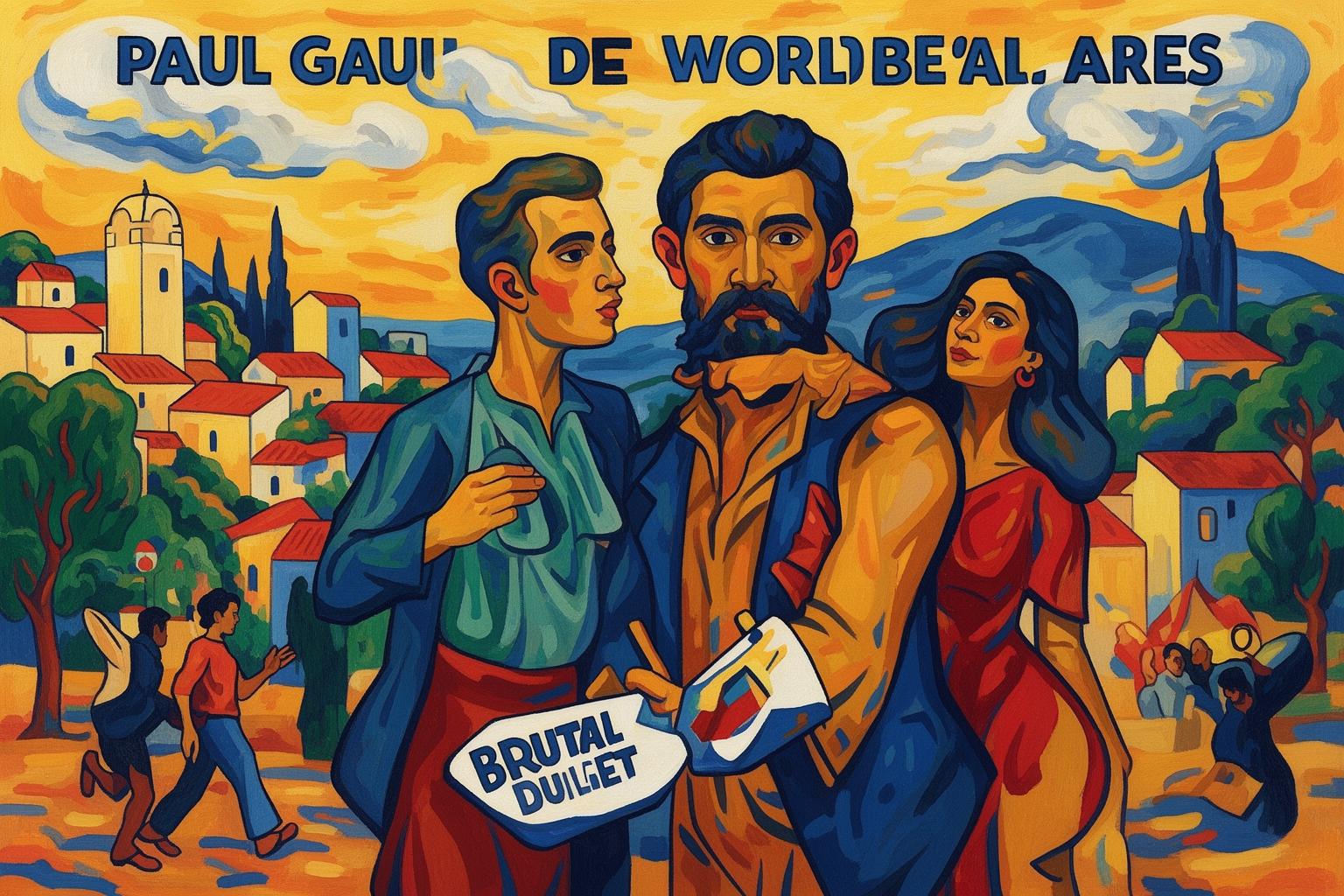
If Brittany was a mystical sanctuary, Arles was a crucible. It served as the backdrop for one of the most renowned, fertile, and explosively catastrophic encounters in art history. For nine weeks in the autumn of 1888, Paul Gauguin and Vincent van Gogh lived and worked together beneath the harsh, relentless sun of Provence. They arrived with a shared vision of creating a “Studio of the South,” a brotherhood of artists destined to illuminate the future. What unfolded was a clash of titans, a storm of creation and destruction that forever marked both men but also produced some of their most iconic works.
The Yellow House of Dreams
Vincent was the driving force behind this endeavor. He had moved to Arles earlier that year and become deeply enamored with the region’s vibrant light and color. He rented a corner building on the Place Lamartine, painted it a striking chrome yellow, and named it “The Yellow House.” This was to be the sanctuary, the headquarters of their artistic colony. He adorned it with his sunflower paintings, waiting with almost feverish anticipation for Gauguin, the master he so admired, to arrive from Brittany.
Today, the Yellow House no longer stands, lost to bombing during World War II. But you can stand on the very spot where it once stood, now part of the Rond-Point des Arènes. You can feel the energy of the place, with the Roman amphitheater looming nearby and the unyielding Provençal sun beating down. The town of Arles has lovingly preserved Vincent’s legacy; you can follow a marked trail to the exact locations where he painted some of his most famous works—the Café Terrace at Night, the Starry Night Over the Rhône. Walking this path, Vincent’s presence is palpable. And you can envision Gauguin arriving in this sunlit town, a more worldly, cynical, and arrogant figure stepping into the fragile, beautiful dream Vincent had so carefully built for them both.
Two Titans, One Canvas
Initially, their collaboration was incredibly fruitful. Fueled by coffee, wine, and impassioned debate, they painted side-by-side. They explored the countryside, the ancient Roman ruins of Les Alyscamps, and the local brothels. They influenced one another profoundly. Gauguin urged Vincent to work more from memory and imagination, to transcend strict natural observation. Vincent, in return, inspired Gauguin with his raw emotional intensity and spiritual bond to the landscape. This dialogue is evident in their paintings. They tackled the same subjects, like the Alyscamps and portraits of the Roulin family, each interpreting the world through his own unique lens.
Yet their personalities were oil and water. Vincent was volatile, intensely emotional, and yearned for harmony. Gauguin was proud, intellectual, and domineering. Their debates on art—on Rembrandt, on Delacroix, on the very essence of painting—grew increasingly heated. The little Yellow House became a pressure cooker. Gauguin painted Vincent while he painted sunflowers, depicting his friend as a kind of holy fool, a worshiper of nature. Vincent, in turn, painted Gauguin’s empty chair, symbolizing his friend’s powerful, looming absence. The tension escalated until, on December 23rd, it finally erupted. After a violent argument, Vincent, in a fit of madness and despair, famously mutilated his own ear. Gauguin, horrified, fled to Paris the next day. The dream was shattered. The Yellow House was no longer a studio of the future but a site of trauma. To walk the streets of Arles is to sense the echoes of this brilliant, tragic duet—a brief, incandescent moment when two of art’s greatest rebels tried and failed to share one world.
An Interlude in the Tropics: The Martinique Rehearsal
Long before Tahiti became the defining landscape of his imagination, Gauguin embarked on a crucial exploratory voyage into the tropics. In 1887, disillusioned with the “civilized” world and seeking a deeper connection with nature, he and fellow artist Charles Laval set sail for Panama and, afterward, the French Caribbean island of Martinique. This journey was more than a mere vacation; it served as a rehearsal and a test of his endurance—a trial run for his belief that the so-called “primitive” world held the key to revitalizing authentic art. Martinique ignited his palette and planted the seeds of his future Polynesian masterpieces in its fertile, volcanic soil.
Escaping the ‘Civilized’ World
His motivation was clear. He expressed a desire to live like a savage, escaping the artificiality and hypocrisy of European society. The experience in Panama, where he briefly worked as a laborer on the canal, was harsh and disheartening. But Martinique was different. Upon arrival, he was immediately overwhelmed by a sensory explosion: the oppressive, humid heat; the impossibly lush green vegetation bursting from every surface; the riot of unfamiliar flowers; and the brilliant, crystalline light—everything Paris and Brittany lacked. It was a realm of raw, untamed life.
This immersion in a tropical environment had an immediate, transformative effect on his art. His Impressionist-influenced style began to dissolve almost overnight. His brushstrokes became more fluid and rhythmic, his compositions more decorative. Most importantly, his colors erupted—he embraced vibrant, non-naturalistic hues: singing yellows, deep blues, and countless shades of green—to convey the heat, energy, and vivid exoticism of the place. He was no longer merely observing a landscape; he was translating its very essence, its life force, onto the canvas.
Painting Paradise, Enduring Hardship
Works from this period, such as Tropical Vegetation and By the Sea, Martinique, are intoxicating. Filled with languid figures, dense foliage, and a sense of dreamy stillness, they depict a world of simple, harmonious existence—a discovered paradise. Yet the reality of his stay was far from idyllic. He and Laval lived in a small hut, struggled financially, and suffered from illness. Gauguin endured severe dysentery and malaria, ailments that would trouble him for the rest of his life. This was a crucial lesson: the paradise he sought was not one of comfort or ease but had to be earned through suffering, wrested from a harsh and unforgiving reality.
Despite the hardships, the Martinique experience marked a point of no return. It confirmed his conviction that his artistic destiny lay far from Europe. It provided the visual vocabulary—the vibrant colors, simplified forms, and decorative patterns—that he would later refine and perfect in the South Pacific. This short, difficult chapter was essential in his story: Martinique was the dress rehearsal for Tahiti, the first deep breath of tropical air that would forever change the atmosphere of his art.
Tahiti: Inventing a Paradise Lost
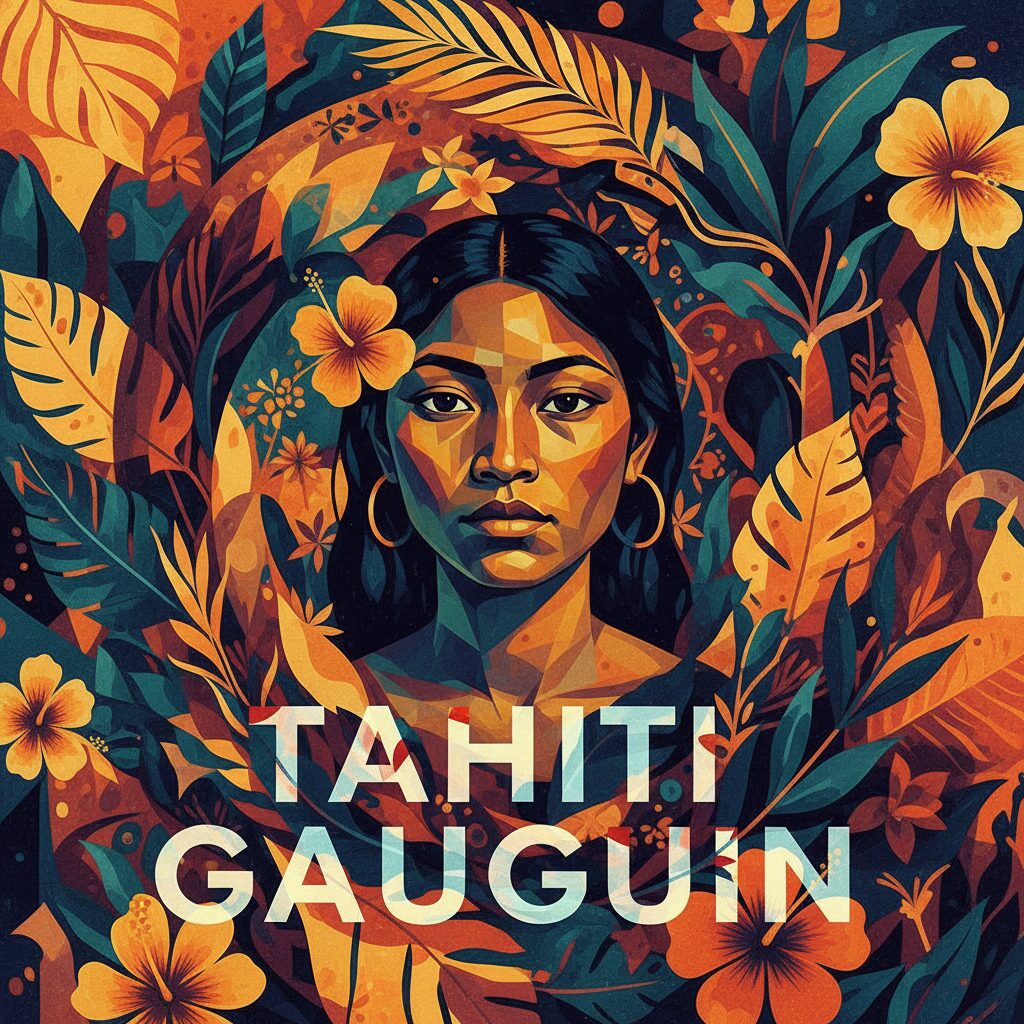
This is the core of the pilgrimage, the destination now inseparable from Gauguin’s name. In 1891, he set out on the journey that would define both his life and legend, venturing to the far side of the world in search of a mythical Eden. He envisioned Tahiti as a pre-colonial paradise, inhabited by noble savages living in simple, free harmony with nature. What he discovered, however, was far more complex—a world caught between its ancient past and a colonial future. Yet, from this tension between dream and reality, Gauguin created his greatest work, crafting a vision of Tahiti that was partly observation, partly invention, and entirely his own.
The Arrival: Illusions and Disappointments
Picture the long sea voyage, the weeks of anticipation, and finally arriving in the harbor of Papeete. Gauguin expected to find the world portrayed in 18th-century travel accounts. Instead, he encountered a colonial capital resembling a small French provincial town. There were administrators, merchants, and missionaries. The Tahitian people wore European-style clothing, and Christianity had largely replaced the old religions. The “Eden” he had traveled so far to find seemed to have disappeared.
Deeply disappointed, he did what he often did: he escaped from the center to the outskirts. He left Papeete and settled in the rural district of Mataiea on the island’s southern coast. Here, at least, he could glimpse the life he had imagined. He lived in a bamboo hut typical of the region, surrounded by breadfruit and coconut trees, with volcanic mountains behind him and a turquoise lagoon before him. The landscape was stunningly beautiful, the colors more vivid than he had ever witnessed. The air was saturated with the fragrance of tiare flowers and the constant, rhythmic sound of surf breaking on the distant reef. In this relative isolation, he began the work of truly seeing—and reimagining—Tahiti.
The Colors of Mana: Creating a New Mythology
Gauguin soon understood that Tahiti’s true essence was not surface-deep, but found in its soul—in the ancient beliefs and emotions persisting beneath the colonial facade. He became captivated by the Polynesian concept of mana, a pervasive spiritual power inhabiting people, objects, and places. His art aimed to capture this invisible force and render it visible through color and form. He began portraying the Tahitian people not as ethnographic subjects but as figures within a new, personal mythology.
In iconic works like Ia Orana Maria (Hail Mary), he merges the Christian Annunciation with a vibrant Tahitian setting, depicting Mary and Jesus as Polynesians receiving offerings of tropical fruit. In Vahine no te tiare (Woman with a Flower), he paints a Tahitian woman whose enigmatic and timeless expression evokes the Mona Lisa, her direct gaze both inviting and mysterious. This period also reveals the most controversial aspect of his life: his relationships with very young Tahitian girls, his vahine, who became his companions and models. His most famous companion during this first stay was Teha’amana, probably no older than fourteen. Viewing his work without acknowledging this troubling context—a middle-aged European man exercising colonial and artistic power over young indigenous women—is impossible. His paintings offer a romanticized vision, yet the reality was entangled in a complex and unequal power dynamic that cannot be overlooked.
A Philosophical Testament: The Great Masterpiece
After a brief, unsuccessful return to France, Gauguin came back to Tahiti in 1895, this time permanently. This second chapter was marked by worsening poverty, debilitating illness from syphilis and lingering malaria, and profound despair. From this darkness arose his monumental masterpiece, his artistic final testament: the massive canvas titled Where Do We Come From? What Are We? Where Are We Going?.
He painted it in a fervent creative outburst, convinced it would be his last work before a planned suicide. Into this single, expansive canvas he poured all his spiritual and philosophical questions. Designed to be read like a fresco from right to left, it depicts the cycle of life. On the far right, a sleeping infant symbolizes birth (“Where do we come from?”). In the center, figures in their prime engage in daily tasks, picking fruit, representing the present (“What are we?”). On the far left, an elderly woman nearing death contemplates her fate, while a strange white bird embodies the futility of words (“Where are we going?”). In the background, a mysterious blue idol raises its arms skyward, symbolizing the spiritual realm that haunted Gauguin. This deeply personal, complex, and somber work is the culmination of his lifelong search for meaning. To view it in person is to confront humanity’s ultimate, unanswerable questions, expressed in a uniquely Tahitian visual language.
Discovering Gauguin’s Tahiti Today
Experiencing Gauguin’s Tahiti today requires some imagination. The Paul Gauguin Museum, once near the beautiful Harrison Smith Botanical Garden, is sadly closed, though its spirit endures. A visit to the Musée de Tahiti et des Îles remains essential for understanding the vibrant Polynesian culture Gauguin entered and interpreted. But the true pilgrimage lies beyond museum walls. It is found on the coastal road to the former Mataiea, gazing upon the jagged green mountains that served as the backdrop for his paintings. It is in visiting a local market in Papeete, overwhelmed by the bright colors of pareo fabrics and the scents of vanilla, monoi oil, and tropical fruits. It is in watching a sunset over Moorea, seeing the sky shift through shades of orange, pink, and purple that seem drawn from a Gauguin canvas. Though he crafted his own version of paradise, the raw elements—the light, the color, the mana—remain, waiting for those willing to seek them out.
The Final Exile: Hiva Oa, The House of Pleasure
Even Tahiti ultimately proved insufficiently remote for Paul Gauguin. His final flight from the European world led him even farther—to the rugged, untamed shores of the Marquesas Islands. In 1901, ill, burdened by debt, and still in pursuit of a more “primitive” society, he settled in the village of Atuona on the island of Hiva Oa. This was his last frontier, a wild and dramatic landscape that would become the setting for the final, defiant chapter of his life.
Farthest Shore, Final Stand
The Marquesas differ greatly from Tahiti. These younger volcanic islands possess a harsher and more dramatic beauty. Towering, cloud-wreathed peaks dive straight into the deep blue ocean. There are no protective lagoons here—only powerful swells crashing against black sand beaches and sheer cliffs. The atmosphere exudes raw, elemental force. For Gauguin, this must have felt like the edge of the world, the ultimate refuge from the civilization he despised.
In Atuona, he kept painting, but his life became increasingly dominated by conflict. He saw himself as a defender of the Marquesan people against the abuses of the colonial government and the Catholic Church. He sent fiery letters to officials, denounced their hypocrisy, and urged locals to boycott French schools and taxes. He was a constant irritant to the establishment, a self-appointed rebel fighting one last battle on behalf of a culture he believed was being systematically destroyed.
Maison du Jouir: A Defiant Sanctuary
His rebellion took artistic shape in the home he built for himself. He named it the Maison du Jouir, or “House of Pleasure,” a provocative choice meant to challenge the local bishop. The house was decorated with intricate, explicit wood carvings celebrating sensuality and mocking European morals. Above the doorway, he inscribed the phrases “Be Mysterious” and “Be in Love and You Will Be Happy.” His home became both fortress and manifesto—a work of art dedicated to the freedom and pleasure the church sought to suppress. It was a bold, final declaration from a man whose body was failing but whose rebellious spirit burned fiercely on. Though the original house is gone, a faithful reconstruction stands in Atuona, giving visitors a glimpse into the world he fashioned in his last years.
A Grave with a View
Paul Gauguin died in his House of Pleasure on May 8, 1903, aged 54. He was buried in Calvary Cemetery, perched on a quiet hill overlooking Atuona’s stunning bay. Visiting his grave is a profoundly moving experience. You ascend a winding path perfumed with frangipani. The cemetery is serene and windswept. His grave is simple, marked by a rough-hewn stone replicating one of his sculptures of a grieving woman. He is not alone in exile—nearby lies the grave of another renowned European who sought sanctuary in these remote islands, the Belgian singer Jacques Brel.
Standing there, gazing out at the breathtaking harbor and mountain views once seen by Gauguin, one feels a deep sense of peace and closure. At the furthest edge of the world, the restless wanderer finally came to rest. He spent his life chasing a horizon that forever receded, searching for a paradise existing only in his imagination. Yet in this quiet corner of Hiva Oa, shaded by tropical trees, it seems as though he might have finally found it.
The journey tracing Paul Gauguin’s footsteps is a winding and complex one. It carries you through tranquil French villages and lively tropical towns, across oceans and into the heart of an intricate, brilliant mind. You follow a man who forsook security for uncertainty, comfort for suffering, and realism for a realm of dreams and symbols. He was a visionary who transformed the language of art, opening the door to Fauvism, Cubism, and a century of modernism. He was also a flawed and difficult figure—a colonial exile whose quest for paradise was intertwined with exploitation and a romanticized view of the people he painted.
Yet to travel these places—to feel the cool Breton mist, to behold the impossible color of a Tahitian lagoon, to stand at his final resting place in the Marquesas—is to grasp the sheer force of his conviction. Gauguin did not merely paint landscapes; he painted his soul onto them. He never truly found the untouched Eden he sought, for it had already been changed by the world he fled. So he created that paradise himself, on his canvases, in bold, beautiful, and heartrending hues. To follow his path is to understand that the most vital journeys are not those seeking a perfect destination but those honoring the relentless, unquenchable, and profoundly human spirit of the search itself.