There are artists who paint a country, and then there are artists who repaint a country, changing the very way its people see the light, the air, and themselves. Kuroda Seiki was the latter. Standing at the crossroads of a nation hurtling from feudalism to modernity, he picked up a Western brush and taught Japan a new visual language. He is, without exaggeration, the father of modern Western-style painting in Japan, a revolutionary figure whose influence flows through the veins of Japanese art to this day. To follow in his footsteps is to take a journey not just to physical places, but into the very soul of the Meiji Era—an age of immense change, intellectual ferment, and cultural collision. It’s a pilgrimage that takes us from the volcanic shores of southern Japan to the bustling artistic heart of Tokyo and the serene, misty mountains that gave birth to his most iconic masterpiece. This is a story of place, of light, and of a vision that forever altered a nation’s canvas. We’ll walk the paths he walked, stand where he stood, and try to see the world through the eyes of a master who found his inspiration in the sun-drenched fields of France and brought that brilliance home to illuminate his native Japan.
This journey to understand Kuroda Seiki’s world is part of a broader tradition of artistic pilgrimages that seek to connect a master’s vision to the landscapes that inspired them.
The Southern Cradle: Kagoshima, a Samurai’s Son
Our journey starts at the southernmost point of Kyushu, in Kagoshima. This is a land of fire and water, always living beneath the watchful eye of the active volcano Sakurajima, which releases smoke into the clear blue sky like a dormant dragon. This is more than just a dramatic setting; it is the elemental forge that molded Kuroda Seiki’s spirit. Born in 1866 as the son of a samurai from the Shimazu clan, rulers of the influential Satsuma Domain, Kuroda was raised in a world defined by discipline, loyalty, and a profound connection to the land. The very atmosphere in Kagoshima feels distinct—heavier with history, salt, and volcanic ash. To understand the man, one must first grasp this rugged land of enduring pride and beauty.
Birthplace and Early Years in a Land of Ash and Sea
Strolling through modern Kagoshima City, the echoes of its samurai heritage are still palpable. The city stretches along Kinko Bay with the commanding figure of Sakurajima looming across the water. Picture a young Kuroda, shaped by the strict codes of the warrior class, gazing out at this very scene. The intense southern sunlight, far stronger and clearer than in other regions of Japan, would have been his daily reality. This light, which later became the centerpiece of his art, served as his earliest mentor. Although his childhood home no longer exists, the environment that nurtured him persists. A visit to Shiroyama Park Observatory offers a sweeping view of the city, the bay, and the volcano—a perspective he knew intimately. It’s a panorama that feels both majestic and deeply personal, where nature’s forces and history converge.
The Kagoshima City Museum of Art is a must-see on this journey. While it is not solely dedicated to Kuroda, it houses an important collection of his works alongside artists from the region. Viewing his paintings here, in his hometown, is a moving experience. The connection between the landscapes on canvas and the living scene outside the museum resonates deeply. The museum contextualizes his origins, displaying the artistic traditions he inherited as well as those he ultimately challenged. It helps one appreciate the enormity of his transformation from a samurai’s descendant in provincial Kagoshima to a pioneering avant-garde artist in Japan’s capital.
For first-time visitors, Kagoshima is best explored on foot combined with the convenient city trams. A useful tip is to buy a day pass, allowing easy hopping on and off. The ideal seasons to visit are spring and autumn when the weather is mild, and the skies are often clear, providing stunning views of Sakurajima. Summer tends to be hot and humid, with a greater chance of typhoons. While in Kagoshima, be sure to try the local cuisine. The city is renowned for its kurobuta (black pork) and fresh seafood from Kinko Bay. Enjoying a meal while gazing at the volcano offers a sensory connection to the world that shaped Kuroda’s youth.
The Influence of Satsuma’s Untamed Landscape
The landscape of the old Satsuma Domain is more than picturesque; it has a raw, untamed character. The volcanic soil supports lush, nearly tropical vegetation, while the coastlines are wild and dramatic. This vivid environment, full of rich colors and sharp contrasts, surely left an imprint on Kuroda’s young mind. Though he later mastered Western plein-air painting techniques in France, his foundational sensitivity to light and atmosphere was likely nurtured here. The way the afternoon sun falls on Sakurajima’s slopes, turning them a deep, bruised purple; the shimmering reflections on the bay’s surface; the rich greens of camphor trees—these are the building blocks of a Kuroda painting waiting to emerge. One great way to experience this is by taking the ferry from Kagoshima Port to Sakurajima itself. Walking along lava-marked trails and visiting an observatory near the crater is a humbling encounter with the formidable nature that was a constant presence in Kuroda’s early life. This was no gentle, manicured landscape; it was a place of immense power—an apt origin for a man who would unleash a powerful new energy in Japanese art.
The Parisian Transformation: Forging an Artist in France
No pilgrimage in pursuit of Kuroda Seiki is complete without a conceptual voyage to France. While following his footsteps in Japan, the decade he spent in Paris and the French countryside was the crucible where his artistic identity was formed. It was there that the samurai’s son, initially sent to study law in 1884, made the pivotal decision to devote his life to art. This was not a whimsical choice; it was a profound personal rebellion and a dedication to a new way of seeing. He arrived in Paris, the undisputed center of the art world, a city alive with the energy of the Impressionists and the heritage of the Barbizon School. Immersing himself in this world, he enrolled at the studio of Raphaël Collin, an academic painter celebrated for his bright palette and idyllic scenes. It was an ideal match. Collin’s style, while firmly rooted in academic tradition, embraced a lighter, more naturalistic approach that deeply resonated with Kuroda.
From Law to Art in the City of Light
Consider the culture shock experienced by a young man from Kagoshima, suddenly immersed in the bohemian world of late 19th-century Paris. He exchanged the rigid structures of Meiji society for the cafés and studios of the Latin Quarter. This period surpassed mere technical learning; it was about embracing a new philosophy. At the heart of this philosophy was plein-air painting—the practice of creating art outdoors to capture the transient effects of light and atmosphere. For a Japanese artist trained in studio-based, line-focused traditions, this was a revelation. It marked a shift from depicting the idea of an object to portraying its sensation. This concept unlocks the key to his entire oeuvre.
Although Paris served as his base, the small village of Grez-sur-Loing, an artists’ colony near the Forest of Fontainebleau, became his spiritual and artistic refuge. This tranquil village, with its ancient stone bridge and the gentle Loing River, was where he truly found his voice. It was here, in 1891, that he painted “Reading,” a depiction of a woman engrossed in a book within a sun-dappled room. The painting is a masterclass in light handling, with sunlight filtering through trees outside, casting a soft, gentle glow over the scene. Grez also inspired his painting “Maiko” (1893), a portrait of a Japanese apprentice geisha he had encountered in Paris. In this piece, he merged his newly acquired Western techniques with a distinctly Japanese subject—a fusion that became his signature. Visiting Grez today, one can still see the same bridge, the same riverbanks, and feel the peaceful, creative ambiance that enchanted Kuroda and countless other artists. It was his sanctuary, the place where he mastered the art of capturing not just likeness, but a moment in time, bathed in genuine light.
Tokyo’s Art Scene: A Revolution in the Capital
When Kuroda returned to Japan in 1893, he brought back more than just canvases and paint tubes; he brought back a revolution. Tokyo, the driving force of the Meiji Restoration, was a city undergoing a frantic and exhilarating transformation. It was the perfect setting for the artistic upheaval Kuroda was poised to ignite. He was appointed a professor at the Tokyo School of Fine Arts (now the prestigious Tokyo University of the Arts), a role from which he would champion his new style, which he named gai hikō (open-air light). He challenged the established norms of Japanese art, long dominated by the traditional Nihonga style, advocating for a realism and brightness that were entirely fresh. His base of operations—and now the heart of his legacy—is Ueno.
The Kuroda Memorial Hall: A Shrine to a Master
Tucked away in a quiet corner of sprawling Ueno Park, the Kuroda Memorial Hall is the ultimate destination for any admirer of Kuroda. It is more than a museum; it is a monument born from the artist’s final wish. In his will, he bequeathed a portion of his fortune to promote art, and this building stands as the direct fulfillment of that legacy. Designed in 1928 by architect Shin’ichiro Okada, the hall itself is a stunning example of early Showa-era architecture, exuding a stately, classical atmosphere. Stepping inside feels like entering a sanctuary. The atmosphere is hushed and reverent, and the design maximizes the use of natural light—a fitting homage to an artist who revered the sun.
The centerpiece of the hall is the Kuroda Memorial Room, a grand space housing his most important donated works. Here, visitors can stand before “Wisdom, Impression, Sentiment” (1899), a triptych that serves as his artistic manifesto. The allegorical figures are rendered with bold, confident brushwork, but it is the light that truly defines them. Seeing the works in person allows one to appreciate the scale and ambition of his vision. Other masterpieces, such as “Reading” and “Maiko,” are also frequently on display, enabling visitors to trace his artistic journey stemming from his time in France. The experience is intimate; you can get close enough to see the paint’s texture, the individual brushstrokes, and feel the artist’s presence. Practical visitor information is refreshingly straightforward: the Kuroda Memorial Hall is located right next to the Tokyo National Museum in Ueno Park, just a short walk from JR Ueno Station. Remarkably, admission is free—a testament to Kuroda’s wish to make art accessible to all. A helpful tip is to visit on a weekday morning to enjoy the collection in relative solitude, allowing quiet contemplation of his work.
Ueno Park: The Cultural Heart of Meiji Tokyo
To truly grasp Kuroda’s impact, one must explore the area surrounding his memorial hall. Ueno Park was—and remains—the cultural epicenter of Tokyo. For Kuroda, it was his battlefield, classroom, and exhibition space. Close by lies the campus of the Tokyo University of the Arts. Walking its grounds, you can imagine a young Kuroda, fresh from Paris, passionately instructing his students, urging them to leave behind stale studio conventions and take their easels outdoors. He was a charismatic and influential teacher, nurturing a generation of Western-style painters and forever transforming the curriculum and direction of Japanese art education.
It was also here in Ueno that Kuroda co-founded the White Horse Society (Hakubakai), an influential artistic association that held exhibitions promoting the new painting style he espoused. These exhibitions often sparked controversy, challenging the conservative public’s tastes. A suggested itinerary for a day in Ueno would be to start at the Kuroda Memorial Hall, then visit the Tokyo National Museum to see the traditional Japanese artworks from which Kuroda’s style departed. Afterward, wander over to the Tokyo Metropolitan Art Museum, which continues the legacy of showcasing modern art. Finally, take a stroll around Shinobazu Pond, a place where Kuroda might have sketched, observing the shifting light on the water and lotus leaves. The entire park stands as a living museum of the cultural history he helped shape.
The Scandal of the Nude
Kuroda’s revolution was not without its battles. One of the most famous and revealing episodes of his career was the controversy surrounding his painting “Morning Toiletries,” displayed at the 4th National Industrial Exhibition in Ueno in 1895. The large-scale painting depicted a nude woman from behind, gazing into a mirror. In 19th-century Europe, the academic nude was a standard genre, a way to demonstrate mastery over the human form. In Meiji Japan, however, it caused a public scandal. The depiction of a nude figure was considered obscene and morally corrupting. The police ordered the painting to be covered, igniting a fierce national debate over art, censorship, and the influx of Western culture. Kuroda, a man of strong conviction, fought back, advocating for artistic freedom and the educational value of studying the human form. Although the original painting was lost during World War II, the story of its reception powerfully illustrates the cultural divide Kuroda sought to bridge. He was not merely introducing a new style; he was challenging the fundamental values and aesthetics of his society. This incident, which unfolded right here in Ueno, cemented his reputation as a courageous, if controversial, pioneer.
Hakone’s Retreat: Inspiration in Nature’s Canvas
Every artist needs a refuge from the pressures of city life, a sanctuary where they can connect with nature and renew their creative energy. For Kuroda Seiki, one such essential retreat was Hakone. This breathtaking mountainous area, just a short trip from Tokyo, features volcanic peaks, lush forests, and the peaceful, gem-like Lake Ashinoko. For centuries, it has served as a place of restoration and inspiration. It was here, on the banks of Lake Ashi, that Kuroda created what is arguably his most famous and cherished masterpiece, a work that captures the quiet elegance and emerging modernity of the Meiji woman: “Lakeside.”
Capturing the Light on Lake Ashi
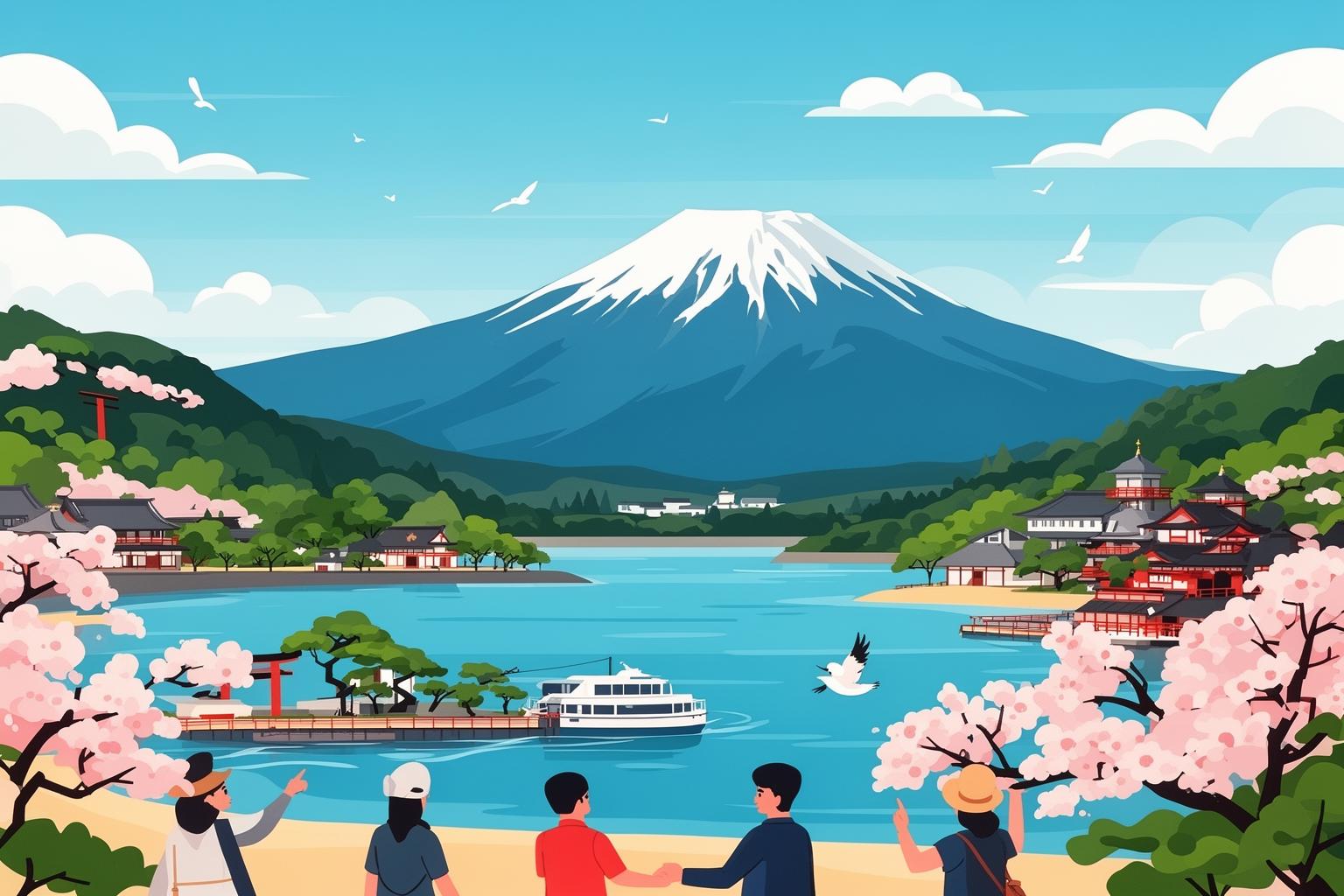
Painted in the summer of 1897, “Lakeside” portrays a woman, believed to be Kuroda’s wife, Taneko, seated by Lake Ashi’s shore. She wears a simple summer yukata and holds a round fan (uchiwa), her gaze turned away from the viewer, lost in thought. The painting is a harmonious blend of soft light and delicate color—the deep blues of the lake, the rich greens of the surrounding hills, and the cool tones of the woman’s robe merge seamlessly. Yet, the true brilliance lies in its atmosphere. Kuroda evokes a sense of peaceful reflection, an intimate, unguarded moment. This represented a new artistic approach to depicting Japanese women—not as idealized beauties or historical figures, but as real people with their own inner worlds. The setting is unmistakable. The painting was created on Lake Ashi’s northern shore, near the village of Moto-Hakone. Visiting Hakone today often involves seeking out this exact spot. While the precise location remains somewhat debated, walking along the lakeside trail from Moto-Hakone toward Hakone Shrine offers many viewpoints that capture the painting’s spirit. On clear days, with Mount Fuji in the distance, you can find a tranquil spot, feel the cool breeze off the lake, and picture Kuroda at his easel, carefully rendering the subtle shifts in light and color. The air in Hakone is fresh and crisp, a sharp contrast to Tokyo’s humid summer—making it easy to see why this place was such a restorative haven for him.
For practical tips on visiting Hakone, take advantage of the excellent local transportation system. The Hakone Free Pass, available at Tokyo’s Shinjuku Station, provides a great deal, covering round-trip train fare plus unlimited use of local buses, the Tozan mountain railway, cable cars, ropeways, and even sightseeing cruise ships on Lake Ashi. A classic way to explore is the “Hakone Round Course,” a scenic loop utilizing all these transportation modes. This journey not only offers spectacular views but also a vivid sense of the region’s terrain and natural charm. To fully immerse yourself in the “Lakeside” experience, take a sightseeing boat across the lake. Viewing the shoreline from the water gives a perspective closer to what Kuroda painted—an expanse of water, mountains, and sky.
Beyond the Painting: Experiencing Hakone’s Art and Nature
Hakone’s artistic significance extends well beyond Kuroda. The area boasts world-class museums. A visit to the Hakone Open-Air Museum is essential, where sculpture is beautifully integrated into the landscape, fostering a dialogue between art and nature that Kuroda would surely have admired. The Pola Museum of Art, with its impressive collection of French Impressionist and modern Japanese Western-style paintings, offers broader context for Kuroda’s work. Viewing paintings by Monet and Renoir alongside those by Kuroda and his contemporaries reveals direct lines of influence and highlights the distinctive Japanese reinterpretation of these artistic movements. To round out the Hakone retreat experience, consider staying in a traditional Japanese inn, or ryokan. Soaking in a natural hot spring (onsen) after a day of walking and museum visits is the perfect way to relax. It connects you to a timeless Japanese tradition of seeking peace and healing in nature—the very impulse that drew Kuroda to these mountains over a century ago. Hakone is a destination to savor slowly. Each season presents a different palette: the soft pinks of spring cherry blossoms, the rich, overwhelming greens of summer, the fiery reds and golds of autumn leaves, and the stark, serene beauty of winter, when the air is clearest and offers the best views of Mount Fuji, Japan’s ultimate artistic muse.
A Journey Through Light and Time
Following the path of Kuroda Seiki is to journey through the very core of Japan’s modern transformation. Our voyage begins in the sun-scorched, volcanic lands of Kagoshima, where the spirit of a samurai was shaped, then moves to the revered halls of Ueno in Tokyo, where that same spirit ignited an artistic revolution. Finally, it leads us to the serene, mist-shrouded shores of Lake Ashi in Hakone, where his revolutionary vision found its gentlest and most lasting expression. Each place unveils a distinct aspect of the man and the artist: the disciplined youth, the daring innovator, the reflective master. Kuroda did more than merely adopt a foreign style; he transformed the world of light, shadow, and color into a language that resonated with the Japanese soul. He taught a nation to view its own landscape, its people, and its evolving identity in a fresh, more radiant light. To walk these routes today is to do more than simply retrace an artist’s life; it is to experience firsthand the vibrant tension and thrilling potential of Meiji Japan, an era when every brushstroke carried the promise of a new world. It is an invitation to see the sunlight filtering through the trees in Ueno Park, to feel the cool breeze across Lake Ashi’s waters, and to understand that the pursuit of capturing light is, ultimately, a pursuit of capturing life itself.