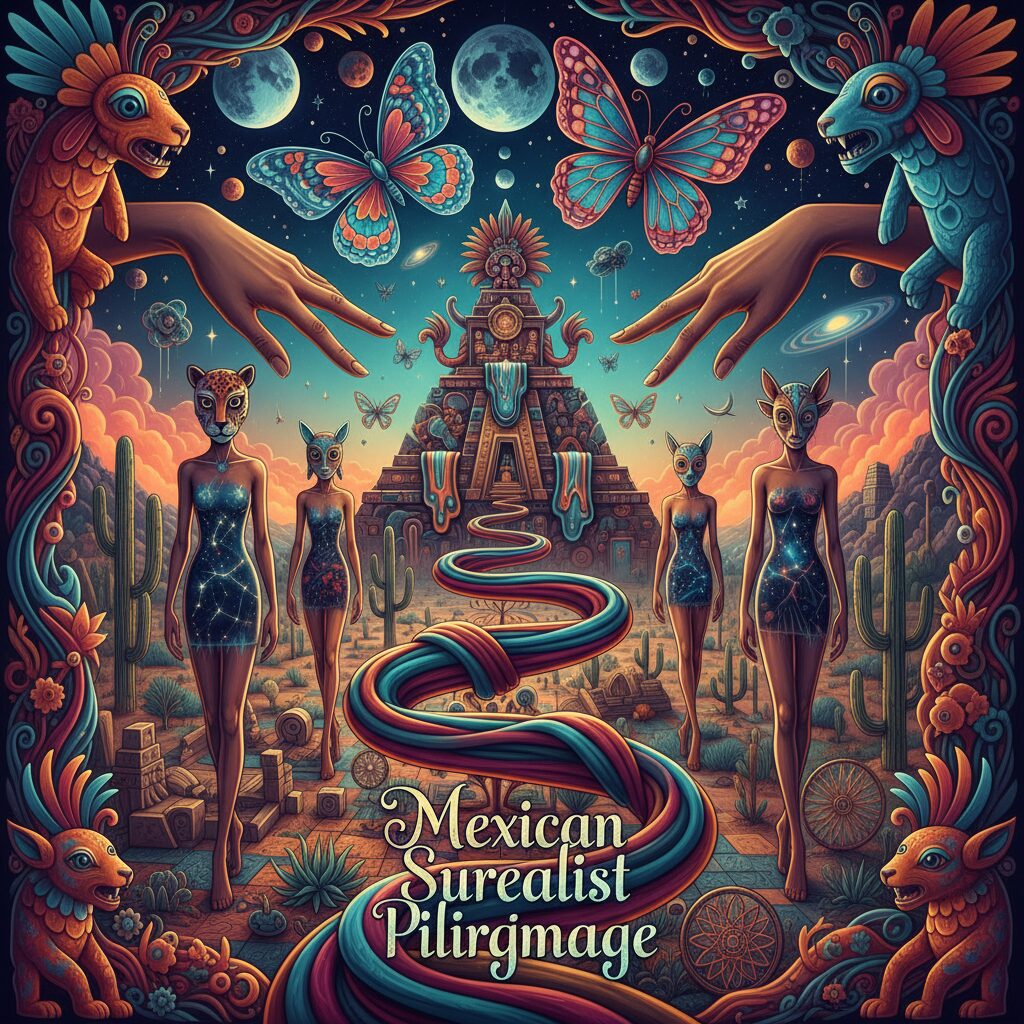
To trace the life of Leonora Carrington is to chase a phantom across continents, a journey guided by the spectral light of her own otherworldly imagination. She was not merely a painter or a writer; she was a cartographer of the subconscious, a high priestess of Surrealism who charted the hidden territories of myth, magic, and personal metamorphosis. Her life was her greatest, most defiant masterpiece, a sprawling narrative of rebellion against a gilded cage, a plunge into the alchemical fires of love and madness, and a triumphant rebirth in a land that mirrored the vibrant chaos of her soul. This is not just a travel guide; it is an invitation to walk the path she blazed, to stand in the spaces that shaped her vision, and to feel the lingering echo of her untamable spirit. We begin in the mist-shrouded hills of England, follow her flight to the revolutionary heart of Paris, descend with her into the Spanish abyss, and finally, find sanctuary and power in the kaleidoscopic streets of Mexico City. This pilgrimage is a quest to understand how a place can become a crucible, forging an artist whose work continues to bewitch and challenge us, beckoning us to look beyond the veil of the ordinary and into the marvelous reality she so brilliantly illuminated.
For a different kind of artistic pilgrimage, one that traces the legacy of a Spanish master, consider following in the footsteps of Diego Velázquez.
A Gilded Cage: The Rebellious Youth in Lancashire
The story does not begin in a sunlit artist’s studio, but beneath the perpetually damp, grey skies of Northern England. Leonora Carrington was born into vast wealth as the daughter of a textile magnate, destined to become a debutante, a society wife, a decorative figure in a world constrained by suffocating propriety. Her early years unfolded in an imposing neo-Gothic mansion, Crookhey Hall, near Clayton Green, Lancashire. This was her first and most formative prison—a place of immense beauty and rigid rules. Visiting the Lancashire countryside today reveals the foundational textures of her imagination. The landscape is ancient, rolling, and green, charged with a deep, brooding magic. It is a land of Celtic whispers and Gaelic folklore, stories nurtured by her Irish mother and nanny about sidhe, mythical beasts, and otherworldly queens that took root in her young mind.
The Haunting Beauty of Crookhey Hall
Crookhey Hall now lies in ruins, with its skeletal remains reclaimed by nature. For the devoted pilgrim, witnessing these ruins may be even more powerful than seeing the house intact. It resembles one of her own paintings: a structure of power and memory slowly consumed by the wild, untamable forces she so revered. Standing there, you can almost envision the young Leonora, eyes gleaming with fierce intelligence, sketching phantom horses and hybrid creatures in her notebooks while the outside world tried to mold her into something she was never meant to be. The atmosphere is thick with profound solitude and history. You feel the weight of the industrial revolution that financed her family’s fortune intertwined with the ancient, pre-Christian magic of the land resisting it. Her rebellion was not just against her family; it was against the entire machinery of a patriarchal, industrial society determined to tame both the wildness of nature and the untamed spirit of women.
A Traveler’s Note: Exploring Lancashire
To grasp this world, base yourself in a nearby town like Preston or Chorley. Rent a car and drive through the Ribble Valley. The journey isn’t about visiting a particular tourist spot but about soaking in the atmosphere. Walk the public footpaths, feel the damp earth beneath your feet, and watch the mist cling to the hills. This is the raw material of her early work. It is a quiet, reflective experience. Visiting in autumn, when the colors are deep and the air is crisp, heightens the Gothic romance of the setting. It is a landscape that invites introspection—a perfect starting place to understand the rich, dark soil from which her surrealist visions later emerged.
Cracking the Shell: The London Awakening
London was her first step toward escape. Sent to finishing schools across Europe, from which she was repeatedly expelled due to her rebellious nature, she eventually persuaded her father to let her study art. She enrolled at the Chelsea School of Art and, more importantly, Amédée Ozenfant’s Academy of Fine Arts in London. The city in the 1930s was a crucible of modernism, worlds apart from the provincial conservatism of Lancashire. For Leonora, it was a breath of fresh, intoxicating air. Here, her eccentricities were not only tolerated but became a valuable currency in a society that celebrated the new and the shocking.
The Encounter That Changed Everything
The defining moment came in 1936 at the International Surrealist Exhibition. It was there that she first encountered the Surrealists—artists and thinkers who seemed to speak the language her soul had long understood. It was also at that exhibition she first saw a painting by Max Ernst, the German artist who was a leading figure in the movement. A year later, they met at a party. The connection was immediate and electric. He was twenty-six years her senior, a celebrated artist at the height of his powers. She was a nineteen-year-old debutante in revolt, bursting with raw, untrained genius. Their meeting was a clash of worlds, and for Leonora, it was the key that unlocked the door of her gilded cage. She abandoned her former life, her family, and her country, following him to Paris, the undisputed heart of the Surrealist revolution.
Finding the Vibe of 1930s London Today
To experience this era of her life, wander through the streets of Chelsea. Although now one of London’s most affluent neighborhoods, pockets of its bohemian past remain in the quiet mews and garden squares. Visit the Tate Modern’s Surrealism collection. Standing before works by Max Ernst or Salvador Dalí, you can sense the shock and exhilaration that must have surged through Leonora. It is a reminder that Surrealism was not merely an artistic style but a radical call for the liberation of the human mind. For a young woman who had spent her life being told what to think and how to behave, it was nothing less than a declaration of independence.
An Alchemical Romance: Paris and Saint-Martin-d’Ardèche
Paris was more than just a city; it was a concept. Arriving on the arm of Max Ernst, Leonora was immediately immersed in the heart of the Surrealist circle—a chaotic, brilliant, and fiercely patriarchal group led by its pope, André Breton. She found herself among the era’s great figures—Dalí, Man Ray, Paul Éluard, Marcel Duchamp. Yet she was often perceived through their gaze as the beautiful, enchanting ‘femme-enfant,’ a muse rather than a creator. This was a role she resisted fiercely, carving out her own artistic identity amidst these towering personalities with quiet, determined intensity. Her paintings from this time pulse with a vibrant, personal mythology, rich with alchemical symbols, fantastical creatures, and powerful female figures who defy passive muse stereotypes.
The Heart of Surrealism: Saint-Germain-des-Prés
The Surrealists’ intellectual and social life unfolded in the cafés of Saint-Germain-des-Prés. Walking these streets today is like moving through ghosts. Sitting at Les Deux Magots or Café de Flore, where Breton held court and debates on art, politics, and the nature of reality flared over coffee and wine, offers a glimpse of that era. Though the atmosphere is now more polished and tourist-heavy, the elegant architecture and historical weight endure. Picture a young Leonora, navigating this world of immense egos and intellectual fireworks, holding her own, absorbing everything, and quietly forging her own path. She existed as both insider and outsider, a duality that granted her a unique perspective—less dogmatic, more deeply attuned to a personal, intuitive magic.
A Sanctuary in the South: Saint-Martin-d’Ardèche
Weary of the relentless dramas of the Parisian art scene, Leonora and Max sought refuge. They found it in a small, remote farmhouse in Saint-Martin-d’Ardèche, a sun-drenched village in southern France. This house became their Eden, a living sculpture and testament to their love. They adorned its walls with reliefs of fantastical beings—personal guardians. A giant mermaid guarded the doorway, while hybrid creatures roamed the stone walls. Here, Leonora’s creativity blossomed in serene isolation. She wrote her iconic short story, “The House of Fear,” and painted some of her most significant early works. The Ardèche landscape, with its dramatic gorges, ancient caves, and clear, brilliant light, seeped into her art. It was a place of deep peace and productivity—a world they had crafted for themselves, far from societal judgments and Surrealism’s constraints.
The Shadow of War
Yet this paradise was heartbreakingly brief. The outbreak of World War II shattered their world. As a German national, Max Ernst was arrested by French authorities as an enemy alien. He was taken away, and their idyllic life crumbled overnight. The house, once a refuge, became a place of fear and loss. Leonora was left alone to face the escalating chaos of a nation on the verge of occupation. The trauma of this separation set in motion a devastating chain of events, propelling her on a desperate flight that marked the darkest chapter of her life.
Visiting the Ardèche Today
The house in Saint-Martin-d’Ardèche is now privately owned and closed to the public, but the village and surrounding region remain well worth visiting. It is a place of breathtaking natural beauty. You can kayak down the Ardèche river through the majestic Pont d’Arc and explore the prehistoric cave paintings at Chauvet Cave—a testament to the ancient human urge to capture animal spirits on stone walls, an impulse Leonora deeply shared. The atmosphere is timeless. The powerful connection to the earth that nourished her here can still be felt. It is a place to disconnect, reconnect with a more elemental existence, and understand the creative sanctuary she found—and the profound loss she endured when it was taken away.
Descent into the Abyss: The Spanish Breakdown

The fall was as rapid as it was brutal. After Max Ernst was arrested for a second time—this time by the Gestapo following the German invasion—a devastated Leonora fled south, hoping to secure his release in Madrid. The strain of the war, the loss of her partner, and the terrifying uncertainty of her future became overwhelming. In Madrid, she experienced a complete psychotic break, a violent descent into a personal underworld. Her surreal visions, once confined to canvas and paper, now seeped into reality in frightening and overwhelming ways.
The Sanatorium in Santander
Alarmed by her erratic behavior, her parents, who had followed her to Spain, had her forcibly admitted to a private asylum in Santander, a coastal city in northern Spain. The ordeal that followed was nightmarish, a harrowing experience she would later recount with chilling clarity in her memoir, Down Below. She was subjected to powerful, debilitating drugs and harsh convulsive therapy. This was the psychiatric establishment’s attempt to “cure” her: to extinguish the very fire of her unique vision and force her back into conventional sanity. She was stripped of her autonomy, dignity, and freedom. It was the ultimate embodiment of the confinement she had battled against her entire life—not one of social convention, but of medical tyranny.
From Trauma to Transformation
Yet even in this abyss, her artistic mind remained active, observing, analyzing, and transforming her suffering. Down Below is not merely a record of trauma; it stands as a profound mythological text. She reinterpreted her breakdown as a shamanic journey, a necessary descent into the underworld to acquire knowledge and power. She viewed the sanatorium as a laboratory, where she was alchemically broken down to be reborn. This ability to convert personal horror into profound art is among the most remarkable facets of her genius. The experience, horrific as it was, became a foundational element of her life’s work, shaping her understanding of madness, transformation, and the porous boundary between worlds.
Contemplating Santander
Visiting Santander within the context of Carrington’s life is a somber, reflective act. It is not about finding the exact location of the sanatorium—that would feel morbid. Instead, it is about absorbing the city’s atmosphere with the weight of her story in mind. Santander is a beautiful, elegant city, with golden beaches like El Sardinero and a refined promenade. The contrast between this pleasant, orderly facade and the violent chaos of Leonora’s inner experience is striking. A walk along the windswept coast, gazing out at the turbulent Bay of Biscay, provides a powerful moment for reflection. One can contemplate her resilience, her bravery in documenting her ordeal, and the incredible strength it took not only to survive but also to transform that darkness into a source of immense creative power.
The Rebirth and a New World: America and Mexico
Leonora’s escape from the sanatorium was as daring and surreal as any of her tales. Released into the care of a nurse, she was being transferred to another facility in Portugal. During a stopover in Lisbon, she managed to slip away and sought refuge in the Mexican embassy. There, she encountered Renato Leduc, a Mexican poet and diplomat she had known in Paris. In a practical act of rescue, he agreed to marry her—a marriage of convenience that granted her diplomatic immunity and, most crucially, passage out of war-torn Europe. Lisbon, at that time, was a city of spies and refugees, a hectic, transitional space between the old world and the new. For Leonora, it was a short, breathless layover on the road to freedom.
An Interlude in New York
Their first destination was New York City. She joined the community of exiled Surrealists, including André Breton and even Max Ernst, who had also escaped Europe with the aid of Peggy Guggenheim. But the reunion was far from joyful. Too much had transpired. The trauma of her breakdown and his imprisonment had created a rift between them. Moreover, New York, with its relentless pace and towering skyline, never felt like home. She found it cold, alienating, and disconnected from the earth. Although she continued to paint and write, it was a period of transition—a waiting room before the final, most significant chapter of her life commenced. She divorced Leduc on amicable terms and, in 1942, made the decision that would shape the rest of her life: she moved to Mexico.
Finding Home: The Magical Realism of Mexico City
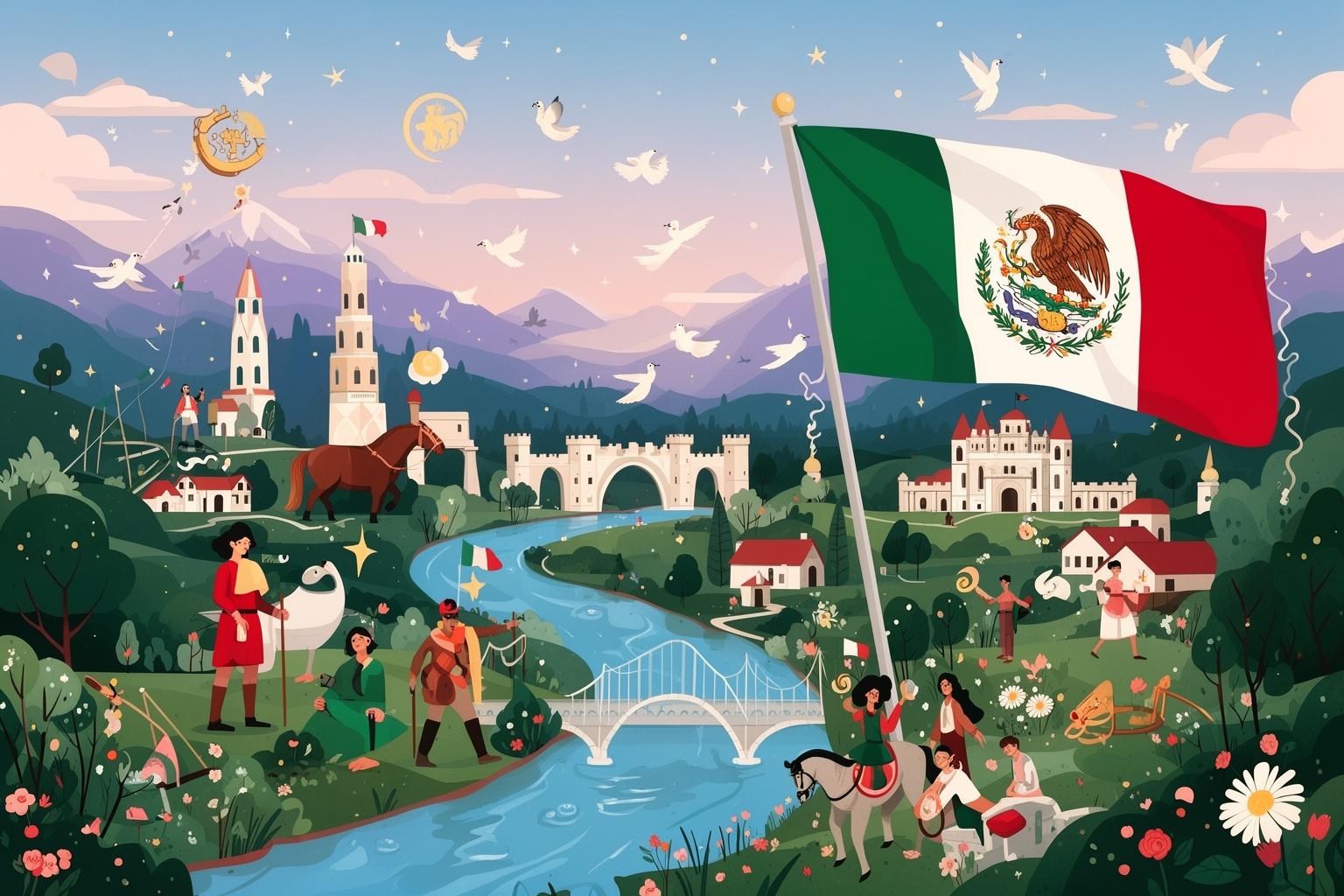
If Leonora Carrington’s life was a quest for a place to embrace her expansive spirit, she found it in Mexico City. Upon her arrival, the city was a vibrant cultural hub, a refuge for artists, intellectuals, and political exiles from around the world. It was a place where ancient Aztec mythology blended with modern life, where folk magic thrived beneath the shadow of Catholic cathedrals, and where the surreal was simply part of everyday experience. For the first time, Leonora didn’t need to create a surreal world; she was living within one. She had finally found her home.
Colonia Roma: A Neighborhood of Witches and Artists
She made her home in Colonia Roma, a neighborhood characterized by elegant yet slightly decaying Porfirian-era mansions and leafy streets. It was here that she discovered her true community. She forged a deep, lifelong friendship with the Spanish painter Remedios Varo and the Hungarian photographer Kati Horna. The three women, all European exiles, formed an inseparable bond and were playfully nicknamed “the three witches.” They shared everything: recipes, dreams, occult studies, and artistic critiques. Their kitchens became laboratories where they concocted not only elaborate meals but also magical potions and creative ideas. This supportive, female-centered creative circle was a vital counterpoint to the competitive, male-dominated Parisian Surrealist world. In Mexico, Leonora was no longer a muse; she emerged as a master in her own right, a celebrated figure within a flourishing artistic community.
The Epicenter: Chihuahua 194
For over sixty years, her residence at Chihuahua 194 in Colonia Roma was the heart of her universe. Today, this house has been preserved and opened to the public as Casa Estudio Leonora Carrington. Entering it is like stepping straight into her world. The house is not a sterile museum; it remains a living space, preserved almost exactly as it was when she passed away in 2011. Her sculptures fill the rooms, her paints and pigments are arranged in her studio, and her kitchen—the alchemical core of the home—feels as if she has just stepped away momentarily. Visitors can see the herbs she cultivated, the mystical diagrams she drew on the walls, and the pots and pans that served as much as magical tools as her paintbrushes. Touring her home offers an intimate, almost spiritual experience, offering profound insight into how she wove her art and life into a unified, magical tapestry.
Exploring Colonia Roma
To truly appreciate this chapter of her life, spend a day wandering through Colonia Roma and the neighboring Condesa area. While now a trendy hub of cafes, galleries, and boutiques, the neighborhoods still maintain their bohemian, artistic essence. Stroll along tree-lined avenues, admire the Art Nouveau and Art Deco architecture, and pause for coffee at a local café. It’s easy to envision Leonora, Remedios, and Kati walking these same streets, deeply engaged in conversations about alchemy, feminism, and the universe’s mysteries. The neighborhood itself stands as a tribute to the creative spirit they nurtured.
The Public Art of a National Treasure
Throughout the decades, Leonora became a cherished figure in her adopted country—a national treasure. Her profound engagement with Mexican culture is eloquently expressed in her monumental mural, “El Mundo Mágico de los Mayas” (The Magical World of the Maya). Located in the prestigious Museo Nacional de Antropología in Mexico City, the mural is a stunning synthesis of Mayan cosmology, folklore, and the natural world of Chiapas. It is a sprawling, intricate composition filled with gods, demons, sacred plants, and astronomical symbols. Standing before it reveals her deep respect for and understanding of Mexico’s indigenous cultures. The mural is not a tourist’s appropriation, but a visionary interpretation—a dialogue between her European mythological heritage and the rich spiritual traditions of her new home.
Practical Tips for the Museo Nacional de Antropología
A visit to this world-renowned museum is essential when in Mexico City. The Carrington mural is housed in the Maya exhibition hall. Allow plenty of time, as the museum is extensive. Viewing her work in this setting, surrounded by the artifacts and histories that inspired it, is a powerful experience. It affirms her status not only as a Surrealist but as a deeply Mexican artist. While exploring the city, also be on the lookout for her public sculptures. “Cocodrilo,” a whimsical and imposing crocodile-shaped boat, can be found on the grand boulevard Paseo de la Reforma, offering a delightful and surreal interruption to the urban landscape.
The Legacy in San Luis Potosí and Xilitla
Leonora’s legacy is formally honored in the state of San Luis Potosí, where two museums dedicated to her work stand. The primary Leonora Carrington Museum, located in the city of San Luis Potosí, is a magnificent space devoted to her sculptures and later works. It showcases her remarkable skill in bronze, displaying her fantastical menagerie on a grand scale. A smaller sister museum is situated in the enchanting town of Xilitla.
The Surrealist Garden of Edward James
Xilitla is a pilgrimage site in itself. It hosts Las Pozas, the surrealist garden created by the eccentric English aristocrat and arts patron Edward James. James was one of Carrington’s most important supporters, recognizing her genius early and remaining a lifelong friend. Although Leonora never lived in Xilitla, the spirit of her work feels perfectly at home there. Las Pozas is an expansive, fantastical ensemble of concrete arches, spiral staircases, and enormous floral sculptures set within a subtropical rainforest. Wandering through this garden is like stepping into one of her paintings—a place where nature and human imagination have merged to form something utterly unique and magical. A combined visit to the Carrington museum in Xilitla and the gardens of Las Pozas offers an unforgettable immersion into the heart of surrealism.
Weaving the Threads: The Enduring Themes in Her Art
A journey through the places that shaped Leonora Carrington’s life uncovers the profound geographical and emotional roots of her recurring themes. The mist-covered Celtic folklore of her Lancashire childhood inspired the white horses, goddesses, and otherworldly beings that populate her work. The alchemical and hermetic studies she pursued with Max Ernst in France supplied the language of transformation—the crucible and the egg—that she would draw upon throughout her career. Her harrowing descent into the underworld at a Spanish sanatorium became the foundational myth of her survival, a motif of psychic death and rebirth she revisited repeatedly. Finally, the rich tapestry of Mexico—its myths, markets, magic, and strong female camaraderie—offered the vibrant palette with which she painted her mature vision. Her art serves as a map of her life, and exploring these places teaches one how to read it.
A Traveler’s Guide to Carrington’s World

Embarking on a pilgrimage following the footsteps of Leonora Carrington can be a transformative experience. It stretches across continents and decades but can be adapted to fit any traveler’s schedule and interests. The undeniable core of any Carrington journey is Mexico City, where she lived most of her life and where her legacy remains most vivid.
Planning Your Pilgrimage
For a concentrated visit, spend at least four to five days in Mexico City. Allocate a full day to Colonia Roma to visit her home and studio while absorbing the neighborhood’s atmosphere. Reserve another full day for the Museo Nacional de Antropología to view her mural and explore its remarkable collections. Use additional days to dive into the city’s dynamic art scene, from the Frida Kahlo Museum in Coyoacán to the Palacio de Bellas Artes. For the more devoted traveler, a side trip to San Luis Potosí and Xilitla is highly recommended, involving a short flight or a comfortable bus ride, adding another three to four days to your itinerary. For those interested in her early life, the European portion of the journey—Lancashire, London, Paris, and the Ardèche—provides a quieter, more historical insight into the influences that shaped her rebellious beginnings.
Safety and Sensibility for the Solo Explorer
As a writer who often travels alone, I find Mexico City to be an incredibly rewarding destination, though like any major city, it demands attentiveness. My advice is to embrace the local rhythm while taking sensible precautions. Use trusted ride-sharing apps like Uber or DiDi to get around, especially at night, rather than hailing cabs on the street. Keep your belongings secure in crowded areas such as markets and public transportation. Learning a few basic Spanish phrases will be very helpful and always appreciated. The best time to visit is during the dry season, from November to April, when the weather is pleasant and sunny. Stay hydrated, be open to new experiences, and allow yourself to get lost in the city’s magic. Mexico is a country of immense warmth and generosity, and it welcomed Leonora Carrington for the same reasons it will welcome you: for having a spirit open to its wonders.
To follow Leonora Carrington is to recognize that a life is a geography, with its own unique climates, terrains, and hidden maps. Her journey was a relentless pursuit of a place where her inner world could flourish outwardly, a place free from the limits of convention and logic. She found that place in the magical reality of Mexico, though the seeds were planted in every landscape she called home. Walking in her footsteps, from the green hills of England to the vibrant chaos of a Mexico City market, is more than a tour of an artist’s life. It is an invitation to embark on our own path of discovery, to find the places that nourish our creativity, and to have the courage to create a world of our own design—a world as enchanting, defiant, and vividly alive as her own canvases.