There are artists whose lives are as meticulously constructed as their canvases, every line and angle leading to a predetermined point. And then there are artists like Juan Gris, whose journey was a vibrant, sometimes chaotic, collision of places, ideas, and brilliant minds. To follow in the footsteps of Gris is to trace the very birth of modern art, from the dusty, sun-baked streets of turn-of-the-century Madrid to the smoke-filled, revolutionary ateliers of Montmartre. It’s a pilgrimage not to static monuments, but to the living, breathing cities that shaped him, a man born José Victoriano González-Pérez who would later rename himself to become one of the triumvirate of Cubism, standing shoulder-to-shoulder with Picasso and Braque. Our journey is a quest to understand how a place can infuse itself into an artist’s soul, how the light of the Pyrenees can alter a palette, and how the intellectual fervor of a Parisian neighborhood can shatter and then reassemble the known world onto a canvas. This is more than a tour of museums; it’s an exploration of the atmosphere, the energy, and the geography that forged a master. We’ll walk the same cobblestones, breathe the air of the same hills, and stand in the galleries where his legacy now echoes, connecting the man to the map he traversed.
To continue this exploration of how geography shapes artistic genius, consider embarking on a similar artistic pilgrimage to Mexico City.
Madrid: The Formative Years and a Spanish Farewell
Every story has a beginning, and for Juan Gris, that beginning is in Madrid. Not the bustling tourist city we know today, but a city poised on the brink of a new century, steeped in deep tradition and wrestling with the forces of modernity. Born in 1887 to a well-off family, José Victoriano González-Pérez grew up in a city that was like a living museum, its streets resonating with the legacy of Goya and Velázquez. To walk through Madrid with Gris in mind is to sense this foundational weight—the immense pressure and inspiration of Spanish art history that he both revered and ultimately transformed in radical ways.
The Royal Academy of Fine Arts
Our first meaningful stop on this pilgrimage is the Real Academia de Bellas Artes de San Fernando. This imposing neoclassical building just off the Puerta del Sol exudes an air of formal academic authority. Gris studied here from 1902 to 1904, and one can almost feel the presence of the young, aspiring artist roaming its revered halls. At that time, instruction was rigorous, centered on classical draftsmanship, anatomical studies, and reproducing the Old Masters. This was a far cry from the artistic revolution he would soon embrace. Visiting the academy today presents a fascinating contrast. Its museum holds masterpieces by Spanish greats like Goya, Zurbarán, and Ribera. You can walk through the same galleries Gris once did, imagining him absorbing the rules of perspective, composition, and form that he would later so masterfully dismantle. Understanding this is key to grasping his journey; one must know the rules intimately in order to shatter them with such precision and elegance.
The Bohemian Illustrator
However, academic life was only part of the story. The young Gris also immersed himself in Madrid’s lively, somewhat rough-edged bohemian scene. To support himself and refine his craft, he began producing illustrations for popular satirical magazines of the time, such as Blanco y Negro and Madrid Cómico. This phase is often overlooked but was vital. It honed his graphic intuition, his command of line, and his ability to express character and mood with economy of stroke. It also connected him to the city’s literary and artistic underground. Picture him in a smoky café in Malasaña, sketchbook in hand, working feverishly to meet deadlines while absorbing the city’s energy, politics, and humor. This experience gave him a practical, streetwise artistic education that sharply contrasted with the formal training of the Academy. Though the offices of those long-gone magazines can no longer be visited, their spirit lives on in the twisting lanes of the Barrio de las Letras (Literary Quarter), where writers and artists have gathered for centuries. Stop at a classic taberna, order a vermut, and soak in the ambiance that nurtured Gris’s early talent before he made his monumental leap to the north.
A Pilgrim’s Guide to Artistic Madrid
For the modern traveler following Gris’s path, Madrid serves as a prologue. The best way to experience it is through the city’s ‘Golden Triangle’ of art museums, all within easy walking distance. Begin at the Prado to see the masters Gris studied. Feel the gravity of Velázquez’s Las Meninas and the darkness of Goya’s Black Paintings. Then move on to the Thyssen-Bornemisza Museum, which forms a brilliant link, displaying movements from Impressionism to German Expressionism, helping to contextualize the sweeping changes across Europe. The final and most essential stop is the Museo Nacional Centro de Arte Reina Sofía. Here the story comes full circle. In the same city where he learned classical drawing, Gris’s revolutionary Cubist masterpieces now hang in celebration. Standing before works like La Bouteille d’anis (The Anis del Mono Bottle), in the same building that houses Picasso’s Guernica, is a deeply moving experience. It embodies his journey from an ambitious Madrid illustrator to a cornerstone of the international avant-garde. For first-time visitors, a practical tip is to purchase the ‘Paseo del Arte’ card, which grants access to all three museums. Staying in the Huertas area or the Barrio de las Letras places you right in the artistic and historical heart of the city. Madrid was the city Gris had to leave to become the artist he was meant to be, making it an essential and poignant starting point on our journey.
Paris: The Crucible of Cubism in Montmartre
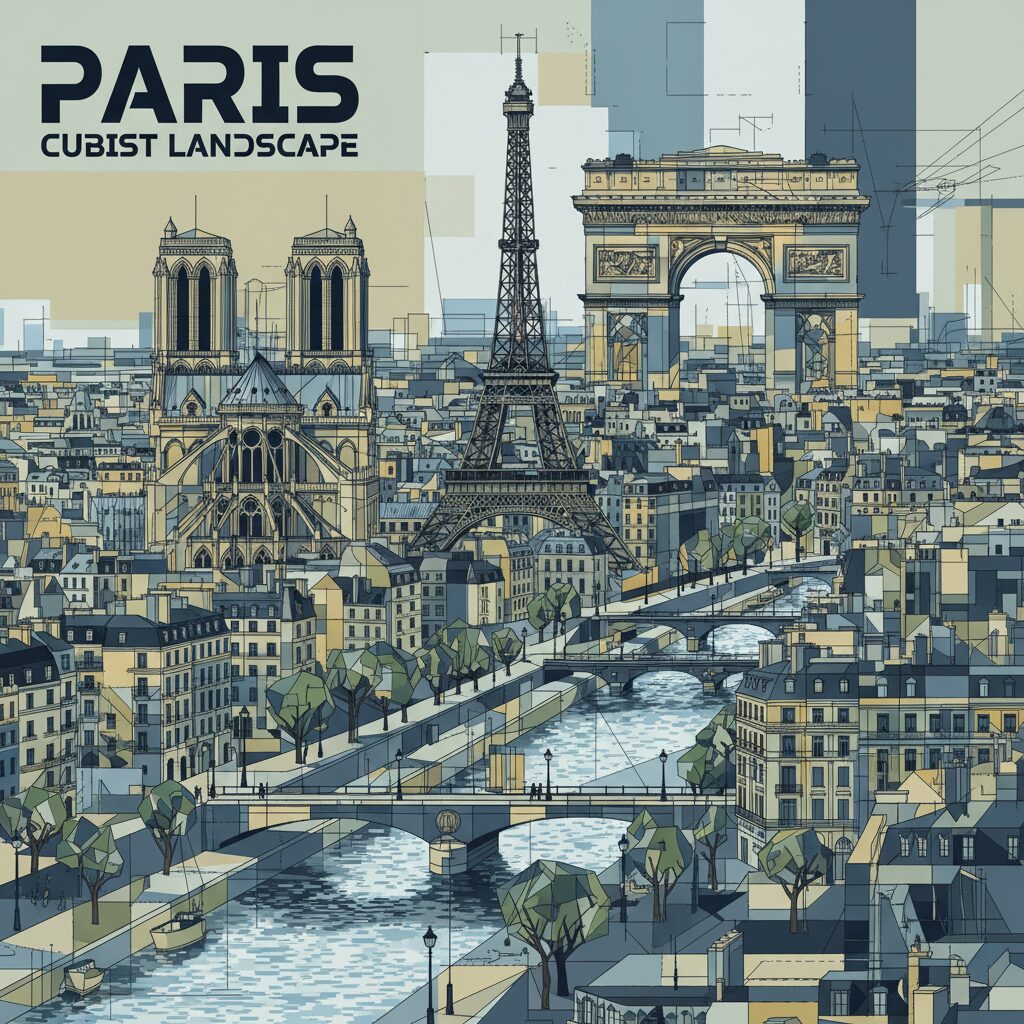
In 1906, at nineteen, Gris sold all he owned and boarded a train to Paris, carrying little besides his talent and a fierce determination to avoid military service. He arrived in a city that was the undisputed art capital—a chaotic, exhilarating hub of new ideas. His destination was a run-down, ramshackle building perched on Montmartre’s hill: the Bateau-Lavoir. This was more than an address; it was the avant-garde’s epicenter and the crucible where Juan Gris the artist was truly forged.
The Bateau-Lavoir: A Legendary Atelier
Today, if you stroll up the steep, charming Rue Ravignan in Montmartre, you’ll find a quaint square and a plaque marking where the Bateau-Lavoir once stood. The original wooden building, a former piano factory, was lost to fire in 1970, but its spirit still lingers in the neighborhood. Standing here, one can imagine one of art history’s most creatively fertile, if squalid, places. The name, meaning ‘laundry boat,’ was coined by poet Max Jacob because the creaky structure groaned in the wind like the laundry barges on the Seine. It was a maze of thin-walled studios with no gas, one water tap, and questionable sanitation. Yet it housed an extraordinary group of future legends: Pablo Picasso, Amedeo Modigliani, Kees van Dongen, Max Jacob, and soon after, Juan Gris. He took a studio next to Picasso, who was then painting the revolutionary Les Demoiselles d’Avignon. The atmosphere must have been electric—a potent blend of poverty, ambition, intellectual debate, and the constant scent of turpentine and cheap wine. Gris initially survived through illustration work but absorbed everything around him, observing, listening, and crafting his response to the Cubist revolution unfolding next door.
Forging a New Vision: The Architect of Cubism
For years, Gris watched closely. While Picasso and Georges Braque pioneered Analytic Cubism—breaking objects into multiple viewpoints rendered in monochrome ochres and greys—Gris studied intently. When he emerged as a Cubist painter around 1911, his voice was already unique. He didn’t just dissect reality; he rebuilt it with logic and color. This approach became known as Synthetic Cubism. His style was more cerebral, more architectural. Where Picasso was explosive and instinctive, Gris was measured and precise. He reintroduced vibrant color, collage elements (papier collé), and a strong sense of structure to the movement. He famously said, “I work with the elements of the intellect, with the imagination… I try to make concrete that which is abstract.” He regarded his paintings as flat, colored architecture. This distinct vision earned him peer respect and the admiration of collectors like Gertrude Stein. Today in Montmartre, you can still tap into this spirit. Avoid the tourist crowds at Place du Tertre and explore quieter side streets. Sit at a café like Le Consulat, which has watched over these streets for generations, and try to see the world through his eyes—not as it is, but as a collection of interlocking shapes, colors, and planes. The view of the city from Sacré-Cœur’s steps, with its jumble of rooftops, becomes a vivid Cubist composition.
Masterpieces of a Parisian Decade
This Parisian decade produced some of Gris’s most iconic works. His 1912 Portrait of Picasso is a landmark painting—a loving yet rigorously analytical tribute to his friend and mentor, capturing Picasso’s formidable presence through a crystalline arrangement of intersecting planes. It is a masterpiece of Analytic Cubism that hints at the greater clarity and color Gris would soon champion. Each brushstroke conveys the intense intellectual dialogue between them. Soon after, his work blossomed into Synthetic Cubism. Paintings like Guitar and Flowers (1912) and The Sunblind (1914) display his genius in composition and bold use of color and texture. He glued newspaper clippings, wallpaper, and labels onto his canvases, blurring the boundary between painted and real worlds—a radical innovation influencing art for a century. To fully appreciate these works, a visit to Paris’s Centre Pompidou is essential. Seeing his paintings in person reveals the subtle textures and vibrant palette that reproductions cannot capture. The museum’s modern, inside-out architecture feels a fitting home for an artist dedicated to unveiling underlying structure.
Practical Tips for the Parisian Pilgrim
When exploring Gris’s Paris, focus on Montmartre while understanding its modern form. The area around the Bateau-Lavoir site and the nearby Musée de Montmartre offers the most authentic connection to the past. The museum, housed in one of the hill’s oldest buildings, beautifully evokes the early 20th-century bohemian atmosphere. Visit on a weekday morning when crowds are sparse. Take your time, lose yourself in the alleys, and notice small details—an old gas lamp, worn cobblestones, a hidden garden. After Montmartre, descend into the 9th arrondissement, the so-called ‘New Athens,’ where many artists, including Gris, later set up studios. This less touristy area offers a glimpse into the more established yet still artistic Parisian life that followed the wild Bateau-Lavoir years. This Paris chapter lies at the heart of Gris’s story; here, José González-Pérez ceased to exist, and Juan Gris was fully and truly born.
Céret: The Mecca of Cubism in the Pyrenean Sun
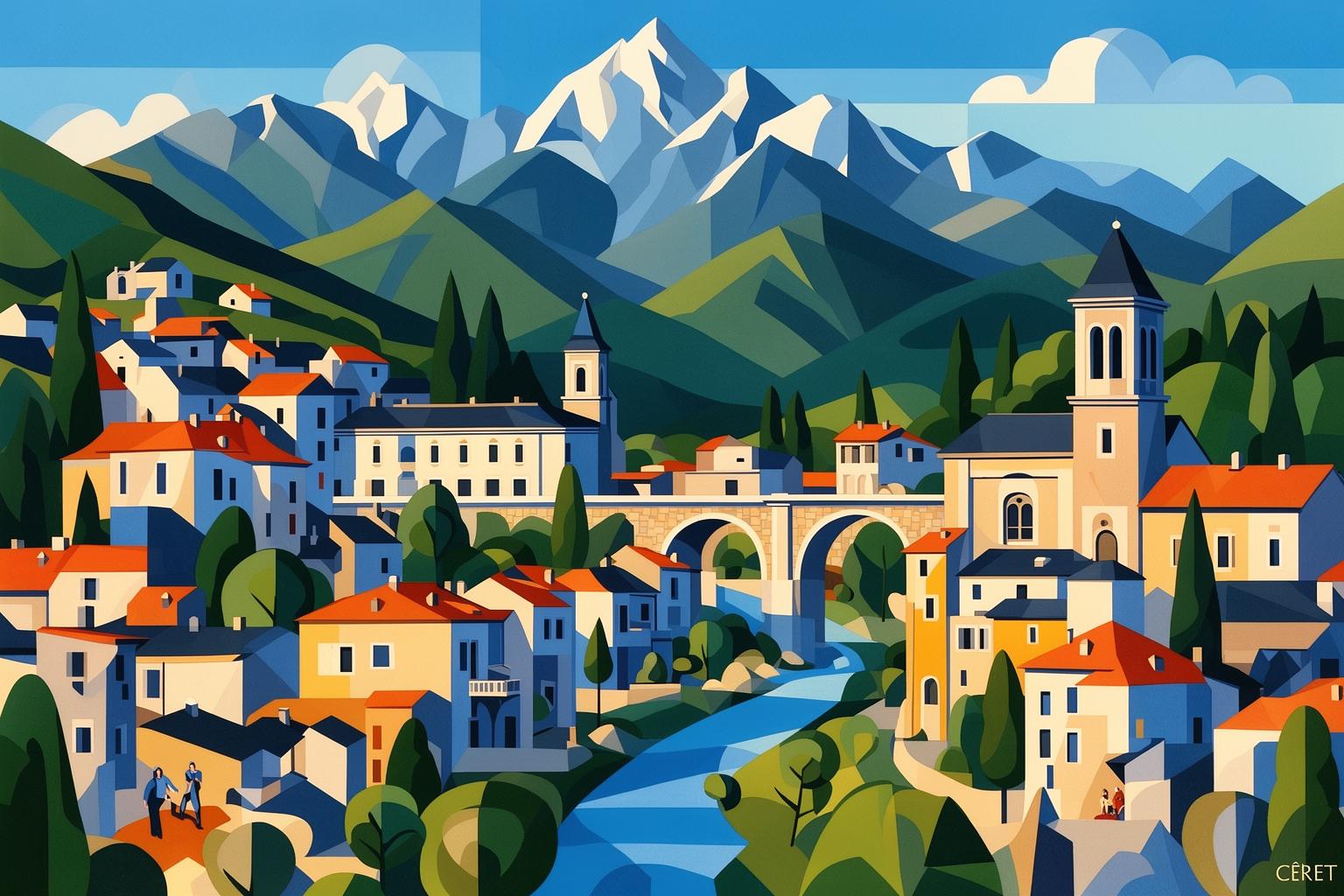
While Paris was the intellectual and social heart of Cubism, the movement also had a summer retreat—a place of intense creativity and camaraderie—nestled in the foothills of the French Pyrenees. That place was Céret. Between 1911 and 1913, this small Catalan town became, as one art historian described it, the “Mecca of Cubism.” Attracted by the brilliant Mediterranean light, affordable living costs, and the presence of friends, a stream of avant-garde artists traveled south, with Juan Gris among them. His time there marked a significant evolution in his work, characterized by a brightening palette and newfound confidence in his artistic direction.
A Town Transformed by Art
At the turn of the century, Céret was a quiet market town, known for its cherries and grand plane trees lining the boulevards. Its transformation began when sculptor Manolo Hugué, a friend of Picasso, settled there. He was soon joined by Georges Braque, and then Picasso himself. In the summer of 1913, Juan Gris arrived, joining a vibrant, though temporary, artistic colony that also included writer Max Jacob. Imagine the scene: these Parisian revolutionaries, used to the dim light of their studios, suddenly immersed in the dazzling southern sun. Local cafes, such as the Grand Café, became their open-air headquarters, buzzing with lively debates and collaborative energy. The townspeople were reportedly bemused by these eccentric artists, painting guitars and bottles that looked nothing like their real counterparts. Yet, this period was immensely fertile. The artists pushed the boundaries of Cubism, and the change of scenery proved a powerful catalyst.
The Influence of Southern Light
Céret’s most immediate impact on Gris’s work was through light—and thus color. The muted, cerebral greys and ochres of his early Parisian pieces gave way to brighter, more vibrant hues. The intense blue of the Mediterranean sky, the deep green of the plane trees, and the warm terracotta rooftops began to permeate his canvases. In works painted during his stay, like The Smoker (1913), this shift is clear. While the composition remains a complex, analytical grid of Cubist planes, the colors are richer and the contrasts bolder. He began exploring light and shadow not as tools for realistic modeling but as compositional elements within his “flat, colored architecture.” A stroll through modern-day Céret allows you to experience this influence firsthand. Walking down Boulevard Maréchal Joffre beneath those same ancient plane trees, you notice how dappled sunlight fractures the world into shifting patterns of light and shadow. It’s a living Cubist painting. The landscape itself—the sharp angles of the mountains, the geometric layouts of the vineyards—seems to reflect the principles of the art born here.
The Musée d’Art Moderne de Céret
No visit to Céret is complete without a contemplative tour of the Musée d’Art Moderne. This museum stands as the town’s lasting legacy from that golden era. It owes its foundation largely to the generosity of the artists themselves, including Picasso and Matisse, who donated works in gratitude to the town that welcomed them. The collection features important pieces from the Cubist period, highlighting the work created in and around Céret. Seeing Gris’s paintings here, in the very town where they were made, is a powerful experience—it links the abstract canvases to the tangible landscape outside the museum walls. The museum itself is a beautiful, modern space that feels simultaneously world-class and intimately connected to its local roots, proving that great art is not confined to capital cities but can flourish wherever creativity finds a receptive home.
Experiencing Céret and the Region
Visiting Céret today offers a wonderfully atmospheric experience, as it has retained its authentic Catalan character. The Saturday market is unmissable—a vibrant explosion of local produce, crafts, and culture. Renting a car is advisable for exploring the surrounding Vallespir region. You can wind your way up into the Pyrenees or head east to the stunning Côte Vermeille and the picturesque port town of Collioure, another favorite haunt of Fauvist artists like Matisse and Derain. The whole region is steeped in artistic heritage. For travelers following Gris’s path, the best advice is to slow down. Spend several days here. Settle into the local rhythm. Savor the cuisine, blending French and Catalan influences, and sample the robust local wines. By immersing yourself in Céret’s landscape, light, and culture, you gain a deeper, more intuitive appreciation of the forces that shaped a pivotal chapter in Juan Gris’s artistic journey.
Boulogne-Billancourt: Maturity, Classicism, and Final Acts
Following the revolutionary enthusiasm of Montmartre and the sunlit experiments in Céret, Juan Gris’s life and art entered a fresh chapter. In 1922, he and his wife, Josette, relocated from central Paris to the then-suburb of Boulogne-sur-Seine (now Boulogne-Billancourt). This move marked a transition in both his career and personal life, shifting from the bohemian avant-garde to a more established yet still innovative position within the art world. This era was characterized by refinement, theoretical inquiry, and a renewed engagement with classicism, all while he struggled with declining health that would ultimately end his life prematurely.
A New Home, A New Order
Boulogne-Billancourt in the 1920s stood in stark contrast to the gritty, chaotic Bateau-Lavoir. It was a bourgeois suburb known for its thriving automobile and aviation industries and increasingly recognized as a center for modernist architecture. Leading architects such as Le Corbusier were constructing groundbreaking homes there. For Gris, the move embodied a quest for stability, tranquility, and a workspace conducive to focused, methodical creativity. His home and studio at 8 Rue de la Mairie became his sanctuary. The art he created during this time reflects this altered environment. The intense fragmentation that defined his earlier work gave way to a calmer, more monumental style. His compositions grew more serene, with larger, simplified forms that embodied a sense of classical harmony. He began painting a series of open windows, gazing from his interior into the light and landscape beyond. These works, like The Open Window (1925), are masterpieces of balance and tranquility yet retain his distinctive Cubist language. They reveal an artist who had mastered his revolution and was now constructing a new, ordered world from its principles.
The Stage and the Sorbonne: Expanding the Canvas
This period of stability also enabled Gris to explore new creative avenues. One of the most notable was his collaboration with Sergei Diaghilev’s illustrious Ballets Russes. He was commissioned to design sets and costumes for several productions, including Les Tentations de la Bergère (The Temptations of the Shepherdess). This posed an intriguing challenge: how to adapt the static, two-dimensional principles of Cubism into the dynamic, three-dimensional realm of the stage. His designs triumphed through bold geometric shapes and vivid colors, crafting a visual environment that perfectly complemented the music and dance. This work demonstrated the versatility of his vision and his capacity to apply his architectural compositional sense on any scale. Beyond theatre, Gris also reinforced his status as a leading intellectual of the Cubist movement. In 1924, he delivered a pivotal lecture at the Sorbonne entitled “On the Possibilities of Painting,” where he expounded his deductive method—starting from an abstract concept and moving toward a concrete reality—famously stating, “Cézanne turns a bottle into a cylinder, but I begin with a cylinder and create an individual of a specific type: I make a bottle—a particular bottle—out of a cylinder.” This lecture secured his reputation as the movement’s philosopher.
Exploring Boulogne-Billancourt Today
For those tracing Gris’s final chapter, Boulogne-Billancourt offers a different kind of pilgrimage. It is less about bohemian spirits and more about the cool sophistication of the Art Deco and Modernist eras. Although his house remains a private residence, visitors can stroll the streets he once walked and experience the atmosphere of this unique Parisian suburb. A key destination is the Musée des Années Trente (Museum of the 1930s), devoted to the artistic and industrial design of the interwar period. While its collection holds few of Gris’s paintings, it perfectly captures the aesthetic milieu in which he lived and worked during his last years. The area itself is an open-air museum of architecture, where walking tours reveal buildings by Le Corbusier, Robert Mallet-Stevens, and other pioneers of the modern movement. This offers insight into the world that surrounded Gris—one fascinated with clean lines, novel materials, and rational design, all concepts that deeply resonated with his artistic philosophy.
A Legacy Cast in Light
Juan Gris’s years in Boulogne were a race against time. Despite battling ailments including asthma and uremia, he worked relentlessly. The paintings from this final phase are often suffused with poetic, melancholic beauty. His still lifes became increasingly complex, filled with overlapping objects that appear to float in an ethereal space. Gris passed away in 1927, at the tragically young age of forty, and was buried in the cemetery of Boulogne-Billancourt, where he rests today. His friend and early supporter Gertrude Stein wrote his epitaph, famously declaring, “Juan Gris was the only person whom Picasso wished away.” This tribute acknowledged Gris’s immense talent and the unique, powerful, and deeply intelligent vision he contributed to Cubism. His final years in Boulogne were not a retreat but a consolidation of his life’s work—a final, brilliant act synthesizing the chaos of revolution into a timeless, classical order. Visiting this place is a tribute to the quiet, determined master who completed the Cubist trinity and left behind a legacy as solid and enduring as the ‘flat, colored architecture’ of his canvases.