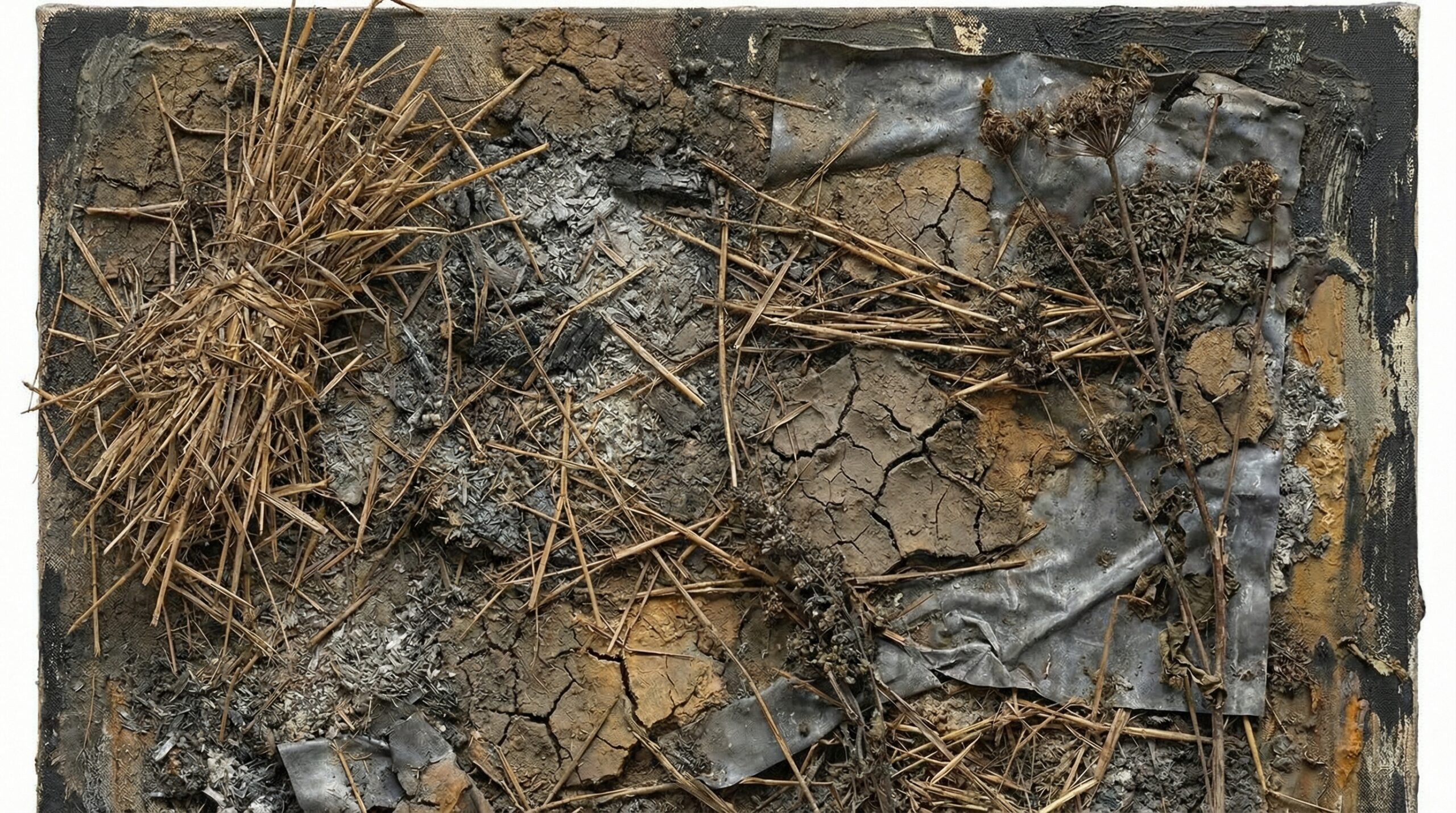
To stand before a work by Anselm Kiefer is to stand at the edge of a world. It’s a landscape scarred by history, enriched by myth, and built from the very substance of the earth—lead, straw, ash, and sun-bleached clay. His canvases are not mere paintings; they are territories of memory, vast and formidable, demanding not just to be seen but to be entered. Kiefer, born in the final, smoldering months of World War II in Germany, has spent a lifetime excavating the past, sifting through the rubble of his nation’s identity to confront its darkest chapters and its most profound myths. He is less a painter and more of an alchemist, transforming the raw, often brutal, materials of existence into monumental statements on history, memory, and the human condition. A journey into his world is not a simple tour of museums. It is a pilgrimage, a path that traces the artist’s own footsteps from the dense, myth-haunted forests of his German homeland to the sun-scorched, post-industrial paradise he built in the south of France. It is an exploration of the very landscapes that shaped his vision, places where the soil itself seems to whisper the stories he tells in his art. This journey follows the arc of his life and work, venturing into the real-world locations that serve as the foundation for his monumental, soul-stirring creations. It’s a road map to understanding how place becomes memory, and how an artist can turn that memory into a universe.
This pilgrimage through Kiefer’s world echoes the profound connection between artist and environment explored in Walking with Ghosts: In Search of Patrick White’s Sydney.
The Schwarzwald’s Shadow: Donaueschingen and the Source of Myth

Every story originates from a source, a starting point from which everything else emerges. For Anselm Kiefer, this source is both literal and richly symbolic. He was born in Donaueschingen, a peaceful town situated on the eastern edge of Germany’s Black Forest, or Schwarzwald. This place holds profound meaning in the German cultural imagination—a landscape of towering pines, deep shadows, and folklore as ancient as the roots of its venerable trees. It is famously known as the spot where two small streams, the Brigach and the Breg, merge to form the Danube, the grand river flowing eastward across Europe, silently witnessing the rise and fall of empires. For Kiefer, this blending of water and myth became a fundamental element of his artistic language.
To visit Donaueschingen is to enter the ambiance that influences his early work. The air is thick with moisture and history. Within the castle park, the Donauquelle—a magnificent nineteenth-century karst spring—is honored as the river’s ceremonial origin. Standing there, one senses the narrative’s pull—the notion that from this peaceful, singular site, a mighty force begins its extensive, continent-crossing journey. This idea of the source, of beginnings, is a persistent preoccupation for Kiefer. His art continually returns to the origins of myth, language, and national identity, probing where things start and how they become distorted or transformed through time.
Yet the true essence of the place exists beyond the town center, deep within the forest itself. Entering the Schwarzwald, whether by car or on foot, is a fully immersive experience. Sunlight struggles to break through the thick canopy, casting an ethereal, almost somber glow upon the forest floor. The air is rich with the scent of pine and moist earth. This is the realm of the Brothers Grimm, where fairy tales seem tangibly real. It is also the landscape that inspired German Romanticism, influencing poets like Hölderlin and philosophers such as Heidegger, both frequent references in Kiefer’s work. For a young artist growing up amid the ruins of the Third Reich—a regime that had warped these very myths into a toxic ideology—this forest was a complicated inheritance. It was both a site of sublime natural beauty and a repository of a tainted cultural past. Walking these paths, one begins to grasp the duality in his work: the tension between beauty and horror, sacred and profane. The experience isn’t about locating a single scene Kiefer painted; it’s about absorbing the elemental force of the landscape—towering trees appearing in works like Varus or the dark, fertile soil he later incorporated physically into his canvases.
Practical Pilgrimage: Experiencing the Source
Reaching Donaueschingen is simple, typically by train from larger cities such as Stuttgart or Freiburg. The town is easy to explore on foot, but to truly immerse oneself in Kiefer’s inspiration, renting a car to venture into the surrounding Black Forest is highly advisable. The ideal time to visit is late spring or early autumn, when the light turns golden and the forest reaches its most atmospheric mood. Take your time. Spend a day hiking the trails, allowing the silence and vastness of the woods to penetrate you. This journey isn’t about finding a particular landmark; it’s about attuning to the atmosphere of a place that serves as much as a psychological landscape as a physical one. It is here, in the shadowed heart of the German forest, that the first seeds of Kiefer’s monumental vision were planted.
Echoes in the Odenwald: Confronting a Troubled Past
After leaving the Schwarzwald, Kiefer’s journey led him to another of Germany’s ancient, myth-steeped forests: the Odenwald. This gently rolling range of wooded hills, nestled between the Main and Neckar rivers, served as the setting for one of the most pivotal and contentious phases of his early career. It was here, in the late 1960s, that he settled and began to directly confront the shadows of Germany’s recent past. Like the Black Forest, the Odenwald is rich in history. It once marked a frontier of the Roman Empire, and its woods are said to form the backdrop for parts of the epic Nibelungenlied. Yet, it also bears the heavier, more immediate burden of the twentieth century.
Within the landscapes of the Odenwald and its surroundings, Kiefer created his provocative photographic series Besetzungen (Occupations). In these images, he portrayed himself at various European locations, clad in his father’s Wehrmacht uniform and delivering the Sieg Heil salute. This was a shocking act of artistic confrontation—a deliberate and painful effort to wrestle with the legacy of Nazism that his parents’ generation had sought to suppress in silence. He did not glorify the gesture; instead, he provoked an uneasy conversation, questioning how such a symbol could have taken root in the German psyche. By executing this act amid these deeply German landscapes—forests, fields, and coastal areas—he linked the nation’s romantic natural heritage directly to its devastating history.
Visiting the Odenwald today feels distinct from the Schwarzwald. It carries less the aura of a fairy tale and more the weight of a history book with difficult chapters. The forests remain beautiful, but they seem haunted by a more palpable past. During this time, Kiefer’s studio was housed in a former schoolhouse in the village of Hornbach. Later, he relocated to a larger space near Buchen, at the edge of the Odenwald. While these buildings are private, the surrounding region served as his true canvas. Traveling through this area reveals the quiet fields, dense woods, and sleepy villages that Kiefer used as his stage. The atmosphere is one of deep stillness, a silence that holds unspoken memories. It’s a place that invites reflection on how ordinary landscapes can become settings for extraordinary and terrible events. Kiefer’s art insists that the past is not a foreign land; it lies just beneath the surface of the earth, in the very ground on which one walks.
Journeying Through Layers of Memory
A trip through the Odenwald is a voyage through these layers. One can hike segments of the Nibelungensteig, a long-distance trail tracing the paths of mythical heroes, and on the same day drive through villages that seem untouched by time but were undeniably witnesses to the upheavals of the last century. This is central to the Kiefer experience: realizing that myth, history, and landscape are inseparably intertwined. He compels viewers and travelers alike to perceive the Roman ruins, medieval legends, and the shadows of the Third Reich not as discrete eras but as a complex, often painful continuum. A first-time visitor should simply wander. Take the smaller country roads, pause in villages like Amorbach or Michelstadt with their half-timbered houses, and sense the immense weight of centuries carried by this landscape. It is in those quiet moments—gazing over a misty valley or walking a path through dark woods—that the power and importance of Kiefer’s early, challenging work become evident.
The Alchemist’s Forge: The Buchen and Höpfingen Studios

An artist’s studio is a sanctuary, a laboratory, and a universe uniquely shaped by its creator. For Anselm Kiefer, the studio is far more than a space where art is produced; it is an essential element of the artwork itself. In the late 1980s, his growing need for room to realize his monumental visions brought him to a vast, deserted brickworks in Höpfingen, a small town near Buchen on the edge of the Odenwald. This was no pristine white cube—rather, it was an expansive industrial cathedral of brick, steel, and earth, which became the alchemical forge for some of his most iconic creations.
This era marked a significant transformation in his practice. The scale of his canvases expanded dramatically, and his use of materials grew bolder. Within the cavernous halls of the brick factory, he found the space to burn, melt, corrode, and transform. Lead, a material he favored for its weight, alchemical history, and energy-absorbing qualities, emerged as a signature element. He crafted gigantic books with lead pages, their surfaces scarred and weathered. Molten lead was poured onto canvases, cooling and cracking like volcanic earth. The factory itself provided raw materials—clay, dust, and broken bricks. He incorporated straw and ash into his paint, creating textured surfaces that resembled excavated earth or archaeological sites of memory rather than traditional paintings.
Imagining the Höpfingen studio evokes a scene of controlled chaos and monumental creation. Billboards-sized canvases lay on the floor, worked on from above as Kiefer subjected them to weathering and elemental processes. He exposed them to rain and sunlight, letting nature become a collaborator in his work. The brickworks served as a crucible where his long-standing themes—German history, Jewish mysticism, cosmology, and the cyclical nature of creation and destruction—were smelted and forged into tangible form. The industrial ruin’s very architecture echoed his aesthetic: a decaying space repurposed for creation, embodying the metaphor at the heart of his project—finding life and meaning within the ruins of the past.
Echoes of Industry and Art
Today, the Höpfingen studio, like his others, remains a private space. However, visitors can still connect with the spirit of that era. Traveling through northern Baden-Württemberg reveals a landscape dotted with former industrial sites. These old factories and quarries give a tactile sense of the environment Kiefer reclaimed. The red earth of the region—the very clay used to make the bricks—is visible in fields and road cuts. This earth is the substance of his art. A visit to the region offers a lesson in seeing the world through his eyes, recognizing the artistic potential in decay, rust, and neglected industrial corners. It’s about appreciating the profound beauty found in the textures of ruin and the history bound up in raw materials. Although entry to the forge is not possible, walking the land that supplied its fire and clay brings an understanding that for Kiefer, the factory was more than a workshop—it was a microcosm of the world, a place where history could be deconstructed and rebuilt on his own terms.
A New Genesis in Provence: The Barjac Cathedral
In 1992, in a move that shocked the art world, Anselm Kiefer left Germany and relocated to the south of France, settling on an expansive 35-hectare site on the outskirts of Barjac. There, on the grounds of a derelict silk factory named La Ribaute, he commenced his most ambitious endeavor yet: not merely creating art, but constructing an entire world. For nearly twenty years, La Ribaute served as his home, studio, and masterpiece—a Gesamtkunstwerk, or total work of art, blending architecture, sculpture, and landscape into a stunning, unified entity.
While his German studios confronted a dark past, Barjac represented the creation of a new cosmology from those ruins. The Provence landscape offered a different palette and light: harsher sun, drier earth, and a history stretching back to Roman times and beyond. Kiefer embraced this new environment, digging into the earth and reaching towards the sky. He transformed the silk factory and its surrounding land into a labyrinthine complex of art and architecture, constructing a series of pavilions—some glass and steel, others rough-cast concrete—each designed to house specific works or installations. These are not conventional galleries; they are immersive environments, chapels dedicated to his artistic vision.
Yet the true marvel of La Ribaute lies in its hidden realms. Kiefer excavated an extensive network of underground tunnels and crypts, crafting a subterranean world that feels both primal and futuristic. Walking through these cool, dimly lit corridors is a powerful sensory experience. Visitors pass installations of crumbling concrete towers resembling post-apocalyptic cityscapes and enter chambers filled with his signature lead books, resting like relics on shelves in a forgotten library. Above ground, soaring concrete towers—stairways to nowhere that stretch skyward—echo ancient ziggurats. The entire complex physically expresses his philosophical interests: the link between heaven and underworld, cycles of decay and renewal, and the enduring force of myth.
Visiting La Ribaute: A Modern Pilgrimage
For years, La Ribaute was a legendary, rarely visited place, accessible only to a select few. Now, managed by the Eschaton-Anselm Kiefer Foundation, this extraordinary site is open to the public through guided tours. Visiting La Ribaute is, without exaggeration, one of the great artistic pilgrimages of our era. It is an essential destination for anyone wishing to grasp the fullness of Kiefer’s vision. Advance booking is vital, as access is limited to protect the site’s unique atmosphere. The experience is transformative: it is not a passive viewing of art but an active exploration of a world created by a singular artistic mind. You feel the grit of the concrete, the coolness of the underground air, and the intense heat of the Provence sun reflecting on glass structures. You are not merely observing art about landscape; you are immersed in art that has become a landscape.
The nearby town of Barjac, a charming Renaissance village, makes an ideal base for this journey. Its ancient stone buildings and sunlit squares offer a beautiful contrast to the raw, industrial aesthetic of Kiefer’s creation. The surrounding countryside—the garrigue, dotted with scrubby oaks, fragrant herbs, and hidden streams—adds another layer of context. This is the land Kiefer chose for his new beginning, a site where he could build a new world from scratch, embodying the enduring human impulse to create meaning, order, and beauty, even amidst ruins.
The Parisian Pantheon: Stars Falling on Hallowed Ground

Although Kiefer’s studios are intensely private spaces of creation, his work has also reached some of the most public and sacred places in the world. Perhaps no installation better captures the artist’s journey from the German forest to the international stage than his permanent commission at the Panthéon in Paris. This neoclassical temple, originally a church dedicated to Saint Genevieve, was transformed during the French Revolution into a secular mausoleum honoring the “great men” of the French Republic. It serves as the final resting place for luminaries such as Voltaire, Rousseau, Victor Hugo, and Marie Curie—a tribute to French reason, nationalism, and intellectual accomplishment.
In 2020, Kiefer, a German artist whose work is deeply connected to the complexities of his nation’s history, was invited to install a permanent work within this French sanctuary. The result is a stunning intervention that introduces a new cosmology to the revered halls. In two of the building’s alcoves, Kiefer created a series of installations that feel both ancient and cosmic. He installed six towering, glass-fronted vitrines, each containing a collection of his signature materials: weathered lead, dried sunflowers, rusted metal, and worn books. These sculptures evoke artifacts from a lost civilization or relics of a future one.
Dominating the installation are two enormous paintings, vast canvases portraying a barren, cracked-earth landscape beneath a dark, star-filled sky. The works are titled with phrases from the Austrian poet Ingeborg Bachmann and the Jewish philosopher Gershom Scholem, connecting them to themes of exile, celestial mechanics, and the search for meaning in a post-catastrophe world. On the canvases, Kiefer has inscribed the names and catalog numbers of distant stars, anchoring earthly decay in a cosmic order. The effect is overwhelming. Standing within the grand, rational, and politically charged space of the Panthéon, one is confronted by Kiefer’s world of myth, alchemy, and a universe indifferent to human history. His dense, dark, terrestrial materials root the soaring classicism of the building, while his celestial charts direct the gaze upward, beyond national heroes to infinity.
A Contemplative Experience in the Heart of Paris
Visiting the Panthéon to see Kiefer’s work is a must for any art lover in Paris. It is best experienced on a weekday morning to avoid larger crowds, allowing for a more contemplative visit. The installations are located near the back of the nave, commanding their space with quiet, immense power. Take time to examine the vitrines closely, noting the intricate layering of materials and subtle details amidst the seeming chaos. Then step back and let the massive canvases envelop you. The experience is a profound dialogue between art and architecture, German and French history, and the finite lives of great individuals versus the infinite cosmos. It reveals the universal force of Kiefer’s art to transcend its origins and address the deepest questions of existence—even within the heart of a monument devoted to a nation’s particular story.
The Global Stage: Museums as Modern Temples
While traveling to the landscapes that inspired Anselm Kiefer provides the most profound connection to his work, his art now inhabits contemporary temples worldwide: museums and galleries that have devoted considerable space to his monumental vision. For many, these venues serve as the most accessible gateways into his world, offering thoughtfully curated explorations of the key themes and phases throughout his career. Experiencing his work in person is fundamentally different from viewing reproductions. The overwhelming physical presence of his canvases—their vast size, rugged textures, and somber, powerful impact—can only be fully appreciated firsthand.
Thus, a pilgrimage to Kiefer’s art can extend to the major art capitals across the globe. In Berlin, the Hamburger Bahnhof – Museum für Gegenwart houses a significant collection, often exhibiting his works in spacious, open halls that honor their monumental scale. Here, one can feel a direct link to the German history his art scrutinizes, seen in the context of the city once divided and now reunified.
In London, the Tate Modern has regularly featured his work, with its collection including key pieces that trace his artistic development. The museum’s industrial character, a former power station, offers a fittingly raw and expansive setting for Kiefer’s material-heavy artworks. In the United States, several institutions stand out as essential destinations. The Museum of Modern Art (MoMA) in New York has long acknowledged his significance, with seminal works in its collection. However, for a fully immersive experience, The Broad in Los Angeles is unmatched. This museum dedicates an entire gallery to Kiefer’s work, allowing visitors to be enveloped by his compelling vision, including the stunning large-scale sculpture The Secret of the Ferns.
Likewise, the San Francisco Museum of Modern Art (SFMOMA) boasts an impressive collection, including the masterpiece Melancholia, a massive lead aircraft that seems to carry the burden of a century’s dreams and disasters. Visiting these museums is like entering different chapters of Kiefer’s epic narrative. You may encounter pieces inspired by the poetry of Paul Celan, such as the renowned paintings Margarethe (with golden straw) and Sulamith (with black ash), which engage with Holocaust memory. Elsewhere, you might find yourself surrounded by his cosmic works, filled with star charts and references to Kabbalistic mysticism.
Approaching the Museum Experience
When viewing Kiefer’s work in a museum, the best approach is to take your time. Avoid rushing from one piece to another. Find a bench and spend time with a single painting. Allow your gaze to roam over the surface, noting the cracks, layers of paint, and embedded materials. These are not works that reveal their secrets easily. They are rich with historical, literary, and philosophical allusions; and even without full knowledge of every reference, their emotional depth is palpable. They communicate a universal language of ruin and renewal, the weight of the past, and the ongoing pursuit of transcendence. Each museum gallery becomes a sacred space, a quiet place for reflection where the artist’s journey from the Black Forest to the global stage finds a powerful, if temporary, home.
The Journey’s End is a New Beginning

Tracing the path of Anselm Kiefer is embarking on a journey that is as philosophical as it is geographical. It begins in the dark, romantic forests of Germany, a landscape rich with myth and heavy with history. It continues through the industrial ruins of a nation wrestling with its identity, where a former brickworks transforms into an alchemist’s laboratory, turning the base materials of the past into artistic gold. The path then leads south to the sun-bleached earth of Provence, where a new world is built from the ground up—a vast cathedral of art that gazes both toward the heavens and into the deep recesses of the earth. Finally, the journey rises to the public squares and hallowed halls of the world’s great cities, where these intensely personal creations become part of our collective cultural consciousness. Following in his footsteps reveals the profound truth at the core of his work: that we are all shaped by the landscapes we inhabit, and history is not something that happens elsewhere, but is inscribed into the very soil beneath our feet. A pilgrimage through Kiefer’s world does not offer easy answers; instead, it leaves you with a deeper appreciation for the textures of memory, the beauty of imperfection, and the awe-inspiring, terrifying, and ultimately redemptive power of art to confront darkness and discover a flicker of starlight within.