Welcome, fellow traveler, to a journey not just through the streets of Tokyo, but into the vibrant, chaotic, and profoundly complex mind of one of contemporary art’s most iconic figures: Takashi Murakami. To walk through the city that shaped him is to peel back the layers of his art, to see beyond the smiling flowers and psychedelic mushrooms, and to understand the cultural currents that power his Superflat universe. This isn’t just about visiting galleries; it’s about experiencing the landscapes of post-war Japan, the frenetic energy of otaku culture, and the hushed halls of ancient tradition that all collide in his work. From the suburban sprawl where he first dreamed, to the hallowed university where he mastered ancient techniques, and finally to the neon-drenched districts where his art now lives and breathes, we’re about to trace the footsteps of a modern master. This pilgrimage is an invitation to see Tokyo through his eyes, to find the origins of his characters in the arcades of Nakano, to feel the weight of history in the parks of Ueno, and to witness the future of art being forged in the heart of the city. Prepare to have your perceptions challenged and your senses overwhelmed as we dive deep into the world that made Murakami.
While Murakami’s work explodes with color and chaos, you can explore a contrasting artistic pilgrimage in our guide to the serene world of Agnes Martin.
The Cradle of Otaku: Nakano Broadway and the Genesis of Superflat
Our journey starts not within a pristine, white-walled gallery, but in a place that feels like a glitch in Tokyo’s very fabric: Nakano Broadway. To truly grasp Murakami, you must first understand the culture he both critiques and celebrates, and this sprawling, multi-level complex serves as its vibrant heart. Situated just a short train ride west of Shinjuku, Nakano initially appears to be a typical Tokyo neighborhood. A lively shotengai, a covered shopping street, runs from the station, bustling with locals purchasing groceries and everyday items. Yet at the arcade’s end lies the entrance to another dimension. Stepping into Nakano Broadway feels like plunging headfirst into the collective subconscious of Japanese pop culture. The air thickens with the scent of old paper, plastic, and sweet crêpes. The lighting hums with fluorescent constancy, accompanied by a cacophony of retro video game jingles, anime theme songs, and the quiet murmur of devoted collectors.
The Temple of Subculture
This is the birthplace of otaku culture—the obsessive fandom that Murakami identified as a defining feature of post-war Japanese society. Where the West had Pop Art, Japan cultivated an intense, inward-looking universe of manga, anime, and collectibles. Murakami recognized in its flat, character-driven style a direct lineage from traditional Japanese art and saw in its obsession a psychological portrait of the nation. Nakano Broadway’s first floor may seem ordinary, filled with clothing stores and pharmacies, but as you ascend the perpetually moving escalators, you delve deeper into the otaku mindscape. The second and third floors form a labyrinth of tiny glass-fronted shops, each a miniature museum devoted to a particular niche. You’ll find stores brimming with vintage manga from the 1960s, walls adorned with kaiju (monster) figures like Godzilla and Gamera, and showcases featuring cel-ga—the original hand-painted celluloid frames behind classic anime. This is not a place for casual browsing; it’s a pilgrimage site for those fluent in the language of subculture. You could spend a whole day here and barely scratch the surface, uncovering rare childhood toys or art books that reshape your understanding of Japanese illustration.
Mandarake: The Dragon’s Lair
At Nakano Broadway’s core lies Mandarake, an otaku empire spanning dozens of storefronts throughout the complex. Each Mandarake shop is themed, turning visits into a treasure hunt. One might focus on shonen manga (boys’ comics), another on delicate shojo (girls’ comics) artwork, while a third is dedicated solely to vintage robots and sci-fi memorabilia. Their flagship store boasts an impressive entrance marked by a massive red torii gate—a deliberate and powerful blend of sacred Shinto architecture and commercial pop culture. This embodies Murakami’s philosophy: the boundaries between sacred and profane, high and low culture, in modern Japan have completely dissolved. Standing before that gate, you realize that for otaku, these plastic figures and printed pages carry a near-spiritual significance. This very intensity is what Murakami channels into his art, elevating characters like his mischievous Mr. DOB—seen as a twisted, deconstructed incarnation of icons like Sonic the Hedgehog or Doraemon—into the realm of high art.
Visiting Nakano Broadway: A Practical Guide
To fully experience Nakano Broadway, visit on a weekday afternoon to avoid the thickest crowds, though the weekend atmosphere offers its own distinctive charm. Take the JR Chuo or Sobu Line, or the Tozai Subway Line, to Nakano Station and exit via the North Exit. Walk straight through the Sun Mall shopping arcade to reach the entrance. Allow yourself at least three to four hours to explore, and don’t hesitate to get lost in the narrow corridors. Some of the most fascinating shops are hidden in quiet corners. Be sure to visit the rooftop, which provides a surprisingly tranquil view of the surrounding neighborhood—a calm moment amidst sensory overload. For a break, check out the basement food court, home to a famous eight-scoop ice cream cone that is both a challenge and a delight. As you admire the meticulously curated collections in the shops, keep Murakami’s perspective in mind: this is not mere childish nostalgia. It’s a culture that, having been denied traditional national pride after the war, channeled its creative and intellectual energy into these fantastical worlds. Nakano Broadway stands as the vibrant, living museum of that phenomenon.
The Roots of a Rebel: Ueno and the Halls of Tradition
From the chaotic pop-culture hub of Nakano, our journey takes a sharp turn into the realm of tradition, history, and academic rigor. We travel to Ueno, a vast park in northeastern Tokyo that stands as one of the city’s most significant cultural centers. This is where Takashi Murakami spent his formative years as an artist, studying at the prestigious Tokyo University of the Arts (commonly known as Geidai). To truly understand the revolutionary nature of his Superflat style, one must first comprehend the world he was rebelling against—and Ueno is where that world is preserved. The atmosphere here contrasts starkly with Nakano’s. Wide, tree-lined avenues replace narrow alleys. The air is filled with the sounds of temple bells and the soft footsteps of museum visitors rather than anime theme songs. It’s a place of reflection, history, and profound cultural significance.
Geidai: Shaping a Master, Igniting a Fire
Tokyo University of the Arts is Japan’s most renowned art school, where centuries of artistic tradition are carefully passed down. Murakami enrolled not in contemporary art but in the Department of Nihonga. Nihonga, meaning “Japanese-style painting,” is a discipline formalized in the late 19th century to distinguish traditional Japanese art from the influx of Western oil painting (Yoga). It involves strict rules, natural pigments derived from crushed minerals, shells, and even semi-precious stones, and a profound philosophical connection to nature and history. The techniques are painstaking and exacting. Students learn to paint on washi paper or silk, using animal-hide glue as a binder. The subjects tend to be classical: landscapes, birds, flowers, historical tales. For years, Murakami devoted himself to mastering this ancient craft, ultimately earning a Ph.D. in Nihonga. This foundation is the secret weapon in his artistic toolkit. When you notice the incredible precision of his lines, the flawless flatness of his color fields, and the intricate compositions of his paintings, you witness the discipline of a classically trained master. Yet, this training also bred deep frustration within him. He felt that the world of Nihonga was insular, elitist, and detached from contemporary Japanese life. He saw an art world catering to a small group of wealthy collectors with conservative tastes, while real cultural energy erupted in places like Nakano. His decision to shift from this revered tradition to the “low” culture of otaku was not ignorance but a profound, informed rebellion. He took the tools of the old masters and directed them boldly at the modern world.
Ueno Park: A Museum Without Walls
A visit to Ueno is incomplete without exploring the institutions surrounding Geidai, as they constitute the very canon Murakami studied and ultimately deconstructed. The Tokyo National Museum, located in the park’s heart, is the world’s most important museum of Japanese art. Walking through its galleries, you can trace the artistic DNA coursing through Murakami’s work. Notice the decorative, flattened perspectives in Rinpa school paintings, with bold designs and gold leaf use. These elements echo in Murakami’s use of platinum and gold leaf backgrounds and his non-perspectival compositions. Observe the expressive, sometimes grotesque characters in the Heian and Kamakura period narrative handscrolls (emaki); their spirit is reborn in the wild, chaotic energy of Murakami’s cast of characters. Pay special attention to Edo-period “eccentrics” like Ito Jakuchu, whose obsessive, almost psychedelic animal depictions foreshadow Murakami’s manic, pattern-heavy creations. A visit here is like a crash course in Murakami’s art history, showing that his work is not a rejection of Japanese art history but a radical reinterpretation for the 21st century.
Exploring the Ueno Area
Plan to spend a full day in Ueno. The area is easily accessible via the JR Yamanote Line or the Ginza and Hibiya subway lines to Ueno Station. Begin your morning with a stroll around Shinobazu Pond, adorned with beautiful lotus plants and the striking Bentendo temple hall on an island. From there, head to the Tokyo National Museum, allowing yourself two to three hours to explore the main Honkan gallery. Afterwards, walk through the park toward Geidai’s vicinity. Though the university itself is not generally open to the public, its university art museum often hosts excellent exhibitions featuring works by students, faculty, and historical masters. The campus atmosphere exudes quiet creativity. Sitting on a bench in Ueno Park, watching art students pass by carrying portfolios, you can imagine a young Murakami walking these same paths, his mind ablaze with the clash between the ancient world he was mastering and the modern world he was determined to transform.
The Factory and the Gallery: Where Art Becomes Reality
Having examined the cultural influences of Nakano and the academic roots of Ueno, our journey now shifts to the locations where Murakami’s vision takes physical form. This stage of the pilgrimage moves us from central Tokyo’s gleaming, international art center to its less glamorous, industrial outskirts. It is through this contrast that we witness the dual nature of Murakami’s enterprise: the sleek, public-facing gallery alongside the industrious, factory-like studio where creativity is manufactured. This duality highlights his profound engagement with the mechanisms of art production and commerce, a philosophy heavily shaped by Andy Warhol’s Factory.
Kaikai Kiki: The Motoazabu Headquarters
Our initial stop is in the refined neighborhood of Motoazabu, a tranquil residential area nestled between the vibrant districts of Roppongi and Hiroo. Here lies the Kaikai Kiki Gallery, the central hub of Murakami’s Tokyo art empire. The name “Kaikai Kiki” originates from a phrase coined in the late 16th century by art critic Kano Eitoku to describe the work of his rival, a painter renowned for a style both powerful and strange, yet sensitively executed. It is often translated as “bizarre yet refined” or “powerful and sensitive,” perfectly capturing Murakami’s own aesthetic. Visiting the gallery is essential. Situated in the basement of a modern office building, its entrance is understated, but descending the stairs feels like entering a sacred space. The environment is clean, minimalist, and impeccably lit, designed to let the art command attention. Here, you may encounter Murakami’s latest pieces, from monumental paintings to intricate sculptures, or exhibitions by emerging artists he mentors through the Kaikai Kiki collective. It offers a rare chance to study the astonishing level of detail, flawless paint application, and the commanding physical presence of his work. Observe the perfection of the surfaces, a result of the factory-like production process where dozens of assistants labor under his precise direction. This is art consciously and unapologetically crafted as a luxury product intended to compete on the global stage.
The Hidari Zingaro Galleries in Nakano
Intriguingly, Murakami brings this high-art presentation back into the heart of otaku culture. He runs a cluster of smaller galleries known as Hidari Zingaro, situated on the third floor of Nakano Broadway. The name is a playful, Japanized take on “Left Eye of the Tiger,” and its location is a statement itself. By situating pristine, white-cube galleries amid the chaotic collectibles shops, Murakami sparks a dialogue between the realms of high art and subculture. One moment you might be admiring a rare Godzilla figurine under fluorescent lighting, and the next, contemplating a contemporary painting in a curated gallery environment. Hidari Zingaro frequently features exhibitions by emerging artists, ceramicists, and creators who blur these cultural boundaries. Visiting here after exploring Nakano Broadway is a striking experience, allowing you to witness the raw cultural material of the complex being refined, reinterpreted, and presented as contemporary art.
The Dream Factory: Miyoshi, Saitama
Though it is not open to visitors, understanding the existence of Murakami’s main studio is vital to grasping his practice. Situated in an industrial park in Miyoshi, a city in Saitama Prefecture just outside Tokyo, this vast, multi-building complex serves as the powerhouse of his global art production. It is here that Murakami’s concepts are brought to life by a large team of skilled assistants. The process is meticulous and rigorously organized, resembling the production lines of anime studios or automobile factories. Assistants are trained to replicate his signature styles precisely, from the exact application of colors to the painstaking process of sanding and polishing his paintings’ surfaces until they achieve a mirror-like smoothness. This factory model enables Murakami to create on a monumental scale, producing the enormous paintings and sculptures that define his work. It is also central to his artistic philosophy. He challenges the romantic myth of the solitary genius artist working alone in obscurity. Instead, he presents the artist as a CEO, director, and brand manager, orchestrating a complex creative enterprise. The Saitama studio, in its anonymous industrial setting, epitomizes this Superflat system, where the artist’s vision is leveled and disseminated through a network of skilled labor, producing a work that is both intensely personal and impeccably crafted.
Practical Tips for Gallery Hopping
To visit the Kaikai Kiki Gallery in Motoazabu, take the Hibiya or Oedo subway line to Roppongi Station. It is about a ten-minute walk from there. Be sure to check their official website before your visit, as gallery hours can be irregular or closed for installations between exhibitions. The surrounding area is delightful to explore, featuring embassies, small parks, and upscale cafes. For Hidari Zingaro, simply return to Nakano Broadway and ascend to the third floor. Its hours may also vary, so a quick online check is recommended. As you move through these gallery spaces, consider the journey of an idea in Murakami’s world: born from the cultural richness of Nakano, refined by the historical insights of Ueno, and ultimately brought to life through the industrial power of the Miyoshi studio, to be showcased in the pristine galleries of Motoazabu and reflected again in Nakano. It is a complete, self-sustaining artistic ecosystem.
Art in the City: Murakami’s Public Footprint
Beyond the dedicated galleries and historical origins, Takashi Murakami’s art commands a powerful presence within Tokyo’s public sphere. His work frequently appears in the city’s most vibrant and commercially active areas, engaging directly and often spectacularly with the public. Exploring these settings reveals how his art operates beyond the exclusive gallery context, becoming an integral part of the living, breathing urban environment. Here, his themes of commerce, culture, and the merging of art and entertainment come alive most vividly.
Roppongi Hills: The Corporate Canvas
Roppongi Hills stands out as a pivotal site for Murakami’s large-scale public artworks. This vast urban development, self-styled as an “Artelligent City,” blends office buildings, luxury residences, high-end retail, dining, and notably, the Mori Art Museum—a world-class cultural institution. The complex exemplifies the fusion of culture and commerce central to Murakami’s practice. Situated on the 53rd floor of Mori Tower, the Mori Art Museum has hosted major retrospectives of his work, including the landmark 2015 exhibition “The 500 Arhats.” This exhibition was a milestone, featuring a monumental 100-meter-long painting that reimagined traditional Buddhist themes through his distinctive, kaleidoscopic style. Created in response to the 2011 Tohoku earthquake and tsunami, it was a profound statement about Japan’s capacity to process and heal trauma. Even when his pieces are not exhibited within the museum, his presence permeates Roppongi Hills’s public spaces. His enormous, smiling flower-ball sculptures and iconic character statues often adorn the main plaza, greeting visitors with their eerily joyous expressions. Encountering his art here—amid the logos of global corporations and the urban bustle—places it in its natural setting. His work speaks the language of branding and mass media, standing on equal footing with these forces, demanding attention and inviting viewers to reconsider the boundaries between art and product.
The Spirit of Ginza: High Fashion and High Art
Though less focused on public installations, Ginza represents another vital dimension of Murakami’s world: his profound and sometimes contentious collaborations with luxury fashion. Tokyo’s premier upscale shopping district houses flagship stores of the world’s most prestigious brands. Murakami’s groundbreaking partnership with Louis Vuitton in the early 2000s propelled him to international fame. By superimposing the brand’s classic monogram with his vibrant, smiling flowers, cherries, and eyeballs, he created a cultural sensation. The Louis Vuitton store in Ginza became a pilgrimage site for fashion amateurs and art enthusiasts alike, its windows transformed into vivid displays of his work. This collaboration exemplified his Superflat theory in practice, collapsing the hierarchy between the revered French luxury brand and the “low” aesthetics of Japanese anime to create something novel, exciting, and highly lucrative. Today, even if the partnership is not currently active, the spirit of that collaboration lingers throughout Ginza. The district stands as a testament to the power of branding and the seamless blend of art and commerce. Elaborate window displays, flagship stores’ architectural marvels, and meticulous design underscore this dynamic. In this context, Murakami’s art fits perfectly. He recognized that in a hyper-commercialized world, the facade of a luxury store can serve as a canvas as powerful as a museum wall.
Finding Murakami in the Urban Wild
When visiting Tokyo, it’s always worth looking out for temporary public art installations or pop-up events featuring Murakami’s work. Districts like Omotesando, another high-fashion hub, or major transport centers have hosted his art. Monitoring announcements from the Mori Art Museum and Kaikai Kiki Gallery is recommended. Experiencing his art unexpectedly—turning a corner and encountering a giant, grinning Mr. DOB—is quintessentially Tokyo. It reinforces the idea that his characters have escaped the gallery, now inhabiting the city like modern-day yokai (spirits or monsters). These public encounters serve as a poignant reminder of his ultimate aim: to create art that isn’t confined to an educated elite but communicates directly with the masses through the visual language of our era. In doing so, he transforms the city itself into his gallery—a vast, ever-evolving exhibition space open to all.
A Journey’s End: The Enduring Echoes of a Superflat World
Our pilgrimage through the world of Takashi Murakami concludes, yet the journey toward fully understanding his work is truly never-ending. We have traversed the vibrant, revered corridors of Nakano Broadway, feeling the heartbeat of the otaku culture that fuels his inspiration. We have paused in the tranquil, reflective spaces of Ueno, sensing the deep weight of classical traditions he mastered and cleverly subverted. We have peeked into the polished, professional realm of his galleries and imagined the industrious hum of his studio, witnessing the intricate machinery that animates his Superflat universe. And we have observed his creations break free, occupying public squares and commercial thoroughfares in the city, becoming woven into the very fabric of contemporary Tokyo.
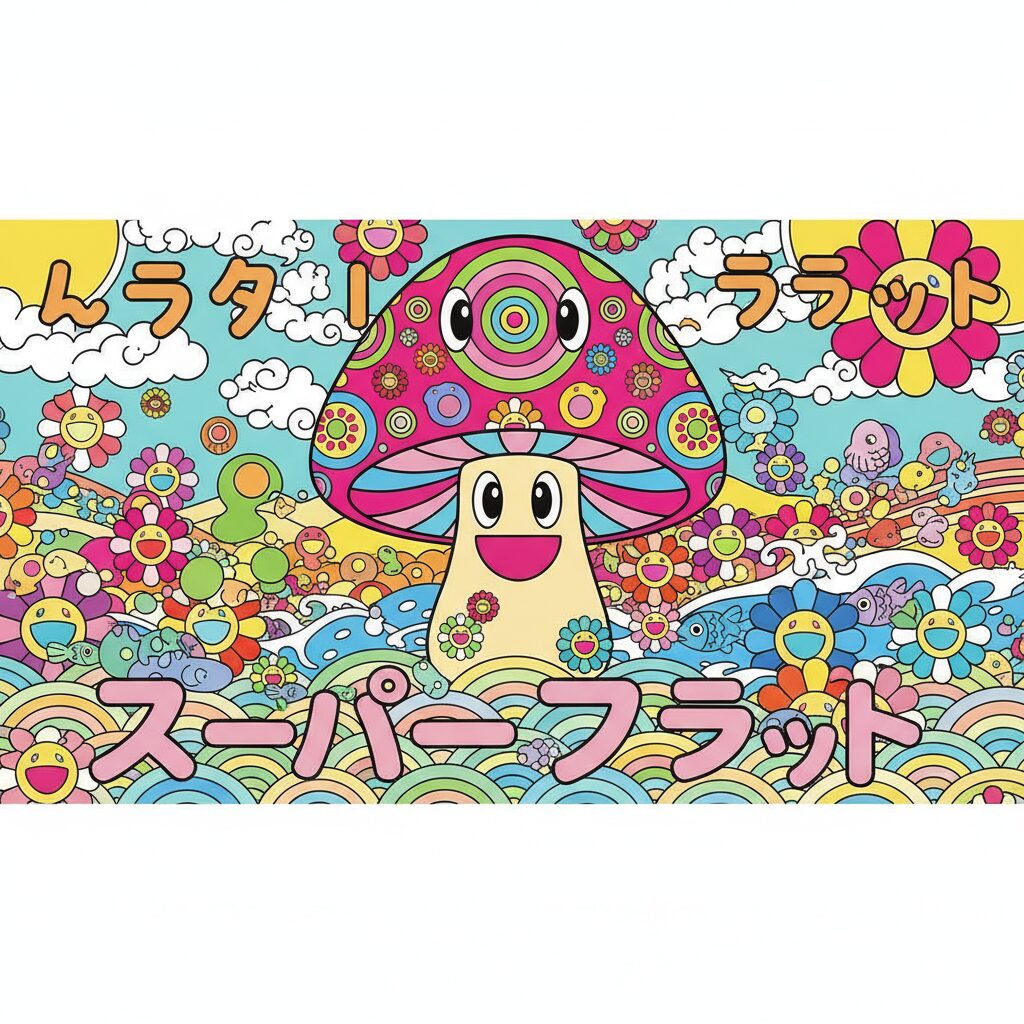
To follow Murakami’s path is to see Japan in a fresh light. It reveals that the country is not a simple dichotomy of ancient tradition versus futuristic technology, but a complex, layered, and often contradictory tapestry where these forces continually collide, merge, and create something entirely new. His art acts as a mirror reflecting this reality. The smiling flowers carry subtle echoes of historical trauma, the cute characters are infused with a dark, manic energy, and the most esteemed artistic techniques depict the disposable icons of pop culture. This is the core of Superflat—it is a worldview, a survival strategy, and an artistic language all rolled into one.
As you depart Tokyo, you will notice Murakami’s world everywhere. You’ll see it in the character-adorned packaging in convenience stores, in the flattened perspective of traditional woodblock prints, in the passionate devotion of collectors, and in the seamless blend of art and commerce in a Ginza window display. He has provided us with a lens through which to view modern Japan, and indeed, our contemporary world. Your journey may have been a tour of physical places, but ultimately, it is an exploration of ideas. The greatest souvenir you can bring home is this fresh way of seeing—a deeper appreciation for the profound complexities lying just beneath the bright, colorful, and impossibly flat surface of our times.