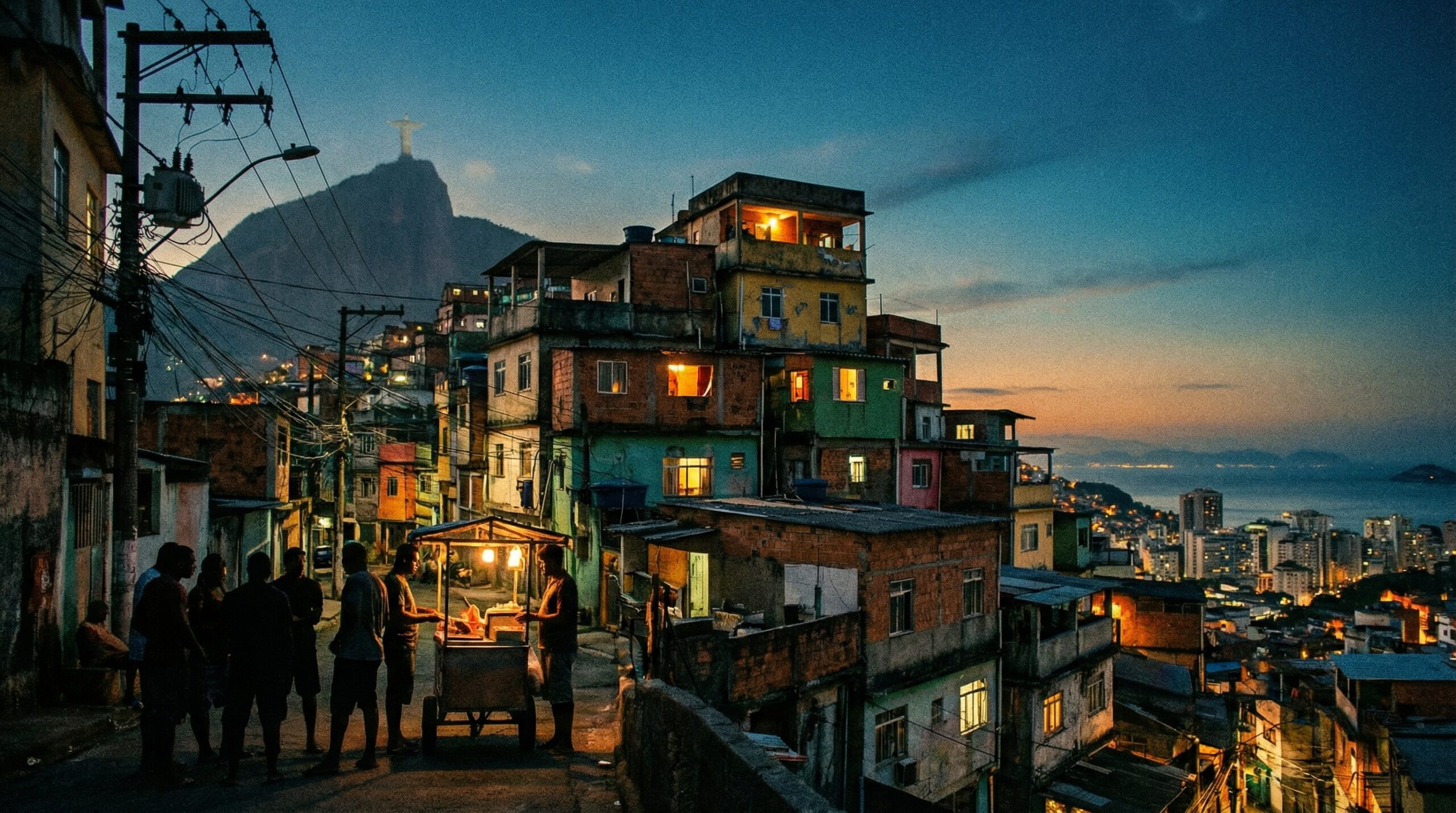
There are films that entertain, and then there are films that grab you by the collar, shake you to your core, and never let go. Fernando Meirelles’s 2002 masterpiece, Cidade de Deus, or City of God, is firmly in the latter camp. It’s a dizzying, sun-scorched, and brutally honest chronicle of life, crime, and survival in the favelas of Rio de Janeiro, told with a kinetic energy that leaves you breathless. The film exploded onto the global stage, not just as a piece of cinema, but as a cultural document, a window into a world many had never seen, or perhaps, had refused to see. For those of us haunted by its powerful imagery and unforgettable characters—Rocket, Li’l Zé, Benny—the idea of walking those same streets, of feeling the pulse of the place that birthed this story, is an irresistible call. This is not your typical cinematic pilgrimage. It’s a journey into the heart of Rio’s complex social fabric, an exploration of the line between fiction and a reality that is, in many ways, even more profound than what was captured on screen. It’s about understanding the soil from which such a powerful story could grow. This guide is your first step into that world, a map not just of locations, but of the history, the culture, and the very soul of the real City of God.
If you’re captivated by the idea of tracing the footsteps of cinematic history, you might also be interested in exploring the iconic Berlin locations from the film Run Lola Run.
The Myth and The Reality: Understanding Cidade de Deus
Before exploring the cinematic locations, it’s essential to grasp a fundamental fact that shapes this entire journey: the film City of God was not actually shot in the real Cidade de Deus favela. The reasons behind this are as intricate and layered as the story itself, rooted in the history of the area and the perilous reality of Rio during the late 1990s when filming began. To truly appreciate the film and its settings, we must first understand the real story of the community that inspired its name.
A City Born from Eradication
The actual Cidade de Deus has a history marked by social engineering and displacement. It was not an organically developed settlement. Rather, it was a government-built housing project erected in the 1960s under Carlos Lacerda’s administration. The aim was clear: to eliminate favelas from Rio’s wealthy, scenic South Zone—areas such as Copacabana, Ipanema, and Lagoa—and relocate their poor inhabitants far from the city’s glamorous tourist districts. Families were forcibly removed, their makeshift homes destroyed, and relocated to this new, isolated development far to the west. On paper, it appeared to be a solution. In reality, it was segregation. The government promised a fully developed community with infrastructure, sanitation, and opportunities, but delivered instead a grid of concrete houses in a remote area with little access to jobs, transport, or public services. These promises never materialized, leaving the community to survive on its own. This systemic neglect created a void that, over the decades, was filled by poverty, desperation, and eventually the organized drug trade that forms the violent backdrop of the film.
The Lens of Paulo Lins
The story’s harrowing authenticity comes from the fact that it was lived firsthand. The film is based on the semi-autobiographical novel of the same name by Paulo Lins, who grew up in the real Cidade de Deus during the turbulent ’60s, ’70s, and ’80s. Lins was not an outsider looking in; he belonged to the community and knew the real-life counterparts to the characters in his story. He was Rocket, the observer with a camera, navigating a world of extreme violence while seeking a different path. His novel, published in 1997, was a sprawling and unflinching epic crafted from years of anthropological research and personal experience. It gave voice to a generation lost to drug wars, humanizing what might otherwise have been mere statistics and headlines. This source material, born of lived experience, provided the unshakable foundation for the film’s impact. It was not just a gangster tale; it was a sociological study, a heartfelt cry from a forgotten community.
Why They Couldn’t Film There
By the time Fernando Meirelles and co-director Kátia Lund were ready to shoot, the real Cidade de Deus was off-limits for a major film production. The community was engulfed in a violent conflict between rival drug factions, making it far too dangerous to bring in a large crew, costly equipment, and actors. The very tensions shown in the film were unfolding in real time. Shooting there would have been reckless and irresponsible, risking the safety of everyone involved. The production team needed a controlled and safer environment where they could recreate the look and feel of the story’s setting without putting themselves in harm’s way. This vital decision led them to select substitute locations that could visually and spiritually capture the world Paulo Lins had vividly portrayed.
The Cinematic Stand-Ins: Unveiling the True Locations
The magic of filmmaking lies in illusion, and the crew of City of God were true masters of this craft. They explored numerous communities across Rio, searching for locations that not only looked authentic but also shared a similar energy and history. The final product is a composite—a cinematic version of Cidade de Deus pieced together from various favelas and neighborhoods, creating a world that feels entirely real and cohesive on screen. The primary setting they chose was a community that provided the film with its gritty, sun-bleached aesthetic and served as the main backdrop for the unfolding drama.
The Heart of the Shoot: Morro da Coroa and Cidade Alta
Most of the film’s favela scenes were filmed in a cluster of neighborhoods in Rio’s central and northern zones. Though details can be scattered, much of the shooting occurred in and around Morro da Coroa in the Catumbi neighborhood, as well as in Cidade Alta, a housing complex in Cordovil. These were not tourist hotspots but working-class communities presenting unique logistical and social challenges. The production team worked hard to foster relationships with locals, casting many as extras and ensuring the filming process benefited the community. This approach lent the film an extraordinary layer of authenticity. The faces seen in the background are not paid Hollywood extras but real residents whose lives and expressions contribute a documentary-like realism to the story.
The Gritty Streets of the “Tender Trio”
Recall the early scenes with the Tender Trio—Shaggy, Clipper, and Goose—and their ill-fated gas truck robbery? The dusty, unpaved streets and makeshift buildings that defined the early days of the City of God were recreated within these substitute locations. Watching those scenes, you witness the raw texture of communities like Cidade Alta. The filmmakers selected areas with a distinct visual character: narrow, winding alleyways that generate a sense of claustrophobia and constant vigilance; open dirt fields that serve as settings for soccer games and gangland executions; and the repetitive, near-brutalist architecture of government housing projects. These visual elements were essential in telling the story of a community both tightly bonded and perilously exposed.
Li’l Zé’s Reign of Terror
The settings used to depict Li’l Zé’s violent ascent are key to the film’s terrifying momentum. The notorious apartment complex where he and his gang establish dominance—a hub of drug dealing and casual brutality—was an actual residential block in one of these filming sites. The production team dressed the set to fit the period, but the basic structure—the imposing concrete facade, the open-air corridors, the sense of a contained, lawless realm—was already present. The narrow passageways where Rocket desperately flees from the police, the open plaza where Benny’s farewell party tragically unravels, and the dusty back roads where rivals are eliminated were all shot in these carefully chosen locations. Touring similar neighborhoods today requires a guide and profound respect but offers insight into the spatial dynamics the film so deftly captured: the lack of privacy, the way sound carries, and the feeling that there is nowhere to hide.
Beyond the Favela: Weaving Rio’s Tapestry
City of God extends beyond the favela, skillfully contrasting the insular world of the housing project with Rio de Janeiro’s broader, more iconic landscape. These scenes function as powerful narrative devices, symbolizing escape, aspiration, and the stark social divisions shaping the city.
The Beaches of Escape and Contemplation
One of the film’s most poignant visual symbols is the beach. For Rocket, Rio’s famous coastline—the golden sands and rolling waves—represents a world far removed from the violence and poverty of his neighborhood. The beach is a place of freedom, photography, and a possible future. Many of these scenes were filmed on the renowned beaches of the Zona Sul (South Zone), likely including stretches of Ipanema and Copacabana. When Rocket photographs his friends against the ocean backdrop or characters gaze out at the water, these moments provide visual relief from the favela’s oppressive grit. A visitor standing on that same sand feels the duality vividly: looking one way, the iconic Sugarloaf Mountain and throngs of tourists come into view; turning around reveals a completely different reality just beyond the hills. This geographical truth underlines the film’s themes of social immobility and longing for escape—the beach is so close yet, for City of God residents, might as well be another world.
Downtown’s Concrete Jungle
As Rocket’s journey as a photographer advances, he ventures into downtown Rio’s professional sphere. Scenes set in the offices of a major newspaper were filmed in Centro, the city’s bustling commercial core. This environment starkly contrasts with the favela. It is a world of concrete and glass towers, formal business attire, and rules and hierarchies vastly different from the ganglands’ brutal power structures. The shift from the favela’s organic chaos to the city center’s rigid grid visually mirrors Rocket’s own ascent, crossing social and economic barriers using his camera as his passport into a different social stratum. Exploring Centro today, one can still feel that same energy—the rush of commerce, the historical weight in its colonial architecture, and the sense that this is the operational heart of a sprawling metropolis, a world apart from the struggles portrayed in the film.
The Pilgrim’s Journey: How to Experience the Real Rio
Embarking on a pilgrimage inspired by City of God is a complex endeavor. It requires more than just a map and a camera. It calls for sensitivity, an awareness of ethical issues, and a sincere wish to understand rather than merely observe. The world portrayed in the film is not a theme park; it is the lived reality for millions of Cariocas (residents of Rio).
To Tour or Not to Tour? The Favela Tourism Debate
The rise of “favela tourism” is a direct result of the global fascination triggered by films like City of God. This phenomenon is a double-edged sword. On one side, it can bring much-needed income to marginalized communities, challenge negative stereotypes, and promote cultural exchange. On the other side, if handled poorly, it can be exploitative, voyeuristic, and profoundly disrespectful—often referred to as “poverty tourism.” The image of tourists in air-conditioned jeeps taking pictures of residents as if they were zoo exhibits is deeply troubling. Therefore, the choice to take a favela tour should be made with careful thought.
Choosing an Ethical Tour
If you decide to visit a favela, the most important factor is to select an ethical, responsible tour operator. The best tours are designed and led by the residents themselves. These guides do more than just show you a place; they share their home, culture, history, and personal stories. Look for companies that clearly state that a substantial portion of their profits are reinvested in the community, supporting social projects, schools, or local businesses. An ethical tour should feel like being welcomed as a guest, not like being an intruder. The emphasis should be on cultural immersion—visiting a local artist’s studio, learning about a community music initiative, dining at a resident-owned restaurant—rather than gawking at poverty or hunting for sensationalized “danger.” Research thoroughly, read reviews, and ask about the company’s philosophy and its relationship with the community. A good tour will leave you feeling humbled, informed, and inspired, with a deeper respect for the resilience and vibrancy of these neighborhoods.
Independent Exploration: A Word of Caution
Let’s be clear: entering a favela alone as an uninformed tourist is unwise. It is not a sign of bravery or authentic travel; it is folly. The social and political dynamics of these areas are highly complex. While many favelas, especially those that have been pacified, are home to warm, welcoming, and hardworking people, some remain under the control of criminal gangs. The rules are unwritten and constantly changing. As an outsider, you cannot interpret the signs, you do not know the boundaries, and you could easily find yourself in danger through simple ignorance. Your presence might be misunderstood, and one wrong turn could lead to serious consequences. Always go with a trusted local guide who understands the current situation on the ground and has the community’s approval to be there.
Capturing the Spirit, Not Just the Shot
If you are a photographer like Rocket, the visual richness of a favela is undeniable. The colors, textures, light, and life flowing through the streets create a compelling canvas. However, this comes with great responsibility. The rule is simple: do not treat people as mere subjects. Do not point your camera in someone’s face without permission. Instead, the approach should be about connection. Smile. Learn a few words of Portuguese—“Bom dia” (Good morning), “Tudo bem?” (How are you?), “Posso tirar uma foto?” (Can I take a picture?). Engage people first as fellow human beings, not just as photographic subjects. Often, the best photos come after you’ve put the camera down, shared a conversation, and earned trust. The aim is to capture the community’s dignity, resilience, and joy—not to reinforce stereotypes of poverty and violence.
The Enduring Legacy: How “City of God” Changed Everything
The influence of City of God extends well beyond its box office success and critical praise. The film sent shockwaves through Brazilian society and the world, permanently reshaping the landscape of national cinema and sparking a global dialogue about the harsh realities of urban poverty and violence.
A New Wave of Brazilian Cinema
City of God revitalized Brazilian cinema by proving that a movie featuring local actors, using local slang, and telling a distinctly Brazilian story could resonate worldwide. Its raw, dynamic style and unflinching storytelling inspired a new generation of filmmakers. It opened the door for other acclaimed films addressing similar themes, such as Elite Squad (Tropa de Elite), which explored the realm of Rio’s special police forces. The film showed that the stories emerging from the country’s favelas were more than mere crime tales—they were epic human dramas deserving of global attention. It also launched the careers of many non-professional actors, notably Seu Jorge and Alice Braga, who went on to achieve international fame.
The Pacification Effect and Its Aftermath
The film’s release coincided with a period of intense international scrutiny of Rio as it prepared to host the 2014 FIFA World Cup and the 2016 Olympic Games. The global perception of Rio’s favelas, largely shaped by films like City of God, became a critical concern for officials. This led to the introduction of the UPP (Unidade de Polícia Pacificadora, or Pacifying Police Unit) program. Its aim was to establish a lasting police presence in favelas formerly controlled by drug traffickers, expelling gangs and reintegrating these communities into the city. In its early years, the program achieved some success in lowering homicide rates and improving safety in certain areas. However, the UPP program has been beset by controversy and difficulties. Critics highlight issues such as police brutality, insufficient long-term social investments, and the displacement of violence to other neighborhoods. In recent years, amid Brazil’s economic and political crises, funding for UPPs has been slashed, and many favelas have witnessed a resurgence in gang activity. This complex and ongoing reality serves as the real-world epilogue to the era depicted in City of God.
The Real “City of God” Today
But what about the actual Cidade de Deus community? Although the film was not shot there, it has placed a lasting spotlight on the neighborhood. Since its release, the community has come to symbolize both the challenges and potential of Rio’s outskirts. It has seen the emergence of remarkable community-driven organizations, cultural centers, and social initiatives. Groups like CUFA (Central Única das Favelas), a nationwide organization founded in Cidade de Deus, have become influential forces for social change, employing hip-hop, graffiti, and other cultural expressions to empower youth and create new opportunities. While poverty, violence, and governmental neglect remain significant challenges, the true Cidade de Deus is not simply the place of despair portrayed in the film. It is a community rich with millions of stories, abundant cultural wealth, resilience, and a strong determination to build a better future. It is home to artists, musicians, entrepreneurs, and families who continue to fight for their dignity and rightful place in the city.
Beyond the Silver Screen: Finding Rio’s Soul
A pilgrimage into the world of City of God is ultimately a journey of perspective. It starts with the excitement of chasing cinematic ghosts through Rio’s vibrant, chaotic streets, but concludes with a much deeper understanding of the city’s human geography. You won’t find the exact street corner where Li’l Zé met his fate or the particular apartment where the gang planned their takeover. Those locations exist only on film—an exceptional and brutal fiction woven from threads of reality. What you will discover is something far more enduring. You will encounter the spirit of resilience in the communities that formed the film’s backdrop. You will sense the striking contrast between the postcard-perfect beaches and the complex, striving life within the favelas. You will witness the lasting legacy of a film that gave voice to the voiceless and compelled the world to acknowledge a place long ignored. To walk these streets is to realize the story never truly ended. It lives on today in the lives of those who call these places home. Approach this journey not as a tourist, but as a student—with an open heart, respectful presence, and a readiness to see beyond the frame. By doing so, you will uncover the true, unconquerable soul of Rio de Janeiro.