
There are films that entertain, films that thrill, and then there are films that resonate so deeply they feel etched into our collective memory. Tom Hooper’s masterpiece, The King’s Speech, is one such film. It’s more than a historical drama; it’s a profoundly human story about the crushing weight of expectation, the quiet terror of a personal struggle played out on a global stage, and the unlikely friendship that helped a king find his voice. The film swept us away with its impeccable performances and poignant narrative, but it also transported us to a world of breathtaking grandeur and intimate, history-soaked spaces. The story of King George VI, or ‘Bertie’ as we come to know him, and his Australian speech therapist, Lionel Logue, unfolds against a backdrop of some of England’s most magnificent and atmospheric landmarks. To walk these halls, to stand in these rooms, is to step directly into the world of the film, to feel the echo of Bertie’s stammer and the steadfast calm of Logue’s encouragement. This is not just a tour of film sets; it is a journey into the heart of a story about courage and connection, set against the very real fabric of British history. It’s a chance to explore the contrast between the gilded cage of royalty and the humble strength found in a London consulting room, to understand how place itself can become a character in a story. From the hallowed aisles of a great cathedral to the time-worn elegance of a Georgian townhouse, these locations are waiting to share their secrets. Come, let’s embark on this royal pilgrimage and discover the tangible world behind the cinematic magic.
If you’re fascinated by how films use real-world locations to tell their stories, you might also enjoy exploring the surreal filming locations of David Lynch’s Lost Highway.
The Gilded Cage: Lancaster House as Buckingham Palace
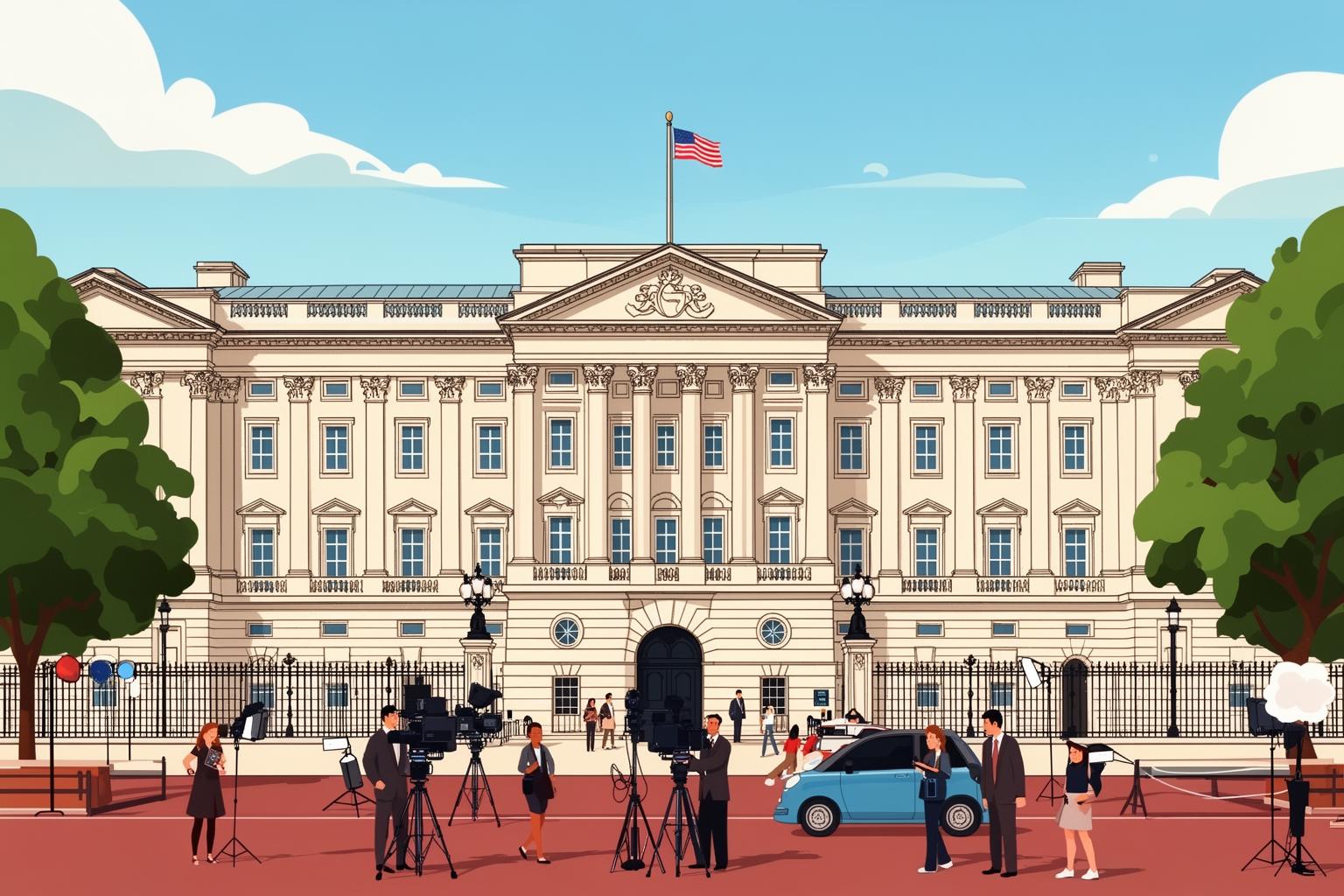
No location in The King’s Speech more vividly captures the stifling grandeur of royal life than Lancaster House. Serving as a stand-in for the far more logistically complex Buckingham Palace, this splendid neoclassical mansion, nestled in the St. James’s district, provides the film with its regal core. From the moment it appears on screen, you grasp the world Bertie inhabits—a realm of immense privilege coupled with immense pressure. The filmmakers expertly utilized its opulent interiors, conveying the vast scale and strict formality that enveloped the royal family. It is here that we see Prince Albert, Duke of York, making his way through the vast, resonant corridors, a small figure amid a monumental setting, his personal anxieties overshadowed by the grandeur surrounding him. The Long Gallery, with its soaring ceilings, intricate gilded decorations, and rich crimson fabrics, serves as the backdrop for tense family dialogues and formal processions. You can almost sense the chill in the air and the feeling that every word and gesture is scrutinized within these historic walls.
Stepping into Royalty
One of the most unforgettable scenes filmed at Lancaster House depicts Bertie rehearsing for his coronation, walking the length of the gallery as Logue coaches him. The camera pulls back, highlighting the vast distance he must traverse—a visual metaphor for his journey. The State Drawing Rooms and Music Room also stood in for the palace’s private apartments, where formal audiences and strained meetings with government officials unfold. The extraordinary detail in these rooms—the delicate plasterwork, priceless artworks, and gleaming chandeliers—creates an atmosphere that is both stunning and intimidating. It is a world crafted for ceremony, not comfort. For visitors, appreciating this context is essential. While Lancaster House functions as a government building, primarily hosting diplomatic events and rarely open to the public, it occasionally welcomes visitors during the annual Open House London weekend. Stepping inside is a rare privilege. The atmosphere is one of muted reverence. The floors creak with history, and the light streaming through the tall windows seems to illuminate dust motes dancing with centuries of secrets. It feels less like a home and more like a museum you are momentarily permitted to inhabit—perfectly reflecting Bertie’s own sense of estrangement in his life.
The Practicalities of a Palace Visit
For those eager to glimpse this cinematic landmark, timing is crucial. Watch closely for the Open House London schedule, usually released in late summer for the September event. Booking is almost always necessary and fills quickly, so be ready. If you miss the chance to enter, strolling through the St. James’s area remains richly rewarding. Lancaster House’s imposing façade can be admired from outside, and its proximity to St. James’s Palace and The Mall lets you absorb the royal ambiance of the neighborhood. Picture the black cars pulling up to the entrance, the weight of a nation resting on the shoulders of the man stepping out. The house itself is a masterpiece of early 19th-century design by Benjamin Dean Wyatt, and its history is as deep as its interiors. Once the most expensive private residence in London, its transformation into a center for government hospitality adds another chapter to its story. Standing outside, you can almost feel the power and ceremony defining this corner of London—the very forces that shaped the man who became King George VI.
A Cathedral of Anxiety: Ely Cathedral as Westminster Abbey
Arguably the most crucial scene in The King’s Speech is the coronation. As the climax of Bertie’s journey, where he must confront his deepest fears before God and his subjects, it required a setting of immense grandeur and reverence. Although the actual event took place in Westminster Abbey, the challenges of filming in such a busy and sacred location led the production to choose the magnificent Ely Cathedral in Cambridgeshire. And what an extraordinary choice it proved to be. Ely Cathedral, affectionately known as the ‘Ship of the Fens’ due to its dominance over the flat landscape, serves as a stunning stand-in. Its expansive, uninterrupted nave is among the longest in Britain, and the filmmakers made full use of its length and height to heighten Bertie’s sense of isolation and vulnerability. As he makes the long, solitary walk toward the Coronation Chair, the camera ascends dramatically, portraying him as a small, fragile figure within a vast, awe-inspiring space. The weight of the crown, scepter, and the historical significance of the moment is echoed by the enormous stone pillars and soaring vaulted ceilings around him.
The Architecture of Intimidation
Ely Cathedral’s distinctive architectural elements perfectly complement the film’s emotional tone. The overwhelming sense of history is palpable. Originally founded as a monastery in 673 AD, the present structure dates back to 1083. Those centuries seem to press down as you walk across the stone floors. Inside, the light is ethereal, streaming through stained glass and highlighting the intricate details of the choir and presbytery. The film’s cinematographer, Danny Cohen, employed wide-angle lenses to subtly distort perspective, making the cathedral appear even larger and more formidable, mirroring Bertie’s own fearful view of the occasion. One of the cathedral’s most breathtaking features, the Octagon Tower—a marvel of medieval engineering—floods the central crossing with a gentle, divine light. It is beneath this celestial lantern that the Archbishop of Canterbury anoints the new king. Visiting this very spot is a deeply moving experience. You can tilt your head back to admire the intricate wooden structure high above and picture the quiet crew, the actors’ intense focus, and the weight of history they were recreating. The atmosphere inside is cool and still, tinged with the faint aroma of incense and ancient stone. The echoes of countless prayers seem to hang in the air, creating a fitting ambiance for a scene about finding faith in oneself.
Planning Your Pilgrimage to Ely
A trip to Ely makes a delightful day out from London, easily reachable by train from King’s Cross Station in just over an hour. The city itself is charming and compact, with the cathedral as its unmistakable focal point. Unlike some other filming locations, Ely Cathedral is friendly and accessible to visitors. As it is an active church, it’s advisable to check the schedule for services or special events before visiting. There is an admission fee that goes towards maintaining this historic gem, and it is well worth the cost. Plan to allow at least a couple of hours to explore fully. Don’t limit yourself to seeking out filming sites; take the time to discover the cathedral’s other marvels. The Lady Chapel, with its delicate, lace-like stone carvings, is regarded as one of the finest in Europe. For a modest additional fee, you can join a tower tour, offering unmatched views of the surrounding Fenlands and a unique insight into the cathedral’s construction. For families, the sheer scale of the cathedral often fascinates younger visitors, and the open grounds provide a perfect space for running around after a quiet indoor visit. Ely Cathedral is a place that manages to be both grand and serene—a perfect symbol of the inner victory King George VI achieves within its walls.
The Heart of the Matter: 33 Portland Place
If the palaces and cathedrals symbolize the rigid, public world Bertie must navigate, then Lionel Logue’s consulting room at 33 Portland Place serves as the film’s private, emotional heart. This sanctuary is an unconventional space where a king can simply be a man, and where true healing begins. The filmmakers sought a location that felt genuine, lived-in, and distinctly un-royal. They discovered it in a stunning, Grade II* listed Georgian townhouse in Marylebone. What makes this site so ideal is its magnificent sense of ‘faded grandeur.’ The peeling paint, the vast, empty-feeling rooms, and the striking, unfiltered light streaming through tall, unadorned windows create an atmosphere of intimacy and gentle decay. It’s a space rich in character and history. It feels authentic. The consulting room itself, with its textured walls and slightly cluttered appearance, contrasts sharply with the gilded perfection of Lancaster House. It’s a space meant for work, not display. This visual contrast is key to the film’s narrative. It is in this room that the rigid hierarchy between king and commoner is dismantled, and where Bertie is compelled to confront his demons on neutral ground.
A Room with a View to a Soul
The selection of 33 Portland Place was inspired. Designed by the renowned 18th-century architect Robert Adam, the building exudes its own kind of grandeur—one that is human in scale. The film skillfully uses the building’s layout. We witness Bertie’s initial hesitation as he enters the unpretentious structure, his surprise when led down to a basement consulting room. The journey through the house is a descent, both figuratively and literally, into a more honest and intimate space. The main room where the therapy sessions occur is the centerpiece. The filmmakers were so taken with the texture of the walls that they fashioned the entire set around them. This raw, unpolished backdrop becomes a canvas reflecting the emotional turmoil and eventual breakthroughs of the characters. We recall Bertie shouting profanities, his wife Elizabeth seated with steadfast patience, and Logue guiding him with gentle persistence, all within these four walls. Although 33 Portland Place is a privately owned events venue and not open to public entry, its exterior is distinctive and worth seeing. Standing on the pavement outside, you can gaze up at the elegant façade and envision the story unfolding inside. The Marylebone neighborhood itself is a delight to explore, filled with lovely Georgian architecture, independent shops, and serene garden squares. It feels like a village nestled within the city—a perfect backdrop for Lionel Logue’s private world.
The Allure of Authenticity
While the interior is closed to public tours, the building is frequently used for other film productions and upscale events, highlighting its unique ambiance. Its cinematic legacy is rich, and its role in The King’s Speech has secured its place in the hearts of film enthusiasts. The beauty of this location lies in what it symbolizes: the power of a safe space. Logue’s consulting room was more than just a room; it was a haven where the rules of the outside world were suspended. It was where Bertie could show vulnerability without fear of judgment. Though you might not be able to sit in the chair where Colin Firth gave his Oscar-winning performance, simply being near Portland Place connects you to that central theme. It serves as a reminder that the most significant journeys often take place not in grand palaces or cathedrals, but in quiet rooms where one person has the courage to seek help and another the kindness to offer it.
Recreating the Roar of the Crowd
The film is framed by two powerful speeches at Wembley Stadium, charting Bertie’s evolution from crippling fear to hard-won confidence. The opening scene, set during the 1925 British Empire Exhibition, masterfully captures anxiety. Through Bertie’s eyes, the vast, intimidating stadium looms large, the microphone like an instrument of torture, and the faceless crowd a sea of judgment. The filmmakers faced the challenge that the original Wembley Stadium, with its iconic twin towers, was demolished in 2003. A modern stadium lacked the right historical feel. The solution was a clever blend of two different locations combined with digital effects. The grandeur of the stadium and royal box were shot at Elland Road, home of Leeds United Football Club. Its older architecture and steep seating banks provided the perfect backdrop. The production team adorned a section with period-appropriate banners and filled it with hundreds of extras dressed in 1920s attire. The sense of scale and the feeling of one man facing a vast audience were brilliantly conveyed here. For scenes on the pitch, including Bertie’s solitary walk to the microphone, filming shifted to Odsal Stadium in Bradford, a rugby league ground. Odsal’s expansive, bowl-like shape and sprawling terraces gave the filmmakers the raw, epic scale needed to express the crowd’s enormity and the Prince’s isolation.
The Art of Illusion
Today, visiting Elland Road or Odsal Stadium requires a good deal of imagination to see them as 1920s Wembley. They are modern, active sports venues. Yet, knowing their role in the film adds a fascinating dimension for any fan. Attending a match at Elland Road, for example, lets you experience the roar of a passionate crowd firsthand, offering a glimpse of the overwhelming sound that confronted Bertie. It’s a powerful reminder of the filmmaking team’s skill—the set designers, costume department, and visual effects artists—who transformed these contemporary locations into a convincing historical world. Using substitute locations is a common filmmaking practice, driven by the search for the right atmosphere, logistics, and budget considerations. In this case, moving production north to Yorkshire proved highly successful, delivering scenes that feel historically authentic and emotionally resonant. It also expands the geography of our journey, highlighting that the story of this English king was brought to life through the support of communities and landmarks across the country.
The Royal Tour Continued: Other Notable Locations
While the key locations form the film’s main framework, numerous other historic sites across England were used to enrich the world of The King’s Speech, each contributing its own distinctive texture and historical significance.
Old Royal Naval College, Greenwich
This stunning UNESCO World Heritage Site in Greenwich, designed by Sir Christopher Wren, is one of London’s most popular filming spots—and for good reason. Its magnificent classical architecture and grand courtyards can convincingly portray a variety of stately settings. In The King’s Speech, the colonnades and grounds stood in for the entrance to Buckingham Palace in several scenes, enhancing the sense of imposing, formal grandeur. A visit to Greenwich is essential for any London traveler. You can walk the same grounds as the actors, admire the Painted Hall (often called Britain’s Sistine Chapel), and enjoy breathtaking views of the London skyline from Greenwich Park. The entire area is steeped in maritime and royal history, making it a rich and rewarding place to explore.
Knebworth House, Hertfordshire
When the film required a location to represent Balmoral, the Royal Family’s private Scottish retreat, it chose the romantic, turreted façade of Knebworth House in Hertfordshire. This magnificent Tudor Gothic stately home serves as the backdrop for the tense scenes surrounding the abdication crisis. The shift from formal London settings to the lush greenery of the countryside signifies a move into the family’s private sphere, though political pressures follow even here. Knebworth House is a fantastic spot to visit, particularly for families. The house is steeped in history, but it is perhaps better known today for hosting legendary rock concerts. The expansive grounds include beautiful gardens, a maze, and an excellent adventure playground for children. It’s a place where the weight of history feels somewhat lighter, offering a glimpse into the aristocratic lifestyle far removed from Lionel Logue’s London townhouse.
Drapers’ Hall, City of London
The opulent interiors of Drapers’ Hall, one of the historic Livery Halls in the City of London, were used to depict the accession council room at St. James’s Palace. It is here that, following the death of his father King George V, Bertie must stand before the council and speak. The room’s grandeur, highlighted by marble columns and elaborate paintings, emphasizes the solemnity and gravity of the moment. Like Lancaster House, Drapers’ Hall is not generally open to the public but does participate in events such as Open House London. A stroll through the City of London reveals many of these hidden architectural treasures, providing a glimpse into the ancient traditions and wealth that have shaped the capital for centuries.
Planning Your Own Royal Pilgrimage
Exploring the filming locations of The King’s Speech offers a wonderful opportunity to immerse yourself in England’s history, architecture, and cinematic heritage. With some careful planning, you can create an itinerary that is both inspiring and manageable.
A London-Focused Itinerary
Spending two or three days visiting London sites is easy to do. Begin in Marylebone with a stroll past 33 Portland Place, soaking up the ambiance of Lionel Logue’s neighborhood. From there, it’s a pleasant walk or a quick tube ride to St. James’s, where you can view the exterior of Lancaster House. Continue your royal walk down The Mall towards Buckingham Palace, picturing the processions and ceremonies that define this area. A visit to Greenwich to see the Old Royal Naval College is essential and can be combined with a trip to the Royal Observatory and a boat ride on the Thames for a perfect day out. Be sure to check the Open House London schedule if you wish to tour the interiors of Lancaster House or Drapers’ Hall.
Day Trips Beyond London
To experience the film’s most impressive locations, you’ll need to travel outside the capital. Ely Cathedral makes for the most rewarding day trip. Fast, regular trains from London King’s Cross make it an easy visit. The city itself is compact enough to explore on foot. Plan to spend at least half a day at the cathedral to truly appreciate its grandeur and beauty. Knebworth House is another excellent choice, especially from spring through autumn when the gardens are in full bloom. It is best accessed by train to Stevenage, followed by a short taxi ride. This makes for a relaxed, family-friendly day, combining history with outdoor enjoyment.
Tips for First-Time Visitors
Getting around these sites is relatively simple. London’s public transportation system is excellent, and an Oyster card or contactless payment is the most convenient way to travel on tubes and buses. For trains outside the city, booking tickets in advance is often more economical. When visiting cathedrals and stately homes, always check their official websites for opening hours, ticket costs, and any special events or closures. Most importantly, take your time. These places aren’t just items to tick off a list. They hold deep, evocative atmospheres. Sit in a pew at Ely, walk the length of the colonnade at Greenwich, stand quietly on Portland Place. In these moments of reflection, the film’s story and the history of the locations truly come alive.
The Enduring Voice of History

Visiting the locations of The King’s Speech is more than simply retracing the footsteps of its characters; it offers a deeper appreciation for the film’s artistry and the true history that inspired it. These buildings serve not just as backdrops but as silent witnesses to the story, their very stones carrying the weight of the past. From the grand splendor of a palace to the modest stillness of a consulting room, each place reveals a piece of Bertie’s journey. They remind us that history is not merely a sequence of grand events but a collection of profoundly personal struggles and victories. Standing in these magnificent spaces, you can almost hear the echo of a hesitant king finding his voice—a powerful reminder that even within the grandest halls, the most significant battles are often fought in the quiet chambers of the human heart.