
There’s a certain kind of story that lodges itself in your heart, not with grand battles or epic magic, but with the quiet, earnest struggle of finding one’s place in the world. P.A. Works’ 2017 anime, Sakura Quest, is one such tale. It follows five young women, led by the adrift Yoshino Koharu, as they stumble through the monumental task of revitalizing a sleepy, forgotten town called Manoyama. They grapple with tradition, modernity, and the bittersweet ache of a community fading away. We watched them, we cheered for them, and for many of us, a quiet wish formed: to visit a place like Manoyama. A place with deep roots, whispering rivers, and a soul that just needed a little coaxing to shine again. What if I told you Manoyama is real? It doesn’t bear the same name on any map, and you won’t find a Chupakabura statue at the station, but its spirit, its streets, its very essence exists, nestled in the heart of Toyama Prefecture. This is the story of Nanto, the collection of towns and villages that breathed life into the Kingdom of Manoyama, and a journey into the world where anime and reality beautifully, seamlessly blur.
For the traveler, the photographer, the dreamer, a pilgrimage here is more than just spotting anime locations. It’s an immersion into the very themes the show so tenderly explores. It’s about witnessing the dignity of craft, the warmth of a close-knit community, and the breathtaking beauty of rural Japan—a landscape of emerald rice paddies rolling toward the stoic embrace of distant mountains. This isn’t just a backdrop; it’s a character in its own right, one that shapes the lives of its people just as it shaped the narrative of Sakura Quest. It’s a journey to the heart of a story that reminds us that even in the quietest corners of the world, there are kingdoms waiting to be rediscovered. Prepare to leave the bustling metropolis behind and tune your senses to a slower, more profound rhythm. The Kingdom of Manoyama is waiting.
This journey into the heart of Nanto is a perfect example of how an anime pilgrimage can transform a simple trip into a deep, thematic exploration of a story’s world and its real-life inspiration.
The Arrival: Stepping into Johana Station
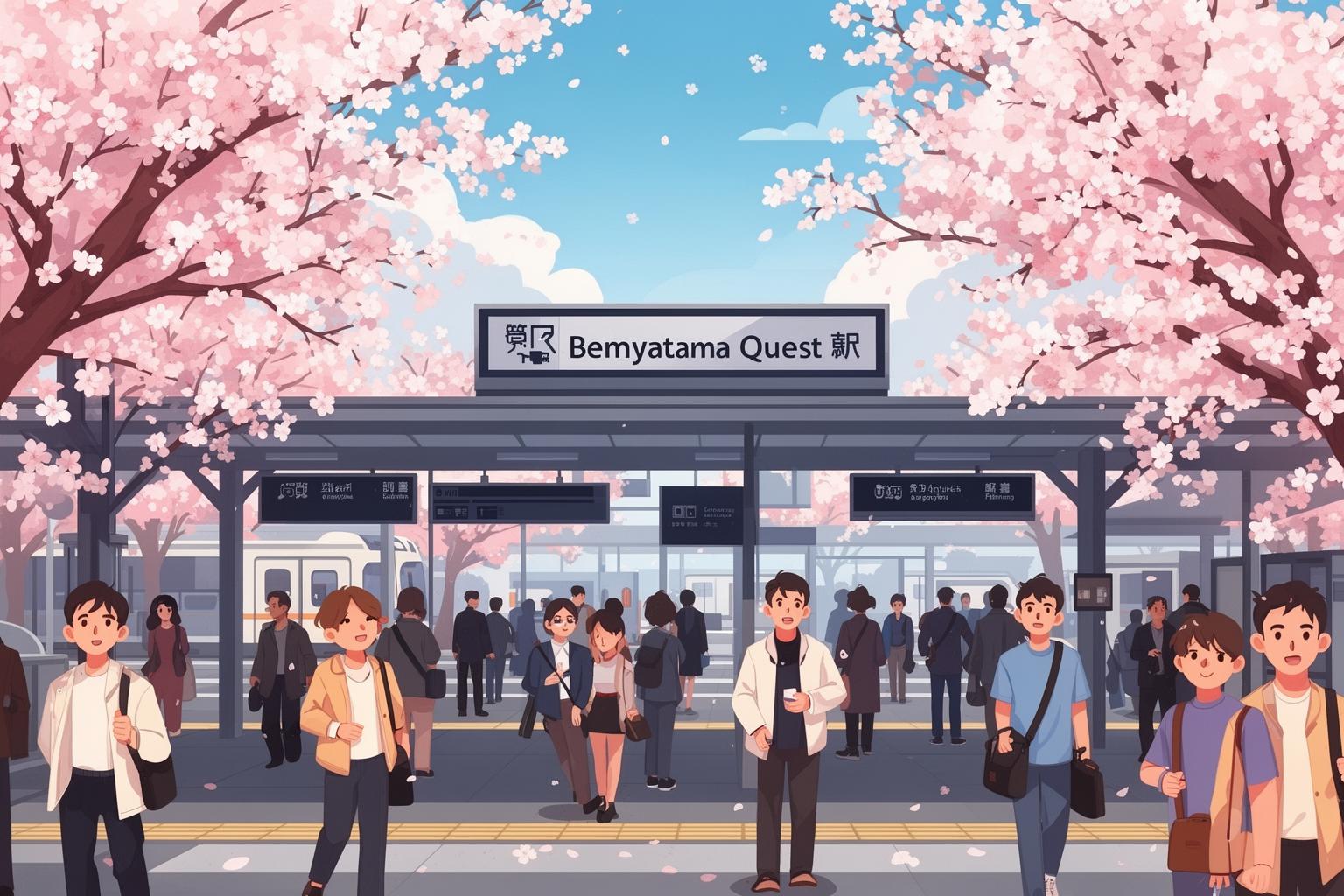
The journey to Manoyama begins, as expected, on a train. Not the sleek, silent Shinkansen that slices through the Japanese mainland at incredible speeds, but a smaller, more modest vessel. Upon arriving at the gleaming hub of Shin-Takaoka, you switch to the JR Johana Line, and it is here that the real transition starts. The landscape outside the window softens. Concrete and steel yield to expansive fields of green, dotted with the distinctive, heavy-tiled roofs of rural farmhouses. The train rocks with a gentle, rhythmic clatter, a sound that evokes a journey back in time. Each stop is a small, quiet platform, a brief pause in a world that seems to run on a different clock altogether.
Then comes Johana Station. For fans of Sakura Quest, the moment is charged with a peculiar sense of déjà vu. This is it—Manoyama Station. The single-story wooden building, the gentle slope of its roof, the very arrangement of the windows—it’s an exact, real-world replica of the anime’s central hub. You almost expect to see Yoshino and her friends bustling around, planning their next revitalization project. The real station, of course, is quieter. A gentle calm fills the air. Though there is no large tourism bureau office inside, the feeling remains the same. It’s a gateway, a portal from the everyday into the world of the story.
Pause for a moment on the platform. Listen. The sound is not of a bustling city, but the wind rustling through nearby trees, the distant murmur of the town, the chirping of birds. Look at the tracks stretching back the way you came and forward into the heart of the town. This is the very place where Yoshino Koharu, our reluctant queen, first took her uncertain steps into her new life. Stepping outside the station, the town of Johana unfolds before you, and you realize the pilgrimage has truly begun. The station is more than just a building; it’s a promise—a promise that the world you fell in love with on screen is tangible, waiting to be explored one quiet street at a time.
The Heart of the Kingdom: Wandering the Streets of Johana
Johana is the heart and spirit of Manoyama. As you leave the station and wander through its maze-like streets, the boundary between fiction and reality blurs into a delightful haze. The scale is intimate and human. This is a town designed for walking—meandering without a set destination, letting your curiosity lead you down narrow alleys and across quaint stone bridges. The Tourism Board, the central workplace of Yoshino and her team, isn’t confined to a single building but is embodied in the town’s spirit—in the carefully preserved storefronts, the historic markers, and the town’s quiet pride. Johana itself served as the main inspiration for Manoyama’s townscape, and its essence is woven into every frame of the anime.
Echoes of the Merchant Past
Head to Zentoku-ji Mae Dori, the street that stretches before the imposing Zentoku-ji Temple. This is Johana’s historic core, rich with a sense of history. In the Edo period, Johana thrived as a hub for the silk and cotton trade. The buildings here reflect that affluent past: traditional machiya merchant houses with dark wooden lattices, white plaster walls, and heavy charcoal-grey roof tiles. Though narrow from the front, their interiors are deep and spacious, having served as both homes and workplaces.
As you walk down this street, take note of the small details—the carved wooden signs, colorful potted plants, the way sunlight filters through the lattices. It all feels remarkably familiar. These are the streets where the characters wandered, held meetings, and confronted the everyday challenges of their mission. You can almost see Shiori, passionately explaining the history of these very buildings with her love for her hometown. The grand gate of Zentoku-ji Temple stands as a stunning backdrop—a silent, centuries-old witness to the town’s tale. It’s a powerful reminder that although Manoyama is fictional, its roots lie in real history, real commerce, and a genuine, enduring community.
The Whispering Waterways
One of Johana’s most charming features, carefully reproduced in Sakura Quest, is its network of small canals and waterways. These are more than mere decoration; they form part of the town’s circulatory system, a legacy of its agricultural and industrial heritage. Clear, cool water, drawn from the surrounding mountains, flows gently through these channels. In many, you’ll see flashes of bright orange, white, and gold. Johana is well-known for its koi carp, which leisurely swim in the canals lining the streets.
There is a meditative calm in walking alongside these waterways. The gentle sound of flowing water becomes the town’s natural soundtrack. The sight of vibrant koi gliding gracefully through their clear-water habitats is endlessly soothing. It reflects a profound bond with nature, blending the natural with the built environment—a hallmark of traditional Japanese town planning. For anime fans, these scenes are instantly recognizable, serving as backdrops for quiet conversations, moments of reflection, and the simple, everyday beauty of life in Manoyama. The carefully tended koi also symbolize the town itself—a lively, enduring essence flowing just beneath the surface, a treasure to be cherished and protected.
The Soul of a Craftsman: The Inami Woodcarving Tradition
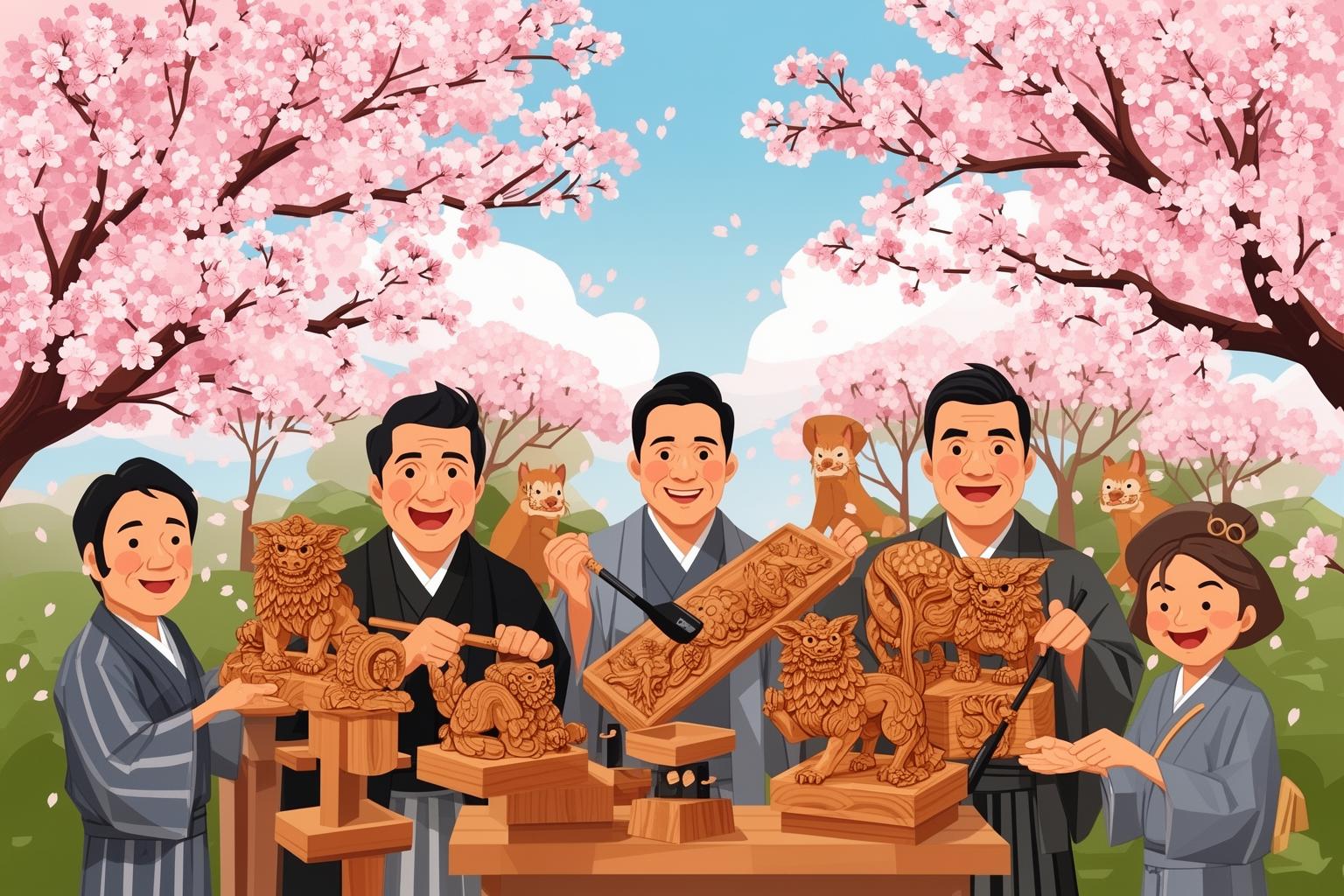
A short trip from Johana brings you to the town of Inami, another vital piece of the Manoyama puzzle. If Johana represents the kingdom’s heart, Inami is its artistic soul. In Sakura Quest, woodcarving is a cherished local tradition that serves as both a source of pride and economic challenge. This narrative draws directly from the vibrant reality of Inami, a town celebrated across Japan as the nation’s foremost center for woodcarving.
The moment you step into Inami, it becomes clear: wood is more than just a material here; it’s the town’s language. The air carries a subtle, sweet aroma of cypress and camphor wood. The soundscape is marked by the steady tap-tap-tapping of chisels—the creative heartbeat echoing from workshops hidden from view.
A Town Carved from Wood
Inami is a living tribute to this remarkable craft. It’s not limited to a museum or a single studio; the whole town serves as a gallery. Intricately carved panels decorate bus stops. Above the entrance to a simple shop, you might find a dragon or a spray of peonies. Even the phone booths sport carved wooden roofs. The most celebrated works are the public sculptures lining Yokamachi-dori, the main street. Here, from massive logs, you’ll find the seven lucky gods alongside whimsical animals, each carved with stunning detail and character.
Strolling down this street is a journey of discovery, inviting you to slow your pace and look more deeply. The skill on display is breathtaking—you can see the texture of an animal’s fur, the gentle curl of a leaf, or the fierce gaze of a deity, all coaxed from wood by a master’s hand. This world inspired the character Sandal-san, the eccentric woodcarver in the anime. His passion, dedication, and role as a tradition keeper mirror the hundreds of artisans who have preserved this craft in Inami for centuries.
Zuisen-ji Temple: A Cypress Masterpiece
Inami’s woodcarving legacy begins with Zuisen-ji Temple. This grand, magnificent temple serves as the town’s spiritual and artistic core. After the main hall burned down in the mid-18th century, master craftsmen from Kyoto were called in to lead its rebuilding. Local carpenters worked alongside these masters, acquiring the intricate temple carving techniques and birthing a local industry.
Visiting Zuisen-ji today reveals the peak of this art form. The main gate alone is a breathtaking masterpiece, adorned with carvings of lions, dragons, peonies, and celestial beings. Every beam, panel, and bracket is rich with detail. The interior matches the exterior’s grandeur, with vast ceilings and elaborate carvings evoking profound awe and reverence. The highlight for many is the dragon carved on the main hall’s transom, a piece so dynamic it appears ready to come alive.
Spending time at Zuisen-ji helps one grasp the deep cultural importance of this craft. It’s more than decoration; it’s devotion, storytelling, and a physical expression of faith and community. It is the legacy that Manoyama’s artisans in the anime desperately strive to protect.
The Hidden Cats of Inami
For a playful element in your Inami visit, keep a lookout for a recent charming addition to the town’s wooden collection. Hidden in unexpected places—peeking from eaves, resting on signposts, or playfully swatting at a string—are dozens of carved wooden cats. This delightful project was initiated by local artisans to bring a sense of fun and discovery to a walk through town. Finding them becomes a joyous scavenger hunt, a secret shared between you and the town’s creators. Each cat has a distinct personality, a whimsical spark perfectly embodying Inami’s creative and warm spirit.
The Dragon’s Slumber: The Serenity of Sakuragaike Pond
In the mythology of Manoyama, Sakura Pond and its dragon legend are central to the town’s identity. It serves as the dramatic climax location in their Mizuchi Festival play and holds deep mystical significance. This enchanting spot also has a beautiful real-world counterpart: Sakuragaike Pond. Nestled in a quiet, hilly area of Nanto, visiting this pond feels like stepping into one of the anime’s most serene and visually stunning scenes.
A Reflection of the Sky
Sakuragaike Pond is renowned for its striking natural beauty. Its deep, calm blue-green waters perfectly mirror the sky above and the lush greenery along its banks. A walking trail circles the pond, offering ever-changing views of the water and its surroundings. In spring, as its name suggests, the area is adorned with delicate pink and white cherry blossoms, creating an almost magical scene. In autumn, the hills blaze with fiery reds, oranges, and golds, their colors reflected in the tranquil water. Summer brings a rich green canopy, providing a cool, shaded retreat.
The atmosphere here is deeply peaceful. The air is fresh, with only the sounds of rustling leaves, birdcalls, and gentle lapping water. It is an ideal spot for quiet reflection—a place to escape the noise of daily life and be fully present in nature. One can easily imagine Yoshino and her friends coming here to clear their minds, find inspiration, or simply enjoy a moment of calm away from their busy routines.
From Local Myth to Anime Tale
What makes Sakuragaike Pond even more special is its rich legendary background. Local folklore tells of a powerful romance and a tragic transformation—a story of a human turning into a dragon. This ancient tale directly inspired the dragon legend in Sakura Quest. Knowing this adds a deeper dimension to visiting the pond, as you stand in the place that sparked the anime’s creative imagination.
The small shrine on the water’s edge serves as a reminder of the history embedded in this area. It exemplifies how the anime drew not only on the location’s appearance but also on its stories and spirit. The fictional Mizuchi Festival portrayed in the show becomes a heartfelt tribute to the real folklore of the Nanto region. Walking the path around Sakuragaike Pond, you’re not merely admiring a beautiful landscape; you’re journeying through a local legend passed down for generations, now brought to life and shared worldwide through the magic of anime.
The Rhythm of Community: Festivals and Local Life

Sakura Quest is fundamentally a story about community. It explores the effort to unite people, bridge the generational gap between old and young, and celebrate a collective identity. This theme is expressed most vividly through the festivals of Manoyama, which, like their locations and legends, are deeply rooted in the rich cultural fabric of Nanto.
The Dance of the Straw Hats: The Johana Mugiya Festival
The climax of the anime often centers on the Bonbori Festival, a beautiful, fictional tradition. However, the spirit of Manoyama’s festivals is inspired by real events, especially the Johana Mugiya Festival. Held every September, this is one of the region’s most significant cultural celebrations, featuring folk music and dance with a history that spans centuries.
The hallmark of the festival is the Mugiya-bushi, a melancholic folk song recounting the story of fleeing Heike clan warriors who settled in this remote area after their defeat in the 12th century. The accompanying dance is both elegant and sorrowful. Dancers, dressed in simple but graceful kimono, move with restrained poise, often wearing deep, wide-brimmed straw hats (amigasa) that partially conceal their faces. The kokiriko, an ancient bamboo percussion instrument, provides a distinctive rhythmic beat. Experiencing the Mugiya Festival is profoundly moving. The whole town of Johana comes to life. The historic streets, quiet most of the year, transform into stages for these heartfelt performances. It is a powerful example of cultural preservation—a community uniting to honor its history and art. This festival’s essence is reflected in the anime’s portrayal of community events—the dedication, rehearsals, shared pride, and bittersweet beauty of sustaining an old tradition in the modern age.
The Art of Revitalization: Life Imitating Art
Perhaps the most remarkable aspect of visiting Nanto is seeing the theme of revitalization unfold in real life. Sakura Quest was not only set in a rural area but was about the very challenges facing rural Japan—aging populations, the youth migration to big cities, and the struggle to preserve local industries and traditions. These are not fictional concerns. They represent the genuine challenges that Nanto and many other towns across Japan confront daily.
Visiting Nanto after Sakura Quest feels like stepping into a feedback loop. The anime, inspired by the region’s charm and struggles, has subsequently sparked a new wave of interest and tourism. Signs of this synergy abound: anime posters in local shop windows or small displays at tourist centers. Local businesses, much like those in the anime, find that connection to contemporary pop culture can be a powerful asset.
This adds a rich, almost meta-narrative dimension to the journey. You are not merely a tourist; you become a small part of the revitalization effort. Your curiosity, your visit, and your support for local shops and artisans contribute to the very cause Yoshino and her friends championed. It is a beautiful, hopeful phenomenon—art not just reflecting life but actively shaping and sustaining it. This transforms the pilgrimage from a simple sightseeing trip into a meaningful engagement with the story’s core.
A Pilgrim’s Practical Guide to Nanto
A journey to the authentic Manoyama is extremely rewarding, though it demands a bit more preparation than visiting Tokyo or Kyoto. This is rural Japan, and embracing its rhythm and unique qualities is part of the experience. Here’s what you need to know to ensure your pilgrimage goes smoothly and remains memorable.
Charting Your Course: Getting to Nanto
Nanto is situated in the southwestern area of Toyama Prefecture. The most efficient route is via the Hokuriku Shinkansen. From Tokyo, this is a scenic and comfortable journey of about two and a half hours to Shin-Takaoka Station.
From Shin-Takaoka, you’ll transfer to the local JR Johana Line. This picturesque, 30-minute ride takes you directly to Johana Station, the starting point of your adventure. Trains are less frequent than in major cities, so be sure to check the timetable in advance to reduce waiting times. To explore the broader Nanto area, including Inami and Sakuragaike Pond, public transit options can be limited. The best way to explore is by renting a car, available from major outlets in nearby larger cities like Takaoka, Toyama, or even Kanazawa in the neighboring Ishikawa Prefecture. Having a car offers the flexibility to travel at your own pace, chase the perfect light for photos, and discover hidden spots inaccessible by train or bus.
Finding Your Royal Quarters: Where to Stay
While Johana itself has some small inns (ryokan and minshuku), more accommodation options are available in the surrounding regions. For a traditional experience, staying at a local ryokan is highly recommended. These Japanese-style inns feature tatami mat rooms, futon bedding, and often include exquisite meals prepared with local, seasonal ingredients.
For a broader selection, consider lodging in the larger cities of Takaoka or Toyama. Both are within reasonable driving or train distance and offer a variety of Western-style hotels to fit all budgets. Staying in a nearby city also provides a convenient base for exploring other attractions throughout Toyama Prefecture. For a truly distinctive experience, consider staying in the nearby UNESCO World Heritage Site of Gokayama, renowned for its gassho-zukuri thatched-roof farmhouses. Some historic houses there have been converted into inns, offering an unforgettable glimpse into traditional mountain living.
The Flavors of the Kingdom: Local Cuisine
A visit to Toyama wouldn’t be complete without savoring its remarkable cuisine. The prefecture is blessed with bounty from both the mountains and the sea. Toyama Bay is celebrated for its seafood. Don’t miss trying the local firefly squid (hotaru-ika) and glass shrimp (shiro-ebi), both regarded as delicacies. The pure mountain water yields excellent rice and sake, and the region’s vegetables are fresh and flavorful.
In the Nanto area, seek out rustic mountain fare. Dishes featuring wild vegetables (sansai), river fish, and hearty soba noodles are common. One local specialty you must try is Gokayama Tofu. Prepared using traditional methods, it boasts a firm texture and rich soybean flavor unlike any tofu you’ve tasted before. Dining in Nanto is a chance to taste the landscape—enjoy food that is simple, seasonal, and closely tied to its origins. Don’t hesitate to visit small, family-run restaurants. Even without a shared language, a smile and a gesture toward the menu often lead to the most delicious and authentic meals of your trip.
The Echo of Manoyama
Leaving Nanto feels unlike departing from a typical tourist spot. There’s a lingering feeling of having been invited into a beautiful secret. You came seeking the sites from an anime, and you found them. You stood on the platform at Johana Station, strolled through the historic streets, and sensed the peaceful atmosphere of Sakuragaike Pond. Yet, you leave with something beyond that. You carry with you the scent of cypress wood in your memory, the taste of mountain water, and the sound of a gentle river flowing through a tranquil town.
You realize that Sakura Quest wasn’t merely a fantasy. It was a love letter—a love letter to a real place, with genuine people, authentic history, and true challenges. The series captured the essence of Nanto so perfectly that visiting feels less like discovery and more like coming home. The boundary between Yoshino’s journey and your own begins to fade. The wish to see a community flourish, honoring its traditions while welcoming the future, becomes deeply personal.
As a photographer, I came to capture an image of a fictional world. I left with photographs full of vivid reality. The true magic of this journey lies in that understanding: the Kingdom of Manoyama isn’t simply a place you visit. It’s an idea. It’s the belief that every small town holds a story worth telling, a treasure worth preserving. And in the quiet, beautiful corners of Nanto, you can see, hear, and feel that story all around you—a gentle echo that lingers long after the train has departed the station.