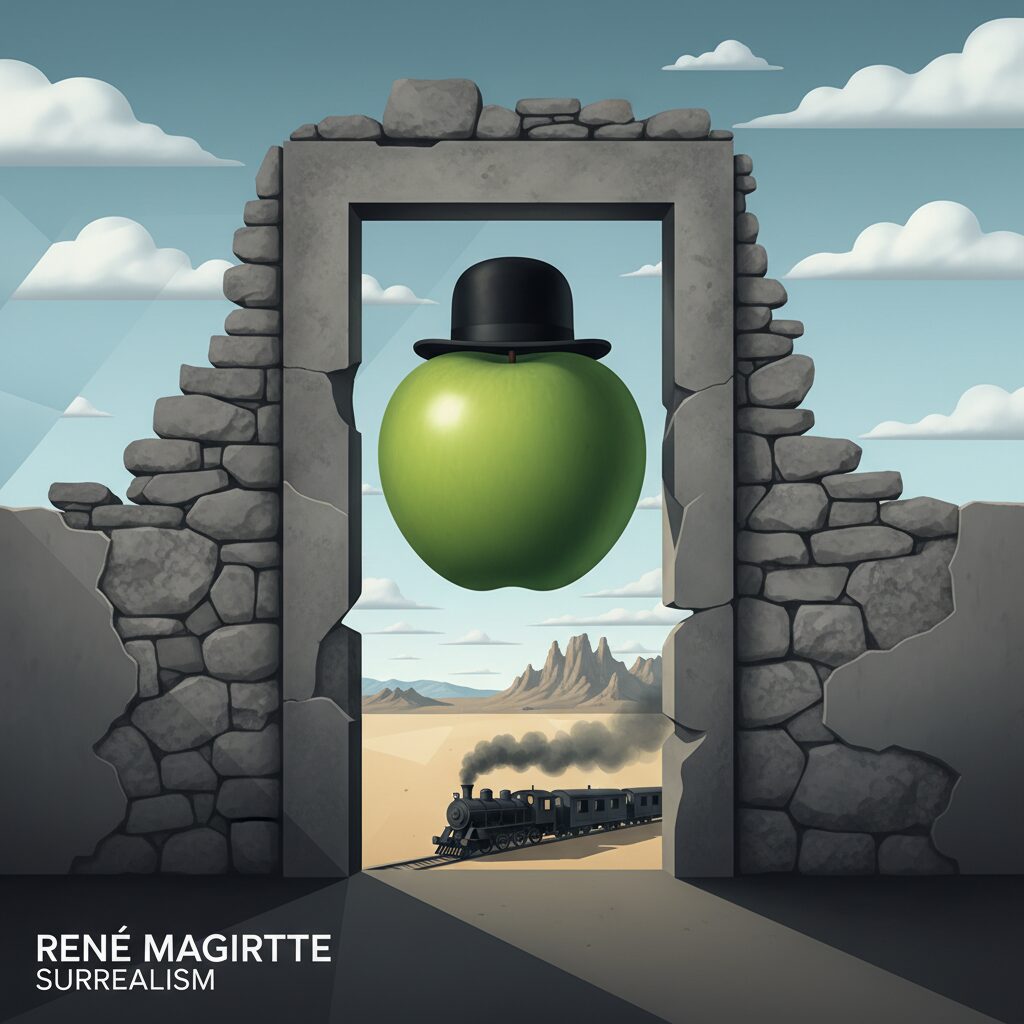
There’s a certain kind of quiet that falls over Brussels when the sky turns a particular shade of pearly grey. It’s a soft, diffused light that seems to blur the edges of the ornate, centuries-old buildings, making the world feel both intensely real and strangely dreamlike. It is, in every sense of the word, Magritte weather. To walk through the Belgian capital is to walk through the living canvas of one of the 20th century’s most profound and enigmatic artists, René Magritte. This isn’t just a journey to see paintings hanging on a wall; it’s a pilgrimage into the very heart of a philosophy that questioned the nature of reality itself. It’s a quest to find the cobblestone streets, the modest brick houses, and the overcast skies that birthed a universe of bowler-hatted men, impossible objects, and skies where day and night coexist in sublime harmony. Magritte’s art wasn’t an escape from the world but a deeper, more quizzical look into it. He took the mundane—an apple, a pipe, a drinking glass—and held it up to the light until it fractured into a thousand new meanings. Our journey will follow this same principle. We will trace his footsteps from his provincial birthplace to the industrial heartland of his youth, from the bohemian cafes of Brussels to the intellectual battlegrounds of Paris, and finally to the grand museums that now house his legacy. This is a quest to understand the man who painted not what he saw, but what he thought, and in doing so, changed the way we see everything. Prepare to have your perceptions delightfully scrambled, to see the mystery lurking just behind the veil of the ordinary. Welcome to the world of René Magritte, a reality that is, perhaps, more real than our own.
If you’re inspired to explore other artists who transformed the mundane into the extraordinary, consider embarking on a pilgrimage to understand the world of Constantin Brancusi.
The Heart of the Enigma: Brussels, a City of Grey Skies and Hidden Worlds
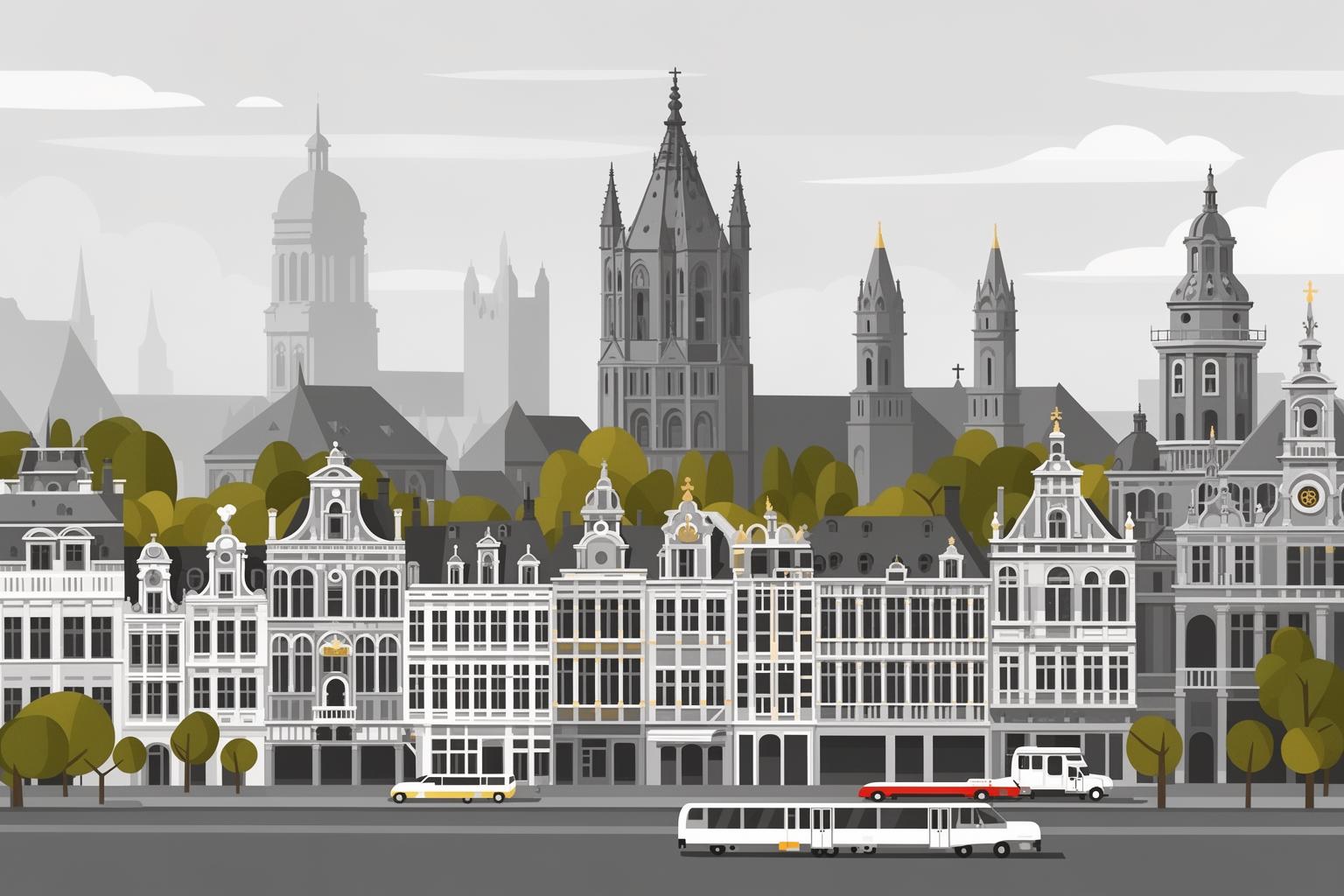
Brussels stands as the undisputed heart of the Magritte universe. It was here that he spent most of his life, and the city’s distinctive character is reflected in nearly every canvas he created. The city is full of contrasts—between grand, gilded squares and quiet, modest residential streets; the formal grandeur of the European Union and the rebellious spirit of the Surrealists who gathered in its smoky cafés. To truly grasp Magritte, one must first understand the rhythm of Brussels, its subtle elegance, and the ever-present sense of mystery simmering just beneath the surface.
The Royal Quarter’s Crown Jewel: The Musée Magritte Museum
Situated on the imposing Place Royale, just steps from the Royal Palace, the Musée Magritte Museum is the ultimate destination for any fan of his work. Housed in the neoclassical splendor of the former Altenloh Hotel, the museum itself embodies a Magrittean paradox: a shrine to the subversive nestled within a stronghold of tradition. This is not a place to simply stroll through; it is a carefully curated journey into a brilliant mind. The visit begins on the top floor and spirals downward in chronological order, tracing the artist’s life and development. You start with his early impressionist and cubist experiments—interesting, yet barely recognizable as the work of the master he would become. It’s like hearing the tentative opening notes before the symphony begins.
As you make your way down, the transformation becomes tangible. The rooms darken, and the atmosphere intensifies. You enter his “vache” period, a deliberate and provocative burst of garish colors and crude brushwork designed to shock the Parisian art world. It’s abrasive, confrontational, and key to understanding his defiant spirit. Then, the true enchantment unfolds. You reach the galleries devoted to his mature Surrealist period, where the outside world fades away. Standing before “The Empire of Light” is profound. The painting, showing a quiet, lamplit street at night beneath a bright, sunny, cloud-filled sky, is both disorienting and deeply soothing. It doesn’t demand attention; it softly poses a riddle about time, perception, and the arbitrary nature of reality. The museum’s lighting is masterful, allowing each painting to breathe, drawing you into deep blues, subtle greys, and sharp details. You’ll find yourself mere inches from “The Treachery of Images” (“Ceci n’est pas une pipe”), where the simple yet profound statement feels less like an art history lesson and more like a personal philosophical challenge. With over 200 works, including sculptures, drawings, and painted objects, the collection reveals recurring motifs—the birds, bells, apples, bowler hats—not as repetitive quirks but as a rich, evolving vocabulary. Set aside at least three hours for your visit. Rushing through would be like trying to read a poetry book by glancing only at the first letter of each line. True impact comes from immersion, letting the quiet power of the images seep into your consciousness. It’s a place that changes you. You emerge onto Place Royale, squinting in the daylight (or the soft, grey light that may be), seeing the world anew.
A Doorway to the Domestic: The René Magritte House Museum in Jette
If the grand museum on Place Royale represents the formal exhibition of Magritte’s mind, then the house at 135 Rue Esseghem in the tranquil, residential district of Jette offers a glimpse into his soul. René and his wife Georgette lived here for 24 years, from 1930 to 1954—arguably the most creatively fertile period of his career. Nearly half of his life’s work was produced behind these modest brick walls. The stark contrast with the palatial downtown museum is intentional. Magritte, the great disruptor of reality, lived a deliberately ordinary, almost humorously bourgeois life.
Visiting the house feels like stepping into one of his paintings. The ground floor has been carefully restored to reflect how it looked when the Magrittes lived there. The furniture is simple, the décor modest. You can almost sense the quiet, orderly rhythm of their daily life. But then the details begin to emerge. The fireplace instantly conjures “Time Transfixed,” with its impossible steam engine emerging from the mantel. The modest staircase and street-level window evoke his uncanny compositions where interior and exterior worlds collide. The heart of the home is the small studio-dining room. Magritte had no grand, light-filled atelier; he painted in the corner where he also ate—a testament to his belief that art was not a mystical, separate pursuit, but integral to everyday thought and living. The room is small, intimate, and imbued with creative energy. You can imagine him there, suit and tie, carefully applying paint to a canvas on an easel, transforming a simple apple into a cosmic symbol.
The upper floors house a more traditional biographical exhibit, with photographs, letters, and personal objects that add depth to his story. But the real power lies on the ground floor, in the quiet authenticity of the space. Here, you realize Magritte found the surreal not in distant fantasy but by gazing ever more closely at the familiar objects and spaces of his own home. Jette is a short tram ride from the city center and well worth the trip. It provides essential human context for the towering artistic genius, reminding you that the man who painted skies filled with falling men was also a man who cherished routine, his quiet neighborhood, and life with Georgette. His secret was that the extraordinary was always hiding in plain sight, right there in the living room.
The Surrealist’s Stomping Grounds: Cafés and Cobblestones
Magritte’s Brussels extended far beyond his home and museums. It was a living, breathing city—an intertwining of streets, cafés, and gathering spots that fueled the Belgian Surrealist movement. To complete the pilgrimage, walk the same cobblestones he once did. Though many original haunts have vanished, their spirit endures. The most famous and indispensable stop is La Fleur en Papier Doré. Hidden on a side street near the Grand-Place, this historic café was the hub for Magritte and his circle, including E.L.T. Mesens, Paul Nougé, and Louis Scutenaire. Stepping inside is like stepping back in time. The walls, darkened with age, are covered in a wild collage of poems, sketches, photos, and aphorisms left by generations of artists and writers. The air is thick with echoes of passionate debates on art, philosophy, and revolution. Order a traditional Belgian beer, perhaps a Gueuze or a Kriek, and settle into a corner table. The vibe is not solemn reverence but lively, intellectual energy. You can almost hear glasses clinking and the fervent arguments that shaped modern art. It is a place for conversation, reflection, and free thought—an authentic living monument to the city’s bohemian soul. Beyond the cafés, simply wandering his former neighborhoods like Schaerbeek and Jette on foot offers its own rewards. Notice the architecture, the way light plays on brick walls, the sudden hidden gardens tucked behind unassuming gates. This is the visual vocabulary Magritte drew from daily—the rows of identical houses, the curious contrasts of old and new, the ever-shifting sky—all of it there. This is how you begin to see the world through his eyes: by walking his streets and discovering the surreal rhythm woven into the city itself.
Echoes of the Beginning: Wallonia’s Industrial Soul
To truly understand the roots of Magritte’s distinctive vision, one must journey south from Brussels into Wallonia, the region where he was born and grew up. This landscape starkly contrasts with the urban sophistication of the capital. It is a land molded by industry, marked by sharp contrasts and deep melancholy that unquestionably left a lasting impression on the young artist’s mind.
The Cradle of a Visionary: Lessines
René Magritte was born in 1898 in Lessines, a small, tranquil town in Hainaut province. Today, Lessines remains a calm, somewhat sleepy place. Visiting it is less about grand landmarks and more about soaking in the atmosphere of his beginnings. The house where he was born, bearing a simple plaque, can still be seen. The town is typical for the region, featuring a central square and a historic church. What stands out most is its quiet normality. This profound everydayness forms the essential backdrop against which his extraordinary imagination would later revolt. Walking along the river Dender, surrounded by the flat, green landscape, one can picture the young boy starting to sense that the world before him was not the whole truth. The trip to Lessines is like approaching a blank canvas, a space of pure potential before the intricate imagery took shape. It’s a subtle yet crucial element of the story, a reminder that the most groundbreaking ideas often emerge from the most ordinary environments.
Forged in the ‘Black Country’: Châtelet and Charleroi
If Lessines was the gentle opening, the area around Charleroi, known as the “Pays Noir” or “Black Country,” represented the intense and often painful core of his youth. The Magritte family moved there when René was a child, following his father’s employment. This was Belgium’s industrial heart, dominated by the looming silhouettes of coal mines (“terrils”), factories, and slag heaps. The sky was frequently gray with smoke, and the atmosphere was one of hard work and resilient endurance. It was here that Magritte faced the defining tragedy of his early life: his mother’s suicide by drowning in the River Sambre. The image of her body being retrieved, her nightgown obscuring her face, is a haunting visual that scholars believe influenced his later paintings featuring figures with veiled or hidden faces, such as “The Lovers.”
Visiting this region today is a moving experience. Although much of the heavy industry has waned, its imprint remains on the landscape. The terrils, once black coal waste mountains, have gradually been reclaimed by nature and now appear as strange, conical green hills, monuments to a lost era. They stand as surreal shapes on the horizon. Exploring Charleroi and Châtelet, one senses a certain weight, a feeling of history and hardship missing from Brussels. This industrial aesthetic—the sharp lines of factories, the uniformity of workers’ housing, the interaction of light and shadow on metal and brick—undoubtedly influenced Magritte’s later interest in industrial objects like grelots (sleigh bells) and his precise, almost mechanical painting style. Here, he learned the world was not always gentle or picturesque. It was a place of mystery, hidden dangers, and stark, compelling beauty. This raw, industrial spirit of Wallonia is the grit and gravity that anchors the ethereal flights of his most celebrated works.
A Parisian Interlude: Brushes with Breton
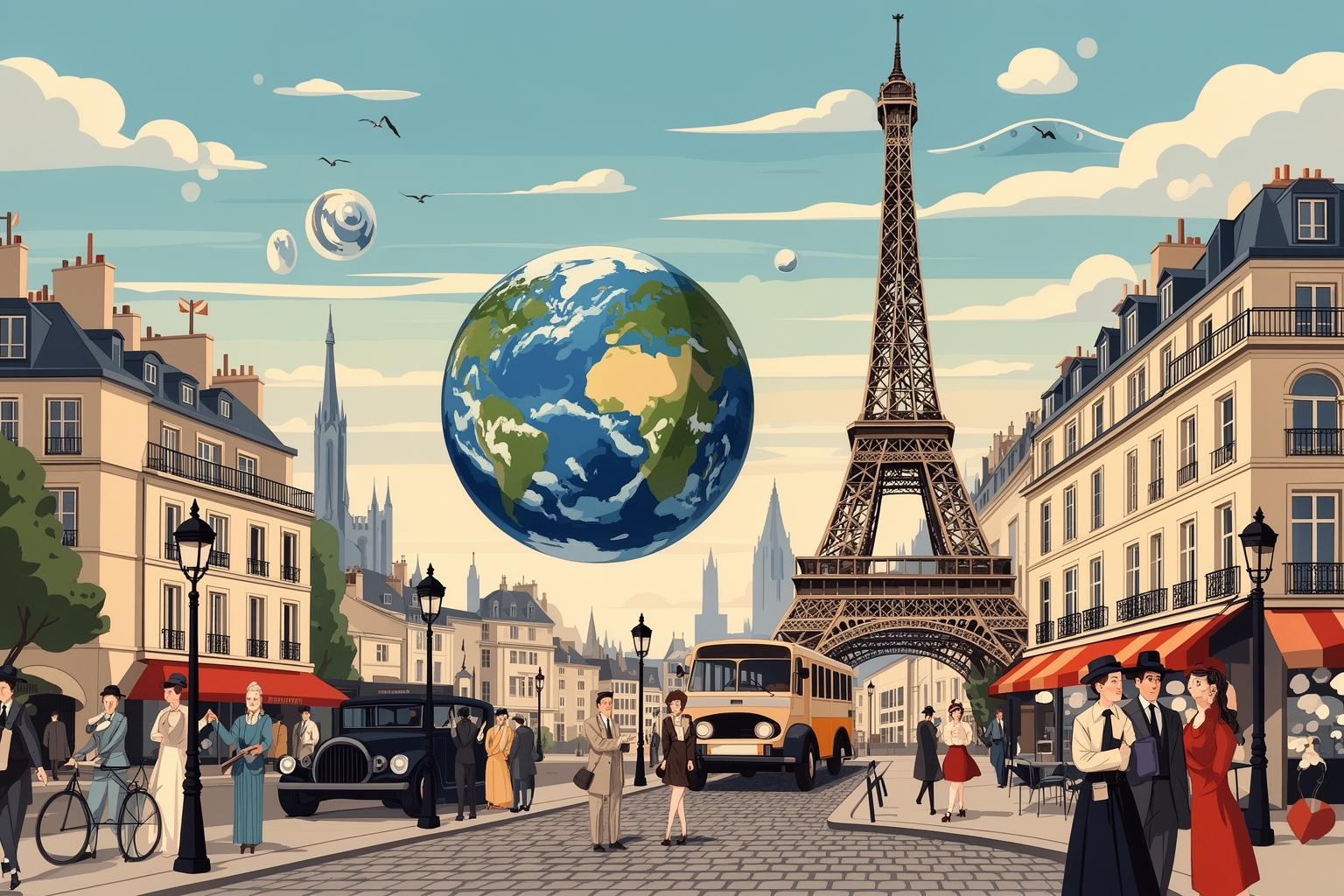
No account of a 20th-century European artist is complete without a chapter set in Paris, and Magritte was no exception. From 1927 to 1930, he and Georgette lived in Le Perreux-sur-Marne, a suburb of Paris. This period was crucial for intellectual cross-pollination. He became involved with the core of the French Surrealist group, led by the authoritative André Breton. This gave him the opportunity to engage directly with the movement’s founders and exhibit alongside luminaries like Salvador Dalí, Max Ernst, and Joan Miró.
Montparnasse and the Avant-Garde
Although residing in the suburbs, Magritte’s intellectual life revolved around the cafes of Montparnasse, the hub of the avant-garde. Amid clouds of cigarette smoke and the clinking of coffee cups, the very definition of art was being debated, dismantled, and reimagined. Magritte attended the group’s meetings and contributed to their journal, “La Révolution surréaliste.” However, his relationship with the Paris group—and Breton in particular—was complex and often tense. Magritte’s Surrealism was philosophical, conceptual, and characterized by a quiet, deadpan wit. He was skeptical of Freudian psychoanalysis and the emphasis on automatism and dream-transcription that so captivated Breton and his followers. Unlike them, Magritte was not interested in unveiling the subconscious; he sought to question the conscious, revealing the cracks in our shared reality. This fundamental difference eventually caused a rift. The breaking point reportedly came over a minor incident in which Breton took offense at a crucifix worn by Georgette at a gathering. To Magritte, this rigid insistence on atheism was just another arbitrary rule, and he had little tolerance for it. Disillusioned by the infighting and dogmatic rigidity of the Paris group, he returned to Brussels in 1930. A walk through Montparnasse today still conjures the spirits of that era. Though the renowned artists have long since departed, grand cafes like La Rotonde and Le Dôme preserve their historic atmosphere. Sitting there, one can imagine the young Belgian, with his precise logic and quiet demeanor, holding his own among the flamboyant egos of the Parisian scene. His time in Paris was not a failure but a crucial clarification. It honed his distinctive vision and cemented his identity as a resolutely Belgian surrealist, whose magic lay not in dreams, but in the lucid, startling poetry of everyday life.
Where the Sky Meets the Sea: The Enchanted Domain of Knokke
Later in his career, Magritte’s work transitioned from the intimate scale of easel paintings to the monumental challenge of public art. The most striking example of this shift is not housed in a museum but rather in a casino located in the elegant seaside resort of Knokke-Heist on the Belgian coast. Within the Grand Casino, Magritte created an expansive, 360-degree panoramic mural titled “The Enchanted Domain” (“Le Domaine enchanté”).
A Mural for the Modern Era
Commissioned in 1953, the mural surrounds the viewer with a seamless, dreamlike landscape. It represents Magritte’s universe on a grand scale. All of his most iconic motifs appear here, intricately woven together into one cohesive world. You can see the bird-leaf hybrids from “Treasure Island,” the sky-filled bird from “The Great Family,” and the bowler-hatted man from “The Son of Man.” A grand curtain reveals a landscape where day and night converge, a ship sails on a sea of sky, and a forest of trees with grelot bells stands silently. Standing at the center of the room places you physically inside a Magritte painting—an immersive and slightly disorienting experience. The scale transforms your relationship with the art; you are no longer just an observer peering through a framed window into another world, but a participant within it. The setting itself adds a further layer of surrealism. The glamour and noise of the casino—the ringing slot machines, the hushed tension of the gaming tables—create a strange and compelling contrast with the silent, philosophical world depicted on the walls. It’s a juxtaposition Magritte would undoubtedly have appreciated. A visit to Knokke offers a refreshing break from the urban explorations of Brussels. The wide sandy beaches and crisp North Sea air provide a distinct Belgian atmosphere. Seeing “The Enchanted Domain” is the perfect culmination to a Magritte pilgrimage, showcasing the power and versatility of his vision. It proves that his quiet riddles can be just as impactful when broadcast from a grand wall as when whispered on a small canvas. It is his world, fully realized, inviting you to step inside and linger.
Seeing the World Through Magritte’s Eyes: A Traveler’s Guide

Embarking on a journey through Magritte’s Belgium is more than merely a tour; it is an exercise in perception. It demands a different way of seeing, a willingness to embrace ambiguity and discover beauty in the ordinary. Here are some practical tips to help you navigate this surreal landscape.
Practical Magic: Navigating Your Pilgrimage
Belgium is wonderfully compact, making a multi-city trip quite straightforward. The train network is extensive and efficient, connecting Brussels with Charleroi, Lessines, and the coast with ease. For the main museums in Brussels, it’s highly recommended to book your tickets online in advance, especially during peak tourist season. The Musée Magritte Museum often has long lines, and securing a pre-booked time slot will save you a considerable wait. The René Magritte House Museum in Jette has more limited opening hours, so be sure to check their website before planning your visit. In my opinion, the best time to visit is during spring or autumn. The crowds are thinner, and you’re more likely to experience that perfect, moody, overcast Magritte sky. The light is softer, shadows are longer, and the overall atmosphere aligns beautifully with the artist’s aesthetic. When staying in Brussels, consider purchasing a Brussels Card, which offers free entry to many museums and unlimited public transport. For accommodation, neighborhoods like Saint-Gilles or Ixelles provide a taste of the authentic, less touristy side of Brussels, featuring beautiful Art Nouveau architecture and a lively local café culture.
The Art of Observation
More crucial than any itinerary is the mindset you bring to this journey. The ultimate aim is not just to visit the places Magritte lived, but to learn to see as he saw. Slow down. Notice the details. Seek out the strange juxtapositions that occur daily. Observe how a single, perfectly round cloud floats in an otherwise empty blue sky. See the reflection of a building in a puddle that seems to form an impossible new structure. Notice how a bowler hat on a mannequin in a shop window can suddenly evoke a profound mystery. Magritte’s genius lay in his ability to isolate these moments of everyday surrealism and present them as questions. He teaches us that mystery is not something to solve but something to savor. Your pilgrimage is complete when you find yourself standing on a street corner, gazing at an ordinary scene, and a single, thrilling thought arises: “This is not what it seems.” That is the gift he offers: the key to unlocking the enchanted world all around us, hidden in plain sight.
The journey through Magritte’s world leaves you with a beautiful, lingering sense of wonder. It is a quiet revolution of the senses. You leave Belgium not just with memories of magnificent art and charming cities, but with a renewed appreciation for the profound mystery woven into the fabric of reality. The world becomes a gallery of endless possibilities, a place where an apple is never just an apple, and a pipe is never merely a pipe. You carry his vision with you, a lasting filter that renders the ordinary perpetually extraordinary. And in quiet moments, when you see a dark suit against a blue sky or a lamppost shining brightly in the midday sun, you’ll smile, knowing you’re part of the secret.