
There are cities you visit, and then there are cities you inhabit through the pages of a book. Naples, for readers of the enigmatic author Elena Ferrante, is overwhelmingly the latter. It’s a place that exists in a state of dual reality: the physical, chaotic, sun-scorched city on the Italian coast, and the ferocious, intimate, and often brutal landscape of the Neapolitan Novels. To walk through Naples with Lila and Lenù as your guides is to search for a phantom, a story so deeply embedded in the city’s tufa stone and asphalt that the fiction feels more real than the fact. This isn’t a pilgrimage to an author’s house—after all, who is Elena Ferrante? Instead, it’s a journey into the heart of a narrative, an attempt to map the emotional geography of a friendship that has captivated millions. We come here not to find Ferrante, but to find the world she so masterfully rendered, to feel the grit of the rione under our shoes, to hear the dialect clash against proper Italian, and to stand in the spaces where two brilliant, complicated women fought for their lives and their minds. Naples is not just the setting of the story; it is its most formidable character, a living entity that shapes, shelters, and suffocates everyone within its grasp. This journey is about tracing its veins, from the impoverished outskirts to the sophisticated heart, to understand the magnetic, terrifying pull of this unforgettable place.
This literary exploration of place shares a spirit with the journey of chasing ghosts and memories through Orhan Pamuk’s Istanbul.
The Rione: In the Heart of the Periphery
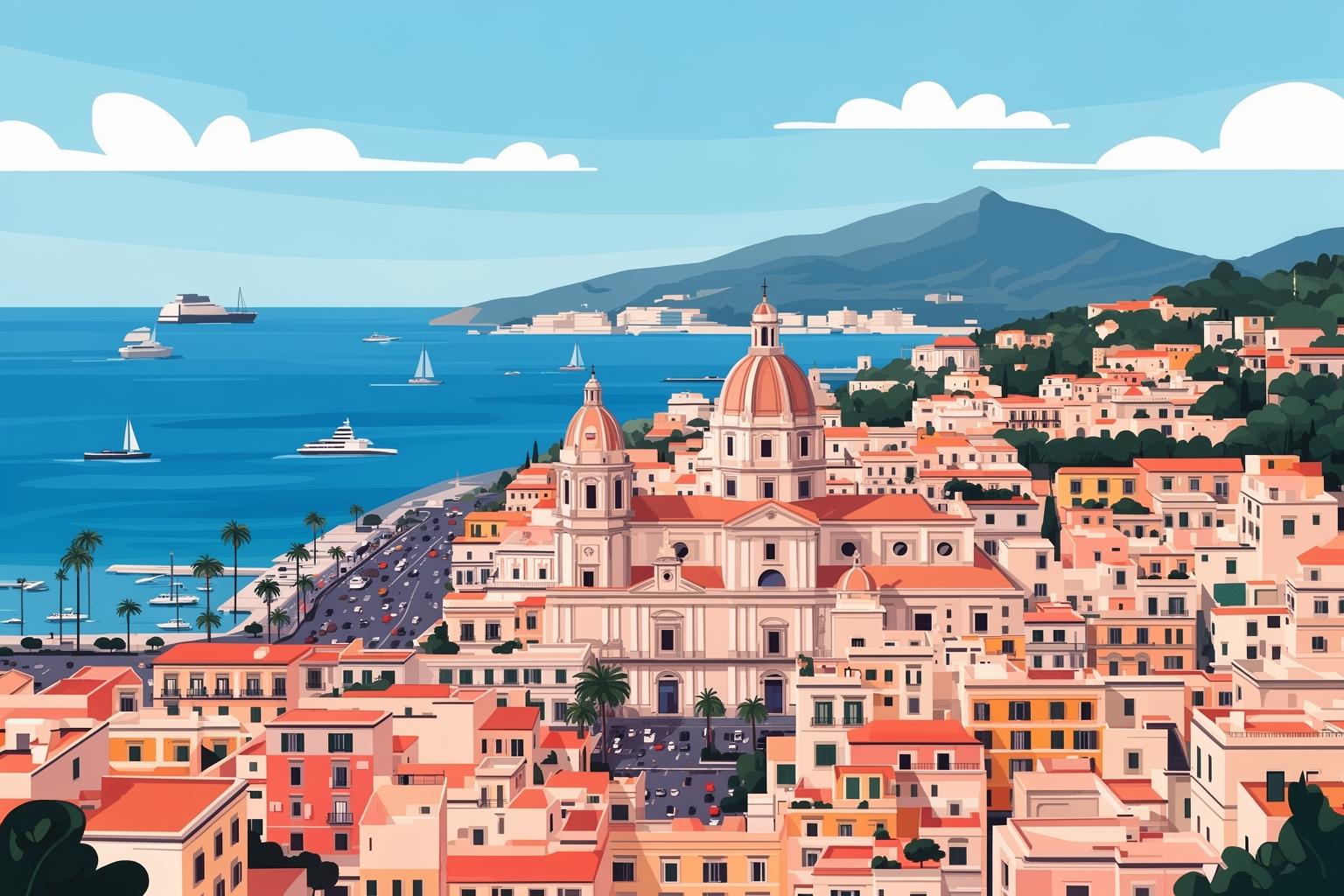
Every journey into Ferrante’s world must start where the story begins: the neighborhood, the rione. Though the author never explicitly names it, literary sleuths and devoted fans widely agree it is Rione Luzzatti, a working-class district east of the central station. Reaching it is the first step in breaking down the divide between page and pavement. You take the Circumvesuviana train or Metro Line 2 a few stops from the chaotic energy of Garibaldi, and the city’s rhythm instantly shifts. The grand, decaying palazzos of the historic center give way to uniform, rationalist apartment blocks built after the war. This is a Naples stripped of baroque romance, a place defined by function, family, and survival.
The Atmosphere of the Courtyards
Entering Rione Luzzatti feels like crossing into a different country within the same city. The air is dense with the sounds of everyday life: a mother’s sharp call from a balcony, the rumble of a scooter echoing through the stone courtyard, the distant clang of the railway line enclosing the neighborhood. The buildings, often faded ochre or gray, are arranged around large communal courtyards that serve as the novels’ main stage. It’s here, in these shared spaces, that much of the drama unfolds—childhood games, vicious arguments, watchful neighbors, the first stirrings of ambition and rebellion. One can almost see the ghosts of Lila and Lenù playing with their dolls, their small figures dwarfed by the imposing, almost institutional architecture. Laundry lines, strung like celebratory banners from window to window, are a constant, colorful presence—testaments to lives lived, washed, and hung out to dry in public view. There is a deep sense of community here, but also of claustrophobia. The very design of the space, meant to nurture a collective spirit, becomes a pressure cooker in Ferrante’s hands. Walking through these courtyards, you feel the relentless scrutiny, the impossibility of keeping secrets, the way the neighborhood itself becomes a character that judges, confines, and defines its residents.
Finding the Straddling Tunnel
One of the most powerful symbols in My Brilliant Friend is the tunnel—the dark, forbidding passage that the young girls dare each other to cross. For them, it marks the boundary of their known world and the terrifying unknown beyond. In Rione Luzzatti, a real underpass perfectly matches the description. It’s a long, low, somewhat grimy passage running beneath the railway tracks, connecting the neighborhood to the outside world. Standing at its entrance sends a chill, even on a warm Neapolitan day. The ambient sky light is swallowed by the artificial, humming glow of the tunnel’s lights. As your footsteps echo off the tiled walls, you sense the weight of its symbolism. This was the threshold Lenù had to cross—literally and metaphorically—to pursue her education and break free from the rione’s confines. For Lila, who turned back, it represents a different kind of boundary, a psychological barrier she challenged throughout her life in other ways. The tunnel is not a tourist spot but a functioning piece of urban infrastructure. Yet, for Ferrante readers, it is a powerful, tangible link to the story’s core themes of fear, courage, and the daunting journey out of the world one is born into.
The Public Library and the Elementary School
Education is the pivotal fault line in Lila and Lenù’s lives, the force that separates their paths. The neighborhood holds the physical symbols of this struggle. Near the central piazza of the rione, you find the local public library and the elementary school—unassuming brick buildings with immense significance in the novels. The school is where the girls’ intellectual rivalry and deep bond were forged under Maestra Oliviero’s watchful eye. It’s a simple, functional structure, but standing outside it, you can imagine the fierce competition, the shared triumphs, and the heartbreaking moment their educational paths diverged. The library, a small, quiet refuge, represents Lenù’s lifeline. It was her portal to other worlds, her escape from the neighborhood’s violence and noise. While the school may be off-limits, the public library is often open. Stepping inside, enveloped in hushed quiet and the scent of old paper, feels like a sacred act. This is the space that offered Lenù her first taste of a different life, a life of the mind that eventually became her escape route. These buildings aren’t monuments, but they are crucial anchors for the story, grounding the girls’ intellectual and emotional growth in real, tangible places.
The Historic Center: Lenù’s Ascent and Lila’s Reign
If the rione serves as the story’s womb, then the historic center of Naples, the Centro Storico, is the vast, chaotic world into which its characters are born. This is where Lenù escapes to attend high school and university, and where Lila, in her own way, stakes her claim. The contrast between these two areas is striking. Leaving the orderly, self-contained periphery for the dense, labyrinthine streets of the old city is a sensory onslaught. The UNESCO World Heritage site is full of dizzying contradictions—breathtaking beauty alongside urban decay, profound history mingling with vibrant, sometimes overwhelming present-day life.
The Decumani: A River of Life
The main veins of the historic center, the three ancient Greco-Roman roads known as the Decumani—with Via dei Tribunali and Via San Biagio dei Librai the most renowned—are the lifeblood of the city. Walking these streets is total immersion. Tall, tightly packed buildings create a canyon-like effect, with just a sliver of sky above. The noise forms a constant symphony: scooters weaving impossibly through pedestrians, vendors shouting, church bells ringing, and the murmur of countless conversations in thick Neapolitan dialect. The air is heavy with the aroma of espresso, fried pizza (pizza fritta), and sweet, rum-soaked babà from the numerous pasticcerias. This is the Naples Lenù navigates as a student, worlds away from the familiar confines of the rione. It is a place of anonymity and opportunity, but also of new dangers and social codes she must learn to decipher. Following her route from the station toward the university district, one feels her mix of awe and apprehension. Every corner unveils another layer of history: a hidden Roman ruin beneath a church, a baroque chapel decorated with skulls, a votive shrine to a saint illuminated by neon lights. It’s a place demanding full attention—a living museum that remains thoroughly alive.
Piazza dei Martiri: The Stage of Elegance
In striking contrast to the gritty energy of the Decumani is Piazza dei Martiri, located in the elegant, upscale Chiaia district. This refined, tree-lined square serves as the setting for one of the novels’ most pivotal locations: Lila’s shoe store. Upon marrying into the affluent Carracci family, Lila transforms a business in this sophisticated area, investing her fierce intelligence and artistic vision into designing and selling luxury footwear. The piazza, dotted with high-end boutiques and featuring a monument to the martyrs of the Neapolitan revolution, symbolizes money, power, and social aspiration—forces that both attract and repel the girls. Standing in the square today, one can see the very storefronts that inspired the setting. The atmosphere exudes polished refinement—a world apart from the dust and clamor of the rione. It’s a place of performance, where people come to see and be seen. For Lila, it was a stage on which she could demonstrate her brilliance and prove to herself and the world that she could conquer any domain she chose. Yet, it was also a gilded cage, symbolizing a life that ultimately couldn’t contain her restless spirit. Visiting the piazza makes palpable the deep social chasm that existed in Naples—the tangible divide between the world Lila sought to enter and the one she originated from.
Corso Umberto I and the University
Corso Umberto I, a broad, grand boulevard known to Neapolitans as the Rettifilo, is another crucial artery in Lenù’s story. This street, carved through the old city in the late 19th century, embodies progress and modernity. It is the route she takes to the University of Naples Federico II, the institution that cements her escape. The university isn’t a single campus but a collection of imposing buildings scattered throughout the area. Upon locating the Department of Humanities, with its stone staircases and echoing halls, you can easily picture Lenù as a young student, often feeling out of place among her more privileged classmates, her mind ignited by the ideas she finds in books. The Rettifilo serves as a commercial and functional thoroughfare lined with shops and offices, but for Lenù, it represents a path of transformation. Walking its length, you sense forward momentum—the movement from the tangled past of the old city toward a future shaped by intellect and ambition. It is a straight line cutting through a city of curves and alleyways—a perfect metaphor for the linear, upward trajectory she desperately sought for her life.
The Vomero and Posillipo: A View from Above
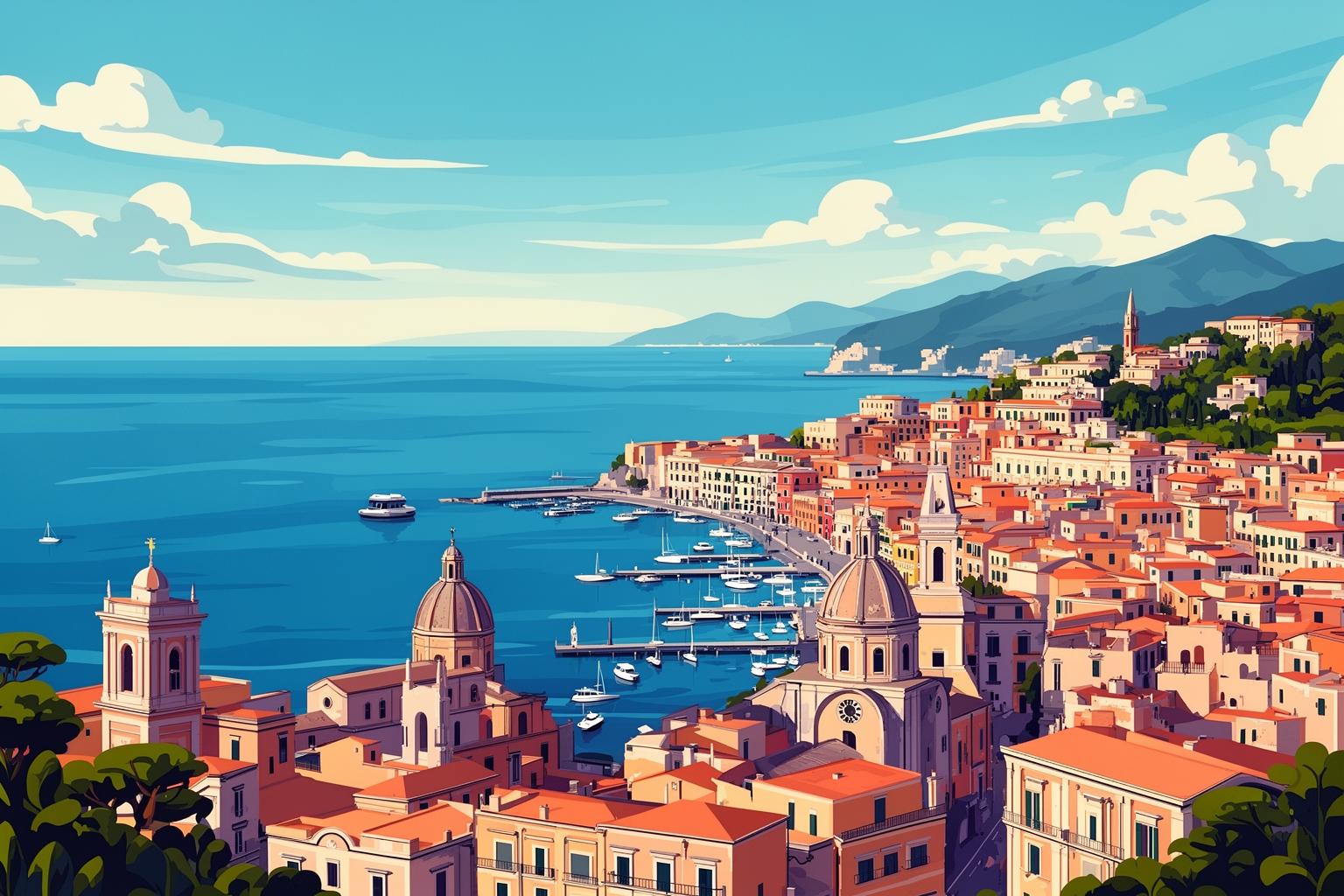
Naples is a city built in layers, both historical and topographical. Towering above the dense historic center lie the affluent hillside districts of Vomero and Posillipo. In Ferrante’s novels, these neighborhoods symbolize the pinnacle of Neapolitan society—the realm of the educated and wealthy—a world that Lenù watches from a distance and eventually, cautiously, enters. To reach these heights, whether by one of the city’s historic funiculars or via a winding road, is to encounter a dramatic shift in perspective, both literally and metaphorically.
Vomero’s Bourgeois Serenity
The Vomero district feels like an entirely different world. The narrow, shaded streets of the lower city give way to broad, tree-lined avenues, elegant Art Nouveau buildings, and a strong sense of order and calm. This is the Naples of the professional class—professors, doctors, and lawyers. It’s the kind of neighborhood where Lenù’s in-laws live, places where conversations take place in hushed tones within tastefully decorated apartments. The atmosphere is serene, refined, and unmistakably bourgeois. The main pedestrian shopping street, Via Luca Giordano, and the elegant Piazza Vanvitelli evoke the feel of Milan or Rome more than the chaotic Naples below. Visiting Vomero provides crucial insight into the social stratification central to the novels. From the heights of Castel Sant’Elmo or the Certosa di San Martino, you can gaze down upon the entire city—a sprawling, magnificent tangle stretching to the sea. You see the grid of the rione in the distance, the densely woven Centro Storico, and the shimmering bay. This panoramic view symbolizes social and intellectual distance—the perspective Lenù attains through her education: the ability to see the entire map of her world, grasp the forces that shaped her, and appreciate how far she has come.
The Appeal of Posillipo
Further along the coast, the road ascends to Posillipo, a name meaning “pause from pain” in Greek. This is the most exclusive residential district, filled with stunning villas with private gardens tumbling down to the sea, offering breathtaking views of the Bay of Naples and Mount Vesuvius. This is the world of extreme wealth and power—the world of the Solara family’s ambitions. In the novels, Posillipo represents a level of society so rarefied it seems almost mythical to the girls from the rione. A visit to Posillipo, perhaps to Parco Virgiliano, a beautiful public park with some of the city’s finest views, lets you experience this allure firsthand. The air feels cleaner, the light brighter, and the city’s noise is a distant murmur. Below, you can spot tiny fishing boats in Marechiaro’s marina and look across the water to the islands of Capri and Ischia. This is the Naples found on postcards—the idealized version of the city. For Ferrante’s characters, Posillipo symbolizes the ultimate prize: a life of beauty, ease, and power. Yet, as the novels reveal, this beauty often conceals deep-seated corruption and moral decay. The serene vistas of Posillipo offer a stunning yet unsettling backdrop to the dark intrigues and violent power struggles defining the city’s elite.
Ischia: The Island of Transformation
Just an hour’s hydrofoil ride from the turbulent heart of Naples lies the island of Ischia, a vital and recurring setting in the Neapolitan Quartet. In the novels, Ischia is more than a holiday destination; it is a place of liberation, transformation, and painful self-discovery. When Lenù first visits as a teenager, it offers her a first true taste of freedom from the suffocating hold of both her family and her neighborhood. The island’s sun-drenched beaches and thermal hot springs provide a sensual awakening, sharply contrasting with the grit and grime of the city.
Maronti Beach and the Sense of Escape
The series vividly depicts Lenù’s time on Ischia, especially around Maronti beach, a long, sweeping crescent of volcanic sand on the island’s southern coast. Visiting Maronti today is like stepping into her shoes. You can take a water taxi from the charming fishing village of Sant’Angelo, just as the characters do, and feel the sea spray on your face. The beach is framed by steep, dramatic cliffs, and the sand is famously hot due to thermal activity beneath the surface. There are spots where locals cook food in the sand itself. Walking along this beach, you can imagine Lenù’s feelings of wonder and displacement. Away from the watchful eyes of the rione, she begins to forge her own identity. The sea is a powerful presence—both a symbol of a vast, unknown world of possibilities and a force of nature that is unpredictable and dangerous. The island’s atmosphere is intoxicating: a mix of lazy summer days, salty air, and the undercurrent of adolescent turmoil and sexual awakening that defines her stay. It’s a place where the city’s rules seem to dissolve, allowing for new connections and devastating betrayals.
The Complexity of Island Life
While Ischia represents an escape, Ferrante carefully shows that it is not a utopia. The island has its own social hierarchies, secrets, and forms of violence. The idyllic setting becomes the backdrop for some of the story’s most emotionally charged and traumatic moments. The beauty of the landscape—the lush greenery, vibrant flowers, and sparkling blue water—is contrasted with the ugliness of human behavior. This duality is essential to understanding Ferrante’s world. No place is truly safe, and personal demons cannot be escaped simply by changing location. Visiting Ischia as a reader allows you to appreciate this complexity. You can enjoy the island for its undeniable beauty—relaxing in a thermal park, exploring the medieval Aragonese Castle, or savoring fresh seafood by the water. But with the novels in mind, you also sense the shadows lurking beneath the sunny surface. You see the island not only as a paradise but as a crucible where character is tested and destinies are irrevocably altered.
A Pilgrim’s Practical Guide
Setting out on a Ferrante-themed exploration of Naples and its environs is an exceptionally rewarding experience, though it demands some planning and the right mindset. This city doesn’t present itself in an orderly fashion. It’s a place to be discovered with curiosity, patience, and openness.
Getting Around Naples
Naples may seem chaotic at first, but its public transportation system is more manageable than it appears. The metro is efficient, with Line 1 (known as the “Art Line” for its beautifully designed stations) and Line 2 being the most useful for visitors. Line 2 is especially handy for reaching Rione Luzzatti (exit at Gianturco) and for connecting to the main train station, Piazza Garibaldi. To reach Vomero, the funiculars (three main lines: Centrale, Chiaia, and Montesanto) offer not only practicality but also a unique experience, providing stunning views as you ascend. However, the best way to explore the historic center is on foot. Expect cobblestones, narrow alleys, and steep slopes. Wear comfortable, sturdy shoes—this is essential. Naples is a walking city, and the most rewarding discoveries come from allowing yourself to get a bit lost within its ancient street layout.
A Taste of Ferrante’s World
To fully immerse yourself in the novels’ atmosphere, you need to eat like a Neapolitan. Food is a constant presence in the books—a source of comfort, a sign of social class, and a reason to gather. Begin your day with a sfogliatella, a delicate, shell-shaped pastry filled with ricotta, from a local pasticceria. For lunch, grab a pizza a portafoglio (a “wallet pizza,” folded and eaten on the street) from one of the famed pizzerias on Via dei Tribunali, such as Sorbillo or Di Matteo. This is the quintessential democratic food, loved by everyone, offering a direct connection to the city’s soul. In the evening, find a traditional trattoria for a plate of pasta with a rich ragù that has simmered for hours, or simple, perfect spaghetti alle vongole (with clams). Recall the meal Lenù enjoys when she first visits her professor’s home—a moment of cultural awakening. Food in Naples is never just sustenance; it embodies history, culture, and family. Savoring these simple, robust flavors is a vital part of the Ferrante pilgrimage.
Safety and Sensibility
Naples has its reputation, and while it is generally safe, it’s prudent to stay street-smart as you would in any large city. Keep your valuables secure, especially in crowded spots like the train station and on public transit. Stay alert to your surroundings, particularly scooters that can appear unexpectedly. The best advice, though, is to relax and not be intimidated. Neapolitans tend to be warm, expressive, and helpful. Don’t hesitate to ask for directions or recommendations. Embrace the chaos. The city’s energy can be intense but also thrilling. By approaching Naples with respect and an open heart, you’ll discover it to be one of the most vibrant and welcoming places in the world.
The Unknowable Author, The Unforgettable City
Ultimately, a journey into Elena Ferrante’s Naples is a journey into mystery. We seek out the physical locations that inspired her fiction, but we are also in search of a connection to the elusive author herself. Every corner turned and every piazza crossed feels like a step closer to the source of her brilliant, searing prose. Yet, the author remains a ghost, and perhaps that is for the best. Her anonymity brings the city itself to the forefront. Naples, in all its contradictory splendor, becomes the true protagonist. It is a city that has been romanticized, maligned, and misunderstood for centuries. Through Ferrante’s eyes, we see it anew, with raw clarity. We witness the fierce intelligence that blooms in the most unlikely circumstances, the deep-seated violence woven into its social fabric, and the unbreakable bonds of friendship forged in its fiery heart. You may leave Naples without ever discovering who Elena Ferrante truly is, but you will depart with a profound understanding of her world. The city will remain with you long after you have gone, a lingering echo of Lila’s brilliance and Lenù’s resolve, a place where stories are not merely told but lived with a passion and intensity that is unforgettable.