Spain feels like a canvas stretched tight over bone and spirit, a land of blistering sun and deep, cool shadows. It’s a country that understands duality, the dance between ecstasy and agony, faith and reason, celebration and sorrow. And no one, perhaps in the entire history of art, captured this profound, chaotic soul of Spain quite like Francisco Goya. To walk through the places that shaped him is to do more than just see his art; it’s to trace the steps of a man who saw the world with terrifying, unflinching clarity and dared to paint it all. This isn’t just a museum tour. It’s a pilgrimage into the heart of a genius, a journey from the sun-drenched rococo dreams of a young court painter to the chilling, silent screams of an old man painting his nightmares on the walls of his own home. We’ll wander from the dusty village of his birth to the hallowed, hushed galleries of the Prado Museum, and stand in the very chapel where his bones now rest beneath a ceiling of his own divine creation. This is a journey to understand not just Goya the artist, but Goya the man, a witness to revolution, invasion, and the darkest corners of the human psyche. Welcome to Goya’s Spain.
To further explore the profound connection between an artist and their homeland, consider embarking on a pilgrimage through the fiery world of José Clemente Orozco.
The Cradle of a Giant: The Rustic Heart of Aragon
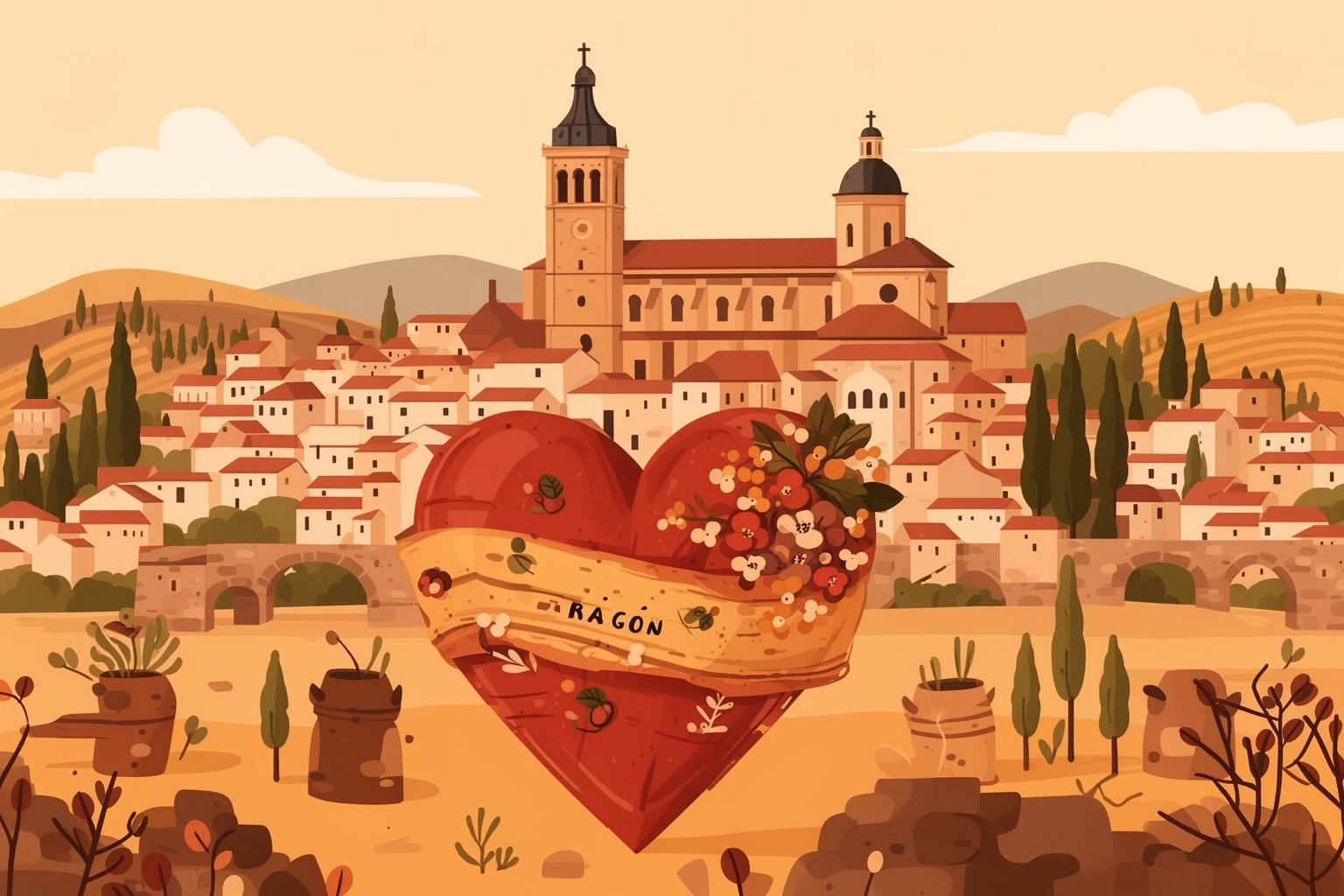
Our journey does not begin in the grand halls of Madrid. It begins much more quietly, beneath a vast, unforgiving sky in the region of Aragon. To truly understand Goya, you must first understand the land that shaped him: a place of harsh winds, sun-baked earth, and a resilient, stubborn spirit. This is where the seed of his genius was sown, far from the gilded cages of the royal court.
Fuendetodos: The Echo of a First Cry
Picture a small village, a cluster of stone houses clinging to a dry, windswept hill. This is Fuendetodos. It feels ancient, a place where time flows at a different pace. It was here, in 1746, in a modest stone house, that Francisco Goya was born. Visiting his birthplace, the Casa Natal de Goya, is a deeply grounding experience. It’s not a palace; it’s a simple, rustic home of a lower-middle-class family. You can feel the coolness of the stone walls, see the small rooms where his family lived, and imagine a young boy gazing out at the endless Aragonese landscape—a landscape that would subtly influence the earthy tones and raw textures of his later work.
The atmosphere here is one of quiet reverence. It’s not a bustling tourist hub. You might find yourself alone with your thoughts, the only sounds being the wind and the distant toll of a church bell. This solitude is a gift. It allows you to connect with the sheer improbability of Goya’s story. How did a boy from this remote, unassuming corner of Spain become the painter to the king and a prophet of modern art? The house itself offers no answers, but the landscape does. It speaks of resilience, of a life stripped down to its essentials—a perspective that would later enable Goya to see through the artifice of courtly life with such a piercing gaze.
Just a few steps from his birthplace stands the Engraving Museum, dedicated to Goya’s masterful work as a printmaker. This is essential. To know only Goya’s paintings is to know only half the man. Here, you can get up close with his series like Los Caprichos and The Disasters of War, witnessing the biting social satire and raw, unfiltered depiction of human cruelty that he couldn’t express in his royal commissions. The fine, intricate lines tell stories of superstition, folly, and the horrors of conflict with a directness that remains shocking today.
A tip for travelers: Fuendetodos is best reached by car from Zaragoza, about a 45-minute drive. The journey itself is part of the experience, as the urban landscape gives way to rolling hills and vast, open plains. Try to visit in spring or autumn; the summer heat can be intense and unforgiving, much like the land itself.
Zaragoza: The First Brushstrokes of Ambition
If Fuendetodos was the cradle, Zaragoza was the training ground. This vibrant city on the banks of the Ebro River is where a young Goya honed his craft and first tasted ambition. It’s a city dominated by the monumental Basílica del Pilar, a baroque masterpiece whose domes glitter under the Spanish sun. It was here, inside this very basilica, that Goya received one of his first major commissions: to paint frescoes on the ceiling. You can crane your neck to admire the Regina Martyrum (Queen of Martyrs), a work of dazzling light and color. It’s a Goya full of youthful confidence and rococo flair, yet even here, you see hints of the dramatic energy and bold brushwork that would define his career.
Walking through Zaragoza feels like walking through the layers of Goya’s early artistic development. The city itself is a blend of Roman ruins, Moorish architecture, and grand Christian monuments. It’s a place of deep faith and tradition, and Goya’s early works were deeply embedded in this world. To delve even deeper, a visit to the Cartuja de Aula Dei, a Carthusian monastery just outside the city, is a must. Here, Goya painted a magnificent cycle of eleven murals on the life of the Virgin Mary. Though damaged over time, the remaining works are breathtaking, showcasing his growing mastery of large-scale composition and dramatic storytelling.
For a more curated experience, the Goya Museum – Ibercaja Collection is a treasure. Housed in a beautiful Renaissance building, it displays works from every stage of Goya’s career and contains the only complete collection of his engraved series. Seeing them all together in one place—Caprichos, Disasters of War, Tauromaquia, and Disparates—is an overwhelming experience. It testifies to his restless mind and relentless drive to document the human condition in all its glory and absurdity.
Zaragoza is easily accessible by high-speed train from Madrid or Barcelona. Set aside at least a full day to explore. The city’s energy is infectious, especially evenings when locals gather in the tapas bars of the El Tubo district. It’s here, amidst lively chatter and clinking glasses, that you can feel the vibrant life Goya left behind as he set his sights on the ultimate prize: Madrid.
The Gilded Cage: Goya in the Heart of the Spanish Empire
Madrid—the name alone evokes images of royal grandeur, expansive plazas, and artistic masterpieces. For Goya, Madrid was the summit he had to reach. It was the hub of power, patronage, and prestige. Here, he would ascend to the height of his career as the First Court Painter to the King. Yet, it was also the stage where he confronted political upheaval, social decay, and brutal warfare, events that transformed him from a society painter into a visionary artist. Madrid is the vibrant heart of our journey, its rhythm most vividly felt within the majestic halls of the Prado Museum.
The Prado Museum: A World Within a Gallery
The significance of the Museo Nacional del Prado to any admirer of Goya cannot be overstated. It is more than a museum housing his works; it is the sanctuary of his legacy. One could spend an entire day—or even two—immersed in Goya’s art and still feel only lightly touched by it. The best way to experience it is as a voyage through his life, with the museum’s arrangement naturally guiding this narrative.
The Sunlit Years: Tapestry Cartoons and Early Portraits
The journey starts in rooms filled with brightness and joy. These are the tapestry cartoons—large oil-on-canvas paintings serving as models for tapestries that adorned royal palaces. Works like The Parasol (El Quitasol) and The Grape Harvest (La Vendimia) enchant with their depiction of an idealized aristocratic world—leisurely picnics in the countryside and charming flirtations. The colors are vivid, the compositions graceful, and the atmosphere lighthearted. This is Goya the rococo master, skillfully crafting the images the nobility desired: a beautiful mirror of their privileged existence. Yet, upon closer inspection, his acute attention to human detail emerges. The faces are unique individuals, not mere archetypes. There is an early realism here, a hint of the perceptive observer he would become.
The Unflinching Mirror: The Royal Portraits
The mood shifts as you enter galleries filled with his formal portraits, where Goya’s genius for psychological insight brilliantly shines. The pinnacle of this era is the monumental The Family of Charles IV. It ranks among the most remarkable group portraits in art history. On the surface, it presents the royal family in all their finery, jewels, and sashes. But Goya’s brush refuses flattery. He portrays them as he truly saw them: plain, awkward, and faintly absurd. At the center stands Queen Maria Luisa, the real power behind the throne, her expression blending pride and vanity. King Charles IV appears vacant and benignly inept. The painting captures a decaying dynasty with stark honesty that makes one wonder how Goya escaped censure. The rumor suggests the royals, accustomed to sycophantic praise, failed to perceive it. They admired the dazzling technique and luxurious attire, while Goya, quietly observing from the shadows on the left, revealed the truth.
The Scandal and the Sensation: The Majas
No visit to the Prado’s Goya collection is complete without seeing the two most famous paintings bearing his name: The Nude Maja (La Maja Desnuda) and The Clothed Maja (La Maja Vestida). Hung side-by-side, they form a compelling pair. The sitter’s identity remains a mystery, though speculation often points to the Duchess of Alba. What is certain is their revolutionary impact. The Nude Maja stands out for its directness. This is no classical Venus or mythological nymph but a real, flesh-and-blood woman, gazing at the viewer with confidence, almost defiance. Her nudity is unidealized, immediate, and sensual. It’s a profoundly modern work that sparked scandal and forced Goya to answer to the Spanish Inquisition. The companion piece, The Clothed Maja, is equally exquisite, with shimmering fabrics barely concealing the same confident pose and alluring form. Viewing them together means witnessing Goya challenging contemporary conventions and pushing the boundaries of acceptable art.
The Cry of a Nation: The Second and Third of May
Then darkness descends. Napoleon’s 1808 invasion of Spain thrust the country into years of brutal conflict—the Peninsular War. This cataclysmic upheaval transformed Goya. The horrors he saw erased any lingering rococo idealism, replaced by raw, brutal truth. This shift is immortalized in two of the most powerful war paintings ever made: The Second of May 1808 and The Third of May 1808.
The Second of May captures chaotic action—the desperate uprising of Madrid’s citizens against the French Mamluk cavalry in Puerta del Sol. It is a whirlwind of flashing blades, rearing horses, and falling men. There are no heroes here, only frantic, bloody struggle.
Its companion, The Third of May, depicts the harrowing aftermath: a nocturnal execution on Príncipe Pío hill. Goya creates an unforgettable icon of suffering. At the center, a figure in white stands with arms outstretched in a Christ-like gesture, moments from being shot by a faceless, mechanized firing squad. His face shows terror and disbelief. Harsh light from a single lantern dramatizes the scene, casting executioners in deep shadow while the victims glow tragically. This is no glorification of martyrdom; it is an unflinching, visceral denouncement of violence. Standing before these vast canvases at the Prado is a profoundly moving, almost spiritual experience—bearing witness to modern art’s birth, where the artist’s emotional response becomes the subject itself.
The Abyss Within: The House of the Deaf Man and the Black Paintings
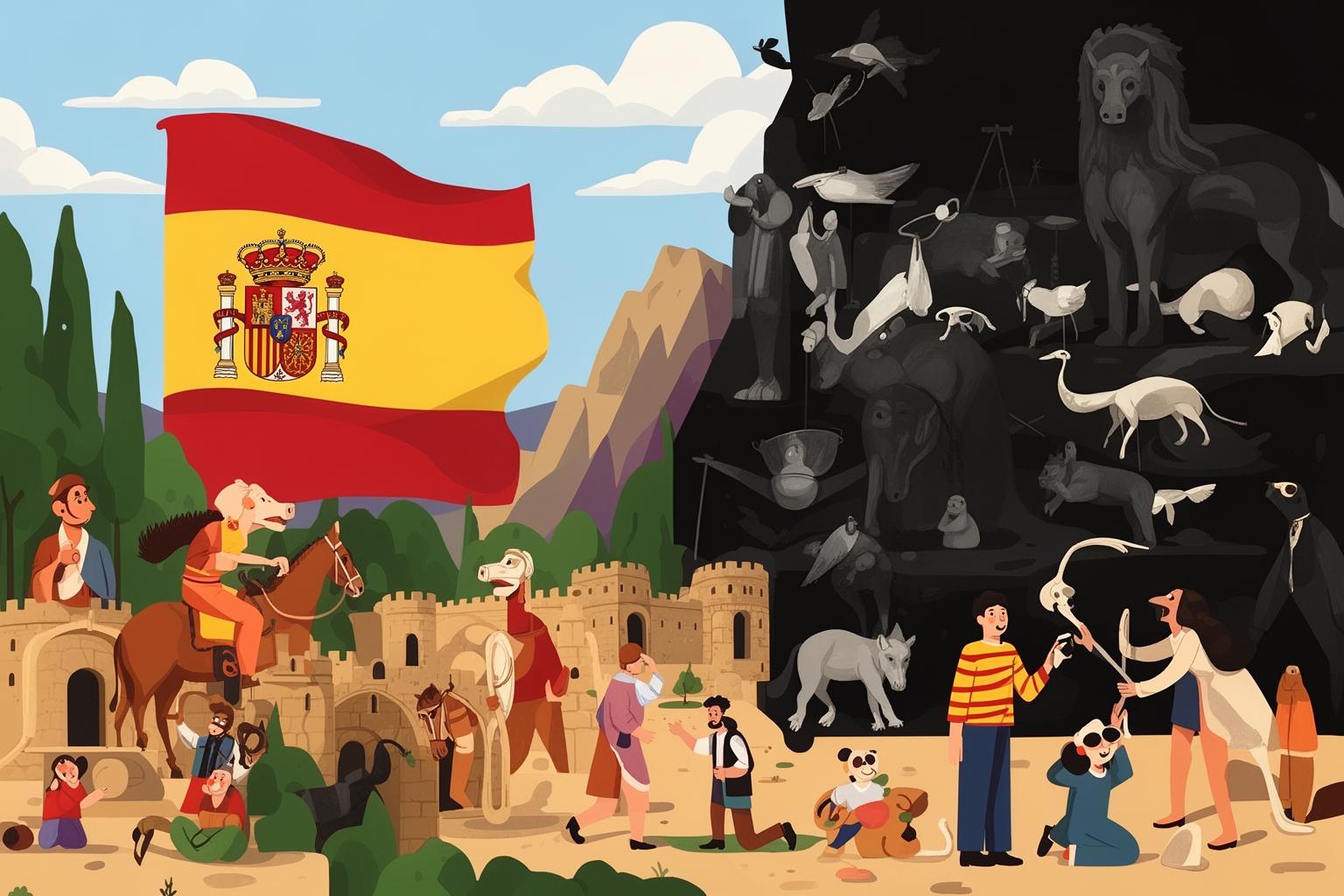
Our journey now shifts, leaving behind the public triumphs and traumas of Madrid for a far more private, introspective space. It brings us to the banks of the Manzanares River, to a location that no longer exists physically but has become one of the most mythologized sites in art history: the Quinta del Sordo, the House of the Deaf Man.
Quinta del Sordo: A Villa of Nightmares
In 1819, disillusioned with public life and increasingly isolated by his profound deafness, Goya purchased a country villa outside Madrid. It was here, in his seventies, that he unleashed the darkest, most disturbing visions of his imagination. He did not paint them for patrons or the public; instead, he painted them directly onto the plaster walls of his dining and sitting rooms. These fourteen murals, known as the Pinturas Negras or Black Paintings, were his private demons brought to life.
The house itself was demolished in the early 20th century, but one can still visit the area near the Segovia Bridge and imagine the solitary old artist at work. The true pilgrimage, however, lies back at the Prado, where the paintings were painstakingly transferred to canvas and now reside in their own dedicated, dimly lit room. Entering this space feels like descending into Goya’s psyche. The atmosphere is heavy, silent, and profoundly unsettling.
The works are a fevered dream of mythology, witchcraft, and pure existential terror. Painted with raw, expressive fury, they use a dark palette of blacks, ochres, and greys. The most notorious is Saturn Devouring His Son, a visceral portrayal of insane, cannibalistic rage—a father-god destroying his own creation. It’s an image unforgettable once seen. Nearby hangs the vast and terrifying Witches’ Sabbath or The Great He-Goat, depicting a grotesque gathering of witches and warlocks worshipping a demonic goat. Their faces are twisted, bestial, lost in a dark ecstasy.
Other paintings are more enigmatic but equally powerful. Fight with Cudgels shows two men, trapped knee-deep in sand, viciously bludgeoning each other to death—a potent, timeless metaphor for civil war and futile, self-destructive conflict. Then there is the most heartbreaking and modern of all: The Dog. Only the head of a small dog is visible, peeking over a vast, empty ochre slope, gazing up at a blank, unforgiving sky. It is an image of utter solitude, of being lost and overwhelmed in a vast, indifferent universe. It speaks directly to the anxieties of the modern soul.
Spending time with the Black Paintings is not an easy experience. There is no joy here, no beauty in the conventional sense. Yet there is a profound and terrifying honesty. This is the art of a man who has witnessed humanity’s worst and confronted the abyss within himself—and refused to look away. It is the culmination of his journey from light into darkness, a final, defiant statement from an artist with nothing left to lose.
The Final Light: Exile and a Resting Place
After the darkness of the Quinta del Sordo, one might believe Goya’s story ends in despair. However, there is a final, unexpected chapter in his life that takes us beyond Spain, followed by a coda that brings him back to a place of surprising beauty and grace in Madrid.
Bordeaux: A Coda of Peace
In 1824, fearing the oppressive political climate under King Ferdinand VII in Spain, Goya chose voluntary exile in Bordeaux, France. There, in his final years, he found some peace. He continued working, exploring the new medium of lithography and painting some of his most intimate and gentle portraits. The masterpiece of this period is The Milkmaid of Bordeaux. Following the monstrous figures of the Black Paintings, this work feels like a breath of fresh air. It is a soft, luminous portrait of a young woman, rendered with free, almost impressionistic brushstrokes. Her expression is calm and gentle, seeming like a final exhale, a moment of quiet grace at the close of a long and turbulent life. Goya died in Bordeaux in 1828, but his story in Spain was not quite finished.
The Royal Chapel of St. Anthony of La Florida: Goya’s Heaven
For the final stop on our journey, we return to Madrid, to a modest neoclassical chapel near the Manzanares River, not far from where his Quinta del Sordo once stood. The Real Ermita de San Antonio de la Florida is one of Madrid’s most treasured hidden gems. From the outside, it is simple and elegant. But stepping inside, you are transported.
The entire ceiling and dome of the chapel are covered in a stunning fresco cycle painted by Goya in 1798. It depicts the miracle of St. Anthony of Padua. Yet this is no somber, formal religious scene. Goya set the miracle in contemporary Madrid. The crowd witnessing the event is not composed of solemn saints, but ordinary Madrileños—majorettes, ruffians, and working-class folks—all leaning over a railing, gossiping and looking down into the church. It is vibrant, lively, and painted with an astonishingly light and swift touch. The colors are radiant, the figures animated, and the whole composition feels wonderfully real and human. It is a work of pure joy and technical brilliance, reminding us that before the darkness, Goya was a master of light.
What makes this place so deeply moving is that it is also Goya’s final resting place. In 1919, his remains were moved from Bordeaux and laid to rest here, in the Panteón de Goya, directly beneath the dome he masterfully painted. To stand in the center of this small chapel, to look up at his joyful vision of heaven, and to know the artist himself lies beneath your feet is an incredibly powerful experience. It feels like a fitting conclusion. After a life spent wrestling with demons, both public and private, the great master rests in eternal peace, watched over by the lively, beautiful, and profoundly human world he created.
A Pilgrim’s Practical Guide
Embarking on a journey through Goya’s Spain requires a bit of planning, but the rewards are truly priceless. The best time to visit is in spring (April-May) or autumn (September-October), when the weather is mild, avoiding both the summer’s intense heat and the winter’s chill. Madrid should serve as your base. The city’s Barajas Airport is a major international hub, and its public transportation system, especially the Metro, is efficient and user-friendly.
For the Madrid leg of your pilgrimage, consider purchasing the Paseo del Arte Card, which grants access to the three major museums: the Prado, the Reina Sofía, and the Thyssen-Bornemisza. Be sure to book your Prado tickets online in advance to skip the long lines. Allocate a full day for the Prado; you will need it. Don’t attempt to see everything—start with the Goya collections, then allow yourself time to explore at leisure. The Royal Chapel of St. Anthony of La Florida is a short bus or metro ride from the city center and offers free entry, though its opening hours can be limited, so check ahead.
To get to Zaragoza, the high-speed AVE train from Madrid’s Atocha station is ideal, taking just under an hour and a half. The city is walkable, but you may require a taxi to reach the Cartuja de Aula Dei. A day trip is possible, but staying overnight is recommended to fully absorb the city’s atmosphere. Fuendetodos is the most difficult destination to reach. Renting a car from Zaragoza for a half-day trip is the best way to get there, also allowing you to appreciate the stark beauty of the Aragonese countryside.
Embrace the Spanish pace of life. Lunch is the main meal, typically enjoyed leisurely between 2 and 4 PM, while dinner is served late, rarely before 9 PM. In between, indulge in the wonderful tradition of tapas. Let your journey be more than a checklist of sights. Sit in Plaza Mayor, wander through the Royal Palace gardens, and listen to the city’s sounds. Goya was, above all, an observer of life. To follow in his footsteps is to do the same—to watch, to feel, and to see the world with greater clarity and deeper soul.
The Enduring Gaze
Leaving the Panteón de Goya, with the light of his frescoes still shining vividly in your mind, you feel a profound sense of fulfillment. You have followed the arc of an extraordinary life, from a humble stone house in a forgotten village to the heart of a global empire, from the bright hopes of youth to the dark night of the soul, and ultimately, to a place of eternal, radiant peace. Goya’s legacy extends far beyond the walls of the Prado. His spirit remains alive in the lively energy of a Madrid tavern, in the quiet stillness of an Aragonese plain, and in the unwavering gaze of the Spanish people. He was more than just a painter; he was a witness. He held up a mirror to his era, and in it, we still see ourselves—our folly, our cruelty, our capacity for suffering, and our fleeting moments of grace. To journey through his Spain is to learn to view the world as he did, a pilgrimage truly worth making.