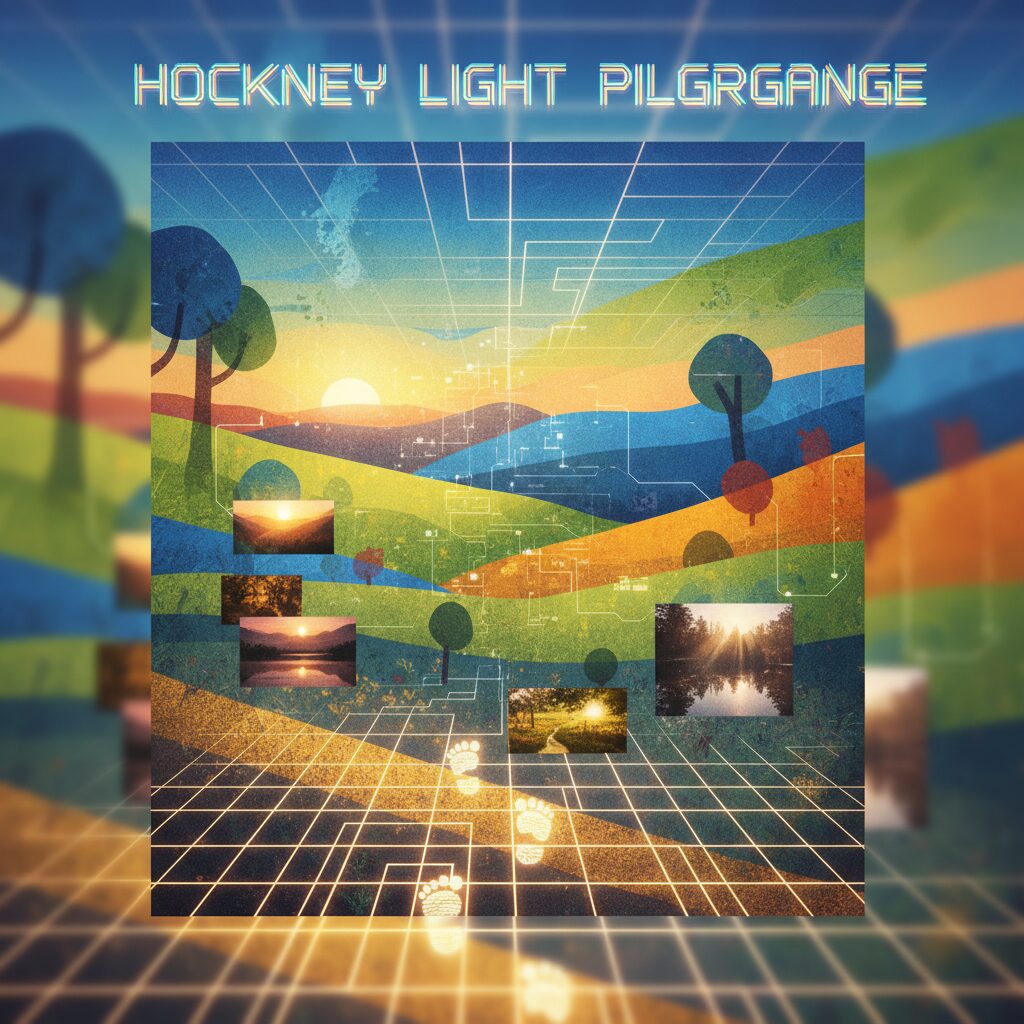
To chase the ghost of an artist, you don’t hunt for signatures on a wall or plaques on a building. You hunt for light. You follow the specific slant of a sunbeam that caught their eye, feel the damp chill of a morning that seeped into their bones, and stand in the very spot where the world arranged itself into a composition that demanded to be captured. For David Hockney, an artist who has spent a lifetime wrestling with the nature of seeing, this pilgrimage is not a journey to a single point, but a sprawling, vibrant odyssey across continents and climates. It’s a path that stretches from the brooding, industrial skies of Northern England to the relentless, crystalline sunshine of Southern California, and finds its latest chapter in the gentle, unfolding seasons of the French countryside. This is not just a tour of studios and galleries; it is an immersion into the very atmospheres that shaped his brush, his camera, and his iPad stylus. It is a quest to see the world through his eyes—a world more vivid, more complex, and more dazzlingly alive. To follow Hockney is to learn a new way of looking, to understand that a landscape is never static, a portrait is never a single moment, and the surface of a swimming pool can hold the depth of an ocean. Our journey begins where his did, in the heart of Yorkshire, where the seeds of his revolutionary vision were sown in the most unlikely of soils.
Much like Hockney’s quest for light, you can explore another artist’s dramatic world by chasing the shadows of Caravaggio.
The Formative Frame: Bradford and the Yorkshire Soul
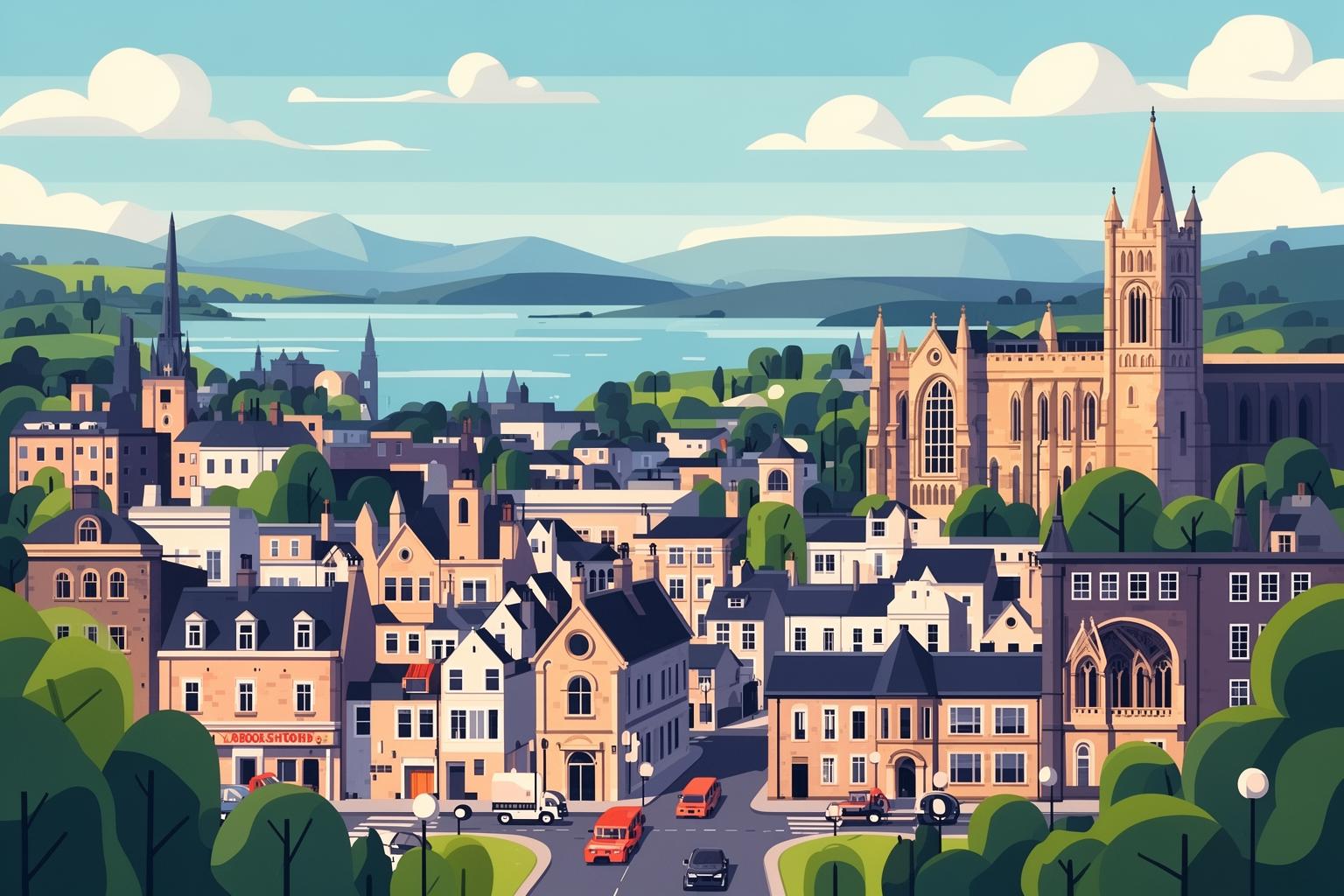
Before the cerulean blues, before the swimming pools and the sun-bleached asphalt of Los Angeles, there existed the distinctive grey light of Bradford. To grasp the explosion of color that would come to define David Hockney’s career, one must first stand beneath the skies of his youth. This is West Yorkshire, a region shaped by the Industrial Revolution, its valleys filled with towering textile mills and its hillsides lined with stone houses seemingly clinging to the earth. It’s a landscape of grit and grandeur, where the air often feels thick with rain and history. Hockney was born into this world in 1937, a world marked by post-war austerity, muted tones, and Methodist chapels. Yet it was here, against the backdrop of soot-stained sandstone and rolling green dales, that he first learned to truly observe. He saw beauty in industrial geometry, character in the faces of his neighbors, and the subtle shifts of light on a damp cobblestone street. This land didn’t just shape him; it provided the foundational visual language against which all his future explorations of light and color would be measured. It gave him an anchor, a sense of place to which he would return, time and again, with fresh eyes and deep, unwavering affection.
Salts Mill: A Cathedral of Industry and Art
There is no better place to begin a Hockney pilgrimage than Saltaire. Just a short train ride from Bradford, this UNESCO World Heritage site is a perfectly preserved Victorian model village, built in the 1850s by the textile magnate Sir Titus Salt for his workers. At its heart stands Salts Mill, a colossal structure that was once the largest industrial building in the world. Today, its days of producing alpaca wool are long behind it. Instead, it has been transformed into a vibrant cultural center and, most importantly, the spiritual home to a vast collection of David Hockney’s work.
Stepping into the main gallery on the third floor is a breathtaking experience. The sheer scale of the room, with its cast-iron columns and soaring ceilings, speaks to its industrial heritage. But the walls tell a different story. They pulse with the electrifying colors of Hockney. Here, you will encounter his monumental Yorkshire landscapes, notably those from his triumphant return to the region in the 2000s. You stand before ‘The Arrival of Spring in Woldgate, East Yorkshire in 2011,’ a dizzying, multi-panel installation stretching the length of the gallery. It’s an immersive symphony of acid greens, shocking purples, and brilliant pinks, all rendered with the joyful immediacy of his iPad. You don’t just view this piece; you walk alongside it, feeling the rhythm of the changing season, the emergence of life in the hedgerows and trees. The mill’s vastness allows the art space to breathe, letting the epic scale of his vision envelop you. It feels less like a museum and more like a secular cathedral—a place where industry and nature, past and present, converge in a celebration of one man’s extraordinary way of seeing.
A visit here can easily fill a full day. The mill also houses a fantastic bookshop, a diner, and other galleries. The best approach is to arrive early, perhaps by train from Leeds, spending the morning immersed in Hockney’s works. Afterwards, explore the village of Saltaire itself. Walk along the Leeds and Liverpool Canal, admire the uniform gritstone architecture, and imagine the world that shaped both Sir Titus Salt’s utopian vision and David Hockney’s artistic rebellion. It’s a place deeply connected to the earth and its own history, providing the perfect backdrop to the art you have just witnessed.
The Wolds’ Rolling Canvas: A Bigger Picture
Leaving the urban landscape of Bradford behind, the true magic of Hockney’s Yorkshire emerges in the countryside. To the east lies a little-known area of rolling chalk hills and hidden valleys called the Yorkshire Wolds. For decades, this was a quiet, unassuming part of England, overshadowed by the more dramatic landscapes of the Yorkshire Dales and the North York Moors. But through Hockney’s eyes, it became the subject of one of the most ambitious and celebrated projects of his career.
In the mid-2000s, Hockney returned from California to Yorkshire to care for his ailing mother and rediscovered the landscape of his youth. He began painting it with fierce intensity, determined to capture its unique character through the changing seasons. This culminated in the landmark 2012 exhibition at the Royal Academy of Arts in London, ‘A Bigger Picture.’ To truly experience this chapter of the Hockney story, you must drive. There is no other way. This journey is about movement, about watching the landscape unfold through a windscreen, just as he did. The key is to take the small, single-track country roads winding through the hills between Bridlington, where he kept a seaside home, and the market towns of Driffield and Pocklington.
One of the most cherished routes is the lane running through Woldgate Woods. Here, Hockney created his iconic ‘tunnel’ paintings, depicting the tree canopy as it changes from the skeletal black branches of winter to the first flush of green in spring, the dense, shadowy summer canopy, and the fiery explosion of autumn colors. To drive or walk this path is to step directly into one of his canvases. You begin to notice what he noticed: the way light filters through the leaves, the vibrant purple of the road surface after rainfall, the stark, graphic beauty of a hawthorn hedge in the snow. It’s an exercise in attentive observation. Practical advice for the pilgrim: the best times to visit are late spring, when hawthorn blossoms glow almost fluorescent, or mid-autumn for spectacular colors. Be prepared for narrow roads and bring a good map, as phone service can be patchy. But getting a little lost is part of the charm. Every turn reveals a new composition, a fresh view that Hockney may have stopped to sketch on his ever-present iPhone or iPad. This is not a landscape of dramatic peaks or majestic waterfalls. Its beauty is quieter, more subtle—and Hockney taught the world how to see it in all its magnificent, seasonal splendor.
The London Scene: Finding a Voice
If Yorkshire provided the soul and the fundamental grammar of his art, London offered Hockney both the stage and the subject matter to shape his identity. When he arrived at the Royal College of Art in Kensington in 1959, London was poised on the edge of a cultural explosion. The grey conformity of the post-war years was about to break apart into the kaleidoscopic energy of the Swinging Sixties. For a young, exceptionally talented artist from Bradford, it was a world filled with unimaginable freedom and possibility.
This London was a city shedding its old skin, a place of sharp new fashions, innovative music, and a tangible sense of creative rebellion. Hockney, with his bleached-blond hair, owlish glasses, and unapologetically Northern accent, became one of its central figures. He was a dandy and a flâneur, soaking in the city’s energy, its anxieties, and its developing visual language. His work from this time serves as a chronicle of a young man discovering his voice, wrestling with his identity, and challenging the establishment. The city itself turned into his canvas, a space to explore themes of love, desire, and social commentary with a wit and graphic confidence that felt entirely new.
The Royal College of Art and a Rebellious Spirit
To sense the essence of Hockney’s London, one must begin in South Kensington. This is London’s cultural core, a distinguished neighborhood of Victorian museums, grand embassies, and elegant mansion blocks. Here, amidst the imposing facades of the Victoria and Albert Museum and the Natural History Museum, stands the Royal College of Art. It was within these institutional walls that Hockney’s rebellious spirit truly ignited. At the time, the college was dominated by somber, gestural abstraction that was in vogue. Hockney, however, was drawn to the figurative, storytelling, and a more personal mode of expression.
His time there was defined by a now-legendary act of defiance. When the college authorities threatened to withhold his diploma because he had not completed a required essay, Hockney responded by creating a painting titled ‘The Diploma.’ It was a satirical piece, a visual protest that cheekily thumbed its nose at the bureaucratic rules he resented. Ultimately, he was awarded his diploma along with a gold medal for his outstanding talent. A walk around the area today still evokes that sense of the establishment he was pushing against. One can stroll through the manicured gardens of Kensington and Hyde Park, visit the V&A to see the classical forms he both admired and subverted, and feel the weight of the tradition that made his fresh, pop-inflected vision so radical. It was here that he learned not only the craft of painting but also the art of being David Hockney: a fearless, individualistic voice.
Capturing the Metropolis
Beyond the college walls, London became Hockney’s playground and muse. His early works from this era are infused with the city’s spirit. He crafted his own modern morality tale in the etching series ‘A Rake’s Progress,’ which relocated William Hogarth’s 18th-century satire to the streets of 1960s London and New York. It is a sharp, witty, and deeply personal narrative of his own experiences as a wide-eyed provincial artist navigating the temptations and absurdities of the big city.
To connect with this period, explore the neighborhoods he would have known. Wander through the vibrant streets of Notting Hill, then a bohemian and slightly gritty enclave. Visit the pubs and cafes of Soho, the city’s historic center of entertainment and vice. These served as the backdrops for his life and work. Although the specific scenes have evolved, the energy persists. One can still sense the clash of cultures, the buzz of creativity, and the feel of a city constantly reinventing itself that so captivated the young artist. His London paintings focus less on specific landmarks and more on the psychological landscape of the city—the chance encounters, private moments in domestic interiors, and the advertisements and graffiti that created the visual texture of modern urban life. He captured the sensation of being young and alive in a city on the verge of transformation, a feeling that continues to resonate in the capital’s vibrant pulse today.
California Dreaming: The Splash of Sun and Color

David Hockney’s relocation from London to Los Angeles in 1964 was more than a simple move; it marked an aesthetic and spiritual renewal. He transitioned from the soft, often melancholic light of England to a realm of dazzling, cinematic sunshine. The effect was immediate and profound, ushering in the most iconic and identifiable period of his career. Los Angeles provided him with a fresh palette, new themes, and a different lifestyle. The city’s landscape—a vast grid of boulevards, modernist homes, and turquoise swimming pools, all framed by arid hills and an impossibly blue sky—stood in stark contrast to the industrial North where he grew up.
Here, Hockney encountered a culture unburdened by European historical weight. It was a world of surfaces, hedonism, and manufactured dreams, and he was captivated by it all. He became intrigued by the quality of light—how it flattened perspective, sharpened shadows, and made colors pulse with an almost artificial vividness. He purchased a car and drove endlessly, absorbing the city’s unique visual rhythm. He traded his muted English palette for vivid acrylics—pinks, yellows, and brilliant blues—that could convey the intense glare of the California sun. This was where David Hockney emerged as the artist we know today, the chronicler of a sun-soaked paradise that is simultaneously real and a stunning illusion.
The Allure of the Swimming Pool
Nothing epitomizes Hockney’s passion for Los Angeles more than the swimming pool. It became his hallmark motif, a recurring theme through which he explored his key artistic concerns: the depiction of light, the passage of time, and the challenge of portraying a transparent, moving surface. For the wider world, the swimming pool symbolized Hollywood luxury and leisure. For Hockney, it was a complex formal problem, an outdoor life drawing class in his own backyard.
His most renowned piece from this era, ‘A Bigger Splash’ (1967), captures the brief, explosive moment after a diver disrupts the water’s surface, set against the calm, flat geometry of a modernist home and a clear blue sky. The painting is full of contradictions—it portrays a dramatic event, yet the composition is peaceful and almost unnervingly still. The human presence is suggested rather than visible. To capture the spirit of these paintings, you need not access a private Beverly Hills estate. Instead, explore the legacy of mid-century modern architecture that defines much of Southern California. A visit to Palm Springs, a desert haven of modernist homes, is a pilgrimage in itself. Here, you witness clean lines, glass walls, and the seamless blend of indoor and outdoor living that inspired Hockney. The entire city feels like a living museum of the aesthetic he celebrated. In Los Angeles, cruise through neighborhoods like Beverly Hills, Bel Air, or the Hollywood Hills, where you’ll see the world he painted: manicured lawns, tall palm trees, and tantalizing glimpses of turquoise water behind garden walls. It’s an ambiance of cool, controlled elegance beneath a hot, indifferent sun.
Life on Santa Monica Boulevard
Hockney established his studio in a modest building on Santa Monica Boulevard, a long, busy thoroughfare that runs across the western side of Los Angeles. This was his base, where he observed the city and its residents. His life and art were closely intertwined. He painted friends, lovers, and intimate domestic scenes of his new life. These portraits, such as ‘Christopher Isherwood and Don Bachardy,’ stand out for their psychological insight and quiet intimacy, offering a stark contrast to the seemingly impersonal, sun-bleached landscapes.
A drive along Santa Monica Boulevard today reveals the diverse fabric of LA life. It shifts from the edgy, rock-and-roll atmosphere of West Hollywood, through the polished opulence of Beverly Hills, to the cool, salty breeze of Santa Monica and the Pacific Ocean. This route reflects the world Hockney chronicled. Although his precise studio spot is not a public landmark, traveling this road offers a sense of his daily surroundings. You’ll see car washes, billboards, diners, and apartment buildings—the visual clutter of his adopted city. It’s a landscape meant to be seen from a moving car, and he captured that fluid, cinematic perspective masterfully.
Winding Roads and Broader Vistas: Nichols Canyon and Beyond
While drawn to the flat, grid-like layout of the LA basin, Hockney was also enchanted by the winding, serpentine roads ascending into the Hollywood Hills and Santa Monica Mountains. He lived for many years in Nichols Canyon, and the daily commute to his studio inspired a series of paintings bursting with color and motion.
Works like ‘Nichols Canyon’ (1980) forego the cool, static pool compositions in favor of dynamic, almost Fauvist energy. The road twists and turns like a ribbon of asphalt, surrounded by lush, tropical vegetation rendered in bold, non-naturalistic hues—reds, purples, and electric blues. To fully experience this, rent a car and drive Nichols Canyon Road, Laurel Canyon, or Mulholland Drive. The journey is thrilling. As you climb, the city grid spreads beneath you, a glowing carpet of lights at night or a hazy expanse by day. You feel the curves’ pull, the steep rises, and the shift from manicured gardens to wild, scrubby chaparral. Here, Hockney’s fascination with perspective becomes clear. From these vantage points, the entire city is visible, yet he chose to depict the intimate, disorienting passage through the canyon itself. It’s a reminder that for Hockney, the journey—the very act of seeing and moving through space—is as vital as the destination.
A French Serenity: The Normandy Chapter
Just as the world had neatly labeled David Hockney as the quintessential artist of the California sun, he made another striking change. In 2019, he relocated to a 17th-century farmhouse in Normandy, France. This move marked a return to a European landscape, yet one with a character vastly different from the rugged hills of Yorkshire. It signaled a shift toward a quieter, more reflective way of life and work. Normandy offered him a gentle, pastoral beauty—a land of half-timbered houses, lush meadows, blossoming apple orchards, and a soft, pearlescent light that constantly shifts with the weather rolling in from the English Channel.
This new chapter does not reject his past but rather synthesizes it. He brought the vibrant palette he developed in California to the four seasons of Northern France, using the digital technology of his iPad, which he had previously employed to capture Yorkshire’s spring, to document his new surroundings with obsessive care. The result has been an extraordinarily prolific creative phase, producing a body of work that honors the quiet rhythms of nature and the profound beauty of staying rooted in one place and observing the passage of time. It is the work of an artist in his eighties who has discovered a new, deep sense of peace and purpose in a secluded corner of the French countryside.
La Grande Cour: A House for Every Season
Hockney’s home and studio, a traditional timber-framed house named ‘La Grande Cour,’ is situated in the heart of the Pays d’Auge, a region famed for its cheese, cider, and pastoral charm. The house itself, with its distinctive thatched roof and surrounding gardens, became his entire world, especially during the global pandemic of 2020. He set out to do for Normandy what Monet, who lived only an hour away in Giverny, had done for his water lilies: to capture the endless, subtle transformations of a single place over time.
Using his iPad, he sketched dawn, rain, moonlight, and most famously, the arrival of spring. These works stand as a testament to joy and a defiant celebration of life. The colors are radiant, almost hallucinatory. The bare trees of winter give way to a burst of blossoms on the pear and cherry trees, the fields turn a brilliant, almost unreal green, and the pond in his garden mirrors the changing sky. Though his home is private, the spirit of these works is evident throughout the surrounding region. The pilgrim’s path here is one of slow, meandering drives. Follow the ‘Cider Route’ (Route du Cidre), a marked tourist trail winding through picture-perfect villages like Beuvron-en-Auge and Cambremer. Here, you’ll find the very scenes that populate Hockney’s recent canvases: ancient timbered farmhouses, cows grazing in lush pastures, and endless rows of apple trees. The best times to visit are spring, to witness the blossom he so joyfully captured, or autumn, when the apple harvest is underway and the leaves turn golden.
Embracing the Slow Rhythm
To truly appreciate Hockney’s Normandy, one must slow down. This is not a landscape of grand, dramatic vistas but of intimate, enclosed spaces. The experience lies in savoring the details: the quality of light filtering through a misty morning, the taste of a fresh croissant from a village bakery, the sound of distant church bells. It stands in stark contrast to the fast-paced, car-centric culture of Los Angeles. A recommended itinerary would be to base yourself in a small town like Honfleur, with its charming historic port, or Pont-l’Évêque, then take day trips into the countryside. Explore local markets, where the vivid colors of fresh produce seem to rival Hockney’s own palette. Wander through an apple orchard. Sit at a café and simply watch the world go by.
This latest phase of Hockney’s work powerfully reminds us that an artist’s vision does not rely on exotic locations but on the depth of one’s attention. By immersing himself in the daily and seasonal life of his Normandy home, he has created a universal message about the importance of finding beauty in our immediate surroundings. It is a quiet, profound final act in a career marked by bold moves and constant reinvention—a peaceful return to the European soil from which he first emerged.
The Traveler’s Eye: Other Canvases
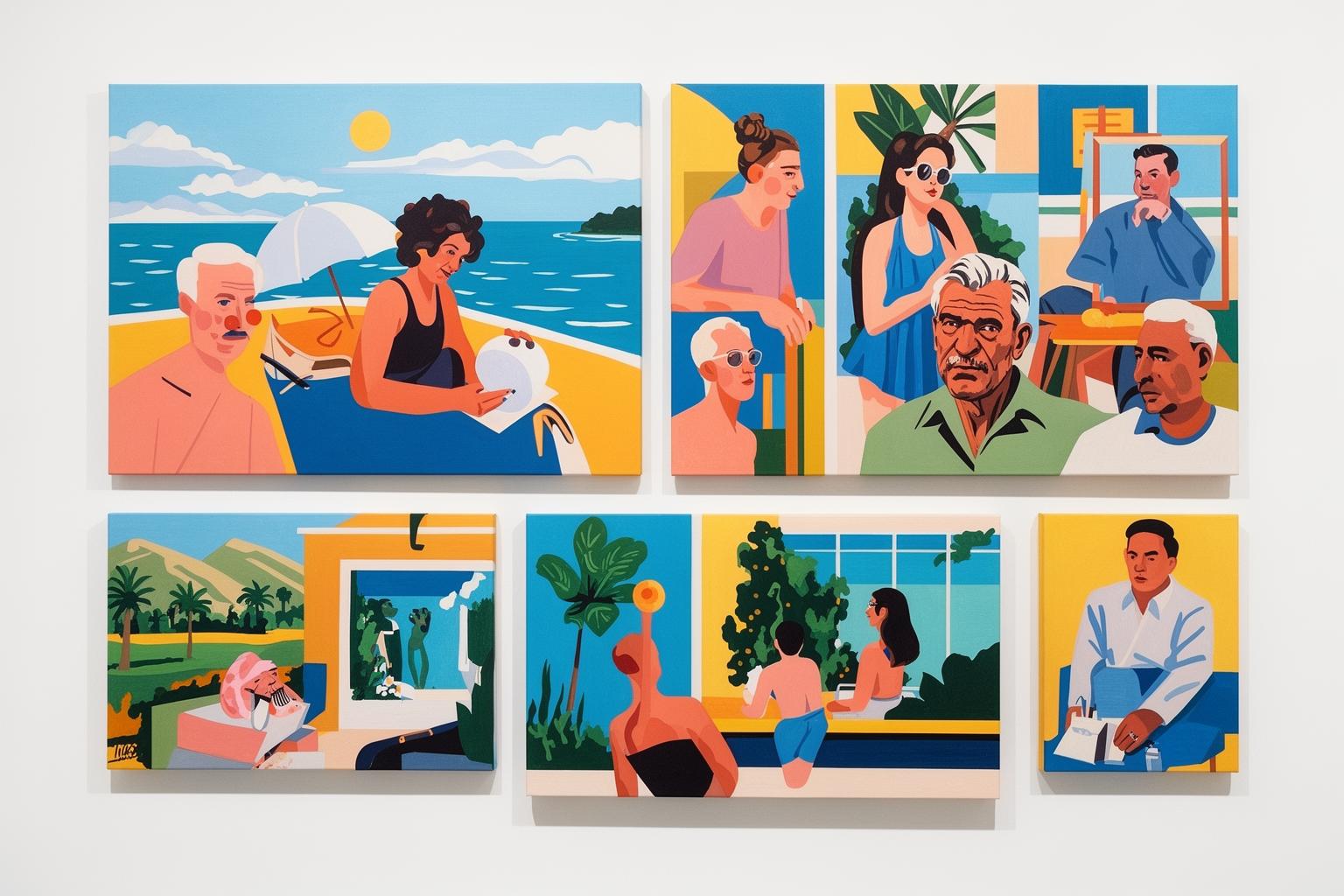
While Yorkshire, London, Los Angeles, and Normandy serve as the main geographical anchors of his life and work, David Hockney has always been an avid traveler, his eye continuously searching for fresh perspectives and new challenges. These travels have resulted in important bodies of work that, although perhaps less renowned than his swimming pools, are essential to fully grasping the breadth of his artistic vision. They reveal an artist consistently wrestling with the challenge of representing a three-dimensional world on a two-dimensional surface.
One of his most ambitious travel-driven projects took place far from the soft greens of Europe or the bright sun of California. In the 1980s, Hockney focused on the monumental landscapes of the American West, especially the Grand Canyon. Confronted by its vast scale and the impossibility of capturing it from a single viewpoint, he developed his renowned photocollage technique, known as ‘joiners.’ He took hundreds of individual photographs of a scene, shifting his perspective and moving his feet, then pieced them together into a large, composite image. Creations like ‘A Bigger Grand Canyon’ are not single snapshots but records of the experience of looking—turning one’s head and focusing on various details. It is a Cubist mode of seeing, interpreted through the camera lens. Visiting the Grand Canyon’s South Rim, particularly Mather Point, lets you stand where he stood and grasp the artistic problem he aimed to solve. You face a vista so immense that the eye struggles to settle, helping you understand his radical approach to portraying not just a scene, but the very act of viewing.
Earlier in his career, other travels also left a lasting impact. A 1963 trip to Egypt, commissioned by a newspaper, deeply influenced his drawing style. He was inspired by the stylized, linear qualities of ancient Egyptian art, an influence evident in the elegant, assured line work of his later portraits and etchings. These journeys—to the ancient tombs of the Nile or the vast canyons of Arizona—were never merely about documenting places. They were about learning to see differently, gathering new visual insights, and continually pushing the limits of his own artistry.
The Pilgrim’s Palette: Experiencing Hockney Today
Our journey through the map of David Hockney’s life comes full circle—not to a single place, but to a state of mind. To follow in his footsteps is to understand that his true subject has never been a specific location, but the very act of perception itself. This pilgrimage begins beneath the dramatic, rain-soaked skies of Yorkshire, where the land seems to carry a deep, soulful memory. It flows through the rebellious, electric energy of Swinging London, a city alive with sharp wit and newfound freedom. It basks in the relentless, dazzling sunshine of Los Angeles, discovering profound beauty in the slick, artificial surfaces of a modern paradise. Finally, it finds rest in the gentle, ever-shifting light of the Normandy countryside, a tribute to the quiet joy of long, focused observation.
To truly complete this pilgrimage, the last step is to carry these lessons with you. Seeing the world through Hockney’s eyes is not merely about visiting Salts Mill or driving through Nichols Canyon. It means returning home and gazing at your own surroundings with the same intensity and curiosity. Notice how morning light strikes the side of a building. Observe the intricate patterns of shadows beneath a tree. See the vibrant, almost startling color of a flower in a public park. Hockney’s greatest gift is to teach us how to pay attention. He reminds us that the world is far more fascinating and beautiful than we often acknowledge, and that the finest works of art are all around us, waiting to be noticed. So go out, wherever you are, and chase the light. See the splash. Feel the arrival of spring. Discover your own larger picture. The world is the canvas, and you hold the brush. Look closely. Look again. It is a spectacular show.