There’s a silence in the paintings of Johannes Vermeer that hums with life. It’s in the way a sliver of light catches a pearl earring, the patient pour of milk from a jug, the weight of a thought on a woman reading a letter. His world, captured with an almost supernatural clarity, feels both impossibly distant and intimately familiar. For centuries, these quiet moments, rendered in jewel-toned pigments, have been locked behind museum glass. But the source of that light, the very air that filled those rooms, still exists. It lingers in the canals and cobblestone streets of Delft, the Dutch city that was Vermeer’s entire world. He was born here, worked here, raised a sprawling family here, and was buried here. To walk through Delft is to walk through the backdrop of his mind, a pilgrimage not to a specific shrine, but into the very essence of his art. It’s a journey to understand how an artist from this one small city managed to paint the universal soul of stillness. As a photographer accustomed to capturing the fleeting interplay of light and shadow in distant landscapes, I came to Delft seeking the origin of this particular, legendary illumination—a quest to see the world, just for a moment, through Vermeer’s eyes.
This quest to see through a master’s eyes is not unique to Vermeer, as a similar pilgrimage can be made into the world of Giotto di Bondone.
The Heart of the Dutch Golden Age: Stepping into Delft

Arriving in Delft is to sense the fabric of time grow thin. The city is not merely a relic; it is a living, breathing place where students cycle past 17th-century gabled houses and the Saturday market hums with the same commercial vitality that fueled the Dutch Golden Age. Still, the past is never far away. It reflects in the calm green water of the Oude Delft canal, mirroring the crooked facades of centuries-old buildings. It stands in the monumental presence of the Nieuwe Kerk and the Oude Kerk, the two churches that frame the old city and serve as its steadfast anchors. This atmosphere is the key to understanding Vermeer. His paintings were no fantasies. They were distilled realities, born from this very environment.
In the 1600s, Delft was a crucible of innovation and wealth. Powered by the Dutch East India Company (VOC), whose local chamber was among the most influential, the city was a center of trade, science, and art. This was the world of Antonie van Leeuwenhoek, the father of microbiology, who lived just down the street from Vermeer. It was a society captivated by optics, lenses, and new ways of seeing the world both microscopically and through telescopes. This fascination forms the cultural DNA of Vermeer’s work. His near-photographic precision, his mastery of perspective, and his reputed use of the camera obscura were not mere artistic idiosyncrasies; they were products of his era and place. He was a man of his city, and his city was at the forefront of a visual revolution.
The light here feels different. It is a soft, northern light, filtered through a moisture-heavy sky that acts as a giant diffusion panel. It does not blast or bleach; it bathes. It spills through the tall Dutch windows, creating long, gentle shadows and illuminating dust motes dancing in the air. For a photographer, this light is a gift. It is a narrative tool, capable of revealing texture, defining form, and evoking mood. Standing by a canal as the late afternoon sun strikes the brickwork, one begins to understand. This is the raw material Vermeer worked with. He did not invent this light; he simply understood it more deeply than anyone else.
The Vermeer Centrum Delft: A Gateway to a Lost World
Before you begin searching for the physical traces of Vermeer’s life, the essential first stop is the Vermeer Centrum Delft. It’s situated on the Voldersgracht, at the site of the reconstructed Guild of Saint Luke, where Vermeer once served as dean. An important fact to understand is that no original Vermeer paintings remain in Delft. His works were sold and dispersed long ago, now housed in major museums worldwide. Thus, the Centrum does not operate as a typical museum. Instead, it fulfills a more vital role: offering an immersive introduction to his life, techniques, and his complete, though modest, body of work.
Stepping inside feels like entering a laboratory devoted to unraveling genius. The ground floor displays full-scale, high-quality reproductions of all 37 of his known paintings, arranged in chronological order. This unique opportunity, unavailable elsewhere, allows visitors to experience his entire artistic progression in one space. You can follow his development from early historical and biblical scenes to the refined domestic interiors for which he is famed. Viewing them together highlights his recurring themes: the solitary woman at the window, the play of light and shadow on a back wall, the rich textures of fabrics and maps.
The upper floors are where his magic is thoroughly examined. One exhibit focuses on his use of perspective. Here, you can look through a life-sized camera obscura, a simple optical device projecting an image onto a surface. It is widely believed Vermeer used this tool not to trace, but to study light and color effects with a precision beyond the naked eye. The slightly soft focus, the brilliant highlights called points of light, and the exaggerated perspective in some paintings all suggest its influence. This exhibit clarifies his technique without reducing his artistry, presenting him as an innovator, a scientist of vision.
Another section explores his renowned use of color. You learn about the high cost of pigments like ultramarine, made by grinding the semi-precious lapis lazuli stone, which Vermeer applied with nearly reckless boldness to create his signature luminous blues. Interactive displays let you mix colors and grasp the principles behind his palette. You leave the Centrum not only with admiration for his beautiful images but also with profound respect for his meticulous, almost obsessive craftsmanship. It provides you with a new way to see, preparing you to recognize the subtle clues he left behind in the very streets of Delft.
Walking the Vermeer Trail: Tracing Footsteps Through Time
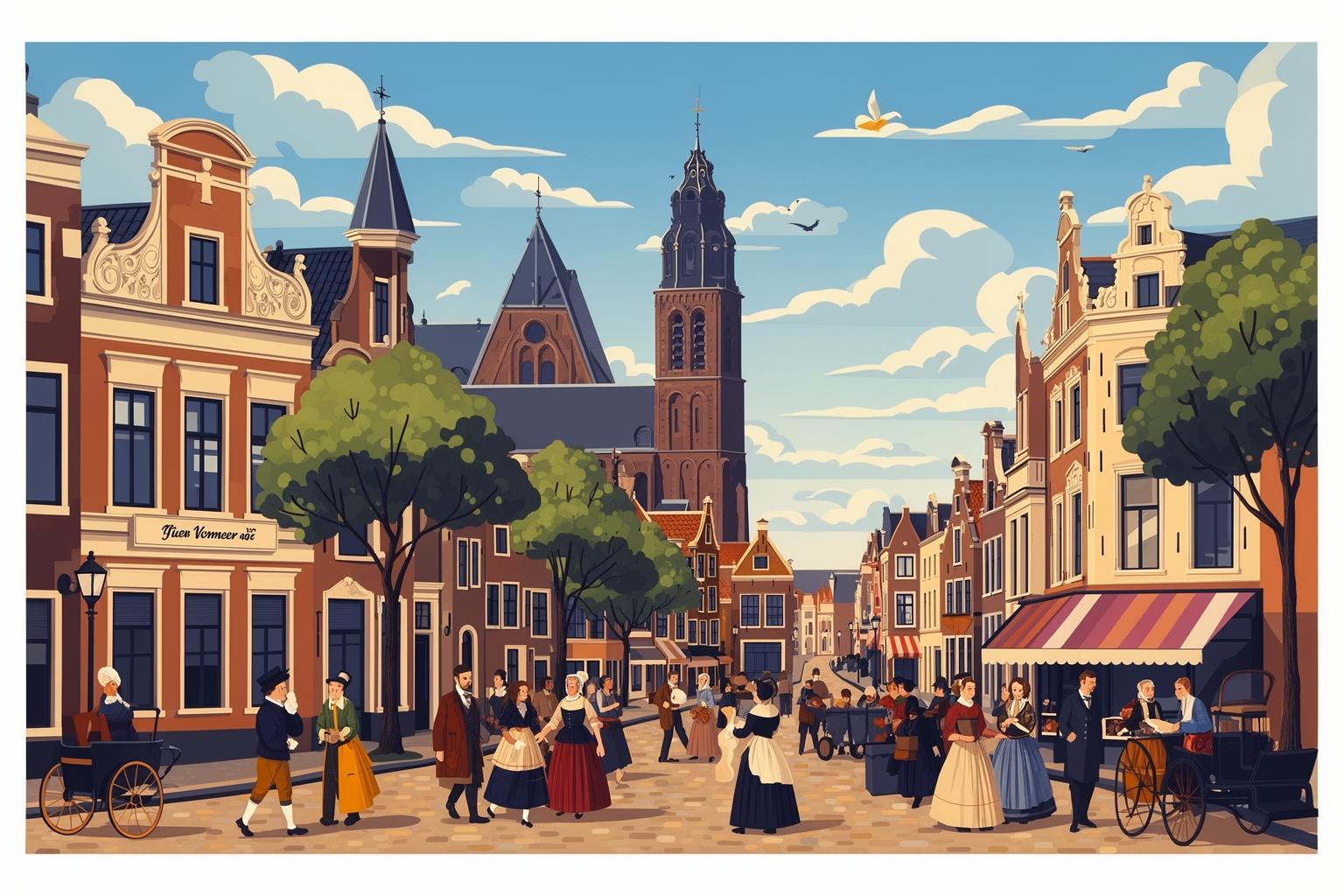
With the Centrum fresh in your memory, the city of Delft transforms. It becomes more than just a picturesque town; it turns into a text waiting to be read. The “Vermeer Trail” is not a formal, cordoned-off route but a personal journey, a deliberate act of connecting the dots between the artist and his surroundings.
The Birthplace and Early Years: Voldersgracht
Your journey starts just outside the Vermeer Centrum, along the Voldersgracht canal. This is where Johannes Vermeer was born in 1632 and baptized at the nearby Nieuwe Kerk. His father, Reynier Janszoon, was an innkeeper and art dealer. The family operated an inn called “De Vliegende Vos” (The Flying Fox) right on this street. Though the original building no longer stands, being on this narrow street, beside the gently flowing water, is a profound experience. This was his first landscape, his initial light. The sounds of the city, reflections on the water, and texture of the bricks—these were his formative sensory impressions. A small, modest plaque marks the approximate site, a quiet tribute to the remarkable life that began here. Nearby, in a small park, a bronze statue of the artist sits thoughtfully on a bench, offering a modern homage and a place to reflect on his legacy before continuing onward.
The Guild of Saint Luke: An Artist’s Brotherhood
The building now hosting the Vermeer Centrum is a reconstruction of the Guild of Saint Luke’s chapel. The original Guild Hall, where Vermeer registered as a master painter in 1653, was just a short walk away. In the 17th century, the Guild was everything for an artist—a union, a school, and a social club that regulated the trade and upheld artistic standards. Membership was essential to sell art professionally. Vermeer was not only a member but was elected headman, or dean, of the Guild multiple times, underscoring the high regard he earned among his peers. Although no records exist of his training—his master remains unknown—his leadership in the Guild shows that he was a central, respected figure in Delft’s artistic community, far from the isolated recluse he is sometimes portrayed as. Walking these streets, one can imagine him conferring with fellow artists like Carel Fabritius or Leonaert Bramer, discussing commissions and debating pigment prices.
A Life in the Markt: The Center of it All
All roads in old Delft lead to the Markt, the expansive central square that functions as the city’s heart. Dominated by the soaring Gothic spire of the Nieuwe Kerk on one end and the grand Renaissance-style City Hall on the other, this square was the hub of Delft’s public life. Vermeer would have crossed this space thousands of times. It was here, in the magnificent City Hall, that he and Catharina Bolnes published their wedding banns in 1653. The market, then and now, was a chaotic blend of sights, sounds, and smells—a sharp contrast to the profound calm of his paintings. This tension is compelling to consider while standing in the busy square. He absorbed this public energy and then withdrew to his studio to create its opposite: the private, introspective realm of the home. The Markt reminds us that his serene interiors were not painted in isolation; they represent a conscious artistic choice, a sanctuary carved out from the noisy world beyond.
The Home of Masterpieces: The Mechelen Inn on the Markt
Situated just off the Markt, Vermeer’s father purchased a larger inn named “Mechelen” in 1641. Johannes inherited it and the associated art dealing business after his father’s death. He lived and worked here with his wife Catharina during the early years of their marriage. The original building is gone, replaced by a modern shop bearing a commemorative plaque, but the location remains significant. From the inn’s upper windows, Vermeer would have had a clear view of the Markt, the City Hall, and William of Orange’s tomb within the Nieuwe Kerk. It’s intriguing to imagine him watching the city’s civic life from this vantage point. Art historians speculate that some of his earlier works may have been painted here, as he balanced roles as innkeeper, art dealer, and emerging master painter—a life mixing commerce and art, common for many Golden Age artists.
The Final Years on Oude Langendijk: A Quiet Corner
The most sacred place on the Vermeer trail is Oude Langendijk, a quiet street nestled in a part of the city known as the “Papists’ Corner” for its Catholic residents. Around 1660, Vermeer and his growing family moved into the home of his wealthy and influential mother-in-law, Maria Thins. This house, much larger than his previous residences, is widely believed to be the setting for most of his famous masterpieces. Though the building no longer stands, its location has been identified, and envisioning the empty space, now a small square, requires imagination.
This is where it all happened. This was the house containing the studio, likely on the upper floor, with windows facing north to capture the cool, steady light treasured by painters. It is where “The Milkmaid” poured her milk, “The Music Lesson” unfolded, and the “Woman with a Pearl Necklace” admired her reflection. The distinctive black and white marble floor tiles found in many of his paintings were a genuine feature of this house, noted in the inventory after his death. Standing here, you can almost overlay those scenes onto the modern streetscape—imagine the light slanting through the windows, illuminating the map of the Netherlands on the wall, catching the corner of a Turkish rug draped across a table. This quiet street held nearly all the magic associated with his name. Here he perfected his art, and here he succumbed to deep financial hardship, dying suddenly in 1675 and leaving his wife and eleven children in debt.
The Views That Became Masterpieces: Beyond the Interiors
While Vermeer is unquestionably the master of interior scenes, two of his most stunning works are landscapes. Discovering the exact locations where he painted these masterpieces is among the most rewarding aspects of a pilgrimage to Delft, forging a deep connection between the real world and his canvas.
View of Delft: A City’s Soul on Canvas
Marcel Proust described it as “the most beautiful painting in the world.” Vermeer’s “View of Delft” is more than just a cityscape; it is a portrait of a place, filled with an almost spiritual calm. To find the viewpoint from which it was painted, you must walk south from the city center, cross the Schie canal, and reach a spot near the Hooikade. Today, the scene has changed. The city walls and gates visible in the painting have disappeared, replaced by modern buildings. Yet the core elements remain—the harbor’s water, the skyline marked by the spires of the Nieuwe Kerk and the Oude Kerk, and above all, the dramatic Dutch sky.
Standing there, you can grasp Vermeer’s artistic decisions. He was not a strict documentarian. He rearranged buildings, altered proportions, and shaped the light to achieve perfect compositional and emotional harmony. He shaded parts of the city while a brilliant band of sunlight highlights the rooftops in the distance, guiding the viewer’s gaze. The water lies unnervingly still, the clouds heavy with rain either approaching or just passed. Seen through a photographer’s eye, this is a masterful study in composition and light. He captured a fleeting weather moment and transformed it into an eternal image of tranquility. Experiencing this view firsthand, especially on a day with a dramatic sky, creates an immediate link to his artistic vision. The painting itself is displayed in the Mauritshuis in The Hague, just a short train ride away, and seeing the original after visiting this spot is unforgettable.
The Little Street: An Ode to the Everyday
If “View of Delft” is a grand public declaration, “The Little Street” is an intimate, private murmur. It quietly honors the humble beauty of ordinary Dutch life: aged brickwork, women engaged in household tasks, children playing on cobblestones. For many years, the exact location of this street remained one of art history’s most fascinating mysteries. Recent studies have convincingly identified it as Vlamingstraat 40-42. Although the original buildings no longer stand, the street’s narrowness and the rhythm of remaining 17th-century architecture evoke a strong sense of the place.
Walking down Vlamingstraat today feels like a treasure hunt. You find yourself examining the façades, searching for the ghost of the distinctive stepped gables and brick patterns from the painting. What makes this work so groundbreaking is its subject. Vermeer chose a scene any other artist might have overlooked—a simple, slightly run-down backstreet corner—and elevated it to high art. He revealed profound beauty in the textures of mortar, the stillness of a woman sewing in a doorway, and the quiet dignity of daily labor. It is a lesson in perception. After visiting this street, you begin to see “Vermeer moments” all over Delft: the way light falls on a weathered door, the quiet geometry of a window frame, the simple elegance of a resident sweeping their stoop. He teaches you to find art in the ordinary—an enduring gift long after you leave the city.
The Final Resting Place: The Oude Kerk
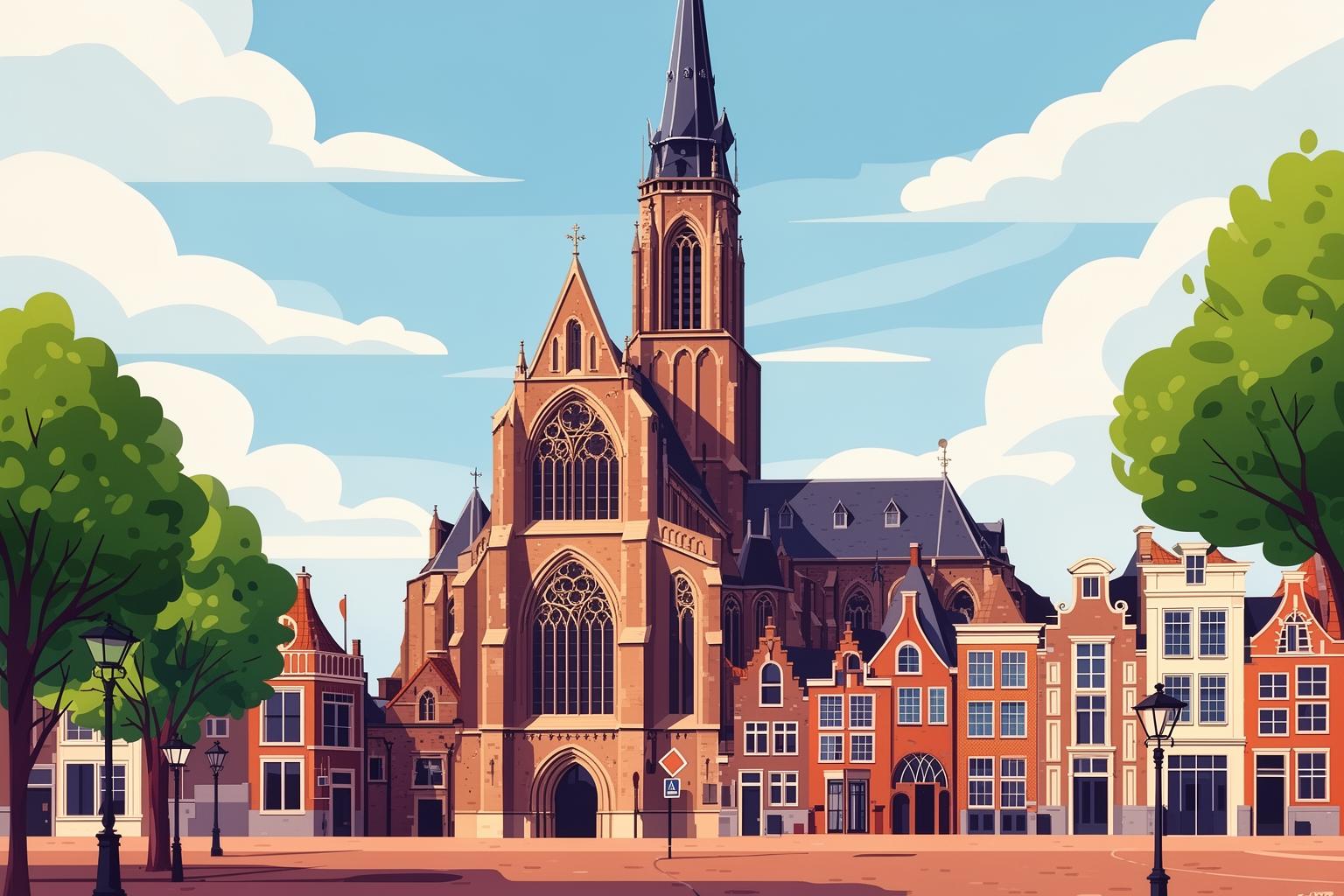
After tracing the arc of his life and work, the pilgrimage ends at the Oude Kerk, or Old Church. With its famously leaning brick tower, this ancient church stands as one of Delft’s most iconic landmarks. Inside, the atmosphere is quiet and reverent. Light filters through the tall Gothic windows, illuminating the worn flagstones on the floor. It is here, beneath one of those stones, that Johannes Vermeer is buried.
His grave is strikingly simple. A small, modern stone, placed in 1975, bears the inscription, “Johannes Vermeer 1632-1675.” There is no grand monument or effigy. His resting place is a humble marker among the ornate tombs of Dutch naval heroes and wealthy regents. This is a poignant reminder of his situation at the time of his death. Despite the artistic respect he commanded, a severe economic downturn had ruined his art dealing business and left him unable to support his large family. He died in obscurity, with his genius going unrecognized by the broader world for another two hundred years.
Standing by his grave invites quiet reflection. It offers a moment to ponder the strange nature of fame and the great gap between artistic achievement and financial security. Here, in this silent church, the journey concludes where his life did. You are left with a full sense of the man: the master of light, the respected Guild dean, and the struggling father and husband. It is a somber yet essential final chapter in the story.
Beyond Delft: Where to See the Originals
No visit to Vermeer’s world is truly complete without witnessing his original canvases. The radiant surfaces, delicate textures, and emotional depth of his work can only be fully appreciated firsthand. Luckily, two of the most significant collections of his paintings in the world are just a short trip from Delft.
The Hague: The Royal Collection at the Mauritshuis
A brief fifteen-minute train ride brings you to The Hague, home to the Mauritshuis. Located in a beautiful 17th-century mansion, the museum is often referred to as the “Royal Picture Gallery.” It is a cozy, jewel-like museum with an unrivaled collection. Here, you will encounter three Vermeers, each a masterpiece of a distinct kind. You will see “Diana and her Nymphs,” an early and rare mythological scene. You will be reunited with “View of Delft,” which, after visiting its real-life inspiration, will feel like meeting an old friend.
And then there is “Girl with a Pearl Earring.” No reproduction can prepare you for the original. She hangs in a small, quiet room, her gaze following you. The painting is deceptively simple yet infinitely complex. The way light plays on her skin, the moisture on her lips, the mysterious tilt of her head, and of course, the pearl—a single, brilliant illusion crafted with just two strokes of white paint. Standing before her is to grasp the nature of transcendent art. It is a unique, profoundly moving experience.
Amsterdam: The Grandeur of the Rijksmuseum
Less than an hour’s train ride from Delft is Amsterdam, home to the magnificent Rijksmuseum, the national museum of the Netherlands. In its beautifully renovated halls, within the Gallery of Honour, you will find a collection of four Vermeers. Here is “The Milkmaid,” a painting that exudes a monumental, earthy dignity. The details are astonishing—the thick, steady stream of milk, the texture of the bread, the light catching the nail on the wall. You will also encounter “The Little Street,” which deeply resonates after having walked the Vlamingstraat. The other two, “Woman Reading a Letter” and “The Love Letter,” are classic examples of his mature style, drawing the viewer into a quiet world of contemplation and whispered secrets. Viewing these four masterpieces in the grand setting of the Dutch Golden Age at the Rijksmuseum perfectly culminates the journey, firmly placing Vermeer among the great Dutch Masters.
Practical Pilgrim’s Guide: Experiencing Vermeer’s World
Exploring Delft and its surroundings is a delight, but a few tips can help you fully immerse yourself in Vermeer’s world.
Getting to and Around Delft
Delft is ideally located between Rotterdam and The Hague. The easiest way to reach the city is by train. The Dutch rail network is clean, efficient, and connects directly to major hubs such as Amsterdam’s Schiphol Airport. Once in Delft, the historic center is compact and very pedestrian-friendly. The best way to explore is on foot. Allow yourself to wander through the maze of canals and alleys. For an authentic Dutch experience, consider renting a bicycle for the day, letting you cover more ground and feel like a local.
The Best Time to Chase the Light
Although Delft is beautiful year-round, the prime times for a Vermeer-themed visit are spring (April-May) and autumn (September-October). During these months, tourist crowds are smaller, and more importantly, the quality of light is exceptional. The low-angled sun casts long shadows and bathes the city in a warm, golden glow that harmonizes perfectly with the artist’s color palette. Summer is lovely but busier, while winter has its own stark, moody charm, though the days are much shorter.
A Photographer’s Notes
For photographers, Delft is a treasure. Try to look beyond simple snapshots and see through Vermeer’s eyes. Pay close attention to the light. Rise early for the soft morning glow on the canals, or stay out for the “blue hour” after sunset when city lights sparkle and reflect on the dark water. Seek compositions that highlight geometry and reflections. Frame shots through doorways and windows to create a sense of interior and exterior space. Don’t just focus on famous landmarks; capture the small details that define the city’s character—a bicycle leaning on a bridge, the detailed pattern of a brick wall, a cat napping in a sunlit window. These are the contemporary “Little Street” moments.
Beyond Vermeer: Savoring Delft
While Vermeer’s spirit is the main attraction, be sure to enjoy all else this charming city offers. Visit a Delft Blue pottery factory to watch the iconic earthenware being hand-painted. Take a canal boat tour for a fresh view of the architecture. Spend an afternoon in one of the cozy, wood-paneled “brown cafes” (bruin cafés) enjoying a local beer or coffee. Delft is a university town, full of youthful energy, quaint shops, and excellent restaurants. Give yourself time to wander freely and soak in the atmosphere. The full experience of Vermeer’s city comes from embracing its present as much as exploring its past.
To stroll the streets of Delft is to realize that Vermeer’s paintings are not merely images; they are emotions. They evoke peace, a slowing of time, and beauty found in the quietest corners of life. The pilgrimage doesn’t end upon leaving the city. The true souvenir you take home is a new way of seeing: noticing the Vermeer light in your own home, the silent poetry of everyday objects, the profound humanity in a moment of quiet reflection. He doesn’t just show you his world; he transforms how you see your own. And that, perhaps, is the deepest form of artistic immortality.