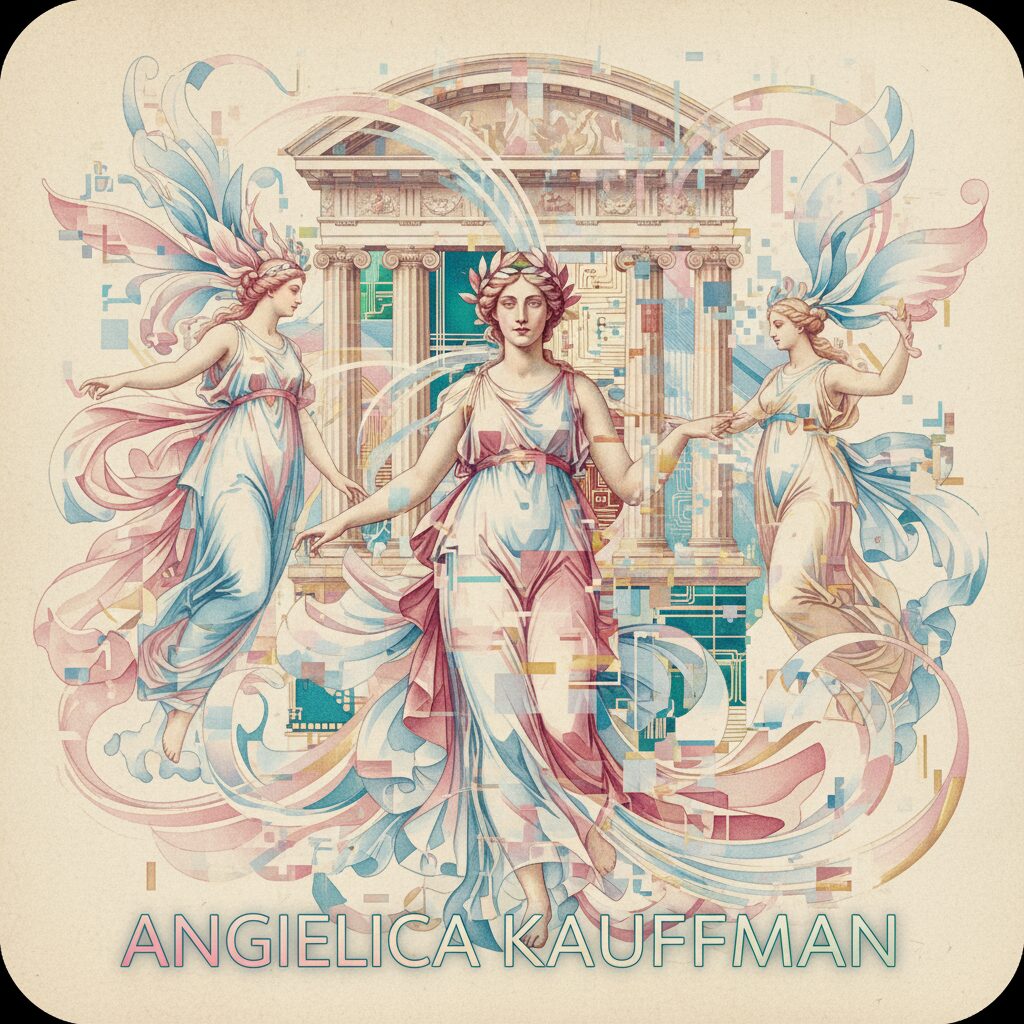
Step into the gilded salons of 18th-century Europe, where the rustle of silk and the murmur of intellectual debate fill the air. In this world, dominated by men, a singular talent emerged, a woman who wielded her paintbrush like a scepter, commanding the respect of kings, artists, and poets alike. Her name was Angelica Kauffman, and she was more than just a painter; she was a phenomenon. A child prodigy born in the Swiss Alps, she rose to become one of the most celebrated artists of her time, a founding member of London’s Royal Academy, and the undisputed queen of Roman society. To trace her journey is to embark on a Grand Tour of the mind and soul, a pilgrimage through the very cities that forged her genius and cemented her legacy. This isn’t just a trip through Europe; it’s a journey back in time, walking in the footsteps of a trailblazer who painted her own destiny on the grand canvas of the Neoclassical age. From the crisp mountain air of her childhood home to the sun-drenched marbles of Italy and the sophisticated clamor of Georgian London, we will follow the muse, exploring the places that inspired her and the masterpieces she left behind. Prepare to discover the world through the eyes of Angelica Kauffman, an artist who saw gods in mortals and timeless beauty in the fleeting moments of history.
Her journey through the Neoclassical age offers a fascinating contrast to the raw, abstract energy explored in a journey into the soul of Jackson Pollock’s America.
An Alpine Overture: The Making of a Prodigy in Chur

Every great story begins with a starting point, a foundation that anchors the epic to come. For Angelica Kauffman, that starting point was Chur, a quiet, ancient town nestled deep within a valley of the Swiss Alps. Visiting Chur today allows one to breathe the same crisp, clear air that filled the lungs of the young Angelica, a world apart from the sprawling, cosmopolitan capitals she would later dominate. This is where the seed of her remarkable talent was planted and nurtured. Born in 1741, her first views were of towering, snow-capped peaks and the sturdy, stoic architecture of Switzerland’s oldest city. The atmosphere here exudes profound tranquility and a rich sense of history. The cobblestone streets of the Altstadt, or Old Town, wind and twist, leading to hidden courtyards and frescoed building facades that tell stories from centuries gone by. It feels like a place frozen in time, the perfect environment for a fledgling imagination.
Her earliest and most influential teacher was her father, Joseph Johann Kauffman, a skilled yet humble painter of murals and portraits. He recognized his daughter’s extraordinary talent from an early age. Picture a young Angelica, no older than nine, already fluent in several languages and displaying exceptional skill with pencil and paint, sketching the stoic faces of local burghers or the dramatic landscapes just beyond the town’s borders. Her father was not merely her instructor but also her first collaborator and lifelong travel companion. He made the crucial decision not to let her talent languish in the provinces. He knew she was destined for a grander stage, and Chur was merely the prologue.
For today’s visitor, a stroll through Chur’s Old Town is essential. Begin at the Martinskirche (St. Martin’s Church), whose distinctive spire is a city landmark. Although her own artwork is not housed here, this was the spiritual heart of the community she was born into. Stand in the square and take in the scale of the place; it is intimate, familiar. It is from this world of relative simplicity that her ambition flourished. The true charm lies in wandering freely, letting the Alpine light—so clear and sharp—guide you through the narrow alleys. The experience is less about discovering specific traces of her presence and more about absorbing the environment that shaped her formative years. The contrast between this peaceful, mountainous setting and the dynamic, ambitious realms of London and Rome is striking, and understanding Chur is vital to appreciating the full scope of her journey.
To bring a more tangible artistic dimension to your visit, stop by the Bündner Kunstmuseum, the local art museum of the Grisons canton. While its collection primarily highlights Swiss artists of later periods, it offers valuable insight into the artistic heritage of the region. This helps you grasp the visual culture she emerged from before embarking on her transformative studies in Italy. Visiting Chur is ideal in late spring or summer when mountain passes are clear and the city buzzes with lively outdoor cafes. Access is incredibly easy via Switzerland’s flawless train system, with frequent connections from Zurich, making it an excellent choice for a day trip or a rewarding overnight stay. Let the quiet strength of the Alps seep into you, and you will leave with a deeper appreciation of the determination and vision required for a young woman to gaze up from this tranquil valley and decide to conquer the world.
The Italian Crucible: Forging a Style in Milan, Florence, and Rome
If Chur was the cradle, then Italy was the classroom, the forge, and the proving ground. For any 18th-century artist, the Grand Tour of Italy was not a luxury but a necessity—a rite of passage, a pilgrimage to the very roots of Western art. For the teenage Angelica, accompanied by her devoted father, this journey proved the most transformative experience of her artistic life. Italy was where she shed the guise of a provincial prodigy and began to shape the identity of a European master. She absorbed the lessons of Renaissance giants, breathed in the air of classical antiquity, and refined a style uniquely her own—elegant, emotionally expressive, and deeply learned. Tracing her Italian itinerary is to witness the birth of her Neoclassical vision, a city-by-city evolution from student to star.
Milan’s Embrace: First Steps into a Larger World
Leaving the Alps behind, the Kauffmans’ first major stop was Milan, the gateway to the Italian peninsula. The transition was immediate and electrifying. The crisp, cool mountain air gave way to the humid, energetic buzz of Lombardy. For Angelica, Milan was an explosion of color, sound, and above all, art. There she encountered the works of the Lombard School, Correggio, and Leonardo da Vinci’s followers. She spent countless hours in churches and palazzos, not merely observing but studying. A voracious copyist, she practiced the foundational method of artistic education of the time. With sketchbook in hand, she deconstructed the compositions of the Old Masters, analyzed their use of color and light, and absorbed their techniques for conveying human emotion.
To walk in her footsteps in Milan today, one must visit the great art repositories that served as her open-air university. The Pinacoteca di Brera and the Pinacoteca Ambrosiana are indispensable. Though her early works may not be prominently displayed, the spirit of her education pervades these halls. Standing before a Raphael or Titian masterpiece in the Brera, imagine young Angelica standing there as well, her mind racing to commit every detail to memory. The experience creates a profound connection, a bridge across centuries. Milan’s atmosphere combines sophisticated commerce and high fashion, yet beneath the glossy surface lies a rich artistic soul. Here, Angelica learned not only how to paint but how to navigate complex social worlds, securing her first important commissions and impressing local connoisseurs with her talent and charm.
Florence’s Crown: Recognition in the Renaissance Heartland
If Milan was the introduction, Florence was the coronation. The city of Dante, Michelangelo, and the Medici was, and remains, the heart of the Renaissance. For an artist like Angelica, arriving in Florence was akin to a scholar reaching the Library of Alexandria. The concentrated genius was overwhelming, a visual and intellectual feast. Here she earned one of her first major institutional honors: in 1762, she was elected a member of the Accademia di Belle Arti di Firenze. This was an extraordinary accomplishment for any artist, especially a woman barely in her twenties—a formal acknowledgment from the art world’s elite that she was no mere curiosity but a serious, formidable talent.
Her classroom was the Uffizi Gallery. Today, visitors shuffle through its hallowed halls to glimpse Botticelli’s Venus, but for Angelica, the gallery was a place of intense study. She obtained permission to set up her easel and copy the masters’ works, a privilege reserved for the most promising artists. Feel the weight of history as you walk the Vasari Corridor or stand in the Tribune room. You tread the same space, beholding the masterpieces that shaped her Neoclassical style. Raphael’s graceful figures and Guido Reni’s classical compositions influenced her later work. A visit to Palazzo Pitti and its magnificent Palatine Gallery further immerses you in her world. Florence was where she truly mastered history painting, learning to construct complex narratives and imbue her historical and mythological figures with psychological depth. The city’s blend of artistic grandeur and vibrant street life clearly energized her. For modern travelers, Florence remains an unparalleled experience. A tip for first-timers: book tickets to the Uffizi and Accademia well in advance to avoid long queues, allowing you more time to absorb the art as she once did.
Whispers of Antiquity: Naples and the Neoclassical Dawn
After absorbing the lessons of the Renaissance, Angelica’s journey led her south, towards Rome and Naples—the epicenter of a new artistic revolution: Neoclassicism. The mid-18th century was a time of great excitement in archaeology. The systematic excavations of Pompeii and Herculaneum, Roman cities frozen in time by Vesuvius’s eruption in AD 79, unveiled a lost world. These discoveries sent shockwaves throughout European culture, igniting a fervent passion for all things classical. For an artist like Angelica, already inclined toward grace, order, and classical themes, this was revelatory.
Her time in Naples was pivotal. With Vesuvius’s silhouette ever-present, the city still throbs with the thrill of history revived. Her greatest treasure there was the Royal Museum at Portici, the forerunner of Naples’ current National Archaeological Museum. Here she viewed the newly excavated frescoes, mosaics, and sculptures from the buried cities. The delicate linear elegance of Roman wall painting and the restrained emotional power of their sculpture seeped into her artistic DNA. This was the visual vocabulary she had been seeking, lending her work new authenticity and intellectual rigor. Visiting today’s National Archaeological Museum in Naples, you see the very artifacts that inspired her—the Farnese Hercules, the graceful frescoes from the Villa of the Papyri—her models. Completing the pilgrimage, a visit to Pompeii’s ruins is essential. Walking the ancient streets, entering Roman villas, and seeing the room layouts provide unmatched context for the decorative schemes she would later design in England. This southern journey was the final vital element of her education. She left Florence a master of Renaissance art; she left Naples a pioneer of the new Neoclassicism.
London’s Roar: Conquering the Capital of an Empire
Armed with the lessons learned in Italy and a growing international reputation, Angelica Kauffman arrived in London in 1766. The city she entered was the vibrant, chaotic, and incredibly wealthy heart of an expanding empire. Unlike the contemplative, sunlit world of Italy, London was a place of ambition, commerce, and relentless social climbing. For an artist, London represented the ultimate prize, and Angelica, with her exceptional talent, multilingual charm, and continental sophistication, quickly captivated the city. Her timing was impeccable. She arrived just as the British aristocracy, enriched by trade and empire, was eager to showcase its worldliness and cultural refinement. They sought portraits that went beyond mere likeness to become elegant expressions of character, along with history paintings that reflected their classical education. Angelica delivered on both fronts, establishing herself as one of the most famous, fashionable, and in-demand artists in Britain.
The Birth of an Institution: The Royal Academy
Within two years of her arrival, Angelica achieved a status that remains remarkable to this day. In 1768, she became one of only two female founding members of the Royal Academy of Arts, alongside the still-life painter Mary Moser. Founded under the patronage of King George III, this institution became the new epicenter of the British art scene, and Angelica was at its heart. Her inclusion was a testament not only to her talent but also to her strong social connections, particularly her close friendship with Sir Joshua Reynolds, the Academy’s first president. They were friends, colleagues, and possibly romantic partners, their relationship a subject of much society gossip. However, their mutual respect was undeniable. Reynolds admired her skill in history painting, a genre he regarded as the highest form of art, and she benefited greatly from his influential support.
To connect with this crucial chapter of her life, a visit to the Royal Academy at Burlington House on Piccadilly is essential. Its grand courtyard and stately facade evoke the Georgian grandeur of her time. Although the building is not the Academy’s original home, the institution itself remains the same. Its annual Summer Exhibition, a tradition that continues today, began during Angelica’s first year there. Picture the scene on opening night: London’s high society packed tightly, eager to view the newest works by the nation’s leading artists, with Angelica’s elegant mythological scenes and sensitive portraits taking pride of place. Visiting the RA today, especially during the Summer Exhibition, offers a vivid sense of her legacy and her foundational role. It stands as a living tribute to her achievement, a place where she shattered one of the highest glass ceilings in the 18th-century art world.
A Brush with Scandal, A Portrait of Resilience
London’s high society was as perilous as it was dazzling, and Angelica’s rapid rise came at a cost. In 1767, she was deceived into a secret marriage with a charming but deceitful man claiming to be Swedish aristocrat Count Frederick de Horn. In reality, he was an impostor and a bigamist, and the revelation of his deceit left Angelica in a humiliating and legally complex situation. The scandal could have ruined her career. At a time when a woman’s reputation was paramount, such public disgrace was devastating. Yet it was here that Angelica’s true resilience shone. Instead of withdrawing from society, she threw herself into her work with even greater determination. She obtained a legal separation and, through professionalism and the ongoing support of her patrons, managed to overcome the crisis with remarkable grace.
This episode adds profound depth to her self-portraits from the period. When viewing her work at the National Portrait Gallery in London, one sees not just a gifted artist but a woman of immense strength. Her gaze is often direct, intelligent, and self-assured. She presents herself not as a victim but as a dedicated professional, frequently depicted holding the tools of her craft. These portraits are powerful acts of self-definition in the face of public scandal. They assert that her identity was tied to her talent, not her marital status. A visit to the National Portrait Gallery allows you to see her within the context of her world—surrounded by portraits of patrons, poets, politicians, and rival artists. It offers a vivid snapshot of the society she conquered.
The Kauffman Touch: Adorning the Homes of the Elite
Beyond her portraits and grand history paintings, Angelica’s influence extended deeply into British interior design. She was a key collaborator with leading Neoclassical architects, most notably Robert Adam. The “Adam style,” characterized by light, elegant, and classically inspired interiors, was the height of fashion, and Angelica’s painted medallions and decorative panels perfectly complemented his architectural vision. She created allegorical scenes on ceilings, classical vignettes on furniture, and delicate motifs on walls, adding grace and erudition to the grand homes of Britain’s aristocracy.
To experience this aspect of her work, a visit to Kenwood House on the edge of Hampstead Heath is highly recommended. This magnificent villa, remodeled by Robert Adam, houses a world-class art collection, including one of Angelica’s most renowned self-portraits. But the house itself is a masterpiece of the style she helped define. Strolling through the stunning library, with its ornate plasterwork and harmonious proportions, it’s easy to imagine her painted roundels enhancing the space. Another key destination is the Victoria and Albert Museum (V&A), the world’s foremost museum of art and design. Its British Galleries display numerous examples of Neoclassical furniture, ceramics, and textiles that demonstrate the widespread influence of her aesthetic. Here you can see how her graceful, linear style, inspired by Pompeii’s frescoes, was translated into a comprehensive design language that defined an era. Angelica Kauffman didn’t simply create standalone paintings; she crafted an entire atmosphere, a total work of art that shaped the visual culture of Georgian England.
The Eternal City’s Laurels: Rome’s Reigning Queen
In 1781, after fifteen remarkable yet challenging years in London, Angelica Kauffman made a significant decision. She returned to Italy, the land where her artistic journey began. However, this was no quiet retirement; it was a triumphant return. She married the Venetian painter Antonio Zucchi, a longtime friend and collaborator, and together they settled in Rome. There, in the Eternal City, she embarked on the final and perhaps most splendid chapter of her life. No longer an aspiring student copying masterpieces, she had become a master herself—one of Europe’s most renowned artists. Her studio turned into a cultural hub, a must-visit stop on the Grand Tour for nobles, artists, and intellectuals alike. Rome, the city that had shaped her, now honored her with its highest recognition.
The Salon on the Spanish Steps
Angelica and her husband took up residence in a grand apartment on the Via Sistina, perched at the very top of the Spanish Steps. This was the heart of the international artists’ quarter, a vibrant neighborhood alive with creative energy. Her home was more than a place to live and work; it became one of the most brilliant and sought-after salons in Europe. It was here she hosted luminaries like Johann Wolfgang von Goethe, who became a devoted friend and praised her talent and intellect in his Italian Journey. He depicted an artist not only supremely skilled but profoundly knowledgeable, a woman driven by relentless passion who created art of remarkable sensitivity.
To stand today at the top of the Spanish Steps, gazing down upon the bustling Piazza di Spagna, is to immerse yourself in the center of her Roman world. The ocher-hued buildings, the flowing crowds, the timeless elegance—though changed, the spirit endures. Nearby, the Antico Caffè Greco, founded in 1760 and among Rome’s oldest coffee houses, is a place she and her circle would have frequented. Stepping inside feels like stepping back in time. Order a cappuccino and imagine the conversations that once filled the rooms—Goethe discussing color theory, Canova debating sculpture’s future, all under the gracious watch of Angelica, the celebrated hostess and artist. Her life in Rome stood as a testament to her enduring fame and her central role in the European cultural sphere.
A Roman Requiem: The Funeral of a Master
The ultimate recognition of her stature came at the end of her life. When Angelica Kauffman died in 1807, her death was deeply mourned throughout the art world. Her funeral was an unprecedented honor for a female artist, arranged by her friend, the great Neoclassical sculptor Antonio Canova, who modeled the procession after the funeral of Renaissance master Raphael—the highest tribute imaginable. Members of the city’s art academies followed her casket in solemn procession, and in a moving homage, two of her finest paintings were carried aloft, just as Raphael’s Transfiguration had been during his own funeral centuries before. It was a grand, public acknowledgment that she belonged among the great masters.
A Final Pilgrimage: Sant’Andrea delle Fratte
Her funeral procession concluded at the Basilica of Sant’Andrea delle Fratte, a beautiful church nestled in the streets near the Spanish Steps, where she was laid to rest. For the modern traveler tracing her story, this is the last, poignant stop. The church, with its soaring Borromini bell tower, offers a quiet refuge from the tourist crowds. Discovering her tomb is a serene, reflective experience. A memorial bust, sculpted by one of Canova’s students, marks her final resting place beside her husband. To stand there is to feel the full arc of her remarkable life—from the small Alpine town of Chur to this honored spot in Rome’s heart. It is a powerful reminder of her journey and the profound respect she earned. This is not a grand monument like those in the Pantheon, but a more intimate and personal tribute, fitting for an artist celebrated for her grace, sensitivity, and deep humanity.
The Echo of Grace: The Enduring Legacy of Angelica Kauffman
Tracing Angelica Kauffman’s path across Europe is more than just a tour of beautiful cities and renowned museums. It reveals the story of a true pioneer—a woman of remarkable talent and even greater determination. In an era rife with restrictions on women, she forged an international career of extraordinary success, combining the savvy of an entrepreneur with the soul of a genuine poet. As a master portraitist, she captured not only the physical likeness but also the inner essence of her subjects. She excelled in history painting—the most esteemed artistic genre—using it to portray strong, noble women from myth and history, subtly challenging the norms of her time. Her influence extended beyond painting, shaping the Neoclassical era’s aesthetic through her contributions to interior design and decorative arts.
Angelica Kauffman’s legacy is twofold. First, there is her art itself—radiant, elegant, and intellectually engaging. Her work reflects a refined sensibility, a profound connection with the classical tradition, and a uniquely delicate style. To view one of her paintings in person, whether at Kenwood House in London or a gallery in Florence, is to enter a world of grace and emotional resonance. Equally significant is the path she carved. She demonstrated that a woman could not only participate at the highest echelons of the art world but could thrive and lead within it. As a founding member of a premier art academy, a celebrated intellectual hosting a prominent European salon, and a shrewd businesswoman managing her career with remarkable skill, she embodied many qualities of a modern woman—an icon of artistic and personal independence.
Following this Grand Tour in her footsteps invites a fresh perspective on history. It offers the chance to stand on the Spanish Steps and feel the ambition of the artists who once gathered there, to wander the Uffizi’s halls and absorb the weight of inspiration, to experience the revolutionary energy of Georgian London. This journey reminds us that behind the grand movements of art history are individuals with compelling stories of struggle, triumph, and genius. So go ahead—pursue the muse. Follow Angelica Kauffman’s trail from the mountains to the sea, and you will discover not only the world of a magnificent artist but also a new source of inspiration for your own journey.