To walk in the footsteps of a ghost is a curious pilgrimage. It’s an act of faith, not in a deity, but in the lingering power of a human vision. For those of us who have spent hours lost in the teeming, earthy, and profoundly human worlds painted by Pieter Bruegel the Elder, such a journey feels less like a vacation and more like a calling. We seek not just the man, but the lens through which he saw the world—a perspective so sharp, so compassionate, and so unflinching that it has transcended the nearly five hundred years since his death. He was nicknamed “Peasant Bruegel,” a label both affectionate and misleading. While his canvases are filled with the vibrant, chaotic lives of common folk, the mind that guided the brush was that of a sophisticated urbanite, a humanist intellectual navigating one of the most turbulent periods in European history. He was an artist of juxtapositions: the sacred and the profane, the grand sweep of nature and the intimate folly of humanity, the joyous celebration and the quiet, ever-present specter of death. His world is our world, seen with terrifying, beautiful clarity.
This journey, then, is an attempt to align our own vision with his. We will travel from the bustling port city of Antwerp, where his ambition took flight, to the political heart of Brussels, where he spent his final, most productive years. We will venture into the rolling green countryside of the Pajottenland, a landscape that became the very soul of his compositions, the living backdrop to his human comedies and tragedies. And finally, we will travel through the hallowed halls of museums that serve as shrines to his genius, particularly the magnificent collection in Vienna. This is more than a tour; it’s an immersion. It’s an invitation to stand on a cobblestone street and imagine the clatter of carts he heard, to gaze across a frosty field and feel the same chill he captured with a few strokes of white and blue paint. It is a quest to understand how a man from the 16th century could create art that speaks so directly to the core of our 21st-century existence. So, let us begin. Let us step into the frame and walk through the world as Bruegel saw it.
For a similar journey into the world of a modern master, consider a pilgrimage through the landscapes of Georges Braque.
The Cauldron of Ambition: Antwerp’s Golden Age
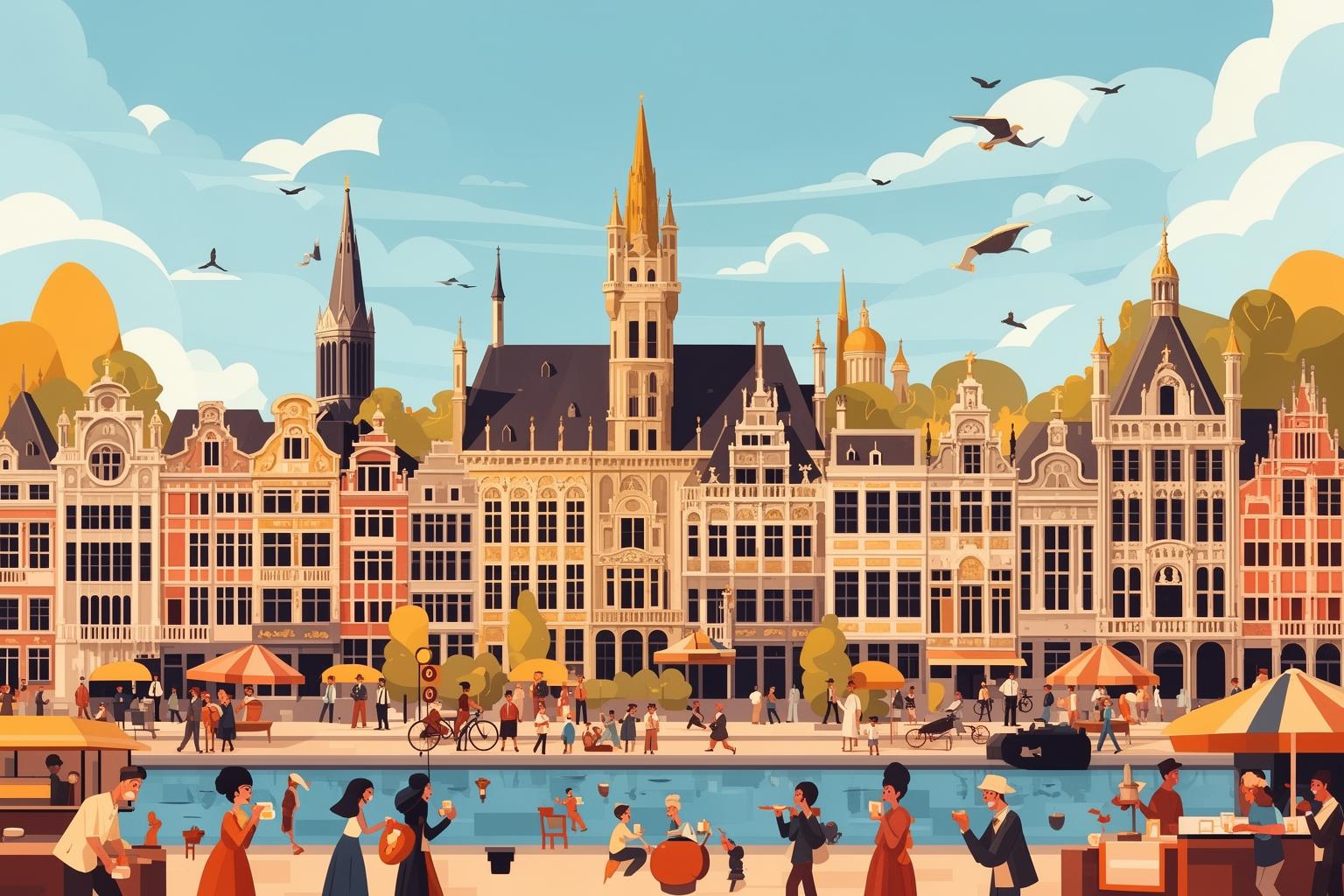
Our pilgrimage begins where Bruegel’s professional journey started: in Antwerp. Arriving in Antwerp today is like stepping into a city that proudly embraces its history with stylish confidence. The central station, a cathedral of iron and glass, ushers you into a bustling metropolis alive with the energy of diamonds, design, and academia. Yet to truly find Bruegel, you must attune yourself to a deeper rhythm beneath the modern buzz. Walk toward the River Scheldt, toward the Grote Markt, the grand market square, and let the soaring Gothic spire of the Cathedral of Our Lady be your guide. It is here, in the shadow of this magnificent edifice, that the spirit of the 16th century feels most vivid.
Echoes in the Cobblestones
The Antwerp that Bruegel entered around 1551 was more than a city; it was a hub of vitality. It stood as one of the largest, wealthiest, and most dynamic urban centers worldwide. The Scheldt connected it to the sea, which in turn linked it to the riches of the New World, the spices of the East, and the markets across Europe. This city thrived with merchants and bankers, printers and cartographers, thinkers and, most importantly for us, artists. The air was thick with the scent of money, salt, and ambition. Standing in the Grote Markt, surrounded by ornate guildhalls, you can almost sense the press of the crowd Bruegel would have known. You can imagine the cacophony of languages, the rumble of wagons over cobblestone, and the intense, restless energy of a city at its zenith. This was the environment that shaped him—a place demanding excellence, rewarding innovation, and offering an endless parade of human behavior for a keen observer to study.
To truly experience this era, a visit to the Plantin-Moretus Museum is indispensable. Though not directly linked to Bruegel, it is a perfectly preserved 16th-century printing house, the home of the legendary publisher Christophe Plantin. Walking through its rooms, with dark wood paneling, lead type, and towering printing presses, you are transported back to the intellectual core of Bruegel’s Antwerp. This was a world of humanism, where new ideas spread with revolutionary speed. Bruegel, with his sharp wit and profound learning, was a product of this atmosphere. He was not an isolated peasant painter but a man deeply engaged with the philosophical and scientific currents of his time. The precision of a cartographer, the insight of a philosopher, and the narrative power of a publisher—all are present in his work, their roots sown in the fertile soil of this remarkable city.
The Guild of Saint Luke and the Birth of a Master
In 1551, Pieter Bruegel the Elder was formally accepted as a master in the Antwerp Guild of Saint Luke, the esteemed institution overseeing the city’s painters, sculptors, and artisans. This was no minor achievement. It marked his professional arrival, the result of years of apprenticeship under Pieter Coecke van Aelst, a court painter to Emperor Charles V and a man of significant artistic and intellectual stature. Coecke’s influence on Bruegel was profound, affecting not only technique but also worldview. He was a traveler, architect, and translator of classical texts, exposing the young Bruegel to the ideals of the Italian Renaissance.
While the original guildhall no longer exists, the spirit of this artistic community lives on. Antwerp remains a city of art. As you wander its streets, you pass numerous galleries and studios. A visit to the Royal Museum of Fine Arts Antwerp (KMSKA), though its Bruegel collection is smaller than those in Brussels or Vienna, provides valuable context. Here you see works by his contemporaries, the artistic environment he both inherited and transformed. You witness the elaborate religious scenes and grand mythological allegories fashionable at the time. And in witnessing them, you begin to grasp the radical nature of Bruegel’s decision to shift his gaze downward, toward the earth and the lives of ordinary people, finding in their simple existence a subject worthy of monumental art.
A World in Print: The House of Hieronymus Cock
Before becoming renowned as a painter, Bruegel was a star in the print world. Shortly after becoming a master, he worked for Hieronymus Cock, an innovative publisher who ran a workshop called “At the Four Winds.” Cock recognized the commercial potential of prints, and in Bruegel, he found a designer of extraordinary imagination and skill. It was here that Bruegel created his famous series of complex, satirical, and often grotesque images, such as “Big Fish Eat Little Fish” and the “Seven Deadly Sins” series.
These early prints reveal a mind deeply influenced by Hieronymus Bosch. They teem with fantastical creatures, bizarre allegories, and sharp critiques of human folly. They were immensely popular, spreading Bruegel’s name and vision across Europe long before his paintings gained recognition. Though Cock’s publishing house no longer exists, the impact of this collaboration is evident throughout Bruegel’s later work. His ability to compose dense, multi-narrative scenes, his fascination with proverbs and moral parables, and his unflinching eye for the absurdities of human nature—all were honed during his years as a master print designer in the vibrant, competitive market of 16th-century Antwerp.
The Heart of Power and Life: Brussels, Bruegel’s Final Canvas
Around 1563, Pieter Bruegel made a crucial decision. He left the bustling commercial center of Antwerp for Brussels, the administrative capital of the Spanish Netherlands. The city presented an entirely different atmosphere. While Antwerp was a chaotic hub of international trade, Brussels was a more dignified, aristocratic seat of power, overseen by Margaret of Parma, the regent for King Philip II of Spain. For anyone following Bruegel’s journey, this move signifies a new phase—marking a transition from his formative years to the period of his mature and most significant masterpieces.
A Shift in Scene, A Change in Tone
Visiting Brussels today, particularly around the stunning Grand-Place, one is immediately struck by a sense of grandeur and history. The lavish guildhalls adorned with gold leaf and the majestic Town Hall speak to centuries of influence and authority. This was the city where Bruegel chose to spend his final years. His relocation was likely influenced by his marriage to Mayken Coecke, daughter of his former master, but it also brought him closer to a wealthy and powerful clientele, including Cardinal Antoine Perrenot de Granvelle, a leading figure in Europe and an avid collector of Bruegel’s art.
However, this period was far from easy. Political and religious tensions that had long been simmering were on the verge of erupting. The Protestant Reformation was spreading, and the Spanish reaction was increasingly harsh. Iconoclastic uprisings swept the region, and the arrival of the Duke of Alba in 1567 inaugurated a brutal reign known as the Council of Troubles. As a keen observer, Bruegel lived and worked amid this turmoil. Although his paintings seldom depict these events directly, the era’s anxiety permeates his later works. Scenes of festive crowds sometimes turn into threatening mobs, and his landscapes, while beautiful, often feel vast, indifferent, and foreboding. Works like “The Massacre of the Innocents” and “The Sermon of Saint John the Baptist” offer powerful, veiled reflections on the suffering and religious persecution that surrounded him.
Domestic Life in the Marolles
Bruegel and his wife settled in the Marolles district, a neighborhood that still retains a distinctive, unpretentious character today. Located just below the grand Sablon square, home to aristocrats and antique dealers, the Marolles offers a grounded, everyday view of Brussels. At its center is the lively flea market at Place du Jeu de Balle, a chaotic treasure trove of forgotten objects. It’s easy to imagine Bruegel wandering through a similar market, observing faces, gestures, and the small human dramas unfolding amidst the clutter.
The house reputed to have been his home, now the Bruegel House museum, stands at 132 Rue Haute. Although historians debate the direct connection to the artist, entering this preserved 16th-century building in his neighborhood is a moving experience. It allows one to grasp the scale of domestic life and imagine Bruegel working in a room lit by northern light, with his children—who later became renowned painters—playing nearby. The Marolles was and remains a working-class area, and Bruegel’s choice to live there rather than in a more fashionable district speaks volumes. It kept him close to the people who inspired his greatest works, not as distant subjects but as his neighbors.
The Church of Our Lady of the Chapel: A Final Resting Place
A short walk from his home is the Church of Our Lady of the Chapel (Notre-Dame de la Chapelle), a beautiful and architecturally complex blend of Romanesque and Gothic styles. This church was central to Bruegel’s life in Brussels. It was where he married Mayken in 1563 and where he was buried following his untimely death in 1569. For the pilgrim, it represents perhaps the most sacred stop on the entire journey.
Inside, the church offers a space for quiet reflection. It is less grand than the great cathedrals of Antwerp or Brussels, with a more intimate atmosphere. In a side chapel, visitors find a memorial plaque erected by his sons, featuring a reproduction of his painting “Christ and the Woman Taken in Adultery,” known for its message of mercy and forgiveness. The original, which Bruegel left to his wife, was a grisaille—a work painted in shades of gray. The selection of this particular image for his memorial, inscribed with the powerful phrase “Let he who is without sin cast the first stone,” feels like a final, poignant statement from an artist who lived through a period of intense moral judgment and violence. Standing here, where he rests, one senses the full weight of his legacy: a call for empathy, a profound understanding of human vulnerability, and a final, quiet gesture of grace.
Bruegel’s Legacy in Brussels: The Royal Museums of Fine Arts
While Bruegel’s remains rest in the Chapel, his artistic spirit lives on within the Royal Museums of Fine Arts of Belgium. This collection ranks among the world’s most significant, offering an unparalleled chance to engage directly with his genius. Experiencing these panels in person is humbling; no reproduction can prepare you for the vivid color, meticulous detail, and vibrant narrative energy of the originals.
The museum houses masterpieces like “The Fall of the Rebel Angels,” a chaotic tableau bursting with Bosch-like creatures, where one could spend an extended time unraveling its swarm of grotesque hybrids—an extraordinary display of imaginative skill. There is also the tender poetry of “Winter Landscape with Skaters and a Bird Trap.” At first glance, it appears as a delightful winter scene, quintessentially Bruegel. Yet, a closer look reveals skaters gliding over thin ice, oblivious to the danger beneath, while a simple trap stands ready to catch unsuspecting birds in the foreground. It serves as a profound meditation on life’s fragility and the hidden perils beneath an attractive surface. The full spectrum of human experience—joy, ignorance, vulnerability—is encapsulated in this single snow-covered scene. Encountering these works in the city where they were created deepens understanding, unveiling them not only as timeless masterpieces but as reflections of a specific era, filled with the anxieties and insights of a man witnessing his world on the edge.
Into the Green Expanse: Discovering the Pajottenland
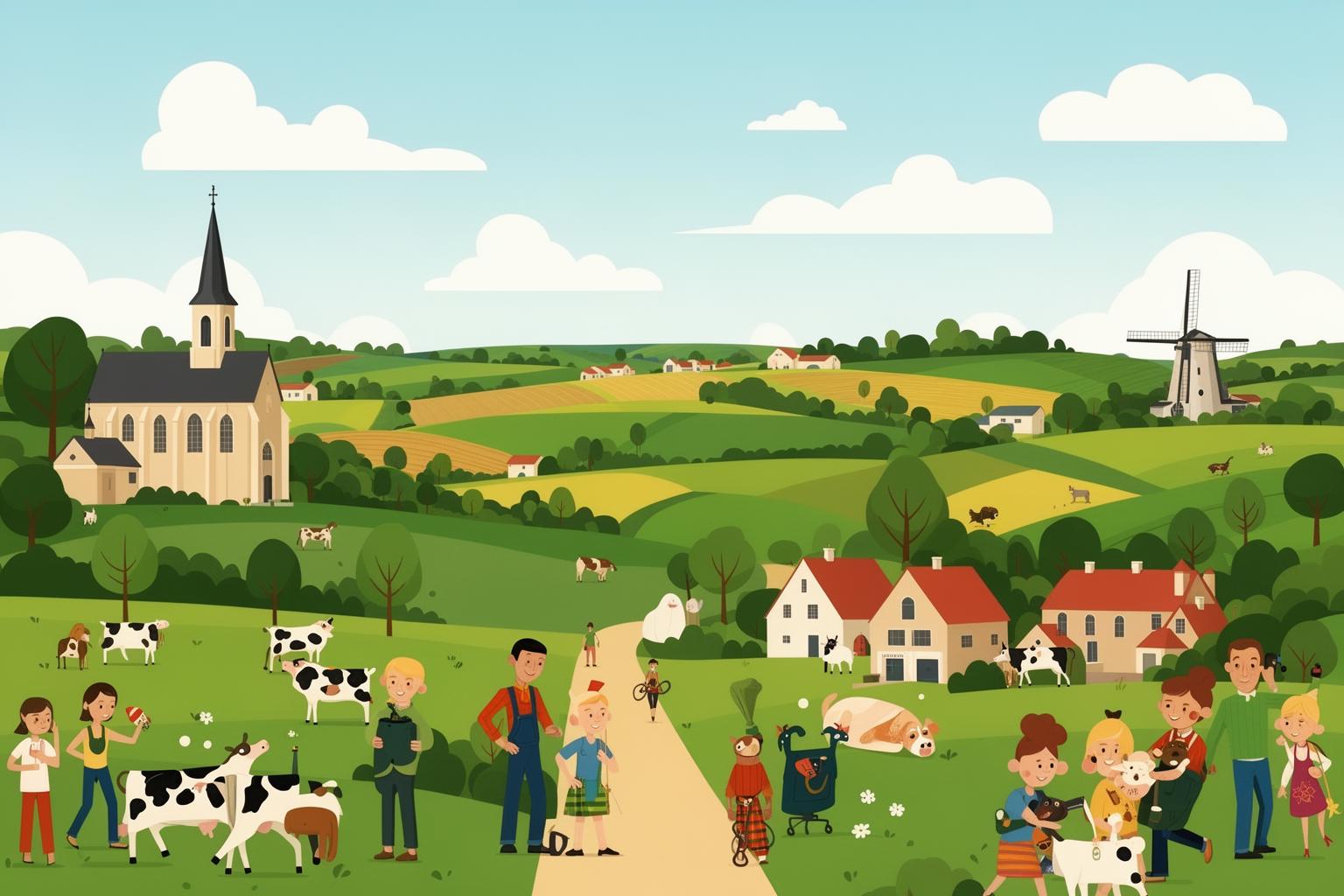
To understand Bruegel’s people, you need to visit the cities where he lived. But to grasp his world, you must leave the city behind and travel southwest of Brussels into a region of rolling hills, fertile fields, and peaceful villages known as the Pajottenland. This landscape is not marked by dramatic mountains or crashing seas; its beauty is subtle, pastoral, and deeply human. For anyone who cherishes Pieter Bruegel’s art, it feels instantly and uncannily familiar. This is the living canvas on which he expressed his grandest ideas about humanity’s relationship with nature.
The Living Landscape
Bruegel did not create this landscape; he uncovered it. He was among the first Western artists to depict landscape not just as a decorative backdrop for religious or mythological scenes, but as a subject in its own right—a character as vital as any human within the composition. He would leave his home in Brussels and walk into the countryside, sketchbook in hand, to observe. He studied how light played on a harvested field, the skeletal forms of winter trees, and the dramatic clouds rolling in from the North Sea. He understood the rhythm of the seasons and the endless cycle of planting and harvesting, celebration and hardship that shaped rural life.
Traveling through the Pajottenland today by car or bike is a remarkable experience. While the modern world has made its mark, the essential landscape remains unchanged. You crest a hill and see a view that could be lifted directly from “The Harvesters.” You follow a sunken road, worn down by centuries of foot traffic and wagon wheels, and feel a deep, timeless connection to the land. You spot a stoic Brabant farmhouse with its characteristic steep roof, instantly recalling “The Peasant Dance.” This is not a theme park or a historical reenactment; it is a living, working landscape that still bears the imprint of the world Bruegel captured with such love and precision.
Walking Through a Painting
The connection between the Pajottenland and Bruegel’s art is so strong that you begin to see the world through his compositional perspective. He mastered the “world landscape” technique, combining a high, almost bird’s-eye view with meticulous attention to foreground detail. This allows the viewer to appreciate both the vast scale of nature and the intimate scenes of human activity within it.
One of the region’s most powerful pilgrimage sites is the small church of Sint-Anna-Pede, in the municipality of Dilbeek. This modest 13th-century church, with its distinctive Romanesque tower, is instantly recognizable as the building in the background of one of Bruegel’s last and most haunting paintings, “The Parable of the Blind Leading the Blind.” The work depicts a line of blind men, each grasping the one ahead, stumbling toward a ditch. It serves as a stark and chilling allegory for a society lost and stumbling into chaos. Standing where Bruegel must have sketched the church, gazing at the gentle slope leading down to a stream, evokes a shiver of recognition. The peaceful, rural scene is forever charged with the tragic power of his vision. It is a profound reminder that for Bruegel, the landscape was never merely pretty scenery; it was the stage for the deepest dramas of human existence.
A Practical Pilgrimage: Trails and Taverns
Exploring the Pajottenland is best enjoyed at a gentle pace. There is a signposted Bruegel Route for cars, but the true magic is uncovered by bicycle or on foot. This allows you to pause whenever you like, breathe in the scent of damp earth, and appreciate subtle shifts in light and color. Numerous walking and cycling paths crisscross the region, leading you through open fields, quiet woods, and charming villages.
A perfect day might involve renting a bike in Brussels, taking a train to a nearby town like Gaasbeek with its magnificent castle, and setting off from there. You can follow the trails, getting intentionally lost, confident that another picturesque view awaits just around the next bend. The journey isn’t about visiting exact photo spots; it’s about soaking in the atmosphere. And no pilgrimage here would be complete without savoring the region’s unique culinary traditions. The Pajottenland is the heartland of Lambic beers, including the renowned Gueuze and Kriek. Stopping at a traditional tavern, or “bruine kroeg,” for a glass of this sour, complex beer alongside local cheese and dark bread is more than a refreshment; it’s a taste of the very terroir, the same earth that nourished Bruegel’s art. It is a way of communing with the spirit of the place in the most fundamental way possible.
The Pilgrim’s Museum Tour: Bruegel Beyond Belgium
While the heart of a Bruegel pilgrimage pulses most strongly through the streets of Brussels and the fields of the Pajottenland, truly understanding his work ultimately requires journeying beyond the borders of modern Belgium. Bruegel was an artist of international acclaim even during his lifetime, with his most important patrons being the Habsburgs, the powerful dynasty that ruled much of Europe. Because of this imperial patronage, the largest collection of his paintings is not found in his homeland, but in the city that once served as the capital of their vast empire: Vienna.
Vienna’s Imperial Treasure: The Kunsthistorisches Museum
Entering the Kunsthistorisches Museum in Vienna is like stepping into a temple of art. The building itself is a masterpiece of 19th-century imperial grandeur, designed to house the vast Habsburg collections. For the Bruegel pilgrim, this is the ultimate, most magnificent destination. Within a single splendid gallery, you will find roughly one-quarter of all his surviving panel paintings. Seeing them together is an overwhelming, life-changing experience. The sheer intellectual and artistic force concentrated in this one room is breathtaking. You witness his development, recurring themes, and the full breadth of his genius revealed before you.
A Year in the Life of Humanity
At the center of the Vienna collection is the famed “Months” cycle. Bruegel was commissioned to paint six panels portraying the seasons of the year. Five of these treasures survive, with three housed in Vienna. Standing before them is to behold one of the most profound achievements in art history. The most renowned is undoubtedly “The Hunters in the Snow.” The composition is bold: we stand on a high vantage point alongside the weary hunters and their dogs, their backs turned, as we look down over a vast, frozen valley. Life thrives below—skaters on the pond, a woman carrying firewood—all beneath a cold, greenish sky. The painting captures not only winter’s appearance but its essence: the chill in the air, the crunch of snow, the quiet fatigue after a long day’s labor. It is a universe encapsulated in a frame.
Adjacent hangs “The Gloomy Day,” a stark, windswept early spring scene, with restless seas and peasants struggling to repair their cottages. It portrays both nature’s might and humanity’s endurance. Then there is “The Return of the Herd,” an autumnal masterpiece where the soft, golden light of late afternoon bathes a valley in a wistful glow as cattle are driven down from their summer pastures. These works are much more than seasonal illustrations; they are profound philosophical reflections on time, the relationship between humanity and nature, and the eternal, cyclical rhythm of life and labor. They depict a world where human life is small yet significant, playing its part in a grand cosmic drama.
Parables and Proverbs on Panel
The Vienna gallery also houses some of Bruegel’s most celebrated portrayals of peasant life and biblical parables. “The Peasant Wedding” is an observational masterpiece. You are not a distant viewer but a guest at the feast, crammed into the barn amidst the revelry. You can almost hear the bagpipes, smell the food, and feel the lively energy. Every detail tells a tale, from the bride’s calm expression to the hungry man greedily spooning porridge. Nearby, “The Peasant Dance” bursts with a more chaotic, almost desperate vitality, a wild outpouring of pent-up energy.
Then there is the monumental “Tower of Babel.” Here, Bruegel merges his landscape mastery with the precision of an architect and the insight of a philosopher. The tower is an impossible, majestic structure, a monument to human ambition and engineering. But look closely, and cracks are already visible. The project is doomed, symbolizing human pride and the folly of challenging divine order. This painting would have deeply resonated during an age of religious conflict and political turmoil, and its message remains powerful today.
Scattered Masterpieces: Other Essential Stops
Although Vienna is the primary destination, the true Bruegel enthusiast knows that his works are precious treasures scattered worldwide. Completing a full pilgrimage could take a lifetime. It would bring you to Madrid’s Prado Museum, to stand in horrified awe before “The Triumph of Death,” a terrifying, panoramic vision of destruction and Bruegel’s most explicit response to the horrors of his age. It would lead you to the Alte Pinakothek in Munich to behold the satirical, gluttonous dreamscape of “The Land of Cockaigne.” And it would bring you back to Antwerp’s Museum Mayer van den Bergh, to confront the fierce, indomitable figure of “Dulle Griet” (Mad Meg), a hellish housewife leading an army of women to pillage the underworld.
Each of these paintings is a world unto itself, a vital piece of the puzzle that is Pieter Bruegel the Elder. They reveal the astounding range of his imagination, from rustic humor to apocalyptic terror, from quiet reflection to savage satire. Seeking them out is to continue the dialogue with this extraordinary artist, to discover new facets of his vision, and to deepen one’s appreciation for his unique place in art history.
Through Bruegel’s Eyes: A New Way of Seeing
Our journey is drawing to a close. We have strolled along the cobblestones of Antwerp and Brussels, breathed in the fresh country air of the Pajottenland, and stood in quiet reverence within the museums of Vienna. We have pursued the ghost of Pieter Bruegel across more than five centuries. But what have we discovered? We have uncovered more than just the places he sketched or the buildings he knew. We have found a new way of seeing the world. Completing a Bruegel pilgrimage means having your own vision recalibrated.
You begin to perceive the world through his compositions. You observe the sweeping grandeur of a landscape alongside the small human dramas unfolding within it. You pay closer attention to the dignity of ordinary work, the simple joy of sharing a meal, and the absurdity of human pride. You find beauty in an overcast sky and poetry in a snow-covered field. Bruegel teaches us to view the whole picture, to understand that life is a complex tapestry woven from joy and sorrow, wisdom and folly, beauty and decay, all held together under nature’s vast, impartial gaze.
He was an artist of the people, not because he portrayed them as simplistic, rustic caricatures, but because he saw them in their full, flawed, and glorious humanity. In an era dominated by heroes, saints, and kings, he chose to immortalize the farmer, the dancer, the builder, the child. He understood that the deepest truths often lie in the most ordinary places. To follow in his footsteps is to be reminded of this. It is to be inspired to look more closely at our own world, at our own communities, and to discover the epic stories, timeless parables, and enduring beauty hidden within the everyday.