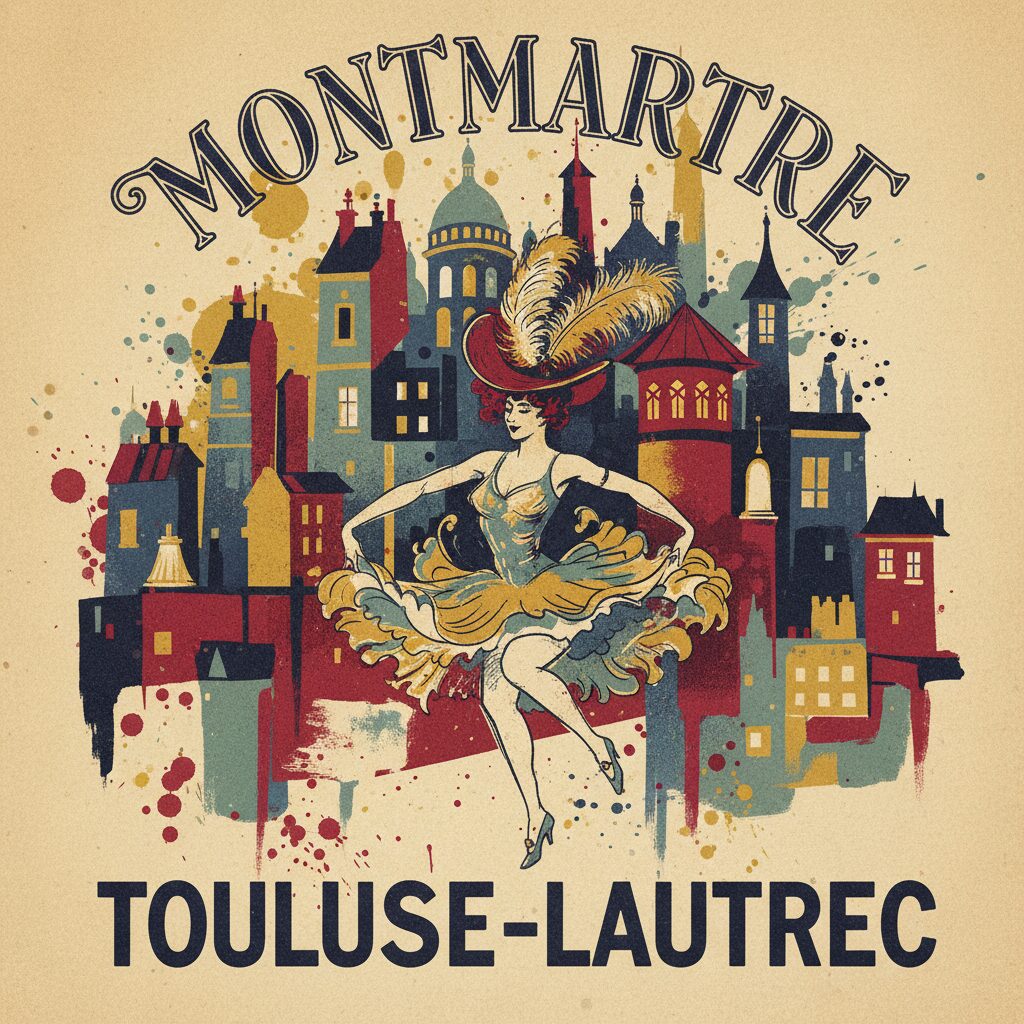
Step into a world painted in absinthe green and lipstick red, a Paris flickering under new electric lights, where the rustle of a can-can dancer’s petticoats mixed with the clinking of glasses and the roar of a crowd hungry for life. This was the world of Henri de Toulouse-Lautrec, an artist who didn’t just paint his era; he became its most vital, empathetic, and unflinching chronicler. To walk in his footsteps is to peel back the polished layers of modern Paris and journey into the raw, vibrant, and utterly intoxicating heart of the Belle Époque. Forget a simple museum tour; this is a pilgrimage. It’s a quest to find the electric soul of a bygone age, a journey that winds from the sun-baked bricks of his southern birthplace to the rain-slicked cobblestones of the Butte Montmartre, the stage where his genius exploded in a riot of color and character. We’re not just looking at paintings on a wall; we’re seeking the very air he breathed, the music he heard, the faces he loved. This is a story written on the streets, in the theaters, and in the quiet corners where he captured the profound humanity of the people of the night. So, lace up your walking shoes, open your mind, and let’s chase the ghost of Henri de Toulouse-Lautrec through the landscape of his extraordinary life.
If you’re inspired to explore other artistic pilgrimages, consider a journey into the luminous world of Paolo Veronese.
The Southern Sun: Roots in Albi and the Countryside
Every story has a beginning, and Lautrec’s does not start beneath the gaslights of Paris, but rather under the brilliant, unrelenting sun of southern France. To truly grasp the artist who became emblematic of the urban demimonde, you must first travel to Albi, the city of his birth. It is a place that feels ancient, powerful, and profoundly distinct from the world he would later dominate.
The Red City and the Palace of a Boy Prince
Albi is called ‘La Ville Rouge’ for good reason. As you approach, the entire city seems to shimmer with a rich, rosy glow. Its buildings are made from local red brick that captures the sunlight, producing an atmosphere both warm and formidable. Towering over the skyline is the Cathédrale Sainte-Cécile, a fortress of God resembling more a military bastion than a church. It reflects a history of conflict and faith, a gravity far removed from the frivolity of the can-can.
It is in this city of stark beauty that Henri Marie Raymond de Toulouse-Lautrec-Monfa was born into one of France’s oldest aristocratic families. His world was one of privilege, filled with hunting, drawing, and country estates. The core of his Albi story lies in another fortress-like edifice, the Palais de la Berbie. This former archbishop’s palace, perched majestically above the River Tarn, now hosts the Musée Toulouse-Lautrec, home to the largest collection of his works anywhere on earth.
Visiting the museum is not merely an artistic encounter; it is a biographical exploration. You begin with his earliest creations, the sketches and paintings of horses and family members from his youth. You witness the raw, prodigious talent, the sharp eye for movement and form. These early works offer an essential foundation, revealing the classical training and aristocratic life he would eventually subvert and leave behind. Portraits of his mother, the Comtesse Adèle—an immensely important and devoted figure throughout his life—also appear. Moving through the galleries, you observe the explosion of his later art. The posters, scenes of Montmartre, portraits of singers and dancers—they seem even more revolutionary when contrasted with the stately, sunlit canvases of his early years. The museum lays out the full arc of his life before you, from young nobleman to radical artist.
To fully appreciate your visit, allow yourself a morning or afternoon. The collection is extensive. Stand before the iconic posters of Aristide Bruant and Jane Avril. Do not rush past the sketches—they reveal his creative process, the lightning-fast observations that underpinned his masterpieces. The atmosphere inside is quietly reverent, a stark contrast to the noisy cabarets he portrayed. It is a place to reflect on the foundations of a man who redefined modern art.
A World of Green: The Château du Bosc
To see the more intimate side of his childhood, venture beyond Albi into the Aveyron countryside to the Château du Bosc. This summer home belonged to his family, a place where he roamed the woods and fields before two separate accidents in early adolescence fractured both of his thigh bones. Due to a congenital condition, his legs stopped growing while his torso developed normally. This physical reality profoundly shaped his view of the world, making him both an outsider and an exceptionally acute observer.
The Château du Bosc provides a deeply personal connection to the artist. Still owned by his descendants, a visit here feels less like touring a museum and more like being welcomed into a family home that just happens to be a castle. You see the rooms he inhabited, the furniture he used, and most poignantly, the drawings and caricatures he sketched directly onto the walls as a child. His early fascination with horses is evident, as is his sharp wit in sketches of family and friends. Walking these halls, you can almost sense the presence of young Henri, a boy of remarkable talent and spirit confronting a future physically limited yet artistically boundless. It is here, in the quiet of the French countryside, that you come to understand the resilience and inner world he would carry with him to the bustling streets of Paris.
Montmartre: The Electric Heart of Lautrec’s Universe
If Albi was his foundation, Montmartre was his explosion. In the late 19th century, this hill, or ‘Butte,’ overlooking Paris was a world unto itself. It was a semi-rural village on the city’s edge, scattered with windmills and vineyards, its low rents attracting a chaotic, brilliant, and dissolute community of artists, writers, poets, and performers. For a young nobleman eager to escape his background and physical limitations, Montmartre was more than a neighborhood; it was a liberation. Here he found his tribe and his subject matter—the raw, unfiltered humanity that would define his art.
Walking the Butte: Echoes on the Cobblestones
To explore Lautrec’s Montmartre is to become a detective of time. Although the area has certainly evolved, its essential geography and spirit endure. Begin your walk at the base of the hill near the lively Boulevard de Clichy, and start ascending the winding, cobblestoned streets. As you climb, the city’s noise fades, replaced by a village-like intimacy. Picture these same streets filled with horse-drawn carriages, the air heavy with the scent of coal smoke and cheap wine. This was Lautrec’s daily commute, his hunting ground for inspiration.
A key stop is the Musée de Montmartre. Nestled in one of the oldest buildings on the Butte, the museum beautifully captures the bohemian soul of the era. It’s not devoted to a single artist, but to the entire creative ecosystem that thrived here. Inside, you’ll find posters, paintings, and photographs that tell the story of legendary cabarets like Le Lapin Agile and Le Chat Noir. The museum also features a reconstruction of the studio of Suzanne Valadon, a formidable artist who started her career as a model for painters like Renoir, Degas, and Lautrec himself. Wandering through the museum and its charming gardens, offering a stunning view over a small, working vineyard, you gain a tangible sense of the community that nurtured and challenged Lautrec.
The Artist’s Lair: In Search of the Studios
Lautrec was a creature of the night, yet his days were spent in intense work. Exceptionally prolific, his studios were the crucibles where his observations turned into art. Though he moved several times, his best-known studio was at the corner of Rue Tourlaque and Rue Caulaincourt. Today, a plaque marks the building. While entry is not possible, you can stand on the street corner and gaze up at its large windows. This was a custom-designed space, featuring the high ceilings and northern light that artists cherish. It was here he created some of his most iconic paintings and refined his revolutionary lithography techniques—a medium that would carry his art to the masses through his posters.
Picture him here, surrounded by canvases, bottles of ink, and lithographic stones. Friends, models, and hangers-on drifted in and out. Known for his hospitality, he often prepared elaborate meals for his guests. Though small in stature, he possessed a large personality; he was a brilliant conversationalist, a witty host, and a deeply loyal friend. Walking these streets—Rue Caulaincourt, Rue Lepic with its famous windmills—is to follow his daily rhythm, from the intense focus of the studio to the nightly plunge into the entertainment world he adored.
The Can-Can and the Cabaret: Nights of Color and Sound
Nightfall in Montmartre marked the beginning of Lautrec’s true theatrical world. The district was the heart of Parisian nightlife—a dazzling, decadent, and sometimes perilous realm of dance halls, cabarets, and cafés-concerts. Lautrec was no mere bystander; he was an essential part of this scene. He had his own reserved table in many venues, always carrying a sketchbook, with keen eyes that missed nothing.
The Red Windmill: Birth of an Icon
The Moulin Rouge, with its huge, glowing red windmill, opened in 1889 and instantly became the emblem of Parisian pleasure. It was an entertainment palace where the working class, bohemians, and aristocrats mingled in a vibrant, democratic dance. The main highlight was the Quadrille, a wild, high-kicking dance that would soon gain fame worldwide as the can-can.
Lautrec was present from the start, but his fame and that of the Moulin Rouge became forever linked in 1891. The cabaret’s director commissioned him to create a poster promoting the venue. The result—”Moulin Rouge: La Goulue”—was a masterpiece that revolutionized advertising. Bold, simple, and striking, it portrayed the star dancer La Goulue (‘The Glutton’) with her distinctive topknot, lifting her skirts, while her partner, the boneless Valentin le Désossé, twisted in the foreground. Dynamic and instantly recognizable, it perfectly captured the venue’s kinetic energy. Displayed all over Paris, the poster made Lautrec and the Moulin Rouge overnight sensations.
He became the club’s unofficial artist-in-residence, portraying its stars with an insider’s perspective. He depicted La Goulue not just as a performer but as a person, revealing both her swagger and vulnerability. He was especially captivated by another dancer, Jane Avril. Nicknamed ‘La Mélinite’ (an explosive), she was the opposite of assertive La Goulue—intelligent, ethereal, with a uniquely nervous grace in her dancing. Lautrec’s portraits of Jane are some of his most sensitive and psychologically insightful works. Visiting the Moulin Rouge today is, of course, a very different experience—a polished, expensive tourist attraction. Yet, standing outside on the Boulevard de Clichy and seeing that iconic red windmill turning against the night sky connects you directly to the electrifying moment when Lautrec’s art first burst into public awareness.
The Man in the Black Cape: Le Mirliton
Not far from the Moulin Rouge stood another legendary venue, Le Mirliton, the realm of Aristide Bruant, a singer and songwriter known for his commanding presence and biting wit. Bruant performed in his trademark black cape, wide-brimmed hat, and red scarf, verbally taunting his high-society audience, who strangely adored it. He sang of the Parisian underworld—the poor, pimps, and prostitutes—giving voice to the city’s outcasts.
Lautrec’s posters of Bruant rank among his most powerful works. They are lessons in branding, distilling the singer into a few bold, unforgettable elements. The strong typography and the imposing, nearly menacing silhouette perfectly conveyed Bruant’s confrontational style. Though the original Mirliton has long vanished, walking down the Boulevard de Rochechouart invites you to imagine it—the doors swinging open, Bruant’s gravelly voice spilling into the street, and Lautrec’s striking poster announcing a truly original artist.
Glimpses of Other Stages
Lautrec’s vision was broad, capturing life across many venues. His poster for Le Divan Japonais stands as a compositional masterpiece, heavily inspired by the Japanese Ukiyo-e woodblock prints popular in Paris at the time (a style known as Japonisme). The poster crops the image radically, showing the performer only from the neck down, while the true focus lies on the audience—particularly his friend Jane Avril, looking elegant and thoughtful, with writer Édouard Dujardin seated behind her. This sophisticated, stylish piece eloquently comments on the culture of spectatorship. Lautrec also famously portrayed singer Yvette Guilbert, known for her long black gloves, capturing her unique performance style with just a few skillful lines. His work across these diverse venues showcases his remarkable versatility and deep insight into the performance of identity, both onstage and off.
The People of the Night: Portraits of a Hidden Paris
More than the venues themselves, it was the people who captivated Lautrec. His art serves as an extensive portrait gallery of Montmartre’s residents. He looked beyond costumes and stage personas to the individuals underneath. His gaze was democratic; he painted aristocrats and prostitutes, famous dancers and unknown laundresses, with equal intensity and psychological insight.
Dancers, Clowns, and Friends
He uncovered the humanity behind the spectacle. In his paintings, Jane Avril is not merely a dancer; she is a complex, modern woman, often shown in quiet, off-stage moments, adjusting her hat or standing alone. He was drawn to distinctive characters, such as the female clown Cha-U-Kao, whose stage name was a phonetic play on a chaotic dance. At a time when female performers were often valued only for their beauty, Cha-U-Kao was a talented acrobat and comedian, and Lautrec portrayed her with a strength and professionalism that was groundbreaking. He also painted his friends with great affection—from the fellow artists he socialized with to his cousin and confidant, Dr. Gabriel Tapié de Céleyran. His group portraits are not stiff or formal; they are lively snapshots filled with movement and conversation.
Elles: An Unflinching Look Inside the Brothel
Perhaps the most radical and empathetic work of Lautrec’s career is the series of lithographs published in 1896, titled “Elles” (“Them,” or more colloquially, “The Girls”). To create this series, he spent a considerable time living in a licensed brothel on Rue des Moulins. This was not done for titillation but as an act of deep artistic immersion. The resulting images completely lack the moralizing or voyeuristic tones that usually characterized 19th-century depictions of prostitution.
Instead, Lautrec presents the women in their everyday lives. We see them sleeping, bathing, eating breakfast, and stretching wearily in the morning. He captures their boredom, camaraderie, and quiet moments of solitude that shaped their existence. The prints are rendered in soft, beautiful colors, with intimate and gentle compositions. He does not depict these women as fallen angels or exotic objects of desire; he portrays them as human beings. The “Elles” series stands as a testament to his remarkable empathy and his ability to see the person behind the social label. Though the brothels of his era have disappeared, these works endure as a powerful statement of his artistic and humanistic vision. The best place to view these sensitive pieces is in major museum collections, where their quiet power can be fully appreciated.
Curating the Legacy: Where to See Lautrec Today
While wandering the streets of Montmartre sets the atmospheric scene, the full impact of Lautrec’s genius is most profoundly felt when standing before his original works. Fortunately, his art is safeguarded in some of the world’s finest museums.
The Parisian Crown Jewel: Musée d’Orsay
After the Musée Toulouse-Lautrec in Albi, the Musée d’Orsay in Paris is the next most important destination for any enthusiast. Situated in a stunning former railway station beside the Seine, the Orsay houses a world-class collection of Impressionist and Post-Impressionist masterpieces. Lautrec’s pieces are exhibited alongside those of his contemporaries such as Van Gogh, Degas, and Monet, providing insight into the artistic revolutions of his era.
Head to the upper-level galleries, where natural light streams through the station’s magnificent arched ceiling. Here, you’ll encounter masterpieces like “La Goulue Arriving at the Moulin Rouge” and his evocative formal portrait of his mother at breakfast. You can stand mere inches from the canvases and admire his daring brushwork, unconventional color choices, and the powerful emotional resonance of his portraits. A helpful tip for visitors: the Orsay is vast and popular—purchase tickets online in advance to skip the lines, and pick up a museum map at the entrance to navigate directly to the Lautrec collection if you’re short on time. Experiencing his paintings in this grand setting is an essential pilgrimage.
The Final Years: A Somber Retreat
Lautrec lived at a relentless pace, driven by creativity, friendship, and an enormous intake of alcohol. His small stature could not endure such intensity indefinitely. By the late 1890s, his health was deteriorating, and his alcoholism had become severe. His brilliant, tumultuous life in Paris was starting to diminish, and he returned once again to the south, under the care of his devoted mother.
Château de Malromé: The Final Canvas
His last refuge was the Château de Malromé, an estate his mother had bought in the Bordeaux wine region. This beautiful, serene property, surrounded by vineyards, was a stark contrast to the chaotic energy of Montmartre. It was here, in the quiet countryside, that he spent his final months. Despite his declining health, he kept working, painting and drawing until the very end. He passed away at Malromé in September 1901, just months short of his 37th birthday.
Today, Château de Malromé operates as a working winery that honors the artist’s legacy. Visitors can explore the historic sections of the château, including the room where Lautrec died. Standing in this tranquil place and reflecting on the close of such a turbulent life is deeply moving. The contrast between the serene surroundings and the art he was known for is striking. It offers a space for quiet contemplation of the man behind the myth, a final, somber chapter in his life.
Verdelais: A Modest Resting Place
Henri de Toulouse-Lautrec, the aristocrat turned king of bohemian Montmartre, is not buried in a grand Parisian cemetery like Père Lachaise. Instead, his final resting place lies in the small, peaceful cemetery of Verdelais, a village near Malromé. His grave is modest, marked by a simple stone, fitting for a man who left such a bold and colorful legacy. For the truly devoted admirer, visiting here is the ultimate tribute. It is a quiet spot, away from tourists and spectacle, a place to honor an artist whose life was tragically brief but whose vision remains vividly alive.
Tracing Toulouse-Lautrec’s life reveals that his art was not just a product of his imagination, but a direct reflection of the world he lived in so completely. From the sunlit landscapes of his youth to the shadowy corners of a Parisian dance hall, each place tells part of his story. Walking these paths, you begin to see the world through his eyes—a world of spectacle and intimacy, joy and sorrow, extraordinary characters experiencing ordinary moments. He showed us that there is beauty in imperfection, dignity in the marginalized, and that the most profound stories often unfold not in palaces, but in the fleeting, electric moments of everyday life. The ghost of Montmartre may be elusive, but his spirit, immortalized in strokes of paint and ink, awaits your discovery.