There’s a certain kind of light in Normandy, a soft, pearlescent glow that filters through a sky often veiled in grey. It’s a light that settles on damp cobblestones, illuminates the chalky cliffs of the coast, and reflects off the slow, steady current of the Seine. This is the light that Gustave Flaubert knew. It was the light of his confinement and his canvas, the very atmosphere he distilled into a prose so precise, so potent, that it changed the course of literature forever. To walk through the landscapes of his life is not merely to trace the biography of a 19th-century author; it is to enter the very laboratory where modern realism was forged. It’s a journey into the heart of a region that was, for Flaubert, both a provincial cage to be rattled and a profound, unending source of inspiration. We are not just visiting places; we are chasing the ghost of a style, the echo of a sentence shouted aloud to test its rhythm, and the quiet, obsessive dedication of a man who believed the right word was a matter of life and death. This is a pilgrimage to the soul of Normandy, seen through the exacting eyes of its most famous, and perhaps most conflicted, son. From the bustling, ancient streets of Rouen to the monastic solitude of his riverside study in Croisset, we will explore the places that built the man and, in turn, were immortalized by his pen.
For another perspective on how a great writer’s environment shapes their work, consider a literary pilgrimage through the heart of France.
Rouen: The Crucible of Realism and Rebellion
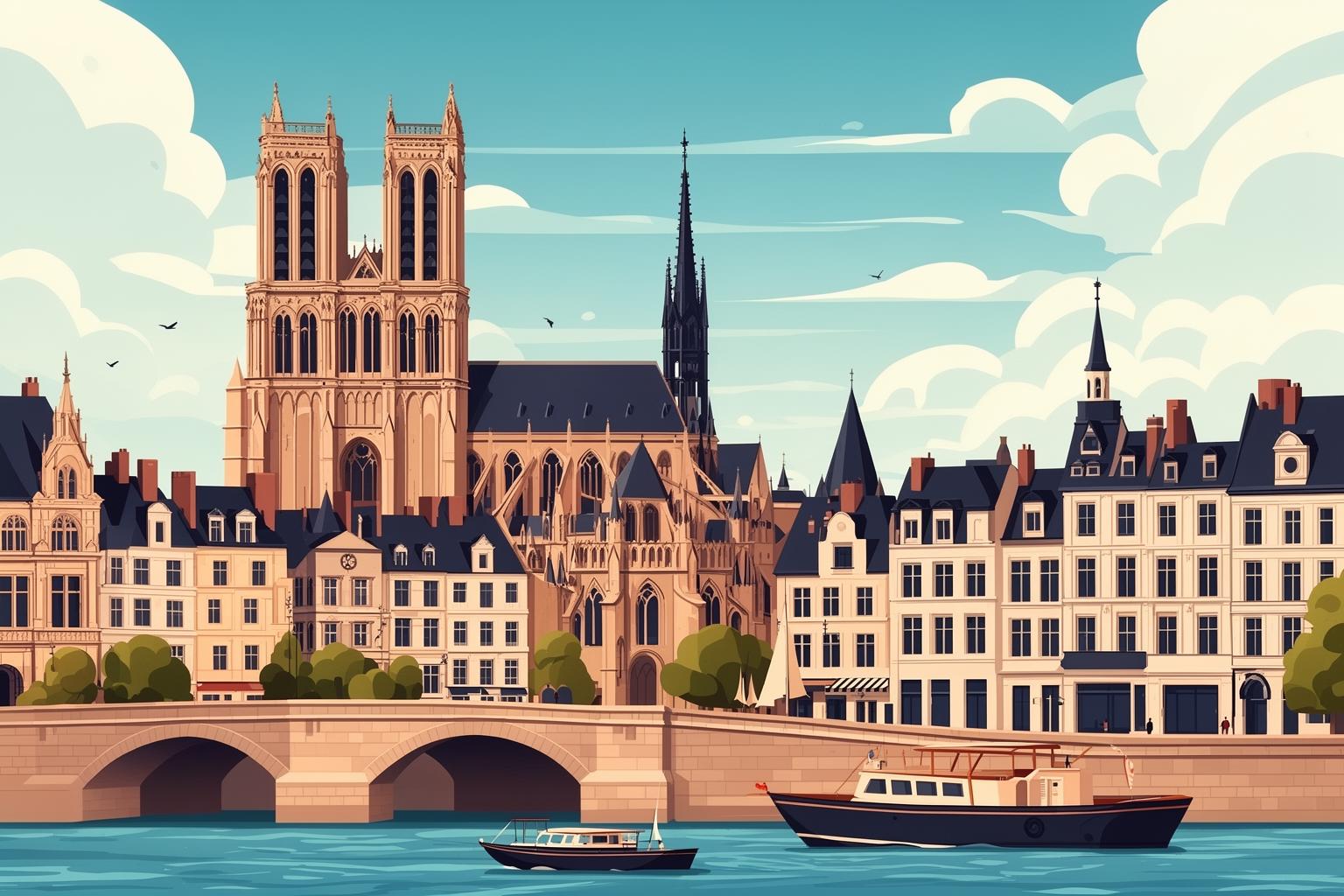
Rouen lies at the heart of Normandy, a city crowned with a hundred spires reaching skyward, its history carved into timber-framed houses and the grand gothic facade of its cathedral. For Gustave Flaubert, it was more than just a hometown; it embodied the bourgeois society he would spend his life dissecting with surgical precision. It was where he was born, educated, and the setting for the tragic downfall of his most famous creation, Emma Bovary. To wander Rouen is to sense the pulse of Flaubert’s world—a city alive with commerce, religion, and the simmering discontent that fuels great art.
The Birthplace Museum: A Room with Two Views
Your journey begins, just as his life did, at 51 rue de Lecat. Here, within the expansive complex of the old municipal hospital, stands the Musée Flaubert et d’Histoire de la Médecine. This is no ordinary author’s house. Flaubert was born in this very building, in the apartment assigned to his father, the chief surgeon. Visiting here is a profound, almost disconcerting, fusion of two worlds. One steps from a hallway filled with chilling 19th-century surgical tools, wax anatomical models, and jars of medical specimens, directly into the restored, intimate apartment of the Flaubert family.
The atmosphere itself seems to change. The antiseptic scent of history gives way to the imagined aroma of wood polish and old books. You see the small salon where the family would gather, the furniture solid and respectable—a perfect picture of the provincial elite. But the real power of this place lies in its dual nature. Picture young Gustave, a boy with boundless imagination, growing up to the sounds of the hospital filtering through the floorboards. His bedroom window overlooked not a garden, but the hospital courtyard and, beyond it, the dissection amphitheater. He was a child living, quite literally, between life and death, between the orderly conventions of his family’s salon and the stark, raw reality of the human body explored by his father’s scalpels. This is essential to understanding his work. The clinical detachment, the obsession with precise detail, the unflinching look at the messiness of human existence—all originated here.
You can stand in his childhood room, a modest, simple space, and feel the weight of that closeness. The museum excels at preserving this atmosphere. There are first editions of his novels, portraits of his family, and personal effects that forge a tangible link to the man. One of the most moving displays is a collection of exotic birds, referencing the parrot in “A Simple Heart,” a story that beautifully captures the quiet sorrows of a life devoted to service. Take your time here. This is not a place to rush. It is a place to absorb the strange and potent mixture of influences that shaped one of literature’s great observers.
The Shadow of the Cathedral: A Monument to Time and Art
From the contained world of his childhood home, you emerge into the grand stage of Rouen itself. And nothing dominates the city like the Cathédrale Notre-Dame. For Flaubert, this immense monument was a constant presence. He passed it on his way to school, saw its silhouette against the ever-changing Norman sky from his home across the river, and absorbed its immense, overwhelming history. It was less a place of religious devotion for him and more a symbol of endurance, of art transcending human folly.
To stand before its facade—a dizzying tapestry of stone lace famously captured in many of Monet’s paintings—is to grasp its power. Flaubert saw not just the whole, but every detail—the leering gargoyles, the serene saints, the intricate carvings that told stories to a largely illiterate populace. He admired the sheer, brutal effort of its creation, the centuries of anonymous hands chiseling at the stone. This respect for craftsmanship deeply influenced his own artistic philosophy. He famously likened the writer to a stonemason, chipping away at the rough block of language to reveal the perfect form within.
Strolling around the cathedral, especially in early morning or late evening when crowds have dispersed and light stretches long, you can sense its weight. The air cools in its shadow, and city sounds are softened by its thick walls. This atmosphere permeates his work—a sense of history that dwarfs his characters’ fleeting dramas. In stories like “The Legend of Saint Julian the Hospitaller,” one can feel the cathedral’s stained-glass narratives’ influence, blending the grotesque with the sublime. When visiting, don’t only look upward. Observe how the cathedral anchors the city, how the ancient streets radiate from it like spokes on a wheel. Follow Rue du Gros-Horloge, with its magnificent astronomical clock, and imagine Flaubert watching prosperous merchants and their wives, collecting material for the provincial vanities he would later satirize with sharp wit.
The Streets of Yonville: Chasing Emma Bovary
While Flaubert’s novel Madame Bovary is set in the fictional village of Yonville-l’Abbaye, the spirit of the book—its moral and social universe—is pure Rouen. The city is the magnetic center of Emma’s ambitions and desires. It is the place she dreams of, the stage for her secret meetings with her lover Léon, and ultimately, the site of her financial and spiritual collapse. A walk through Rouen becomes a treasure hunt for Emma’s ghost.
Begin at Place du Vieux-Marché, the square where Joan of Arc was burned at the stake. Historically significant, it also represents for a Flaubert pilgrim the city’s bustling public heart, the kind of place where Emma would have felt a thrill of anonymity and possibility. From there, wander toward the Palais de Justice, the imposing courthouse. Its Gothic and Renaissance architecture radiates implacable authority. Within walls like these, Emma’s fate is sealed—not through a criminal trial, but by the cold, legal machinery of debt collection. You can nearly hear the rustle of legal papers and the murmurs of clerks signaling her doom.
Continue to the Théâtre des Arts, the opera house. For Emma, the opera in Rouen is a transcendent experience, a brief, intoxicating escape from her stifling boredom. She is swept away by the drama, the music, the glamour of the crowd. It is here she reconnects with Léon and begins her tragic affair in earnest. Standing outside the modern theater that replaced the one she knew, you can still sense the power of that fantasy. Rouen embodied everything Yonville was not: sophistication, passion, art, and danger.
The most evocative part of this journey is simply to wander the commercial streets, especially those near the cathedral. Flaubert describes with painstaking detail Emma’s trips to the city, the shops she frequents, the luxurious goods she buys on credit from the cunning merchant Lheureux. As you browse modern boutiques, you can overlay the past onto the present. Imagine Emma, eyes wide with longing, gazing at displays of silks, ribbons, and fine furniture—each purchase another nail in her coffin. For Emma, Rouen was a beautiful, seductive trap, and walking its streets lets you feel the pull of that same allure and the tragic weight of its consequences.
Croisset: The Hermitage of the Word
If Rouen served as Flaubert’s stage for observing the world, Croisset was his sanctuary for recreating it. Just a short journey downriver from the city, this riverside hamlet was where Flaubert did his true work. It was here, in a comfortable house inherited from his father, that he lived for more than thirty-five years in semi-reclusion, dedicating himself with monastic fervor to the craft of writing. Unfortunately, the house was demolished in the late 19th century to make way for a distillery—an industrial fate harshly at odds with such a literary haven. Yet, the spirit of the place endures, concentrated in the one small structure that was spared: the Pavillon Flaubert.
The Pavilion on the Seine: A Sanctuary of Style
This modest, two-story summer house, perched right on the banks of the Seine, is the sanctum sanctorum for any admirer of Flaubert. This was his study. This was his refuge. This was the room where Madame Bovary, Salammbô, and Sentimental Education were painstakingly crafted, word by agonizing word. To visit the pavilion today is a deeply moving experience. It now serves as a small, beautifully preserved museum—a quiet island of literary history amid the bustle of the nearby port of Rouen.
The atmosphere inside is one of intense, creative silence. The ground floor exhibits artifacts, manuscripts, and portraits, but it is the upstairs room that holds the true power. This was his study. A simple room, furnished with a desk, a divan where he would collapse from exhaustion, and, most importantly, a large window offering a sweeping view of the river. The Seine was his constant companion. He watched commercial barges chug past, sailboats glide by on Sundays, and the water’s changing colors reflecting the sky. This view was his clock and calendar—the single glimpse of the outside world he allowed into his fortress of solitude. It provided a rhythmic, moving backdrop to the static, torturous work of writing. The slow, relentless flow of the river seems a perfect metaphor for his own literary process—a steady, powerful current beneath a seemingly calm surface.
Standing in this room, you can sense the immense concentration it must have taken to build entire worlds within these four walls. You see his writing desk—a replica that allows you to imagine him sitting there for twelve-hour stretches, wrestling with a single sentence. You see the divan and can picture him throwing himself upon it, groaning in despair over the inadequacy of language, as his letters so often described. The pavilion is not just a place; it is a monument to artistic dedication, radiating the energy of a lifetime of intellectual labor.
Echoes of the Gueuloir: The Discipline of an Artist
The most legendary aspect of Flaubert’s time at Croisset was his invention of the gueuloir, roughly translated as “the brawler” or “the gullet.” This was not a physical object but a process, a test of literary endurance. Flaubert believed that prose needed rhythm and musicality, that it must please the ear as much as the mind. To test his sentences, he would shout them at the top of his lungs in his study or while pacing the garden path alongside the house. He would bellow his words across the Seine, listening for any awkward phrasing, clunky rhythm, or sound that broke the spell of the prose. If a sentence failed the test of the gueuloir, it was rewritten, again and again, until it passed.
This practice reveals much about his philosophy. For Flaubert, writing was not a gentle, inspired outpouring; it was a physical, almost violent struggle with the raw material of language. He treated words as solid objects, to be weighed, measured, and fitted together with absolute precision. His friends, like the writer Maxime Du Camp, would describe visiting Croisset and hearing this literary giant roaring in his study—a sound both terrifying and magnificent.
When you stand by the pavilion, gaze out at the river and try to imagine it: picture this large, imposing man with a booming voice, making the air vibrate with the carefully constructed clauses of Madame Bovary. It was a process of purification by sound. This is why his prose feels so solid, so inevitable. Every sentence was tested against the body, not only the intellect. The gueuloir is the secret ingredient of his style, the hidden engine that powers the flawless machinery of his novels. Visiting Croisset lets you stand where that engine ran at full throttle and appreciate the immense physical and mental fortitude it demanded.
The Normandy Countryside: The Canvas for Flaubert’s World
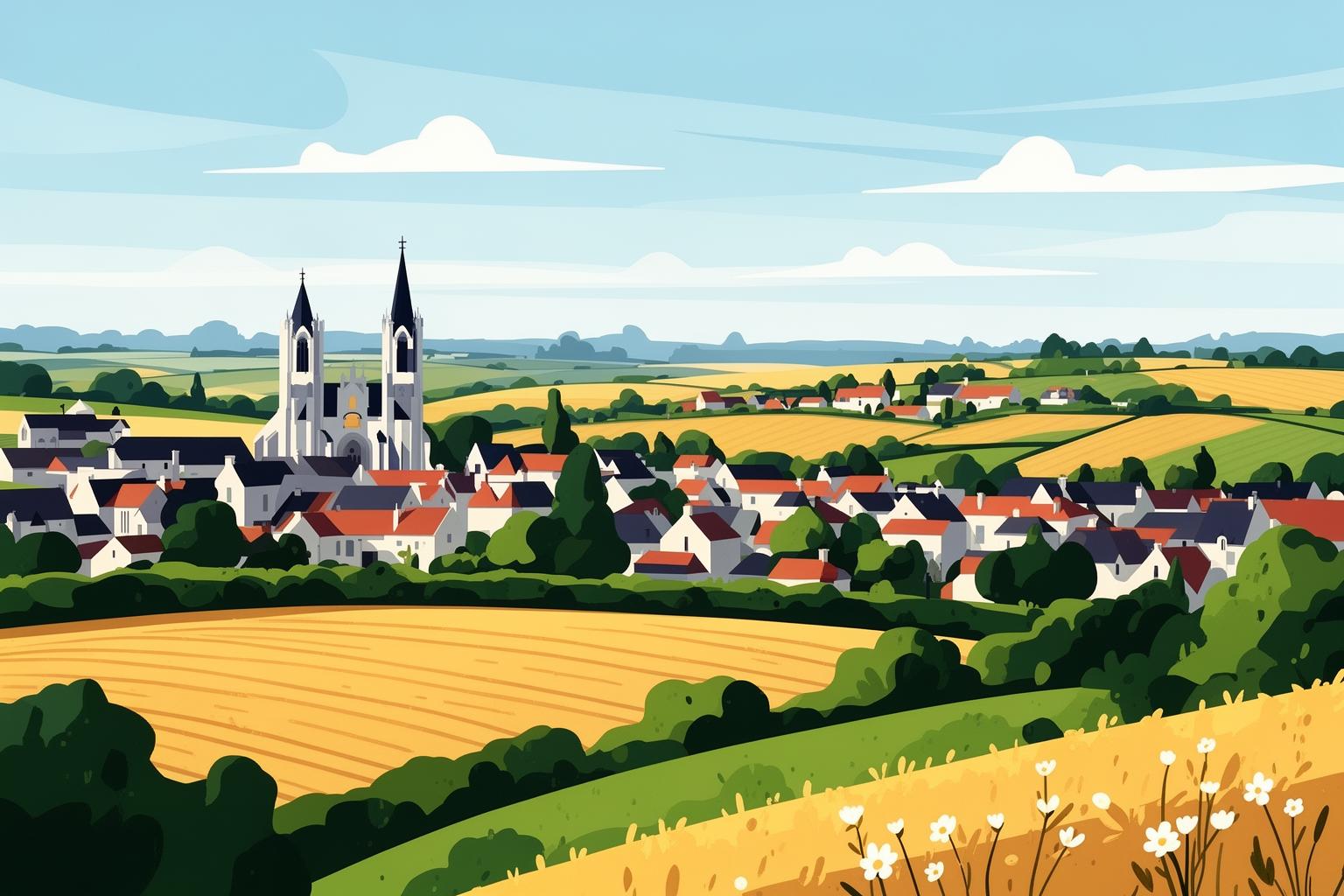
Although Flaubert’s life was rooted in Rouen and Croisset, his imagination freely wandered across the broader Normandy landscape. The region’s rolling hills, lush pastures, and dramatic coastline were more than just beautiful scenery; they formed the emotional and psychological backdrop for his characters’ lives. Even the weather—the persistent drizzle, sudden bursts of sunshine, and melancholic mists—infuses his prose, creating a vivid sense of place as crucial as any character.
The Pays de Caux: Emma’s Restless Heart
North of the Seine lies the Pays de Caux, a plateau of gentle farmland ending abruptly at the chalky white cliffs of the Alabaster Coast. This is the setting of Madame Bovary. While Flaubert invented Yonville, he shaped it using the architectural and atmospheric details of villages in this region. Towns like Ry, which proudly claims the title of the “real” Yonville, offer a captivating glimpse into the world Emma inhabited.
Driving through the Pays de Caux feels like stepping into the novel itself. The landscape seems to breed the particular kind of boredom, the ennui, that torments Emma. You see the same narrow country lanes she would have traveled by carriage, the same vast, empty fields beneath an often-overcast sky, and the same compact villages, each with a church spire and central square. It’s a landscape of subtle beauty but also deep, quiet melancholy. It’s easy to understand how a soul like Emma’s, yearning for drama and passion, would feel utterly stifled here.
In Ry, you’ll find a small museum dedicated to the novel and can visit the pharmacy, inn, and doctor’s house corresponding to the book’s locations. Whether or not it is the definitive model matters less than the experience of absorbing the authentic atmosphere of a 19th-century Norman market town. You sense the claustrophobia of a community where everyone knows each other’s business, the limited horizons that so tormented Flaubert’s heroine. A walk in this countryside, especially on a grey, damp day, is the quickest way to grasp the emotional climate of his most famous work.
Trouville: The Allures of Society and Lost Love
If the countryside represented provincial confinement, the Normandy coast symbolized escape, romance, and the alluring world of high society. Flaubert spent many summers in the fashionable seaside resort of Trouville-sur-Mer with his family. It was a stark contrast to his studious life at Croisset—a world of grand hotels, bustling boardwalks, and elegant Parisians on holiday.
Trouville was the site of one of the most significant events in his life. In the summer of 1836, as a teenager, he met Élisa Schlésinger on the beach. She was an older, married woman, and he fell instantly and irrevocably in love. This unrequited, idealized passion haunted him throughout his life, becoming the emotional heart of his masterpiece, Sentimental Education. The character of Marie Arnoux is a direct and affectionate portrait of Élisa.
Visiting Trouville today, you can still sense that 19th-century glamour. Stroll along the famous boardwalk, Les Planches, and gaze out upon the vast sand and sea. You can sit at a café where Flaubert might have sat, watching the fashionable crowds. The grand villas lining the shore still speak of an era of opulent leisure. It’s a place charged with memory and longing. To stand on Trouville’s beach is to stand at the scene of Flaubert’s own sentimental education, to feel the sea breeze that carried the scent of a love shaping his art for decades. It is a poignant reminder that behind the detached, clinical narrator of his novels was a man of profound and enduring feeling.
A Traveler’s Guide to Flaubertian Normandy
Embarking on a Flaubertian pilgrimage is a journey that rewards slow, reflective travel. It goes beyond merely ticking off sites on a list; it involves fully immersing yourself in the ambiance that inspired a literary genius. Planning these locations into a seamless trip is straightforward, as they all lie within a relatively compact and picturesque region of France.
Crafting Your Itinerary
It’s best to use Rouen as your headquarters for at least two or three days. This allows ample time to explore the city’s medieval heart, enjoy a leisurely afternoon at the Musée Flaubert, and dedicate a full day to wandering the streets in search of Emma Bovary’s spirit. The city has good train connections from Paris, making it an easy place to start.
From Rouen, a visit to Croisset makes an ideal half-day trip. You can take a local bus or taxi for the short ride along the river. While the Pavillon Flaubert itself can be seen quickly, the real reward lies in spending time beside the Seine, perhaps with a volume of Flaubert’s letters, allowing yourself to soak in the tranquility and creative energy of the spot.
To explore the Pays de Caux and the coastline, renting a car is highly advisable. This provides the freedom to wander down narrow rural roads, pause in villages like Ry at your leisure, and continue on to the coast. Spending a night in a seaside town such as Trouville or the nearby, equally charming Honfleur lets you fully experience the maritime atmosphere that Flaubert knew well.
The Flavors of the Region
A journey through Normandy is also a treat for the senses—something Flaubert, a man of hearty appetite, would surely appreciate. The region is the heartland of French dairy farming, celebrated for its rich cheeses: Camembert, Livarot, and Pont-l’Évêque. You can find them at local markets. Here, the apple reigns supreme, appearing in many delightful forms. Sip the crisp, dry local cider, sample the potent apple brandy known as Calvados, and savor a Tarte Tatin or other apple-based pastries. The cuisine is rustic and hearty, filled with cream sauces, fresh seafood from the coast, and savory crêpes. Dining in Normandy offers a way to connect with the very land Flaubert walked on, tasting the terroir that shaped his world.
When to Visit
Normandy is beautiful year-round, with each season offering a different Flaubertian mood. Spring brings blooming apple orchards and a sense of renewal to the countryside, perfect for a drive through the Pays de Caux. Summer suits the coast best, when towns like Trouville bustle with life, albeit alongside many other visitors. For the true literary pilgrim, autumn may be ideal. The melancholic light, morning mists over the Seine, and thinner crowds create an atmosphere deeply aligned with Flaubert’s contemplative, often somber genius. The grey skies and damp air aren’t drawbacks; they’re an essential part of the experience.
Following Gustave Flaubert through Normandy reveals how a place can shape a mind. It offers a strikingly clear view of the raw material for his art: the bourgeois architecture of Rouen, the provincial rhythms of the countryside, the solitary flow of the river at Croisset. You leave with more than memories of beautiful scenes—you gain a deeper understanding of his relentless quest for truth in art, his heroic struggle for Le Mot Juste—the exact word. This landscape was his collaborator, the silent witness to his toil and the infinite source of his inspiration. And as you stand on the banks of the Seine, watching the water drift toward the sea, you sense a profound connection to the spirit of the hermit of Croisset, who, from this small patch of Norman soil, managed to capture the entire human comedy.