Step into a world painted not in broad strokes, but in infinite, obsessive, and utterly mesmerizing dots. This is the universe of Yayoi Kusama, an artist whose name is synonymous with polka dots, radiant pumpkins, and mirrored rooms that stretch into eternity. More than just an artist, Kusama is a global phenomenon, a cultural icon whose vibrant, pulsating creations have captured the hearts and minds of millions. Her work is an explosion of joy, a deep dive into the cosmic, and a courageous confrontation with the anxieties of the human mind. To understand her art is to understand her life, a journey that spans from the quiet fields of pre-war Japan to the chaotic heart of the New York avant-garde and back to a serene Tokyo studio where, even in her nineties, she continues to create with relentless passion. This is not just a guide to her museums and installations; it’s a pilgrimage. A journey that follows the trail of her dots, tracing a path through the landscapes and cityscapes that forged one of the most singular artistic visions of our time. We’ll travel from the mountain city of her birth to the sun-drenched art islands of the Seto Inland Sea, and land in the pulsating core of her creative world in Tokyo. Prepare to lose yourself in a reality remade, where the self is obliterated and the universe opens up, one dot at a time. Before we begin our journey into the infinite, here is a starting point, the epicenter of her dedicated world in Tokyo.
For a different perspective on an artist’s life journey shaping their iconic work, explore the muralist’s trail of David Alfaro Siqueiros.
The Roots of Infinity: Matsumoto, Nagano

Every infinite journey begins at a single point from which everything else unfolds. For Yayoi Kusama, that point is Matsumoto, a historic castle town nestled beneath the majestic Japanese Alps in Nagano Prefecture. It is here, surrounded by the crisp mountain air and fertile soil, that the roots of her artistic vision took hold. Visiting Matsumoto is like peeling back the layers of her global renown to reveal the raw, elemental forces that shaped both her psyche and her art from the very start. The stark contrast between the serene, traditional landscape and the explosive, psychedelic nature of her work is striking, yet it is within that very tension that Kusama’s story truly begins.
A Seed is Planted in a Field of Flowers
Born in 1929 into a family that operated a large and prosperous seed nursery, Yayoi Kusama’s childhood was far from idyllic; it was marked by family struggles and the first signs of vivid, often terrifying, hallucinations that would define her life and art. She remembers seeing flowers with human faces that spoke to her, and patterns in fabrics that seemed to leap off the material to engulf her. This experience, which she would later call “self-obliteration,” caused her great fear. In response, she began to draw and paint obsessively, desperately capturing these visions before they could consume her entirely. Art became her therapy, her anchor, and her means of survival. The fields of the family nursery, with their endless rows of flowers and gourds, became her first canvas. The pumpkins she encountered there, admired for their “generous unpretentiousness” and “solid spiritual balance,” became a lifelong companion and recurring motif—a symbol of comfort and stability in a world that often seemed to dissolve around her.
The Matsumoto City Museum of Art: A Hometown Embrace
There is no better place to witness the origin of Kusama’s brilliance than the Matsumoto City Museum of Art. This museum is not just a repository for her work; it stands as a tribute to its most famous native daughter. You know you have arrived long before entering, as the building’s entire facade is covered in her signature dots, a bold and jubilant announcement of her presence. At the entrance, a colossal and otherworldly sculpture, “The Visionary Flowers,” welcomes visitors—a vibrant cluster of her iconic tulip-like forms adorned with massive, watchful eyes. It feels less like entering a museum and more like stepping into Kusama’s personal realm.
The permanent exhibition dedicated to her is deeply moving. It features works from every phase of her career, but its true power lies in the display of her earliest pieces. Here, you can witness the dark, surrealist-influenced paintings she created as a young woman in Matsumoto, long before she gained worldwide acclaim. These works are raw and charged with the turmoil of her youth, with early impressions of her Infinity Nets and polka dots clearly emerging. Experiencing these fragile early experiments and then turning a corner to confront a fully immersive installation from her later career is breathtaking. It physically connects the dots—quite literally—between the troubled young girl in the mountains and the global art icon she became. The museum’s atmosphere blends local pride with international admiration. Visitors include Matsumoto schoolchildren learning about their hometown hero alongside art lovers who have journeyed across the globe.
Practical Journey to the Source
The trip to Matsumoto is itself a scenic and enjoyable experience. From Tokyo, the most picturesque and efficient route is via the Hokuriku Shinkansen to Nagano City, followed by a local express train that winds through breathtaking mountain valleys. The total journey takes just under three hours. The museum is a pleasant fifteen-minute walk or a short bus ride from Matsumoto Station. A helpful tip: while in Matsumoto, be sure not to miss the magnificent Matsumoto Castle, one of Japan’s few remaining original castles. Its striking black-and-white fortress offers a powerful aesthetic contrast to Kusama’s explosive palette and helps to contextualize the traditional environment from which she emerged. Visiting in autumn, when the surrounding mountains blaze with color, adds an extra layer of enchantment to the experience, echoing the vibrant hues found within the museum’s walls.
The New York Explosion: Conquering the Art World
If Matsumoto was the seedbed, New York City in the late 1950s and 60s served as the chaotic, fertile, and often brutal greenhouse where Kusama’s art burst onto the global stage. Motivated by a desire to break free from the conservative limitations of the post-war Japanese art scene and a fierce ambition to make a name for herself, she arrived in New York in 1958 with a few dollars sewn into the lining of her kimono and a portfolio of her work. The city she encountered was a crucible of artistic innovation, a battleground of ideas where Abstract Expressionism was yielding to Pop Art and Minimalism. It was the ideal setting for a revolution, and Kusama was ready to lead it.
The Leap of Faith into a Concrete Jungle
Kusama’s early years in New York showcased her remarkable resilience. She endured extreme poverty, living in a cold, unheated loft, often surviving on scraps of food. She worked relentlessly, channeling her hallucinations and obsessions into her art with fierce intensity. During this time, she began creating her signature large-scale “Infinity Nets,” vast canvases covered with tiny, repetitive loops of paint. These were not typical abstract paintings; they were direct translations of her visions, attempts to capture the infinite nets that threatened to overwhelm her. The process was exhausting and obsessive, a physical and psychological ordeal. She described these early years as a living hell, yet this very struggle propelled her breakthrough. The city’s relentless energy, indifference, and limitless possibilities pushed her to create art as bold and uncompromising as her new surroundings.
The High Priestess of Polka Dots
By the mid-1960s, Kusama had emerged as a key figure in the New York avant-garde. She was a contemporary of artists like Andy Warhol, Claes Oldenburg, and Donald Judd, often influencing and competing with them for recognition. She expanded beyond painting into sculpture and performance art. Her “Accumulation” sculptures featured everyday objects such as chairs and sofas covered in phallic fabric protrusions, offering unsettling yet humorous critiques of domesticity and patriarchal society. She staged provocative “happenings” in public spaces, painting polka dots on nude participants to protest the Vietnam War and celebrate free love—a radical act of “self-obliteration” that united individuals in a shared pattern. It was during this time that she created her first Infinity Mirror Room, “Phalli’s Field,” in 1965. By placing her phallus-covered sculptures in a room lined with mirrors, she fashioned a disorienting, infinite landscape where the physical and psychological merged into a dizzying, repeating universe. This groundbreaking work became the foundation for one of her most beloved and enduring series. Today, no shrine remains to her 1960s life in New York. Her lofts and studios have vanished, swallowed by the ever-evolving city. Yet her spirit endures in the collections of the city’s foremost museums, such as the Museum of Modern Art (MoMA) and the Whitney. Seeing her work there, in the very city she fought so hard to conquer, reveals the magnitude of her triumph.
The Triumphant Return: Tokyo and the Global Icon

After fifteen years of intense activity in New York, a weary and unwell Kusama returned to Japan in 1973. The art world she had left behind did not warmly welcome her at first, causing her to fade from the international spotlight temporarily. However, this was not the end. It was a strategic withdrawal—a period of recovery and regrouping that eventually led to her remarkable comeback as a global art icon. Her return to Tokyo signaled the start of a new, highly productive, and enduring phase of her life, centered around the peaceful neighborhood of Shinjuku.
A New Beginning in Shinjuku
In 1977, seeking stability and a supportive environment to continue her work while managing her mental health, Yayoi Kusama voluntarily admitted herself to a psychiatric hospital in Tokyo, where she has lived by choice ever since. Nearby, she maintains a studio she visits daily to work. This choice has allowed her to dedicate herself fully to her art, establishing a disciplined and productive routine free from the overwhelming pressures she faced in New York. Far from withdrawing from the world, this sanctuary became the command center for her global artistic dominance. From this quiet part of Shinjuku, she has created a vast body of work, including monumental outdoor sculptures, her vibrant paintings from the “My Eternal Soul” series, and her continuously evolving Infinity Mirror Rooms. This setting is essential to understanding the woman behind the art—her life embodies the transformation of personal struggle into an endless source of creativity, discovering a universe of inspiration within a focused and structured existence.
The Yayoi Kusama Museum: An Invitation into Infinity
For decades, the chance to experience Kusama’s art in Tokyo was limited to temporary exhibitions or public sculptures. But in 2017, the ultimate destination opened: the Yayoi Kusama Museum. Nestled in a residential area of Shinjuku, not far from her studio, the museum is a five-story minimalist white tower designed by the architectural firm Kume Sekkei. Its understated, elegant exterior contrasts with the vibrant, kaleidoscopic world inside. Visiting this museum is an intimate and highly coveted experience that requires careful planning.
The Building Itself: A Vertical Canvas
The museum’s design is integral to the experience. Each of its five floors presents a different aspect of her art. The intimate spaces encourage quiet reflection as visitors ascend through various stages of her work. The pristine white walls and ample natural light offer an ideal backdrop for her intensely colorful paintings and sculptures. The journey concludes on the rooftop, where one can often find one of her iconic pumpkin sculptures standing proudly against the Tokyo skyline—a playful surreal moment as a dotted gourd overlooks one of the world’s largest megacities.
The Experience Within: A Journey Upward
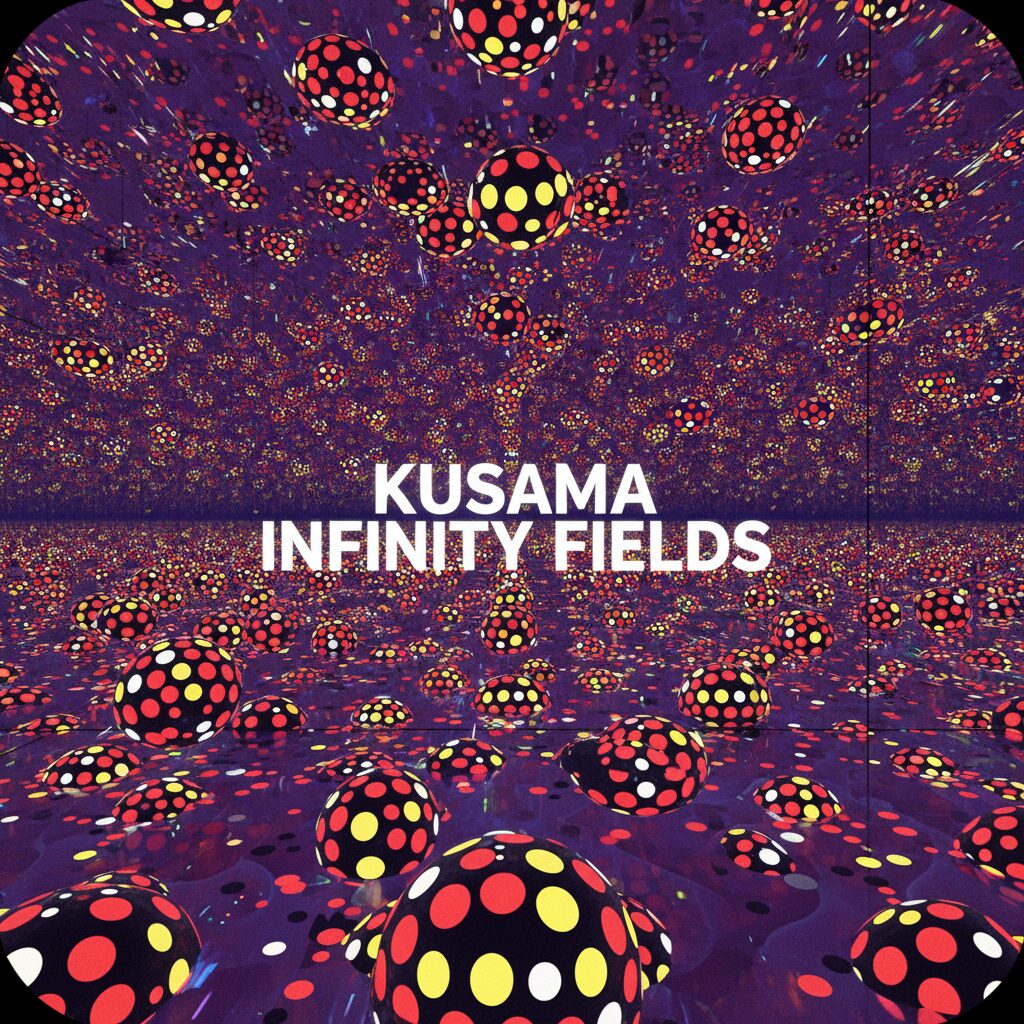
A visit to the Yayoi Kusama Museum is a carefully curated event. Tickets are sold online for specific time slots and typically sell out months in advance, making it impossible to visit by chance. This exclusivity ensures the galleries never become overcrowded, allowing each visitor a personal, meaningful connection with the art. Exhibitions rotate, providing fresh perspectives on her vast oeuvre with every visit. One floor may display her recent acrylic paintings, a riot of color and fantastical shapes from the “My Eternal Soul” series, while another may showcase smaller installations or soft sculptures. The highlight for many is the Infinity Mirror Room, where visitors are usually allowed just a minute or two—a fleeting moment that feels timeless. Stepping into the small, dark chamber, the door closes behind you, immersing you in an infinite cosmos of lights. Thousands of LED lights hang from the ceiling, endlessly reflected in mirrored walls, floor, and ceiling. Your own reflection dissolves into this starfield, embodying her concept of self-obliteration as the boundaries between self and universe blur. The experience is exhilarating, disorienting, and profoundly moving.
Atmosphere and Essential Tips
The atmosphere inside is one of hushed awe, with visitors speaking in whispers, their faces illuminated by vivid artworks or the twinkling lights of the mirror room. To get there, take the Toei Oedo Line to Ushigome-yanagichō Station, from which the museum is a short walk through a quiet, charming neighborhood far removed from the neon frenzy of central Shinjuku. The most crucial advice cannot be overstated: book your tickets the moment they are released on the museum’s official website—usually on the first day of the month for entry two months later. Set a reminder, be ready, and book immediately. This is the key to unlocking access to Kusama’s most intimate and concentrated world.
Art Islands and Open Spaces: Kusama in Nature
While Kusama’s Infinity Mirror Rooms immerse viewers in the depths of her psyche through their enclosed, intense environments, encountering her work outdoors—under open skies and beside shimmering seas—reveals a completely different kind of insight. When placed in nature, her sculptures do more than occupy space; they engage in a dialogue with it. The organic shapes of her pumpkins and flowers resonate with the living world surrounding them, while their psychedelic patterns and colors create a vibrant contrast with the natural landscape. Two locations in Japan have become iconic outdoor galleries for her art: the art island of Naoshima and the Kirishima Open-Air Museum.
Naoshima: The Realm of the Yellow Pumpkin
Nestled in the calm waters of Japan’s Seto Inland Sea, Naoshima has been wonderfully transformed from a quiet fishing village into a renowned destination for contemporary art. Managed by Benesse Art Site, the island represents a unique blend of nature, architecture, and art. At the center of this blend, for many years, stood a singular, unforgettable sculpture: Yayoi Kusama’s “Yellow Pumpkin.”
The Iconic “Yellow Pumpkin”: A Resilient Emblem
Positioned at the end of a small, weather-beaten pier, with the vast sea and sky as its backdrop, the “Yellow Pumpkin” was more than a sculpture—it was a landmark, a beacon, and a symbol of Naoshima itself. Its bold black dots on vibrant yellow skin seemed to pulse with life, a cheerful, otherworldly presence amid serene natural beauty. Visitors journeyed to this spot to be photographed with the iconic gourd, to touch its smooth surface, and to absorb its joyful energy. Tragically, a typhoon swept away the beloved original pumpkin into the sea in 2021. Yet, the story continued. In 2022, a newly crafted, more durable version was installed in the same spot, standing as a powerful testament to resilience and the lasting impact of the image. The pumpkin’s return was a celebration, symbolizing that both Naoshima’s spirit and Kusama’s art can endure any storm. Seeing it now, you sense that history—it’s a cheerful survivor, a happy sentinel watching over the coast.
Discovering the Art Island
Kusama’s influence on Naoshima extends beyond the yellow pumpkin. At Miyanoura Port, the island’s main entrance, you are welcomed by her “Red Pumpkin.” This enormous, hollow sculpture is covered with perforated dots that visitors can climb inside, popping their heads through the holes for playful photos. This interactive piece sets the welcoming tone of the island’s accessible art experience. The best way to explore Naoshima is by renting an electric bicycle near the port, allowing you to leisurely cruise coastal roads and uncover hidden art installations. The island also boasts world-class museums, such as the subterranean Chichu Art Museum, designed by Tadao Ando, featuring works by Claude Monet, Walter De Maria, and James Turrell, and the Benesse House Museum, which combines a hotel with a museum. A visit to Naoshima is a holistic journey—encompassing the sea breeze, striking architecture, and the delight of spotting a vibrant red or yellow pumpkin by the water’s edge. Plan to spend at least a full day, or better yet, stay overnight at Benesse House to experience the art after the day-trippers have left.
Kirishima Open-Air Museum: Blossoms Amid a Volcanic Terrain
Far to the south, on Kyushu Island in Kagoshima Prefecture, lies another extraordinary setting for Kusama’s art. The Kirishima Open-Air Museum is situated on a highland plateau offering panoramic views of the Kirishima volcanic mountain range. The museum’s goal is to harmonize large-scale international contemporary sculptures with the magnificent natural surroundings. Here, Kusama’s contribution is a burst of unfiltered joy: “Flowers of Shangri-La.”
Rather than a single sculpture, this work is a dynamic field of her signature floral forms. Oversized, flamboyant, and covered in vibrant polka dots, these flowers rise from the green lawns with an otherworldly elegance. Their giant scale makes visitors feel like tiny insects wandering through a giant’s garden. This experience contrasts profoundly with the enclosed intensity of a gallery; here, her work breathes. The colors stand out vividly against the deep green grass and the hazy blue mountains in the distance. Visitors can walk among the flowers, view them from every angle, and observe how changing daylight dances on their glossy surfaces. The piece feels optimistic and celebratory—a vision of a psychedelic paradise blooming in the highlands of southern Japan. Reaching the Kirishima Open-Air Museum requires a bit more effort—typically by bus or rental car from Kagoshima Airport or city center—but the reward is an immersive art experience amid truly spectacular natural surroundings.
Beyond the Museums: Finding Kusama Everywhere

To truly grasp the extent of Yayoi Kusama’s universe is to realize that it cannot be confined within museum walls or isolated islands. Her artistic philosophy centers on proliferation, expansion, and enveloping the entire world in her nets and dots. Her work has transcended the traditional art world and infiltrated global pop culture, establishing her as one of the most visible and recognizable artists worldwide. This expansion goes beyond mere fame; it represents the ultimate expression of her fundamental artistic concept: self-obliteration.
Ephemeral Encounters: Pop-Ups and Collaborations
One of the most thrilling aspects of tracing Kusama’s career is the unpredictability of where her work will emerge next. Her major retrospective exhibitions tour the world, presenting her Infinity Mirror Rooms and vivid paintings to new audiences in cities ranging from Los Angeles to London to Helsinki. These exhibitions are cultural phenomena, drawing huge crowds and generating remarkable excitement on social media. The collective experience of a Kusama exhibition—the awe, the perfect photo opportunity inside an Infinity Room—has itself become a sensation. Beyond the conventional art sphere, she has participated in high-profile collaborations, most notably with the luxury fashion brand Louis Vuitton. Through these partnerships, her polka dots have adorned handbags, apparel, and storefronts globally, transforming busy city streets into temporary Kusama installations. For Kusama, this is not commercialization but a radical democratization of her art. It’s a means to spread her vision as widely as possible, to erase the boundary between a high-end boutique and a museum, to envelop the entire world in her patterns.
The Spirit of Obliteration: The Philosophy Behind the Dots
To see a polka dot is to observe a single, finite shape. But to see a field of polka dots is to witness the infinite. This paradox lies at the heart and profound beauty of Kusama’s work. The polka dot, she explains, resembles the sun—a symbol of energy and life—and the moon—a symbol of calm. It is also a circle, a shape without beginning or end. By repeating this simple form, she generates complex, pulsating rhythms that dissolve the surfaces they cover. This is what she calls “obliteration.” When she coats a room, object, or person in dots, she seeks to dismantle the ego and merge the individual with the greater cosmos. “Our earth is only one polka dot among a million stars in the cosmos,” she has said. “Polka dots are a way to infinity.” When you enter an Infinity Mirror Room, you are not merely a passive viewer; you become part of this act of obliteration. Your reflection fractures and multiplies into infinity, your sense of self becomes fluid, and for a fleeting, magical moment, you merge with the endless field of lights. This philosophical foundation elevates her work from simple decoration to a powerful, spiritual experience. It conveys a message of connection, peace, and the search for one’s place in the vast, beautiful, and sometimes overwhelming universe.
An Ever-Expanding Universe
A journey through the world of Yayoi Kusama reveals vibrant contrasts. It carries you from the quiet, mountainous landscape of her childhood to the relentless pulse of New York City. It guides you to tranquil art islands where dotted pumpkins stand watch by the sea, and into sleek Tokyo museums where mirrored rooms offer glimpses of eternity. This path traces the evolution of an artist who confronted her personal demons and transformed them into a universe of boundless joy and wonder, generously shared with the world. To follow her footsteps is to do more than merely see art; it is to embrace a philosophy of life. It’s about recognizing that our anxieties and joys, our individuality and our cosmic connection, are all part of the same infinite pattern. Kusama’s work powerfully reminds us that from a single point—a single dot, a single vision, a single life—an entire universe can emerge. And that universe continues to expand, reaching out and inviting us all to step inside and become part of its infinite, polka-dotted dance.