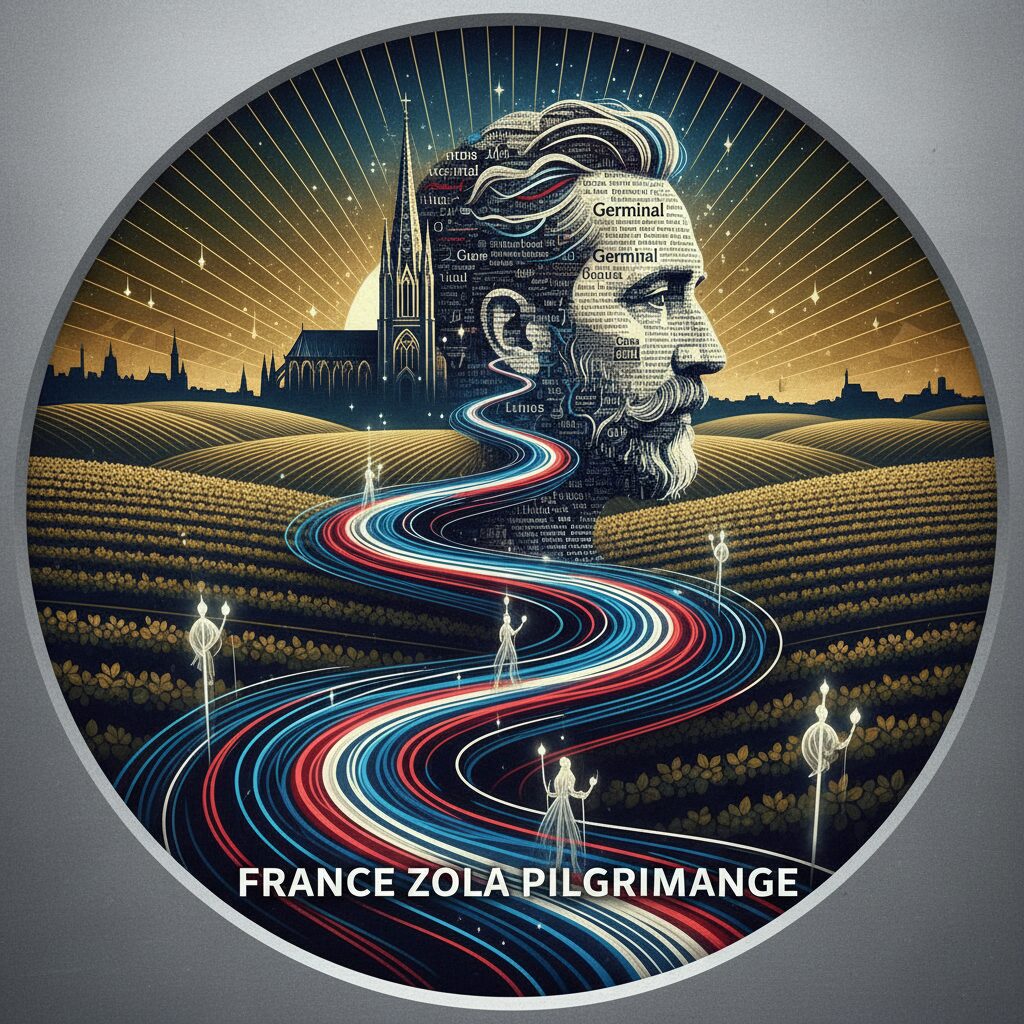
To walk through Paris is to walk through a story. But to walk through Paris in the footsteps of Émile Zola is to plunge headfirst into the novel itself—a sprawling, breathing, magnificent and messy epic of human life. Zola, the undisputed master of literary Naturalism, didn’t just write about France; he dissected it. He peeled back its gilded facade to reveal the teeming, pulsing lifeblood beneath: the sweat of the laundry worker, the roar of the marketplace, the intoxicating perfume of the department store, the quiet desperation of the artist. His magnum opus, the twenty-volume Les Rougon-Macquart cycle, is as much a character study of a family as it is a biography of the Second French Empire, with Paris as its chaotic, beautiful, and cruel protagonist. This journey isn’t just about visiting plaques on walls or peering at statues. It’s about feeling the rhythm of the city as he felt it, understanding how a place can seep into a writer’s soul and emerge, transformed, as world-changing literature. We’ll start where he did, under the sun-drenched skies of Provence, before diving into the Parisian crucible where his genius was forged, and finally finding solace in the riverside retreat where he penned his masterpieces. This is a pilgrimage into the very heart of his work, a chance to see, smell, and hear the world that Zola captured with such ferocious, unapologetic honesty. Prepare to walk the streets that sparked a revolution, not of politics, but of the written word.
For another profound journey into how a place can shape a writer’s work, consider a literary pilgrimage through Dostoevsky’s Russia.
The Provençal Prelude: Zola’s Youth in Aix-en-Provence

Before the grit and grime of Paris shaped his literary world, Émile Zola’s early life was bathed in golden light and rugged earth. His story begins in Aix-en-Provence, a city of fountains and honey-colored stone, where the air is scented with lavender and thyme. Born in Paris but raised here from the age of three, Zola’s formative years were immersed in the sensory richness of the South of France. To understand the man who later chronicled the darkest corners of urban life, one must first stroll the sun-drenched streets of his youth, where a passion for truth and an unbreakable friendship took root.
The atmosphere of Aix stands in stark contrast to the Paris found in Zola’s novels. The pace is gentler, the light more tender. As you walk down the Cours Mirabeau, the city’s main boulevard, shaded by a canopy of plane trees, you can almost picture a young Émile wandering here, dreaming of a future beyond this provincial town. This was his playground, his open-air classroom, and the place where he met the boy who would become his closest friend and, later, a source of artistic rivalry: Paul Cézanne. Their bond, forged among the hills and valleys around Aix, became a crucible for two of the 19th century’s greatest creative minds.
A Friendship Forged in Art: The Collège Bourbon
The intellectual center of Zola’s youth was the Collège Bourbon, now called the Collège Mignet. Nestled on Rue Cardinale, its stately façade conceals the courtyard where Zola and Cézanne solidified their friendship. As a Parisian newcomer, Zola initially felt like an outsider. It was Cézanne who defended him from bullies, an act that sparked a deep and lasting bond. They were known as “the inseparables.” Within these classrooms, they discovered a shared passion for literature, especially the Romantic works of Victor Hugo. Hours were spent discussing poetry and art, their youthful dreams taking flight. Visiting the school today, one senses the weight of its history. Though you cannot freely wander the halls, standing outside its gates and imagining these two young visionaries shaping their futures is a moving experience. It was here that the seeds of Zola’s literary ambition and Cézanne’s revolutionary vision in painting were planted, nourished by a friendship that would define their early years.
Landscapes of Inspiration: The Bibémus Quarries
To truly connect with Zola’s Provençal roots, one must leave the city streets and venture into the surrounding countryside, especially the Bibémus Quarries and the towering Mont Sainte-Victoire. This was Zola and Cézanne’s refuge. They escaped the confines of town to hike, swim, and lose themselves in the wild, untamed nature of Provence. The ochre-red rocks of the quarries, the twisted olive trees, and the piercing blue sky formed their cathedral. For Cézanne, this landscape became a lifelong obsession. For Zola, it offered a profound lesson in observation. He learned to see the world through a painter’s eye: to notice subtle shifts of light, the texture of stone, and the vibrant life thriving in the undergrowth. This intimate connection to the natural world, nurtured in the wilds of Aix, would later underpin his “Naturalist” philosophy. Although his novels are renowned for their stark portrayal of urban squalor, they rest on a foundation of meticulous sensory detail first honed here. Walking the trails around Bibémus today, with the scent of pine and wild herbs in the air, you can feel the energy that captivated them. It’s a landscape that demands close observation and heartfelt feeling—the very essence of Zola’s literary approach.
Paris: The Cauldron of Creation and Controversy
If Aix-en-Provence was the birthplace of Zola’s sensibility, Paris was the forge that shaped his genius. He arrived in 1858, a young man brimming with ambition but with empty pockets, and the city became his university, his muse, and his laboratory. He perceived Paris not as a mere backdrop but as a living organism, a complex machine of power, poverty, pleasure, and pain. It was here that he devised the Rougon-Macquart cycle, an immense project to chronicle the “natural and social history of a family under the Second Empire.” Each novel plunged deeply into a different aspect of Parisian life, from the gleaming new department stores to the grimy laundries of the working-class neighborhoods. Following Zola’s path through Paris is to witness the birth of modern life and see the city through the eyes of its most insightful and uncompromising observer.
The Latin Quarter: A Bohemian Beginning
Zola’s early years in Paris were marked by hardship. Like many aspiring artists and intellectuals, he settled in the Latin Quarter, the historic student district on the Left Bank. The 5th and 6th arrondissements became his world. He lived in a succession of shabby, unheated attic rooms, struggling against poverty and loneliness. Walk down the Rue Saint-Jacques, one of Paris’s oldest streets, and picture him treading these same cobblestones, observing the vibrant mix of students, workers, and shopkeepers. This neighborhood, alive with bookstores, cafes, and academic institutions, was a crucible of new ideas. Zola absorbed it all. He took on odd jobs before securing a position as a clerk at the publishing house Hachette, which offered him an invaluable education in the literary business. The Latin Quarter still retains a bohemian, intellectual energy today. Though the garrets have become expensive apartments, the spirit of inquiry and artistic ambition remains. Sitting at a café watching the world pass by, you partake in a ritual Zola knew well—the art of Parisian people-watching, the first step towards understanding the city’s complex soul.
Les Halles: The Belly of Paris
No place in Paris is more closely associated with Émile Zola than Les Halles. In the 19th century, this was the city’s central market, a vast, sprawling ecosystem of food and commerce that Zola famously named Le Ventre de Paris—The Belly of Paris. For his 1873 novel of the same title, he fully immersed himself in this world, spending countless hours, day and night, documenting its sights, sounds, and above all, its smells. He viewed the market as a symphony of life, where the abundance of gleaming fish, mountains of cheese, and cascades of vegetables starkly contrasted with the human dramas of poverty and struggle unfolding in its shadows. He carefully chronicled the flow of goods from the countryside into the city’s heart, portraying Les Halles as Paris’s digestive system.
The iconic cast-iron and glass pavilions Zola described are long gone, replaced in the 1970s by a modern underground shopping center and park, the Forum des Halles. Yet, the spirit of the old market lingers. The best way to connect with Zola’s vision is to visit the nearby Church of Saint-Eustache, a magnificent Gothic structure overseeing the neighborhood just as it did in the novel. Stand on its steps and survey the redeveloped area, imagining the chaos and energy Zola witnessed. Then explore the surrounding streets, such as Rue Montorgueil, a vibrant pedestrian market street offering a taste of the old market atmosphere. Specialty food shops, fromageries, and patisseries still fill the air with their aromas. It’s a faint but powerful echo of the vibrant, all-consuming world Zola vividly brought to life.
The Grands Boulevards and the Rise of the Department Store
Zola was a chronicler of modernity, and nowhere was the shock of the new more apparent than on the Grands Boulevards, broad, elegant avenues carved through Paris by Baron Haussmann. This was the stage for a new urban spectacle, and Zola captured its essence in his 1883 masterpiece, Au Bonheur des Dames (The Ladies’ Paradise). The novel is a striking portrayal of the birth of the modern department store, a revolutionary force that transformed shopping from a necessity into a seductive, theatrical experience. Zola understood these establishments as temples of consumerism, designed to overwhelm the senses with lavish displays, mountains of fabric, and dazzling light.
To step into this world, visit Boulevard Haussmann and explore the grand department stores that still dominate the area, such as Galeries Lafayette and Printemps. While neither was the specific model for Zola’s fictional store, they are its spiritual successors. Ignore the modern brands momentarily and admire the architecture. Inside Galeries Lafayette, stand beneath the breathtaking Art Nouveau stained-glass dome. Ride the escalators and observe the whirlwind of commerce below. This is the very spectacle Zola described: controlled chaos, mesmerizing displays, the intoxicating power of consumption. He documented the brutal business tactics that crushed small retailers and the grueling lives of the young shopgirls, exposing the dark machinery beneath the glittering facade. Visiting these stores today is more than shopping; it’s experiencing a piece of social history Zola powerfully dissected.
A Glimpse into Nana’s World
The Grands Boulevards were also the heart of Parisian nightlife, a realm of theaters, cafes, and excess that Zola depicted in Nana, his provocative 1880 novel about a high-class courtesan. The area around the Opéra Garnier was the playground of the wealthy and powerful, where fortunes were made and lost, and reputations forged and shattered. While the theater where Nana performed is fictional, the spirit of the era lives on in the ornate facades of venues like the Folies Bergère and Olympia. Walking these streets at night, when theater lights sparkle and cafes buzz with energy, you can sense the decadent, feverish atmosphere Zola captured—a world of superficial glamour and deep moral decay, where desire was currency and the elite indulged their fantasies.
Montmartre and Goutte d’Or: The World of the Working Class
Zola’s social conscience and commitment to portraying all societal levels led him to the impoverished, working-class neighborhoods on the city’s outskirts. For L’Assommoir (1877), perhaps his most powerful and controversial novel, he turned his uncompromising gaze toward the Goutte d’Or, a district in the 18th arrondissement just east of the more famous, bohemian Montmartre. The novel recounts the tragic story of Gervaise Macquart, a laundress whose hopes for a better life are gradually crushed by poverty, alcoholism, and harsh realities. Zola spent months traversing these streets, thoroughly researching the lives of local workers. He visited laundries to grasp the physical toll, and frequented local bars—the assommoirs—observing the gradual descent into despair.
Visiting Goutte d’Or today offers a different experience from central Paris’s monumental areas. It remains a vibrant, multicultural, predominantly working-class neighborhood. The main street, Rue de la Goutte d’Or, still exists. Exploring here calls for a different kind of tourism—not focused on landmarks but on atmosphere. It’s a place for respectful observation, to visit the bustling Marché Dejean, an African market reflecting the area’s contemporary identity. Although the bleakness Zola described has shifted, the neighborhood’s distinctive energy and its separation from Paris’s postcard-perfect image endure. It powerfully reminds us that Zola’s Paris was many cities in one, and he gave voice to them all, especially those society preferred to overlook.
The Battleground of “J’Accuse…!”: The Dreyfus Affair
Zola’s legacy stretches beyond literature into the very core of French justice and politics. In his later years, he became the foremost defender of Alfred Dreyfus, a Jewish army captain wrongly convicted of treason. On January 13, 1898, Zola published an open letter on L’Aurore’s front page with the explosive headline: “J’Accuse…!” (“I Accuse…!”). This act of profound moral courage turned the case into a national scandal and ultimately led to Dreyfus’s exoneration, but it forced Zola into temporary exile in London to escape imprisonment.
The key sites of this political drama lie in the city’s heart. On the Île de la Cité, you can see the imposing Palais de Justice, where Dreyfus’s trials unfolded. Standing in its vast courtyard, you can envision the fevered atmosphere as the nation was divided. But the ultimate symbol of Zola’s vindication is the Panthéon in the Latin Quarter. This grand mausoleum is the final resting place of France’s most honored citizens. In 1908, six years after his death, Zola’s ashes were transferred here in a solemn ceremony, the ultimate acknowledgment of his role as France’s conscience. Visiting his tomb is a deeply moving experience, marking the final step on his journey from controversial novelist to national hero.
Médan: A Writer’s Retreat on the Seine

After years immersed in the frantic energy of Paris, Zola sought a refuge. He found it in the sleepy village of Médan, a quiet spot on the Seine about an hour from the city. In 1878, with the earnings from the success of L’Assommoir, he purchased a modest house he jokingly called a “rabbit hutch.” Over time, as his fame and fortune increased, he expanded it into a large, eclectic villa that became both his sanctuary and creative workshop. It was here, far from the distractions of Paris, that he wrote many of his greatest novels, including Germinal and La Bête Humaine. The Maison d’Émile Zola remains perhaps the most intimate and revealing site a literary pilgrim can visit, offering a direct window into the writer’s daily life and creative process.
The House of a Literary Giant
The house at Médan is a story in itself, reflecting Zola’s personality and success. He added wings and towers, creating a distinctive architectural collage. He even named the two main towers after his most successful novels: Nana and L’Assommoir. Visiting the house, now a museum, is like stepping into his world. The highlight is his study, carefully preserved. You can see his large wooden desk positioned by the window, bookshelves filled with reference materials, and his pipe resting in an ashtray. The room feels alive with creative energy. Etched into the stained-glass window above the fireplace is his personal motto, Nulla dies sine linea—”No day without a line.” This was the creed he lived by, a testament to his formidable work ethic. Roaming through the rooms, from the grand dining hall where he entertained guests to the private bedrooms, offers unparalleled insight into the man behind the books.
The Dreyfus Museum
Adding another layer of significance, the grounds of the Médan property now host the Dreyfus Museum. This modern, thoughtfully designed museum is the only one in France dedicated entirely to the Dreyfus Affair. It provides crucial context for understanding Zola’s most famous public act. Through historical documents, interactive displays, and compelling exhibits, the museum tells the full story of the affair that divided a nation, from Dreyfus’s wrongful accusation to his eventual rehabilitation. Situating this museum here, on Zola’s property, establishes a powerful connection between his literary life and his political engagement, showing how the quiet writer’s retreat also became a base for the fight for justice.
Les Soirées de Médan
Zola’s home was not just a place for solitary work; it was also a lively intellectual hub. He led the Naturalist movement and hosted a group of younger writers known as the Groupe de Médan. This circle included talents such as Guy de Maupassant and Joris-Karl Huysmans. They gathered at the house for long weekends filled with boating on the Seine, lavish meals, and passionate literary debates. These meetings produced a collaborative collection of short stories, Les Soirées de Médan, which served as a manifesto for the Naturalist school. Visiting the garden and gazing out over the calm river, you can almost hear their conversations, the clinking of glasses, and the forging of a literary movement that would change fiction’s course.
Practical advice for visitors: Médan is easily reachable as a day trip from Paris. Take a train from Gare Saint-Lazare to Villennes-sur-Seine, followed by a pleasant walk or a short taxi ride. Be sure to check the opening hours for both the house and the Dreyfus Museum online, as they may vary. It’s a destination best enjoyed at a leisurely pace, so allow at least half a day to fully absorb the atmosphere and explore both the historic home and the modern museum.
The Final Chapter: Zola’s Tomb in the Panthéon
The journey that began under the sun of Aix-en-Provence and wound through the intricate labyrinth of Paris reaches a solemn and monumental conclusion within the sacred walls of the Panthéon. Originally built as a church dedicated to Saint Genevieve, this neoclassical masterpiece was converted during the French Revolution into a secular mausoleum honoring the “great men of the nation.” To be interred here is the highest honor France can grant a citizen, a final tribute to an enduring contribution to the country’s history and culture.
Émile Zola died in 1902 under mysterious circumstances, likely due to carbon monoxide poisoning. His initial burial took place in Montmartre Cemetery. However, his involvement in the Dreyfus Affair transformed his public image from that of a scandalous novelist into a champion of truth and liberty. In 1908, the French government decided to transfer his remains to the Panthéon. The ceremony marked a moment of great national importance but was also marked by controversy when an anti-Dreyfusard journalist fired a pistol at Alfred Dreyfus during the procession, causing a minor injury. This incident highlighted the deep divisions that Zola had helped to reveal.
Visiting the Panthéon today is a humbling experience. After admiring the grandeur of the main hall, with its soaring dome and Foucault’s pendulum, one descends into the crypt. The air becomes cooler and more still. The labyrinth of stone corridors contains the tombs of France’s intellectual and political luminaries. Zola rests here, alongside Victor Hugo and Alexandre Dumas, forming a trio of French literary giants. Standing before his simple yet powerful sarcophagus invites reflection on the entirety of his journey. This final resting place, a symbol of national respect, contrasts sharply with the gritty, often reviled worlds he boldly portrayed. It is the ultimate testament that his unyielding pursuit of truth, however unsettling, had secured him a permanent place in the heart of the nation he both cherished and critiqued.
A Traveler’s Guide to the Zola Trail

Embarking on a journey through Zola’s France offers a uniquely rewarding experience, blending literary history with the vibrant life of modern cities and towns. It takes some planning, but the effort results in a much deeper understanding of the author and his world. Here are a few tips to help you design your own Zola-inspired adventure.
Planning Your Itinerary
It’s best to tackle this trail in sections. Paris stands out as the undeniable centerpiece. Set aside at least three to four days to explore the Parisian sites. You might dedicate one day to the Left Bank (Latin Quarter, Panthéon), another to the Right Bank’s grand commercial heart (Les Halles, Grands Boulevards), and a third to the more peripheral, working-class neighborhoods like the Goutte d’Or. Médan makes a perfect day trip from Paris, offering a peaceful contrast to the city’s intensity. Aix-en-Provence, located in the south, fits best into a longer trip through Provence, where you can combine your Zola and Cézanne pilgrimage with the region’s other renowned attractions. Don’t rush; the aim is to fully absorb the atmosphere of each place.
Getting Around
Exploring Zola’s world is simple. In Paris, the Métro is your best resource—efficient, extensive, and able to bring you close to almost all the key locations. Still, don’t hesitate to walk. Zola was an avid walker, and strolling on foot allows you to truly appreciate the changing character of the city’s neighborhoods. For the day trip to Médan, take the Transilien commuter train from Gare Saint-Lazare. To travel from Paris to Aix-en-Provence, the high-speed TGV train impressively shuttles you from the capital to the heart of Provence in just a few hours.
Beyond the Landmarks
The true enchantment of a Zola tour lies in embracing his approach: observation. This journey is as much about the spaces between landmarks as the landmarks themselves. Allow yourself to get lost. Wander down a side street in the Goutte d’Or. Sit in a park in the Latin Quarter and read a chapter of his work. Stop at a classic Parisian bistro and order a simple meal, imagining the conversations that once filled such places. Visit a bustling outdoor market, like the Marché d’Aligre, to experience a slice of the sensory richness Zola cherished. The essence of his work lives not only in preserved buildings but also in the living, breathing rhythm of everyday French life.
The Enduring Echo of a Literary Master
Following in Émile Zola’s footsteps is more than a historical tour; it is an immersive literary experience. It is a journey that bridges the gap between the page and the pavement, turning abstract descriptions into concrete realities. To stand before the shining dome of a department store and remember Denise’s struggles in Au Bonheur des Dames, or to stroll along the peaceful banks of the Seine at Médan and envision the writer at his desk, is to connect with his work on a deeply personal level. You come to understand that his characters were not mere inventions, but products of these very places—their hopes, struggles, and destinies inseparably tied to the streets they walked and the air they breathed.
France, and Paris in particular, has transformed greatly since the 19th century. The steam-filled laundries of L’Assommoir have disappeared, and the grand market of Les Halles exists only in memory. Yet, the spirit of Zola’s world endures. It lingers in the essential energies of the city: the relentless ambition, the sharp divide between wealth and poverty, the intoxicating chase of pleasure, and the quiet resilience of ordinary people. Zola gave voice to the voiceless and illuminated the darkest corners of society with unwavering bravery. By following his path, we do more than simply see the places he knew; we learn to view the world as he did, with sharper insight, deeper empathy, and a lasting appreciation for the complex, tragic, and beautiful story of human life.