There’s a certain kind of magic that hums in the air of Catalonia, a vibrant, electric energy that pulses from the sun-baked earth and the sapphire shimmer of the Mediterranean. It’s a land of fierce winds and ancient stones, a place where reality itself seems to bend at the edges. It’s no wonder, then, that this corner of northeastern Spain became the crucible for one of history’s most audacious and unforgettable minds: Salvador Dalí. To know Dalí is to know more than just his melting clocks or his spindly-legged elephants. It’s to understand the landscape that forged him, the light that illuminated his visions, and the spaces he meticulously crafted as extensions of his own surrealist soul. This isn’t just a trip to a museum; it’s a pilgrimage into the heart of a dream, a journey through what is famously known as the Dalí Triangle. This trinity of locations—his grand theatre-museum in Figueres, his intimate seaside home in Portlligat, and the romantic castle he gifted his wife in Púbol—forms a map not of a region, but of an entire universe contained within one man’s imagination. It’s here, walking the same ground he walked, that you begin to unravel the brilliant, beautiful madness of his world. Prepare to have your perceptions challenged, your senses awakened, and your understanding of art forever changed. This is Dalí’s Catalonia, and it’s waiting to welcome you into its wild, wonderful embrace.
If you’re inspired to explore other artistic pilgrimages, consider a journey through Masaccio’s Florence.
The Birthplace of a Dream: Figueres and the Dalí Theatre-Museum

Every great story requires a dramatic opening, and for Salvador Dalí, that scene is set in the modest town of Figueres. This is where the artist was born and where he crafted his spectacular final masterpiece. The Dalí Theatre-Museum is more than just a building housing his art; it stands as perhaps his largest and most intricate surrealist creation, embodying a life lived without compromise. Your journey into Dalí’s imagination begins here, beneath the watchful presence of giant eggs and unusual bread-like sculptures that decorate its vivid pink walls.
A Majestic Prelude to Surrealism
Approaching the Theatre-Museum for the first time is a delightfully disorienting experience. It doesn’t resemble any museum you’ve encountered before. Built on the ruins of the town’s old municipal theatre destroyed during the Spanish Civil War, the structure boldly declares its purpose with dramatic flair. The walls, painted a rich, celebratory terracotta red, are adorned with golden, three-dimensional Catalan bread rolls—a recurring motif in Dalí’s art symbolizing life and nourishment. Atop the building sits a massive geodesic dome, a transparent orb appearing as if it fell from another world, bathing the main stage below in an ethereal, almost divine light. And then, of course, there are the eggs. Perched along the roofline, these enormous white ovals are a quintessential Dalí emblem representing birth, hope, and intrauterine memory. The entire structure announces: you are now departing from the ordinary. The experience is startling, playful, and utterly captivating even before you cross the threshold. It feels less like an entrance and more like stepping through a portal.
Within the Maze
Once inside, the sensation of being immersed in a labyrinthine mind grows even stronger. The museum’s interior is a chaotic, interconnected maze of rooms, corridors, and courtyards, each crafted to surprise and provoke. Dalí intended for visitors to have a theatrical experience—to lose themselves in a realm of optical illusions, strange juxtapositions, and hidden jokes. The central courtyard, located in the original orchestra pit, features the ‘Rainy Taxi,’ a vintage Cadillac with a mannequin chauffeur perpetually showered by rain on its ivy-covered interior. Looking up, you’ll spot an enormous boat once owned by his muse and wife, Gala, precariously suspended with blue droplets of “water” hanging beneath. There are no guided routes or prescribed paths; visitors are encouraged to wander, get lost, and discover at their own pace. You might stumble upon the famous Mae West Room, where a collection of furniture, when seen from a precise angle, forms the face of the Hollywood icon. Or you may find yourself in the Palace of the Wind room, with its stunning ceiling painting that seems to pull your gaze heavenward. The collection spans Dalí’s entire career, from his early impressionistic pieces to his later nuclear mysticism phase, showcasing his incredible technical skill alongside boundless imagination. At the very heart of it all, beneath the stage and the magnificent dome, lies Dalí himself, buried in a simple crypt, making the museum not only his greatest creation but also his final resting place, eternally part of the spectacle he designed.
The Heartbeat of the Town
While the museum is undoubtedly the centerpiece, Figueres offers a richer context for understanding the artist’s life. This proud Catalan town features a lively rambla and an unassuming, everyday charm. Walking its streets, you can visit the church where Dalí was baptized and the house where he was born, both just a few blocks from the museum. The town’s atmosphere feels inextricably tied to its most famous native. Local cafes and shops often carry a hint of the surreal, a tribute to the legacy that placed Figueres on the world map. It’s a place that feels grounded and authentic, a stark contrast to the fantastical realm contained within the museum’s walls. This duality is essential to understanding Dalí—the showman was also a man deeply rooted in his homeland, its traditions, and its people. Spending a few hours exploring the town and enjoying a coffee in the main square offers a grounding counterpoint to the dizzying museum experience.
Practical Tips for Visitors
Visiting the Dalí Theatre-Museum requires some planning to fully appreciate the experience. The most important advice is to book your tickets online well in advance, especially if traveling during the high season from May to September. The lines can be very long, and entry is timed. To enjoy the art without feeling rushed by crowds, aim to visit during the shoulder seasons of spring or autumn. The lighting is beautiful, the weather pleasant, and the atmosphere far more intimate. Figueres is easily reachable by high-speed train from Barcelona and Girona, making it an ideal day trip. However, staying overnight lets you experience the museum’s special night openings during summer, a truly magical event where the installations take on a different, more mysterious character under artificial lighting. Allow at least three hours for your visit—but don’t be surprised if you end up staying longer, captivated by the endless details.
Where the Sea Meets the Surreal: Portlligat’s Sacred Hideaway
If Figueres serves as the grand, public declaration of Dalí’s genius, then his home in the tiny fishing cove of Portlligat is its intimate, whispered secret. This is where he lived and worked for most of his life, from 1930 until Gala’s death in 1982. Nestled in a secluded bay near the stunning town of Cadaqués, this house is less a piece of architecture and more a living organism. It’s a place where the boundary between life and art completely dissolves, shaped by the rhythm of the waves, the intensity of Mediterranean light, and the contours of the artist’s most personal obsessions.
A Home Built from Dreams and Driftwood
The Salvador Dalí House-Museum in Portlligat began as a simple fisherman’s hut. Over four decades, Dalí and Gala acquired neighboring shacks, linking them with a maze of narrow passages, winding stairs, and unexpected dead ends. The result is a sprawling, asymmetrical structure that clings to the hillside like a cluster of barnacles. From the outside, its whitewashed walls and terracotta tiles blend seamlessly with the local style, yet surrealist touches abound. Iconic giant eggs crown the rooftops, and disembodied heads peek from the walls. The house was designed to follow the sun’s path. Dalí famously claimed his was the first house in Spain to greet the morning light, which would stream into his bedroom to awaken him. Each window is uniquely shaped and precisely positioned to frame a particular view of the bay, turning the breathtaking landscape into a series of living paintings. This home was built not from architectural plans but from impulse, dreams, and a profound connection to its surroundings.
The Spirit of the Place
Stepping inside the Portlligat house is like entering the couple’s everyday life. Their presence is palpable. Everything remains exactly as they left it. In Dalí’s studio, easels stand ready, brushes soak in turpentine, and the last canvases he worked on remain in place. The light here is extraordinary—a pure, crystalline brilliance Dalí believed was unmatched anywhere else in the world—that floods the space, illuminating the organized chaos of his creative process. The rest of the house resembles a cabinet of curiosities. A giant taxidermy polar bear, adorned with jewelry, welcomes visitors in the entrance hall. The library is filled with books on science, philosophy, and mythology. In the Oval Room—an acoustically perfect chamber designed for Gala—whispers travel across the domed ceiling. Outside, eccentricities continue: a phallic-shaped swimming pool is surrounded by kitschy Michelin Man statues and giant Pirelli tire advertisements. A cushioned seating area is modeled after Mae West’s lips. This is a space of profound creativity, deep love, and boundless eccentricity. The powerful bond between Dalí and Gala permeates everywhere, a shared world crafted for two. The scent of dried flowers, sea salt, and old paint lingers—a sensory ghost of the lives once lived within these walls.
Cadaqués: The Whitewashed Muse
The journey to Portlligat is inseparable from the experience of its neighboring town, Cadaqués. This arguably one of the most beautiful villages on the Costa Brava, with whitewashed houses and blue-shuttered windows cascading down a hillside to a sparkling bay. For decades, it attracted artists like Picasso, Miró, and Marcel Duchamp long before Dalí made it his permanent home. The town retains its bohemian, artistic spirit. Its narrow cobblestone streets are filled with art galleries, small boutiques, and charming seaside restaurants serving fresh fish. To truly grasp why Dalí chose this spot, you must walk its shores. Hike part of the Camí de Ronda, the coastal path winding along the cliffs, and you’ll witness the same stark, beautiful landscapes that appear in his paintings. The twisted olive trees, rugged rock formations, and dramatic interplay of light on the water—all are here. Spending an evening in Cadaqués, watching fishing boats bob in the harbor at sunset, is to experience the essence of the place that nurtured his vision.
Navigating the Dreamscape
Visiting the Portlligat house requires more planning than the Figueres museum. Access is strictly limited to protect the fragile structure. Small groups are admitted every ten minutes, and tickets must be booked online, often months ahead, especially in summer. Arriving without a reservation is not an option. The drive to Cadaqués is an adventure itself: a narrow, winding road that snakes through the mountains for about 30 minutes. Take it slow and savor the breathtaking views. Once in Cadaqués, Portlligat is a pleasant 15-minute walk from the town center. The best way to experience this part of the Dalí Triangle is to stay at least one night in Cadaqués, allowing for a relaxed visit to the house and time to immerse yourself in the landscape so central to his work. As an outdoor enthusiast, I highly recommend exploring Cap de Creus Natural Park. This wind-sculpted peninsula, with its fantastical rock formations, is pure, elemental surrealism—the raw material from which Dalí drew his inspiration.
A Queen’s Court in the Countryside: The Gala Dalí Castle in Púbol
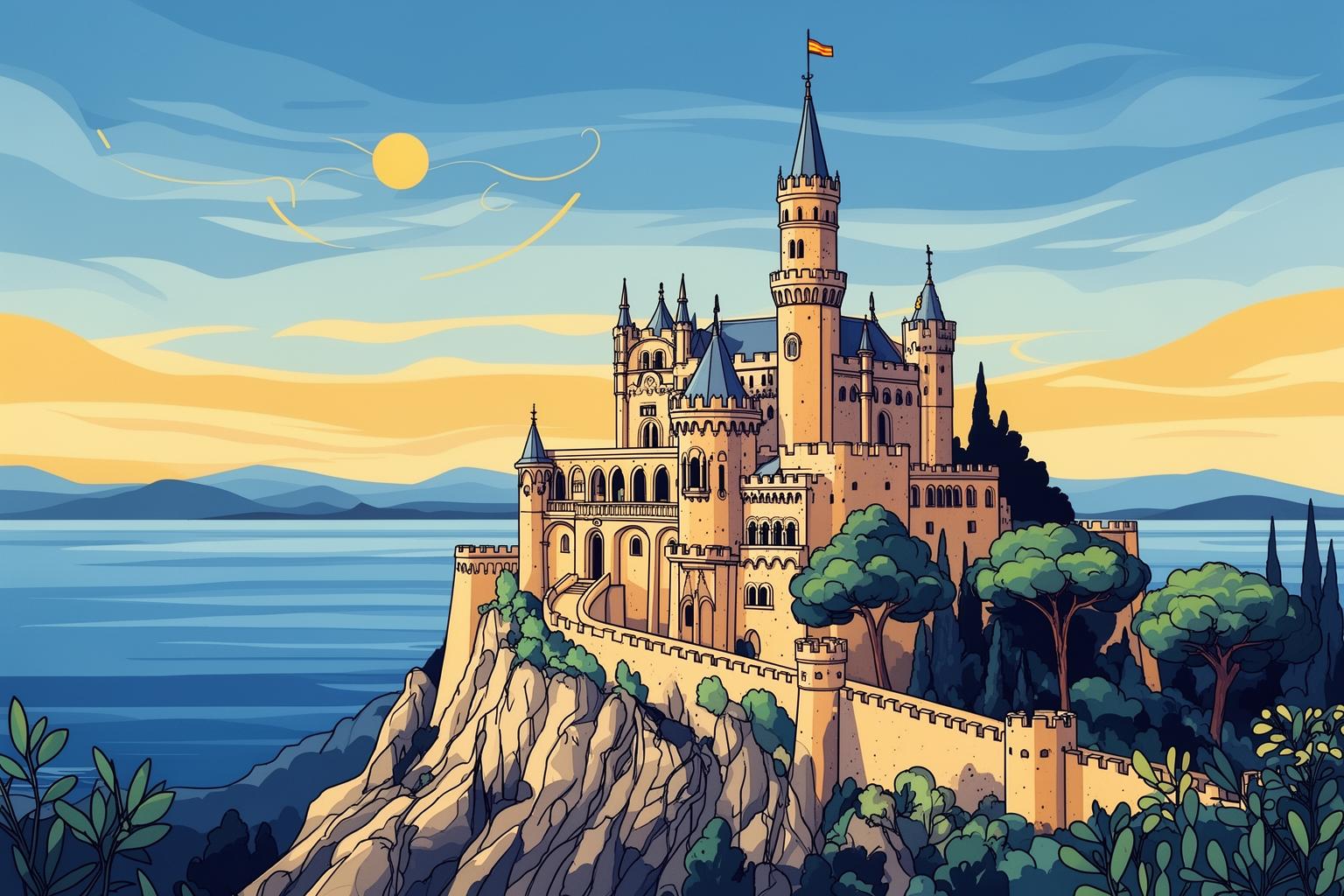
The final point of the Dalí Triangle is the most romantic, the most melancholic, and in many respects, the most revealing. The Gala Dalí Castle in Púbol contrasts sharply with the flamboyance of Figueres and the rugged coastal wilderness of Portlligat. Situated inland amid the tranquil, sun-soaked plains of the Empordà region, this medieval castle was a gift from Dalí to Gala, fulfilling a promise he made early in their relationship to one day buy her a palace. It became her sanctuary, her personal realm, governed by the mysterious rules of their unique love story.
A Fortress of Love and Legend
Dalí purchased the ruined 11th-century castle in 1969 and devoted himself to its restoration and decoration—not for his own sake, but entirely for Gala. It was meant to be her refuge, a place where she held undisputed sovereignty. Reflecting their theatrical and highly ritualized relationship, Dalí agreed never to visit the castle without first receiving a formal written invitation from her. This was not a sign of distance but rather a romantic game, embodying the courtly love ideal that intrigued him so much. The castle became Gala’s private stage, where she entertained her own guests and lived her later years on her own terms. This backstory casts the entire place in a veil of mystery and reverence. It is less about Dalí the artist and more about Dalí the devoted, almost subservient, lover.
Echoes of Gala
Walking through the castle feels like stepping into a beautifully preserved, slightly haunted memory. The décor represents a collaboration between Dalí’s surrealist vision and Gala’s more classical, elegant taste. The color palette is more muted, and the ambiance more reflective. Yet Dalí’s influence is unmistakable. He painted trompe-l’œil effects on the walls, making radiators appear as part of an intricate mural. The ceilings are decorated with paintings that create the illusion of an open sky. Furniture designed by Dalí fills the rooms, alongside Gala’s personal belongings—her books, clothes, and photographs tracing their extraordinary life together. The garden is where Dalí’s imagination was given freer rein. Slender-legged elephant sculptures with obelisks on their backs roam the grounds, and a fountain is adorned with Wagnerian busts. The most poignant part of the castle lies in the crypt, where Gala was laid to rest in a tomb designed by her husband. A twin tomb stands beside hers, intended for Dalí, but after her death, events led to his burial in Figueres instead. The empty tomb is a silent, powerful testament to their bond and their ultimate separation by death. The castle serves as a quiet monument to a great love, filled with the lingering presence of its enigmatic queen.
The Empordà Plains: A Different Canvas
The landscape around Púbol provides a strikingly different view of the Catalonia that inspired Dalí. Gone are the dramatic cliffs and rugged shores. Here, the land is gentle and fertile, a mosaic of sunflower fields, cypress trees, and medieval stone villages perched on low hills. This is the Empordà plain, a setting that appears in many of Dalí’s works, often symbolizing classical order and pastoral calm. The atmosphere is one of timeless peace. The air is warm, carrying the scent of dust and wild herbs. It’s a place that invites slow travel. Exploring nearby villages such as Peratallada, Pals, or Monells—with their impeccably preserved medieval architecture—feels like stepping into another era. This serene, golden-hued countryside offers a perfect contrast to the wild energy of the coast, revealing a more classical side of Dalí’s artistic sensibility.
A Royal Invitation
Púbol is the most remote of the three Dalí sites, and a car is by far the easiest way to reach it. This remoteness also means it is the least crowded, providing a much more intimate and unhurried experience. Visitors can take their time wandering through the rooms and gardens, soaking in the unique atmosphere without the distraction of crowds. While tickets should still be booked online in advance, the urgency is less than at the other two locations. A visit to the castle pairs wonderfully with a day spent exploring the Baix Empordà region. Plan for a long, leisurely lunch at a restaurant in one of the nearby medieval villages, savoring local cuisine and wine. The visit to Púbol serves as the perfect, contemplative conclusion to the Dalí pilgrimage, a quiet final chapter that focuses not on the flamboyant artist, but on the powerful, enigmatic woman who was the center of his universe.
Beyond the Triangle: Other Dalinian Echoes
While the Triangle lies at the heart of any Dalí pilgrimage, the artist’s essence and influence resonate in many other places, both near and distant. To fully comprehend the raw, elemental force behind his work, one must explore the wild landscapes that inspired his earliest and most lasting muse.
Cap de Creus: Nature’s Surrealism
Just north of Cadaqués is the Cap de Creus peninsula, the easternmost point of mainland Spain. This area is a realm of raw, untamed beauty, a national park where the Pyrenees dramatically meet the sea. Over millennia, the fierce ‘tramuntana’ wind has sculpted the rock into fantastical, dreamlike shapes. As a hiker, this land stirs my soul. Walking its trails feels like stepping inside one of Dalí’s paintings. You’ll encounter rocks resembling camels, eagles, and reclining figures—natural sculptures far more surreal than anything an artist could dream up. Dalí spent his childhood summers here and returned throughout his life, drawing endless inspiration from its geological marvels. He saw faces and monsters in the stones, forms that appear throughout his paintings, especially in works like The Great Masturbator. To hike in Cap de Creus is to connect with the very essence of his visual language. It is a powerful, nearly spiritual experience, a direct link to the creative source of his imagination.
Paris and New York: The World Stage
Naturally, Dalí’s influence extended well beyond Catalonia. He was a global icon. During the 1920s and 30s, he emerged as a pivotal figure in the Surrealist movement in Paris, where he befriended André Breton and created some of his most legendary works. Later, he and Gala spent many years in the United States, especially New York City, where his flair for showmanship and self-promotion made him a major celebrity. He collaborated with Alfred Hitchcock and Walt Disney, designed jewelry and furniture, and became a fixture of high society. These cities shaped his career and magnified his fame, but they always served as a stage. Catalonia remained his sanctuary, his studio, and the true home of his heart. Understanding his time abroad helps contextualize his global impact, but it also underscores the profound truth that to truly know Salvador Dalí, one must return to the wind-swept shores and sun-baked plains of his homeland.
Crafting Your Dalinian Journey
Embarking on a journey through the Dalí Triangle is an immersive experience that calls for a bit of logistical planning to fully appreciate. Attempting to fit everything into a single day is not only exhausting but also diminishes the depth and richness of each site. This pilgrimage is best enjoyed at a leisurely pace, allowing time for reflection and exploration.
A Practical Itinerary
For a well-paced and coherent trip, plan to devote at least two to three days. A great way to structure your visit is by following a narrative arc. Begin in Figueres. The Theatre-Museum offers a spectacular introduction to Dalí’s world, providing a comprehensive overview of his life’s work and theatrical personality. You could easily spend most of a day here. From Figueres, head to the coast and stay in Cadaqués for a night or two. This gives you the opportunity to visit the Portlligat house, the centerpiece of the pilgrimage, as well as plenty of time to absorb the town’s atmosphere and explore the stunning natural beauty of Cap de Creus. Conclude your trip at the Gala Dalí Castle in Púbol. Its serene, contemplative ambiance serves as a fitting finale, gently winding down the experience after the sensory intensity of the other sites. This progression—from public spectacle to private retreat to romantic monument—beautifully narrates Dalí’s life story.
Getting Around the Triangle
Flexibility is essential, and for this reason, renting a car is the most practical choice. It allows you to travel between the three points of the triangle at your own pace and is nearly indispensable for reaching the more remote Púbol and exploring the backroads of Empordà and the dramatic landscapes of Cap de Creus. Driving in Spain is relatively simple, and the roads are generally well-maintained. However, if you prefer not to drive, a combination of public transportation is possible with careful planning. High-speed trains connect Barcelona and Girona to Figueres. From there, you can catch a bus to Cadaqués. Reaching Púbol by public transit is the most challenging part, often involving a train to a nearby town followed by a taxi. Whichever mode you choose, the travel between sites is part of the experience—an opportunity to take in the scenic landscapes that shaped the artist.
When to Chase the Dream
Planning your visit thoughtfully can greatly enhance your experience. The best times to visit are during the shoulder seasons: from April to early June and then September to October. During these periods, the weather is generally warm and sunny without being oppressively hot, the Mediterranean light is soft and beautiful, and the crowds are much smaller than in the peak summer months of July and August. Summer visits often involve dealing with intense heat and long lines, which can detract from the magic. Winter offers a quiet, solitary experience, but the weather can be unpredictable, and some local restaurants and hotels may be closed. For the perfect blend of pleasant weather and comfortable exploration, aim for late spring or early autumn. This is when Catalonia, and Dalí’s world within it, is truly at its most enchanting.
A Final Brushstroke on the Canvas of Memory
To journey through the Dalí Triangle is more than just retracing the biography of an artist. It is to partake, in a small way, in his grand surrealist experiment. You don’t simply observe his world; you live within it. You feel the sharp ‘tramuntana’ wind that carved the rocks of Cap de Creus, you watch the morning light pour into the Portlligat studio as he did, and you sense the quiet devotion resonating through the stone halls of Púbol. You come to realize that his surrealism was not an escape from reality, but a deeper, more profound engagement with it. He took the elements of his homeland—its light, sea, stones, and legends—and refracted them through the lens of his extraordinary mind.
When leaving Catalonia, you carry a piece of this world with you. The boundary between the real and the imagined feels somewhat more fluid. You may begin to notice the dreamlike essence of a landscape, the strange beauty in ordinary objects, or the theatricality woven into your own life. This is Dalí’s ultimate gift. He doesn’t merely show you his dreams; he inspires you to discover the surrealism that surrounds you, waiting to be found. The pilgrimage concludes, but the vision endures, like one of his unforgettable images, permanently etched into your memory.