
To speak the name George Orwell is to invoke a universe of ideas. Big Brother, the Thought Police, Room 101, Newspeak—these are not just literary inventions; they are fragments of our modern lexicon, specters that haunt our political discourse and color our understanding of power. But before there was Orwell, the prophetic sage, there was Eric Arthur Blair, a man whose life was a relentless journey through the defining crucibles of the twentieth century. His was a life lived on the front lines, not just of war, but of class, poverty, and ideology. To truly understand the chilling clarity of Nineteen Eighty-Four or the biting satire of Animal Farm, one must walk the paths he trod. This is not merely a sightseeing tour; it is a pilgrimage to the very sources of his fierce, uncompromising vision. It’s a journey that stretches from the dusty plains of colonial India to the windswept shores of a remote Scottish isle, passing through the gilded halls of Eton, the grimy kitchens of Paris, the coal-blackened heart of Northern England, and the blood-soaked trenches of the Spanish Civil War. Each location is a chapter in the story of how Eric Blair became George Orwell, and each step taken in his footsteps reveals another layer of the man who taught us how to see the world with unflinching honesty. So let’s embark on this journey, to feel the atmosphere, breathe the air, and explore the landscapes that forged one of history’s most vital literary voices.
This literary pilgrimage is just one way to explore the profound impact of place on a writer’s vision, much like the spiritual journey through Oaxaca reveals the deep connections between landscape, culture, and creativity.
The Distant Dawn: A Birthplace in British India

Our journey begins in a place that seems almost unimaginably far from the cold, grey dystopias Orwell would later envision: Motihari, a small town in Bihar, India. It was here, on June 25, 1903, that Eric Arthur Blair was born. His father, Richard, was a low-ranking official in the Opium Department of the Indian Civil Service, a small part of the vast machinery of the British Raj. The environment into which he was born was one of colonial order imposed on a vibrant, ancient culture—an order he would come to detest.
Visiting Motihari today requires a leap of historical imagination. The town is now a bustling, dusty center of activity, worlds apart from the manicured lawns of the English countryside where Blair spent his youth. The main draw for an Orwell pilgrim is his birthplace, a simple bungalow that for decades fell into neglect. Thanks to the dedication of local supporters and the state government, the house has been restored and now functions as a modest museum. Standing on the grounds, you can almost sense the oppressive heat and humidity that would have been a constant presence in daily life here. The building itself is modest, a relic from a past era, its whitewashed walls quietly holding the memory of the Empire’s reach.
What strikes visitors most deeply in Motihari is a sense of profound irony. This is the origin of a man who would become one of the most articulate critics of imperialism. The quiet privilege of his family’s status, the sharp divide between British rulers and the Indian population, the very atmosphere of unquestioned authority—these were the circumstances he was born into and would dedicate his life to challenging. The museum offers photographs and information about his life, but the true experience is standing there, beneath the vast Indian sky, reflecting on the enormous distance—both geographical and ideological—that Orwell traveled from this quiet corner of the British Empire. For first-time visitors, managing expectations is key. This is not a grand monument, but rather a humble and sincere tribute. Reaching Motihari can be an endeavor itself, usually requiring a train or a lengthy drive from Patna, the state capital. The journey is not for the faint-hearted, but for the committed literary traveler, it provides an unmatched starting point—a ground zero for the development of a remarkable anti-authoritarian conscience.
Forging a Conscience: The Halls of Privilege and the English Coast
From the sweltering heat of India, the young Eric Blair was thrust into the very core of the English establishment. His passage through the rigid class system of early 20th-century England was a story of two sharply contrasting places: the elite, secluded world of Eton College and the quiet, middle-class respectability of Southwold on the Suffolk coast.
Eton College: A Rebel in the Making
To walk the grounds of Eton College is to be surrounded by centuries of power and privilege. The magnificent gothic chapel, the ancient cobblestone courtyards, the students in their iconic tailcoats—all reflect a tradition designed to shape the future leaders of the British Empire. It was here that a young, fiercely intelligent Eric Blair arrived as a King’s Scholar, a tribute to his academic brilliance. Yet, he was always an outsider looking in. Less wealthy than most of his peers and sharply aware of the social codes and hierarchies, his time at Eton was marked by a growing sense of alienation and a rebellious spirit. He famously said that he felt his time there was wasted, yet it undeniably influenced him, giving him a firsthand education in the very class system he would later dissect with such surgical precision.
For visitors today, Eton, nestled across the River Thames from Windsor Castle, presents a beautiful and imposing sight. While access to the school’s inner workings is limited, wandering the high street and the lanes surrounding the college offers a strong sense of the atmosphere. You can peer into the courtyards and imagine the young Blair, perhaps escaping to a local bookshop or formulating his early critiques of authority. The air is thick with history, a palpable sense of the institution’s weight. It was in this crucible of conformity that Orwell’s nonconformist spirit was truly shaped. Visiting on a crisp autumn day, with students bustling between classes, allows you to feel the living history of the place and to understand the profound internal conflict Blair must have felt within these hallowed walls.
Southwold: The Writer’s Coastal Retreat
If Eton symbolizes the world Orwell rebelled against, Southwold represents a version of England for which he held a complex affection. This charming seaside town in Suffolk, with its iconic pier, colorful beach huts, and historic lighthouse, became the Blair family home. It was to Southwold that Orwell returned periodically throughout his life, especially after his service in Burma, to recover, teach, and most importantly, write. Here, in a house now marked with a blue plaque, he worked on his first novel, Burmese Days. The atmosphere stands in stark contrast to Eton’s grandeur. Southwold feels quintessentially English—a place of bracing sea air, local pubs, and a gentle, unhurried pace of life.
Walking along the Southwold seafront, with the cry of gulls overhead and the North Sea stretching to the horizon, you can sense the environment that nurtured his early literary efforts. This was a place for reflection, a sharp contrast to the chaotic experiences he had abroad. You can visit the local museum to learn more about the town’s history or simply sit on the pier and watch the waves, just as he might have done. It was in and around Southwold that he gathered material for novels like A Clergyman’s Daughter. This coastal town offers a crucial piece of the Orwell puzzle: the deep, albeit critical, connection he felt to English culture and landscape. For visitors, Southwold provides a peaceful and evocative stop on the pilgrimage. It’s a place to slow down and contemplate the man behind the political writer—the son, the brother, the budding novelist finding his voice against the soothing backdrop of the English coast.
The Imperial Machine: Unlearning the Empire in Burma

Emerging from the rarefied environment of Eton, Eric Blair made a choice that would permanently change the trajectory of his life and political views: he joined the Indian Imperial Police and was assigned to Burma (now Myanmar). For five years, he acted as an agent of the colonial regime he was already beginning to doubt. This period, more than any other, shattered his youthful innocence and filled him with a deep sense of guilt and anger that would inspire his writing throughout his life. It was amid the heat and dust of Burma that the anti-imperialist George Orwell truly came into being.
Following Orwell’s exact path in Myanmar is difficult, due both to the passage of time and the country’s complex political circumstances. However, the setting of his incisive first novel, Burmese Days, is widely thought to be modeled on the town of Katha in the Sagaing Region. For those who can make the trip, visiting Katha is like stepping directly into the book’s pages. The colonial-era buildings, the British Club, the police station—many of the structures that formed the novel’s backdrop still stand, slowly weathering under the tropical sun. The atmosphere is one of faded grandeur and lingering memory. Walking along the banks of the Irrawaddy River, you can sense the same oppressive heat and social confinement that he depicted so powerfully.
His service also took him to other parts of the country, from the expansive Irrawaddy delta to Moulmein, where he experienced the pivotal encounter with an elephant that he later commemorated in his famous essay, “Shooting an Elephant.” This essay serves as a brilliant analysis of the corrupting nature of power, the central theme of his experience in Burma. He described the “dirty work of Empire,” a role that placed him in a position of authority he found morally abhorrent. Visiting these locations allows one to grasp the source of those feelings. The weight of history is palpable in the colonial buildings, and the legacy of a system that vested absolute control in a small group of foreigners over a large population is evident. For any traveler venturing into this region, understanding Orwell’s experience offers a profound perspective on the intricate history of colonialism and its enduring effects. It is a journey into the moral wilderness that shaped his steadfast resistance to tyranny in all its forms.
Down and Out: The Underbelly of Europe’s Great Capitals
Returning from Burma, disillusioned with imperialism and seeking a new direction, Blair chose to enter a self-imposed exile of poverty. He was resolute in his desire to comprehend the lives of the dispossessed, aiming to view society from the ground up. This purposeful descent into destitution in two of Europe’s most glamorous cities, Paris and London, provided the raw material for his first published book, Down and Out in Paris and London. This stage of his journey leads us from the bohemian streets of the French capital to the bleak lodging houses of his native city.
Paris: The Life of a Plongeur
Orwell arrived in Paris with literary aspirations, settling in the 5th arrondissement, the Latin Quarter, a neighborhood long linked to artists and intellectuals. Yet, his stay soon became a fight for survival. He undertook the grueling labor of a plongeur, a dishwasher, working in the stifling, underground kitchens of Parisian hotels and restaurants. The exact hotel remains unnamed, but he lived on Rue du Pot-de-Fer, a narrow, modest street still existing today. To walk this street is to connect directly with his experience. The buildings are aged, and the air is thick with the history of countless lives lived in close quarters. A plaque marks his residence, where one can stand and imagine the young writer, often hungry and perpetually exhausted, returning to his cold room after a fourteen-hour shift.
Though the Latin Quarter today is lively and full of students and tourists, a trace of its bohemian and frequently impoverished past endures. Visitors can explore the labyrinthine streets, old bookshops, and markets to sense the city Orwell knew. He wrote of the camaraderie and desperation, the filth mingled with fleeting beauty. To best experience Orwell’s Paris, one must stray from the main avenues, find a small, local café, and observe the city’s rhythm. It’s about feeling the texture of the ancient stone, smelling the blend of fresh bread and diesel fumes, and realizing that beneath the city’s romantic exterior lies a world of hard labor and struggle—the very world Orwell was so determined to portray.
London: The World of Spikes and Bookshops
The London portion of his journey was, in many respects, even bleaker. Here, he was no longer an expatriate but an Englishman marginalized within his own society. He descended into the world of tramps, sleeping in communal lodging houses known as “spikes” and walking for miles in search of food and shelter. He documented this existence with a journalist’s sharp eye, capturing the slang, social codes, and quiet despair of the homeless. Following this route leads a visitor through parts of London far from the usual tourist spots, such as Kentish Town and across the river into Kent, tracing the migratory paths of the tramps.
Although the specific spikes where he stayed have long since disappeared, the spirit of his London remains. Walking along the Thames Embankment on a cold, grey day gives a sense of the exposure and vulnerability he must have endured. Yet Orwell’s London was not only about poverty. Later, he worked as an assistant in a bookshop in Hampstead, an experience recounted in his novel Keep the Aspidistra Flying. Booklover’s Corner, the shop where he was employed, no longer exists, but Hampstead itself—with its literary heritage, leafy streets, and intellectual ambiance—offers a stark contrast to his time on the road. Visiting Hampstead Heath, the vast, untamed park he loved to walk in, allows a pilgrim to connect with a different aspect of Orwell: the writer and intellectual, honing his craft and political ideas. This dual experience of London—from the depths of poverty to the heart of its literary scene—was crucial in shaping his broad understanding of English society.
The Road to Wigan Pier: Into the Industrial Heartland
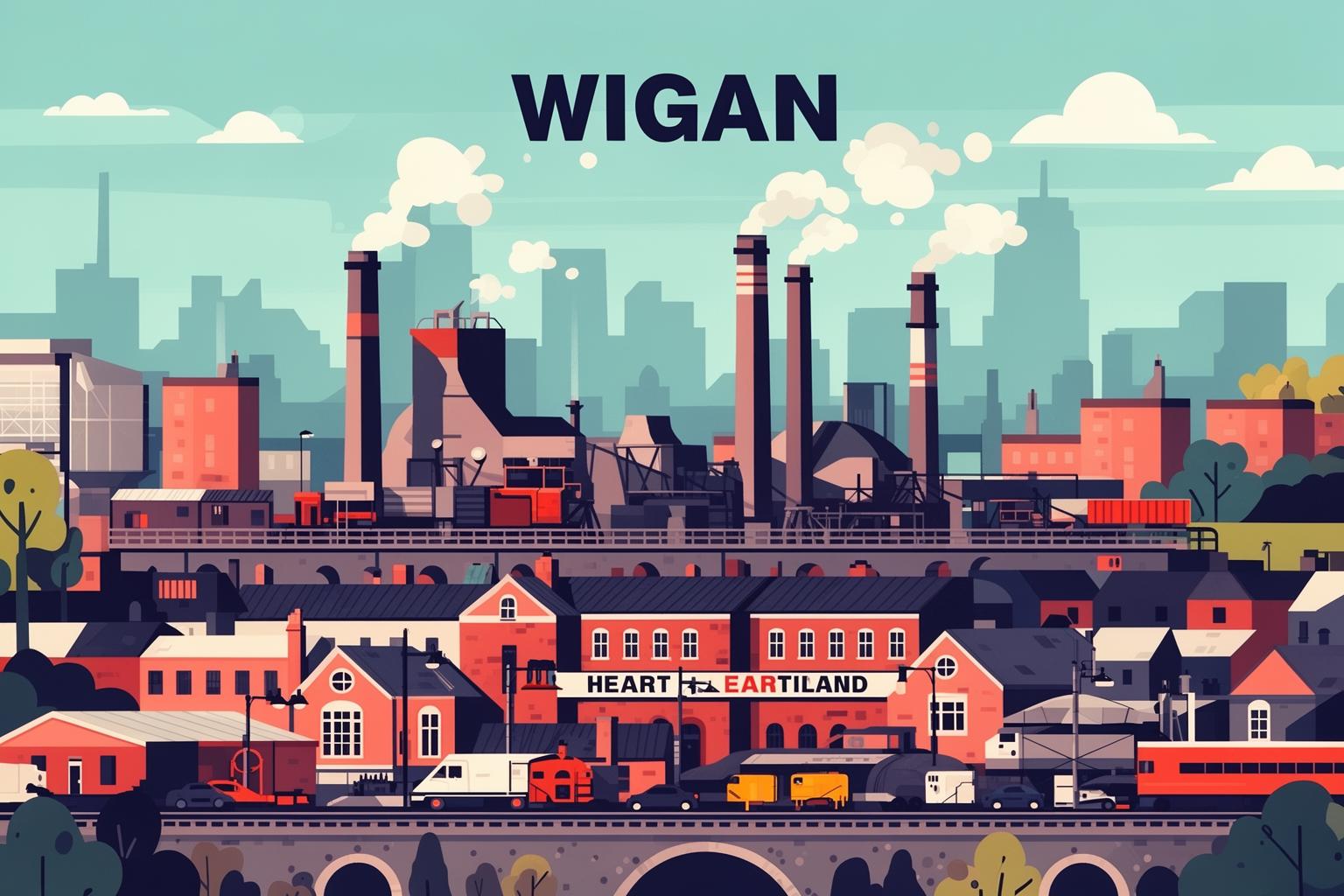
By the mid-1930s, George Orwell had become a committed socialist, but his socialism was grounded in experience rather than abstract theory. To gain a deeper understanding of the working class and the devastating effects of the Great Depression, he was commissioned to travel to the industrial north of England. The resulting book, The Road to Wigan Pier, stands as a seminal work of investigative journalism—a raw and unflinching portrayal of the lives of coal miners and the unemployed. This exploration of what he termed the “lunar landscape” of industrial decay is an essential stop on any Orwellian pilgrimage.
Wigan: Heart of the Industrial North
Wigan, located in Greater Manchester, became the symbolic center of Orwell’s journey. When he arrived in 1936, it was a town defined by coal and poverty. He stayed with a working-class family, filled his notebooks with detailed observations, and, most famously, descended into a coal mine to experience the brutal, back-breaking labor firsthand. He vividly described the cramped, dark tunnels, the choking coal dust, and the immense physical toll of the work. Today, Wigan has been transformed. The coal mines have closed, and the town has undergone considerable regeneration. Yet the past is not completely erased. The spirit of industrial heritage remains strong, and its people retain a proud, resilient character.
The focal point for any visitor is Wigan Pier. In Orwell’s day, “the pier” was not a seaside attraction but a simple coal-loading jetty on the Leeds and Liverpool Canal. His use of the name in his book title made it famous, turning it into a symbol of industrial decline. Although the original pier is gone, the area has been revitalized as a cultural quarter. The old warehouses and mills now house art galleries, performance venues, and a museum. Walking along the canal towpath is one of the most evocative experiences for visitors. The dark water of the canal, the sturdy red-brick buildings, and the palpable sense of history beneath your feet all connect you to the world Orwell documented. This experience allows you to grasp both the hardships of the past and the resilience of a community that has reinvented itself.
Following the Canal Paths
To fully appreciate Orwell’s journey, one must venture beyond the town center. He walked extensively through the surrounding areas, documenting the appalling slum housing and the vast, grey slag heaps. A powerful way to connect with his experience is to take a long walk along the Leeds and Liverpool Canal. The towpaths offer a unique view of the industrial landscape, tracing a route through the heart of the region’s history. You can see the remains of old factories and picture the barges laden with coal that once navigated these waters. This walk provides a moment of quiet reflection, an opportunity to contemplate the social injustices that so enraged Orwell and to appreciate the profound empathy that drove him to tell these stories. Visiting Wigan and its surrounding areas is not just about seeing a place; it’s about understanding a pivotal chapter in British social history through the eyes of its most candid chronicler.
A Warrior for an Ideal: The Crucible of the Spanish Civil War
No experience was more politically and personally transformative for George Orwell than his time fighting in the Spanish Civil War. He went to Spain in 1936 as a journalist but soon joined the militia of the POUM (Workers’ Party of Marxist Unification) to combat Franco’s fascists. What he witnessed there—the revolutionary fervor, the camaraderie in the trenches, and the brutal infighting and betrayal among the Republicans—solidified his lifelong opposition to totalitarianism, whether from the right or the left. This harrowing period is immortalized in his remarkable memoir, Homage to Catalonia.
Catalonia and the Aragon Front
The journey begins in Barcelona, the vibrant capital of Catalonia. When Orwell arrived, the city was gripped by a socialist revolution. Anarchist flags waved from buildings, and there was a tangible sense of hope and equality in the air. He described walking down Las Ramblas, the city’s famous central boulevard, and being struck by the atmosphere of radical change. Today, Las Ramblas is a bustling center of tourists and street performers, but the historical significance remains. The former Hotel Falcón, which served as a POUM barracks, and the area around the Plaça de Catalunya were central to his experience. A visitor can stroll these same streets and, with a copy of his book in hand, imagine the city as he saw it: a beacon of revolutionary possibility.
From Barcelona, he was sent to the Aragon Front, near Huesca. The landscape there is starkly different—a high, arid plateau dotted with rolling hills and olive groves. It was a static, grim war of attrition, fought in freezing trenches. While it is difficult to pinpoint the exact trench locations, traveling through this part of Spain gives a profound sense of the conditions he endured. The vast, empty spaces, the harsh weather, and the ever-present threat of sniper fire—it was here that his idealism was tested by the brutal reality of war. This experience instilled in him a deep respect for the courage of the ordinary soldiers he fought alongside.
The Bullet in the Throat
It was on this front, in May 1937, that the pivotal moment occurred: Orwell was shot through the throat by a fascist sniper. He miraculously survived, but the wound permanently affected his voice. The story of his injury and subsequent recovery is a dramatic high point of his memoir. After recuperating, he returned to Barcelona only to find the political climate had turned toxic. The POUM was being crushed by Soviet-backed communists, and he and his wife, Eileen, were forced to flee the country as fugitives. This experience of being hunted by supposed allies was the ultimate political disillusionment. It taught him the terrifying lesson that totalitarianism could assume any guise. Walking the streets of Barcelona’s Gothic Quarter, where he hid before his escape, one can sense the paranoia and danger he described. The Spanish Civil War gave Orwell his enduring theme: the fight for objective truth in a world filled with propaganda and lies—a theme that would dominate his final, great works.
The Final Act: Wartime London and the Isle of Jura

The last years of George Orwell’s life were a race against time. Beset by declining health, he labored with feverish intensity, driven by the urgent lessons he had learned in Spain. During this period, he endured the London Blitz, crafted his allegorical masterpiece Animal Farm, and then withdrew to a remote Scottish island to write the book that would secure his eternal fame, Nineteen Eighty-Four.
London during the Blitz and the Ministry of Truth
Orwell spent much of World War II in London working for the BBC’s Eastern Service, broadcasting propaganda aimed at India. He loathed the work but was fascinated by the inner workings of propaganda itself. His office was at 200 Oxford Street, and the sprawling, bureaucratic wartime information machine directly inspired the Ministry of Truth in Nineteen Eighty-Four. The city was shrouded in blackouts, air raids, and rationing. Orwell and his wife Eileen lived in several flats during this time, including a notable one at Canonbury Square in Islington, now commemorated with a plaque. Though Islington today is a peaceful and prosperous London borough, traces of its wartime past remain. Orwell’s essays from this era vividly capture the Blitz’s unique atmosphere—the destruction and fear, but also the odd sense of community and solidarity. Visiting landmarks like St Paul’s Cathedral, famously spared from the bombing, and picturing the city enveloped in smoke and darkness, offers a powerful backdrop for the world he began to shape on the page.
Jura: The Remote Forge of Nineteen Eighty-Four
In search of solitude and a healthier environment to fend off the tuberculosis consuming him, Orwell made a drastic change. In 1946, he settled in a remote, isolated farmhouse named Barnhill on the Isle of Jura in the Scottish Inner Hebrides. This was the final and perhaps most significant stop on his life’s journey. Jura remains a wild, untamed place even today, with a single road, one distillery, one hotel, and a human population vastly outnumbered by red deer. Getting there is an adventure itself, typically requiring a ferry to the nearby island of Islay followed by a smaller ferry to Jura. This profound sense of isolation was exactly what Orwell sought. Barnhill sits at the island’s far northern tip, a long, rough drive along a challenging track from the main settlement. Though privately owned and not a tourist destination, one can hike nearby and glimpse the simple white farmhouse from afar.
It was here, in this stark and windswept setting, that he fought his illness while writing Nineteen Eighty-Four. The rugged, bleakly beautiful Jura landscape is woven into the novel’s very essence. The relentless struggle against harsh elements, profound isolation, and the sensation of standing at the world’s edge all fed into the book’s severe, unyielding clarity. Visitors to Jura are immediately struck by an overwhelming sense of peace and solitude—you can walk for hours without encountering another person, the only sounds being wind and sea. This environment provided the ideal crucible for Orwell’s dark vision. While on the island, he survived a near-fatal boating accident when he and his family were almost sucked into the notorious Corryvreckan whirlpool, a fearsome marine vortex lying between Jura and the neighboring island. Their survival is a testament to his stubborn determination. Standing on Jura’s coast, gazing out at the turbulent waters, one can truly sense the raw natural power that formed the final backdrop for his masterpiece.
Visiting these places—from the bomb-ravaged streets of London to the wild, windswept moors of Jura—is to witness the last urgent surge of Orwell’s creative genius. It was in these locations that a lifetime of experience—of empire, poverty, and war—was distilled into two of the 20th century’s most important novels. The journey to these final outposts is a journey to the core of his legacy, a tribute to a writer who fought for truth until his very last breath.