To read Paulo Coelho is to be handed a map, not of a fictional land, but of the human heart itself. His stories are not just tales; they are invitations, whispers carried on the wind, urging you to seek out your own Personal Legend. From the sun-scorched sands of the Sahara to the ancient pilgrim trails of Spain, his words have inspired millions to look beyond the horizon and within themselves. But these landscapes are not mere backdrops. They are characters in their own right, places that molded the man and breathed life into his most profound philosophies. This is a journey into that world, a pilgrimage through the very locations that shaped Paulo Coelho and became the sacred ground for his characters. We will walk the path that transformed him from a songwriter into a literary magus and follow the shepherd boy Santiago on his quest for treasure. This is more than a travel guide; it is an exploration of how a place can change a soul, and how a story can change the world. Prepare to lace up your boots, open your heart, and step into the living narrative of one of the most beloved authors of our time. The omens are all around us; we just have to learn how to read them.
If you’re inspired to explore other landscapes that have shaped great writers, consider embarking on a literary pilgrimage through the world of George Orwell.
The Road to Santiago: Where the Legend Began
Every great story begins with a moment that sets the hero on an unexpected journey. For Paulo Coelho, this journey was a literal one: an ancient, dusty trail spanning nearly 800 kilometers across northern Spain. The Camino de Santiago, or the Way of Saint James, is far more than a mere walk; it is a spiritual lifeline that has carried the footsteps of pilgrims for over a thousand years. In 1986, at age 38 and already a successful lyricist in Brazil, Coelho faced a profound spiritual crisis alongside a deep yearning to become a writer. His journey was not just a physical ordeal, but a transformative rite of passage that forever changed his life and inspired his first book, The Pilgrimage.
The Spark of Transformation
Before The Alchemist became a worldwide sensation, there was The Pilgrimage. This raw, autobiographical narrative recounts Coelho’s trek on the Camino, detailing his meeting with a mysterious guide named Petrus, his internal battles with pride and doubt, and his initiation into mystical practices aimed at unlocking deeper self-knowledge and universal insight. The journey sought a sword, a symbol of his own power and purpose. For Coelho, the Camino was a crucible—the physical exhaustion stripped away his defenses, and the endless walking evolved into a moving meditation. The solitude forced him to face his fears, while the fellowship with other pilgrims, or peregrinos, revealed the beauty of shared humanity. Upon reaching the magnificent cathedral in Santiago de Compostela, he discovered something far more precious than any tangible object: the courage to pursue his Personal Legend—to write. He left his lucrative career behind and poured his experience into the pages, forever changing the literary world. To truly grasp Coelho’s essence, one must first appreciate the transformative power of this ancient path.
Tracing the Steps of the Sword
Walking the Camino today is like stepping into a living history where every stone and village echoes the stories of countless pilgrims before you. The most famous route, the Camino Francés, is the same trail Coelho followed. It starts in the quaint French town of Saint-Jean-Pied-de-Port, nestled in the Pyrenees foothills. The first day is a tough climb over the mountains into Spain, a baptism by fire that immediately tests a pilgrim’s resolve. The air is crisp, the landscape stunningly green, and the sound of cowbells resonates through the valleys. This is the point where the mundane world fades away and the journey truly begins.
The atmosphere on the Camino is unique, balancing profound solitude with a deep sense of community. You may walk for hours without seeing anyone, lost in thought while crossing the vast, sun-baked Meseta—an arid plateau stretching hundreds of kilometers. This section is often called the spiritual heart of the Camino, as its stark, monotonous beauty drives pilgrims inward. Then, as evening falls, you arrive at a small village and find yourself in an albergue, a pilgrim hostel, sharing meals and stories with people from all over the world. Students, retirees, artists, and engineers all come together with the simple shared goal of putting one foot in front of the other. Language barriers disappear over a bottle of local wine and a bowl of hearty lentil soup.
Key towns along the way mark milestones on this epic trek. Pamplona, famed for its running of the bulls, offers pilgrims beautiful cathedrals and cobblestone streets. Burgos boasts a breathtaking Gothic cathedral soaring into the sky, a tribute to centuries of faith. León follows, known for its celestial stained-glass windows that illuminate the interior with ethereal light. Each city provides a chance to rest weary feet and soak in Spain’s deep history. Yet the true magic lies in the spaces between—the endless wheat and sunflower fields, shaded tracks through ancient oaks, and the steady rhythm of the walk itself.
Practical Pilgrim’s Notes
Embarking on the Camino requires some preparation but is accessible to anyone with reasonable fitness and determination. Your most important gear is a well-broken-in pair of hiking boots—blisters are the pilgrim’s greatest foe. Pack light; a common Camino saying advises packing your bag and then removing half of it. You’ll carry everything on your back, so every ounce counts. Essentials include quick-drying clothing, rain gear (the northern Spain weather is unpredictable), a sleeping bag for albergues, and a basic first-aid kit.
The best seasons to walk are spring (April to June) and autumn (September to October), when the weather is mild and the paths less crowded than in summer. At the start, you receive a Credencial, the pilgrim’s passport. You collect stamps, or sellos, at churches, hostels, and cafes along the route; this serves as proof of your journey and is needed to stay in public hostels. It becomes a treasured keepsake, a colorful tangible record of your adventure. The Camino can be quite affordable. Public albergues typically operate on a donativo (donation) basis or charge a modest fee of around 10-15 euros per night. A simple pilgrim’s menu for dinner—usually three courses with wine—can be found at a similar price.
Santiago de Compostela: The Final Destination
Anticipation builds in the final days as you traverse the lush, rolling hills of Galicia. The scenery grows greener and mistier. Then, from Monte do Gozo (Mount of Joy), you glimpse the spires of Santiago de Compostela’s Cathedral for the first time. The feeling is electric, a flood of emotions—relief, joy, exhaustion, and profound accomplishment. Entering the city, you follow scallop shell symbols embedded in the pavement—iconic markers of the Way—until you stand in the vast Praza do Obradoiro, the main square before the cathedral.
Here, pilgrims from all routes converge. People weep, laugh, embrace, or lie on the ground, gazing silently at the magnificent baroque facade. The atmosphere is pure, unfiltered triumph. The journey’s end is marked by rituals: attending the daily Pilgrim’s Mass, where the names of new arrivals are read aloud—a powerful moment of recognition. If lucky, you witness the spectacular swinging of the Botafumeiro, a colossal silver censer that eight men hoist and swing through the cathedral’s transept, filling the air with fragrant incense. Finally comes the tradition of embracing the statue of Saint James behind the altar, a gesture of gratitude and completion. After receiving your Compostela, the official certificate of completion, the city invites exploration. Its ancient stone streets abound with music, excellent seafood restaurants, and the vibrant energy of a place both holy and lively with university life. It is the perfect setting to reflect on your completed journey and the new journey beginning within you.
From Andalusian Fields to the Saharan Sands
If The Pilgrimage was Coelho’s personal journey, The Alchemist was his gift to the world. It is a simple, beautiful fable about a young Andalusian shepherd named Santiago who dares to follow a recurring dream of treasure at the Egyptian pyramids. This journey—from the fields of Spain across the sea to the deserts of Africa—is a masterclass in symbolism, a narrative map for discovering one’s own Personal Legend. The places Santiago visits are not merely settings; they serve as teachers, each imparting a vital lesson on his path to enlightenment. To follow in his fictional footsteps is to embark on a journey that feels as real and transformative as the Camino.
Tarifa: The Winds of Destiny
The adventure begins in Andalusia, the sun-drenched southern region of Spain. Santiago wanders these lands with his flock, but his story truly ignites in the windswept coastal town of Tarifa. This is the southernmost point of mainland Europe, where the Mediterranean Sea meets the Atlantic Ocean. From its shores, you can see the mountains of Morocco shimmering across the Strait of Gibraltar—a constant, tangible reminder of another world just a short journey away. It is here that Santiago encounters the mysterious old king, Melchizedek, who encourages him to sell his sheep and pursue his dream. Tarifa is both the literal and metaphorical launching point—a place of decision, where the comfort of the known world is weighed against the thrilling, terrifying promise of the unknown.
The town itself feels infused with this energy of possibility. Known for its powerful winds, the levante and the poniente, it is a world-renowned destination for kitesurfing and windsurfing. The sky is often dotted with colorful kites dancing on the breeze, a visual symbol of the surrender and skill needed to harness powerful, unseen forces—a central theme in Coelho’s philosophy. The old town is a charming maze of whitewashed walls, narrow alleys, and hidden squares, enclosed by medieval fortifications. Walking through the Puerta de Jerez, the ancient Moorish gate, feels like stepping back in time. You can almost picture Santiago sitting in the plaza, contemplating his life-changing choice. The atmosphere is a unique blend of laid-back surf culture and deep, multi-layered history, where ancient walls stand firm against the constant, modern motion of wind and waves.
A Taste of Tarifa
To capture the spirit of Tarifa, spend time outdoors. Walk along the vast, golden sands of Playa de los Lances, feeling the powerful wind and watching the surfers hone their craft. Climb the walls of Guzmán el Bueno Castle for a panoramic view of the strait and the African coast. Lose yourself in the old town, discovering small tapas bars and artisan shops. The local specialty is red tuna, or atún rojo, and enjoying it fresh from the sea is a must. Above all, the most important thing to do in Tarifa is simply to sit by the port, look across the water to the hazy silhouette of another continent, and allow yourself to dream. It is a place that invites contemplation and dares you to ask, “What if?”
Tangier: A Labyrinth of Beginnings
Following the old king’s advice, Santiago takes a ferry from Tarifa to Tangier, Morocco. The moment he steps ashore, he is plunged into a world that assaults and awakens his senses. The air is thick with the scent of exotic spices, grilled meats, and the sea. The call to prayer, the adhan, echoes from minarets—a sound both haunting and beautiful. The bustling medina is a labyrinth of narrow, winding streets where everything and everyone seems to be in constant motion. For Santiago, this new world is overwhelming. He is soon swindled of all his money, left alone and destitute in a foreign land. It is a harsh but essential lesson. His journey will not be easy; he must learn resilience, trust his instincts, and understand that loss is often part of the path.
Tangier is a city of layers, a crossroads of cultures—African, European, and Berber. It has a romantic, slightly gritty allure that has attracted artists and writers for decades, from Henri Matisse to William S. Burroughs. For a visitor, the experience can mirror Santiago’s own. The initial disorientation in the medina can be challenging, but it is also thrilling. Every turn reveals a new sight: a colorful display of leather babouches, a pyramid of fragrant spices, a hidden courtyard with a bubbling fountain. It is in Tangier that Santiago finds work with a crystal merchant. This character is one of the most poignant in the book. He too has a dream—to make a pilgrimage to Mecca—but has allowed the comfort of routine and fear of disappointment to hold him back. He represents the danger of a dream deferred. Working in the shop, Santiago learns about patience, hard work, and the importance of seeing the world through new eyes. He revitalizes the merchant’s business and, in doing so, rebuilds both his fortune and his confidence.
Navigating the Medina
When visiting Tangier, the best approach is to embrace the chaos. Hire a local guide for your first few hours to get your bearings and learn some basic etiquette, then allow yourself to get intentionally lost. The medina is meant to be explored, not conquered. Find a rooftop café overlooking the Grand Socco, the main square, and sip sweet mint tea while watching the world go by. This is the heart of Tangier’s social life. Be prepared to bargain politely in the souks; it is an expected and integral part of the shopping experience. Above all, be open. Talk to people, listen to the sounds of the city, and let its vibrant, chaotic energy seep into you. Like Santiago, you may face moments of confusion, but you will also discover incredible warmth, beauty, and the resilience of the human spirit.
The Sahara Desert: The Language of the World
Having earned enough money, Santiago joins a caravan crossing the vast Sahara Desert toward Egypt. The desert is perhaps the most important setting in The Alchemist. It is not an empty wasteland but a living, breathing entity—a stern and profound teacher. Its immense silence and stark beauty strip away all that is unnecessary, forcing Santiago to listen to the whispers of the wind, the wisdom of the stars, and, most importantly, the voice of his own heart. Coelho writes, “The desert is a capricious lady, and sometimes she drives men crazy.” It is in this vast emptiness that Santiago truly begins to understand the Soul of the World—the idea that all things are interconnected, from a grain of sand to a distant star. He learns to read omens in the flight of hawks and feels the universal language that needs no words.
His destination within the desert is the Al-Fayoum oasis—a lush, sprawling sanctuary teeming with life amid the desolate landscape. It is here that he meets two pivotal characters: Fatima, the love of his life, and the Alchemist himself. Fatima teaches him about a love that does not possess but understands and supports one’s Personal Legend. The Alchemist becomes his final guide—a powerful and enigmatic figure who pushes Santiago to face his greatest challenges, teaching him to turn lead into gold not literally, but metaphorically—to transform fear into courage and realize his own divine potential. While the oasis in the book is fictional, it is inspired by real oases like Siwa in Egypt and Tafilalt in Morocco. These are places of incredible magic, where the sudden abundance of water and palm trees feels miraculous. To visit a desert oasis is to understand the preciousness of life and the stark contrasts that define our world. The journey through the desert culminates in Santiago’s most profound spiritual awakening, where he learns to communicate with the desert, the wind, and the sun, ultimately realizing that the power of the universe resides within himself.
The Marvelous City: Coelho’s Birthplace and Muse
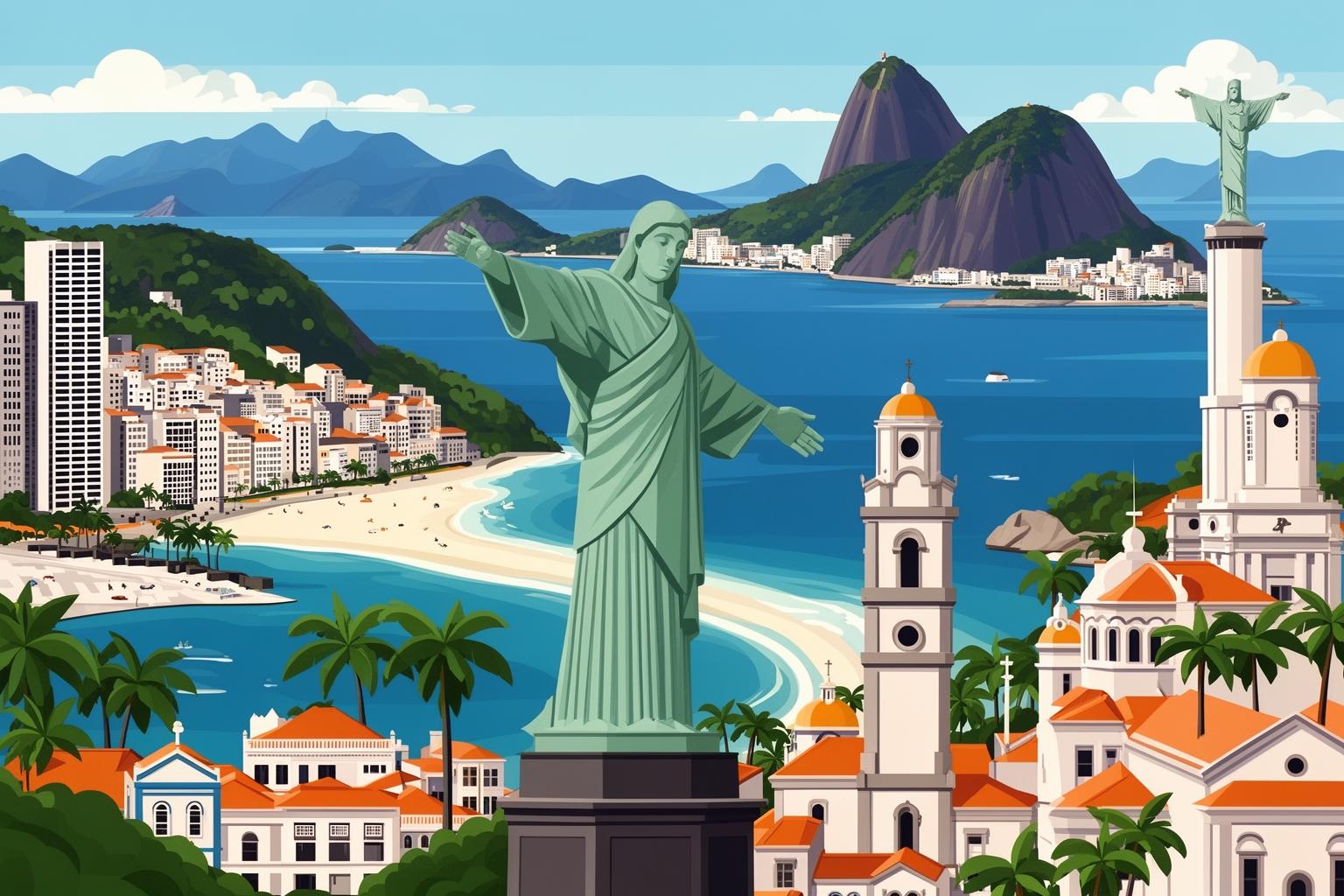
Long before he embarked on the Camino or penned tales of desert journeys, Paulo Coelho’s story began in the vibrant, chaotic, and stunningly beautiful city of Rio de Janeiro. Known as the Cidade Maravilhosa, or Marvelous City, Rio is a place of striking contrasts. Towering granite peaks like Sugarloaf and Corcovado descend into a turquoise sea, lush tropical forests press against sprawling urban neighborhoods, and extravagant Carnival festivities coexist with deep-rooted social issues. This city of intense light and profound shadow is not only Coelho’s birthplace; it is intricately woven into the essence of his being and his work. Its energy, spirituality, and inherent drama provided the fertile soil from which his creative spirit blossomed.
A Carioca’s Soul
To be a Carioca, a native of Rio, is to grasp life as a complex dance of joy and sorrow. Coelho’s early years reflected this deeply. Born into a middle-class family, he was a rebellious and introspective youth who often clashed with his parents’ conventional expectations. His dream of becoming a writer was viewed as madness, leading to his confinement in a mental institution three times during his teenage years. This traumatic experience, later explored with raw honesty in his novel Veronika Decides to Die, shaped his enduring themes of conformity, madness, and the bravery required to live authentically. In the 1960s and 70s, he immersed himself in Rio’s burgeoning counter-culture scene, becoming a successful and provocative lyricist for Brazilian rock stars like Raul Seixas. His songs brimmed with mystical and rebellious themes, challenging the military dictatorship of the era and resulting in his arrest and torture. Rio was his playground, his university, and his prison. It was the city that both nourished his artistic soul and inflicted his deepest wounds. The city’s blend of sensuality and spirituality, its lively street life and quiet moments of natural beauty, all permeate the rhythm of his prose. He writes with a Carioca‘s understanding of passion, destiny, and the magic found in life’s most unexpected corners.
Landmarks of a Life
Though Coelho now resides in Europe, his spirit remains forever tied to Rio’s landmarks. The world-famous beaches of Copacabana and Ipanema served as the backdrop to his youth. More than mere tourist spots, they act as social equalizers where people from diverse backgrounds gather to bask in the sun, play music, and celebrate life. One can imagine a young Coelho strolling along the iconic black-and-white wave-patterned promenade of Copacabana, dreaming up lyrics and contemplating the cosmos. High above the city, the towering statue of Christ the Redeemer stands with arms outstretched atop Corcovado mountain. This globally recognized symbol is more than a landmark; it is a constant, watchful presence over the city. It embodies a form of faith deeply embedded in Brazilian culture, a fusion of traditional Catholicism and other spiritual beliefs often reflected in the syncretic nature of Coelho’s philosophies. He writes not of dogmatic religion, but of a personal, direct connection to the divine—a feeling palpable when standing at the statue’s base, gazing over the sprawling, beautiful, and complex city below. Visiting these sites offers a tangible link to the cultural and spiritual landscape that shaped him into the writer he became.
Experiencing Coelho’s Rio
To truly sense Coelho’s Rio, one must venture beyond the usual tourist itinerary. Certainly, visiting Sugarloaf Mountain and Christ the Redeemer for their breathtaking views is essential. Feeling the sand of Ipanema between your toes is a must. But to genuinely connect with the city’s soul, you need to delve deeper. Wander through the charming, bohemian neighborhood of Santa Teresa, with its winding cobblestone streets, colorful colonial mansions, and creaky yellow tram. Drop into a traditional boteco, a small neighborhood bar, to enjoy a cold beer and classic Brazilian snacks while chatting with locals. Seek out a live performance of bossa nova or samba, the musical heartbeats of the city and the soundtrack to Coelho’s early career. Explore Tijuca Forest, the world’s largest urban rainforest, to appreciate the powerful presence of nature sharing space with the concrete jungle. Rio is a city to be felt, not just seen. It is in the warmth of its people, the rhythm of its music, and the striking, sometimes jarring, contrasts of its beauty and challenges where you will discover the spirit that infuses every page of Paulo Coelho’s work.
Journeys Beyond the Horizon
While the Camino, Andalusia, and Rio de Janeiro form the foundational pillars of Paulo Coelho’s life and work, his journey—much like that of his characters—has never been bound to a single location. His tireless pursuit of spiritual insight and his career as a world-renowned author have carried him across the globe. Certain places have become sanctuaries for both his creativity and his spirit, offering a distinct kind of landscape—one of quiet reflection, intellectual engagement, and serene retreat. These sites also form part of the map of his world, symbolizing the later chapters of a life devoted to exploring both external and internal realms.
Geneva, Switzerland: A Writer’s Sanctuary
For many years, Paulo Coelho has made Geneva, Switzerland, his principal home. This choice might strike some as unexpected for a man whose soul was shaped by the fiery vibrancy of Rio. Geneva is known for its calm, order, and diplomacy—a city of international organizations, tranquil lake views, and understated elegance. Yet it is precisely this contrast that renders it an ideal sanctuary for a writer. After decades of a turbulent and adventurous life, Geneva provides a haven of peace and stability, a place where he can withdraw from the pressures of global fame and concentrate on the inward work of writing. The city’s atmosphere is one of precision and intellect, the perfect setting for the meticulous craft of storytelling, transforming the grand, mystical experiences of his travels into carefully chosen words that resonate with millions of readers. Strolling along the shores of Lake Geneva, with the majestic Alps in the distance, one senses profound tranquility. This is the landscape of a mature artist—not a place for seeking new adventures, but for reflecting upon them. Here, the magic discovered on dusty roads and in sprawling cities is distilled and preserved within novels that continue to inspire the world.
The Pyrenees, France: A Mountain Retreat
Close to the very starting point of the journey that transformed his life, Coelho has found another refuge. He owns a converted mill in a small village in the French Pyrenees, near Saint-Jean-Pied-de-Port. This location brings his story full circle. It is intimately connected to the Camino de Santiago, allowing him to remain near the spiritual energy of the path that set him on his writing journey. The Pyrenees offer a landscape of raw, untamed beauty—ancient mountains dotted with deep forests, rushing rivers, and a profound sense of solitude. For Coelho, this home serves as a spiritual retreat, a place for contemplation, archery (which he links to focus and intention), and communion with nature. He and his wife have also founded the Paulo Coelho Foundation here, an institution dedicated to sharing his work and supporting underprivileged communities. This mountain home represents a different kind of pilgrimage—the inward journey. It embodies the peace and wisdom that arrive after the long walk, the quiet strength found in stillness and a deep connection to the earth. It is a physical manifestation of the inner sanctuary his books encourage every reader to discover within themselves.
Amsterdam, Netherlands: A Walk with the Valkyries
Coelho’s travels are not merely physical but profoundly spiritual quests. In his book The Valkyries, he recounts a 40-day journey he and his wife, Christina, undertook through the Mojave Desert in the United States, aiming to confront personal demons and communicate with their guardian angels. Though the book is set in America, the spirit of this quest—a deliberate journey for spiritual revelation—is a recurring theme throughout his life. Cities like Amsterdam frequently appear in his travels worldwide. Known for its open-mindedness, intricate canals, and celebration of personal freedom, Amsterdam resonates deeply with Coelho’s philosophies. It is a place where diverse ideas and lifestyles coexist, encouraging individuals to question convention—a central principle in his work. While not a main setting in a major novel, cities like Amsterdam represent the ongoing, global scope of his search for understanding. They are part of the broader tapestry of a life devoted to exploring varied cultures, spiritual traditions, and ways of being, all in the pursuit of uncovering the universal truths that connect humanity.
The Journey Within
To follow in the footsteps of Paulo Coelho is to journey across the world, from the vibrant energy of Brazil to the silent vastness of the Sahara and the ancient paths of Europe. However, visiting these places quickly reveals that the journey he outlines is not ultimately about reaching a physical destination. The Cathedral of Santiago de Compostela, the Egyptian pyramids, the peaceful shores of Lake Geneva—each is a powerful, beautiful site, yet their true meaning lies in their role as mirrors. They reflect our own hopes, fears, and profound longing for meaning. They serve as catalysts for the one journey that truly matters: the journey within.
Coelho’s life and work embody a simple yet profound truth: the universe conspires to help us realize our dreams, but we must have the courage to take the first step. That step could be along a pilgrim’s path, on a boat heading to a new continent, or simply the blank page at the start of a new chapter in our lives. Santiago’s lessons in the desert—to listen to the heart, to read the omens, and to understand that love supports rather than obstructs us—are universal. They are accessible to everyone, whether standing in the winds of Tarifa or in our own backyard. Visiting these places offers a powerful way to connect with the source of that wisdom, to feel the energy that inspired these timeless tales. It allows us, for a moment, to walk in the world of the Alchemist, to sense the rhythm of the Camino, and to realize that we are all pilgrims on our own unique journey. Ultimately, the greatest treasure is not hidden beneath the pyramids; it is the wisdom, courage, and love we find along the way. The map is drawn. The path awaits.