
The American landscape, in all its sprawling, contradictory glory, is more than just a setting in the novels of Jonathan Franzen; it’s a character, a force, a mirror reflecting the anxieties of the families who inhabit it. To read Franzen is to journey through the heart of the country, from the manicured lawns of the Midwest to the frenetic intellectual cauldrons of the East Coast and the sun-drenched, secret-laden shores of California. His work maps the fault lines of the American dream, and to walk the streets he writes about is to step directly into the pages of his novels. This is not just a tour of an author’s life, but an exploration of the soul of modern America, a pilgrimage for anyone who has ever felt the profound, complicated pull of family and place. We will trace his footsteps, breathe the air that filled his characters’ lungs, and understand, on a visceral level, the geographical DNA of his great American stories. From the quiet desperation of St. Louis in The Corrections to the sprawling ambition of New York and the utopian promises of California in Purity, we embark on a journey to find the real-world roots of his fictional worlds.
This literary pilgrimage is part of a broader tradition of exploring the profound connection between authors and their landscapes, much like the volcanic journey through the Azores.
The St. Louis Suburbs: The Cradle of Midwestern Angst
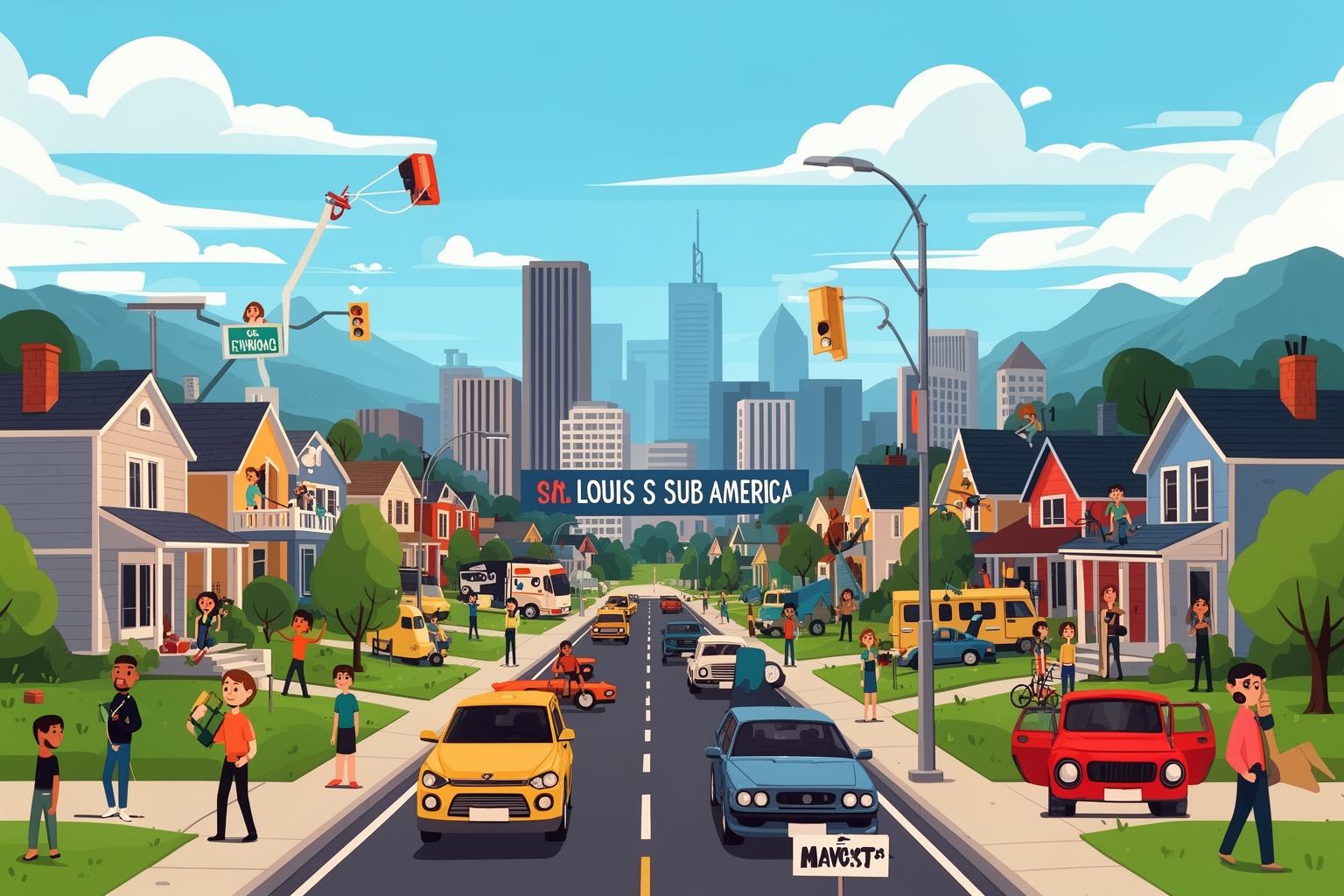
The light in the American Midwest carries a distinct quality—a soft, golden haze that drifts over the expansive, flat landscape in the late afternoon. It invokes a sense of nostalgia, even pastoral calm, yet beneath its gentle glow often simmers a quiet tension, the feeling of lives confined within well-defined limits. This is the world that shaped Jonathan Franzen and his breakthrough novel, The Corrections. To truly grasp the Lambert family—with their simmering resentments, unmet desires, and urgent need for connection—you must first understand the landscape that formed them: Webster Groves, Missouri, a suburb of St. Louis.
Strolling through Webster Groves feels like entering a carefully crafted film set representing the ideal American suburb. The streets are broad and leafy, shaded by mature oak and maple trees that create a thick canopy in summer. The homes proudly display early 20th-century architecture: solid brick Tudors, stately Colonial Revivals, and quaint Arts and Crafts bungalows. Lawns are immaculately kept, with sprinklers humming rhythmically on hot days. There’s an overwhelming sense of order, history, and community values rooted in stability. Yet, it’s precisely this order that Franzen expertly dismantles. This is the world Enid Lambert strives to maintain, the world threatened by her husband Alfred’s neurochemical decline, and the world their children—Gary, Chip, and Denise—escape in search of more authentic, if disorderly, lives.
The atmosphere is deeply quiet. You hear cicadas buzzing in the humid air, the distant jingle of an ice cream truck, the soft thump of a newspaper landing on a driveway. But this quietness can feel heavy, weighed down by unspoken expectations. It is the sense of knowing your neighbors’ routines, adhering to silent social codes, and following a life path that seems predetermined. This pressure cooker forged the Lamberts’ dysfunctions: the urge to maintain appearances, the passive-aggressive stand-in for open conflict, the profound fear of failure—all ingrained in the very fabric of these peaceful, tree-lined streets.
Finding the Fictional in the Real: A Walk Through Lambert Territory
Though Franzen’s St. Jude is fictional, its spirit unmistakably reflects Webster Groves and nearby communities. A self-guided walking or driving tour is the best way to soak in the atmosphere. Begin near the historic Old Webster district, with its charming storefronts and local shops. It’s easy to picture Enid Lambert running errands here, preserving the illusion of a flawlessly managed life. As you move into the residential neighborhoods, notice the architectural details of the houses. Imagine the fictional Lambert home: a solid, respectable brick house, perhaps with a porch swing—a symbol of middle-class success that becomes a prison of memory and obligation. No specific address is necessary; the Lambert house represents every house, its story resonating through the silent windows of the neighborhood.
To gain a wider perspective, venture into St. Louis proper. Visiting Forest Park, a vast urban oasis larger than New York’s Central Park, offers a glimpse of the city’s civic pride. Its grand institutions, such as the Saint Louis Art Museum and the Missouri History Museum, reflect a bygone glory and a deeply rooted cultural heritage shaping Midwestern identity. This city is the place the Lambert children would have associated with escape and possibility—a tantalizing world just beyond the suburban fringe. Standing beneath the Gateway Arch, the iconic symbol of westward expansion, you sense the lure of the American promise of reinvention, the very dream Chip, Gary, and Denise pursue with such desperation.
The Literary Landscape of The Corrections
The Corrections is inseparably linked to this place. The novel’s core drama—the children’s reluctant return for “one last Christmas” in St. Jude—is a pilgrimage back to the source of their neuroses. In Franzen’s hands, the Midwest is not mere flyover country but the nation’s psychological heart. Alfred Lambert’s career with the Midland Pacific railroad symbolizes the region’s industrial past, a world of concrete realities and dependable systems that is fading away, much like Alfred’s own mind. His struggle with Parkinson’s reflects the erosion of a particular kind of American certainty.
Enid’s obsession with appearances, her frantic efforts to stage a perfect family gathering, arise from this suburban pressure cooker. Social anxieties, neighbors’ judgments, and strict moral and social codes govern her world. The meticulously detailed Lambert home—from the worn armchair to the holiday decorations—is not just a backdrop; it is an artifact of life, charged with the emotional weight of decades of joy, disappointment, and compromise. Visiting Webster Groves reveals the raw material of Franzen’s craft. You begin to see that the novel’s power stems from its profound sense of place and its ability to capture the universal human drama unfolding behind closed doors in these quiet, respectable neighborhoods.
For first-time visitors, autumn is the ideal season to experience this mood. The crisp air, the scent of burning leaves, and the melancholy beauty of the changing seasons perfectly complement the novel’s tone. Find a local coffee shop in Old Webster, settle in with a copy of the book, and observe the town’s rhythm. Remember that these are private homes and communities—the goal is to observe and absorb, not intrude. This journey is an inward one, a chance to connect with the emotional truth of a place that has left a lasting imprint on American literature.
The East Coast Intellect: Swarthmore and the Forging of a Writer
If the Midwest served as the fertile ground for the family dramas that Franzen would later cultivate, the East Coast was the forge where his intellectual and literary identity was forged. The transition from the quiet conformity of Webster Groves to the vibrant, demanding world of Swarthmore College in Pennsylvania epitomizes the classic American narrative of reinvention. Swarthmore, a small, prestigious liberal arts college near Philadelphia, stands in stark contrast to the suburban environment of his upbringing. It is a place of intense intellectual challenge, youthful idealism, and academic pressure that can either overwhelm or crystallize one’s ambition. For Franzen, it was the latter.
The campus itself resembles a sanctuary devoted to intellectual pursuit. Situated on a nationally registered arboretum, the grounds present a breathtaking mosaic of rolling hills, ancient trees, and carefully tended gardens. The architecture is dominated by the imposing gray stone of Parrish Hall, the college’s main administrative building, which exudes a Gothic, almost monastic, aura. The atmosphere is decidedly serious. Students can be seen engaged in passionate debates on the lawns, reading dense philosophical works under the shade of towering oaks, or moving across campus with focused intensity. There’s a tangible energy here, a sense that the ideas discussed within these revered halls hold the potential to change the world—or at least change oneself.
This environment is a crucible. Here, a young writer from the Midwest would have confronted a new set of social codes and a hierarchy based on intellectual merit rather than social status. It was a place where he was introduced to literary theories, critical debates, and canonical works that would become his professional toolkit. The pressure to be brilliant, original, and to hold a distinctive, defensible viewpoint was immense. This setting would go on to shape the intellectual anxieties of his characters, their struggles with authenticity, their fear of exposure as frauds, and their often-comical pursuits of academic and artistic grandeur.
Exploring the Grounds of Ambition
Visiting Swarthmore College is a serene and inspiring experience. The campus is open to the public, and wandering its winding paths is the best way to absorb the atmosphere. Begin at the Scott Arboretum, a living museum of trees, shrubs, and flowers. The sheer beauty and order of the space feel like a metaphor for the structured intellectual life the college encourages. Find a quiet bench in the Crum Woods, an expansive forest bordering the campus, and it’s easy to imagine a young Franzen retreating from academic pressures to wrestle with profound questions of life and art.
Next, make your way to the McCabe Library—the sanctum sanctorum of any college campus and a second home to an aspiring writer. Picture endless stacks, quiet study carrels, and the scent of old paper and binding glue. Within these walls, Franzen would have absorbed the works of literary predecessors, carving his own path, debating with the dead, and gradually discovering his voice. The library is a repository of ambition, where the dream of becoming a writer takes tangible shape.
Don’t overlook the broader context of Philadelphia. A short train ride away, the city would have offered a gritty, real-world contrast to the idyllic, insular college environment. Its rich history, working-class neighborhoods, and vibrant arts scene formed an essential part of Franzen’s education. Exploring Old City streets, touring the Philadelphia Museum of Art, or grabbing a cheesesteak in South Philly provides a glimpse into the larger world that Swarthmore students prepared to enter and, in their own way, master.
The Intellectual Roots of the Franzen Persona
Though Franzen’s novels rarely take place on college campuses, the intellectual DNA of Swarthmore is embedded in all his work. The sharp intelligence, dense prose, fascination with complex systems—whether global economics, ornithology, or family dynamics—and the relentless self-examination of his characters all bear the mark of a mind shaped by this demanding environment. His well-known 1996 Harper’s essay, “Perchance to Dream,” lamenting the diminishing cultural authority of the serious novelist, springs directly from this milieu. It’s an argument rooted in a place that holds literature in the highest regard, insisting that novels must engage with the most pressing social and political matters of our time.
This is also where his characters’ intellectual pretensions originate. Consider Chip Lambert in The Corrections, the disgraced academic whose abstract thesis on “semio-social agitations” becomes a running joke—symbolizing intellectual labor disconnected from reality. Or Walter Berglund in Freedom, whose sincere environmentalism is continually challenged and complicated by human desires and corporate greed. These characters are products of a world where ideas matter deeply but also wrestle with the disconnect between those ideas and the complexities of real human experience.
For visitors, the key is to appreciate the campus not as a literal setting but as an incubator. Visiting during the academic year (with respect for exam periods) allows one to feel the intellectual vitality. Attend a public lecture or a performance if possible. The experience offers insight into the origin story of a major American author, revealing where the raw talent and Midwestern angst were forged into the formidable intellectual force he wields in his novels.
New York City: The Crucible of Ambition and ‘The Corrections’

Every aspiring artist in America feels the irresistible draw of New York City. It stands as the undisputed capital of ambition—a place where fortunes are made and dreams are shattered with astonishing speed. After his intellectual formation at Swarthmore and a stint in Boston, Jonathan Franzen moved to New York, where, amid the city’s relentless energy and fierce competition, he wrote the novel that would establish his reputation: The Corrections. The city is more than just a backdrop in his work; it acts as a dynamic force that shapes, challenges, and often torments his characters. To truly grasp the anxieties of Chip Lambert or the ambitions of the writers and artists around him, one must experience the exhilarating yet terrifying reality of New York.
The city Franzen portrays is one of stark contrasts. It’s the gilded world of the Upper East Side, with its doorman-guarded apartment buildings, exclusive restaurants, and the quiet, affluent hum of established power. But it’s also the scrappy, vibrant, and ever-gentrifying neighborhoods where artists and writers actually reside, such as Harlem, where Franzen himself lived. The atmosphere is a potent mix of possibility and pressure. On one hand, there is an incredible creative energy, the feeling of being at the center of the universe, surrounded by the best and brightest. On the other hand, there is the crushing indifference of the city—a mass of people, soaring living costs, and the ceaseless struggle to leave your mark—that creates a unique desperation Franzen captures with precision.
Walking the streets of Manhattan is a sensory overload. The rumble of the subway beneath you, the chorus of sirens and honking cars, the mingling scents of street food and exhaust, the dazzling lights of Times Square, the canyon-like streets of the financial district—it’s a city that never allows you to rest. This environment fuels Chip Lambert’s frantic energy in The Corrections. His life in New York unfolds as a series of frantic hustles: a failed academic career, a disastrous screenplay, a dubious investment scheme in Lithuania. For him, the city is a stage for spectacular failure, exposing his intellectual pretensions and forcing him to confront mediocrity.
Charting a Course Through Franzen’s Manhattan
To follow Franzen’s New York, one must explore its varied facets. Begin on the Upper East Side, the neighborhood symbolizing the peak of success and social status that Chip both covets and resents. Stroll along Park Avenue or Madison Avenue, past designer boutiques and elegant pre-war buildings. Stand before one of the grand canopied entrances and imagine Chip’s humiliation as he tries to navigate a world of inherited wealth and effortless power. Then, wander through Central Park, the city’s great democratic space where people from all backgrounds gather. It is both a place of respite and a site for acute social observation—an ideal backdrop for a novelist.
Next, take the subway uptown to Harlem, where Franzen lived on 125th Street. The contrast is immediate and striking. The architecture shifts to historic brownstones and vibrant murals, and the rhythm of the streets changes—music pours from storefronts, and neighbors gather on stoops. Harlem is a neighborhood rich in cultural history, a longstanding center of Black art and culture. By choosing to live here, Franzen positioned himself as an observer, removed from the insular literary scene of downtown Manhattan. This outsider’s perspective is critical to his work. Exploring Harlem’s streets, visiting the Apollo Theater, or dining at a soul food restaurant offers a more grounded, authentic view of the city he called home.
No literary tour of New York is complete without a visit to The Strand Bookstore near Union Square. With its famed “18 miles of books,” this legendary institution is the heart of the city’s literary community. It attracts writers, students, and bibliophiles alike who come to browse, discover, and feel part of a larger literary tradition. One can easily picture a young Franzen spending hours here, lost among towering shelves, dreaming of the day his own book would be found among them.
The Urban Anxieties of The Corrections and Freedom
New York forms the backdrop for some of the most memorable scenes in The Corrections. Chip’s comically disastrous attempt to impress his parents at a trendy, overpriced restaurant, The Eden, perfectly encapsulates the city’s obsession with status and novelty. His small, exorbitantly priced apartment symbolizes the sacrifices made to live in the city—the trade-off of comfort and space for proximity to the action. The city acts as a crucible that tests Chip’s character and ultimately drives him to escape.
In his later novel, Freedom, New York continues to exert its powerful pull. It is where young, ambitious characters seek transformation. The city nurtures the indie rock scene that Patty and Walter’s son, Joey, becomes part of, and it houses the shadowy military contractors central to the novel’s darker political themes. For Franzen, New York embodies the engine of American capitalism and culture—a place of immense creative vitality and destructive force. His characters are drawn to it like moths to a flame, pursuing success and self-discovery but often getting burned along the way.
For visitors aiming to understand Franzen’s New York, embracing its chaotic energy is essential. Use the subway—it is the great equalizer and the best way to grasp the city’s layout. Be prepared to walk long distances. Most importantly, be an observer. Sit in a West Village café, watch stockbrokers rush through Wall Street, listen to street musicians in Washington Square Park. New York is a city of countless stories, and by immersing yourself in its rhythm, you begin to understand why it has served as such a powerful and enduring muse for one of America’s most significant novelists.
California Dreaming: Santa Cruz and the ‘Purity’ of the West Coast
If Franzen’s early work is characterized by the compressed, claustrophobic anxieties of the Midwest and East Coast, his later novels mark a significant westward expansion, both geographically and thematically. His relocation to Santa Cruz, California, signaled a shift in focus, broadening his writing to encompass the vast landscapes, countercultural histories, and technological obsessions of the American West. This setting forms the backdrop of his novel Purity, a sprawling, globe-spanning tale that remains deeply anchored in the distinct culture and ambiance of Northern California. To explore Santa Cruz and the surrounding Bay Area is to enter the final, and perhaps most expansive, chapter of Franzen’s literary journey.
The mood of Northern California is fundamentally distinct from other parts of the country. There is a palpable sense of being at the continent’s edge—a place where people arrive to escape their pasts and forge new futures. The very air feels different—cleaner, tinged with the salty scent of the Pacific and the sharp, resinous aroma of eucalyptus and redwood trees. Santa Cruz captures this spirit perfectly. It is a city of beautiful contradictions: a laid-back surf town anchored by a world-class university (UC Santa Cruz), a refuge for hippies and spiritual seekers that exists in the shadow of Silicon Valley’s hyper-capitalist engine, and a place of stunning natural beauty continually imperiled by earthquakes and wildfires.
This atmosphere of uncertainty and reinvention lies at the heart of Purity. The novel’s protagonist, Purity “Pip” Tyler, is a young woman adrift amid debt and confusion, searching for her identity and her father. Her path leads her to the Sunlight Project, a WikiLeaks-style organization led by the charismatic yet manipulative German dissident Andreas Wolf. While the group has outposts worldwide, its spiritual home seems to be Northern California, a region with a long tradition of utopian experiments, radical politics, and deep mistrust of authority. The area’s blend of idealism and paranoia, its fusion of nature and technology, creates the perfect environment for Franzen’s tale of secrets, deception, and the elusive quest for truth.
Journey to the Edge of the Continent
A pilgrimage to Franzen’s California begins with the landscape itself. Drive along West Cliff Drive in Santa Cruz, a breathtaking coastal road offering sweeping views of the Pacific Ocean. Watch surfers at Steamer Lane, their black wetsuits contrasting with the churning blue-gray water. Feel the cool, moist fog roll in—a phenomenon so common it has its own name, the “marine layer.” This proximity to nature’s raw, untamable power remains a constant in the lives of Northern Californians, a humbling reminder of forces far beyond human control.
Next, head inland to the Santa Cruz Mountains and Henry Cowell Redwoods State Park. Walking among these ancient trees is a near-religious experience. The forest’s profound silence is broken only by footsteps on the soft needle-covered ground. Light filters down through the canopy hundreds of feet above, creating a dim, cathedral-like setting. This is the kind of landscape that invites introspection—a place to reflect on the vastness of time and one’s own small place within it. It’s easy to imagine the characters of Purity, with their tangled histories and moral dilemmas, seeking clarity or escape in the solemnity of these woods.
To grasp the human dimension of Purity, one must also explore the urban fabric of the Bay Area, especially Oakland, where much of the novel’s American storyline unfolds. Oakland serves as the gritty, diverse, and historically radical counterpart to San Francisco’s polished wealth. Visit the area around Lake Merritt, wander through lively Jack London Square, and drive through neighborhoods that range from beautifully restored Victorian homes to more modest, working-class areas. Oakland is a city in transition, contending with gentrification, technological upheaval, and its complex legacy of activism and social change. This is the world Pip inhabits—a realm of communal living, dead-end jobs, and a simmering political awareness that draws her into the orbit of the Sunlight Project.
The Sprawling Canvas of ‘Purity’ and Beyond
Purity mirrors its setting. Unlike the tightly focused family dramas of The Corrections or Freedom, it is more sprawling and loosely structured, filled with wild plot twists, international intrigue, and a large cast of interconnected characters. This narrative style reflects the landscape itself—vast, unpredictable, and full of hidden ties. The novel’s preoccupation with the internet, with the way secrets are uncovered and identities crafted online, is a direct consequence of its proximity to Silicon Valley, the global hub of the digital revolution.
Franzen uses the California setting to explore distinctly American themes of innocence and corruption, idealism and cynicism. The very name of the protagonist, Purity, highlights these tensions. Is it possible to remain “pure” amid moral compromises? What does truth mean in an era dominated by misinformation? These questions resonate deeply in California, a place that has long marketed itself as a land of fresh starts, clean slates, and new ways of living.
For visitors wishing to experience this world, embracing its diversity is key. Spend a day at the beach in Santa Cruz, then hike through the redwoods the next. Explore the political murals decorating Oakland’s streets, then tour the sleek, futuristic campuses of Silicon Valley tech companies. The ideal time to visit is spring or fall, when the weather is mild and crowds are fewer. Be open to the region’s quirks and contradictions. This is Franzen’s most recent, and perhaps most complex, American landscape—a place still actively shaping his work and our understanding of the nation’s future.
The Franzen Archipelago

To journey through the landscapes of Jonathan Franzen’s life and work is to understand that his America is not a single, uniform entity, but an archipelago of distinct islands, each possessing its own climate, culture, and psychological terrain. From the orderly, repressed heartland of St. Louis to the intellectual battlegrounds of the East Coast, the relentless urban jungle of New York, and the expansive, morally complex frontier of California, each location has left a unique mark on his fiction. These places serve as crucibles testing his characters, sources of their deepest desires and most significant failures.
Exploring these places changes the reading experience. The quiet streets of Webster Groves become filled with the unspoken grief of the Lambert family. The Gothic halls of Swarthmore resonate with the intellectual clashes that sharpen his prose. The roar of a New York subway carries the frenetic energy of Chip’s ambition, and the scent of the California redwoods holds the promise of a purity that Pip earnestly seeks. A pilgrimage through Franzen’s America is a journey into the core of our contemporary anxieties, an opportunity to walk the ground where the great American novel continues to be written—one complex, conflicted, and unforgettable character at a time. It reminds us that our stories are inseparable from our landscapes, and that to truly understand who we are, we must first understand where we come from.